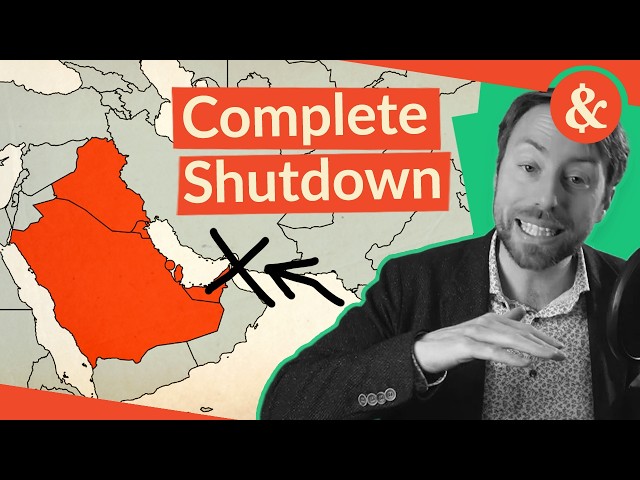
The Gulf economies are in BIG trouble
Money & Macro
0:00 Iraq, Kuwait, Bahrain, Qatar, the United Arab Emirates and Saudi Arabia.
0:07 They are literally built their entire economies
0:11 on oil and then to diversify to the risk,
0:14 if you will, they build some of the biggest airliners in the world.
0:19 And they became a so-called safe haven in the Middle East.
0:22 But now this war and specifically the blockade of Hormuz
0:28 are threatening all of it at the same time.
0:32 And honestly, I don't think people realize yet how
0:36 unfathomably big this crisis is for the Gulf economies.
0:40 For example, take Qatar.
0:42 Its economy depends on oil, and especially natural gas for roughly 42%.
0:51 And almost all of that has to go through the Strait of Hormuz to de-risk.
0:57 Though Qatar became an international air travel hub,
1:01 which means now aviation accounts for a little
1:05 over 10% of its economy and tourism.
1:11 For another, roughly 10% of GDP seemed very smart just a few months ago.
1:18 But now, with both its airspace and the strait close,
1:23 it means that at least 62% of Qatar's
1:28 entire economy is in a state of total paralysis.
1:33 But just for context, Ukraine's economy contracted by roughly 30% in 2022.
1:38 The US economy contracted for 29% during
1:41 the Great Depression over the course of four years.
1:45 But of course, Qatar is not Ukraine.
1:47 It is one of the wealthiest countries in the world.
1:50 So a month long shutdown was manageable.
1:53 So if the war ends in a month.
1:56 A Goldman Sachs economist has estimated that Qatar's
1:59 economy will only contract by 14% in 2026.
2:06 Still, that is a substantially bigger recession than happened during Covid.
2:11 But of course, like after Covid, Qatar will bounce back from this.
2:16 No problem.
2:18 However, the thing is, this conflict,
2:20 it doesn't look like it's getting any better.
2:22 In fact, I've read some pretty alarming reports that Gulf states like
2:26 Qatar depend for 99% of their drinking water on these six desalination plants,
2:36 which have in Bahrain already been targeted in the war.
2:40 This means that in a true disaster scenario,
2:43 the entire country may need to be evacuated.
2:47 So that raises the question are Gulf economies facing a total collapse?
2:52 Iran has said it wants U.S.
2:54 troops out of the Middle East.
2:56 Could it soon forced Gulf economies to eject U.S.
2:59 troops simply by choking their economies?
3:03 Hey, I'm Yuri, I'm a pizza in economics,
3:05 and I've spent the last days analyzing all of the Gulf
3:08 economies and how bad they will be affected by three potential scenarios.
3:14 Scenario number one, a quick end to the war,
3:17 either because the US wins are because Iran forces them to push out US troops,
3:23 the Gulf countries, that is.
3:24 Then there's scenario number two, a long a war,
3:27 in which case I've calculated how long the various Gulf
3:31 economies can survive without export revenue through the Strait of Hormuz.
3:35 And finally, scenario number three,
3:38 a disaster scenario in which either the Gulf economies run out
3:43 of water or population given that some rely for almost 90% on immigrants.
3:50 So let's get into it with scenario number one.
3:54 A short war, which is exactly what we have been seeing so far.
3:58 To understand the damage done so far,
4:00 we have to look at the two biggest disruptions done to the Gulf countries,
4:06 which is exactly what we have seen so far a short disruption.
4:11 But to understand the damage that has already been done,
4:14 we have to look at the two biggest
4:17 disruptions that to go of countries have faced.
4:20 First, there's the stencil of industries that depend
4:22 on the Strait of Hormuz for exports, such as oil and gas and also manufacturing,
4:29 plus the effective standstill of air travel and tourism, oil and gas.
4:33 So far, Bahrain is the least dependent on it,
4:37 with it accounting for roughly 26% of its economy.
4:43 Actually, its main diversification strategy has been manufacturing,
4:47 which now accounts for roughly 15% of its economy.
4:53 But sadly, that is also mostly for exporting
5:00 Bahrain is also a major tourist destination these days,
5:02 but that is mostly for local tourists, so that seems to be fine so far.
5:07 So all in all, I'd say that roughly 41% of its economy is paralyzed right now.
5:15 Compare that to Kuwait, which depends for 35% on oil and gas,
5:20 while trade, tourism and manufacturing is relatively small.
5:24 So I'd say that roughly 38% of its
5:28 economy is paralyzed and its northern neighbor, Iraq, it depends for about 55%.
5:34 That's quite a lot on oil and gas for its GDP.
5:38 And almost all of that was exported through her moose.
5:41 But now Iraq has just reopened its pipeline to Turkey,
5:49 and that will help it divert about 20% of its oil at this very important,
5:54 roughly double the price as before.
5:57 So for them, I'd say that roughly 33% of their economy is paralyzed,
6:06 much less than Qatar, which we've already discussed to be at 62%.
6:12 And now moving on to the big boy in the region, Saudi Arabia.
6:16 It depends for roughly 34% on oil and gas
6:20 and 33% on manufacturing and 8% on aviation.
6:26 And 5% on tourism.
6:28 However, calculating how much of Saudi Arabia's economy
6:30 is paralyzed is very difficult for two reasons.
6:34 First, much of their airspace,
6:36 tourist areas and many of their ports are actually open.
6:40 Second, they have a hugely important pipeline which allows
6:45 them to export about 60 to 70% of their oil.
6:48 But this is more crucial than they think.
6:51 Again, because they are currently selling that oil at almost
6:55 double the price than they were before the war.
6:58 Finally, there's the UAE, which depends for roughly 24% on oil and gas.
7:04 But like Saudi Arabia,
7:06 it has a pipeline that has been estimated to help itself 43% of its oil.
7:13 And again, because the prices are roughly
7:15 double than that they were before the war,
7:17 it means that they roughly have the same revenue from oil as they had before.
7:22 But much like Bahrain and Saudi Arabia, they have major manufacturing sector,
7:27 and they also have a lot of mining, unlike these economies.
7:30 And a lot of this is actually exposed to their biggest port being closed.
7:36 That's right over here.
7:37 That being said, the UAE and especially of course
7:40 Dubai relies heavily on aviation 18% and tourism 11%,
7:47 which have both mostly been paralyzed.
7:51 So for these two countries is really anyone's guess.
7:54 But let's say just for the sake of argument,
7:57 that the UAE has 20% of its economy being paralyzed and Saudi Arabia ten.
8:05 Of course, it's more in reality,
8:06 but both of them are really profiting now from much higher oil prices.
8:10 But of course, stuff doesn't just go out through the Strait of Hormuz.
8:15 In fact, the Gulf economies also used the Strait of Hormuz
8:19 for about 70% of their crucial food and medicine imports.
8:27 However, after the main imports,
8:31 ports such as and I hope I'm going to pronounce this correctly,
8:35 Qasr in Iraq or the port in the city of Kuwait,
8:41 or the port south of Doha, and especially, most importantly,
8:46 the port in Dubai known as Jebel Ali, are essentially now shut down.
8:53 Now they have to rely for these imports
8:56 on land routes via Jordan and via Saudi Arabia,
9:04 and finally, of course, via the ports of Fujairah in the UAE.
9:11 Meanwhile, Qatar has largely started importing via air,
9:15 which is much more expensive,
9:17 and the result of all of this, these imports has been long
9:21 traffic jams at ports not made for such high volumes of goods,
9:25 and therefore a big spike in the cost of food and medicine imports.
9:29 But crucially, because many Gulf governments
9:31 have prohibited supermarkets from price gouging,
9:35 and because many of them have large food reserves,
9:38 so far the damage from this has been limited and consumer prices
9:43 have not gone up by as much as you would have expected.
9:47 So these are, I think, the main pain points for the Gulf countries so far.
9:53 All of them are facing far higher import costs for food and medicine,
10:00 and a chaotic reshuffling of trade routes.
10:05 Qatar and Kuwait.
10:07 So Qatar and Kuwait have been hit the hardest so far,
10:12 while Saudi Arabia and to a lesser extent
10:16 the UAE have been doing fairly okay so far due
10:19 to them getting a much higher price for the oil
10:23 that is still being exported through their pipelines.
10:27 And therefore, I think it makes sense that Goldman Sachs economist Farouk
10:31 Snoozer muddled in early March that if the war ends late April,
10:36 so fairly soon, the 2026 economies of Qatar
10:40 and Kuwait will contract both by roughly minus 14%.
10:49 On the other hand, the UAE would only shrink
10:52 by minus 5% in 2026 and Saudi Arabia by minus 3%.
11:00 Given what we've seen,
11:02 I think Bahrain and Iraq will then land somewhere in between these numbers.
11:08 Now, all of that is very substantial.
11:10 It is a bigger hit than during Covid.
11:13 But honestly, me as well as most analysts think
11:16 that this will be manageable given how rich these countries are.
11:19 However, will the war actually end late April?
11:23 That assumption is looking increasingly unlikely,
11:25 and this brings us to scenario number two a long war.
11:31 So what happens to the Gulf countries if the war last much longer?
11:35 Can Iran break their economies?
11:37 Historically, if we want to know whether
11:39 or not a war economy will actually break.
11:42 What matters is not GDP.
11:43 What matters is whether or not a country can earn
11:46 enough international currency to finance its war efforts and more importantly,
11:50 in this case, feed its population.
11:53 Now, given that the Gulf countries are
11:56 highly reliant on crucial food and medicine imports,
11:59 plus the fact that they may need to import a lot
12:03 of missiles and other defense systems in a long war.
12:06 I think it's safe to assume for a worst case scenario,
12:09 that they need to keep importing just as many goods as before.
12:14 So fewer luxury goods, but more essential goods.
12:17 But while Qatar, Bahrain and Kuwait's economies may depend on the Strait
12:24 of Hormuz for less than or about half their GDP,
12:29 their export revenues depend on it.
12:31 For a whopping 95%.
12:36 On the other hand, Iraq's northern pipeline now means that it
12:39 has about an exposure of 80% when it comes to export revenues.
12:45 Meanwhile, again, Saudi Arabia and the UAE are difficult to estimate,
12:48 but thanks to their pipelines and the increased price of oil,
12:52 especially if there is a long war,
12:55 for simplicity, I will assume that the Saudis only take a 20%
13:01 hit and the UAE takes a 30% hit to their export to revenues.
13:11 But I feel a lot, honestly, that would cause an immediate currency collapse
13:15 for 90% of economies around the world,
13:18 especially if they lose 95% of their export revenue.
13:22 But as you can see here, the Gulf currencies look surprisingly stable.
13:27 For example, the Saudi Riyadh is nice and tied to the U.S.
13:32 dollar.
13:32 The Kuwaiti dinar is very stable
13:36 and the Emirati dirham is also extremely stable.
13:42 It may not look very stable like
13:44 this, but if you look at these numbers over here,
13:47 it's just tiny, tiny, tiny movements.
13:50 These currencies are absolutely fine.
13:53 So why is that the case?
13:54 Well, it's because they are extremely wealthy.
13:58 Everybody knows that.
13:59 But how wealthy?
14:01 Let's go back to our map.
14:03 Let's go from north to south.
14:05 Iraq has the smallest, a wealth fund estimated at roughly $6 billion worth.
14:14 It's tiny, but a central bank.
14:16 A war chest is actually pretty full at roughly 800 billion USD.
14:26 Next, let's go to their small southern neighbor, Kuwait.
14:30 Their wealth fund is absolutely massive, with $1 trillion in assets.
14:40 However, its central bank only has half of what Iraq has at 54 billion.
14:47 Meanwhile, Qatar has about $550 billion in its wealth
14:55 fund and about 72 on top of that in reserves.
15:00 Now, compared to that, Bahrain looks very poor indeed,
15:04 with only 17 billion in its wealth fund
15:07 and just 4 billion in central bank reserves.
15:11 Saudi Arabia, the giant, is surprisingly not the richest country.
15:16 It's famous wealth funds.
15:18 The piss has an estimated 1 trillion, so still way, way more than Bahrain.
15:26 In its assets.
15:28 And then the central bank has about 500 billion in reserves.
15:34 And next the UAE is surprisingly richer.
15:38 It has about 2 trillion in all of its wealth funds combined,
15:43 and then about 227 billion in the central bank reserves.
15:50 But of course, me drawing these numbers on the screen by themselves,
15:54 they are meaningless, right?
15:55 Just big numbers.
15:56 Bahrain may look poorer,
15:58 but it also has a much smaller population than, for example, Saudi Arabia.
16:02 So it doesn't need to import as much.
16:04 So what we need to do now is to put all of that together
16:08 and calculate how many years each Gulf country
16:10 can keep importing stuff while exporting way less,
16:13 and in some cases, almost nothing.
16:16 And this simple exercise will actually reveal
16:18 why Gulf currencies look as stable as ever.
16:21 That is, even if we assume, conservatively, that only 40% of their oil funds can
16:27 be sold fairly easily without absolutely crashing global markets.
16:32 We will find that Saudi Arabia can survive actually forever,
16:37 thanks to its pipeline.
16:41 Hyper exposed Kuwait also quite surprisingly so 95% less export revenue.
16:46 It can still survive a whopping ten years based on its massive wealth fund,
16:52 which is almost as big as that of Saudi Arabia, which is of course, much bigger.
16:56 Qatar also very wealthy.
16:57 No more exports almost can survive for almost
17:02 eight years just based on its massive wealth.
17:06 Similarly, the UAE can hold out for about seven and a half years despite
17:12 the destruction of Dubai's entire business model
17:15 thanks to its wealth and, of course, its pipeline and alternative harbors.
17:20 Over here.
17:21 Iraq can hold out almost for two years,
17:26 mostly thanks to now its pipeline to Turkey and its big central bank of artists.
17:32 And it's only really Bahrain that looks very vulnerable,
17:36 being able to survive only for a seven months due
17:40 to its reliance on Hormuz and relatively small wealth funds.
17:44 But honestly, Bahrain is so small that Saudi
17:47 Arabia could simply bail it out if need it.
17:51 Unless, of course, you can goes truly scorched earth on the Gulf,
17:56 bringing us to scenario number three a disastrous war.
18:01 Total war in this scenario,
18:03 Iran tries to break Gulf economies export capacities by bombing their pipelines,
18:09 which is, of course possible.
18:13 And on top of that, they could really
18:16 bomb the alternative ports that the UAE has, which are fairly close to Iran.
18:21 Now, in that case, the UAE may become just as blocked as Qatar,
18:26 but because it is less wealthy per person,
18:29 it would now be able to survive for a little under two years.
18:36 On the other hand, thanks to its red seaports all across the coast over there,
18:41 Saudi Arabia, even if it no longer has its pipeline,
18:44 it would still have some export capacity left 20%,
18:47 roughly allowing it to hold out for about five
18:52 and a half years purely on their massive wealth.
18:57 That is still quite a long time.
19:00 So okay, now Iran again escalates bombing major population centers.
19:05 This exposes yet another big weakness in the Gulf economies,
19:09 namely their massive, massive reliance on immigrants.
19:14 Specifically, the UAE consists of about 88% immigrants.
19:20 The Da also 88% immigrants.
19:24 Roughly Kuwait's 70% immigrants.
19:28 Still, Bahrain 50 3 a.m.
19:31 running out of space to draw on.
19:33 But you get the point.
19:34 And Saudi Arabia way less 41% immigrants.
19:39 Iraq.
19:41 It does have immigrants,
19:42 but these are mostly Syrian refugees which are less affected by this crisis.
19:47 So yeah, if the war escalates, a lot of these could be leaving,
19:52 going back home, often to South Asia crashing or Britain crashing.
19:59 The Gulf economies.
20:00 However, from a pure war economy perspective,
20:02 the upside would then be that the Gulf economies would need a lot fewer imports,
20:09 meaning that they could hold out quite a bit longer.
20:11 So if the war truly escalates, it may not be in Iran's best interest to actually
20:17 bomb all of these population centers and send the immigrants home.
20:20 Honestly, the only real existential weakness that I
20:24 see right now are the water desalination plants, especially Qatar, Bahrain,
20:29 Kuwait and the UAE rely on more than half
20:35 roughly for their entire water supply on the Asian plants,
20:38 which is this red bar.
20:40 So these are sitting ducks.
20:44 And for drinking water, it's even worse.
20:47 99% of Qatar's drinking water comes from these plants, 90% in Bahrain.
20:53 And while in Saudi Arabia it is way less.
20:55 I'm still betting that you will see
20:57 a humanitarian disaster if Iran destroys them all.
21:01 Entire cities would have to be evacuated.
21:04 It would be terrible.
21:05 Yet again, this could then also mean that the immigrants
21:08 go home while the native population are evacuated.
21:11 Yet then again, this could also mean that the immigrants will go
21:16 home while the native population will
21:19 be evacuated to further inland Saudi Arabia.
21:24 From there, they could regroup.
21:26 And because their central bank wealth and wealth funds will be unaffected.
21:30 After all, these are global.
21:32 On top of that, the foundation of their economy is their massive oil wealth.
21:38 It will all still be there on the ground.
21:42 A lot of that infrastructure then there will be lost.
21:45 Of course, now could be rebuilt once the Iranian regime is out.
21:49 So honestly, even in a complete disaster scenario,
21:53 the Gulf countries look more resilient than I initially thought.
21:58 So in conclusion, yes, the Gulf economies are exceptionally exposed.
22:04 If this war continues,
22:05 we could see an economic destruction on a truly gigantic scale.
22:10 All the economic diversification efforts of Dubai, Qatar, Bahrain,
22:15 all what they've worked for for years,
22:17 even decades, it is now truly all at risk.
22:20 And given their dependance on desalination plants for water,
22:23 we could even see a major humanitarian disaster if the war escalates.
22:28 However, honestly, in a true all out war scenario,
22:31 the Gulf economies are less likely to collapse than I thought.
22:35 When I first started my analysis and found out
22:37 how much they depended on the Strait of Hormuz.
22:40 It's like if you hear that your friend just lost his job and half his wealth.
22:45 Of course, your first reaction might be that you think that he is
22:49 ruined until you find out he still has half of his Ferrari collection left.
22:54 I think that analogy kind of sums it up for me.
22:58 Those are the Gulf states.
22:59 That being said, these guys have worked for years
23:02 and years to become a global safe haven,
23:05 and that status is now truly under threat.
23:08 Dubai's entire business model looks very shaky indeed.
23:12 And what will happen to Saudi
23:15 Arabia's ultra expensive megaprojects like the line?
23:19 Even in our optimistic scenario,
23:20 the Gulf states are still facing a major recession,
23:23 and it may take years for them to recover.
23:26 But perhaps even worse, if they are forced to start selling their wealth.
23:34 And if many poor South Asian immigrants are forced
23:38 to leave the Gulf states and go back home, who is really in trouble?
23:45 That's right.
23:45 Poor and indebted countries like Egypt, Jordan, Pakistan and Bangladesh.
23:55 But I have to do a follow up analysis on that soon.
23:59 So let me know if you want to see that.
24:00 Finally, there is, of course, Iran itself,
24:02 which has many of the same vulnerabilities that the Gulf has
24:07 its oil also has to go through the Strait of Hormuz,
24:11 and it's all concentrated on a single island.
24:14 And it also relies a lot on water desalination plants all across its ghosts.
24:22 And very crucially, it does not have
24:24 the same financial buffers that the Gulf countries do.
24:28 So to get a better sense of that, I highly recommend
24:30 you check out the excellent analysis by our advertising sponsor, The Economist.
24:34 Specifically, I urge you to read this analysis on how Iran is still
24:39 making lots of money from its oil exports through the Strait of Hormuz.
24:43 And on this analysis on how not just the US.
24:46 Also, Iran still risks overplaying its hand by dragging the war out longer.
24:51 And then to better understand the ultimate doom scenario,
24:54 I recommend you read their take on why,
24:57 in the current Gulf War, water may prove as decisive as oil,
25:01 which goes into why Iran is vulnerable as well as these article show,
25:06 The Economist delivers insights to let you
25:09 see the bigger picture and think for yourself.
25:12 This is why I have almost always relied on their analysis for my research,
25:17 and it's why I highly recommend you subscribe to The Economist,
25:20 which I'm excited to say has agreed to give
25:24 a special 35% discount exclusively for money and macro viewers.
25:30 Whether you want daily journalism in the Economist app,
25:34 or you are like me and prefer to catch up on the global
25:37 economy during the weekend with a nice cup of coffee and the paper edition,
25:43 you'll always stay on top of the latest
25:46 global developments and support journalism that values factual information,
25:51 integrity and an independent point of view.
25:55 So don't miss out!
25:57 Click the link in the description or top comment below,
26:00 or head over to economist.com/money Macro
26:03 to claim your exclusive 35% discount today.