The Islamic City that Made the West
The Present Past
0:00 There's a picture I can't get out of my head.
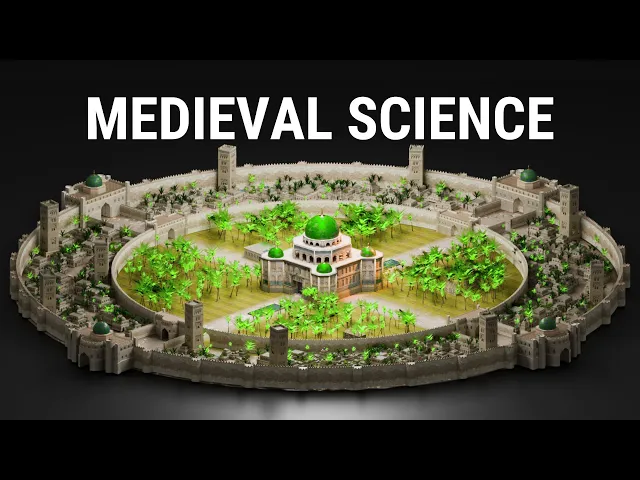
0:06 This image of a perfectly round city.
0:10 Three walls shelter a green domed palace.
0:12 This picture is supposed to be of Baghdad in Iraq.
0:16 A city you might only know from negative news.
0:19 A suicide car bomb attack that's killed
0:22 more than 20 people in Baghdad's Sadr city.
0:25 But Baghdad was once called the city of peace.
0:30 It was the center of vast trade networks,
0:33 the birthplace of early science and mathematics.
0:35 The capital of an Islamic world stretching from the Atlantic
0:38 Ocean all the way to the gates of China.
0:41 But if you look at a satellite image of Baghdad now,
0:44 you can't find anything of this circle city.
0:48 The walls, the palace, nothing remains.
0:53 What happened to Baghdad's circle city?
1:02 What seems strange to me is that this story of a circle city is so well known.
1:06 That you can find images, Minecraft reconstructions,
1:08 that there's even an Assassin's Creed game set in Baghdad.
1:12 But we don't have any archaeological evidence that it ever existed.
1:17 Many modern cities with ancient origins still have physical remains.
1:20 In Rome you stumble over Roman heritage.
1:23 Even a place like London has its Roman walls.
1:26 So where did it all go?
1:29 But where the evidence is missing,
1:31 the stories told about Baghdad are so wild you wonder,
1:35 what is myth and what is reality?
1:37 To answer these questions I read dozens of literary sources,
1:40 I modeled the city in 3D,
1:42 and I worked with an Iraqi filmmaker living in Baghdad today.
1:45 But for the start of this story we have to go back almost 1300 years.
2:00 It's time to sleep, Arwa.
2:01 But daddy, can you tell me the story of the city again?
2:05 Of course, habibti.
2:06 Will you start from the beginning, please?
2:09 Well, our ancestors have lived in this area for a very long time.
2:13 Here between the two rivers where all the crops grew so well,
2:17 the first cities were born.
2:20 But Baghdad was just a small village.
2:23 Until 762, when the great Abbasid Caliph Mansur came here.
2:27 He wanted to build a new capital.
2:30 Who are the Abbasids again?
2:32 The Abbasids are the rulers who founded our third caliphate,
2:36 our empire of Islam.
2:37 They are descendants of the uncle of Prophet Muhammad, peace be upon him.
2:42 Al-Mansur's name means "the victorious".
2:44 He came to power shortly after a bloody revolution.
2:48 The capital of the old rulers was Damascus,
2:50 far to the west at the edge of the caliphate.
2:53 Al-Mansur wanted his new city to sit at the heart of the empire.
2:57 He wasn't just building a normal city, he was founding a new dynasty.
3:01 Al-Mansur traveled all over Iraq to search for the best spot.
3:05 He sailed up and down the Tigris until he saw our village of Baghdad.
3:09 Then he said, "This is a good place for an army camp.
3:12 Here is the Tigris with nothing between us and China.
3:15 And on it arrives all that the sea can bring,
3:17 as well as provisions from the Jazirah, Armenia and surrounding areas.
3:21 Further there is the Euphrates, on which can arrive everything from Syria,
3:25 Al-Raqqa and surrounding areas." Do the fire part now!
3:29 So after choosing the site,
3:32 Mansur drew the city's outline in ash, two circles with four gates.
3:36 Satisfied with his design, he ordered cotton socks and flammable liquid to be
3:41 placed along it before setting them on fire.
3:48 Flames rose high from the ground, revealing a city of fire.
3:59 Al-Mansur finished Medina al-Salam, the city of peace, in 766.
4:05 This started a golden age for the Abbasids and Islam.
4:09 The city grew to a million people,
4:11 spices came all the way from modern day Indonesia,
4:15 oranges were introduced in Spain.
4:17 Muslim scholars started a translation project unlike the world had ever seen,
4:22 translating and updating classic texts from Greek and Sanskrit,
4:26 advancing our knowledge of medicine, mathematics and a natural world.
4:29 As the great poet Mukkadasi described,
4:31 "In it are to be found the best of everything, and all that is beautiful.
4:36 All hearts belong to it, all wars are against it,
4:39 and every hand is raised to defend it." Thank you, daddy.
4:46 There is an issue with the image I showed you before.
4:52 It's more of an artist's imagination than based on fact.
4:55 Historians have looked at all the sources and pieced together information,
4:59 and they've come to an idea of how this city looked like.
5:03 So I printed two models.
5:04 One model that is the artist's imagination, and the other how it really looked.
5:10 If we can compare, we can see where the differences are.
5:13 In this version, there's five walls, but in reality,
5:16 there were double circular walls with an empty space inside it.
5:20 They are surrounded by a moat.
5:22 There are four gates that are evenly distributed around a circle,
5:26 like points on a compass.
5:27 These mark the entrances of the four main roads in and out of the city.
5:32 The Kufa and Basra gates opened into the Sarat Canal,
5:35 the Sham gate pointing towards the road to Syria,
5:38 and the Khorasan gate led to a bridge of boats across the Tigris.
5:42 Inside the city, there were market stalls along
5:46 the main corridors and residential areas behind it.
5:51 Inside the round city, you would find the Palace of the Caliph,
5:56 and the Caliph's palace had a 36-meter-high dome.
6:00 Around the palace, in the grounds,
6:02 you would find administrative buildings and also barracks.
6:06 It was said that the only person that would be able
6:08 to go or allowed to go on horseback was the Caliph himself.
6:11 It's often said there was a weathervane shaped like a horseman atop the dome,
6:16 a horseman that pointed to the direction of the empire's enemies.
6:20 To make these models, I used Bambu Labs A1C printer.
6:24 I've never used a 3D printer before, but this was actually really easy.
6:28 These models are very intricate,
6:29 but I was surprised at the speed and precision with which they print.
6:34 The printer has full auto-calibration, bed leveling, and vibration calibration,
6:38 so when it starts, you can just watch it print.
6:41 The active flow rate compensation makes the border smooth at every corner,
6:45 and with the automatic material system,
6:47 you can print with multiple materials and colors at the same time.
6:50 For this model, I combined white and green to shape the domes of the city,
6:55 but the PLA also comes in matte and translucent.
6:58 If you don't have any 3D experience, don't worry.
7:00 There's this huge community called MakerWorld,
7:02 and here you can find tons of models ready to be printed.
7:06 Here I found a model of the Yugoslav memorial I made a video about,
7:09 but there are tons of other options.
7:12 If you also want to get into 3D printing,
7:15 you can check the link below to see what Bamboo printer best suits your needs.
7:21 For now, let's get back to the video.
7:24 So why was this city round?
7:26 With the move of the capital of the Caliphate to the east,
7:30 Islam fused with traditions of empires that had come before,
7:34 adopting building traditions that had existed for centuries.
7:37 The city itself was a crossroad of cultures,
7:41 three ethnic groups dominated, Arabs, Persians, and Turks.
7:46 But not everyone was Muslim.
7:48 There were neighborhoods where groups of different faiths lived.
7:51 There were Christian churches and Jewish
7:54 synagogues among the hundreds of mosques.
7:56 For its time, it was a truly cosmopolitan city,
8:00 a city at the center of the world.
8:03 But with untold riches also came inequality.
8:05 Vast slums surrounded the city,
8:07 and slavers took people from the icy north and from the deep south.
8:14 So what happened?
8:15 How did such a city just disappear?
8:19 If you go through modern-day Baghdad,
8:21 the old round city Mansur built is completely gone.
8:25 But there are some remains from that era.
8:30 Ask a filmmaker from Baghdad to find these locations.
8:36 There's the Abbasid Palace, built in the late 1100s.
8:41 The Mustansiriyah Madrasa, a place for studying Islamic law.
8:46 The Suhrawardi Mosque from the same time.
8:50 And there's even an old gate,
8:54 not from when it was founded, but from the early 1200s.
9:03 A gate that could not protect the city.
9:10 In 1258 Baghdad is invaded by the Mongols.
9:14 They pillaged the city,
9:16 some accounts say a million people were put to the sword.
9:22 This is surely an exaggeration, but it must have been a bloodbath.
9:28 A Mongol invasion to end the city of peace.
9:33 Was this really the reason for the end of Baghdad?
9:37 This picture of a walled city standing alone in the desert.
9:41 It tells a good story,
9:43 but the city would have only existed like this for a very short time.
9:47 In Al-Mansur's own lifetime, it began expanding beyond the walls.
9:50 Markets and bazaars were moved to the Karkh district in the south.
9:54 The city grew organically,
9:55 spreading out across the Tigris from the moment it was founded.
9:59 But urban sprawl did not end the circular city.
10:03 Al Mansur's city was built using sun-baked mud bricks.
10:09 I've seen similar technology before in Shibam and other towns in Yemen.
10:13 These can be great to live in, but the buildings need constant upkeep.
10:18 If you don't take care of them, they crumble.
10:21 When the empire prospered, so did the city.
10:24 But when wealth and power declined, it faced crisis after crisis.
10:29 In the end, the round city itself only served
10:32 as the home of the Caliph for about 60 years.
10:35 New palaces were built in different districts, and between 836 and 892,
10:39 the capital was even moved to another city entirely.
10:42 By some accounts, the inner circles of Al
10:46 Mansur's round city were abandoned in the 940s.
10:50 There's a line between history and myth that can sometimes get blurred.
10:57 I thought about this a lot while researching this video.
11:01 Many of the sources that describe the design
11:03 of the city are like folklore legends.
11:05 Of a great leader at the start of a new
11:08 dynasty who builds the most impressive and beautiful city on earth.
11:12 Without archaeological evidence, all that we know about the round city
11:15 of Baghdad comes from a number of written sources.
11:17 And what these tell us,
11:18 that they were written centuries after the city itself was founded.
11:22 They are all speaking about events
11:23 that happened long before the author's lifetime.
11:25 If we look at the time that many of these sources were written,
11:28 we find out that the Abbasid Empire was already in decline.
11:32 So these authors are writing official histories,
11:35 but they want to invoke a sense of pride in the history of the empire.
11:40 In a way that it sometimes almost reads as fanfiction.
11:44 That said, it's hard to overstate the impact the city had on our time.
11:48 The legacy of Al-Mansur's city is very much alive in the present.
11:52 In Baghdad, the move of the markets outside of the city is still there,
11:56 although the markets have evolved with time.
11:59 The work of the scholars and translators in medieval Baghdad,
12:04 it laid the foundation for the Western Renaissance.
12:08 For our modern world.
12:10 Al-Mansur's dream came true, not just in the city he built,
12:14 but in its image being perpetuated across time.
12:17 The memory of its original shape and the ideas behind it lasted for centuries
12:21 in a way that has no equivalent in the history of other cities in the region.
12:26 The round city was realized, remembered and revered.
12:30 Hey, I hope you enjoyed the video.
12:33 And if you want to know more about cities with ancient architecture,
12:38 you can check out the videos I made
12:41 about the medieval skyscrapers in Italy and Yemen.
12:45 You can find them over here.
12:48 Alright, see you in the next one.