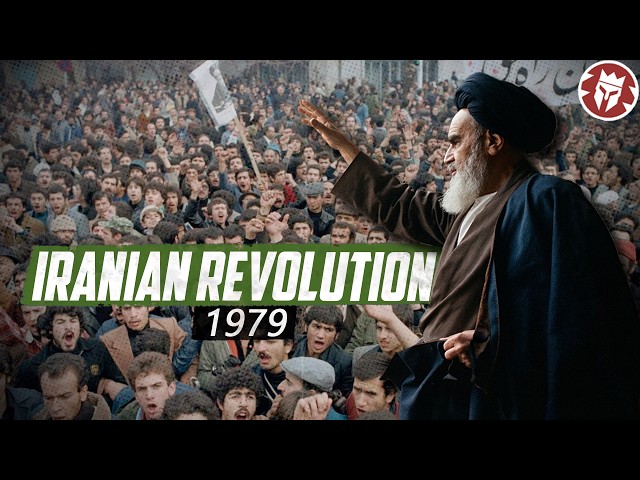
Why Iranian Revolution Happened - Kings and Generals Modern
Kings and Generals
0:11 The Islamic revolution in Iran is one
0:13 of the most consequential political upheavals of the 20th century.
0:17 It gave rise to a truly unique political system and turned
0:20 Iran into one of the biggest challengers to the Pax Americana.
0:24 Much has been written about how the revolution unfolded and how
0:28 Shia clerics came to power in one of the world's oldest countries.
0:32 The joint attack of the United States and Israel on Iran has
0:36 once again brought the Iranian revolution
0:38 and its clerical regime to the spotlight,
0:40 but we are not going to make a video on how the revolution happened.
0:44 Instead, we want to answer one question:
0:47 “Why did the Iranian Revolution Happen?”
0:56 POLITICAL CAUSES AND OPPRESSION Iran has had
1:18 its fair share of disruptive and transformational
1:35 political events in the 20th century.
1:38 Revolutions, coups, foreign occupation,
1:40 and the substitution of one royal family for another.
1:43 The truth is that Iranian society has always been politically very active,
1:48 and even during the harshest authoritarian periods,
1:50 they have found ways to express their dissent,
1:53 often putting their lives at risk in the process.
1:56 The Iran of the 1970s was one of the most oppressive regimes in the world.
2:01 Ever since the US-sponsored 1953 coup,
2:04 which toppled the democratically elected Mossadegh government,
2:07 the Shah of Iran, Mohammad Reza Pahlavi,
2:10 had been curbing the political space and persecuting his opposition.
2:15 One by one, political parties had been banned.
2:18 In 1957, the Shah created SAVAK,
2:21 the secret police, to protect his regime from dissent,
2:25 which Time magazine described as “Iran’s most hated and feared institution”.
2:29 SAVAK routinely engaged in torture and execution
2:33 of people suspected of opposing the Shah.
2:36 This effectively turned Iran into an authoritarian police state,
2:40 which pushed the opposition underground.
2:42 By the mid-1970s, the Shah had become fully totalitarian.
2:47 In 1975, he created the Rastakhiz (Resurgence) Party,
2:51 whose sole purpose was to promote Mohammad
2:54 Reza Shah’s rule and implement his policies.
2:56 Anyone disagreeing with him was branded a traitor by the Shah,
3:00 who said: “The place of those who oppose the Constitution,
3:04 the monarchical system and the People-Shah Revolution
3:06 is either in jail or outside Iran.
3:09 Those who do not wish to enter
3:11 into this political organization (the Rastakhiz) have two alternatives:
3:15 They either belong to an illegal political party,
3:18 like the Tudeh, in which case they should be jailed”.
3:21 [second part missing here?] The Shah himself admitted that there
3:23 were 3000 political prisoners in the country in 1976.
3:27 Foreign journalists and Iranian exile groups put
3:31 the estimate from 25,000 to 100,000 political prisoners.
3:34 So, the sheer scale of political oppression in Iran was unbearable.
3:39 The Shah’s reign of terror targeted many groups,
3:42 most notably Iranians with leftist or liberal sympathies.
3:46 While repression against politically active people
3:48 was perhaps deplored by the ordinary Iranians,
3:51 it was nonetheless within the realms of what was expected.
3:55 Iranian shahs were never really known for tolerance for dissent.
3:59 But in hindsight, the Shah, increasingly blinded by arrogance,
4:02 which can be caused only by excessive wealth and unfettered power,
4:06 and seeing himself as some kind of reformist messiah of Iran,
4:10 crossed some red lines he was not supposed to.
4:14 He targeted Iran’s notoriously independent merchant class, the bazaar,
4:18 which has been the center of life and commerce of Iranian cities for centuries.
4:22 The mood of Iranian bazaars had often been a barometer of society at large,
4:26 and when that mood soured, Iranian shopkeepers and merchants were often
4:30 at the forefront of discontent and revolt.
4:33 The bazaars had protested the Shah already
4:36 twice before the revolution- once in 1954,
4:39 striking against the new oil agreement
4:41 with the West and the second time in 1963, when they took to the streets
4:46 to speak out against rigged parliamentary elections.
4:48 So, the Shah rightly saw the bazaars
4:51 as a source of threat to his increasingly totalitarian rule.
4:55 But also, the bazaars were not part of his vision of a modernized future Iran,
5:00 as he preferred big businessmen who largely depended on his goodwill.
5:04 He wanted to bulldoze old bazaars and build state-run markets,
5:08 new roads and modern restaurants in their stead.
5:11 After creating Rastakhiz,
5:12 Mohammad Reza started making moves to take control over the bazaars.
5:17 His party opened local branches in the bazaars
5:20 and replaced local merchant guilds with a Chamber of Guilds,
5:23 appointing wealthy outsiders to its presidency.
5:25 While big businessmen borrowed money from banks
5:28 at a reasonable 6 percent interest rate,
5:31 small shopkeepers had to pay exorbitant rates, often exceeding 20%.
5:35 When Iran was hit with spiralling inflation in 1975,
5:39 the regime chose to target small shopkeepers
5:42 as scapegoats and launched a major campaign against them.
5:46 “The Bazaar profiteers” were accused of artificially increasing prices.
5:50 Some 8,000 bazaar-related businessmen were jailed.
5:53 23,000 were exiled from their homes, and some 200,000 men were fined.
5:59 Simultaneously, the Shah waged war against the religious establishment.
6:02 He believed that the crucial element of his drive
6:06 for modernization was eliminating the Shia clergy's independence,
6:09 which had been a major political force in Iran for centuries.
6:13 A series of laws that contradicted the Sharia was passed.
6:17 The minimum marriage age for girls was raised to 15 under the 1967 law,
6:23 then to 18 under its 1975 amendment.
6:26 The Family Protection Law of 1967 restricted polygamy
6:29 and made the process of divorce more complicated for men.
6:33 Female students wearing chador veils
6:35 were prohibited from registering at universities.
6:38 The Islamic Hijri calendar was substituted with a new royalist calendar,
6:43 as Iranians suddenly experienced an overnight transition from 1355 to 2535.
6:50 The Religious Corps was established to ideologically challenge the traditional
6:54 Shia clergy class and promote the Shah’s version of Islam,
6:58 which was proclaimed the “spiritual guide” of Iran.
7:02 Many prominent clerical leaders,
7:04 who criticized these new policies, were imprisoned.
7:07 The future leader of the revolution,
7:10 Ayatollah Ruhollah Khomeini, was sent into exile.
7:13 By destroying the liberal and leftist opposition,
7:16 while also making strong moves against the religious and merchant classes,
7:19 the Shah regime was driving the opposition deep underground.
7:23 On the surface, the Iranian police state had weakened
7:26 the opposition to the point of making it nearly invisible,
7:29 but at a deeper level,
7:31 the harshness of repressions turned the resentment against Mohammad Reza Pahlavi
7:35 into pure hatred hidden from plain sight for the time being.
7:39 But many authoritarian and totalitarian regimes engage
7:42 in brutal political repression and continue existing despite them.
7:46 So, although political repression is an important
7:49 motivator and cause of revolutionary movements,
7:51 it is almost never sufficient to be the sole factor behind mass movements.
7:56 ANTI-WESTERNISM, ANTI-MODERNIZATION Mohammad Reza Shah’s modernisation
7:59 programme was breathtaking in its ambition— he
8:02 intended to transform Iranian society beyond recognition
8:05 in an extremely short period of time.
8:08 This is never an easy task and almost
8:11 always requires an immense degree of legitimacy,
8:14 popularity and control for rulers to realize their ambitions.
8:17 Something not many leaders have ever enjoyed.
8:21 Because radical modernisation envisages taking on entrenched
8:24 order and societal forces and centuries-long societal dynamics.
8:28 The Shah’s vision of modernization
8:31 included eliminating the influence of traditional
8:33 societal forces such as the Shia clergy and the merchant class.
8:37 They were seen as remnants of the past.
8:40 There would be no opposition to his rule,
8:42 and he would surround himself with Western-educated technocrats,
8:45 specialists, and large businessmen.
8:48 Iran’s massive oil revenue was going
8:51 to fund the industrialization of the country,
8:53 rapidly building up its infrastructure, turning Iran into a military powerhouse,
8:58 improving healthcare and education and emancipating
9:00 women from the shackles of religion.
9:02 Here, the problem for the Shah was that a significant portion
9:05 of the Iranian population was conservative
9:08 and rejected such a rapid transformation.
9:10 On top of that, modernization
9:13 in Iran was closely associated with Westernization.
9:16 The United States, Britain and Israel were seen
9:20 as the staunch allies of the Shah regime.
9:22 And the religious, leftist and nationalist forces in Iran
9:25 had many reasons to be critical of the West.
9:29 An anti-Western attitude was part of the Iranian psyche to some extent,
9:33 as Iranians had long bemoaned the Western meddling in their affairs,
9:37 taking over their resources and controlling their leaders as puppets.
9:41 In 1890, the tobacco protests occurred after
9:44 the Iranian government sold the tobacco concession to Britain.
9:48 In 1953, the US and Britain orchestrated a coup
9:52 to depose the democratically elected prime minister Mossadegh,
9:55 who had previously decided to nationalize Iran’s oil industry.
9:59 Mohammed Reza Shah was friendly with Israel.
10:02 All of these were legitimate causes for resentment
10:05 against the West in large portions of Iranian society.
10:08 The former prime minister of Iran, Jamshid Amouzegar,
10:11 argued that the collapse of the Shah regime was
10:14 caused by a clash between Western modernization and traditional,
10:17 religious, economic and social structures.
10:20 Indeed, the anti-foreign sentiment is a common feature in many revolutions,
10:25 and the Iranian revolution is no exception.
10:28 URBANIZATION AND EXPANSION OF HIGHER EDUCATION One of the key
10:29 elements of the Shah’s modernization plan was rapid urbanization,
10:31 the uncontrolled manner of which became one of the causes of the revolution.
10:36 The urban population of Iran increased from 6
10:40 million to 16 million between 1956 and 1976.
10:43 At the same time, the rapid expansion of higher education,
10:47 state bureaucracy and industry increased the number of jobs in cities.
10:52 By the 1970s, there had been a fourfold increase
10:56 in the number of university graduates– roughly 300,000 people.
11:00 The number of people working as civil servants,
11:03 teachers, engineers, managers, doctors, and other typical middle-class jobs rose
11:07 from an estimated 324,000 to 630,000 by 1977.
11:12 The urban working class is estimated to have grown from around
11:18 300k in 1953 to more than 1.7 million by 1977,
11:22 with the oil industry, factories, railways,
11:25 and transportation companies as the largest employers.
11:28 On the surface, this looks impressive and indicates a rapid transformation.
11:32 But such progress also brought challenges
11:34 that the Shah regime was ill-equipped to deal with.
11:38 The oil boom caused a major construction boom in Iran.
11:41 One of the unintended consequences was a major internal migration
11:45 of the low-skilled rural population to the cities in search of jobs.
11:50 Many struggled to get permanent employment.
11:52 On top of that, the lack of adequate housing
11:55 and social services led to the emergence of new shantytowns.
12:00 Poor socio-economic conditions, lack of prospects and youthful restlessness have
12:04 always been a perfect combination for political unrest.
12:07 But it also caused the proliferation
12:10 of crime and vices like alcoholism and prostitution.
12:14 This, in turn, handed the clergy
12:16 powerful material for its anti-regime messaging.
12:19 The Shah’s modernization and westernization were blamed for immorality,
12:22 a message which found some resonance among ordinary Iranians.
12:26 Moreover, the newly urbanized people and the increasingly
12:30 young and educated population of Iran
12:32 inevitably sought communities to identify with and for opportunities
12:36 to rise in the social ladder.
12:38 But the destruction of practically all independent organizations,
12:41 such as political parties, labor unions and professional associations,
12:46 meant that finding such communities and avenues to express themselves
12:50 and convey grievances in a non-violent manner did not exist.
12:53 One of the aims of Rastakhiz was to bring
12:56 these young people into the fold, but it was belated,
12:59 and the Shah’s and his party's messages did
13:02 not really appeal to this new social stratum.
13:04 Enter the only remaining independent institution,
13:08 to which throughout history many have turned for the sense of community,
13:12 comfort and hope- the clergy.
13:14 For all the pressure the Shah was putting on institutionalized Shiism in Iran,
13:19 it was still standing.
13:20 In the absence of other options, thousands of urban migrants,
13:24 especially those who had been left behind,
13:26 sought financial and moral support from the clergy.
13:29 This gave the religious opposition a significant
13:32 young supporter base in big cities.
13:34 CORRUPTION.
13:34 SOCIAL PROBLEMS Yet, for all the progress Iran had made during the Shah’s reign,
13:39 thanks to a massive influx of oil money,
13:41 the country still faced major socio-economic problems.
13:44 On the eve of the revolution, 68% of adults were still illiterate,
13:48 while fewer than 40% of children had completed primary school.
13:53 43% of urban families lived in one-room houses,
13:56 on top of the shanty towns we mentioned earlier.
13:59 Many cities, including Tehran,
14:01 lacked proper sewage systems and public transportation.
14:04 Although the government funded the formation of farm
14:07 cooperatives and provided some machinery to farmers,
14:10 their overall agricultural strategy, as in many other spheres,
14:14 was bafflingly incomplete and inconsistent.
14:17 Most rural areas lacked electricity, and banks did not offer favourable loans
14:22 to farm cooperatives to boost their productivity.
14:25 On the opposite side of the spectrum,
14:27 businessmen and bureaucrats close to the regime were
14:30 enriching themselves thanks to preferential treatment and outright corruption.
14:35 In 1974-75 alone, the Commander of the Iranian
14:38 Navy and the Commander of the Air Force,
14:40 the latter of whom was Mohammad Reza’s brother-in-law,
14:43 were implicated in corruption.
14:44 And the public saw that the very few were
14:48 enriching themselves on their country’s wealth at their expense,
14:51 which only made their resentment worse.
14:53 Many felt like modernization,
14:55 and the Shah’s policies served the purpose of making the rich richer,
14:59 while ignoring the problems and interests of ordinary people.
15:02 And this was the majority- one whose silence would not last much longer.
15:08 THE REVOLUTION Up until now,
15:09 we have focused on pre-existing structural causes that ignited
15:12 the mass protest movement in Iran in 1978.
15:16 But similar causes had existed in many other
15:19 countries with similar contexts without revolutions toppling the incumbents.
15:23 So, what made the Iranian protest movement different?
15:27 Iran’s revolutionary history is unique in a sense.
15:30 At least, in terms of tactics used by protesters.
15:33 For instance, bast- people taking sanctuary in mosques,
15:37 other holy places and foreign embassies in large numbers as a sign of protest,
15:42 which was used in the 1906 revolution.
15:45 But arguably the most impactful,
15:47 uniquely Iranian mobilization tactic is called Chehelom,
15:50 which means the “40th” in Persian.
15:53 In the Shia tradition, the dead are mourned for 40 days,
15:56 with the final respects being given on the 40th day.
15:59 As a revolutionary tactic,
16:01 it meant gathering for the 40th day ceremony of a protester,
16:05 who had been previously killed by the regime.
16:08 Then this gathering would transform into a protest of its own.
16:11 And it became a self-sustaining wave
16:14 of protest across Iran during the 1978-79 revolution.
16:17 The revolutionary cycle began with the Qom
16:20 protests and the government’s bloody response, which killed at least 5 people.
16:25 40 days later, Tabriz rose up in Chehelom with bazaars
16:29 and mosques playing a crucial role in mobilizing the people.
16:33 The regime once again responded by killing several protesters.
16:36 Then, 40 days later, on March 29,
16:40 protests took place in dozens of Iranian cities, including the capital, Tehran.
16:44 This cycle continued through the summer and then
16:47 the shocking events like the Cinema Rex fire
16:50 and the Jaleh Square massacre turned the wave
16:53 of protests into a truly revolutionary mass movement.
16:56 Without a doubt, the Chehelom tradition was an important element of this.
17:00 Scholars of the Iranian revolution also point out
17:03 the inconsistency of the regime’s decision-making- sometimes too heavy-handed,
17:08 other times hesitant in the face
17:10 of the growing revolutionary movement and unrest.
17:12 At the initial stage of the mass movement,
17:15 the Shah cracked down very hard on the protests in Qom.
17:18 This reaction was expected for an authoritarian regime,
17:21 but the death of protesters launched the cycle of Chehelom,
17:24 growing the movement and expanding the geography of demonstrations.
17:28 The brutality of his regime peaked at the Jaleh Square massacre,
17:32 with more than 100 casualties reported on both sides,
17:36 mostly among the civilians.
17:37 This is when the situation reached the point of no return.
17:41 The only chance of saving his power for the Shah
17:43 was to continue relying on excessive violence to defeat the revolution.
17:47 Instead, Mohammad Reza suddenly changed his strategy and tried
17:51 to appease the opposition by dismissing his government,
17:54 releasing political prisoners,
17:56 easing censorship and promising free elections to the parliament in 1979.
18:00 This step could have been a viable option for maintaining his power,
18:05 while gradually moving towards a constitutional monarchy,
18:07 at the start of the protests.
18:09 After the Jaleh Square massacre,
18:11 this move was seen as a sign of weakness by the Shah,
18:15 who was quickly losing any popularity he had.
18:18 In November, Mohammad Reza Shah declared that he had “heard
18:21 the voice of revolution” and ordered the army to constrain its reaction.
18:25 But around the same time,
18:26 he appointed a military government led by General Azhari,
18:30 who tried to restore order through
18:32 curfews and strict enforcement of martial law.
18:35 However, mass strikes in the oil sector and defections from the regime
18:39 during this period demonstrated that it was likely beyond saving.
18:43 The appointment of a moderate opposition figure, Shapour Bakhtiar,
18:46 as prime minister in January 1979 was a very
18:50 late and unsuccessful attempt to appease the public.
18:53 Like many authoritarian leaders before and after,
18:56 the Shah decided to disperse protests through force.
18:59 But the army was ill-equipped to effectively contain the protests,
19:02 because they relied excessively on live ammunition,
19:05 since they did not have other means of crowd control,
19:08 nor training in this very specific task.
19:11 Shah’s contradictory orders didn’t help.
19:13 The scale of killing of the people by the regime
19:17 and standalone shocking events like the Cinema Rex fire,
19:19 which the Shia establishment very masterfully used
19:22 for its advantage by blaming the Shah, had made the revolution too powerful
19:27 and the regime absent of answers and solutions.
19:30 We will talk about Iran and the current situation in future videos.
19:33 If you don’t want to miss those videos,
19:35 make sure you are subscribed and have pressed the bell button to see them.
19:39 Please consider liking, subscribing, commenting,
19:41 and sharing- it helps immensely.
19:43 Recently, we have started releasing weekly
19:45 patron and YouTube member exclusive content,
19:47 consider joining their ranks via the link in the description
19:51 or button under the video to watch these weekly videos,
19:54 learn about our schedule, get early access to our videos,
19:57 access our private discord, and much more.
19:59 This is the Kings and Generals channel, and we will catch you on the next one