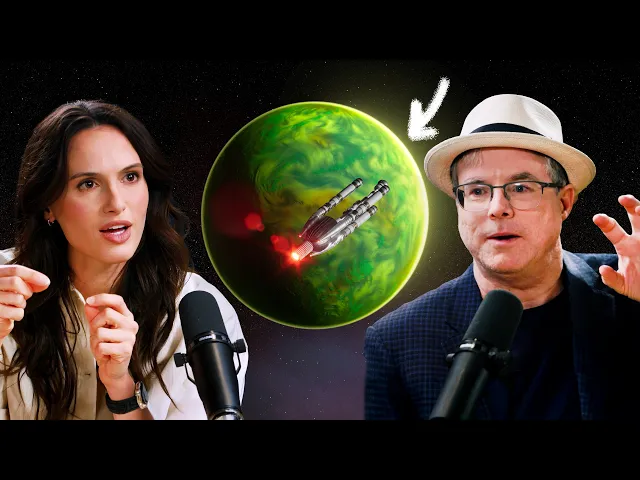
I Wrote a NEW Sci-Fi with Project Hail Mary Author Andy Weir
Cleo Abram
0:00 That's an interesting angle.
0:01 I haven't seen that.
0:02 I wrote a brand new sci-fi story with Project Hail Mary author Andy Weir.
0:06 Andy is one of the most popular science fiction writers alive.
0:10 He also wrote The Martian.
0:11 And what's special about his work is how real his fake stories are.
0:15 He showed me the secret spreadsheets that he uses
0:18 to calculate all of the science in his stories.
0:20 And the reason that that matters is that great
0:23 fiction can help you see the real world more clearly.
0:26 Sci-fi is HUGE*, if true.
0:28 This show is about real science and technology,
0:31 but we've used a little bit of sci-fi to start to explain complicated things.
0:35 So, I wanted to learn from Andy.
0:37 In this conversation, we go deep inside his fictional worlds to see
0:41 exactly how he makes them feel so real,
0:45 and we play out our brand new sci-fi story together in real time.
0:51 Welcome to HUGE* Conversations.
0:52 Fist my bump.
0:54 Success.
0:54 Fist my bump.
0:55 Exactly.
1:03 Hello.
1:03 Hello.
1:03 Thanks for doing this.
1:05 Sure to have you.
1:06 Nice to meet you.
1:08 Please.
1:08 I am a fan.
1:09 Likewise.
1:10 Oh, this is going to be so much fun.
1:12 I never thought you'd start out that way.
1:15 I Well, I saw I love that video of like
1:17 just a short of you with like a lightsaber.
1:20 It's like and just the look on your face like that's cool.
1:25 just this de like it's like you were 10 again.
1:28 It felt like that and you see it come out and you can't help but make
1:32 the noise like you of course immediately you're like
1:35 it's like I can't see well that they had
1:37 to edit out when Ewan McGregor when they
1:39 were filming like the Phantom Menace they had
1:41 to edit out because they found on the things
1:43 he was making lightsaber noises during the fight scenes.
1:45 Oh, this is going to be so much fun.
1:47 Thank you so much for being here
1:49 to meet you and congratulations on escaping Alcatraz.
1:51 Thank you.
1:52 That was way harder than I thought it was going to be.
1:55 Well, I mean, the prevailing theory is that those guys died, right?
1:58 Yes.
1:58 Yes.
1:58 And now I know why.
2:00 We were like hour four in the freezing water and I was like,
2:04 so these guys definitely died.
2:06 These guys died.
2:07 Definitely.
2:08 Definitely.
2:08 They died.
2:09 Well, maybe.
2:10 Who knows?
2:10 I have so many questions for you.
2:12 I feel like I feel like I've been preparing for this my whole life.
2:16 Great.
2:16 Whatever you want.
2:17 Let's talk about whatever.
2:18 So, just whatever your first question is, my answer is seven.
2:22 Awesome.
2:23 I'll make sure what six plus.
2:25 Um, okay.
2:26 So, it sounds like maybe you know a little bit about our show.
2:29 Yes.
2:30 Taking a step back, HUGE* Conversations is a show about possible futures.
2:34 Okay.
2:34 And often we're interviewing tech CEOs and scientists and folks like that.
2:39 You spend all day every day imagining
2:41 possible futures and sharing them with other people.
2:44 And you have written some of my favorite books of all time.
2:47 So, first I just want to say thank you.
2:50 I I know I speak for millions of people when I say
2:52 how much joy I have gotten out of the stories that you've written.
2:56 Nerd.
2:57 Exactly on behalf of the millions of nerds around the world,
3:00 thank you for your service.
3:02 So this is not a list of PR questions about the Project Hail Mary movie.
3:08 We'll get into it in in some ways.
3:10 Um but I'm hoping to have a larger conversation about science and science
3:14 fiction and we could not be in a better place to do it.
3:17 Yeah, exactly.
3:17 We're in the American Museum of Natural History.
3:21 That is a real meteorite.
3:23 It is the largest meteorite in any museum anywhere.
3:26 Excellent.
3:26 Why are we here?
3:28 Because it's cool.
3:29 It's cool.
3:30 It's cool.
3:30 I just thought, what a perfect spot.
3:32 I love meteorites.
3:33 I have a sugar tight at home.
3:34 Do you really?
3:35 I have It's about the size of a walnut.
3:38 Yeah.
3:38 It's perfectly legal.
3:39 Buy buy a sugar tight.
3:41 Yeah.
3:41 It's a It's a It's a Mars meteorite
3:43 and it's about It's about the size of a walnut.
3:46 It cost an absurd amount of money,
3:47 but I had just gotten paid a bunch for the Martian.
3:49 So, I'm like, wants it.
3:50 And so, I have it on display in my house.
3:52 It's like, here, this unremarkable looking rock is from Mars.
3:56 It's this was on Mars.
3:58 That's so awesome.
3:59 That's really cool.
4:00 I have three things that I want to do in this conversation.
4:03 The first is I want to get into the details
4:05 of what you've called your favorite part of the whole process,
4:08 which is world building.
4:09 Yeah.
4:09 And I want to do some of that together.
4:11 I think the best way to do that is to do it in real time a little bit.
4:15 So the second category of question I want to ask
4:17 you is about a sci-fi story that I am working on.
4:19 Okay.
4:19 And then I want to zoom out and I want to talk
4:22 about what I love most about your stories which is the optimism.
4:25 You don't write dystopias.
4:27 You write about good people solving hard problems.
4:30 Thank you.
4:31 And I want to talk about that.
4:32 Yeah.
4:32 I'm an optimist.
4:33 I'm a bit of a polyiana in real life.
4:34 So me too.
4:35 That's how I am.
4:36 This is going to be great.
4:37 And I think humans are neat.
4:38 Yeah.
4:39 I think we're pretty neat.
4:40 It's easy to lose sight of that because you watch
4:41 the news and you see all this misery and stuff.
4:44 But the reason that you're seeing all this bad
4:46 stuff on the news is because bad stuff is newsworthy.
4:49 Yeah.
4:49 You don't report like people doing good stuff
4:52 because it's so incredibly common that that's the norm.
4:54 Like so somebody slips on a street corner
4:56 and breaks their leg and seven total strangers crowd around,
4:59 bring him to safety, maybe give them a bottled water, call an ambulance,
5:03 ask if they can call any family, try to stabilize his leg.
5:06 You know, that happens all the time.
5:08 It doesn't make the news because it's expected ordinary normal human behavior.
5:11 Yeah.
5:11 But I think it's beautiful that the the kind of compassion and empathy
5:15 and selflessness that humans have is so ordinary that it's not newsworthy.
5:20 That's the feeling that I want people to have when they watch my show as well.
5:23 And that's the feeling that I get from reading your books.
5:26 Thank you.
5:26 I want to start with Project Hail Mary.
5:28 Okay.
5:28 I want to summarize it really quick.
5:30 Please interrupt me in any question,
5:32 but especially when I'm summarizing one of your books to you.
5:36 Okay.
5:36 In Project Hail Mary, our sun begins to dim.
5:39 Scientists figure out that there is a space bacteria
5:41 called astrophage that is dimming our sun and that not
5:44 only our sun is infected but all of the stars
5:47 in our near vicinity are infected too except one.
5:50 And so your main character Dr.
5:52 Ryland Grace needs to go on the world's longest space adventure
5:55 to discover what's happening with that star to maybe save Earth.
5:58 Okay.
5:59 I want to start by talking about these.
6:01 Yes.
6:02 Yes.
6:02 This is um like one of my many spreadsheets
6:07 that I used in writing um project Hail Mary.
6:11 And this has mostly to do with the physics of astrophage.
6:14 At the bottom here, there's a bunch of tabs.
6:16 And oh yeah, this tab, Hail Mary, has all the information about the ship.
6:20 And this one, Beetle Tau Ceti.
6:22 Yep.
6:23 Yep.
6:23 40 Eradani.
6:24 And then there's even one that's called
6:27 like wrong math because I had to calculate
6:30 how much fuel the Eridians brought along
6:33 with them because they didn't know about relativity.
6:36 So they assumed they Eridians have pure Newtonian
6:39 physics all the way from Eridani to Tau Ceti.
6:42 So they their math was completely wrong.
6:44 So I had to calculate all of that to know what we had.
6:47 You did their wrong math for them.
6:49 I did their wrong math and figured out how much extra
6:51 fuel they would have as a result of their wrong math.
6:54 which is why Rocky can have some leftover for grace.
6:57 So this is all about astrophage.
6:59 Um this is the temperature that astrophage needs to be which
7:03 is 96.415 degrees uh Celsius is what it works out to be.
7:07 This is the temperature astrophage needs to be to be able
7:10 to generate nutrinos which is what it uses to store energy.
7:13 So the way it makes nutrinos is it has a temperature.
7:16 That heat energy causes some um hydrogen
7:19 ions inside the astrophage to be bouncing around just you know root mean square
7:24 calculate their phys their velocity that they
7:26 will have at any given temperature and that is the velocity they need
7:31 to have to have the kinetic energy equal to the mass energy of two nutrinos.
7:35 Hm.
7:36 So, um you you you back calculate, okay, if they're going to be going this fast
7:41 to have this much kinetic energy on the collision, then what is the temperature?
7:45 If you know the average particle speed,
7:47 you can calculate the temperature in Kelvin and then work it out backwards.
7:49 And so, that is the minimum temperature
7:51 required because if the particles are hitting
7:53 each other slower than that, there's not
7:55 enough kinetic energy to create two nutrinos.
7:56 And you have to make two because they
7:58 have to be going opposite directions to balance momentum.
8:00 And this informs how they build the engines and all kinds of other things.
8:04 All sorts of stuff.
8:05 And is it that you came up with an idea like astrophage and then
8:09 do all of the math to if something that could actually you know
8:16 acts like this around the sun exists then these are all of the second
8:20 order effects that you would see and that's how you build the story.
8:23 How do you use actually use these spreadsheets
8:25 in the process of telling the story as you write it?
8:29 Well, I mean, so first I need to go
8:32 I love the research and and making this stuff up,
8:34 but I I go on a deep dive into the math
8:37 to find out what is the effect of all of this.
8:39 Like what is the effect?
8:40 It's like, okay, doing all this math tells me,
8:42 oh, astrophage is 90 is it 96.415 degrees.
8:45 Okay, great.
8:46 And I know it's how much mass it can hold before it does that.
8:51 And as a result of that, plus its own black body radiation,
8:54 when it's going through space,
8:55 I can calculate how long it takes before it starves.
8:58 If it's just out in space, just going in a straight line,
9:02 it'll radiate away heat and then then it will eventually run out of all of its.
9:07 So, you know, like how far the stars could
9:09 be between each other that couldn't get infected, right?
9:11 Got it.
9:12 Because And I had to account for the fact
9:14 that it's moving in its own inertial reference frame.
9:16 So, it's only living for like a few months.
9:19 Yeah.
9:19 Away from its star.
9:20 But it can go up to like eight light years away because of special relativity.
9:26 So that's why the infection distance is eight lighty years.
9:29 And so I I didn't decide that.
9:31 I derived it.
9:32 Yeah.
9:32 That's what I think feels so satisfying.
9:35 So speaking of the ways that the stars all get infected or don't,
9:39 one of my favorite moments in an interview that you've done before is where
9:43 you played out how you invented the character and the species rather of Rocky.
9:47 This will be a spoiler for the book,
9:50 but not a spoiler for the movie because it's in the trailer.
9:53 Everybody knows at this point that Rocky exists.
9:55 I'm going to call you Rocky.
9:57 It's now or never.
9:59 So, Dr.
9:59 Ryland Grace gets to the star that's
10:02 uninfected and he sees another spaceship there.
10:04 And that spaceship has in it an alien that becomes the cutest,
10:08 best friendship of all space time.
10:10 It's just the most wonderful thing.
10:12 And they have to save both their civilizations.
10:15 But what I'm really interested in is how you
10:18 worked into what the alien of Rocky would be like.
10:22 You chose a real star, a real planet, and then you had a flow of logical
10:28 decisions that worked into a whole rich creation.
10:31 Could you walk me through that flow?
10:34 Sure.
10:34 Um, well, first off, I have to give a disclaimer.
10:37 Since writing Project Hail Mary,
10:39 it has been shown that that planet doesn't actually exist.
10:41 But at the time I wrote Project Hail Mary,
10:44 it was believed that 40 Aerodani AB was a real exoplanet that had about
10:49 eight Earth masses and was orbiting 40 Eridani around uh once every 46 days.
10:53 And that's all we knew.
10:54 So I figured I'm going to start with that and then
10:57 I get to do whatever I want beyond that.
10:59 Anything that we don't know, I get to define, right?
11:01 So I said, "All right, I want life to be on this planet." And also um giving
11:05 a little bit more information from the book here we later learn
11:09 that all of the life in the entire book um earth Erid
11:13 and Tau Ceti all of it astrophage everything is a has common ancestry.
11:19 Yeah life ev within my fiction life only evolved
11:23 once and it only evolved on Adrian planet Adrien.
11:27 Primordial astrophage it really just ev evolved to go
11:30 back and forth between Tau Ceti and Adrian.
11:32 That's it.
11:33 It wasn't supposed to be an interstellar species.
11:35 But then what happened was occasionally it would miss
11:38 and this would cause a panspermia event because occasionally it would miss.
11:42 Most of the time that would die but sometimes it would end up hitting a planet.
11:45 Most of the time it would die but sometimes it was able to survive long
11:48 enough to reproduce a little bit and that's what seeded life on Earth and Erid.
11:52 So that's why when they take apart
11:53 the cells they find out that astrophage has like
11:57 ribosomes and RNA transcription and everything like stuff
12:00 that it is impossible to believe would parallel evolve.
12:03 It has to be there.
12:05 So we are descendants of life that evolved at Tau Ceti.
12:08 That's one of the reasons I chose Tau Ceti.
12:10 Itwas kind of perfect for it because first off,
12:13 Tau Ceti is a solar analog and so I figured it is more likely
12:17 that life would be able to seed
12:19 in environments similar yeah to where it started.
12:22 So I wanted solar analoges across Tau Ceti.
12:25 Also Tau Ceti, I forget exactly how old it is,
12:27 but it's got a few billion years on us.
12:29 Like it's much older than the sun.
12:31 So it had more time to evolve life.
12:33 That's why like we got seeded with life like when
12:36 the sun was only like half a billion years old.
12:39 It's like how do you explain that?
12:41 Well, because Tau Ceti was already like 3 or 4 billion years old.
12:44 And so that's how we got seeded with life.
12:47 So all that having been said, this this uh Erid,
12:50 the planet Erid had to have water.
12:53 Had to have liquid water because it's all we're all related.
12:55 It's all you have to have water for this to work.
12:58 I'm like, okay, so this is a planet that is really close to its star,
13:02 closer to its star than than Mercury is to ours.
13:05 It's a 46 day year.
13:06 I mean, it's it's very close.
13:08 So I thought, how do you have liquid water
13:10 on a planet that's that close to a star?
13:12 It's going to be really hot.
13:13 Yeah, pressure.
13:13 If you have really high pressure, the boiling point goes up.
13:17 So the their oceans are like 200° C.
13:19 Their their air is also 200°C.
13:22 And in fact, they have a fairly
13:24 constant temperature on their planet all the time,
13:27 which is what we see on Venus, where it doesn't even matter if you're
13:30 on the day side or the night side of Venus.
13:32 It's it's always about the same temperature because its atmosphere is so thick.
13:35 So now from that I've said I want liquid water.
13:37 So that means I have to have a thick atmosphere.
13:39 Now what's my next problem?
13:41 My next problem is how do you have
13:42 a thick atmosphere when you're that close to a star.
13:45 If you're right next to a star the solar
13:46 wind is just going to just blast your atmosphere off.
13:49 That's why Mercury doesn't have an atmosphere at all.
13:51 Really strong magnet part of it.
13:53 Yeah.
13:54 Two two things can help you with this one.
13:56 You may remember that Venus has a really
13:59 thick atmosphere and it's close fairly close right.
14:02 So the answer is uh two things.
14:05 One, your atmosphere can be made out of really heavy molecules.
14:08 Earth's atmosphere is mostly just N2, nitrogen.
14:11 It's not very heavy, right?
14:13 Venus's atmosphere is carbon dioxide.
14:15 It's much heavier.
14:16 So, the sun can't really knock those out of Venus's gravity well as easily.
14:21 So, that's why Venus gets to keep its atmosphere and Mercury doesn't.
14:25 Um, so I said Erid has an atmosphere of ammonia.
14:28 We see ammonia all over the place in in our solar system.
14:31 Gas giants are made of it.
14:33 So, it's plausible to assume, okay, that that there there's a bunch of ammonia.
14:37 So, that's a heavy molecule that's hard to knock out of the gravity well,
14:40 and it's also a bigger gravity well, which helps.
14:42 Uh, the next thing is a strong ass magnetic field, just like you said.
14:46 So, I decided that Erid has a liquid,
14:48 you know, ferroagnetic core and also rotates really, really fast.
14:52 The faster you rotate, the stronger your magnetic field will be.
14:56 So, it has a magnetic field that's about 25 times as powerful as Earth's.
15:00 And it rotates.
15:01 I did all the math.
15:02 It takes about 6 hours to do one revolution.
15:04 So it's whipping around fun stuff that never made it into the book.
15:08 Yes, please.
15:08 Is this creates such an oblong shape for the planet
15:12 because of this in it's below the ro limit.
15:15 It's not going to rotate itself apart, but it creates such a deviance.
15:19 So the distance from the center of Erid to its equator is
15:23 significantly different than the distance from the center of Erid to its pole.
15:27 And so much so that it would be like measurably different gravity.
15:31 Oh wow.
15:32 So they could have a whole sort of culture around like where they end up in it's
15:37 not it's not by much but it's on the order of centimeters per second per second.
15:42 It's like different.
15:42 It's like to their ancient world
15:44 notably different and that so that's interesting.
15:47 Yeah.
15:47 So I I said okay we got a planet spins really fast got thick ass atmosphere.
15:52 It's got a very very strong magnetic field.
15:54 Now what evolves there?
15:55 And I decided, well, for starters, I mean,
15:58 maybe the ammonia would be clear all the way to the surface,
16:01 but I decided it wasn't.
16:02 So, I decided that their atmosphere acts kind of like an ocean.
16:05 There's um life that absorbs light, you know,
16:08 sunlight and reproduces that way up in the upper parts of the atmosphere,
16:12 then life below that that eats that, and then life below that that eats that.
16:15 Kind of like our oceans.
16:17 Like sunlight only gets what, 10, 20 meters into the ocean,
16:19 and that's as far down as it goes.
16:21 But there's life in the ocean all the way down to the floor.
16:24 So that biosphere can filter down.
16:26 Um, and so that's the same thing that happens in Erid's atmosphere.
16:29 And then the larger fauna live on the surface
16:32 and that's Eridians are one of them.
16:34 So I thought, well, what do you need to be like to live on the surface of Erid?
16:39 Okay.
16:39 Well, it's nice to know that there's liquid water,
16:42 but there's no oxygen in the atmosphere.
16:44 So your body has to basically be not like
16:48 not like Earth's system where you know animals exhale
16:52 carbon dioxide then plants consume the carbon dioxide
16:54 and give off oxygen and it goes back and forth.
16:57 That entire system has to be internalized to each animal.
17:01 So eridians h are like a biosphere.
17:04 They need energy so they need to eat you know other animals.
17:07 They're they're omnivores just like we are.
17:09 And so they need to hunt and kill and eat other animals.
17:12 I mean like caveman eridians did that and um
17:15 so that's how energy enters the system but as long as you have energy entering
17:18 the system they can maintain their biological biosphere.
17:21 I said, "No light gets to the surface,
17:23 so there's no need for them to evolve vision.
17:26 Instead, they evolved echolocation so accurate that they can get, you know,
17:29 they can fully understand their room." And what's funny is people are like,
17:33 "Wow, that'd be really,
17:34 it's hard to imagine having that level of detail in echolocation." I'm like,
17:37 "Try lots of animals." Yeah.
17:39 Try explaining try explaining how vision works to Eridians.
17:42 It's like an Eridian's like,
17:44 "Let me get this straight." Okay, so electromagnetic radiation,
17:46 you just kind of bounce it around and you
17:50 have an organ that gathers it and then kind
17:53 of like bends it and moves it around a bit
17:56 and then from that you know your 3D environment.
17:59 There's a bunch of intervening steps here I do not understand.
18:03 Right.
18:03 So this is this is so much fun.
18:06 I know.
18:06 Like did did you know that you were trying to get to some
18:10 kind of animal that had a different sort of more musical way?
18:14 Like no, it just really was like the chips.
18:16 That's where it came from.
18:18 Yeah.
18:18 I Oh, that's cool.
18:19 I said like, well, one thing is I
18:21 genuinely wanted an alien species that was alien.
18:24 Like I wanted it not to be like a Star Trek forehead bumps.
18:27 No dis on Star Trek.
18:28 Love Star Trek.
18:29 Love Star Trek.
18:30 Love Star Wars.
18:30 My number one true love is Doctor Who.
18:33 So that's those are where my loyalties are.
18:35 Obviously soft sci-fi doesn't bother me at all,
18:37 but I wanted my alien and my hard sci-fi book to be really alien.
18:41 You can't I wanted him to be I
18:43 wanted our environment to be completely incompatible with theirs.
18:45 And because I mean even on Earth,
18:47 if you exchange the positions of a shark and a camel,
18:50 they're both going to die, right?
18:52 So it's like why would an alien be comfortable?
18:54 So anyway, so I it wasn't so much that I
18:56 was going out of my way to make something specific.
18:58 It's that I was saying like there are no rules.
19:01 I don't have to follow any rules for narrative purpose.
19:04 I am creating a life form and then that's what he's going to meet.
19:08 And so now I have Eridians that I I I went way deep dive.
19:13 I mean there's there's the spreadsheets I have on aridians.
19:16 I I posted a whole document online of Eridian biology and how their bodies work.
19:21 You've seen it, did you see?
19:23 Yeah.
19:23 Broadly speaking, an Eridian isn't like
19:25 we are mostly made of biological material.
19:28 We're mostly cells.
19:29 The only thing that's not like living biological tissue on you is your hair,
19:34 your fingernails, the irises of your eyes,
19:36 parts of your teeth, that sort of stuff.
19:38 But that's about it.
19:39 But for an Eridian, it's mostly inorganic
19:41 material that was assembled by its worker cells.
19:43 Yeah.
19:44 And so an Eridian is kind of like if a beehive could walk, right?
19:48 It's like they the little things inside build it,
19:51 but they also look a little bit like crabs.
19:54 Crabs.
19:54 Carson.
19:55 Yeah.
19:55 Carcinization.
19:56 I was curious if you were drawing from Earth's
19:59 history of everything kind of evolving into a crab.
20:01 Everything eventually becomes a crab.
20:03 Yeah.
20:03 Favorite thing.
20:04 Yeah.
20:04 And that's what I that's what I did.
20:06 I decided that arbitrarily that you know
20:08 in evolution something happened like a billion
20:11 years ago and then all of the species since then are formed by that.
20:15 It's like the ideal body type.
20:17 But also in evolution it's like okay why why
20:20 why does DNA spiral this way instead of that way?
20:24 Because that's how it started and now it can't change.
20:27 Right?
20:27 So I decided that for whatever reason
20:29 Eridian life tends to be very pentagonally symmetrical.
20:32 So everything's in fives.
20:33 It's just fives.
20:35 Why?
20:35 I don't know.
20:37 Because that happened at some point in their evolutionary
20:39 tree and then everything is like very pentagonal.
20:41 Yeah.
20:42 Okay.
20:42 So now I've defined how their bodies work.
20:44 And I'm like, well, if they're not exchanging with the outside air,
20:47 how do they make noise?
20:48 Because since they have such incredibly good hearing,
20:50 they're hearing they don't have ears.
20:52 They have every like hearing is almost like touch.
20:55 Every part of their carrapase can hear.
20:57 Yeah.
20:57 Wouldn't it be neat if you clapped and it
21:00 made a light because that's what it is for them.
21:03 Yes, it would.
21:04 Like, oh, it's it's completely quiet in here.
21:06 Give me a second.
21:07 Oh.
21:07 Oh, okay.
21:07 I see.
21:08 All right.
21:08 Yeah.
21:08 Now I get it.
21:09 It would be as though we could glow.
21:11 Yeah.
21:12 Yeah.
21:12 Yeah.
21:12 Yeah.
21:13 Yeah.
21:13 And then also this led to all sorts
21:15 of other fun things about how their brains work,
21:18 which is because they use echolocation,
21:20 they have a 360° constant input of their 360° environment.
21:23 We have to have parts of our brains dedicated to remembering what's behind me.
21:28 Eridians don't have that because they don't need it.
21:31 So they are constantly getting that input.
21:34 Yeah.
21:34 And so if for some reason they lose that input,
21:37 they won't remember the layout of the room.
21:39 They've never had any need to memorize their 3D environment like we do.
21:43 If you close your eyes,
21:44 you can probably still tell me a bunch of stuff about this room.
21:48 Like maybe not every last little detail,
21:50 but you you know there are stairs there.
21:52 You know there's a camera there, there,
21:54 there, a lighting thingy there, and so on.
21:56 But an Eridian would be like, uh, I got I got nothing.
22:01 Yeah.
22:01 This is one of my favorite things about science fiction generally, I think,
22:06 which is that what as you were describing the different
22:09 way in which Eridians work and you're describing how we work,
22:13 I'm appreciating being human in a different way.
22:16 It allows you to really appreciate the world that we
22:19 live in by by reminding us that it is also strange,
22:23 reminding us that it is also cool,
22:25 like that that the animals that live in the deep sea are, you know,
22:28 fundamentally alien too in some in some way that we,
22:31 you know, that you can appreciate.
22:33 Um, and I I really love that and I want to play
22:36 that out if you're okay with it in a with a new story.
22:40 I think one of the best ways to see potentially
22:42 how your process works is to offer you new examples.
22:45 Okay.
22:45 Oh, wow.
22:46 I don't get nervous very often.
22:47 I'm nervous to tell you about my sci-fi story.
22:49 Okay, here we go.
22:50 Ultimately, our goal is to educate people about science.
22:52 And we want to share with people the real science
22:55 and technology that we're using to search for aliens right now, right?
22:58 The Europa Clipper is on its way.
23:00 All of the cool telescopes that are looking
23:02 for signs of life in different atmospheres, right?
23:04 And so, one of the ways that we've
23:06 started to do this is with small fiction stories.
23:09 They're sort of intercut into our videos.
23:11 We did it with a video about finding near-Earth asteroids
23:14 by playing out what if an asteroid were coming for Earth.
23:17 And we go through all the real steps that we might take and we
23:20 went to an observatory and looked
23:21 at the way that they discovered near-Earth asteroids.
23:23 It was very fun.
23:25 And Mark Robber voiced the fiction sections of that video.
23:28 Okay.
23:28 So, we're doing another version of that where
23:30 we're playing out what if we really find aliens.
23:33 What if it works all of this science that we're doing right now?
23:35 Sort of like if we catch the squirrel, what would we do next?
23:39 Um, and so I have some parameters here.
23:43 It's I really don't want it to be that they're sending us a message.
23:46 I want it to be that our ways of searching work.
23:48 That feels different to me.
23:49 I think one of the struggles is that a lot of the things that we're doing
23:53 will just take an enormous amount of time and I want to sort of speed it up.
23:56 So one of the things that I'm thinking is that we will set this um
24:02 character this scientist in a future world where
24:05 we have already discovered microbes on maybe Venus
24:09 or Europa or somewhere nearby and all
24:12 of a sudden there's all of this investment because
24:14 we think wow if we discovered life arising
24:17 in two different places maybe it really is everywhere.
24:20 maybe we should really invest a huge amount of money in finding aliens,
24:24 intelligent aliens far away.
24:26 So that gives me the excuse to kind
24:28 of speed up the the technological process here.
24:30 I can sort of imagine like if the physics say that this telescope is possible,
24:34 if someone at NASA says it's a good idea, then we could conceivably make it.
24:37 I didn't even bother to explain why people
24:40 why they sent people to Mars in the 2030s.
24:42 I just said they did.
24:44 Yeah.
24:44 Like I didn't work on the funding aspect of it.
24:47 That's way less fun.
24:48 So, if I've set up this premise, I've set up these goals,
24:52 I want to pull the string, as you just told me that you did.
24:56 What are the questions that you're asking yourself at this point?
24:59 Well, okay.
25:00 So, the the I I would my first questions would be about
25:03 the world that you've already set up that what your characters already know.
25:06 Okay.
25:07 So, the microbes they found on say Venus and Europa.
25:10 Yeah.
25:10 Were they a separate genesis?
25:12 Yes.
25:12 Okay.
25:13 In both cases, they only discovered one.
25:15 I'm saying Venus.
25:16 And yes, we have reason to believe for reasons.
25:19 Just the cellular mechanisms are so completely different to ours.
25:23 Yes.
25:23 The Drake equation has changed dramatically and we now believe that life arises.
25:27 The Drake equation approaches one.
25:29 Yes.
25:30 Okay.
25:30 It's everywhere.
25:31 It's everywhere.
25:31 And so we're super motivated to go find it.
25:34 So we have established that there's microbial life
25:36 on Venus and it is its own genesis.
25:38 We're positive of that.
25:40 Furthermore, there's no multisellular life or at least
25:41 none that we found on Venus.
25:43 Not that we found.
25:44 No.
25:44 our scientist character is um not working in that particular field.
25:47 So he's like the guy who is I in my wildest dreams this is
25:52 voiced by okay he's like an expert in um transmission spectroscopy or something.
25:56 His thing is like he's like yes I fully agree that there are microbes on Venus.
26:01 Microbes aren't my thing.
26:02 I want the intelligent aliens and now I believe that they really are out there.
26:06 So I am just So how do we find intelligent aliens?
26:09 Well, and and he's thinking of looking at other stars or just
26:13 in our solar system or I think he's looking at So,
26:16 I think that we pick a star system.
26:18 I'm imagining that the planet is a invented one
26:21 that we discover because of all this investment in new telescopes.
26:24 Okay.
26:25 Well, then the first thing that comes to my mind
26:27 is if we had like all this awesome technology is look
26:30 for a planet and it would be very slight but look
26:34 for a planet that is not emitting as much radiation as it's absorbing.
26:40 Huh?
26:40 Why?
26:41 Because the radiation it's absorbing is going into the form of life.
26:45 Yeah.
26:46 Because if you think about earth,
26:48 a lot of sunlight is coming in and not bouncing away
26:51 because plants are absorbing it and turning it into complex carbohydrates
26:55 and that energy is being stored in the form of chemical bonds
26:58 but it's happening at a global scale and algae forest everything like that.
27:02 So if you saw a planet absorbing like it cuz
27:06 a dead planet like Mercury will be emitting exactly as much radiation
27:11 as it is absorbing from the sun because it has
27:14 to otherwise it would be heating up or cooling down or something.
27:17 It it has had a few billion years
27:20 to reach that stasis point and that's where it is.
27:23 So if you see a planet, you know, absorbing more radiation than it's emitting,
27:29 then that is probably a planet that has not just life, but fairly complex life.
27:37 Life like plant life, like multicellular life,
27:40 not or either that or a whole lot of algae.
27:44 Yeah.
27:44 Right.
27:45 But you could see that's my first hint, I think,
27:48 would be that that's a planet worth checking out.
27:50 How much detail is too much detail?
27:52 Well, that's that's where you're getting into the the made up.
27:55 Yeah.
27:55 Like how how much should I pull a thread versus like the way I do
28:00 it is I try to do one thing and then everything derives from that one thing.
28:04 So if you say, "Oh, they've got really good, you know,
28:08 exoplanet like investigation technology," then you should the the way
28:12 I would do it rather is um I would say I would spend a lot of time
28:19 defining exactly what that exoplanet detection technology you have is,
28:22 what it can and can't do, and then work from there.
28:25 And then if you find out that it's not doing enough for your plot to happen,
28:30 then give it a little more gas.
28:32 But don't come up with like 12 different things.
28:34 come up with one thing that you can amp up.
28:37 So, what I'm taking from what you're saying is
28:39 let's imagine that the telescopes are really that much better.
28:42 Okay.
28:42 And there are real plans.
28:44 I was talking to a bunch of um NASA folks
28:47 and scientists that are working on plans to block out
28:50 the light of stars that are more sunlike in order
28:54 to learn about more Earthlike planets that are near them.
28:57 So, there's one called Star Shade, for example.
28:59 And by doing that, you would be able to see more Earthlike planets,
29:02 but also more planets um on other orbits that don't perfectly transit.
29:07 So, um let's imagine just just pulling
29:09 on this thread like you said of like saying, "Okay, they have better telescopes.
29:12 What does that mean?" That means they can
29:15 identify more new Earthlike planets around more sunlike stars.
29:18 That means that our character is exploring a lot of them
29:23 and um identifies one with not just a bio signature,
29:26 but let's give it a techno signature, too.
29:28 got lots of CFC's in its atmosphere.
29:30 It's like you look for okay there's no there's no natural process by which like
29:34 there's a bunch of carbon monoxide and CFC's
29:36 and other stuff like that in an atmosphere.
29:38 So that must be like a civilization generating that as waste.
29:42 Yeah.
29:42 And then I think if you go by NASA has this wonderful scale called the cold
29:46 scale that allows you to think about okay
29:48 what would the process be to rank different discoveries?
29:52 Um, and so you increase, you go up the levels on this scale if you are,
29:57 you know, checking with a secondary piece of evidence.
29:59 So let's imagine our character sends this information to all the radio
30:03 telescopes and now they're looking for radio signals from this planet, right?
30:07 And they actually find something.
30:09 They could be blasting like a signal meant to be detected by SETI.
30:14 That's getting really close to your initial prohibition, right?
30:18 That's true.
30:18 So let's assume they're not doing SETI.
30:21 How about something like this?
30:22 We have this systemwide array, the S, the S SWA.
30:25 Come up with a cool acronym for it.
30:27 Whatever the systemwide array and it and we've been watching lots of planets,
30:32 let's say, yeah, and we've been watching for radio signals.
30:34 We've been watching for anything like that.
30:36 It's just we have much more advanced one than one planet one time
30:40 there's a burst and then nothing and we're like the hell was that, right?
30:44 Or or there's just like a burst of electromagnetic whatever
30:47 from that and and it happens over the course of like you know,
30:51 minutes and that's it.
30:52 And then and then they're like,
30:54 "What was that?" And then so then you turn you turn
30:57 your guns on it and you're really super and then then you
31:01 discover that planet has an atmosphere and it you know it
31:04 has a life science and pollution and all that stuff like that.
31:07 And then what happens is they just had themselves a nuclear war.
31:11 Oh yeah.
31:12 You can back into like why was now there's oh there's radiation.
31:17 Yeah.
31:17 Oh, they just failed the cosmic filter, I'm afraid.
31:20 Oh, yeah.
31:21 So, then we get to explain like the great filter.
31:23 The great filter.
31:24 Yeah.
31:24 One of the things that a lot of science fiction misses if they're contacting you
31:28 is the moment when humanity has to decide
31:30 whether or not they say hi back, right?
31:32 That feels very rich to me.
31:33 That feels like a well, these people just blew themselves up, we think.
31:37 Yeah.
31:38 Or maybe they invented some new form of energy and made a mistake.
31:42 Or maybe they did something on purpose and they're fine.
31:45 or but there was a sudden massive burst of electromagnetic
31:48 radiation that came from not the star but the planet.
31:51 Should we say hi?
31:52 Should we say hi?
31:54 Did and yeah.
31:54 In fact, make it less obvious.
31:56 Say like did they just have a global nuclear
31:58 war or is that their new technology for launching spacecraft
32:01 to their moon or is that like a test of their new
32:05 energy system that's fusion based that we don't even understand?
32:08 At what point do you add a character with specific personality
32:11 traits that has to make decisions in this world that you've built?
32:14 Well, okay.
32:15 So, in in a scenario like this, I would have the discoverer character.
32:19 He'd be the guy who'd be like,
32:21 "There was like a burst at this planet or something like that." Like,
32:25 one thing that annoys me in fiction is when the main character is like the only
32:31 person who believes something and then goes
32:33 on to be vindicated over and over again.
32:35 The the oh, this this guy was right all along.
32:37 That that annoys me.
32:38 It could just be the guy who happened to notice it.
32:41 Yeah.
32:41 Like you've got some Tiko Brahe equivalent dude who's just an amateur who
32:47 just happened to be like looking that way that day, you know, whatever.
32:50 It could be something as simple as that.
32:51 Like he could be just out stargazing.
32:53 He's an amateur astronomer.
32:54 Maybe maybe you make him more interesting.
32:57 He's a rich guy.
32:58 He's actually built a little a little astronomy dome in his home.
33:01 I I know some people who have done
33:03 that who have their own like straight up massive
33:06 telescope like that they go from their living
33:08 room into their telescope room and stuff like that.
33:10 and he's just stargazing and that's what he loves to do.
33:12 He likes to take measurements and stuff like
33:14 that and he happens to be looking at the moment.
33:17 He sees this little visible light and he's like,
33:20 "That was odd." And of course he has, you know,
33:22 he records everything he sees and he's like,
33:24 "Let's play that back." He's like, "Yeah, that was that was over there." Okay.
33:28 Were there any satellites in the area at the time?
33:30 Were there?
33:31 Nope.
33:31 It was from there.
33:32 Talks to other amateur astronomers.
33:34 Anybody see that?
33:35 Any anybody see that over at this star over here?
33:37 This little bloop.
33:38 And people are like, "No, I wasn't looking that way." It's like, "I don't know.
33:41 I don't know." He's like,
33:42 "There there was a there some something happened there."
33:44 And maybe maybe there's some guy in Australia who says like,
33:47 "I saw that, too." And then then they then they they say,
33:50 "Okay, well, we've got two independent corroborating sources." Like,
33:53 so then the people who run the great systemwide array say like,
33:57 "Okay, we've got two corroborating sources that say they saw an event." Yeah.
34:02 In in this solar system, and they have this new telescope technology.
34:07 it's accurate enough to kind of tell it didn't happen at the star.
34:11 It happened away from the star.
34:13 Not on the star, but next to the star.
34:15 And maybe cuz maybe this um planet is a little further away than 1 AU.
34:20 Maybe it's like 5 AU away.
34:22 Maybe it's bigger.
34:23 Maybe whatever.
34:24 It's a brighter star.
34:25 It's five whatever.
34:27 So it's 5 AU away.
34:28 And they can tell with their telescopes, yeah, it didn't happen at the star.
34:30 It happened near the star.
34:31 So that gets the powers at B to go like,
34:34 well, let's look at it with the great array and Okay.
34:37 Yeah.
34:37 Okay.
34:38 We call it what's your name again?
34:40 Steve.
34:41 Okay.
34:41 Steve's world is whatever we look at Steve world and um and yeah,
34:45 now we're seeing these evidence in the atmosphere of like,
34:49 you know, there's like free oxygen and methane and pollution which
34:53 implies like intelligent life and we don't know what that flash was.
34:56 And then you can get to your question of like, should we say hi?
35:01 I think I'm okay with the idea that they would be signaling somehow.
35:05 So, what are the problems?
35:07 Well, so what I was saying is you No,
35:09 I think you're on to something identifying it for sure.
35:12 Well, I think you're on to something with they aren't trying to contact us.
35:15 They don't even know about us.
35:17 We spotted them first.
35:18 That's an interesting angle.
35:19 Yes, that's what I And so,
35:20 and and that's I haven't seen that, you know, outside of like Space Opera.
35:25 Narrated by There we go.
35:27 Uh but I haven't seen that outside of like uh like space opera
35:30 or like Star Trek and stuff where we are the ones who detect them first.
35:34 But then it's like, okay, so there's this planet, Steve's world.
35:36 They put the big array to work and they say like, yeah, it has oxygen.
35:40 It has methane.
35:41 And we don't know what that big flash
35:43 of light is and there's pollution in the atmosphere.
35:45 So maybe they're inventing fusion.
35:46 Maybe they invented fusion wrong.
35:48 Maybe they just didn't like the mountain range because
35:51 it was unsycling and wanted to get rid of it.
35:53 Maybe it's something completely different.
35:54 Maybe this is their reproductive molting cycle and it happens every 500
35:59 years and we just happen to see it for the first time.
36:02 Now, we have no idea.
36:03 And so then comes the should we say hi?
36:05 We have the technology to say hi.
36:07 And then the question would become so inevitably you would have
36:10 to have them decide to say hi because it's boring if they don't.
36:13 Yeah.
36:14 And uh no no thanks.
36:15 No thanks.
36:16 Actually just cool.
36:18 Just freaking ghost them.
36:21 That's the whole story.
36:23 That's all the end.
36:26 We decided no.
36:27 No, we're good.
36:28 And we're banning all radio broadcasts from Earth.
36:31 We're shutting down SETI.
36:33 We are done with this[ __] No.
36:35 Um, so they they decide to contact him.
36:38 And so then the next fun question is how do you contact him?
36:41 Yeah.
36:41 How do you how do you b You said like 20 light years away.
36:44 Okay.
36:44 How do you send a signal 20 years?
36:46 I want it to be something that could plausibly be within a human
36:49 lifetime that like you could in theory expect bump it a little closer.
36:54 There's a lot of stars out there.
36:56 You you can get, you know, closer than that.
36:58 And so yeah, that's an interesting question of like how would you send that?
37:04 How would you send information?
37:06 So now I'm deep in my spreadsheet.
37:07 Now you're deep in your spreadsheet.
37:09 We have lots of options for you
37:10 know what would be realistically powerful enough.
37:12 And also I guess what would we say?
37:14 Well, would you send are we send are we
37:16 sending prime numbers or are we actually trying to communicate?
37:18 We want them to know we're here.
37:19 That's that's step one.
37:20 It's hi, right?
37:21 That's what we're saying.
37:22 We don't speak their language.
37:23 We don't know anything.
37:24 Prime numbers is you know the Carl Sagan way.
37:26 Yeah.
37:26 Digits of pi.
37:27 Sure.
37:28 Well, that then then you have to wonder if they're
37:31 what what base would you like to do that in?
37:33 If we received a signal and it was just a bunch of random numbers,
37:36 it would take a while before some mathematician is like,
37:39 "Oh, that's pi and base 27." Yeah.
37:41 I think I think this is what I appreciate so much in your stories is
37:46 um you could write a whole set of chapters on how do you say hi?
37:52 There's a rich earnest debate um in in just the the um idea that okay,
37:58 we're going to say hi, but there's a bunch of decisions that have
38:01 to be made about how you would best do that.
38:04 There's debate, real debate,
38:05 and then there's uh actually doing it that is difficult.
38:08 How do you do it?
38:09 Well, I mean, so the first thing that came to my mind talking
38:12 about the ultimate swords to plow shares is set off nukes in space.
38:16 They're very bright.
38:17 Fair enough.
38:17 And then some other people might be,
38:19 should we be worried about them knowing where we are?
38:22 Why don't we send nukes to Mars and set them off there?
38:26 That way, if anybody thinks thinks it's that someone would say,
38:30 "Yeah, but if they can look at us, they'll see our cities.
38:32 They'll see our whatever, they'll be like, "Nice little kid." Yeah.
38:35 But, you know, you could you could send nukes far away from Earth.
38:39 Not to disguise our identity, but just because if you're going to set off nukes,
38:41 you want to be far away.
38:43 Set them away in a line.
38:45 have them so that they go off in sequences and stuff like that.
38:49 That's really bright.
38:50 If you're giving off like a nuclear explosion in space,
38:52 the light just goes and goes and goes.
38:54 That's where my spreadsheet would come in.
38:56 I'd be like, what would a you know, you know, a one megat ton bomb Yeah.
39:01 being detonated out in space, you know,
39:04 like you'd probably want to get further away from our star,
39:06 away from the sun so that it's like more visible against the background.
39:10 So maybe you I mean at this point we're like
39:13 very excited and willing to spend whatever it takes, right?
39:15 So we're sending something out like way out orbit of Saturn, Neptune,
39:19 like way the hell out there so that it's more it has more
39:24 contrast against the background of space because
39:26 if we're really close to the sun, they might not notice it.
39:29 So we'd be sending nukes like way out there
39:31 and set to blow up in a in a sequence.
39:33 And so that'd be a whole a whole thing.
39:35 And then um that's where my spreadsheet would come out.
39:38 I'd be like, okay, how much of a light
39:40 from a one megat ton nuclear explosion would
39:43 be visible to somebody who's however many lighty years
39:45 away and how would that compare to, you know, the arc distance from our star?
39:50 Would we be able to detect that with today's technology if somebody did that?
39:55 And if it needs to be bigger or farther,
39:57 that drives your plot because then we need a bigger we we need
40:00 a bigger boom or maybe nukes are not a good way to do it.
40:03 maybe.
40:03 But but it seems like that's a good way for us
40:06 to release an awful lot of light all at once.
40:08 Yeah.
40:08 So, when I'm telling stories,
40:10 I'm publishing them on YouTube and I'm getting lots of comments,
40:14 some incredibly helpful, some very pedantic.
40:16 Um, when you were publishing The Martian,
40:19 you published first as chapters online, and I have some of them.
40:25 These are the original chapters as you published them.
40:28 And this is my published copy of The Martian.
40:32 And I'm curious, it seems to me both uh like an enormous
40:37 privilege to have the public fact-checking of making things in public.
40:42 Um but also, uh difficult to figure out, okay,
40:46 how do you as an individual creative
40:49 person make changes or not make changes based
40:52 on what you want to get super close to reality versus what you're saying like,
40:55 no, this is driving the plot.
40:57 This is deliberately my choice.
40:59 Tell me about the difference between
41:01 this and the book that you finally published.
41:04 I think there's not much,
41:05 but it looks like you have like some sort of secret like DV.
41:08 I do have a spreadsheet.
41:09 One of my favorites is this is a whole published paper on the differences.
41:13 By the way, I don't know if you've ever seen this.
41:15 I did not see this.
41:16 Um, one of my favorites is the table that they have
41:18 at the back about the difference between the cursing Oh, cool.
41:20 They have a whole chart for you of They had me dial it back a little.
41:25 Yeah.
41:26 These are all the differences between the versions for how many times you curse.
41:30 That's awesome.
41:31 I when we made the classroom edition of The Martian,
41:34 so it's a we have a classroom friendly edition for, you know,
41:38 schools and stuff like that.
41:39 All of the swear words are replaced with PG alternatives.
41:42 Oh, fun.
41:43 Yeah.
41:43 And so and and because I'm they're not
41:46 allowed to change text without me allowing it, right?
41:50 And so in most cases,
41:51 you can almost do a search and replace, but not in all cases.
41:54 It was funny because like they they had a copy editor.
41:58 They said, "We want you to flag every swear word
42:01 in the in the in this manuscript
42:03 that is like not suitable for like classrooms." Like,
42:07 so basically anything that you couldn't put in a PG movie, right?
42:10 And so she was just went through the whole thing and she said,
42:13 "That's the most fun I've ever had." She said,
42:15 "That is the most fun I've ever had." She said, she said,
42:21 "It's just because every single one of our notes is like Amazing.
42:29 Did you enjoy like sometimes I wish I could publish
42:33 my videos and then and then have an opportunity to get,
42:37 you know, sometimes they make good points.
42:39 Sometimes they they say things that I wish I included.
42:42 Like you didn't do that with your other books.
42:44 And I'm curious how I did with the Martian as I did a chapter at a time.
42:48 People would um email and say, "Okay, you got this wrong.
42:51 You got this right." And so on.
42:53 Um the biggest one was like I I had um just spaced and forgotten
42:57 that air like will completely mix together like and so like the hydrogen.
43:02 Yeah.
43:03 Yeah.
43:03 The hydrogen then earlier chapter my original chapter where
43:06 he had the hab had a bunch of like free hydrogen in it and he was like worried
43:11 about how to get rid of it and it was
43:13 all up at the top of the hab because it's hydrogen and so he went up and just
43:16 had small amounts of oxygen that he'd add to burn
43:18 it and he was wearing his stuff like that.
43:20 But of course that's not what happens.
43:22 That happens at the planetary scale.
43:23 But inside of something like the HAB,
43:25 the hydrogen would be evenly distributed throughout the air.
43:28 And someone emailed me that.
43:30 I'm like, "Oh yeah, so I got to come up with a different thing." Yeah.
43:36 I remember thinking about how you published The Martian and what I
43:43 appreciated was obviously there's so many people that help and support you now.
43:47 Obviously, it seems like you're really close
43:49 with your team and have that that wonderful collaboration.
43:52 It also was inspiring to see that you didn't
43:55 need anyone to say yes to you writing the book.
43:57 You wrote the book and then you put it online.
44:00 And to some degree, I always felt like um
44:03 that was the key to what we're doing too.
44:07 Like we just began making videos that we thought were great on YouTube
44:10 and and it's sort of gotten it audience and it's worked from there.
44:15 Fist bump.
44:16 Success.
44:17 Fist bump.
44:17 Exactly.
44:18 Yeah.
44:18 Thumbs down.
44:19 We promise this is irrelevant.
44:21 This matters.
44:22 This is a thing.
44:24 Thumbs up.
44:24 No, that's thumbs down.
44:26 We do the thumbs up.
44:28 It's close enough.
44:29 That freaked me out.
44:31 I saw somebody on a YouTube uh review of Project Hail
44:35 Mary and the guy's on it going like and I'm like,
44:37 "Oh no, he didn't like it." And I'm like, "Oh, no.
44:41 I get it." Okay.
44:42 Yeah.
44:43 One of the things that also feels similar
44:46 is the optimism that you bring to your stories.
44:49 Thank you.
44:50 Can you tell me about the way that you bring that into your process?
44:54 Like for example, I really love the way
44:57 that the astronauts in The Martian all believe in their commander.
45:02 They're there's no love triangle.
45:04 There's no infighting.
45:05 There's no they're not they're just smart people trying to do a good job.
45:09 And I think that over and over again in your books
45:12 when the villains are hard problems that you have to solve,
45:16 it positions humanity as what we are,
45:18 which is a a species that loves to solve hard problems that we're the good.
45:24 Yeah.
45:24 And I'm just curious how you you think about that, how you
45:27 feel about maybe your position in I I'll say it for myself,
45:31 a world of both sci-fi and science
45:33 journalism that feels pretty pessimistic sometimes, pretty dystopian sometimes.
45:36 How do you think of the work that you're making in that context?
45:39 Well, I'm not trying to change society and I'm
45:41 not trying to change anyone's opinion of anything.
45:43 I I firmly consider myself just an entertainer.
45:46 I'm just writing stories to entertain.
45:48 So, I'm not trying to set your opinion or change your mind on anything.
45:52 When you're done with one of my books,
45:53 I want you to put it back on the shelf and say, "That was cool.
45:56 I enjoyed reading that.
45:57 That was nice." That's it.
45:58 That's the only effect I want it to have on you.
46:00 Maybe you tell some of your friends to read it, too.
46:03 You know, that's it.
46:04 But in terms of pessimism, I I I yeah, I don't know.
46:08 I I I'm not here to solve a pessimism epidemic.
46:11 All I can do is just be me.
46:13 I'm not pessimistic.
46:14 I think humans are really awesome.
46:16 I think technology is really awesome because technology is
46:19 then put into the hands of humans who are awesome.
46:21 Yeah.
46:21 You know, people are afraid of AI, but you know, it's like,
46:25 you know, AI is a can do things no human can.
46:28 I'm like, so can a forklift.
46:29 You know, it's it if I give you a hammer,
46:32 you could build a house or you could murder someone.
46:35 It's not there's nothing about the hammer that does it.
46:37 And most people use hammers to build houses.
46:40 Yeah.
46:40 Um so I'm I'm not afraid of technology
46:43 uh because I'm not afraid of my fellow humanity.
46:46 I'm optimistic that way.
46:48 Yeah.
46:49 One of the effects that that perspective naturally
46:52 has is to seed inspiration in other people.
46:56 Right.
46:56 I do think that um you are here to be an entertainer,
47:02 but the effect of your entertainment is
47:04 a lot of people get really excited about science.
47:08 Well, if that if if it has that side effect, then I'm I'm happy.
47:11 Although people have often said, hey, you're helping get people into science.
47:14 I'm like, I don't think I am.
47:16 I think uh you know, people who are already into science maybe
47:20 get encouraged to like pursue it further.
47:23 You're not going to make someone who
47:25 isn't interested in science be interested in science.
47:27 That's kind of like saying like people often ask
47:30 me like how do we get more girls into STEM?
47:33 Like kids like how do we get more girls into STEM?
47:36 I'm like like figure out which ones are interested in STEM and then foster it.
47:41 You're not going to make anyone get into You're not
47:45 going to make anyone take an interest, but they're there.
47:48 They're interested.
47:49 You just got to make it so the other
47:52 kids don't beat it out of her before she Yeah.
47:55 The fostering I think is Yeah.
47:57 Like maybe No, you're not um creating something brand new,
48:01 but I but the fostering is so important.
48:04 The the um normalizing Yeah.
48:06 Yeah.
48:06 Yeah.
48:07 I think there's another debate that feels very rich,
48:11 which is the effects of science fiction on real science.
48:15 And people say science fiction is
48:18 a real meaningful way to inspire actual creativity.
48:21 The Martin Cooper at Motorola said that he was inspired to build
48:25 the first ever handheld cell phone from the Star Trek communicators.
48:29 And then other people will say, "No, come on.
48:32 Cell phones came about because of smaller transistors and, you know,
48:36 technological development and like that was going to happen." And like it's very
48:40 nice after the fact to say that you were inspired by Star Trek,
48:43 but that was a cultural ambition and we accomplished it.
48:46 How do you think about the because because you are
48:50 projecting into the future solutions that smart people might realistically have.
48:53 How do you think about the relationship between science fiction and science?
48:57 Well, I don't think science fiction authors come up
49:00 with anything that real scientists don't already come up with.
49:03 It's just we're better at like making books
49:07 that get into the public zeitgeist about it.
49:09 But I mean obviously the idea of a phone that isn't attached
49:14 to the wall is something that people have like thought about having
49:17 for a long time and once the technology came about to have
49:20 it and like a lot of people say like oh Arthur C.
49:23 Clark was the guy who invented the concept of artificial satellites.
49:26 I'm like no he wasn't.
49:27 I'm sure some other people thought of that first
49:30 but he was also a really talented science fiction author.
49:32 So, he was the one who got to write about it.
49:36 But, I mean, I I I I just don't
49:39 think that science fiction drives real science very much.
49:42 I don't think there's anything I've thought of in any of my stories
49:45 that real science-wise that real scientists haven't
49:49 already like thought of at great length.
49:52 I think your science fiction does the fostering that you talked about in people
49:57 and I think it also perhaps drives cultural
50:00 acceptance of ideas or cultural excitement around ideas.
50:04 I do think that in some way
50:07 the popular excitement about Star Trek communicators,
50:10 the popular excitement that we continue
50:13 to have about self-driving cars or flying cars, the idea that, you know,
50:17 we might get to Mars and and actually accomplish
50:21 that as a species is fostered by great stories about it.
50:25 So, I know that that you feel that you're here as an entertainer.
50:29 I feel that you have inspired I mean I'm not a scientist so but um I think
50:34 you've inspired a lot of people and I think
50:37 um I think that function is is really important.
50:40 I think that the specific way in which you do it the way in which you show
50:46 that you don't have to be a natural genius
50:49 to you know love science and be good at it.
50:52 It is about hard work and solving the problem right in front of you.
50:55 And as they would say, you know, work the problem.
50:58 The exercise that we just went down.
51:00 Okay.
51:00 The spreadsheets, my my pulling on my particular thread.
51:03 Um the the story that you told of how
51:06 you chose Erid and then went down that rabbit hole.
51:09 What are some of the rabbit holes you're going down right now?
51:12 Well, I can't talk about it that much
51:14 because that's the book I'm writing right now.
51:15 Can you give us any hints about the book you're writing right now?
51:18 Uh, no.
51:19 I really don't want to.
51:20 I'm sorry.
51:21 I don't want to.
51:22 Are there scientific concepts or ideas that are exciting to you?
51:25 Yeah.
51:26 What are some I mean so these are not involved in the book that I'm writing now.
51:31 Um so there like so there's two things that I think
51:34 are going to change the world in the real world um dramatically.
51:38 One of them is kind of boring but it's like the self-driving cars.
51:42 Okay.
51:42 I don't think people understand how much that's going to change the world.
51:46 Yeah.
51:46 First off the idea of owning a car I think will kind of go away.
51:50 You'll just be like, you'll be subscribed to a car service.
51:53 It'll be like Uber or Lyft or something like that.
51:56 They'll be just driverless.
51:58 And then cities dedicate something like 10%
52:00 of their total surface area to parking.
52:02 Yeah.
52:02 They're not going to have to do that anymore.
52:04 The car is going to drop you off and then go off
52:07 to pick up someone else and then it'll go off to recharge.
52:09 Also, which is great for urban transport.
52:12 it like it it becomes economically better to use electric
52:17 cars and so they'll just go recharge themselves and continue.
52:20 So that's good for the environment, but also cities will now be fully
52:25 dedicated to being cities instead of parking lots.
52:28 Yeah.
52:29 So that's amazing.
52:30 Also, we're going to have about 50,000
52:32 people a year not dying from car accidents.
52:35 Yeah.
52:35 Which is kind of nice.
52:36 Drunk driving will cease to be a thing.
52:38 Yeah.
52:38 It'll cease to be a problem.
52:40 Dying in car crashes will be as unusual as dying in plane crashes.
52:45 And also, everybody's effectively gonna get a bigger
52:47 house because everybody's going to remodel their garages away.
52:50 I mean, it in a hundred years, people will look back and say,
52:54 "Isn't it weird that people dedicated like a quarter
52:57 of their entire home to a place to put a car?" Yeah.
53:02 It's like, "Your car has more personal space than your kid does." Like,
53:06 your kid has a bedroom.
53:08 Your car has a big bedroom, right?
53:10 and for for an object that you're not using 98% of the time,
53:14 it's just ridiculous, right?
53:15 So, I I think that's going to have a tremendous effect on on society.
53:19 And and then then we get into the weird stuff where it's like, okay,
53:23 there are entire professions that are revolve around human drivers,
53:27 trucking, cabbies, that sort of thing.
53:29 Those are going to go away.
53:31 That's going to have an effect, not necessarily a good one.
53:33 They won't just vanish from the earth.
53:35 They'll have to go find a new profession.
53:38 Um, and then there's other things like um,
53:41 cities like the city of Los Angeles gets something like
53:45 a hundred million dollars a year in parking and traffic violations.
53:48 Electric cars aren't going to break the law.
53:50 So, a lot of cities are probably going to oppose the adoption
53:54 of electric cars because their revenue relies on a lot of this stuff.
53:58 So, it's a really interesting dynamic.
54:01 I was talking to a a tech leader, I won't say by name.
54:06 We were talking about this specific topic
54:09 and they said that a politician had asked them,
54:13 "Okay, you're talking about self-driving cars.
54:15 I believe in this future,
54:17 but what about all of the organs?" Yeah, another good point.
54:22 Yeah.
54:22 No more organ donations.
54:24 Answer is like, "Oh my god,
54:27 I would hope that the organs stay in their original body." Yeah.
54:32 Yeah.
54:32 But that that's a weird way of looking at it.
54:35 You're like incredibly weird way of looking at it.
54:37 So yeah, I'm I'm I'm I'm sad to hear about
54:40 the guy in the hospital who doesn't get the heart transplant,
54:43 but the donor didn't die in this.
54:45 Yeah, that's just the the whole way that people weird way of looking at that.
54:51 Yeah.
54:51 Yeah.
54:51 So that's that's one technology I think is significant.
54:54 The other one is protein folding via AI.
54:57 So, it's really exciting to see that we are
55:00 just just using AI is just blasting up exactly.
55:03 We know that how the proteins fold and stuff like that.
55:06 But what I'm more excited about is doing it backwards, saying,
55:10 "I want a I want a protein that makes this shape." Yeah.
55:14 Tell me the RNA sequence that'll do that.
55:16 Yeah.
55:16 For drug discovery.
55:17 Yeah.
55:18 Exactly.
55:18 Or no, it gets way better than that.
55:20 Oh, it gets so much better than It gets so much better than that.
55:24 No, if you can make a custom shape, yeah,
55:27 with a protein, then you start by saying, "Oh, bad news.
55:31 You have cancer." So, we got a sample, right?
55:33 And we're going to take a look at your cancer cells,
55:36 and we're going to figure out what
55:39 shape of molecule will kill those cancer cells, but not your healthy ones.
55:42 And we'll have computers do that, too.
55:44 We'll have them try out things and figure out, okay, that's the shape we need.
55:47 Okay.
55:48 Now, we'll go to the AI and say, what protein do we need to make that shape?
55:52 Yeah.
55:53 And it'll be like here this this this sequence.
55:56 Okay.
55:56 Now we're going to crisper splice that into a bunch of E.coli
55:59 in a lab and we're going to make this this cures your cancer.
56:03 Yeah.
56:04 Just yours.
56:04 Yeah.
56:05 But here you go.
56:06 And I mean like or or also like viral treatment.
56:10 It's like okay, bad news.
56:12 You've got a virus.
56:13 Good news.
56:14 This is the shape that neutralizes that virus.
56:16 So we're going to massproduce a bunch of it and put it in you.
56:20 We've like you can literally cure a virus which we
56:23 have never done other that we've we've extincted vi we've rendered
56:27 viruses as extinct via vaccination but we've never cured nothing
56:32 other than the human immune system has ever cured a virus.
56:37 Yeah, it is really amazing to hear you do
56:41 the go down the rabbit hole on the physicality
56:45 of an alien species and then go down
56:47 the rabbit hole on self-driving cars and protein folding.
56:51 Just call me Alice.
56:52 I like rabbit holes.
56:54 It feels yeah it feels like it's um it's
56:57 a it's a reminder of where we started which
57:00 is you know the exploration of fictional worlds feels
57:03 like it tells you so much about the real world.
57:05 It feels like you're doing the same process now that you were doing about Rocky.
57:10 And the other thing is like all these things I've been saying like real
57:13 scientists I'm sure have already thought of all of this and are working on it.
57:17 So that's pretty cool.
57:18 Yeah.
57:18 If you thought it someone else probably
57:20 thought it and they're probably working on it.
57:22 There are probably people out there dedic who have dedicated
57:24 their lives to these random ass thoughts that I've just had.
57:27 It's neat.
57:28 One of the questions that I like to end with is if
57:32 someone were to watch the videos that I make after I'm gone,
57:37 I would hope that they would get the feeling that what I'm
57:41 about is trying to get people to feel a little bit more optimistic,
57:45 have a little bit more faith in people trying to solve hard problems,
57:48 and in turn see the possible futures ahead so that they can help build them.
57:53 That's that's what I'm trying to do here.
57:56 And I'm curious if someone is reading your stories, the many,
58:02 many more stories that we're going to be lucky to have.
58:06 What do you want people to take away?
58:08 I just want them to have a good time.
58:10 And when they put the book away, I want them to think that was cool.
58:13 That's the same effect that my father's science fiction collection had
58:16 on me when I was like 12 years old reading his like books
58:20 by Azimov Heinline and Clark with a with a glossy ad for cigarettes
58:25 in the middle because he'd gotten them in the 50s and 60s, right?
58:29 And and I just that was cool.
58:32 Next, you know, that that's all I'm shooting for.
58:34 That's all I want.
58:35 Thank you so much for your time.
58:37 I really thanks for having me.
58:39 It's great.
58:39 Thanks for coming.
58:40 Since that conversation with Andy,
58:42 I have been writing this sci-fi story and it is coming soon to our channel.
58:45 So, if you want to see it and if you
58:49 want to just support optimistic science and tech stories, subscribe.
58:53 See you soon.
58:58 Amazing.
58:59 Thank you.
59:01 Amaze.
59:02 Amaze.
59:03 Amaze.
59:04 And I am a fan, by the way, so it's pretty cool to hang out with you.