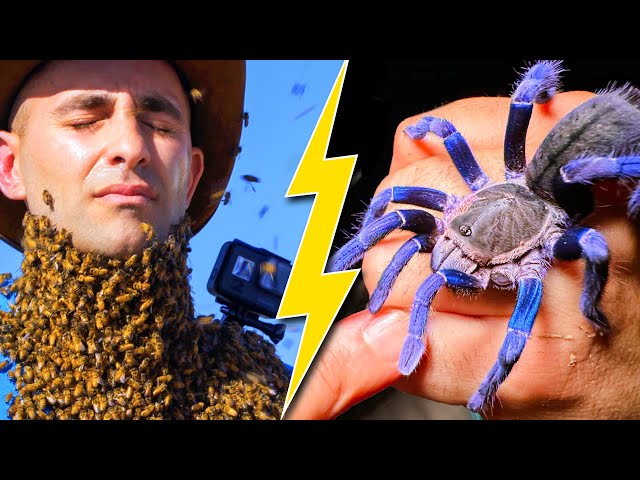
When Wildlife STRIKES: Coyote's Extreme Moments Compilation
Brave Wilderness Top Videos
0:01 I am getting nervous now.
0:02 Go turn back now, buddy.
0:06 You
0:06 all right?
0:07 Don't get stung alive.
0:08 All right.
0:08 All right.
0:08 You got to get off.
0:09 Go ahead and just jump real hard.
0:13 They're all in my face.
0:17 From high in the sky, the Snorn Desert looks like an endless expanse
0:21 of rocky terrain that is speckled with cacti.
0:25 And hidden amongst this unforgiving environment exists a world of animals,
0:30 many of which can be difficult to spot.
0:33 However, today is going to be a little
0:35 different as instead of looking for the animals,
0:38 they are literally going to be placed right in front of us or in my case,
0:43 directly on my skin.
0:44 That's a lot of bees.
0:46 With the goal to prove that honeybees are not
0:48 just out to sting you, or so I thought,
0:52 the crew and I headed out to Life's Sweet Honey Farms,
0:55 where I will be working alongside bee specialist Chris Britain.
1:00 Chris and his team specialize
1:01 in safely removing beeworms from residential areas,
1:05 honey farming, and per my special request, bee beards.
1:12 This the craziest thing you've done this morning, coyote?
1:14 Sure is.
1:15 So that they shaved off my fur beard.
1:18 Ah, yes, the beard.
1:21 I'm sure you were wondering, Coyote,
1:24 what in the world happened to your fur beard?
1:26 Well, the answer to that question is that I shaved it off to make room
1:31 for the nearly 3,000 European honeybees that will
1:34 soon be swarming all over my face.
1:37 Get ready for the newest trend in facial hair fashion, the beard.
1:45 The following scene was filmed on private
1:47 property and under the supervision of bee specialists.
1:52 A single sting has the potential to be fatal.
1:56 Never approach a beehive in the wild.
2:03 Okay.
2:03 Well, we're going to start the preparation here.
2:06 Chris is actually going to apply Vaseline, you said,
2:08 to my nose and my ears and near my eyes so
2:11 that the bees don't go into these holes in my face.
2:14 Right.
2:15 Well, you're going to either look homeless with a beard
2:16 or we're going to look like a nice manicured beard.
2:18 So, this is a pseudo queen.
2:19 This is basically a queen pheromone lure.
2:22 So, this is what's going to push those bees to actually
2:24 gather somewhere because they're actually looking for that queen pheromone.
2:27 They've been separated for a while.
2:29 So, this is what's going to actually hold them on your face.
2:32 So, we're going to put this underneath your chin.
2:33 So, this is going to be the attractive.
2:35 This is the attractant.
2:37 All right, guys.
2:37 Well, I think we have reached the uh final moment here.
2:41 It's either back out or get covered by bees.
2:45 And uh I don't think there's any backing out at this point.
2:48 I have the pheromone attached to my chin.
2:51 Got GoPro here.
2:53 GoPro on my shoulder.
2:54 Both of your cameras going.
2:56 Now, wait, wait, wait, wait.
2:57 Before we go through with this, how do I get the bees off?
2:59 What if something goes wrong?
3:00 What do I do?
3:02 Good luck, man.
3:02 I'm just going to drive away.
3:03 I got Nothing's going to go wrong.
3:07 Um, when it comes down to the bees,
3:09 if they get to the point where they are stinging excessively, Yeah.
3:12 you can just shake off real quick.
3:13 I put these in your pocket.
3:15 Oh, epinephrine pens.
3:17 Just in case this really goes wrong.
3:21 I am getting nervous now.
3:23 Now I'm getting nervous.
3:24 I'm Coyote Peterson and I'm about to take on the BB beard challenge.
3:29 Are you ready?
3:32 Yep.
3:31 Okay, let's do this.
3:33 No turning back now, buddy.
3:41 Come on, girls.
3:44 Come on, girls.
3:44 Up you go.
3:47 How you feeling now, Co?
3:49 It's a lot of bees.
3:50 It's tough to talk.
3:53 There's
3:53 a bee right on your nose.
3:55 I feel it.
3:59 That's a lot of bees.
4:04 Are you feel Are you feeling nervous?
4:10 Have you been stung yet?
4:11 No stings yet.
4:14 That's good.
4:14 That means you're remaining calm.
4:15 My leg is shaking.
4:18 Ow.
4:19 Stuck in the lip, man.
4:23 It's stuck on you.
4:29 You all right?
4:31 Mhm.
4:30 Be brave.
4:33 My neck just got some.
4:34 I'm going to take a couple steps back.
4:37 I just got some right in my head.
4:39 I didn't realize we were getting swore by bees this morning.
4:42 Got a lot of bees on me.
4:44 Get more.
4:50 You got it.
4:50 You got it.
4:51 Getting stung a lot.
4:52 They're getting stung about six times.
4:57 Oh, the neck is getting stung again.
5:02 This is what we start with right here.
5:04 We just get most of the bees to start on him.
5:06 And then what they're going to do is they're going to emit a pheromone.
5:09 And it's a location pheromone.
5:11 And those bees are just going to start basically migrating.
5:14 So now I can actually just basically hold this right here.
5:17 And they're going to all start marching up.
5:19 Are all the bees out?
5:21 No, dude.
5:22 My lip is swelling up.
5:25 You're all right.
5:26 You definitely have a full neck of bees.
5:28 I can feel them all.
5:31 Are you still getting stung?
5:32 No, not right now.
5:36 So, what is coyote?
5:38 Oh, it's starting to look again.
5:40 Oh, no.
5:46 Oh, same spot.
5:48 Really starting to hurt.
5:50 Okay.
5:51 Mhm.
5:51 Wow.
5:51 Cody, there you are just covered in bees, man.
5:54 It's actually turning out pretty well.
5:58 What?
6:02 All right.
6:02 I think I need to get him off.
6:04 Are you okay or you want them off?
6:05 That's a lot of pain.
6:06 Oh, you're But you've almost got it.
6:08 You're so close.
6:09 Go ahead.
6:10 You're going to do this.
6:11 You got it.
6:12 You got it.
6:13 Power through.
6:14 You got this.
6:14 You're already going to get You already got stuck.
6:16 You're good.
6:17 I'm definitely I'm getting stung a lot.
6:20 All right.
6:20 All right.
6:21 Got to get him off.
6:21 Go ahead and just jump real hard and just Whoa.
6:26 They're all in my face.
6:35 Smoke me.
6:35 I'm getting so quite a bit.
6:47 Oh, yeah.
6:47 He just he just stung you big time.
6:49 He got stung up, huh?
6:51 You want to walk away?
6:53 Just go ahead and walk away here.
6:57 This way.
6:57 Here.
7:00 Oh man, my face hurts.
7:01 Are you?
7:01 Oh man, you should see this thing you have in your neck.
7:04 Oh my gosh.
7:05 Are you okay?
7:05 Yeah.
7:06 Yeah.
7:06 Yeah.
7:06 Yeah.
7:06 Are you Is your tongue swelling up?
7:08 The tongue is is the indicator.
7:09 We need to know.
7:10 No, not yet, but my face is on fire.
7:12 Oh man.
7:13 Okay, here.
7:13 I think I think we're good now.
7:15 There's only a couple bees and they're just falling the pheromone in your face.
7:18 Hold on.
7:18 You still have Oh, let me You got stingers all in your ears.
7:22 Oh my gosh.
7:23 Let me see.
7:23 Get them out.
7:25 There's mine.
7:25 Dude, I got stung like so many times.
7:28 All of a sudden, like all at once started stinging my face.
7:31 My ears.
7:32 Let me get the stinger out of here.
7:36 You okay, buddy?
7:38 Yeah.
7:38 Sorry.
7:38 They just I just was getting a lot of stings.
7:40 No, that's fine, buddy.
7:41 You got them through your shirt and everything.
7:42 For some odd reason, all of the sudden,
7:46 they started just absolutely going to town on you.
7:48 You can see.
7:49 Look at that right there.
7:50 That actually literally
7:51 It like drew blood.
7:52 Yeah, I like got blood to the surface.
7:54 You just got stung like 40 times in the face by honey bees.
7:59 40.
8:01 I don't think that was supposed to happen, Chris.
8:04 I don't know why I wasn't getting all blasted up.
8:06 I mean, I got
8:07 I got stung like once or twice, but he was literally just getting beat up.
8:18 Oh my gosh, dude.
8:19 My pain is in My face is in so much pain right now.
8:22 You're right.
8:23 How's the tongue?
8:28 Really, really painful.
8:29 My tongue is not swollen, but my entire my lips I can't feel my lips.
8:33 OW.
8:35 WHERE'S MARIO AT?
8:36 He's over there filming.
8:37 Hey, Tommy, come over here.
8:38 Hey, Mario.
8:41 Mario.
8:41 It's probably covered up by B sounds still.
8:43 Come over here.
8:46 Was it worth it?
8:48 Oh, man.
8:48 I can see my lip in the lens.
8:51 You don't want to look at yourself right now.
8:53 You don't want to look in a mirror right now.
8:58 Well, I guess I better give you some sort of an outro before I
9:00 can't talk cuz I find that my lips are not working properly at the moment.
9:05 All right.
9:06 All right.
9:06 I'm going to try to be calm.
9:07 All right.
9:07 I'm going to be calm.
9:10 I think based on the look on my face, the beard is not the new fashion trend.
9:17 I lasted for about a minute and a half
9:20 with my face covered in around 3,000 bees.
9:24 And once they started seeing my lips, it got really painful.
9:28 They're swarmed around my eyes.
9:29 I was getting stung on my hands, on my arms, on my forehead, on my ears,
9:33 but it was definitely the lips,
9:35 as you can see from how swollen they are right now, that were the worst.
9:40 I definitely say that the BB beard was an experience worth experiencing.
9:44 So far, I haven't had any major adverse allergic reactions other
9:48 than just this localized swelling on my hands and on my face.
9:51 You can hardly tell.
9:53 Yeah, Liz looks okay.
9:54 You can hardly tell.
9:55 I could tell you guys are having a real hard
9:57 time not laughing while we're trying to get this outro,
9:59 but we counted around two dozen stings on my body at this point.
10:05 My lips are swelling up,
10:07 my eyes swelling up as you see the drools coming out of my mouth.
10:11 But I'm Ker Peterson and that was a beard.
10:16 Be brave.
10:18 Stay wild.
10:20 We'll see you on the next adventure.
10:22 Ow, that's painful.
10:25 When it was all said and done,
10:27 we counted a total of 32 stings that span my face, lips, ears, neck, and arms.
10:38 The neurotoxin of the European honeybee is very
10:41 specialized and is notorious for causing extreme localized swelling.
10:47 For me, this began immediately.
10:49 And despite the disfigured, lumpy, baked potato look of my face.
10:54 I actually handled the venom very positively
10:57 and within 48 hours was completely back to normal.
11:01 Now, the guys have their bees suits on and they're
11:03 going to put the bees back into their hives.
11:05 And so far about 30 minutes has gone by.
11:07 No anaphylactic shock.
11:08 So I should be just fine.
11:09 Other than the fact that my face looks like the vase of the elephant man.
11:12 And I can see in the reflection of your glasses.
11:14 It is not pretty.
11:15 It is not pretty.
11:16 If you were wondering how this compared to the single sting from a bullet ant,
11:22 I can honestly say it was worse.
11:26 As compared to the warrior wasp, well,
11:30 I guess we will just have to wait and see.
11:34 Wow.
11:34 Yep.
11:35 That's uh that's about the size we're used to seeing in Costa Rica.
11:38 Look at that.
11:39 Perfect.
11:40 Good.
11:40 Don't change anything.
11:41 Ooh, this is going to be wicked.
11:43 Oh, wowzers.
11:51 Nature is riddled with dangers, and to the untrained eye,
11:55 if you don't recognize one of its many biological landmines,
11:58 it's possible that your next step could be your last.
12:03 Spiders, scorpions, centipedes,
12:06 and even spiky plants can be considered
12:09 explosively perilous if they catch you off guard.
12:12 But nothing is more serious than stepping on a venomous snake.
12:16 On this adventure, we're going to take a look
12:19 at Central and South America's most notorious pit viper.
12:23 A snake that I am all too familiar
12:25 with and a reptile you should definitely be aware of.
12:29 Lest you accidentally encounter it while hiking in the rainforest.
12:39 Whoa, whoa, whoa, whoa.
12:41 We got We got a fertilance right in front of us.
12:44 Right under this leaf.
12:45 Look at this.
12:46 Right in front of me.
12:47 Right in front of me.
12:47 Look at that camouflage.
12:49 Holy cow.
12:50 His head's coming right up past that leaf.
12:52 Oh my gosh.
12:53 That is the camouflage that you hope you recognize before you step too close.
12:59 The snake literally just curled up underneath the leaf.
13:01 Its nose is just poking up right in the middle
13:04 of the path that we are walking down.
13:06 I don't see it.
13:07 Right.
13:07 Right.
13:08 Look at this bright leaf in front of me.
13:09 You see this?
13:10 Its nose is just sticking up on the top of it.
13:12 You see that?
13:14 Got it.
13:14 Keep your light there.
13:16 Completely hidden the fertilance.
13:18 Arguably the most dangerous snake in Central and South America.
13:22 Yes, I was hoping we'd see one of these tonight.
13:24 One thing we've never done before is tube one
13:27 of these vipers and take a closer look from that position.
13:30 So, I'm going to slowly lift back this leaf.
13:34 I have no idea how big the snake is.
13:36 This is sometimes the funnest part.
13:38 What's the leaf going to reveal?
13:40 How big is this snake?
13:41 It looks sizable.
13:44 Oh yeah.
13:44 Oh yeah, that's a goodiz snake.
13:46 Oh, buddy.
13:48 Look at you.
13:49 Okay, right now it is still saying to itself, I'm hidden.
13:53 Nobody sees me.
13:54 If I don't move, maybe you guys will just pass right
13:56 by and I'll continue about my night hunting for prey items.
14:00 But we definitely want to get a better look.
14:04 All right, Mario.
14:05 The snake is actually in a absolutely perfect position for us
14:08 to try to get it safely inside of a snake tube.
14:12 It's the safest situation for the snake and it will
14:14 put the least amount of stress on it as possible.
14:18 Get your camera too too much closer than that.
14:20 What's amazing about these snakes is that they can
14:22 go from completely gargoyle statue still into explosive action.
14:28 And these snakes can launch themselves 2/3 the length of their body forward,
14:33 which is why they are incredibly dangerous to work with.
14:40 And just like that, I dropped my snake tongs and the snake is on the move.
14:43 Okay, we need light.
14:45 It's just kind of slithering slowly, which is good.
14:48 It's not being too explosive.
14:51 Like I said, they can move incredibly quick when they need to.
14:56 Whoa, whoa, whoa.
14:57 Careful.
15:01 All right, Coyote, going to step in.
15:03 Yeah, yeah, yeah.
15:04 Here, I'll tell you what.
15:05 Why don't you take the the snake hook?
15:09 Yeah.
15:09 I'll take the tube.
15:10 You got the right gauge.
15:12 You're going to pick it out.
15:13 Okay.
15:13 Go.
15:14 Switch.
15:16 This never gets any easier.
15:18 This is definitely the most dangerous part.
15:22 Angled down like Yeah.
15:24 Angled.
15:25 Not yet.
15:26 Not yet.
15:30 Down.
15:33 Now.
15:34 Got it.
15:35 There we go.
15:37 Oo, look at the fangs inside there.
15:40 Okay, be very, very gentle now.
15:43 Okay, you just have to take a deep breath after successfully getting control
15:51 of a snake like that because the bite from this species is extremely toxic,
15:57 hemattoxic and mitotoxic.
15:59 It will break down red blood cells.
16:01 This is one of the most potent bites of any
16:03 venomous snake on the western half of the world.
16:07 And if you're bitten by a snake like this and you do not get the proper care,
16:10 it could take your life.
16:12 Now, when I turn the snake like this, you
16:14 can see the scalation is very, very defined.
16:17 It's very rigid, very bumpy.
16:19 It's got incredible texture to it.
16:21 And that texture also helps to keep these snakes camouflaged.
16:25 One of the names that this snake is commonly known by is the lance head.
16:29 And that's because of the triangular nature of the head.
16:31 Almost looks like the tip of a lance or a spear.
16:35 And like all pit vipers, they have a heat sensing pit,
16:38 which of course helps them to detect their prey.
16:41 And while they will take advantage of mammals,
16:43 certain times of year, these snakes primarily feast on amphibians.
16:46 And with all the rain that just recently moved through earlier,
16:49 I'm guessing this snake is on the hunt
16:51 for any sort of creature that can possibly come across.
16:54 Whether it's a mammal or an amphibian,
16:55 it is fair game if you are a snake like this out and on the hunt.
17:01 Now, one of the reasons I was so
17:02 excited to have come across a fertilance tonight is
17:05 that I've always wanted to show you guys what
17:07 happens when you mix this pit viper's venom with blood.
17:11 Human blood.
17:13 But to safely do that, we're going to need to head back to Dan,
17:16 Florida, and connect with our friends at the Reptile Discovery Center.
17:19 We can actually get hands-on with one of these snakes in captivity
17:22 and safely show you guys what it takes to not only milk this species,
17:25 but also to mix its venom with human blood.
17:29 Stay tuned, guys.
17:30 I promise the second part of this episode is going to be wildly entertaining.
17:35 Interacting with a fertile ants is like handling a loaded gun and just
17:39 a single mistake could quickly turn into a medical emergency or worse.
17:44 This species is responsible for 90% of the snake bites in Central America,
17:49 making them the most dangerous snake in their range.
17:53 Sounds horrific, but here's the good news.
17:56 If a bite victim is taken to the hospital
17:58 in a timely manner and antivenenom is administered,
18:01 the survival rate is extremely high.
18:05 We have returned to the reptile discovery center in Dand, Florida.
18:10 Millions of you enjoyed the previous episodes we filmed here,
18:13 so it's an absolute honor for us to return
18:16 and once again work alongside Carl and Mara.
18:20 This serpentarium is not only home
18:22 to dozens of the world's most dangerous snakes,
18:25 it is also the first step in the production of life-saving antivenenoms.
18:30 Yet, in order for antivenenom to be created, first you need the snake's venom.
18:35 And to get the venom, you need to milk the snakes.
18:40 Behind us is a room filled with snakes.
18:42 And in one of those boxes is the fertilance,
18:45 Central and South America's most notorious snake.
18:48 And today we're going to milk it.
18:49 Are you guys ready for this?
18:51 We're ready.
18:51 I think so.
18:52 Are you nervous?
18:54 Never.
18:54 Let's bring out the snake.
18:55 Beautiful.
18:55 Okay, coyote.
18:56 She's coming up.
18:58 All right.
18:58 Now, remember, Carl and Mara are professionals.
19:01 They do this on a weekly basis working with these snakes,
19:04 but it's going to be really interesting to see
19:06 the fertile ants not in its natural environment.
19:09 I don't know what the snake's going to look like, how big it's going to be.
19:11 So, I'm ready to be surprised.
19:13 This is going to get intense.
19:16 Oh boy.
19:16 Here we go.
19:18 Wow.
19:18 Yep.
19:18 That's uh that's about the size we're used to seeing in Costa Rica.
19:22 Look at that.
19:23 They are big, well adapted pit vipers.
19:26 They have highly developed venoms,
19:27 toxic venoms, tend to be tremendously hemolytic,
19:30 and in other words, do lots of destruction to blood cells.
19:33 And so they account for a lot of bites in South America,
19:36 as you know, or Central and South America.
19:38 And so it's a really a formidable pitf.
19:40 So a bite from the snake without antivenenom is almost guaranteed to kill you.
19:45 I'm not going to say always lethal because again sometimes
19:47 a bite from that snake will result in a minor invenimation.
19:50 He won't give you anything.
19:52 But a severe or a significant invenimation by that snake without treatment
19:56 would probably be result in fatality or perhaps a loss of a limb.
20:00 Okay.
20:00 So Carl, at this point the snake is looking right at us.
20:03 I feel like it's probably good point to milk this snake.
20:06 What's this process going to look like?
20:08 So the catch here is going to be a little bit different.
20:10 And if you start to really look at that snake's body language,
20:12 coyote, uh, he's starting to kind of get act up a little bit.
20:16 He's starting to get nervous.
20:17 And fertilance can be really flighty snakes.
20:20 Now, have you ever had one jump off of the table?
20:23 We have.
20:24 Yeah.
20:24 Just not quite as far as you.
20:25 I keep wanting to look off at the camera,
20:27 but then I keeping my eye on the snake.
20:29 It looks like it's in launch mode.
20:30 Okay.
20:32 Absolutely.
20:31 I think this is probably the moment.
20:32 What do you guys need me to do?
20:34 Just step off to the right a little bit.
20:35 We're going to give Mario a little room to kind of work our magic.
20:37 him secured and then I'll hand him over to you.
20:42 Nice.
20:43 Pressure is coming down.
20:44 All wound up.
20:46 Strike.
20:46 And there's full pressure on.
20:48 Perfect.
20:48 Good.
20:48 Don't change anything.
20:51 Perfect.
20:52 It's a strong snake.
20:54 Good.
20:53 So, Carl, this is the most important part right here, right?
20:56 Yep.
20:56 And you'll see normally fertilance are good solid venom producers.
21:02 Went light today.
21:03 Okay.
21:03 Sometimes the snake's going to give us only
21:05 a small amount of her venom or his venom.
21:10 And the big difference here is you've heard the term milking snakes.
21:14 And in the old days, they used to press on those venom glands.
21:17 They'd squeeze that snake's head.
21:18 We don't do that.
21:19 We just allow the snake to bite and give
21:21 us what he's going to give us voluntarily.
21:23 And sometimes they don't give us a lot of venom.
21:25 He's he's remember venom to the snake is precious.
21:28 These are defensive bites.
21:29 And he really has venom to obtain his food.
21:31 Mhm.
21:32 Great job on the body.
21:33 So, I'm going to go back into the cage now.
21:35 But even that little bit,
21:36 you're looking at about 100 millig of dry weight there.
21:39 That's absolutely probably multiple lethal doses of venom.
21:42 Wow.
21:43 Good.
21:43 Beautiful job, Coyote.
21:44 I got him.
21:44 Yep.
21:45 Perfect job.
21:46 Thank you.
21:47 Did you hear that?
21:48 So, just that amount of venom, not even a full venom yield,
21:51 capable of killing multiple people when it's at dry weight.
21:55 Now, Carl, question for you.
21:59 Yes.
21:58 What is this venom going to do to your body?
22:00 So, um, the the little thing
22:02 in your bloodstream that allows platalitates to stick
22:05 to it and clot is actually being broken apart by some of these venoms,
22:09 that's being liced into pieces.
22:11 And so, that net there, that clotting net that's going to allow
22:14 the platelets to stick to it, is being destroyed.
22:18 And so, all of a sudden,
22:19 you're beginning to hemorrhage, you're beginning to bleed,
22:21 you go into shock, you've got all kinds of fluid problems,
22:24 your kidneys are beginning to fail because you've got all
22:26 these things floating around in your bloodstream that shouldn't be there.
22:29 And of course, like all pet viper bites, uh,
22:32 lance heads swell and they destroy tissue, something they call metal proteinis.
22:37 So, it's a messy snake bite.
22:39 It's a painful snake bite.
22:40 They often result in amputations because
22:42 of a delay in treatment or no treatment.
22:45 So, you'll see people missing fingers or even
22:47 bigger parts of their body with these guys.
22:49 So, it's a dangerous snake.
22:52 It is serious business if you're bitten.
22:53 So, you have to admire the snake from a safe distance.
22:56 Now, the next thing that we want to do
22:58 is take this venom and mix it together with blood.
23:02 Of course, my blood.
23:04 And this time, in less of a rudimentary situation,
23:07 and we're going to put it underneath the microscope and see
23:09 if we can see some of those blood cells breaking down.
23:11 That sounds excellent.
23:11 You're stepping up your your experiment a little bit.
23:14 We really applaud that.
23:15 And as you said, maybe we'll get lucky and we'll be
23:17 able to see some of these toxins at work under a microscope.
23:19 Okay, stay tuned, guys.
23:20 The next part of this episode is going to get extremely scientific.
23:25 This is one strong animal.
23:27 Thing I don't want to have happen is this horn
23:29 to come up and hit me straight in the face.
23:43 Okay, so right now the convoy is headed out
23:45 to the area where the rhino crash has been spotted.
23:48 There's one specific male that we are
23:50 targeting this morning with a very large horn.
23:56 For well over a century,
23:58 humans have been decimating populations of our planet's animals.
24:02 Many for reasons that make absolutely no sense.
24:07 The rhinoceros is arguably the most
24:10 recognizable species for this global atrocity.
24:14 To date, nearly 95% of the world's rhino population has vanished,
24:21 and most of it is due to one single thing.
24:31 This is the fight to save a species,
24:33 and our journey to the front lines of battle begins at the Carura Game Reserve.
24:39 I first learned of Kura in March 2012.
24:43 Just after a dark shadow cast upon the reserve
24:47 and left them to face an unimaginable crisis,
24:51 three of their rhinos were tranquilized by poachers,
24:54 brutally stripped of their horns, and left for dead.
24:59 One animal lost its life immediately.
25:01 The second passed within days, its injuries too much to endure.
25:06 But the last, a female known as Tandi,
25:09 miraculously survived due to the herculean efforts of this man, Dr.
25:15 William Foss.
25:16 Looking after these animals is a a massive collaborative effort.
25:19 No single reserve can do this alone,
25:22 and we do rely enormously on the support of people around the world.
25:26 Getting this message out is critically important.
25:30 In many large animal procedures,
25:32 helicopters have proven to be a useful tool as they allow veterinarians
25:36 to cover a considerable amount of distance in a very short period of time.
25:42 White rhinos often graze across open savannah,
25:45 clustered together in a family unit commonly known as a crash.
25:50 And based on human intentions, this social behavior has its pros and its cons.
25:56 The positive is that rhinos are big,
25:59 making them rather simple to locate from an aerial perspective,
26:03 while the negative is that when they are crashed together,
26:06 they become an easier target for poachers.
26:10 Now, we moving from the thicket area into this grassland space,
26:13 and this is where I would expect to find white runners.
26:16 So, we're just scanning the area to see if we can find the right one.
26:19 Our mission centers around a specific male whose horns have
26:23 grown to a length that makes him such a target.
26:26 So, in order to give his facial ornaments less black market appeal,
26:30 it's been decided and the permits granted for us to give him a little trim.
26:35 We got eyes on the target animal.
26:37 With our bull on the run and now clearly in sight, Dr.
26:41 Folds aligns his shot.
26:42 Okay, tell me when you're good, Ed.
26:44 Yeah, I'm good.
26:47 Wow, look at him move.
26:53 That dart looks good.
26:54 Nice and perpendicular.
26:56 We're now going to set the stopwatch.
26:58 This is a really important part of the process because
27:00 we want to track time from when the dart goes in.
27:04 It will be several minutes before the tranquilizer serum takes full effect,
27:08 giving us a narrow but necessary window to land
27:10 the chopper and move in as a ground unit.
27:13 All right.
27:13 So, we got ourselves into a little bit of a tricky
27:15 position here because got his head in a bush,
27:17 which we're going to have to clear up now.
27:18 A rhino procedure is best described as carefully coordinated chaos.
27:23 He's listening to his breathing, which is nice and deep.
27:27 So, that's good.
27:28 But at the same time, it's a masterclass of veterinary medicine.
27:32 Here's how it goes down.
27:33 The chainsaw masters take over and in a matter of minutes,
27:37 they intricately landscape the dense, thorny foliage.
27:40 Right now, it's important for me to just be as out of the way as I can be.
27:43 Chainsaw's going.
27:44 They're taking on all these branches.
27:47 We got to make space around the animal
27:49 before we can get in and do the procedure.
27:52 Next, Dr.
27:53 Folds administered a muscle relaxant,
27:55 which helps to calm heart rate and lower the rhino's intense rush of adrenaline.
27:59 So, it's all about keeping him relaxed and those muscles untens.
28:04 Obviously, he's fired up, right?
28:05 Ah, so we need good relaxed muscles.
28:07 It improves blood circulation, gets lactic acid out of there,
28:10 and while he's shaking, like I guess he's burning up oxygen.
28:13 Shadowing the vet team, I follow precise,
28:16 organized directives as we collect biometrics,
28:20 inject a multivitamin,
28:22 and replace the batteries on this big guy's ankle oriented tracking collar.
28:26 Listen to the power of the breathing.
28:30 Exchanging breath with a white rhino.
28:33 Such a beautiful animal.
28:34 You don't realize truly how big they
28:36 are until you're literally right next to them.
28:38 Look at the size of this animal's head.
28:41 Finally, it's time for the most important order of business.
28:45 Dehorning.
28:46 Do I have uh two seconds at this point to talk about the horn a little bit?
28:50 Sure.
28:50 So, here's what's going to happen today.
28:52 We are performing a dehorning procedure.
28:55 There's a couple very important things that you need to know.
28:57 This horn is not ivory.
28:59 This is keratin.
29:01 Just like the same material your fingernails and your hair are made out of.
29:04 If you look close at this horn, you can see all of these fibrous.
29:09 Let him go.
29:10 Pull him left here.
29:10 Come pull hard.
29:11 It's going to be a bit wobbly.
29:13 What this means is we've got our anesthetic dose.
29:15 A little bit of rum.
29:16 And not too serious cuz we're getting circulation back in his legs.
29:19 We're just going to walk him towards the trailer
29:21 cuz that's where he needs to end up.
29:22 Well, nothing will make your heart race like a rhino getting up mid- procedure.
29:26 This is one strong animal.
29:28 Even when it's in this state,
29:30 you can only imagine how powerful this animal is at full throttle.
29:34 It should get on any minute now.
29:37 Thing I don't want to have happen is this horn
29:39 to come up and hit me straight in the face.
29:42 Okay.
29:42 Just don't support him if he falls over by himself.
29:45 It's nice and soft here.
29:46 He can't damage himself.
29:50 Okay, great.
29:51 Perfect.
29:52 We're just going to give him a chance to settle down.
29:57 That was crazy.
29:58 Okay, we have successfully moved the rhino out into a more open area,
30:02 which is perfect for this next aspect of the procedure, which is horn removal.
30:06 Now, I want to be very clear about a couple of things.
30:09 This is what poachers are after.
30:11 This giant piece of horn.
30:14 And the problem is that poachers don't come in and just
30:16 saw off the piece that doesn't touch the root.
30:18 They come in and they cut it out all the way down to the root.
30:21 So that goes down and into the snout causes massive bleeding.
30:25 It's catastrophic damage that in almost every instance kills the rhino.
30:29 So as much as I hate to take away a piece of this beautiful animal,
30:34 the true thing that defines it, this is how you save a rhino.
30:39 And I cannot stress enough that this does not hurt the rhino.
30:42 Not physically in any way whatsoever.
30:56 Nice and cool.
30:57 Okay, let's do back horn.
31:27 This is the the procedure that we dread doing the most on Rhino.
31:31 Just an absolute sacrilege to take these off.
31:34 So, do you think that this throws off the rhino's
31:37 depth perception at all by not having the horns in front?
31:40 I don't think so, but I They know that they don't have a horn.
31:44 Well, I mean, they obviously have to learn
31:45 that when they wake up from all of this.
31:48 We're going to walk him now.
31:49 So, we're just going to rock him onto his other side.
31:52 If he stands up in the process, then great.
31:54 One, two, three.
31:55 Push.
31:56 Push.
31:59 Just keep supporting him.
31:59 That leg's going to be a little bit floppy.
32:01 And then we're going to go We're going to go left.
32:03 He's in first gear.
32:04 We're going to change to second.
32:05 Keep pulling.
32:05 We're going to line him up with the trailer.
32:07 With the dehorning complete, our final task is to load this bull into a trailer,
32:12 relocate him to another part of the reserve.
32:15 That was unbelievably exhausting.
32:17 Just the force that it takes to balance that animal.
32:20 Dr.
32:21 Fold said probably about 1 and 1/2 tons.
32:23 And that's not a full grown rhino.
32:26 So, what we're looking for in France here
32:27 is that he's got complete control of his body.
32:31 We obviously don't want him to be fighting this crate,
32:34 but he must be able to move himself around.
32:37 and keep himself on his feet without being
32:40 thrown around by the members of the vehicle.
32:43 This new expansive habitat is home to several
32:46 first generation cows and it will only be a matter of time before he claims
32:50 this territory breeds and diversifies the genetic population.
32:55 Quite an animal.
32:59 Unbelievable.
32:58 Hey, amazing to think he's still got growing to do, too.
33:01 He's not even fully grown yet.
33:03 Incredible things.
33:06 The charge of emotion right now is almost hard to explain.
33:10 And as I prepared for today's scene, last night,
33:13 I was laying in bed thinking to myself,
33:14 there are a number of emotions that run through me.
33:16 Sadness, first and foremost.
33:18 I can't tell you how sorry I am that we
33:19 had to take the horn from that beautiful animal.
33:22 Yesterday, we were filming B-roll with it in the wild.
33:25 I mean, I looked right into this animal's eyes, thinking to myself,
33:28 I'm pretty sure that's the one whose horn we're going to take tomorrow.
33:31 So, I had to carry that with me going to sleep last night.
33:34 So that's where the sorrow comes in.
33:36 Sorry that we as humans have put our planet in a state where we are
33:39 now being forced to take the prized element that defines a rhino away from it.
33:45 A dominant male.
33:46 This is everything that makes up his emotion, his spirit, his confidence.
33:52 And within that animal's soul and body, he's going to wake up and wonder,
33:55 "Where did my horn go?" It makes me angry to know
33:59 that we as humans are doing something like this to our planet.
34:03 doing something like this to our animals.
34:05 And the reason these animals are being
34:06 poached is because people in other countries,
34:09 in Asian countries specifically,
34:11 believe that the rhino horn has medicinal purposes.
34:14 I can tell you with 100% certainty,
34:16 it has been proven by doctors that that is absolutely false.
34:20 Another thing is that wealthy people would love to have this on their mantle,
34:24 but I can tell you this much,
34:25 there is absolutely no honor in having the horn of a rhino on your mantle.
34:31 And for as angry as I can be at the process that poachers go through,
34:35 you have to understand that in many instances
34:37 the poachers themselves are almost forced into these situations.
34:40 This horn is worth money.
34:42 If they get this horn and sell that horn, that money provides for their family.
34:46 It is a vicious cycle.
34:48 So the sorrow and the anger build together and I realize to myself,
34:52 you can't fight this fight by being angry.
34:54 You fight this fight with having hope.
34:58 Dehorning white rhinos is necessary because of the way that they move in herds.
35:02 The next animal we're going to look at is the black rhino,
35:05 a slightly more solitary animal.
35:06 And what we're going to try with this next segment is to find out whether or not
35:10 technology can be the answer to the future
35:12 of these animals and not taking its horn,
35:14 but providing something that may be the front lines of conservation.
35:19 This horn will be immediately taken off site to a secure undisclosed location.
35:24 And I want to note that dehorning is only
35:27 one aspect of multi-dimensional wildlife protection at Carura Game Reserve.
35:40 There are around 20,000 white rhinos left in the wild,
35:44 which classifies these gregarious giants as nearthreatened.
35:47 Yet, they are not the only rhinoceros in Africa.
35:51 The black rhino, the more elusive species, is listed as critically endangered,
35:56 and its wild numbers have dwindled to barely 5,000.
36:01 Visually, there are a few noticeable differences between the two.
36:05 For starters, black rhinos are smaller
36:08 in weight and stature as compared to whites.
36:12 Taking a closer look at their heads,
36:14 you will notice that white rhinos have pointed ears and a square upper lip,
36:19 whereas blacks have rounded ears and a pointed prehensile upper lip.
36:25 At ground level, these key features
36:27 make identifying Africa's rhinos quite simple.
36:31 But from a helicopter, it's all about experience.
36:34 This is typical territory for black rhino.
36:37 To find a rhino in here is incredibly difficult.
36:40 We could fly for hours here and not find one.
36:43 Dense Albany thicket blanket the hillsides,
36:46 creating ideal forging and hiding habitat for black rhinos.
36:50 But for Dr.
36:50 Folds and the helicopter team,
36:52 seeking and successfully darting our target animal is a noticeable challenge.
36:58 Coyote.
36:59 Coyote coming in for Mike.
37:00 Go for Mike.
37:01 Eyes on the right.
37:02 We got to move out.
37:04 The good thing is that the hillsides aren't too steep,
37:06 but we might end up on the side of a cliff doing this procedure.
37:10 So, things are about to get intense.
37:12 So, we've identified the right animal.
37:14 Just going to load a dart here quickly.
37:16 Now, what Alex is going to do is just line up this rhino,
37:19 and when she's comfortable, she'll tell me when I can take the shot.
37:27 Okay.
37:29 Ready?
37:33 We are good.
37:35 Good.
37:34 All right.
37:34 Rhino's been darted.
37:35 Nice.
37:36 This is all open flat area right here.
37:41 Okay.
37:41 Got animal down right here.
37:43 This is typical black rhino.
37:44 He's got himself with the head in a bush.
37:46 I'm just going to put his blindfold on.
37:48 Make sure we protect his eyes.
37:50 All in all, black rhino veterinary workups are
37:53 very similar to our previous white rhino experience.
37:56 Carefully coordinated chaos.
37:58 One, two, three.
38:04 Okay.
38:04 The biggest difference is that instead of taking this animal's defining feature,
38:09 we'll be performing an interhornal implant procedure that disguises
38:13 a GPS tracking system into the rhino's rear horn.
38:17 You can notice how much larger the horn is
38:20 on this rhino because it's never been trimmed before.
38:22 Using a Dremel, we carefully carve a cavity
38:25 which provides a snug fit for the GPS.
38:29 It's amazing to hear it breathing.
38:31 This is what we're fighting to protect right now.
38:35 And the toe structure is quite a bit
38:37 different between black rhinos and white rhinos.
38:39 See these three large hooves up front?
38:42 How agile these animals are being able to move around on these steep hillsides.
38:46 lot of cushioning in the foot so these toes can almost grip around rocks.
38:50 For such a large animal, it's amazing how agile they are.
38:54 Next, a strategically colored dental epoxy is used to fuse the unit in place,
38:59 keeping it camouflaged and out of the battle zone
39:02 if this rhino ever squares off with another male.
39:05 All right, you can see how noninvasive this devices on the animal.
39:09 Now, once that epoxyy's cured,
39:10 we will grind it down slightly to blend right into the horn.
39:13 Put in the reversal serum.
39:15 this animal will be good to go.
39:17 All right, let's go, guys.
39:18 Remember, their wakeups are different, so we need to get out of here.
39:20 Okay, all the way.
39:23 All right, the uh transmitter is officially locked in place in the horn.
39:27 That is what you call a successful mission right there.
39:30 We put the reversal serum into the animal and we got the drone up in the air.
39:34 We'll be able to follow it as it tracks back and off into the wild.
39:38 Yes, this was incredible.
39:40 Looks good.
39:40 He's finding his feet very nicely.
39:42 His anesthetic was smooth all the way through.
39:44 very happy about that.
39:45 He didn't give us any surprises which was good
39:47 for the humans and uh I'm actually very impressed with the implant.
39:51 We managed to get it in there with a lot of space around it.
39:53 So, it's been a good procedure.
39:57 I am excited to have participated in one
39:59 of the first interornal implant procedures that has been performed
40:03 on this species and the technology linked to it will
40:07 help protect this animal and its horns on a daily basis.
40:11 That's how you do two rhino procedures in two days.
40:14 The white rhino dehorning the black rhino with a piece
40:16 of technology that might change the face of conservation.
40:19 What an unbelievable experience.
40:22 I'm Coyote Peterson.
40:23 Be brave.
40:25 Stay wild.
40:26 We'll see you on the next adventure.
40:31 After traveling a journey like this, you arrive at the realization
40:35 that your final destination has somehow become a new perspective of the world.
40:42 What happened?
40:43 Where did we go so wrong that as humans,
40:47 we have put a fictitious value on the horn of an animal
40:50 that created a black market demand worth more than gold, diamonds, or oil?
40:57 When are we going to stand up and who is
40:59 going to break the wheel that drives the game of horns?
41:04 Brave Wilderness in collaboration with Global Conservation Force and Carura Game
41:09 Reserve have a pioneering vision to help the future of Africa's rhinos.
41:15 We are building a safe haven in the Eastern Cape that may become a last
41:20 stronghold for the preservation of these animals
41:22 if poaching is not brought to an end.
41:26 What we do now does truly echo in eternity.
41:30 And I can promise you, in less than 10 years,
41:33 these animals will be extinct in the wild if we do not take action now.
41:39 This is the truth of the rhino's plight.
41:42 But you can change their future.
41:45 Become a warrior and join the fight by clicking the donate button
41:49 so that together we can prevent the loss of these vanishing giants.
41:55 Put your finger down into a hole that has a spider
41:58 and know that spider's going to come out and bite you.
42:01 This is the dumbest thing.
42:03 All right, are you guys ready?
42:04 I I'm actually 50/50.
42:06 I'm curious if they're actually going to bite you or not.
42:08 I like it when Mario's 50/50.
42:10 The last time there was like, oh yeah, coyote,
42:12 that's definitely going to bite you was my hand in a box jacket.
42:16 If you really stop and think for a second,
42:18 he's going to put his hand in front of a tarantula burrow,
42:22 trick it to come out so that it bites him.
42:24 I mean, that's pure nightmare fuel right there.
42:26 If you have arachnophobia, this is definitely the episode for you.
42:31 Oh, my tweezers.
42:33 Found one over there.
42:35 Oh my gosh.
42:35 Yeah, there it is right there.
42:38 Oh, wow.
42:39 Yeah, it's a big spider.
42:41 Uh I'm honestly very nervous to attempt doing this.
42:43 These spiders are not small.
42:45 And what's cool about these spiders
42:47 specifically is that they are ambush predators.
42:49 Now, this is not a trapdoor spider.
42:52 Trapoor spider would have a cover over its hole.
42:54 This is some variety of tarantula that definitely just uses
42:58 its burrow to probably entice things to sniff down in there.
43:02 These holes are very well camouflaged
43:05 into the ground and they're lined with webbing.
43:08 So, imagine if you were to be a little lizard or snake
43:12 or mouse and you come sniffing around the edge of this hole
43:15 and all of a sudden a giant spider pops out
43:18 and bites you in the face and sucks you down in there.
43:20 Uh, that's kind of what the scenario is.
43:23 All right, you guys ready?
43:26 I'm Coyote Peterson and I'm about to tickle a blue tarantula.
43:33 Here comes Here we go.
43:40 Oh, it's whing the stick.
43:41 Look at that.
43:46 Oh, try to get my finger close.
43:58 Smack me on the finger and make me jump.
44:01 Just that made me jump.
44:02 Oh my gosh, look at his fangs.
44:07 Oh jeez.
44:08 Oh jeez.
44:10 I'm so nervous.
44:11 I'm so nervous.
44:12 This is so stupid.
44:14 I don't know which finger to get bit on.
44:19 Has to be a small one.
44:21 Oh my gosh.
44:31 Oh, look at that.
44:33 Got to keep your finger still.
44:36 Locky.
44:36 Hold him down.
44:37 You try keeping my finger still.
44:39 Locky.
44:39 You got to hold him down, dude.
44:41 Oh my gosh.
44:43 It was very nerve-wracking.
44:49 God, I put right down the side of my fingernail.
44:51 I heard that.
44:52 You get that?
44:53 I heard it, too.
44:56 Yeah.
44:57 Oh, he got right in the edge of my fingernail.
44:59 I heard him hit your fingernail.
45:01 I don't think he got me, though.
45:04 But I felt the fan go right there.
45:07 All right, I can do better.
45:08 I can do better.
45:10 This might end up being my favorite video.
45:13 Oh my gosh.
45:13 This is This is the dumbest thing.
45:16 Actually, maybe if I do this.
45:18 Yep, that's a good idea.
45:26 He's going to get Yeah, he got me there.
45:30 Oh, yeah.
45:30 Did you get that shot?
45:31 He definitely got me.
45:34 I see it.
45:36 Yeah.
45:37 Two double fangs.
45:39 Oh, it burns.
45:41 That's some pretty quick venom.
45:45 Oh, wow.
45:46 Yeah.
45:46 Wow.
45:46 That's a little bit worse than a That's a little
45:49 bit worse than I thought it was going to be.
45:52 Yowsers.
45:55 That was a play right there.
45:56 get it to come all the way up to the edge and turn my finger sideways.
46:01 My heart's racing.
46:03 And what does it feel like?
46:04 What does it feel like?
46:06 Uh, more than a beasting.
46:08 I would put it on par with probably uh yellow jacket,
46:12 I would say, but we'll see if it starts to build at all.
46:14 You can see obviously the way that the fangs come up
46:18 and those pedapelps spread apart and then the fangs go down.
46:21 Got two solid puncture marks right into my hand there.
46:26 It definitely burns.
46:27 Wow.
46:28 Blue tarantula.
46:29 All right.
46:30 Now, I want to get one actually out of the hole and freehandle it
46:34 to show you guys that they're actually
46:35 rather docile when they're not in feeding position.
46:40 That's nerve-wracking.
46:41 Think about that.
46:43 Put your finger down into a hole that has a spider
46:47 and know that spider's going to come out and bite you.
46:50 Only I would do something with this stuff.
46:51 All right, let's try to catch this bigger one.
47:00 Can you see it?
47:01 Big one.
47:06 All right.
47:07 So, the goal here is to get this spider all the way up and out of its hole.
47:11 And then when I do that, I'm going to freehandle it
47:14 and show you they aren't nearly as aggressive as one might think.
47:26 that stick.
47:40 Oh.
47:50 a bit of balancing act.
47:51 Okay, now I got her.
47:53 There she is.
47:54 Great light off now.
47:57 Yeah, you guys can kill your headl.
48:06 I'm not being able to get a control
48:08 of her, but you can see her is tucked down right there.
48:12 But I don't want her to go to my shirt.
48:14 Get her come down like this.
48:17 Oh, they sure have strong grip on their legs.
48:21 There we go.
48:22 She ran on top of my microphone.
48:24 It's interesting.
48:24 It looks like she has little eggs or a parasite on the side of her thorax.
48:35 Okay, we've seen this scene before.
48:37 Often times I get tarantulas on my back.
48:39 Uh, but we were successfully able to get her up and out of the hole.
48:42 And you can see now as I'm trying to handle
48:44 her, she's more interested in getting away than she is at biting.
48:49 Get you go this way.
48:52 Actually get her into my hand.
48:54 You want me to go?
48:55 Yeah.
48:55 See if you can bring her around.
48:57 There she is.
48:58 She's on your far right side.
49:06 Just kind of pull push her around this way.
49:12 Good.
49:14 Awesome.
49:15 Thanks, Locky.
49:16 When they're on your back, it's a lot harder to get them under control.
49:19 And there you have it.
49:21 Spider's not necessarily aggressive if it's not in hunting position.
49:28 Still nerve-wracking though.
49:29 Not necessarily holding it, but just getting it to come up out of the hole.
49:32 That was a dangerous little game of operation.
49:35 Have you ever heard the phrase, keep your hands where they belong?
49:39 inside of a spider hole is probably not
49:40 a place anybody should be putting their hands.
49:43 But the bite from a spider like this is rather painless.
49:47 And while it did hurt at first,
49:48 right now I'm actually experiencing no pain from the spider's bite.
49:52 No more potent than that of a bee sting.
49:54 On the initial bite,
49:55 I said it was probably closer to the sting of a wasp or hornet.
49:58 But other than that, at this point, pretty much feels like nothing.
50:02 And we proved that a spider once taken up
50:05 and out of its burrow is actually pretty docile.
50:08 I'm Ky Peterson.
50:09 Be brave.
50:11 Stay wild.
50:12 We'll see you on the next adventure.
50:13 All right, let's let this little guy back down into his hole.
50:16 What you see here on the table are a pair of hex armor bite proof gloves.
50:20 Supposedly, these can withstand the bite of a venomous snake.
50:24 What I'm going to do is slowly move my hand in towards the snake's nose.
50:29 Let's just see what the aggression level is
50:31 as I move my hand in toward its face.
50:44 Okay, it's a beautiful night in Costa Rica and I'm sitting
50:48 next to one of the most iconic snake species in this country.
50:52 That is an eyelash viper.
50:54 Now, we've worked with this species in the past.
50:57 In fact, I found the yellow phase
50:58 of this snake out in the wild several years ago.
51:01 But this one here is actually ambassador for its
51:03 species that was born and raised in captivity.
51:06 This snake specifically is used to help
51:08 educate people about the snakes that live
51:10 here in Central America and why you want to safely avoid them at all cost.
51:16 Now, this snake is not necessarily as toxic as something like a fertilance,
51:19 which makes it the perfect subject matter for tonight.
51:22 What you see here on the table are a pair of Hex Armor bite proof gloves.
51:27 Supposedly, these can withstand the bite of a venomous snake.
51:31 Now, obviously, I wouldn't try this with something
51:32 as large as like a western diamond back, an eastern diamond back,
51:35 or a fertilance, but the eyelash viper has smaller fangs,
51:39 and I feel a little bit safer freehandling that snake with these gloves.
51:43 We'll get to that risky entertainment in just a few moments, but first,
51:46 what I want to do is take an educational look at this incredible reptile.
51:52 Now, the eyelash viper is an aoreal species,
51:54 which means they're primarily found up in trees.
51:57 And as you see this snake right here, gently clutched on this branch,
52:01 it almost looks as if it's a gargoyle, staying completely still.
52:04 And this is usually exactly how you will see
52:07 these snakes out in the wild, waiting in ambush.
52:10 They are ambush predators, and all they need to do is hang
52:12 from a tree branch and wait for something to come close.
52:15 They primarily feast upon animals that are going to be up in the treetops.
52:19 Lizards, frogs, bats, even birds fall victim to snakes like this.
52:24 And you see that position the snake's in right now?
52:27 That scurled shape, head pointing down, something gets close,
52:30 it strikes out and with those hinged fangs injects a hemattoxic venom.
52:35 Now, what's unique about the eyelash vipers as compared
52:38 to many other pit viper species is that when they bite, they actually lock on.
52:43 When you think of something like a fertilance,
52:44 it's going to strike out, inflict a bite,
52:46 let go, and then track its prey once it has succumbed to the venom.
52:50 But with a snake like this that lives up in the trees,
52:52 it needs to bite and hold on.
52:54 If this guy bites a bat, and that bat falls out of the tree,
52:57 the snake's got to go all the way down to the ground to get it.
52:59 So, this snake wants to bite, hold on, and then it's got its chance for a meal.
53:03 Now, the name eyelash viper, where does that name come from?
53:06 If you take a real close look at the face of this snake,
53:10 you'll see two little modified scales growing just above the eyes.
53:15 Sort of makes it look like horns or in this case a pair of eyelashes.
53:19 Now, scientists believe that these modified scales
53:22 perhaps help them navigate through the aoreal environment,
53:25 maybe pushing away plant matter or possibly to help keep them camouflaged.
53:29 These snakes are incredibly good
53:31 at keeping themselves hidden within the environment.
53:34 Now, if you're to go out into the Costa Rican rainforest at night,
53:37 the thing that's actually dangerous is that if somebody grabs onto a branch,
53:40 let's say you're moving through the environment,
53:41 you grip onto something, helping yourself navigate.
53:44 If one of these snakes is in the tree, that's how you're accidentally bitten.
53:47 These snakes are not necessarily going
53:49 to ever be aggressive towards humans unless threatened.
53:52 However, if you were to unfortunately be bitten,
53:55 it is a hemattoxic venom, and that means medical emergency.
54:00 Now, you guys clicked on this video because
54:02 the thumbnail likely has this snake close to my hand.
54:05 It's like, "Oh my gosh, is coyote going to get bitten by a venomous snake
54:08 tonight?" I'm not attempting to provoke a bite from this snake.
54:12 The reason that I'm going to try to handle this snake
54:15 with bite proof gloves is because it's a fragile species, right?
54:18 A snake of this size is rather delicate.
54:20 It's not something that you want to squeeze and hold on to.
54:23 You don't want to pin its head.
54:24 You don't want to have complete control of the snake.
54:26 The idea is that if I can hold it gently with these gloves,
54:29 it may be a tactic that we use in the future to handle small venomous snakes.
54:33 Coral snakes, side winders, eyelash vipers.
54:36 These are perfect subject matters for using these bite proof gloves.
54:40 I also have to be aware of how close this snake gets to my face.
54:44 So, keeping it out in front of me like this is extremely important.
54:48 Remember, they've got a rather far reach,
54:50 and a snake like this can lunge forward nearly 2/3 the length of its body.
54:54 If I'm bitten in the face by a snake like
54:56 this, it's going to be a very bad end to my day.
55:02 Takes a little bit of nerves when
55:03 you start thinking about handling a venomous snake.
55:06 And while in the past I've interacted with many different venomous species,
55:09 to actually be hands on with one without controlling
55:12 its head is something that I have not attempted before.
55:16 So, if you're ready, it's time to freehandle the eyelash viper.
55:23 What I'm hoping is that I will be able to get
55:27 it to just kind of come right out onto my hand.
55:29 So, you see that the snake is backing its head up ever so slightly.
55:32 Now, that position right there definitely could warrant a bite,
55:37 but you'll notice this snake is not aggressive in any way whatsoever.
55:41 It's sensing my hand.
55:42 Now, I see the tongue flicking out.
55:44 It's investigating me, saying, "Okay, this is something new in my environment,
55:48 but it doesn't look like something that I would necessarily want to eat." So,
55:51 I'm going to gently see if I can bring it up.
55:58 Oh, there we go.
56:00 See if I can get you to come out here onto my hand.
56:03 There we go.
56:05 There we go.
56:05 Okay, this is going really well so far.
56:08 Really, really well.
56:09 There we go.
56:10 And I just want to make sure that I'm not constraining the snake too, too much.
56:14 There we go.
56:15 Oh, I'm going to keep you right there.
56:17 That's perfect.
56:18 I'm very happy about that position.
56:20 Now, if I just keep my hand like this, you see
56:21 how it's causing the snake to balance itself into a curled position.
56:26 That is absolutely perfect.
56:28 Now, on camera, it's tough to tell exactly how close that snake is to my face.
56:32 It probably looks closer than it really is.
56:33 So, I don't want any of you to think, coyote,
56:35 you've got that pit viper way too close to you.
56:37 Trust me, guys, it would take a huge jump for it to be
56:40 able to leap out and get me in the face at this point.
56:42 It's also why I'm keeping my hand slightly
56:44 here blocked just in case something crazy happens.
56:47 But if I turn it like this, you can
56:49 really get a great look at that snake's profile.
56:53 They are just so incredibly beautiful.
56:56 And like all pit vipers, they have a heatseeking pit.
56:59 And this snake is capable of sensing all sorts of different heat registers.
57:04 So if this snake spots something like a lizard,
57:08 this snake is using its incredible eyesight to be
57:10 able to identify animals that do not have warm blood.
57:14 Notice the vertical pupil that expands and contracts
57:17 based on the amount of light in the environment,
57:18 which helps them to see incredibly well at night.
57:22 And for anybody that's afraid of snakes, the fear, which is called aidedophobia,
57:25 you can see that this is not something that is aggressive toward humans.
57:29 You may be saying to yourselves, "Well, coyote,
57:31 you said that this snake was born
57:32 and raised in captivity." Doesn't make a difference, guys.
57:35 It's behaving the exact same way that one of these snakes would in the wild.
57:38 If you're not swinging your hand in front of it,
57:40 if you're not poking at it with a stick,
57:41 if you're simply admiring it from a safe distance,
57:44 it will be a great experience.
57:46 That's probably also a great spot for me
57:48 to give you guys that stereotypical warning where I say,
57:51 "Never go out into the environment and try to handle a snake." Now,
57:55 the people that use these Hex Armor gloves are typically professionals.
57:58 Anything could happen here.
58:00 I could be bitten.
58:01 While I do trust the gloves, I would never want you guys to be in a position
58:04 where you could accidentally receive a bite from a snake like this.
58:09 Now, like I said earlier,
58:10 the reason that I'm using these bite proof gloves tonight is to test out whether
58:14 or not freehandling smaller venomous snakes like
58:17 this is a good tactic for us moving forward.
58:19 So, if I were to physically grab onto the snake or pin
58:22 its head down with a snake hook or hold it with snake tongs,
58:25 puts a lot of stress on the animal, you can see how calm it's being right now.
58:29 And this is an awesome way for us to be able to get
58:31 these animals up close for the cameras without putting a lot of stress on them.
58:36 I'm going to try a little experiment here.
58:38 What I'm going to do is slowly move my hand in towards the snake's nose.
58:42 Not to necessarily provoke a strike,
58:45 but let's just see what the aggression level is
58:48 as I move my hand in toward its face.
58:51 Very slowly.
58:56 Look at that.
58:57 Snake just basically stays in gargoyle mode.
59:01 Yep.
59:01 I popped you on the nose just a tiny bit there.
59:03 You can see it's kind of curled his head back in a little bit of a strike pose,
59:07 saying, "Okay, you got close.
59:10 Let's not push it too much further than that." And I won't.
59:13 But that's exactly what I wanted to try to determine.
59:16 Is this snake feeling completely calm because it's not restrained.
59:19 It has no reason to strike out and try to bite me.
59:23 Wow.
59:24 What a cool experiment this was tonight.
59:27 determining that using bite proof gloves is
59:31 a great way to interact with smaller venomous snakes.
59:34 It's allowed me to stay calm, the snake has stayed calm,
59:37 and we've gotten a really cool Central
59:39 American species up close for the cameras, the one and only eyelash viper.
59:44 I'm Coyote Peterson.
59:45 Be brave, stay wild.
59:49 We'll see you on the next adventure.
59:50 All right, I'm going to place you back up on your tree branch.
59:52 Sound good?
59:55 YEAH.
59:56 OH, YOU GOT ONE.
59:58 COME ON.
59:58 COME ON.
59:59 COME ON.
1:00:00 Right over here, guys.
1:00:01 It's huge.
1:00:02 OH MY GOSH.
1:00:03 Look at the size of that thing.
1:00:05 Wow.
1:00:06 Can I pick it up?
1:00:07 You can.
1:00:07 Wa!
1:00:08 Look at that.
1:00:08 Wa!
1:00:09 All right, here we go.
1:00:11 Oh my gosh, is it slimy?
1:00:16 If there is one ecosystem on the planet that is constantly changing,
1:00:19 it has to be the tide pools.
1:00:22 With every single rising and falling of the tide,
1:00:24 new waves crash upon the rocks and alter the placement of plants and animals.
1:00:31 Along the coast of California,
1:00:33 there are slew of creatures that you can find if you know exactly where to look.
1:00:38 Got a little striped crab right here.
1:00:40 Oh, got it.
1:00:41 There's definitely no shortage of crabs out here in these tide pools.
1:00:45 However, navigating this terrain can be difficult because
1:00:49 most of the rocks are wet and slippery.
1:00:52 One of the toughest things so far for me
1:00:54 in filming beyond the tide has been the terrain.
1:00:57 I'm used to swamps and deserts.
1:00:59 Everything here is rocky and slippery.
1:01:02 It's all covered in a layer of I guess it's some
1:01:04 sort of algae and using a lot of eye foot coordination
1:01:08 because I'm looking for creatures and every step I take your foot
1:01:12 might slip off of something and these rocks are extremely jagged.
1:01:15 Really easy to get hurt out here and I'm
1:01:17 sure for you Mark it's even more difficult.
1:01:19 Right now you're balancing on these rocks just trying to get the shots.
1:01:22 I'm sure everybody at home isn't easy is it?
1:01:25 Nope.
1:01:25 All right.
1:01:25 Well, let's keep going this way and see what we can find.
1:01:28 Watch your footing.
1:01:28 Oh yeah.
1:01:29 See there you go.
1:01:31 I'm usually pretty good at finding animals in the field,
1:01:33 but sometimes a wildlife expert joins us to help
1:01:36 locate the species that can be very difficult to find.
1:01:40 Today, I'm back out with tide poolool expert Aaron Sanchez,
1:01:43 who has been exploring these Southern California pools his entire life.
1:01:47 And our goal is to locate a giant sea slug.
1:01:50 All right, Aaron.
1:01:51 So, we're here at the tide pools and we're looking for slugs.
1:01:53 What should I be keeping my eye out for?
1:01:55 Well, Cody, these slugs are going to be pretty hard to miss.
1:01:57 They're actually the largest sea slug on the planet.
1:02:00 They come to these rocky shores here to mate and lay their eggs.
1:02:03 Okay.
1:02:03 Now, when you say the largest,
1:02:04 do you mean like 5 to 6 ines in length, or we talking bigger?
1:02:08 We're talking probably almost a little bit less than 3 ft.
1:02:11 A 3ft slug.
1:02:12 So, it's going to be pretty hard to miss.
1:02:15 Yeah.
1:02:14 All right, let's start searching.
1:02:16 The search was on and I was confident
1:02:18 that I could come across one of these giants.
1:02:21 I mean, if they're as big as Aaron says they are,
1:02:24 spotting one should be simple, right?
1:02:28 Hi.
1:02:28 We've been searching for about 45 minutes now through all these layered rocks.
1:02:33 I don't know.
1:02:34 Her said it was going to be easy.
1:02:36 Nothing yet.
1:02:38 We continued to search over jagged outcrops, in crevices,
1:02:42 through knee deep pools, and even under rocks.
1:02:46 I say the odds of finding one of these slugs are slim to none.
1:02:50 Coming in.
1:02:50 Yeah, it's coming in big time.
1:02:51 And all I've seen is crabs.
1:02:52 Crabs.
1:02:53 Crabs.
1:02:54 Hermit crabs, striped crabs, purple shore crabs.
1:02:57 No giant slugs.
1:03:00 With the tide starting to come back in, it was looking like
1:03:03 our search for the giant sea slug was coming to an end.
1:03:06 But if anyone knows how to find a sea creature, it's definitely Aaron.
1:03:14 Searching, searching.
1:03:16 No big slugs.
1:03:20 YEAH.
1:03:21 OH, YOU GOT ONE.
1:03:23 COME ON.
1:03:23 COME ON.
1:03:23 COME ON.
1:03:24 Right over here, guys.
1:03:25 It's huge.
1:03:27 Oh my gosh.
1:03:27 Look at the size of that thing.
1:03:30 Wow, dude.
1:03:32 Yes.
1:03:33 Wow.
1:03:33 That was one heck of a search.
1:03:35 And there it is.
1:03:36 Can I pick it up?
1:03:37 You can.
1:03:37 It's totally safe.
1:03:38 And it's not going to ink me.
1:03:39 Might be a little slimy, but that's it.
1:03:41 Wa!
1:03:41 Look at that.
1:03:42 Wa!
1:03:43 All right, here we go.
1:03:44 Oh my gosh, it's slimy.
1:03:49 Look at that slug.
1:03:50 Oh my gosh, it is heavy.
1:03:53 Jeez, this thing must be about almost 10 lbs, I would guess.
1:03:57 Is that a big one, Aaron?
1:03:58 Oh,
1:03:58 it's a pretty good size.
1:03:59 Yeah, it's one of the bigger ones I've seen.
1:04:01 Wow.
1:04:01 I'm going to let it stretch out of my arm.
1:04:03 See if we can get it to fully elongate itself.
1:04:06 Oh my gosh, it is so slimy.
1:04:08 All right, now tell us about this slug, Aaron.
1:04:10 Well, Coyote, what he's wrapping around your arm
1:04:12 right now is actually his muscular foot.
1:04:15 He uses that to get around.
1:04:17 I can feel him gripping onto my arm.
1:04:19 I mean, I can feel him actually like wrapping around
1:04:21 me and I can feel his little tongue under there.
1:04:24 He can't bite, right?
1:04:25 No, these guys are vegetarians.
1:04:26 They mostly eat algae and kelp.
1:04:28 Okay.
1:04:28 And it does have an internal shell, correct?
1:04:30 Where it has all of its organs.
1:04:31 It does have an internal shell.
1:04:32 It's kind of soft and made of protein.
1:04:34 Okay.
1:04:34 And that is actually what these extensions
1:04:36 of its foot called parapodia are protecting.
1:04:39 I can see why there's no way you would miss stumbling upon one of these.
1:04:43 I have to admit, I was just over there talking to Mark.
1:04:45 I literally said, "I'm really doubting
1:04:47 our chances of finding one of these slugs."
1:04:49 All we've seen all day is crabs and smaller little brown sea hairs,
1:04:54 which by the way, we should grab one of those.
1:04:56 Is there one over here?
1:04:57 Let's see them next to each other.
1:04:59 Yeah.
1:05:00 All right.
1:05:00 You got one of those brown sea hairs.
1:05:02 Okay.
1:05:03 So, this is this is cool.
1:05:04 Showing the comparison of the giant black sea
1:05:08 slug next to the much smaller brown sea slug.
1:05:13 And they're both called sea hairs.
1:05:14 Cuz as you can see, those tentacles sticking up in the air
1:05:18 on the front of the head look like rabbit's ears.
1:05:20 I thought the brown sea hair was big.
1:05:22 Yeah, seriously, there is no mistaking the difference between these two species.
1:05:28 Wow, that thing is absolutely massive.
1:05:31 It weighs about 10 lb and fully stretched out, it's about 2 feet in length.
1:05:37 That is crazy.
1:05:38 And it is so unbelievably slippery, it's actually really hard to hold on to it.
1:05:42 And my hands and arms right now are covered in a slippery mucus.
1:05:46 Now, are they toxic in any way?
1:05:48 No, they're not.
1:05:49 Okay.
1:05:49 So, I'm in no danger right now.
1:05:51 So, they don't bite.
1:05:52 They're not toxic.
1:05:53 They're just slimy and alien looking.
1:05:56 So, how do these defend themselves against predators?
1:05:58 Well, you know, these guys don't have
1:05:59 as many predators as the California sea hair.
1:06:01 Probably due to their size.
1:06:03 So, they would generally just kind of stick to where they
1:06:05 are and they're going to be pretty welded in these rocks.
1:06:07 I can't even imagine what would want to try to eat this.
1:06:11 And it's just so amazing how big this slug is.
1:06:13 When you said to me, "Yeah, we're going to go out.
1:06:15 We're going to catch a giant slug." I honestly didn't believe you
1:06:18 when you said they could grow to be about two feet in length.
1:06:21 And until I actually had this animal in my hand,
1:06:24 really on my arm, I didn't believe it.
1:06:27 This is absolutely amazing.
1:06:30 Well, Aaron, thank you so much for having us out
1:06:32 today to explore the tide pools here in San Pedro.
1:06:35 I think there's no question about it.
1:06:37 This is one big black slug.
1:06:42 I'm Kyrie Peterson.
1:06:43 Be brave.
1:06:45 Stay wild.
1:06:46 We'll see you on the next adventure.
1:06:49 We gently placed these two slimy slugs back into their respective
1:06:52 pools and watched as they slowly returned to the wild.
1:06:56 I think it's fair to say that these creatures are as primordial as it gets.
1:07:01 And while they may be incredibly bizarrel looking,
1:07:03 they are an important part of the tide pool ecosystem.
1:07:07 This is what we call camouflage.
1:07:09 Me camouflaging into the environment while I allow the leeches to crawl.
1:07:14 Oh, that one bit me good.
1:07:21 At the moment, we are in Australia.
1:07:24 It is our very first day here and we're very jet-lagged.
1:07:28 And earlier today, we came to this park and we
1:07:31 found that it was completely infested with forest leeches.
1:07:36 Today, I'm going to set myself the challenge
1:07:37 of trying to make an episode in a single hour.
1:07:40 So, it is 3:00 p.m.
1:07:42 here in Australia, and by 4:00,
1:07:44 I'm going to have been eaten live by these hungry blood suckers.
1:07:50 In Australia, people are famous for walking around barefoot.
1:07:53 I never quite understood this, unless of course
1:07:56 you just want to connect with the planet,
1:07:58 which case I have great respect for that.
1:07:59 When it comes to walking around in Australia,
1:08:01 there are a lot of things that can bite and sting you that are really painful.
1:08:05 The area that we're in right now is
1:08:06 notorious for its number of Sydney funnel web spiders.
1:08:10 Hopefully, I don't run into one of those.
1:08:11 But I feel like my best odds of getting eaten
1:08:14 alive by these leeches will be to take off my socks
1:08:17 and my boots and let my piggies and my dogs out
1:08:22 and see whether or not in the walk around this pond right here,
1:08:25 I managed to get myself swarmed by these forest leeches.
1:08:28 Probably can't see that on the GoPro, but already there's a leech right there.
1:08:33 Here we go.
1:08:39 I got to come back, get the camera, cut it, and then take it with me.
1:08:43 Okay, the quest begins.
1:08:46 And by quest, I mean, well,
1:08:48 they're going to be leeches questing for the delicious taste of my feet.
1:08:54 Now, people often make fun of my feet because to be honest,
1:08:58 I got pretty weak feet.
1:09:00 They're really soft for some reason.
1:09:01 I don't spend a lot of time barefoot.
1:09:03 I should probably spend more time barefoot.
1:09:05 And I did the episode in Alaska with Steve Crochell and the Wolverines.
1:09:09 Oh man, that I put my feet through some serious serious issues.
1:09:14 Now, they're all buried down in this leaf structure.
1:09:18 See this?
1:09:19 All the leaves that you see covering the forest
1:09:21 floor here are exactly where those leeches are hiding.
1:09:25 And similar to ticks, what they will do is quest for their next victim,
1:09:29 which means they can sense heat, body heat, and carbon monoxide.
1:09:34 carbon dioxide.
1:09:35 No, it's carbon dioxide.
1:09:37 The heat from your skin and the carbon dioxide
1:09:39 that's exuded from your skin allows leeches to say,
1:09:41 "That is a warm-blooded creature.
1:09:43 I'm going to hop on, catch a free ride,
1:09:45 and get a free meal." I should be asleep right now,
1:09:48 but you know, it's brave wilderness, so we're making videos.
1:09:57 H So far.
1:09:59 Oh boy.
1:10:00 There we go.
1:10:01 Walking through the underbrush.
1:10:02 Really, all you got to do is step a couple of spots, sit, and wait.
1:10:08 Ah, yeah.
1:10:09 It's starting to starting to dig in.
1:10:11 Mhm.
1:10:12 Now, just like the leeches I was bitten by years ago,
1:10:14 they have a mouthpiece that looks like the MercedesBenz emblem.
1:10:18 These three slicing teeth that once they get on you,
1:10:22 they lube the skin with anti-coagulant and then they slice in.
1:10:26 At least that's how the European medicinal leeches worked.
1:10:29 I can tell you already that the ones right down here,
1:10:33 I can feel them beginning to drink.
1:10:36 Right there, that is one's mouth locked in place.
1:10:39 Got a couple more down here.
1:10:42 The blood buffet line is officially open and ready for business.
1:10:47 All right, let's work my way down here.
1:10:50 Okay, how do I get back up to the trail?
1:10:53 I'm completely lost.
1:10:55 One way people often get leeches on them
1:10:56 is just by simply stopping to admire nature.
1:11:00 You look around, you're standing in an area that is dense with plants.
1:11:04 You're not paying attention to your feet.
1:11:05 You look down, you're like, "Okay,
1:11:07 this is this is totally good to go right here,
1:11:10 except for the fact that leeches are coming up and off
1:11:13 of the plants and onto your legs." I think I have
1:11:16 found a pretty good spot here standing in the ferns because
1:11:20 I am seeing more and more of them jumping onto my legs.
1:11:24 Especially this giant one right there.
1:11:26 Look at this guy.
1:11:27 He just hitched on a couple seconds ago.
1:11:30 Oh, that guy's starting to get close to the shorts line.
1:11:34 What I don't want is for them to crawl up my shorts.
1:11:38 You may be wondering to yourself, why in the world would this man
1:11:41 wander around barefoot in a leechinfested forest?
1:11:44 Stay tuned till the end of this episode,
1:11:46 and I promise I'm going to show you how to safely remove leeches
1:11:49 from your body in the event that you
1:11:50 ever find yourself in this worst case scenario.
1:11:56 I just keep walking and walking and walking
1:11:59 and my feet are taking a beating, but it's worth it.
1:12:02 Okay, I'm going to go meet up with Mario and Trent.
1:12:04 We're going to get the tight B-roll shots.
1:12:06 We're going to get the thumbnail.
1:12:07 And I'm going to get these leeches off of my leg.
1:12:10 Okay, it has been a solid hour since I walked around the outside of this pond.
1:12:17 And while I was hoping for more leeches, there are not just a couple.
1:12:20 There are many.
1:12:21 I'm going to count them real quick.
1:12:22 One, two, three, four, five, six, seven, eight, nine, 10,
1:12:30 11, 12, 13, 14, 15, 16, 17, 18, 19, 20, 21.
1:12:38 21 leeches on my legs, feet, and ankles at the moment.
1:12:43 And the one that definitely took the most advantage
1:12:46 of my Blood Buffet line was this guy right here.
1:12:49 Now, to remove a leech,
1:12:50 you have to remember there is the back end and the front end.
1:12:53 Both ends have suction cups.
1:12:55 You want to remove the back end first, which is going to be the bigger end.
1:12:58 You may think, "Oh, bigger end's probably the head." Nope.
1:13:00 The bigger end is actually the butt and the smaller end is the head itself.
1:13:05 All you need to do is use your fingernail.
1:13:08 Slide your fingernail up against the back end
1:13:11 of leech like that to get it to unadhere.
1:13:14 And then the same exact thing you want to do by its mouth.
1:13:16 Now, what you don't want to do is just pull the leech straight off.
1:13:19 If you do that or if you squeeze leech,
1:13:21 you can actually cause it to regurgitate some of its
1:13:23 meal into your wound and that could cause an infection.
1:13:25 So, you take your thumbnail or a credit
1:13:27 card or anything that's flat and smooth and run
1:13:30 it right from the backside up against its mouth
1:13:36 just like that and the leech will pop off.
1:13:40 And that right there is one very full leech.
1:13:47 Yeah, buddy.
1:13:47 We've had enough to eat, I think.
1:13:50 That is disgusting.
1:13:52 This leech started out short and skinny,
1:13:56 and now it's long and plump, and it's filled with Coyote Peterson's blood.
1:14:01 Now, I'm going to remove every single one of these leeches in that same fashion.
1:14:05 As you can see there, the blood is starting to flow.
1:14:08 That's always going to happen.
1:14:09 Now, for cleanup, all you need to use is a little bit of soap and water,
1:14:12 maybe some Neosporin.
1:14:14 Keep the wound uncovered.
1:14:15 Keep dabbing it.
1:14:16 You don't want to cover it.
1:14:17 You want to just let the wound breathe at the end of the day.
1:14:20 And uh you should be fine.
1:14:22 Very seldom are there infections that are caused from leech bites.
1:14:25 Unless of course you squeeze it and get
1:14:27 some of that regurgitation into the wound itself.
1:14:30 So as long as you're careful when removing leeches,
1:14:32 you hopefully should be just fine.
1:14:34 But I have to say it is very creepy
1:14:36 feeling to have something on you drinking your blood.
1:14:39 Is there any pain that I'm experiencing?
1:14:41 No.
1:14:42 absolutely none whatsoever because of that numbing agent in their saliva.
1:14:46 You may feel a little bit of a pinch.
1:14:48 I did feel a pinch a couple of times, especially the ones in between my toes.
1:14:52 You know, there are many methods that you
1:14:54 may stumble across on the internet for removing leeches.
1:14:57 You know, people say, "Oh,
1:14:58 use salt like you would melt a slug or use a lighter."
1:15:03 This is this is absolutely the wrong way to do it.
1:15:05 It's all about properly removing the back end, using the edge of your thumb.
1:15:10 I find that honestly the best thing to use is a credit card.
1:15:14 And get you off of there like that.
1:15:17 Oh man.
1:15:18 Oh, look at this beast here.
1:15:20 Oh, that is so slimy.
1:15:22 Ah, gross.
1:15:24 Oh, come on.
1:15:25 Don't stick on there, too.
1:15:26 Yeah.
1:15:27 Come on.
1:15:28 Ah.
1:15:29 Oh, one thing I'm not looking forward to is
1:15:31 the last time we did a leech episode,
1:15:35 the itching was a big part of the aftermath.
1:15:38 And I have a feeling that that's going to be the same with these guys.
1:15:43 Oh yeah.
1:15:44 And there you have it.
1:15:45 Coyote Peterson turning himself into a blood buffet line for forest leeches.
1:15:50 But at the end of the day,
1:15:51 we showed you guys how to properly remove these creepy alien looking creatures
1:15:56 from your body if you ever find yourself in the blood buffet line.
1:16:00 I'm Coyote Peterson.
1:16:02 Be brave.
1:16:04 Stay wild.
1:16:05 We'll see you on the next adventure.
1:16:08 What a way to start off Australia.
1:16:13 As I learned from our previous leech experiment, these bites had more to give.
1:16:17 As exactly a week after filming the scene,
1:16:20 I experienced intense itchiness, weird seepage,
1:16:24 and around a dozen nagging wounds that eventually
1:16:26 turned to scars that I still carry today.
1:16:29 Moral of the story, do your best to avoid becoming a leech buffet line.
1:16:36 Fish on.
1:16:37 SHOULD I BE LETTING IT TAKING MINE LIKE THIS?
1:16:40 YEAH.
1:16:42 HE'S RUNNING.
1:16:44 WHOA.
1:16:44 THERE IT JUST JUMPS.
1:16:45 YOU SEE IT?
1:16:46 IT'S like the size of A KILLER WHALE.
1:16:48 WOW.
1:16:49 IT is massive.
1:16:51 This could be your world record size fish.
1:16:54 Woo!
1:17:02 Well, it's the start of a very big adventure.
1:17:04 We are in the middle of nowhere right now.
1:17:06 British Columbia is a massive expanse of wilderness.
1:17:10 And this river that's flowing here is the Frasier River and it's surrounded
1:17:14 in lore and mystery primarily around the sightings
1:17:18 of what may be a prehistoric creature.
1:17:22 We're going to be working with two experts today,
1:17:24 Kevin and Maro, conservationists and anglers.
1:17:28 And our goal is to see if we can catch one of these supposed river monsters.
1:17:34 Sunshine starting to peek out.
1:17:35 You've got clouds lining in between the crest of these mountains.
1:17:39 You got the frost line up top with the snow caps.
1:17:43 British Columbia is absolutely beautiful.
1:17:46 And we're going to catch a river monster.
1:17:48 Ho ho.
1:17:49 A big river monster.
1:17:51 All right, the boat's getting ready to pick me up.
1:17:52 It's go time.
1:17:56 In British Columbia,
1:17:57 we're pretty fortunate with what we have here for fishing, right?
1:18:00 It's a mecca in the world for fishing.
1:18:02 Once I was about 14 years old and and saw one for the first time last year.
1:18:07 We were fortunate enough to land a fish that's 11 foot 6 and 1/2 to the fork
1:18:12 and uh we were pretty excited to say
1:18:14 the least to see something that that spectacular.
1:18:17 It changed my life.
1:18:18 Well, hopefully we catch something between 7 and maybe 14 ft today.
1:18:22 Kevin has the world record at this point,
1:18:23 but as long as we get a big fish on the line, we will have an excellent episode.
1:18:30 Okay, so we officially have a couple
1:18:32 of lines in the water and like most fishing,
1:18:34 now we begin the waiting process.
1:18:37 There's heavy weight on the end of these baits.
1:18:39 So, it essentially stays in one spot.
1:18:40 We want to let the fish come to it 28 ft deep in this spot right here.
1:18:45 So, we're going to catch a big one today.
1:18:51 These two here are real close to this bait here.
1:18:56 They're just sitting beside each other.
1:18:58 Just see those two?
1:19:01 Yep.
1:19:01 Hold on.
1:19:02 Okay, here we go.
1:19:03 We're getting a bite.
1:19:04 Oh, we might have a bite
1:19:06 now.
1:19:06 It could be a smaller fish.
1:19:09 Uh-huh.
1:19:08 Or it could be monstrous and he's just
1:19:10 going super slow with trying to get the bait.
1:19:12 Right.
1:19:16 Oh, yeah.
1:19:16 Definitely pulling a little bit.
1:19:18 Not a big fish.
1:19:19 Oh, okay.
1:19:20 Definitely a lot more pull now.
1:19:23 Oh, yeah.
1:19:24 There he is.
1:19:24 There he is.
1:19:25 Just keep them in the water.
1:19:27 Oh, yes.
1:19:31 Wow.
1:19:31 Just keep them in the water.
1:19:32 Yeah.
1:19:33 Yeah.
1:19:35 Whoa.
1:19:35 That is like perfect handle and hug size.
1:19:39 Look at that prehistoric creature.
1:19:41 A little mini river monster.
1:19:44 Even at this size.
1:19:46 Incredible power.
1:19:47 You going to walk them in?
1:19:49 Walk them in.
1:19:49 Yeah.
1:19:51 Okay.
1:19:52 First one.
1:19:53 Fish is secure.
1:19:54 Good job.
1:19:56 Oh my goodness.
1:19:58 Look at you.
1:20:00 Unbelievable.
1:20:02 That is the white sturgeon.
1:20:04 A very miniaturized version of what we're
1:20:06 hoping to catch throughout the course of today.
1:20:09 But this gives us a chance to really examine the animal.
1:20:12 Look at that beautiful coloration.
1:20:14 It almost glistens white and blue.
1:20:17 Now, what's unique about the body structure
1:20:19 of this fish is that it's very muscular.
1:20:21 The skeleton is made of cartilage, but the head is made of solid bone.
1:20:26 The snout is very shovelnseed in design.
1:20:29 You see those little things dangling off the front there?
1:20:31 Those are the barbles.
1:20:33 And it's those barbles that can sense chemicals within
1:20:35 the environment that help these creatures search for their food.
1:20:38 Now, the mouth of the fish,
1:20:39 I'm going to lift it up just very gently like that so you can see the underside.
1:20:44 They have no teeth.
1:20:45 These are environmental vacuums and that they use suction
1:20:49 to bring small crustaceians and other animal into their mouths.
1:20:52 So they use flat raspy plates to crush down on and then swallow their prey.
1:20:57 They've got these distinct pectoral fins on their side
1:21:00 which helps balance their body when they're underwater.
1:21:02 But it's this dorsal fin in the back
1:21:04 and the tail that really makes it look like a shark.
1:21:07 That codual fin will often be seen coming to the surface and those are
1:21:11 one of the indicators that people think
1:21:12 that they're seeing some sort of prehistoric monster.
1:21:16 This fish is truly ancient in design.
1:21:19 And its reptilian look,
1:21:21 especially if that back just comes to the surface like that, shows
1:21:25 you why people may misidentify this animal as a mythological creature.
1:21:30 At this point, we want to get the fish back off and into the environment.
1:21:34 But this is small, 2 and 1/2 ft in length.
1:21:36 We're hoping to find something that dwarfs this fish.
1:21:39 Something that could truly be considered a river monster.
1:21:43 All right, buddy.
1:21:43 Thanks for hanging out with us and happy hunting.
1:21:50 For us, it's it's very encouraging to see
1:21:52 these fish and when you get the small ones,
1:21:53 they're my favorite and so it's it's great seeing them.
1:21:56 Yeah.
1:21:56 The young ones mean the next generation is growing
1:21:58 to become someday these living dinosaurs in a sense.
1:22:02 Exactly.
1:22:02 Well, certainly the work that you're doing to instill conservation
1:22:06 and education aligns with everything that we're doing at Brave Wilderness.
1:22:09 And if we can catch a big fish,
1:22:10 we'll be able to show the world just why these creatures are so cool.
1:22:14 Yeah, for sure.
1:22:14 And it'll be uh it'll be good to see, you know,
1:22:16 what sizes we get cuz it's kind of like a lottery out here, right?
1:22:19 You get little guys, you get big guys.
1:22:21 We don't know.
1:22:22 Any tips for how to bring in one of these fish,
1:22:24 especially if it's 7 ft or more and weighing close to 300 lb?
1:22:27 Yeah.
1:22:27 So, one thing is never let your guard down ever.
1:22:30 And also, if you have a little bit of a pause,
1:22:33 straighten out your arms rather than keep them really tight in like this.
1:22:37 And that'll give your bicep and your form a little bit of a break.
1:22:40 And then you got to get right back into it.
1:22:43 So, you see that fish on there?
1:22:45 I'm going to try and cast right close to him.
1:22:48 Yeah, it's just trailing off the back of the boat.
1:22:49 The big question is whether or not it's actually hungry and wanting to feed.
1:22:54 If we get that monster on the line, hold on.
1:23:07 Now we got a fish.
1:23:08 Fish on.
1:23:12 Big one.
1:23:13 Bigger.
1:23:15 Bigger.
1:23:15 Okay.
1:23:15 You're going to grab this
1:23:18 and you're going to you're going to stay square to him.
1:23:22 Okay.
1:23:21 So, face him.
1:23:22 Okay.
1:23:22 Yeah.
1:23:23 Like that.
1:23:24 Yeah.
1:23:24 This could be a legit river monster right here.
1:23:25 And hold on tight cuz when he's going, he's going to go.
1:23:29 Yep.
1:23:29 So, I'm just feeling him.
1:23:30 Hold on,[ __] Just hold on.
1:23:32 Yeah.
1:23:32 Yeah.
1:23:33 Okay.
1:23:34 Yeah.
1:23:34 Yeah.
1:23:34 Get ready.
1:23:35 Hold on tight.
1:23:36 Don't reel.
1:23:36 Don't reel.
1:23:37 Just hold.
1:23:38 Just hold.
1:23:39 That's a strong fish right there.
1:23:42 Holy cow.
1:23:42 We definitely HAVE A RIVER MONSTER on the end of this line.
1:23:48 Wow.
1:23:49 This is going to require a lot of strength.
1:23:50 I could tell that.
1:23:51 SHOULD I BE LETTING IT TAKING LINE LIKE THIS?
1:23:53 YEAH.
1:23:53 YEAH.
1:23:54 Let him go.
1:23:54 Let him go.
1:23:54 Just stay square to him.
1:24:02 This is a very, very big fish.
1:24:06 I use all my body weight to hold on to this animal.
1:24:11 Come on, baby.
1:24:15 Oh, boy.
1:24:17 Farewell and ado.
1:24:19 All ye fair Spanish ladies.
1:24:23 Farewell in ado, YOU LADIES OF SPAIN.
1:24:26 WE GOT A BIG ONE HERE, CHIEF.
1:24:31 This could be your world record fast fish.
1:24:34 Kevin and I might break his record today.
1:24:37 My forearms are screaming right now.
1:24:42 That's why you don't skip arm day at the gym.
1:24:45 Wow.
1:24:47 Oh, look at him taking look at him taking slack.
1:24:50 Oh, he's running.
1:24:53 Every time I have the chance for slack, I got to take it.
1:25:01 Oh, there it just jumped.
1:25:02 Do you see it?
1:25:03 It's like the size of a killer whale.
1:25:06 Woo!
1:25:07 It is huge.
1:25:08 Did you see it?
1:25:09 It is really big.
1:25:12 We do not want to lose this fish.
1:25:14 We got the fish up at the surface.
1:25:16 It's absolutely huge.
1:25:17 Mario's filming its heads right alongside the boat.
1:25:20 Wow, it is massive.
1:25:22 Holy cow.
1:25:23 What do you want me to do, Kevin?
1:25:24 This right there's good.
1:25:24 I'm going to grab the weight and then I'm going to grab the weight.
1:25:27 Reel a little bit.
1:25:28 Okay, reel a little bit in.
1:25:30 Just right there.
1:25:30 Yeah, that's good.
1:25:31 Right there.
1:25:33 Hold it there.
1:25:35 Hold it there.
1:25:39 Oh yeah, there.
1:25:43 That is a big fish.
1:25:44 Good job.
1:25:46 Wow.
1:25:47 Holy cow.
1:25:48 Yeah, that is a horse right there.
1:25:51 It's spilling out of the cradle.
1:25:56 Okay, let's see what his length is.
1:26:00 225.
1:26:01 Wow.
1:26:01 Yeah, he's pretty
1:26:04 86.
1:26:03 86 225 86 7 and 1/2 ft.
1:26:07 So that's over huge tail.
1:26:09 Over eight total length.
1:26:10 Over eight total length.
1:26:12 Yeah,
1:26:12 his head is huge.
1:26:13 Absolutely massive.
1:26:15 Look at the size of its head.
1:26:17 It's like a battery ram.
1:26:20 Woo!
1:26:22 We have done it.
1:26:23 We have caught a true dinosaur, the white sturgeon,
1:26:27 measuring 8 ft in length and capping in at probably close to 300 lb.
1:26:33 And when you look at the design of this animal,
1:26:35 it looks exactly like the smaller one we caught earlier.
1:26:39 The big bony head, the skuts that run down the length of the body,
1:26:43 but the difference is the girth and the weight.
1:26:45 This thing is absolutely massive.
1:26:48 Now, the lineage of this fish species dates back 200 million years.
1:26:52 And throughout our adventure, Kevin keeps calling these things dinosaurs.
1:26:56 They truly are living fossils.
1:26:58 What would you guess, Kevin?
1:26:58 This fish is probably close to 70 or 80 years of age.
1:27:01 Yeah, for sure.
1:27:02 At this size.
1:27:02 Yeah, that is ancient.
1:27:05 Something very cool about this fish is, see these scoots around here?
1:27:08 They're like blue.
1:27:10 Every fish has different unique markings.
1:27:12 You can always see it on the head and you can also see it on the scoots.
1:27:15 This fish is got really, really unique markings which is very cool to see.
1:27:20 Yeah, it almost looks like this diamond pattern and the head is
1:27:24 so smooth and then as soon as you get to those scoots,
1:27:27 they really are razor sharp, but they have this iridescent glow to them
1:27:31 and the pattern on each individual fish is completely unique.
1:27:34 Correct.
1:27:35 Yeah.
1:27:35 And and also the scoots, right?
1:27:37 The further they go up river on the Fraser here,
1:27:39 they'll wear down like sandpaper.
1:27:41 So the closer to the ocean, they're sharper.
1:27:44 And if they're a transient fish,
1:27:45 you can get sharp fish in areas that you typically don't.
1:27:50 We spent hours traveling up river by boat.
1:27:52 But believe it or not, civilization is all around us.
1:27:55 The biggest threat a fish of this size faces is non- selective salmon nets.
1:28:00 These animals get tangled up.
1:28:02 The nets aren't checked for significant periods of time,
1:28:05 and they end up drowning.
1:28:06 80 years that it takes to get to this size,
1:28:09 and it can be lost in a single day simply because a net is not being checked.
1:28:13 It's really heartbreaking when you think about it,
1:28:15 but at the same time, people don't think about these animals.
1:28:19 The sturgeon is not exactly the prettiest fish on the face of the planet.
1:28:22 It lives in murky water, feeding at the bottom, an environmental vacuum cleaner.
1:28:27 But they're incredibly important.
1:28:28 And without them, the river system will completely fall out of balance.
1:28:33 You got to love something that's this big and this ancient.
1:28:36 When do you ever get to be hands on with a dinosaur?
1:28:40 I absolutely love this fish.
1:28:43 Sturgeon have been one of those misunderstood creatures
1:28:46 that I've loved since I was a little kid.
1:28:49 Oh, this was so cool.
1:28:50 Now, angling this fish was incredibly difficult.
1:28:54 Exhausting on the body, but the reward,
1:28:56 being able to get it up close and most importantly being able to share it
1:28:59 with the audience is what's going to help
1:29:01 change the face of conservation for these fish.
1:29:03 If you can't see it, if you can't appreciate it, you can't truly love it.
1:29:07 And if you can't love something, you don't have a real reason to protect it.
1:29:12 Kevin, thank you so much for bringing us out on this expedition.
1:29:15 For me, this is a new personal best.
1:29:18 8 ft in length, 300 lb.
1:29:20 Thank you, Sturgeon.
1:29:21 You have now topped the alligator gar.
1:29:24 I'm Cy Peterson.
1:29:26 Be brave.
1:29:28 Stay wild.
1:29:29 We'll see you on the next adventure.
1:29:31 All right, big fish.
1:29:32 Off you go.
1:29:35 Every day, another giant vanishes from our planet.
1:29:38 Many of which go unseen and unrecognized.
1:29:42 But conservation warriors like Kevin and Maro
1:29:44 are working tirelessly to change this.
1:29:48 To glimpse a river monster at the surface is a sight one never
1:29:51 forgets and is a story of the unexplained that can last a lifetime.
1:29:57 But to physically angle,
1:29:59 get hands-on with, and spiritually connect with these ancient
1:30:02 creatures is a privilege one can only experience in person.
1:30:07 If you would like to raise awareness for white
1:30:09 sturgeon and become part of a research expedition,
1:30:12 make sure to visit and book your adventure today.
1:30:17 Oh my gosh.
1:30:18 Oh my god.
1:30:19 All right, here's the revealing piece right here.
1:30:20 OH MY GOSH.
1:30:22 REX, DUDE.
1:30:22 It's a Rex dude.
1:30:23 Oh my god.
1:30:25 Nice.
1:30:25 This is the same size brain as a coyote's brain, too.
1:30:29 It's all about form.
1:30:30 We're going to do it and we're going to do it right.
1:30:34 Okay, we are on a dirt road out in the middle of nowhere,
1:30:37 outskirts of Jordan, Montana.
1:30:40 The fact that we are in T-Rex territory is just
1:30:42 a different feeling as compared to any other fossil episode we've made.
1:30:46 So, the Hellcoolians,
1:30:48 they've got uh an incredible eye for snipping out prehistoric treasures.
1:30:52 So, we're relying on them to get us
1:30:54 out to the spot that they've been digging at.
1:30:56 If we were to like lose track of the hooligans,
1:31:00 I don't know if I could get back to this town.
1:31:02 I really don't know.
1:31:02 Like, we really don't have any tracks
1:31:05 in front of us to determine where we're going.
1:31:07 We are really in the middle of nowhere.
1:31:09 And we're about 35 minutes away from the dig site.
1:31:12 Uh, my heart's racing.
1:31:14 So excited right now.
1:31:16 With the current population of around 300 people,
1:31:19 T-Rex isn't the only thing this tiny town is famous for.
1:31:22 Let's take a tour.
1:31:28 In 1902, the very first T-Rex skeleton was dug up right here in Jordan, Montana.
1:31:35 But that's not its skull.
1:31:37 And if you're on a tight budget like me,
1:31:39 don't worry, cuz you can see the dinosaurs for free.
1:31:42 This is Rexy Red.
1:31:43 Quite possibly the oldest firet truck in the world.
1:31:46 Keep fighting, old girl.
1:31:49 I personally like this dump truck cuz it reminds me of a dinosaur.
1:31:53 This one's an even bigger dinosaur.
1:31:56 Roar.
1:31:57 They have a post office.
1:32:00 World class coffee.
1:32:02 And Ryan's Groceries, which is famous for their Triceratops stakes.
1:32:05 No joke.
1:32:06 We'll get to that later.
1:32:08 And that concludes our tour of Jordan,
1:32:10 a quaint little town that I bet Michael Jordan has never actually set foot in.
1:32:19 Dude, we haven't even got into the dig
1:32:21 site and you're already getting into the snacks.
1:32:22 Uh, it's just fruit snacks.
1:32:24 I mean, and all I had was oatmeal for breakfast.
1:32:26 I'm hungry.
1:32:27 I don't want fossil fatigue to set in too quickly.
1:32:29 I got to fire up my energy.
1:32:31 First to get into snacks means his rations will be gone soon,
1:32:36 which means he's going to be starving.
1:32:38 It's going to impair his judgment.
1:32:39 He's not going to be able to find fossils.
1:32:41 It's really to my advantage.
1:32:43 Eat up, buddy.
1:32:46 Okay, we have officially ended up at the dig site.
1:32:48 Long adventure to get here,
1:32:50 but I can see in the backdrop there are dinosaurs waiting to be found.
1:32:53 We've broken today's competition into two teams.
1:32:56 Coyote and the Cretaceous Kid versus Mario and Dino Dan.
1:33:01 I mean, I just call them losers right out of the gate cuz a little trash talk.
1:33:06 Now, to make today's challenge interesting,
1:33:08 we're each going to search for fossils.
1:33:10 And at the end, we're going to have a Cretaceious council that's
1:33:13 going to judge and decide which team has got the best fossils,
1:33:17 and winner takes all.
1:33:19 What?
1:33:20 That's right.
1:33:20 Winner takes the other team's fossils.
1:33:23 Absolutely.
1:33:23 Hi,
1:33:24 see what coyote finds so we can take it from.
1:33:26 May the uh best fossil hunter win.
1:33:29 Let's do it.
1:33:30 Dan's girlfriend, Raina, is going to be our Cretaceous Council.
1:33:35 And what's crazy is that Raina recently found like
1:33:38 only the fourth existing Ankyosaurus skull on the planet.
1:33:43 She is like the envy of the paleontological world at the moment.
1:33:48 And um all the dogs are gathering around
1:33:49 cuz they apparently want to say hi, too.
1:33:51 This is Paco.
1:33:52 Hi, Paco.
1:33:53 How are you?
1:33:54 Um where's Luke's partner?
1:33:59 This is Rudy.
1:34:01 I think he's goofing off.
1:34:02 He's goofing off.
1:34:03 Yep.
1:34:03 Well, as usual, Cody hasn't showed up.
1:34:06 He's He's literally playing with dogs right now
1:34:09 while Danny and I we're hard at work.
1:34:11 At least Danny's hard at work.
1:34:12 He's He's digging like crazy.
1:34:14 So Luke is giving me a mission of an area
1:34:17 that's a cool shelf that I'm going to dig out.
1:34:19 So yeah, I'll just loosen it up a little bit for you.
1:34:21 We'll have two shelves.
1:34:22 Those guys look like they just have one over there for two people.
1:34:25 I just don't think that's a good idea, but I don't like their strategy.
1:34:27 I don't either.
1:34:28 Okay, time to get to digging.
1:34:37 So, uh, I just found this and my heart raced
1:34:40 because I thought it was a tooth, but it's not.
1:34:43 It's just a rock.
1:34:44 It looks like a tooth, so I feel like I'm getting close.
1:34:47 I found my first Rex tip.
1:34:50 Part of a Rex tooth.
1:34:51 And hey, what are you doing there, sir?
1:34:53 I just sick having a peek.
1:34:54 What you got there?
1:34:55 What is that?
1:34:56 A little Rex tube.
1:34:57 Dang.
1:34:57 Let me have a little peek.
1:35:00 Cool.
1:35:00 Yeah.
1:35:00 Hey.
1:35:01 Hey sir, coyote's a trickster.
1:35:03 Can't trust him with their fossils.
1:35:05 You know that's what coyotes are known for being tricksters.
1:35:08 Okay, my partner's got an update.
1:35:09 What'd you find?
1:35:10 Just found the uh shard of a Rex tooth.
1:35:12 Another one.
1:35:12 This one actually has the serration line still on it.
1:35:15 Kind of like a steak knife.
1:35:16 It's got little ridges on it.
1:35:17 Sandy, what do we got?
1:35:18 It's a T-Rex tooth and it's just the tip of one.
1:35:20 You can see it's broke off in the back.
1:35:23 We are getting very close.
1:35:24 I mean, that in itself is really exciting.
1:35:27 Team Mario Bros.
1:35:29 Okay, I got my first shard.
1:35:30 It's probably really tough to tell, but I can see the serrations.
1:35:34 First PCG Rex tooth.
1:35:35 That's number six on shards.
1:35:36 So, six more and we should have a Rex tooth.
1:35:38 Okay, so the theory is that after you find 12 shards of tooth,
1:35:42 you will find a whole tooth.
1:35:44 Glad I can finally contribute to the effort.
1:35:47 Yes, Mario's got something big.
1:35:51 I was just digging.
1:35:53 I'm pretty excited.
1:35:54 Oh my gosh.
1:35:56 All right.
1:35:56 What do I do?
1:35:57 All right.
1:35:57 I would just start like um you want to take
1:35:59 the pressure away from the fossil, not into it.
1:36:02 Okay.
1:36:01 So, you could take your knife and start coming back through here.
1:36:03 I'll take mine.
1:36:04 Wait, where?
1:36:04 Right here.
1:36:05 Yep.
1:36:05 Yeah.
1:36:06 Just flick it away from the much.
1:36:08 They can be pretty fragile.
1:36:09 So, let's just All right.
1:36:10 Here's the revealing piece right here.
1:36:14 OH MY GOD.
1:36:15 REX TOOTH.
1:36:16 Rex tooth.
1:36:17 Oh my god.
1:36:19 Nice.
1:36:19 Oh my Oh my god.
1:36:21 This is what Jealous looks like.
1:36:22 I'm shaking.
1:36:25 Dang.
1:36:24 That's a gnarly Rex tooth.
1:36:26 That's a good one.
1:36:27 All right, I'll let you pick it up, Mario.
1:36:29 It's your dude.
1:36:29 Oh my god.
1:36:32 Wow.
1:36:32 That's a nice tooth.
1:36:33 Look at the size of that.
1:36:35 You ready to see the rest?
1:36:38 Yeah.
1:36:39 That's That's all I wanted.
1:36:40 That's it.
1:36:41 Satisfied.
1:36:42 This tooth pierced the flesh of countless dinosaurs to keep that T-Rex alive.
1:36:49 And now it's in my hands.
1:36:52 That's amazing.
1:36:53 We got to step up our game a little bit.
1:36:54 I'm excited, but I really want you to find one, too.
1:36:57 So, that will make the trip.
1:36:59 We both got to come home with some big teeth.
1:37:01 That's very kind of you.
1:37:04 Yeah.
1:37:03 What a nice guy.
1:37:04 I would have been rubbing it in his his face if I had
1:37:07 I'm not a competitive person.
1:37:09 I'm still several inches away from the tooth zone,
1:37:11 so I'm I'm confident I'm going to get there.
1:37:13 Oh, yeah.
1:37:13 I won't let you down, partner.
1:37:14 Don't worry.
1:37:15 I'll let you down.
1:37:16 Yeah.
1:37:16 Go take a nap real quick, though.
1:37:22 a clan out here in a landlocked state.
1:37:26 That means that at one point this place was underwater, right?
1:37:28 I'd be better if clams were here.
1:37:30 Yeah.
1:37:30 Pretty neat.
1:37:31 Hey, how are you guys doing over there?
1:37:33 Doing really good.
1:37:34 Hey, hey, hey, hey.
1:37:35 Come on.
1:37:35 Keep the cameras out of our dig zone.
1:37:37 This is a It's a fine line, right?
1:37:39 See that line right there?
1:37:40 Yeah.
1:37:40 You're in our territory.
1:37:41 I'm not in it.
1:37:42 I'm on the edge of it.
1:37:42 I just want to make sure.
1:37:44 Stop crowd my partner.
1:37:45 Dino Dan, we got a hot moment here, guys.
1:37:48 I just heard back of a Rex tooth.
1:37:50 Who found this?
1:37:51 Mario again.
1:37:52 Oh my gosh.
1:37:54 Dude, like you do not find Rex bugs every day.
1:37:56 This is Oh, no.
1:37:59 It's a half.
1:38:01 Oh.
1:38:01 All right.
1:38:01 That was exhilarating.
1:38:03 However, it's still a fantastic find because these guys were stoked.
1:38:07 That's all right.
1:38:09 Okay.
1:38:08 Keep going.
1:38:09 I mean, this is technically my second big T-Rex.
1:38:11 Dude, Ky, how many teeth have you found?
1:38:15 Okay, Luke just called out.
1:38:16 We got something camera worthy here.
1:38:17 That's a nice claw.
1:38:18 What they call it in business.
1:38:21 Uh, that is definitely going to help us out, Carter.
1:38:26 Perfect.
1:38:25 That might be our find of the day right there.
1:38:28 This is not fossil fatigue.
1:38:29 This is lunch.
1:38:30 Well, Coyote was goofing off.
1:38:32 I found this sweet nano tooth.
1:38:34 On my lunch break and these guys are just finding dinosaur teeth.
1:38:37 All right, my partner got something big here.
1:38:39 Nanotyrannus tooth.
1:38:40 Wow, that is incredible.
1:38:43 I just found a Triceratops tooth.
1:38:45 My first trike tooth.
1:38:47 Yes, T-Rex prey species officially in the bag, which means T-Rex must be next.
1:38:53 We are currently in the halftime zone.
1:38:57 And uh I'm taking the lead.
1:38:58 Simple as that.
1:38:59 And uh right now we're using the Bobcat to take out some of the soil
1:39:03 and kind of set a new plate for us to get in there and start looking again.
1:39:08 So Raina, what did you uh start to uncover here?
1:39:11 Um pretty decent sized TX.
1:39:14 Are you excited?
1:39:15 Yeah.
1:39:15 The Cretaceous Council herself showing us how it's done.
1:39:22 OH, IT'S THE WHOLE TOOTH.
1:39:27 Oh my goodness.
1:39:29 Raina, how you feeling about that, Mario?
1:39:32 I say I'm feeling good because at least it wasn't you that found it.
1:39:36 I'm just going to sit in her little uh Rex hole
1:39:38 right here and try to absorb some of this good luck.
1:39:41 I just found a razor sharp raptor tooth.
1:39:45 Nice work, guys.
1:39:46 All right, I must BE IN THE HOT ZONE.
1:39:48 IN THE TOOTH ZONE.
1:39:50 LET'S GO.
1:39:51 WE MIGHT have something big happening right here.
1:39:53 I think it is a ridiculously wicked sharp little raptor claw.
1:39:58 This may be the difference in the game.
1:40:04 Wow.
1:40:04 Oh man, your hand is shaking.
1:40:06 Oh my gosh.
1:40:08 We just got a raptor tooth and a raptor claw back to back.
1:40:11 Fine that tip goes down to.
1:40:13 I mean, that is a razor sharp, dude.
1:40:17 We're in the game.
1:40:18 Well, hey, what's that feel like, boys?
1:40:19 Eat your heart out, Dr.
1:40:21 Grant.
1:40:21 We're bringing back raptors.
1:40:24 All right, just when we thought it was slowing down.
1:40:29 My partner here, look at this thing, Dad.
1:40:32 Is uncovering something spectacular.
1:40:36 Oh, yeah.
1:40:38 Oh, yeah.
1:40:39 So, that's the back of a pretty good size Rex tooth.
1:40:41 say probably at least a 4 incher.
1:40:43 I hope.
1:40:43 All right.
1:40:44 And if it gets Dad excited, that means it's a good one.
1:40:47 This is a beautiful tooth.
1:40:49 Come on, man.
1:40:50 Holy smokes.
1:40:51 That's a good one.
1:40:52 Dan, this is the thing with this.
1:40:53 You got to put your knife somewhere.
1:40:54 And there's there's a point of discovery mark on a lot of the fossils.
1:40:57 So, there's a fine line between going too fast and breaking everything,
1:41:01 not going fast enough to find anything.
1:41:03 Oh, whoa, whoa, whoa.
1:41:05 Something something big is unfolding back here at the dig site.
1:41:09 Yeah.
1:41:10 Yeah.
1:41:10 Yeah.
1:41:10 Just keep KEEP WALKING, GUYS.
1:41:12 OH my goodness.
1:41:15 Dino Dan.
1:41:17 Oh my gosh.
1:41:19 Oh my gosh.
1:41:20 Are you kidding me?
1:41:22 That is a beautiful tune, partner.
1:41:24 We're in trouble.
1:41:26 We're in trouble, partner.
1:41:27 Let's go.
1:41:28 Let's go.
1:41:30 Nice.
1:41:29 A 4 incher.
1:41:31 How you feeling in this moment?
1:41:33 I am feeling pumped up.
1:41:34 I've been looking for a long time.
1:41:35 The last two days, I haven't found much.
1:41:36 And feel a little better now about stabbing this hill.
1:41:41 You know we found something good when everyone is huddled around.
1:41:45 Persistence.
1:41:46 Guess who wasn't walking around.
1:41:48 Hey, let's go take a little walk while there's T-Rex teeth to be found.
1:41:52 You know, I was hoping that we would walk over to that side
1:41:55 of the ravine and we would see this just sitting there.
1:41:58 We literally left the dig site for 10 minutes and this happened.
1:42:02 You do the honors.
1:42:03 This is the lift.
1:42:03 Is it a full tooth?
1:42:04 I hope so.
1:42:05 I hope that the side's all there.
1:42:07 Oh my god.
1:42:08 Oh my gosh.
1:42:10 Look at that.
1:42:12 Awesome.
1:42:13 I am in complete awe.
1:42:15 Oh my goodness.
1:42:17 Unbelievable, man.
1:42:19 Unbelievable.
1:42:24 Woo!
1:42:24 Sun's getting low.
1:42:25 Everybody's exhausted.
1:42:26 It's been a wild day of digging.
1:42:29 We've got some great fossils.
1:42:30 And now we need to head back to the prep
1:42:32 lab to get the fossils ready for the Cretaceous Council.
1:42:36 Team Mario is definitely going extinct.
1:42:39 Of all my amazing finds that I found today, this is my prized possession.
1:42:45 And it's got a lot of work that's going to be needed in order to prep it.
1:42:48 So, I want the master to do it himself.
1:42:51 Are you nervous?
1:42:51 Does this feel like somebody's delivering your baby?
1:42:54 I'm not nervous at all.
1:42:55 It's in great hands.
1:42:56 It's an honor for him to do that.
1:42:57 It's an honor for us to be here.
1:42:59 I'm excited.
1:43:00 It's a completely different tube.
1:43:02 The master himself's confirming that this is likely a young Tyrannosaurus Rex.
1:43:08 Okay, so we have prepped our fossils
1:43:11 and my goodness do they look gleamy and amazing.
1:43:15 The table is yours, fellas.
1:43:17 Uh let me start off.
1:43:18 Raina, I just wanted to give you u some fruit snacks in case you're hungry.
1:43:23 Danny, take it away.
1:43:24 All right, so we found a lot of cool dinosaurs.
1:43:26 Let's start off with the triceratops.
1:43:28 We got a ton of their teeth, but we also got a full crown,
1:43:31 which came out of their mouth after they died, probably.
1:43:33 This is a unique tooth.
1:43:34 Look at that.
1:43:35 Look at that tooth.
1:43:36 It's like rounded.
1:43:37 And I mean, that's just the boring stuff of our group.
1:43:38 We've also got a ton of shards.
1:43:40 Almost all of them have sweet serrations parts.
1:43:42 You could glue them together and make a dinosaur.
1:43:44 We could.
1:43:44 We could.
1:43:44 Yeah, we probably will actually later.
1:43:46 Then we also got some nano teeth.
1:43:47 Couple big nanos.
1:43:48 Couple nice little raptors, too.
1:43:49 And you know, the other exciting dinosaur,
1:43:51 Rain's kind of partial to it probably is, is the Kyosaur.
1:43:53 We got one of their scoots.
1:43:55 And then of course, you know,
1:43:56 every collection has its crown and that would be the T-Rex dude.
1:44:00 T-Rex.
1:44:00 I mean, that stopped the entire dig site, right?
1:44:02 Everyone came over and pictures.
1:44:05 You're burning with jealousy.
1:44:06 I give credit where credit's dudes big tooth.
1:44:08 Okay, re real quick.
1:44:08 We've got this other T-Rex tooth here that is sliced in half.
1:44:12 Now, that's what we call a heartbreaker.
1:44:14 However, this is great for like anatomy, right?
1:44:16 You can see the anatomy of a tooth structure right there.
1:44:20 But let's just put that aside.
1:44:21 Now, that's speculation.
1:44:23 I found this guy right here.
1:44:25 What an epic find.
1:44:27 Now, most people might think that's a huge nanrannosaurus tooth,
1:44:30 but actually it is a young Tyrannosaurus Rex.
1:44:34 Exactly.
1:44:34 Right.
1:44:34 So, the king itself.
1:44:35 In conclusion, Danny and I had a fantastic time.
1:44:37 There was a lot of highs, no lows at all.
1:44:41 Exactly.
1:44:40 Well, well done, fellas.
1:44:41 I'm fist bumps all the way around on that.
1:44:43 And Mario, congratulations on finding I mean, in all fairness,
1:44:46 Mario's dream come true finding a T-Rex tooth.
1:44:49 I am a jealous coyote that he had found that tooth.
1:44:52 But we've got a smorgas board
1:44:53 of delicious cretaceous fossils for you here tonight.
1:44:56 We've got some prey for T-Rex.
1:44:58 And you got this nice hydrosaur jaw section teeth batteries right there.
1:45:01 We have an ornithamid or maybe overaptor and nano.
1:45:04 Probably a metatarsal.
1:45:06 Could be a new species.
1:45:07 So this is an ankyosaur osteoderm or scoot.
1:45:10 And not only do we get the scoot, I mean this is cool enough in itself.
1:45:12 If we had found this, we'd probably be winning,
1:45:14 but we also well coyote found an ankyosaur tooth.
1:45:18 Oh, coyote found something for once.
1:45:20 That's right.
1:45:20 This is the only ankyosaur tooth of the day.
1:45:22 Now, with these two pieces combined with your skull,
1:45:24 you are three pieces closer to having an entire dinosaur.
1:45:27 How cool is that?
1:45:28 This is a carist footclaw.
1:45:30 And this is probably a little archerioraptor, which is incredibly rare.
1:45:34 So, we have three of these.
1:45:36 And this team got How many did these guys get?
1:45:38 They didn't get any of these council.
1:45:39 Just saying.
1:45:40 Not only do we have over 30 therapod teeth, about four of them are to a T-Rex.
1:45:46 Mhm.
1:45:46 But I think the thing that I am most proud
1:45:48 about that we found the missing piece to your Ankyosaurus skull.
1:45:52 That is an Ankyosaurus brain.
1:45:55 Sure this isn't just a rock.
1:45:57 That is 100% unquestionably an Ankyosaurus brain.
1:46:02 What I read is that this is the same size brain as a coyote's brain, too.
1:46:07 And on that insult, we are going to now give council a full minute to debate,
1:46:13 deliberate, and ultimately decide who is the champion of the Cretaceous.
1:46:18 Is it Team Mario Bros, or is it the Cretaceous kid and old Yodi the Bonehound?
1:46:25 Okay, I've come to a decision.
1:46:27 Partner, I am nervous, but I am also confident.
1:46:29 I'm very confident.
1:46:31 Well, out in the field,
1:46:33 I thought these guys had got you beat with Danny's massive Rex tooth.
1:46:38 However, Luke kind of came in clutch and found three claws.
1:46:42 Swear fortunately, I think it's a tie.
1:46:46 A tie.
1:46:48 Cool.
1:46:47 Well, I thought that it was like we were going to win each other's fossils.
1:46:50 Kind of wanted that tooth.
1:46:51 No.
1:46:52 I think you guys are going to keep your fossils
1:46:54 and you're going to have a competition of feats of strength.
1:47:01 Council has decided that we are going to do a gentleman's feats of strength,
1:47:06 which is push-ups and pull-ups.
1:47:08 Lifter, are you ready?
1:47:11 Ready.
1:47:12 He's not even getting tired.
1:47:13 It's all mental.
1:47:14 He went first, so all I have to do is beat his number.
1:47:20 Woo!
1:47:21 After a day of digging.
1:47:23 That's pretty impressive.
1:47:25 25.
1:47:25 How you feeling about that?
1:47:26 I'm going to really, really dig deep on this.
1:47:28 Okay.
1:47:29 I noticed you took your shoes off.
1:47:31 I did.
1:47:31 Makes you look tough.
1:47:32 Makes you look hard.
1:47:34 Destroy him.
1:47:34 Destroy him.
1:47:35 You got this.
1:47:36 Oh, he's got the strut.
1:47:41 Oh, he's got a lot of swing.
1:47:45 Uh-oh.
1:47:46 He's Is he getting up?
1:47:50 Get that chin above the bar.
1:47:56 That wasn't chin over.
1:47:57 He's got 26 in terms of form here.
1:48:00 I was clearing I you know I I was in the sky.
1:48:04 I got to I got to give it to Mario console and I'm sorry partner but you
1:48:09 have a lot that I don't think cleared
1:48:12 but he does technically get the number 39 years old.
1:48:15 Look at the grays.
1:48:16 Look at my stragglies.
1:48:18 This has got to be military style push-ups.
1:48:21 Okay, T-Rex.
1:48:22 You go first.
1:48:23 All right, let's do it.
1:48:28 Take that form.
1:48:28 Is he going all the way down?
1:48:30 He is.
1:48:31 I don't think he's going down enough.
1:48:33 5 seconds.
1:48:39 Oh, he's shaking.
1:48:40 Woo.
1:48:41 Let's go, man.
1:48:42 Solid, dude.
1:48:43 Solid.
1:48:44 Us oldtimes here, it's all about form.
1:48:46 We're going to do it and we're going to do it right.
1:48:48 Um, I'm rooting for my partner, though.
1:48:49 All right, let's go.
1:48:50 Good luck.
1:48:53 All right, halfway.
1:48:57 Let's go.
1:48:59 It's like halfway there.
1:49:00 You can do 10.
1:49:01 You can do a million.
1:49:02 Keep going.
1:49:04 Oh man, he's creeping up on it.
1:49:06 I will admit.
1:49:09 Oh man.
1:49:11 Oh no.
1:49:15 Nice work, champ.
1:49:16 Oh, man.
1:49:17 All right.
1:49:17 I say we call it uh I don't know what we call it.
1:49:20 You tell us.
1:49:21 I don't have to leave that up to the viewers in the comments.
1:49:23 Hey, that's a good one.
1:49:24 That's true.
1:49:24 The Wild Boys versus the Hooligans.
1:49:27 Write in the comments section below.
1:49:28 You know what, guys?
1:49:29 I think it's time for some Triceratops steaks.
1:49:32 I think so.
1:49:32 Woo!
1:49:32 I'm hungry.
1:49:34 That is insane.
1:49:35 Look at the size of those things.
1:49:37 Well, that officially brings us to the end of our Cretaceous competition.
1:49:41 One heck of a battle.
1:49:42 Like T-Rex going up against Triceratops.
1:49:44 Hell, Cruculians, thank you so much for having us out here.
1:49:48 Thank you.
1:49:48 It was fun working with you guys.
1:49:49 Heck yeah.
1:49:50 Be brave, stay wild.
1:49:52 We'll see you on the next prehistoric adventure.