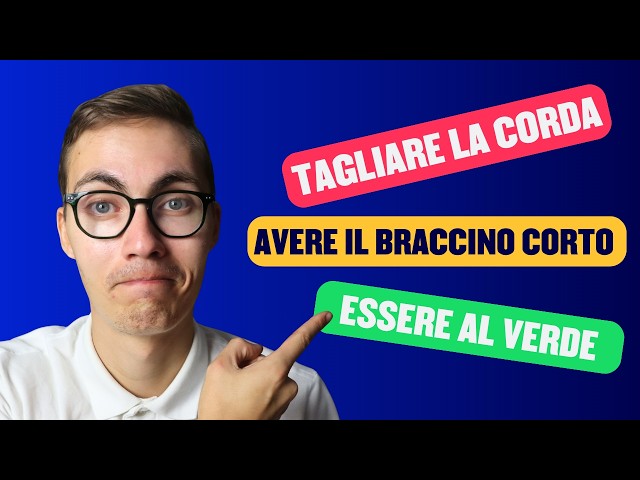
Parla come gli ITALIANI: i modi di dire
Podcast Italiano
0:00 If you want to speak like an Italian,
0:03 or at least express yourself more naturally...
0:05 there's something you can no longer afford to ignore: idioms.
0:13 You see, we Italians constantly use expressions
0:17 that can't be interpreted literally and can be confusing.
0:22 What does "to make your knees run cold" mean?
0:26 What does "to cut the cord" mean?
0:28 And "to have a short arm" mean?
0:31 You see, idioms are important for two reasons.
0:35 The first is that they're very, very common,
0:39 and therefore it's important to know them to improve
0:42 your comprehension and understand what Italians are saying to you.
0:46 And the second is that they're a great
0:50 way to make your Italian more idiomatic and natural,
0:54 and sound less like a foreigner.
0:57 Those who don't use idioms come across as much colder,
1:02 more robotic, and with less personality.
1:04 On the other hand, students who use
1:07 a lot of them express themselves spontaneously,
1:10 more naturally, and more brilliantly.
1:12 And so, if you learn to use many of them, native speakers will be amazed...
1:19 or, to use a figure of speech, they'll be amazed.
1:22 But first, if you don't know me, my name is Davide and this is Podcast Italiano,
1:27 a channel for those learning the Italian language.
1:31 Turn on the subtitles if you need them;
1:33 the full transcript of the video is on my website, podcastitaliano.com.
1:37 As always, I've prepared a PDF associated with the quiz:
1:42 I'll leave the link in the description,
1:44 but you can also scan this handy QR code.
1:48 The PDF is very useful because it contains a review of the video's topics,
1:54 extra examples, and exercises for practice.
1:57 It's truly the perfect accompaniment to the videos and will help
2:02 you take the content of this video and really learn it.
2:06 Oh, and watch this video until the end because I have a very,
2:11 very important announcement for you:
2:13 an idiom challenge that will help you master this part of the Italian language.
2:18 We'll talk about that later.
2:19 Okay, let's start with a story.
2:21 Listen to it and read it on the screen.
2:24 Gloria had met that guy on Tinder, and they'd decided to meet at a bar.
2:30 After all, he'd seemed cute.
2:33 But the date was a complete disaster.
2:36 That Gennaro, who owned a dairy farm in the province of Naples,
2:41 started talking to her about buffalo mozzarella, curd cheese, and mozzarella.
2:44 After 10 minutes, he'd managed to make her feel sick to her knees.
2:49 As if that weren't enough, when it came time to pay the bill, he suggested...
2:55 you know what?
2:56 Splitting it!
2:56 For two hot chocolates and four cookies!
2:59 Even though he was really cute, he was a tightwad, besides being boring.
3:05 Gloria didn't worry too much:
3:07 "I'm going to the bathroom for a minute," he announced;
3:10 instead, she took advantage of his distraction to get away.
3:14 The first is making her feel sick to her knees.
3:18 When you heard "making her feel sick to her knees," did you perhaps imagine
3:23 buffalo milk mysteriously making its way from Gennaro's
3:27 dairy to Gloria's legs, and her joints?
3:31 Well, if that's what happened, then you've interpreted the expression literally.
3:36 Which must be interpreted, on the contrary, metaphorically.
3:41 "To make someone's milk knee-deep" means "to cause someone mortal boredom,
3:48 to tire them out with long, monotonous,
3:53 boring speeches." But where does this meaning come from?
3:57 Its origins lie in the peasant world
4:00 and in the manual milking of cows (or buffalo).
4:04 The milker sat on a low stool and had to fill a bucket placed between his legs.
4:10 It was a long, repetitive, and tiring job.
4:14 When the milk reached "knee-deep," it meant that a long time had passed,
4:21 and that fatigue was probably already at its limit.
4:25 The second idiom is to have a short arm.
4:29 When you heard "he had a short arm," did you perhaps
4:33 imagine a Gennaro with upper limbs more or less similar to these?
4:38 "To have a short arm" means "to be stingy, miserly,
4:43 to find it difficult to spend money
4:46 or offer something to someone." The expression is ironic:
4:50 one imagines that the miser has such a short arm that he can't
4:55 reach his pants pocket to take out his wallet and pay the bill.
5:02 The third expression is to cut and run.
5:05 When you heard that Gloria "took advantage
5:08 of "of his distraction to cut the rope",
5:11 have you perhaps wondered what rope there could possibly be to cut in a bar?
5:16 Here too, we must not interpret the expression literally, but metaphorically.
5:22 "Cutting the rope" means "to quickly
5:26 and secretly leave an unpleasant or dangerous situation".
5:31 Gloria "cuts the rope"; in other words: Gloria escapes without being seen.
5:37 The expression comes from nautical language.
5:40 In case of sudden danger (an enemy attack or a storm),
5:45 sailors did not waste time untying the knots of the anchors or moorings,
5:50 but cut the rope with a blade to allow the ship to move instantly.
5:57 "To make milk come to the knees", "to have a short arm",
6:01 "to cut the rope" are "idioms" of the Italian language,
6:06 also defined, more technically, as "idiomatic expressions".
6:10 We cannot help but ask ourselves, at this point: what is an idiom?
6:15 An idiom is a fixed expression whose meaning is NOT obtained
6:20 by composing the meanings of the individual words it refers to.
6:25 It's a composite meaning,
6:27 but rather the result of other processes, often metaphorical.
6:33 Let's take another example.
6:35 Take the expression "essere al verde," which means "to be penniless," right?
6:41 Clearly, the meaning can't be obtained by adding the individual meanings
6:49 of the words "essere," "al," and "verde," but it's a composite meaning,
6:52 which we can't predict.
6:53 Why does "essere al verde" mean "without money"?
6:56 If you don't know, you can't predict.
6:59 So let's ask ourselves: how many idioms are there in Italian?
7:03 Dictionaries provide different answers.
7:06 Specialized dictionaries dedicated to Italian idioms
7:10 contain between 300 and 10,000 entries,
7:14 depending on the scope of the work and its purpose.
7:18 For example, the dictionary of idioms
7:20 published by Zanichelli has around 7,000 entries,
7:25 Hoepli's 9,000, and Rizzoli's 10,000.
7:28 A thousand more, a thousand less, that's for sure.
7:33 The fact is that there are so many idioms in our language,
7:37 they represent a truly essential component of the Italian lexicon.
7:40 But don't worry, because you don't have to know them all.
7:44 If you know a few dozen, you'll make a great impression on Italians.
7:49 The ones we teach in our challenge are the most used,
7:52 the ones you absolutely must know!
7:54 We'll talk about them later.
7:55 So, let's ask ourselves: what idioms are there in Italian?
8:01 Idioms can be classified into four grammatical categories: 1.
8:06 The first category is verbal expressions, made up of a verb and an object
8:12 (like the expressions we encountered in the story,
8:16 "tagliare la corda" and "avere il braccino corto").
8:19 2.
8:20 The second category is nominal expressions,
8:23 made up of a noun accompanied by an adjective (like patata bollente,
8:28 which indicates "a very difficult problem to solve
8:31 and for which no one wants to take responsibility"; or like vicolo cieco,
8:36 which indicates "a critical situation that seems to have no way out").
8:40 I'll leave you with more examples of all these expressions in the PDF.
8:44 Take a look.
8:45 I'll leave it here for you.
8:47 3.
8:48 The third category is that of adjectival expressions,
8:51 which function as adjectives and therefore modify a noun (think, for example,
8:57 of a job done with rose water, meaning "carried out with little care," or a girl
9:04 who is "naturally beautiful and doesn't use makeup").
9:08 4.
9:08 The fourth and final category is that of adverbial expressions,
9:12 which function as adverbs and therefore modify a verb (for example,
9:18 mangiare a bizzeffe means to eat "in large quantities," while
9:23 cantare a squarciagola means to sing "at the maximum volume,
9:28 almost to the point of tearing one's throat out from the effort").
9:34 Let's now ask ourselves: where do idioms come from?
9:39 Idiomatic expressions, as we said before,
9:42 are the result of processes of transformation of meaning,
9:46 in the direction "from literal
9:48 to metaphorical." The distinction between "literal meaning"
9:53 and "metaphorical meaning" concerns the way in which words refer to reality.
10:01 For "meaning “literal” means the primary sense of a word or phrase.
10:07 For example, in the sentence: The wall is made of stone,
10:10 the word "pietra" indicates a "solid mineral material.
10:17 Metaphorical "meaning," on the other hand, refers to a secondary sense,
10:21 arising from the transfer of a word from its common context to a new context,
10:29 based on a similarity.
10:31 Let's see what I mean.
10:34 For example, in the sentence: Valerio has a heart of stone,
10:38 the word "pietra" does not refer to the mineral,
10:41 but to the quality of hardness that the stone shares with Valerio,
10:46 with his heart, as a person incapable of emotion, insensitive.
10:51 The memory of the processes of transformation of meaning "from literal
10:56 to metaphorical" at the origin of idiomatic
10:59 expressions has been lost to history, in most cases, at least.
11:03 But not in all cases.
11:05 Because in some cases, it is possible,
11:07 instead, to trace the origin of expressions.
11:09 This is the case, for example,
11:11 of the expression "fare il portoghese," which means
11:15 "to use a service without paying the ticket." In 1713,
11:22 to celebrate Portugal's liberation from Spanish rule,
11:26 the King of Portugal's ambassador to the Papal
11:30 States (or, according to other sources,
11:32 a reception) organized a grand theatrical
11:35 performance (or, according to other sources,
11:37 a reception) at the Teatro Argentina in Rome.
11:41 Admission was completely free,
11:43 but it was reserved exclusively for Portuguese citizens residing in Rome.
11:48 A paper invitation wasn't required to enter:
11:52 simply stating your nationality verbally at the door was sufficient.
11:57 Many Romans, of course,
11:59 pretended to be Portuguese to sneak in, to get in without paying.
12:05 And this seems to be the origin of the expression.
12:09 The sources from which idioms originate are varied and diverse.
12:13 Italians' linguistic imagination has drawn,
12:17 imagine, from classical mythology, the Bible, popular fables, literary classics,
12:24 the world of agriculture, entertainment, and sports.
12:28 In the PDF, you'll find plenty of examples
12:31 of idioms from a wide variety of contexts.
12:35 Let's start with classical mythology:
12:37 we use the metaphor of the Achilles' heel, for example,
12:40 to refer to "a person's weak point,"
12:44 to "what makes that person vulnerable." I could say,
12:48 for example: Mathematics has always been my Achilles' heel.
12:53 Mind you: it's an Achilles' heel, not a killer's, as I've heard in the past.
13:00 From the Bible, we inherited the gesture of the Roman
13:04 prefect Pontius Pilate before the crowd calling for Jesus' crucifixion,
13:09 transforming his washing of Christ's blood
13:13 into the universal symbol of disengagement, of refusal of responsibility.
13:19 Washing one's hands of it.
13:21 Today we might say: They decided to fire him,
13:24 I had nothing to do with it, I wash my hands of it.
13:27 Moving on to popular fables, Aesop still teaches us today not to cry wolf,
13:32 so as not to lose credibility: Stop crying wolf,
13:37 otherwise no one will help you when you really need it.
13:40 So, don't create alarm where it's not needed; it's not necessary.
13:45 Again, we've drawn heavily from literary
13:48 classics—and especially from our national Dante.
13:51 From the Florentine poet, for example,
13:54 we've borrowed the expression "galeotto fu il libro" (literally,
13:57 "the book was the cause of the crime"),
14:00 to indicate the person, situation, or object that fosters love.
14:04 The expression comes from Canto V of the Inferno of the Divine Comedy;
14:09 the "galeotto" (meaning" responsible") book in the Comedy is the one
14:14 that makes Francesca and her brother-in-law Paolo fall in love,
14:17 condemning them both to eternal punishment among the lustful.
14:22 Today, we might hear, for example,
14:25 a phrase like this: "We met at that cooking class:
14:29 the recipe book was the cause of the crime!"
14:32 Practical life has also left its mark on the language: from the rural world,
14:36 for example, comes the invitation not to "tar
14:38 everyone with the same brush," that is, not to generalize crudely,
14:42 as in the phrase: Not all young people are nerds,
14:46 we shouldn't tar everyone with the same brush.
14:49 From the world of entertainment,
14:51 we borrowed the term "tread the boards" to refer
14:54 to someone who plays a leading role in a certain sector.
14:57 For example: That politician began to grace
15:00 the stage of international diplomacy at a young age.
15:04 And finally, from the world of sports, and boxing in particular,
15:09 we've borrowed the expression "to throw in the towel"
15:12 as a metaphor for the decision to give up, to abandon a challenge.
15:16 For example, you might hear a phrase like this: The project was too difficult;
15:21 we had to throw in the towel.
15:23 Many of these expressions likely have equivalents in your language,
15:27 but not always exactly the same,
15:29 so let me know in the comments how all these expressions are said,
15:34 because it's very important to compare languages.
15:37 To close this video, the last question,
15:40 and by far the most important: why is it important to know idioms?
15:47 Well, there are essentially two reasons, as we said before.
15:51 The first has to do with comprehension skills in Italian, both written and oral.
15:58 Do you remember how many idioms there are?
16:00 Thousands.
16:00 And do you know how many times they
16:03 appear in spoken and written Italian by native speakers?
16:07 A lot.
16:08 Let's do a frequency test.
16:10 If I type "cut the rope" into Google, I get about 24,100 results.
16:17 Or, if I type "all'acqua di rose" (rose water), I get almost 50,000 results.
16:22 If you want, you can repeat this test with other idioms.
16:26 What's certain is that it's impossible to fully understand what native
16:30 speakers say and write without a thorough knowledge of Italian idioms.
16:35 And the second reason why knowing idioms is so important has
16:40 to do with the ability to produce Italian, write, and speak.
16:45 Is your dream to speak or write like a native speaker?
16:49 Then you MUST use idioms, you MUST enrich your speeches and texts
16:53 with expressions like "non avere pelo lingua"
16:55 (don't mince your words) or "a ogni morte di papa" (every day of the Pope).
16:59 If you want to sound like a native speaker
17:01 and make a good impression in your interactions with native speakers,
17:04 you MUST know Italian idioms.
17:06 It can really make a difference;
17:08 it can make you much more brilliant, natural, and charismatic in Italian.
17:12 And it's to help you achieve this goal that I have an announcement for you:
17:20 our 21-Day Idioms challenge will begin on May 5, 2026.
17:25 It's a 7-module course consisting of 7 podcasts,
17:28 written in diary format—the diary of an Italian student;
17:33 7 video explanations; 35 exercises.
17:37 In 3 weeks, you'll understand and master 70 Italian idioms,
17:44 a quantity that will allow you to express yourself much more naturally,
17:49 vividly, and charismaticly with Italians.
17:51 The course will follow more or less the same method as this video:
17:56 we'll start with a story, specifically a diary entry,
17:59 analyze the idioms present in the story,
18:02 compare the usages contained in the story
18:06 passages with other examples from authentic texts,
18:09 understand the meaning of the idioms,
18:12 research their origins, and practice using them extensively.
18:17 After 21 days, you'll be familiar with many very
18:21 common expressions that we Italians use almost every day,
18:25 and you'll make a great impression on Italians, I assure you.
18:29 Oh, and "fare un figurone" (to make a good impression) means
18:32 "to make a positive impression." The challenge starts on May 5th,
18:38 and registration closes on May 4th.
18:40 I'll leave the link in the description or on the card
18:43 at the end of the video to find out all the information and register.
18:47 It'll be fun, I promise.
18:51 I'll be waiting for you!