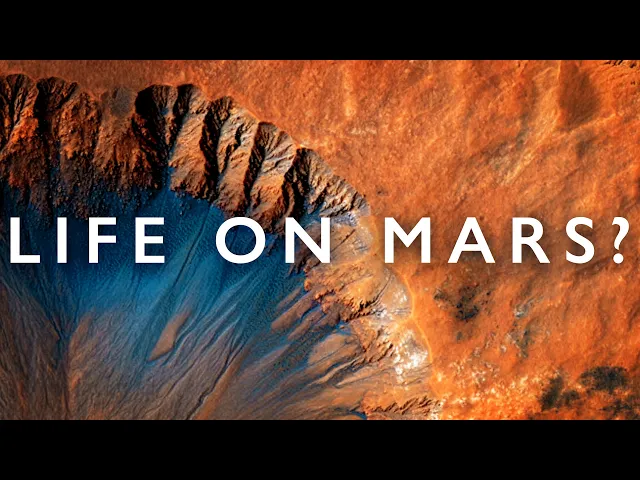
Could There Really Be Life on Mars?
Astrum Extra
0:00 You've likely all seen the news by now.
0:03 NASA found a possible sign of life on Mars.
0:08 These tiny spots, barely visible to the naked eye,
0:12 are the biggest space news in over 50 years.
0:18 If this really is a sign of life,
0:20 it would be the most meaningful discovery in the history of humanity.
0:26 But we've been burned by false alarms before.
0:29 So, have we really done it this time?
0:33 I'm Alex Mccoan and you're watching Astramm.
0:36 Join me today as we dig into the details of what Perseverance found,
0:40 why scientists are excited,
0:43 and what it will take to prove we're not alone in the universe.
0:50 In February of 2021, NASA's Perseverance rover, or Percy to his friends,
0:56 touched down on an ancient Martian lake bed.
1:00 The Yzero crater was once home to a large
1:03 body of water with rivers flowing in and out,
1:06 carving deltas, and carrying sediment.
1:09 The soil is rich in clay minerals that can only form in the presence of water.
1:15 Percy has been sent to hunt for ancient microbial life.
1:20 If it's going to find them anywhere, the Yzero crater seems like a good bet.
1:25 You see, ancient legs often contain perclorate,
1:29 which can be metabolized by microbes.
1:32 Astrobiologists on Earth study microbes like this in extreme environments
1:36 to understand if life could survive in similar conditions on other planets.
1:42 The rover's job is to look for these possible signs of life,
1:46 identify and store the most interesting samples of Martian rock,
1:50 and prepare them to be collected by another
1:52 space mission for an eventual return to Earth.
1:56 One day in July 2024,
1:59 while exploring the edges of the ancient Naret Vales River Channel,
2:04 Percy's cameras spotted something unusual.
2:07 A rock from the Bright Angel Formation.
2:11 two of the rover's instruments,
2:13 the planetary instrument for X-ray lithocchemistry or pixel
2:18 and the scanning habitable environments with ramen and luminescence
2:22 for organics and chemicals or Sherlock for short
2:26 detected sedimentary rocks made of clay and silt.
2:31 On Earth, these materials are excellent preservers of microbial life.
2:36 So Percy took a closer look and it saw something amazing.
2:42 The rock, also known as Chiava Falls, was rich in organic compounds like carbon,
2:49 phosphorus, and iron arranged into rings.
2:53 Affectionately named leopard spots and poppy seeds.
2:57 The tiny spots span 200 micrometers to 1 millimeter in diameter,
3:03 but it was enough to raise the blood pressure of astrobiologists everywhere.
3:09 The light inner part of the leopard
3:11 spot is chemically similar to the surrounding rock,
3:14 but the dark outer rim is enriched with iron and phosphorus.
3:19 It seems to be evidence of localized iron reduction.
3:24 Percy also detected organic carbon-based compounds in the rock
3:28 and based on its texture and geochemical composition,
3:31 we strongly suspect this rock was once in contact with water.
3:36 Usually when we see such a combination of organics,
3:40 water and iron reduction on Earth is interpreted as a sign of microbial life.
3:46 Suddenly NASA had something very unique on its hands.
3:51 Could this mudstone rock hold the first alien bio signature ever found?
4:00 At the center of this story are two very special minerals, vivionite and grey.
4:07 Vivianite is an iron phosphate.
4:10 On earth it forms near metal ores and river
4:13 sediments where microbes like geobacttor metabolize iron instead of oxygen.
4:19 They take in iron 3 oxide and release iron 2 as a waste product.
4:24 The energy given off by this reaction then powers their metabolism,
4:28 a process known as cheosynthesis.
4:31 When the expelled iron 2 reacts with the phosphate
4:34 and the water in the environment, it forms vivionite.
4:38 Greygite follows a similar story.
4:41 Sulfate reducing microorganisms on Earth break down sulfate
4:45 into sulfide which reacts with iron to make greygite.
4:50 But let's be skeptics for a moment and rule out microbes for now.
4:55 What else could have caused these reduction reactions?
5:00 Well, one explanation could be very high temperatures.
5:04 The sulfide needed to produce Greygite could
5:07 have come from volcanic gases leaking into groundwater,
5:11 but that means the sulfide would have had to migrate
5:14 from a hot volcanic system into a much cooler environment.
5:18 And there's been no evidence for such volcanic or hydrothermal sources nearby.
5:24 Another possibility is that sulfate in the rocks
5:27 was reduced to sulfide through reactions with organic matter.
5:32 But unless temperatures exceed 150 to 200° C,
5:37 these reactions would be very slow and require a huge amount of energy,
5:41 making them unlikely.
5:43 And studies of the rocks around this area
5:45 have shown no evidence of high temperatures.
5:49 So there's no way the surrounding environment could have
5:52 got hot enough to reduce sulfate and form Greygite.
5:57 Another possible explanation is acidity.
6:01 Both iron 3 ions and sulfate ions dissolve much more readily
6:06 in water under acidic conditions than they do under neutral conditions,
6:10 making them much more prone to reduction through purely chemical reactions.
6:15 If the water on Mars was more acidic than we anticipated,
6:19 that could have caused the spots Percy saw.
6:23 Perhaps these spots were just the result
6:24 of chemical processes on an alien planet, nothing more.
6:29 But then Percy spotted this little green mineral nestled near the sample site.
6:37 A small rock of olivine knocked the acidic water hypothesis on its head.
6:43 Olivine is the fastest weathering silicut mineral.
6:47 Unlike other silicone structures like silicon dioxide for example,
6:52 olivine doesn't have strong silicon oxygen silicon bonds.
6:56 Instead, it's made up of negatively charged silicut ions held together
7:01 by the electrostatic attraction with positively charged magnesium and iron ions.
7:07 In acidic conditions, these are displaced by hydrogen ions,
7:11 breaking olivine down into orthosic acid and magnesium ions in solution.
7:17 The more acidic the environment, the more hydrogen ions there are and the more
7:22 aggressive the dissolution of olivine would be.
7:26 So the very fact that it exists rules out
7:30 the possibility of acidic conditions causing the strange spots.
7:37 Science is ultimately about falsification.
7:40 It's not about proving a hypothesis true.
7:44 Much more often it's about proving a hypothesis false.
7:49 Over time and through a process of elimination,
7:52 all roads seem to point to the same explanation.
7:56 And if that explanation holds up against enough skepticism for long enough,
8:00 it eventually becomes an accepted theory, testable,
8:05 reliable, and widely accepted by the scientific community.
8:10 In this paper, the Mars research team tried to prove
8:13 that these minerals were not left behind by ancient alien life.
8:18 They started with a null hypothesis and systematically
8:22 investigated all the non-living explanations for what they found.
8:27 But after months of study, they concluded they just couldn't do it.
8:33 Now, saying we can't explain how this was done by something non-living
8:38 is very different from saying this is a definitive sign of life.
8:43 For one thing, all our speculation and contained excitement
8:47 is based on what we know about biochemistry on Earth.
8:51 And no matter how tempting it may be,
8:54 we cannot allow ourselves to assume that just
8:57 because something happens one way on Earth,
8:59 it would happen the same way on Mars.
9:02 Maybe it has a totally different biochemistry we know nothing about.
9:07 NASA's being extra careful not to say too much too soon.
9:12 After all, we've been wrong about potential bio signatures on Mars before.
9:19 Back in 1976, the Viking lander tested Martian soil for life
9:24 by squirting it with nutrients labeled with radioactive carbon 14.
9:30 If microbes were present,
9:32 they'd metabolize the nutrients into radioactive carbon dioxide we could detect.
9:37 And to everyone's shock, that's exactly what happened.
9:41 Excited scientists thought they had proof of alien life.
9:45 But in 2008, NASA's Phoenix Lander found
9:49 Martian soil to be rich in plecchlorate,
9:52 a powerful oxidant that destroys organics and releases gas when heated.
9:57 What looked like a biological reason
10:00 was really just chemistry, a false positive.
10:04 Still, Mars kept dangling hope.
10:07 In 1996, a photo of meteorite Alh84001 made headlines.
10:15 The rock itself was over 4 billion years old
10:18 from a time when Mars had liquid water on its surface.
10:22 Under the electron microscope,
10:24 tiny structures emerged resembling bacterial colonies.
10:28 The world stood still.
10:30 Researchers thought they were on to something big.
10:34 so big that President Bill Clinton
10:36 gave a formal announcement about the discovery.
10:39 Sounds a lot like NASA's recent statement of Percy's discovery, doesn't it?
10:44 But in 2022, those squiggles were ruled non-biological,
10:49 explained instead by a water rock reaction called serpentinization.
10:55 Another false alarm.
10:57 So, is our recent finding in the Yzero crater another close call?
11:02 Or is it proof that the third time really is the charm?
11:07 There's only one way to find out.
11:09 We have to bring the sample home for further testing.
11:15 That's where the Mars sample return mission comes in.
11:19 It's a complex mission which requires sending three separate spacecraft to Mars.
11:25 Percy has already completed phase one.
11:27 It's drilled into Chiava Falls and tucked away a precious
11:31 core sample of the mudstone rock mission scientists named Sapphire Canyon.
11:37 Phase two would be to send another spacecraft to land near Perseverance,
11:41 collect those tubes, and launch them into orbit around Mars.
11:45 The third and final craft would collect the samples
11:48 from the orbiter and ferry them all the way back to Earth.
11:52 It's a huge task with an estimated price tag of 11 billion.
11:57 The Mars sample return mission was first announced
11:59 in 2022 as a joint collaboration between NASA and issa.
12:04 Since then, it has been fraught with financial struggles and uncertainties,
12:08 delaying the project from 2033
12:11 to 2040 before ultimately being suspended indefinitely.
12:17 This is despite the National Academy of Sciences decadel survey,
12:21 a meeting of leading scientists who get together every 10
12:24 years to decide the future priorities for progress in STEM,
12:28 naming the Mars sample return as the highest
12:32 priority for NASA two decades in a row.
12:36 And that was before we discovered
12:38 this potential bio signature on our neighboring planet.
12:42 All we can do is hope this puts political pressure
12:45 on leaders to mobilize the necessary resources to pull it off.
12:50 So if we ever do get the Sapphire Canyon sample back home,
12:55 what kind of experiments might scientists run?
12:58 There's a good chance that among other things,
13:01 they'll be looking for two key fingerprints of life.
13:05 The first is kirality.
13:07 Amino acids come in two mirror image versions.
13:11 right-handed and left-handed, also known as D and L amino acids.
13:16 On Earth, life overwhelmingly prefers the L version of things,
13:21 while non-living materials show more of a 50/50 split.
13:27 If the Martian sample shows a significant chairo preference,
13:31 either right or left-handed, that could be a smoking gun.
13:36 The second fingerprint is carbon isotopes.
13:39 Carbon comes in a few different flavors, most commonly carbon 12 and carbon 13.
13:45 Again, life prefers one over the other.
13:48 The ratio of carbon 12 to carbon 13
13:51 in living things is much higher than in non-living things.
13:54 If we see a similar pattern in the Sapphire Canyon sample,
13:58 that could be another clue that its origin is biological.
14:02 You see, you and I may often think
14:05 of discoveries like these in quite a binary way.
14:08 Either they're a sign of life or they're not.
14:12 But NASA has a much more nuanced take.
14:15 They recently proposed the confidence of life detection scale,
14:18 a framework for ordering how likely discoveries actually are
14:23 to be signs of life based on a set of criteria.
14:26 It has seven levels ranging from we found something that could be caused
14:30 by life all the way to multiple
14:33 teams have independently confirmed life more than once.
14:38 NASA hasn't stated where the discovery in the Ezero crater falls,
14:42 but I'd guess probably somewhere between levels three and four.
14:47 If the samples come back and independent labs around the world all
14:51 confirm that what we are seeing really did come from a biological origin,
14:56 that would push us up to a level six.
14:59 Level seven might even require going back to Mars
15:03 and finding the same evidence in a completely different location.
15:08 So, when NASA says this discovery could be
15:10 the clearest sign of life we've ever found on Mars,
15:14 they don't mean to say it is clearly life.
15:17 But the Mars sample return mission could finally reveal whether we've always
15:22 been alone in the universe or did we once have a cosmic neighbor?
15:30 Even if our sample turns out to not be life,
15:34 it's still an extraordinary discovery that will
15:36 help us understand our own origins even better.
15:40 See, we think Mars is like a time capsule of an early Earth.
15:45 Unlike Earth, Mars doesn't have any continental
15:48 drift or an active plate tectonic system.
15:51 Its crust has been frozen in place for billions of years,
15:55 preserved in a way Earth's crust could never be.
15:59 The ancient landscapes on our planet have been erased through tectonics,
16:03 erosion, oceans, and volcanism.
16:06 So when we study Mars, we're not just asking whether it once carried life.
16:10 We're also peering into a record of planetary
16:13 conditions that resemble Earth at the dawn of biology.
16:17 In that sense, Mars is a window into our own origins,
16:21 offering clues to what Earth might have looked
16:24 and felt like before life left its mark.
16:28 But let's dream for a moment, shall we?
16:31 What if the sample does turn out to be life?
16:35 Well, most immediately it would indicate that Mars was habitable far
16:40 longer than we imagined since the sample comes from relatively young sediment.
16:46 But more importantly, we'd finally answer the question,
16:50 can life exist on other planets?
16:52 And in the same breath, open a Pandora's box of follow-ups.
16:57 Did life on Earth start on Mars or the other way round?
17:01 Did a meteor from interstellar space seed life
17:04 on both our planets or did it arise spontaneously twice?
17:09 Where else could life exist in the universe?
17:12 How common is it really?
17:15 It would also have implications on the Drake equation,
17:19 a probabilistic formula used to estimate
17:21 the number of alien civilizations in our galaxy.
17:25 The L value here, which stands for the fraction
17:29 of potentially habitable planets that go on to develop life,
17:33 would jump from vanishingly small to closer to one.
17:38 Since two out of two neighboring planets would
17:41 then have or have had life at some point,
17:44 an increase in this value causes the number
17:47 of civilizations in the universe to shoot up.
17:50 But crucially, this coefficient only changes if
17:53 life on Earth and Mars rose independently.
17:56 If we're related, the products of panspermia,
18:00 that still represents just one biogenesis event,
18:03 and the outcome of the equation remains unchanged.
18:09 There's a concept known as the 01 infinity rule.
18:13 In astrobiology, it represents the idea that life can only exist in zero,
18:19 one, or infinite places.
18:22 We already know it's not zero.
18:24 If it's just one, then we're alone.
18:27 A single spark in the dark.
18:29 But if it's two, Earth and Mars, then why not five,
18:34 5,000, 5 million, or even infinite places in the universe?
18:39 Suddenly, life isn't rare.
18:41 We're not special anymore.
18:43 And personally, I hope that if we ever discover life out there,
18:48 it brings us closer together down here.
19:00 When it comes to the search for life on Mars,
19:02 we might be looking in the wrong place.
19:05 Recently, I was asked by Timothy Walter on Patreon about the most
19:09 likely places in the solar system to find life outside of Earth.
19:13 Mars is certainly a contender.
19:16 In the first billion or so years of its existence,
19:20 Mars was in many ways similar to Earth,
19:22 and it's entirely possible that life could have emerged on its
19:25 surface before the planet underwent changes that made Mars much less hospitable.
19:31 That's why NASA rovers such as Perseverance
19:33 are investigating places like Yzero Crater to investigate
19:37 those dried up deltas for any evidence
19:40 that life might have once flourished there.
19:43 But as I looked deeper into the topic,
19:45 it struck me that this might not be the most likely home for life on Mars.
19:50 There is another location that is an even more likely contender for life.
19:55 and incredibly that life, if there might even still be alive to this day.
20:03 I'm Alex Mccoan and you're watching Astramm Answers,
20:07 the series where we take questions you post
20:09 to us on Patreon and uncover the answers.
20:12 And today we're going deeper than ever before
20:16 into a world where a deep biosphere might thrive.
20:20 I'm going to answer where I think is the most
20:23 likely place to find life on the planet Mars.
20:29 When it comes to life forming though, we should probably start at the beginning.
20:33 It's worth recognizing that we're going
20:35 to get a little speculative for this video,
20:38 as there are many aspects of the origin of life,
20:40 even on Earth, that are right now still unknown.
20:44 I did a video recently on how life likely first came to be,
20:47 and one of its key points is that there's
20:50 still a lot of debates over the specifics.
20:53 It's also worth noting that we do not know for certain
20:57 that life does exist or ever existed on Mars at all.
21:02 But there is some evidence that is intriguing.
21:05 NASA's Curiosity rover has detected methane in Mars's atmosphere,
21:10 which mysteriously only emerges at night and is strangely absent during the day.
21:16 Methane on Earth is mostly produced by living organisms.
21:20 So, it's an intriguing indication that life might be on Mars, too.
21:24 However, this is not definitive proof,
21:27 as there are also non-organic ways to make methane,
21:30 as I talk about in one of my other videos on life on other planets.
21:34 So then why do scientists think that Mars might be
21:38 or used to be the home for life in the first place?
21:43 It's all thanks to what Mars looked like
21:45 in the first billion or so years after it formed.
21:49 According to our best theories of how life first came to be on Earth,
21:54 there are some key things that you need.
21:56 Water, for one, all life on Earth seems to need it.
22:00 but also mechanisms for producing diverse and complex chemical structures.
22:05 The raw building blocks of life from which protoells could arise.
22:09 Something like a deep sea thermal vent would help with that.
22:13 Or possibly a volcanic hotring as they would
22:16 release a nice spew of minerals and chemicals
22:19 that could then hopefully be formed into very
22:21 basic protoells if conditions were just right.
22:26 Finally, on the note of those conditions,
22:28 you need some kind of selective pressure
22:31 to choose some chemical structures and discard others.
22:35 This is quite similar to evolution in that it wouldn't
22:38 work if there wasn't a selective pressure to guide it.
22:42 For animals, this could be a scarcity of food
22:44 encouraging the survival of those best able to locate it.
22:48 But for chemical structures, it could be something like a cyclical
22:51 environment that is sometimes wet and sometimes dry.
22:55 Testing to see if certain structures can survive those kinds of changes.
22:59 The structures that break apart when faced with this stress test are selected
23:03 out while those that survive can move on to the next round of selection.
23:08 A sort of evolution but for rocks.
23:12 On Earth, evidence suggests that life arose within
23:15 the first billion years after the planet formed,
23:18 which is quite fast on the cosmic scale of things.
23:21 And it turns out that on Mars,
23:23 its first billion years of existence had these key factors and more.
23:28 It also had a thick atmosphere
23:30 and a magnetic field to protect any fledgling life
23:33 from deadly solar radiation and to allow bodies
23:36 of liquid water to form without evaporating away.
23:40 It had volcanism providing energy from the planet's
23:43 warm core and those vital chemical building blocks.
23:47 Sunlight also provided helpful energy to the planet.
23:50 If the presence of these things on Earth made it,
23:53 meaning capable of supporting the genesis of life,
23:57 then it could well make Mars irriable, too.
24:00 However, there's a built-in time limit here.
24:03 After 1 to two billion years, the water had all dried up.
24:07 Mars had cooled enough that the mechanism powering its magnetic field had ceased
24:12 and over just a few hundred million
24:13 years later the atmosphere had been stripped away.
24:17 This eventually led to the evaporation of all the liquid water on the planet
24:22 with the only remaining water being locked in the ice on the polar caps.
24:27 So life on Mars would need to have formed
24:29 during those 1 to2 billion years after the planet's formation.
24:34 NASA is working under the assumption that this is the case and so they've
24:38 sent rovers and landers to investigate craters
24:41 like Yzero for any ancient signs of life.
24:44 Perseverance has collected 21 rock core samples as of April 2024,
24:49 which it got from drilling a few centimeters into the stony surface of Mars.
24:54 Yzero crater once held a large body of water and a delta.
24:59 If living things had made that water a habitat,
25:02 their remains could well have dropped into the bottom
25:04 of the delta to be captured in the sediment there.
25:08 There is even a chance that they're still locked into that sediment.
25:12 Researchers in the journal Astrobiology found
25:14 that even when completely dried up, frozen, and subjected to intense radiation,
25:20 certain kinds of bacteria on Earth could theoretically survive
25:25 hundreds of millions of years without too much ill effect,
25:30 just waiting to be thored out and given water again.
25:34 This is why scientists must be so careful about
25:37 both forwards and backwards crosscontamination when exploring other worlds.
25:43 If not there, there is also a chance
25:46 that life exists in the water lakes on Mars today.
25:50 But Alex, I hear you say through your screens,
25:53 didn't you just tell us that those lakes had all dried up?
25:57 What I told you was mostly true, but not entirely.
26:01 While it seems unlikely that there is
26:03 any water still moving freely on Mars's surface,
26:06 there is a location where water can still be
26:09 found and in liquid form deep beneath the polar caps.
26:14 In 2018, scientists announced that they had found
26:17 an entire lake trapped deep beneath the thick ice.
26:21 Three more were confirmed by 2020.
26:24 This is interesting because it mirrors an ecosystem on Earth called Lake Vosto,
26:30 which is also a lake sealed away 4 km beneath the solar polar ice cap.
26:36 Intriguingly, Lake Vosto was found in the late
26:39 '90s to house bacteria and even potentially fish.
26:43 Some trace DNA was captured and brought to the surface.
26:47 Either way, Lake Vosto is a fascinating ecosystem that has
26:51 been sealed away for 15 to 25 million years.
26:57 Sadly, the chance of Mars's lake being another lake
26:59 Vstto filled with ancient life is actually quite low.
27:04 Given the temperatures on Mars being so much lower,
27:07 it's thought that the water inside the polar lakes there have to be very salty.
27:12 This would not be conducive for most forms of life.
27:16 And on top of that, perhaps the Martian legs are not real after all.
27:21 A recent study in the journal Science Advances offered other
27:25 explanations for why the radar imaging thought it saw a lake,
27:28 suggesting that reflective dust layers spaced
27:31 closely together could create the same effect, a sort of optical illusion.
27:36 If this is what's happening on Mars, the lakes might not even be there.
27:42 So, it seems that Yzero Crater is a better place to search.
27:47 But even Yzero has a point against it.
27:49 Yzero Crater, while certainly habitable,
27:52 is not a likely place where life could have formed.
27:56 It does not contain deep thermal vents and isn't home
28:00 to volcanic springs unlike other parts of the planet like Columbia Hills.
28:04 So the question is, could life have
28:07 formed and then distributed quickly enough that it
28:10 would make it to craters like Yzero before
28:12 Mars underwent its transformation into a barren world?
28:16 It's possible, but it's also possible that it would not.
28:21 As the planet cooled and the water evaporated,
28:24 any bodies of water would have found themselves becoming more and more salty,
28:28 as any salt concentration would have ended up
28:31 with a lower and lower ratio of water.
28:34 Again, too much salt is bad for most forms of life,
28:37 and research suggests it could have been a massive
28:40 hurdle for the survival of undeveloped proto cells.
28:44 Such cells simply may not have developed the tools
28:47 to allow them to survive in such conditions.
28:50 Even more developed Earth life would have struggled
28:53 when combined with the depleting atmosphere and deadly radiation.
28:58 So, it's safer to search where life would
29:00 have begun rather than places it would have distributed.
29:05 Thus, volcanic spring sites like Colombia Hills already seem like a better
29:10 place to look for signs of early life than Yzero Crater.
29:14 If life never made it out of the primordial super on Mars,
29:18 those initial pools are the places that make the most
29:21 sense to look as so far we're not looking there.
29:25 But if you want to talk about where life on Mars might be right now,
29:29 volcanic springs have one other vital feature going for them.
29:34 They are gateways to underground biomes.
29:37 Why explore out of the water when you
29:40 can follow those nutrients down to their source?
29:45 On Earth, life does not just live on the surface.
29:48 There exists a whole world of life known
29:52 as the deep biosphere that exists kilometers beneath our feet.
29:57 Life down there has learned to adapt to living without
30:00 sunlight and without air in high temperature and high pressure environments.
30:05 And incredibly, it's thriving.
30:09 In 2018, Deep Carbon Observatory collaborators,
30:13 a group of over 1,000 scientists, published that if you added up all the weight
30:18 of the living things beneath the surface of Earth,
30:22 it would add up to almost 400 times
30:24 the carbon mass of every human on the planet combined.
30:29 The deep biosphere covers an area of nearly 2.3
30:34 billion km almost twice the volume of all the oceans.
30:39 It contains 70% of all species of Earth's bacteria na.
30:44 Also, viruses and small worms have been found down there.
30:48 Overall, it is thought to be as diverse, if not more diverse, than the surface.
30:54 There has not yet been found a limit to how deep
30:57 or how hot life can survive as records are continually being broken.
31:03 Currently, the hottest survived temperature is 121° C, hot enough to boil water,
31:10 which was found with a bacterium living in a thermal vent.
31:15 And the deepest is 10.5 km beneath the sea level.
31:21 Food is hard to come by when
31:23 your kilometers deep in rock and metabolic processes
31:26 of living things in the deep biosphere is
31:29 10,000 to 1 million times slower than the surface.
31:33 With life ticking so slowly,
31:36 it transpires that they can live almost indefinitely.
31:40 We don't yet know how old things get down there.
31:43 Some species are found at sites globally,
31:46 suggesting that although they're traveling through solid rock to do so,
31:51 bacteria are still somehow able to get around.
31:55 We've only in the last decade begun to grasp
31:58 the sheer scale of the deep biosphere on Earth.
32:01 But all of this is incredibly insightful when it comes to life on Mars.
32:07 Deep beneath Mars's surface, life could be well protected from any
32:11 of the devastation going on at its surface.
32:15 Life is proven to be able to survive thermal vents,
32:18 which means that once life formed in a volcanic region,
32:21 it would have been able to seep
32:23 into the warmer nutrientrich subsurface through cracks.
32:27 It simply would have had to fall down.
32:31 And given the long metabolisms involved, it could still be alive there today.
32:37 there could be a thriving widespread ecosystem alive and well.
32:44 Finding out for sure would be difficult.
32:47 We find it hard to explore the deep biosphere here on Earth,
32:50 requiring deep sea drilling technology or very deep mines.
32:55 On Mars, landers like Insight struggle to even dig 2 to 3 cm.
33:02 But to my mind, that's the most likely place to search for Martian life today.
33:07 Of course, it's worth reiterating that there are a lot of ifs here.
33:12 If life formed on Mars in the first place,
33:15 if it managed to make it out of the hot springs it
33:17 likely formed in, if it evolved and adapted like it did on Earth,
33:22 only then could it still be out there.
33:25 But it's incredible to me to consider
33:27 that while Mars's surface might appear dry and barren,
33:32 there's the potential for an entire
33:34 thriving ecosystem beneath Mars's soil alive today.
33:39 Perhaps that is the cause for the methane
33:41 in Mars' atmosphere detected by Curiosity.
33:46 There's always a chance life spread to legs like Yzero,
33:49 but my bet if it's alive today, it will be deeper.
33:54 I believe that when it comes to finding life on Mars,
33:56 we've barely scratched the surface.
34:00 Do you have a question you'd like us to answer?
34:03 Send it over to us on Patreon and you
34:05 might be selected for a future Astramm Answers episode.
34:09 But for now, thanks for watching and I'll see you next time.
34:15 The universe is a harsh, brutal place.
34:20 Solar winds, high radiation,
34:22 and extreme temperatures and pressures make it largely inhospitable.
34:28 And yet, life found a way.
34:31 It's in you and in me.
34:34 And perhaps there is no quest more epic than
34:37 the search for life beyond our beautiful blue home.
34:41 But scanning the night sky for possible neighbors,
34:45 like most things in astronomy, comes with its challenges.
34:49 Where could they be?
34:51 What would they look like?
34:53 Should we even look for them?
34:55 Are they in turn looking for us?
34:59 One thing that makes the search for alien life tricky
35:02 is that we don't know exactly what we're looking for.
35:06 But by studying ancient life forms on Earth,
35:10 scientists can get a clearer idea of the kind of organisms that are
35:14 most likely to be out there and where we might be best off looking.
35:20 I'm Alex Mccoan and you're watching Astramm.
35:23 Join me today as we uncover how scientists actually hunt for alien life,
35:29 the unique characteristics of Earth's earliest life forms,
35:32 and the surprising role these ancient microbes play
35:36 in guiding the quest to answer the eternal question, is there anybody out there?
35:47 If you were tasked with combing through
35:49 a seemingly infinite universe for signs of life, where would you start?
35:55 I reckon I'd start by looking for a planet similar to ours.
36:00 Starting the search in the most hospitable part
36:03 of the galaxy seems like a smart move.
36:06 The galactic habitable zone is the region of a galaxy
36:10 that has the most optimal conditions
36:11 for potentially lifebearing planets to develop.
36:15 Typically, it's a spot with enough heavy elements for Earthlike
36:20 planets and minimal cosmic drama like supernova or stellar close calls.
36:26 This excludes stars too close to the center or in the spiral
36:30 arms of galaxies since they are full of super intense harmful radiation.
36:37 So far, we've discovered 5,539 exoplanets of all different shapes,
36:44 sizes, and compositions.
36:47 Scientists are still debating what kind of atmospheres
36:50 might be hiding signs of life on other planets.
36:52 As far as we know, life on Earth emerged 3.8 billion years ago.
36:57 At that time, our atmosphere was mainly nitrogen gas,
37:01 carbon dioxide, and water vapor.
37:04 You'd understand then why some scientists choose
37:07 this atmospheric composition as a preferred focal point.
37:11 But others aren't so convinced.
37:13 They say only searching for these compounds is limiting since
37:17 methane and hydrogen gas atmospheres may themselves be signs of life.
37:22 In reality, it seems to be a bit of a chicken egg situation.
37:27 The atmospheric composition of a planet determines what kind of life,
37:31 if any, could emerge on that planet.
37:34 But the kind of life that emerges
37:35 also affects the composition of the atmosphere.
37:39 Let me quickly explain with an example from home.
37:43 Today, Earth's atmosphere is 21% oxygen.
37:47 That wasn't always the case.
37:49 It wasn't until about 2.4 billion years ago
37:52 that free oxygen gas started accumulating in our atmosphere.
37:56 This is known as the great oxidation event.
38:00 The main theory among researchers is that cyanobacteria
38:03 living in the ocean evolved the ability
38:06 to photosynthesize and started releasing oxygen gas
38:09 faster than it could react with other compounds.
38:12 Eventually, this oxygen evaporated from the oceans into the atmosphere,
38:17 replacing the methane that was already there.
38:20 This is an example of a bio signature of life.
38:23 The next step in honing our mission to find alien life.
38:31 Bio signatures are substances,
38:33 signals or patterns that could be a sign of biological activity.
38:39 This could be as obvious and direct as a fossil
38:42 or something more subtle like the composition of a planet's atmosphere.
38:47 They are important because they indicate not only the potential
38:51 presence of life but also the level of its sophistication.
38:55 It's important to understand that all bios
38:58 signatures are really just potential bios signatures.
39:02 Because while they could be signs of life,
39:05 they could also be caused by non-living things.
39:08 A big challenge scientists face is battling all the false positives that arise.
39:14 There's no official classification system for bio signatures,
39:17 but it's useful to think about them falling into three categories.
39:21 Gaseous, temporal, and surface signatures.
39:25 Gaseous bios signatures are direct or indirect products of metabolic activity.
39:31 The most common manifestation of this is the composition of the atmosphere.
39:36 For example, the presence of haze could be
39:39 an indirect byproduct of a methane rich world.
39:43 This could tell us that a particular planet hosts microbial life similar to what
39:47 we had on Earth over 2.5 billion years ago before the great oxidation event.
39:53 It's similar to the example we explored earlier of how having free
39:57 oxygen in the atmosphere could be a bios signature for photosynthesizing life.
40:02 Temporal bios signatures are timebound changes
40:05 that can correlate with biosphere activity.
40:08 On Earth, the concentration of carbon dioxide
40:11 in the atmosphere rises and falls with the seasons.
40:15 Vegetation grows in the spring and decays in the autumn.
40:19 This oscillation is way stronger in the northern hemisphere
40:23 than the southern hemisphere because it has more land mass.
40:27 In theory, we can use this kind of information to see
40:30 where on an exoplanet life is most likely to be.
40:34 However, nothing is so black and white.
40:37 Temporal bios signatures can be caused by abiotic factors too.
40:42 The concentration of methane in Earth's atmosphere, for example,
40:45 changes mainly due to its interaction with water vapor in the troposphere.
40:50 So even though the methane itself is from a biological origin,
40:54 the temporal oscillations are dictated by abiotic factors.
40:59 I personally find surface bios signatures the most interesting.
41:04 Basically, every planet reflects some light from its star.
41:08 Different materials on the surface of the planet
41:10 will reflect different combinations of wavelengths of that light.
41:14 This results in a unique reflectance spectrum for every material.
41:20 Surface features like rocks, snow, water,
41:23 and soil can all be deduced from a reflectant spectra.
41:28 Life can also influence the reflectance spectra of a planet.
41:33 This is an example of a surface bio signature.
41:36 Here's where it gets super cool.
41:39 Today, the Earth appears blue from space because
41:42 its oceans reflect a lot of blue light.
41:45 But some scientists think that there was a time
41:48 when our planet would have been purple instead.
41:55 There's an ancient family of microbes that produce a protein called bacteriosin.
42:01 Bacterio rodopsin can create energy without a carbon source,
42:06 something plants can't do.
42:08 It literally just turns sunlight into metabolic energy the cells can use.
42:14 It is thought to be one of the simplest
42:16 and earliest bioenergetic processes to have developed.
42:20 But why would it make earth appear purple?
42:24 Bacterial redopsin contains a pigment that reflects a lot of purple light.
42:29 This makes its cell membrane appear purple.
42:33 An early Earth would have had oceans full of this organism,
42:37 turning the whole planet visibly purple.
42:41 While it's just a bit of fun to imagine a purple Earth,
42:44 the implications of this theory mean that these microbes and others
42:48 like them could be a very useful surface bio signature of exoplanets.
42:53 Of course, the reflection of purple light alone doesn't mean much,
42:58 but if it were to be combined with evidence of a highly saline surface,
43:02 that could start to paint a more convincing picture.
43:06 You see, the specific family of ancient microbes that produce
43:10 this purple protein are called haloilic ara or halo aa for short.
43:16 Aa are some of the most ancient lineages of life on Earth.
43:21 Even though they're single-sellled organisms,
43:24 they are not to be confused with bacteria,
43:26 the two are actually totally different domains of life,
43:30 but we won't go into that.
43:31 Haloilic means they grow and survive
43:34 best in conditions of extremely high salinity.
43:37 Halophiles belong to a large group of organisms known as extreopiles.
43:42 Extreophiles are life forms that are able to live in very hostile environments.
43:48 There are lots of different kinds of extreopiles that are well adapted
43:52 to different kinds of extreme conditions
43:54 like very high or very low temperatures,
43:57 pressures, dryness, radiation, salinity, acidity,
44:02 and heavy metals or any combination of those extreme conditions.
44:07 These organisms span the globe, inhabiting the harshest parts of our world.
44:12 From sulfuric hot springs in Japan to the Atakama
44:16 desert in Chile to sewage treatment plants
44:18 in Germany and even a hypers saline deep lake
44:22 in Antarctica where our beloved halo aa were found.
44:28 What makes extreopiles so interesting is their unique biology.
44:33 As you can imagine, living in such
44:35 extreme conditions forces you to get creative.
44:38 Extreophiles biochemistry and physiology are often
44:42 modified in very clever ways to help them adapt to their harsh environments
44:47 and this makes them an astrobiological gold mine.
44:56 Many extreophile habitats on Earth are surprisingly
44:59 similar to conditions on other planetary bodies.
45:02 These regions on Earth are called analoges and they can teach us
45:06 a lot about where we might find life beyond our home planet.
45:11 For example, the Atakama Desert in South America
45:14 is a very arid environment with high salinity,
45:17 high UV radiation levels, and oxidizing soil, making it quite similar to Mars.
45:24 In fact, we've been studying it as an analog to Mars for years.
45:28 Life has been found across the Atakama desert,
45:31 but its presence is highly patchy.
45:34 In a way, this is good news.
45:36 It helps scientists identify the exact factors
45:39 that cause life to appear where it
45:41 does and therefore where we might have the best chance to find it on Mars.
45:47 The extreophilic yeast exopa is another example of this.
45:52 It was found in high alitude regions of the Atakama
45:56 and caught the attention of astrobiologists pretty fast.
46:00 Researchers were looking at how exofial's protein
46:03 expression changes in a simulated Martian environment.
46:07 After the first 24 hours of exposure,
46:10 they found some proteins were overexpressed
46:12 and others underexpressed compared to baseline levels.
46:16 However, there were no signs of heat shock proteins.
46:19 The compounds organisms release in response to high stress conditions.
46:24 Even more surprisingly, 7 days into the exposure,
46:28 Exopella's protein expression patterns were back to normal.
46:32 This is a big deal because it indicates that Exofila
46:36 is able to recover and survive under Martian conditions.
46:41 In other studies, exopila show great resilience to the Earth's stratosphere.
46:46 It also showed the highest UVB and UVC
46:50 resistance when compared with other similar yeasts.
46:53 All this together makes it a promising model for potential life on Mars.
46:59 It may be a stretch to suggest, but it is possible any Martian life we might
47:04 find could be biochemically similar to this humble yeast.
47:09 Certain species of halo aa are
47:11 also being studied as exciting astrobiological models.
47:15 Specifically, hello bacterium NRC1 and Helloacterium lacas profundi.
47:22 They are both extreophiles that thrive in high salinity and are
47:26 great candidates for understanding potential life
47:29 on Mars and Jupiter's moon Europa.
47:32 Think about it.
47:32 If there is a planet where conditions
47:34 are totally different to ours here on Earth,
47:37 it makes sense that the life we may find there could be completely different.
47:42 But if the planet does have similarities to our own,
47:45 is it really so crazy to think that life there might look similar, too?
47:55 Mars is a specific focus for our search for life
47:58 because it has several similar early geological processes to Earth.
48:02 Scientists have determined that Mars was possibly
48:04 much warmer and wetter in its history.
48:07 This suggests there could have been super salty brines on early Mars.
48:11 Like we've said, these hypers salient environments are ideal for halo aa.
48:17 Wouldn't it be cool if these ancient microbes could have
48:21 been enclosed in Martian brines lying dormant all this time?
48:26 Similarly, Europa is thought to contain salty oceans two
48:30 to three times the volume of Earth's below its inhospitable surface.
48:35 This subterranean ocean might also be chemically rich thanks to a silicut
48:39 seafloor and surface oxidants making it a great candidate for haloilic life.
48:46 In fact, scientists have been testing this theory
48:48 by shooting Halo Akia into space since 1994.
48:53 Testing to see the types of harsh environments they can survive.
48:57 The first mission involved the ejection of a capsule into low Earth orbit.
49:01 The short-term exposure results were promising
49:04 with the microbes surviving the initial exposure.
49:07 The European Space Agency then designed the expose facility for medium
49:11 and long-term exposure experiments on the outside
49:14 of the International Space Station.
49:16 Three separate missions were launched in 2008 and another
49:20 in 2014 testing survival of various halophilic archa strains in space.
49:26 In March 2019, results emerged from the ISO Biomex experiment.
49:32 They reported that microbes from Earth survived
49:35 18 months of space exposure outside the ISS,
49:39 suggesting life could theoretically survive on our neighbor Mars.
49:43 Clearly, there's still a lot we don't know about these microbes.
49:47 For a start, they've only ever been studied in isolation.
49:51 How would they interact with a wider environment?
49:55 All the research so far has focused on sodium chloride.
49:58 But how would these organisms fare in other salts?
50:02 So even though they seem like promising candidates with lots of potential,
50:07 more research is needed to fully understand their implications for astrobiology.
50:12 So how does knowledge of these ancient microbes turned astrobiological
50:17 models help us in the search for life in the universe?
50:21 Well, within our own solar system,
50:24 having intimate knowledge of these organisms can
50:26 directly impact where we send our space missions.
50:30 For example, the Spirit rover was sent
50:32 to the Gusv crater to investigate a suspected ancient lake.
50:37 We already had lots of evidence for volcanic hydrothermal vents on Mars,
50:41 but Spirit discovered lots of new evidence
50:43 pointing to hotring activity in Mars's past.
50:46 Hot springs are great places to look for bio signatures because they
50:51 can preserve ancient cells in their chemical precipitates for a long time.
50:55 It would be an ideal place to find
50:57 fossils of Martian organisms if they ever existed there.
51:02 Beyond the Kyper belt, studying extreophiles lets us better understand how
51:07 life arises and evolves in the universe.
51:10 Firstly, it can show us what traits to look for in distant planets.
51:14 a certain spectral fingerprint or a particular gas in the sky.
51:19 It also indicates what the signals we receive
51:21 from distant planets could mean about how hospitable they are.
51:25 Extreophiles show us what type of life we might expect on other planets.
51:30 And finally, they push back the limits of life
51:33 as we know it to redefine what is possible.
51:36 Time and time again, our searches for signs of life haven't been very
51:45 fruitful yet and will likely take many decades more.
51:49 Designs are already in the works for a new generation of telescopes
51:53 that will take to the skies in the 2030s and 2040s.
51:57 The Nautilus is a concept telescope that could
52:00 be operational by 2033 and would enable scientists
52:03 to cover 50 times the light collection area
52:06 of the James Webb telescope thanks to its large aperture.
52:11 Another concept put forth by NASA is designed
52:14 to observe potentially habitable exoplanets around sunlike stars.
52:19 The Habitable Exoplanet Observatory or HABEX for short
52:23 would look for bio signatures like water and methane.
52:27 It would also become the first telescope
52:29 with the ability to directly image an Earthlike exoplanet.
52:33 They sound fascinating.
52:35 I hope they get approved.
52:38 We've come a long way and still have a long way to go,
52:41 but we are not giving up our epic mission to find
52:44 other life forms and their homes beyond the bounds of our planet.
52:48 Our distant relatives will just have to wait a little longer to be found.
52:56 Life is a mysterious thing.
52:59 As far as we are currently aware,
53:01 Earth is the only place in the universe where life exists.
53:05 Life is so prevalent on Earth because of a combination of many factors,
53:10 including Earth's distance from its star.
53:13 It is situated in the solar systems Goldilock zone
53:16 in a region that is not too hot or too cold.
53:21 We also have a magnetic field that protects us from solar and cosmic particles.
53:27 We have an oxygenrich atmosphere which we can breathe.
53:33 We also have an abundance of water on the surface.
53:37 These and a few other factors combined allow life to exist as it does here.
53:43 But a quick look around the solar system reveals nothing on the surface of any
53:48 celestial body that is even close to resemble
53:50 the green and blue lush surface of Earth.
53:53 So, does this mean there's no life in the solar system?
53:57 Well, the simple answer is we don't know.
54:00 But there are a few places we are
54:02 still interested in checking out just to be sure.
54:06 I'm Alex Mccoan and you're watching Astramm.
54:08 And together we will travel through the solar system and see
54:12 where the most likely places to find life could be.
54:17 Here's our sun.
54:18 It's a very nice and stable type of star known as a Gtype main sequence star.
54:23 Not a good place to look for life as far as we know though.
54:27 Certainly nothing like life on Earth could survive
54:29 the thousands of degrees temperature on the surface.
54:32 We would have to expand our concepts of what life could be.
54:36 Perhaps beings of energy rather than traditional elements.
54:39 Neil deGrasse Tyson said he wasn't opposed to this idea.
54:44 I don't see why not except uh by the way mass is energy.
54:47 Energy is mass.
54:48 So I can imagine an alien species that is energy.
54:52 Um I can imagine it like a pound of energy.
54:55 I can allow my brain to accept the possibility.
54:59 However, the possibility is extremely remote.
55:01 So, I think we can leave the sun and move safely onto Mercury.
55:07 Mercury does not tick many boxes in regards
55:09 to what would be needed for life to form.
55:12 It has a very tenuous atmosphere and is far too close to the sun.
55:17 This combination means that the temperatures on the day side rise
55:21 to over 400° and the night side can drop as low as -70°.
55:30 It has been discovered that Mercury was geologically active in the past,
55:34 but the last eruption was thought to be 1 billion years ago.
55:40 Many extinction events would have happened during Mercury's history
55:44 that would have most likely prevented life from getting anywhere.
55:49 There is water ice to be found
55:50 in the permanently dark craters around the planet's poles,
55:54 but we theorize that only liquid water can support life.
55:58 Mercury seems to be a dead, inactive, and sterile planet.
56:05 The next place to visit is Venus.
56:07 Venus does have a rather substantial atmosphere,
56:10 but the problem is that it isn't quite far enough
56:13 away from the sun to be in the Goldilock zone.
56:17 On Venus's surface, it is even hotter than Mercury,
56:20 well over 400° C all over the planet.
56:25 This is due to the greenhouse gases in the atmosphere.
56:29 Carbon dioxide make up 96% of it.
56:33 This heat means that water could not stay in liquid form on the surface.
56:38 There is a slight possibility, however,
56:40 that there could be some form of microorganisms high in the clouds
56:44 of Venus that would use UV light from the sun as an energy source.
56:49 The temperature and pressure high in the atmosphere
56:52 is much more hospitable than on the surface.
56:55 So this possibility exists.
56:58 But moving on, one of the best bets in the solar system is Mars.
57:05 It is situated nicely in the Goldilock zone and has an atmosphere.
57:11 The big problem with Mars, though, is it lack of a magnetic field.
57:16 The magnetic field on Earth prevents the solar wind from the sun,
57:19 stripping away the particles in the upper atmosphere.
57:23 Because Mars doesn't have this, its atmosphere has been stripped
57:26 of all but the heaviest molecules consisting of 96% carbon dioxide.
57:34 At one point in its history, it did have some surface water as can
57:38 be evidenced by dried up rivers and lake beds.
57:41 However, today that water has gone.
57:44 And if there was any life on the surface, this is most likely gone, too.
57:49 Scientists have been keen to find evidence in rocks with the Viking missions
57:54 and looking for methane in the atmosphere
57:55 with the rovers currently on the planet,
57:58 but they have so far found only traces of evidence.
58:02 But NASA are not deterred.
58:04 Finding solid evidence of life on Mars is now one of their primary objectives.
58:08 So, they clearly think there's still a good chance of finding something.
58:13 There are a few telltale signs that life exists or could have existed on Mars.
58:19 There are possible bio signatures like methane
58:21 in the atmosphere often the byproduct of life.
58:25 Scientists can't quite agree on where the quantity of methane
58:29 gas comes from and life is a definite possibility.
58:34 We also have 34 meteorites on Earth which originated from Mars.
58:39 These are highly valuable as they are the only samples of Mars that we possess.
58:44 A few of these meteorites even contain what looks to be fossilized bacteria,
58:49 although they are much smaller formations
58:51 than any terrestrial bacteria on Earth.
58:54 Sadly, this is not conclusive evidence as these formations
58:58 could also be explained by natural processes.
59:02 At this point in time,
59:03 there are a couple of possible places to find life on Mars.
59:08 One would be about 10 m under the surface.
59:11 Water can be in liquid form this far down and any
59:14 life would be much more protected from cosmic and UV radiation.
59:20 The other theory is that microorganisms could exist under the polar ice caps.
59:26 Potential evidence of this could be the darkening
59:28 of these spider patterns next to the gizers on the poles.
59:33 The darkening could be these microorganisms as they
59:36 photosynthesize the sun's UV light from under the surface.
59:42 But with all the attention Mars is getting from the global scientific community,
59:46 I guess that we will know conclusively whether there
59:48 is life on Mars within the next 30 years.
59:54 I'm happy to announce we have a weekly newsletter
59:57 to keep up with all the discoveries in our cosmos.
1:00:00 And our designer, Peter, has made the most beautiful email you'll ever receive.
1:00:05 Sign up with the link down below.
1:00:07 It's the best way to stay connected between videos.
1:00:10 Short, focused updates on what's new and fascinating in space each week.
1:00:14 No spam, no filler, just the good stuff.
1:00:18 You'll get the latest news, visuals,
1:00:20 and insights delivered straight into your inbox.
1:00:23 If you enjoy Astramm videos, you'll love this.
1:00:26 Join the newsletter and stay curious with us.