11 hantavirus cases now tied to cruise ship, including 3 dead
CNN
0:00 There are now 11 confirmed cases from the haunt virus
0:03 outbreak on that cruise ship which has killed three people now.
0:06 And the World Health Organization says all the infected
0:09 are either passengers or crew from the MV Hondas.
0:12 In the meantime, at least 29 Americans who are
0:14 on the ship are under monitoring across multiple US states.
0:18 16 of them are in a special facility in Nebraska, including Jake Rosearin.
0:23 He spoke to NBC today about his life under quarantine.
0:29 I I do not have the virus.
0:31 I'm well.
0:31 I have no symptoms.
0:32 I feel good and I'm in good spirits right now.
0:35 Yesterday, I kind of was just taking the time to speak
0:38 to friends and family and let them know that I was okay.
0:41 Yes, you can order out.
0:42 However, it might not be able to be delivered right away,
0:45 but you you can uh get things delivered,
0:47 care packages, and that's that's nice that we have really,
0:50 you know, access to whatever we need.
0:52 Two other US passengers went to a bioontainment unit at Emory
0:56 University in Atlanta and that's where our Jacqueline Howard is standing by.
1:00 Jacqueline, you just got an update uh on the crew's passengers there.
1:07 That's right, Briana.
1:08 The Department of Health and Human Services just
1:10 posted on X just over an hour ago and said that one of the passengers here
1:17 at Emory University Hospital who was showing mild symptoms,
1:20 they have tested negative for the Andes variant of HA virus.
1:25 Now, this is an update where they said this test was done
1:30 last night and this is one of the two passengers here in Atlanta.
1:34 The other passenger is a close contact of that first
1:38 passenger and the other passenger has remained asymptomatic.
1:41 But still, Briana, as these passengers are being evaluated and monitored,
1:46 testing is going to play a big part in this.
1:49 And watching for symptoms is going to play a big part in this.
1:53 Here's what infectious disease physician Dr.
1:56 Anish Meta said about receiving these two patients here in Atlanta.
1:59 He spoke in a news briefing yesterday.
2:02 Have a listen.
2:04 the passengers that um HHS asked us to receive
2:08 here at Emory University in our search communicable diseases unit.
2:11 One was symptomatic um when uh assessed uh when leaving the Canary Islands.
2:17 The other one was a close contact of that individual who was not symptomatic.
2:22 The care that these two individuals receive is the same care
2:25 that we deliver to every patient at every university hospital every single day.
2:29 And that is a patient and family centered model of care.
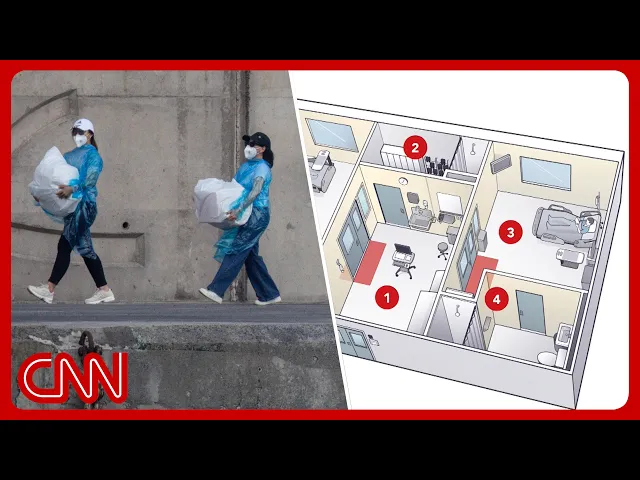
2:36 and Briana, as those two passengers here in Atlanta continue to be monitored,
2:41 here's a diagram of what the special
2:44 isolation facility looks like here at Emery.
2:47 You'll see on this diagram, area one is where doctors enter the space,
2:52 they put on their protective gear.
2:54 Area 2 is an example of what a patient room looks like.
2:58 And again, these two passengers here at Emery are two
3:01 of 18 total that are being monitored here in the United States.
3:05 The 16 others are in Nebraska.
3:07 And in the post on X, the Department of Health and Human Services also said
3:12 that the 16 passengers who arrived at uh in Nebraska,
3:18 they are actually remaining asymptomatic.
3:21 So that's another update again from the Department of Health and Human Services.
3:25 But Briana, you know, this virus has a long incubation period.
3:29 So these passengers are going to continue to be monitored for about 42 days.
3:34 And we also know that when you're in a situation like
3:38 this, it's likely that more cases may emerge in the days to come.
3:43 So that's also something that health officials are watching closely.
3:46 Briana.
3:46 Yeah.
3:46 And they may be expecting that.
3:48 Jacqueline Howard live for us in Atlanta.
3:51 Thank you.
3:51 The World Health Organization now says there are 11
3:54 cases of Hunter virus linked to the cruise ship Handias.
3:58 A French woman who became sick after being evacuated
4:01 is in intensive care in stable condition, we're told.
4:05 Here in the US, 16 passengers are quarantined in Nebraska.
4:09 One is in the bioontainment unit after testing positive.
4:14 None are displaying symptoms.
4:16 Two other people, a couple, are in a bioontainment unit in Atlanta.
4:20 At least one is showing symptoms.
4:22 Today, we're hearing from some of the passengers
4:25 as they begin weeks of quarantine.
4:27 They describe the terrifying moment on the ship
4:30 when they were first alerted to the virus.
4:33 I think it was a really scary moment for me personally.
4:37 I think like anyone,
4:38 when you hear a virus that you may not know about, you Google it.
4:42 And you know probably when you Google this virus,
4:45 it's some very scary statistics.
4:47 However, it is a virus that you we do know about and it took me
4:52 some time over those coming days to do more research and learn more about it.
4:57 But it was a scary time and I had a lot of up and down emotions,
5:02 but I spent most of my time in my cabin.
5:05 And joining us now, our chief medical correspondent, Dr.
5:08 Sanjay Gupta.
5:09 Sanjay, what do the weeks ahead look like for those who are starting quarantine?
5:14 Well, you know, it it's uh 6 weeks, so 42 days, you know,
5:18 that's sort of the uh in in combination with the time on the ship,
5:21 the incubation period for this virus.
5:23 Uh the time period from when someone might have
5:25 been exposed to the time when they might develop symptoms.
5:28 I think these first 72 hours are going to be the most critical.
5:31 Uh this is sort of an assessment period for them.
5:33 uh doing a medical exams, things like that, but also getting a sense of uh
5:38 did they have contact with somebody who has the virus?
5:41 Did they have contact with someone who was sick?
5:44 Obviously, seeing if they develop symptoms.
5:45 I think one of the big questions is going to be uh do people need to stay
5:50 in the in the uh facilities there or could
5:53 they potentially go home and be monitored there?
5:56 Um, we're still sort of trying to nail down where
5:59 I I think the recommendation is they stay in the facilities,
6:02 but they may allow some of these folks to go home as well.
6:05 Um, and then see sort of what happens.
6:07 It is likely, we're hearing from just about everybody that there
6:11 may be more people who subsequently test positive after developing symptoms.
6:15 So, we'll see what happens.
6:17 These are incredible facilities, Wolf.
6:18 As you know, I'm on the faculty at Emory.
6:21 Um, Ebola patients were brought back here several years ago.
6:24 They have a a a uh a mechanism to try and prevent other people obviously
6:29 in the facility from getting sick but also
6:32 provide care should any of these passengers/patients get sick.
6:35 Wolf uh officials have continued to say Sanjay that the risk overall is
6:40 low that the spread of the virus is usually limited to close contacts.
6:45 Here's what the assistant secretary of health uh
6:48 for health and human services had to say.
6:53 Let me be clear.
6:55 Let me be crystal clear.
6:56 The risk of Hanto virus to the general public remains very very low.
7:01 The Andes variant of this virus does not spread easily
7:05 and it requires prolonged close contact with someone who is already symptomatic.
7:10 Even so, we have taken this situation very seriously from the very start.
7:16 Sanjay, do you agree?
7:17 Well, you know, I think a lot of this it comes down to a a study
7:23 that was done of a what what is known as a super spreader event back in 2018.
7:27 There's not a lot of data on this, right?
7:30 So, you know, thousands of cases maybe around the world,
7:32 hundreds of cases of human to human transmission,
7:34 not a lot of data, but let me show you this image and uh you know,
7:38 we we can put it up on the screen
7:40 and basically tell you the story of a guy number one
7:42 in the middle of the screen there who was a guy
7:45 who walked into a birthday party and was there for 90 minutes.
7:48 He was sick when he walked into the party.
7:50 And you see the other red uh num numbers around the tables there.
7:54 Five people who got sick as well became infected as a result of this event.
7:59 Four of those people are are in close proximity as was just said,
8:03 you know, within 4t or so.
8:05 But there was another guy who was across
8:07 the room and that was not in close proximity.
8:09 And the only time they had any proximity was when one
8:12 was leaving the restroom and one was going to the restroom.
8:15 the restrooms in the bottom left corner.
8:17 So, is that considered close contact?
8:19 Probably not.
8:20 I think that the question becomes if you're infectious,
8:23 if you're sick, uh during that time, you could potentially spread it to people
8:28 who are even further away for shorter duration.
8:30 Wolf, Dr.
8:31 Sanjay Gupta, thanks as usual.
8:33 Appreciate it very very much.
8:35 Joining us now is Bryce Warner.
8:36 He's a research scientist at the vaccine and infectious disease
8:39 organization at the University of Saskatchewan
8:42 and has extensively researched antiviruses.
8:44 Bryce, thank you so much for being with us.
8:47 Uh, the Andes strain is rare.
8:49 By some estimates, there's only like 3,000 documented cases of it.
8:53 Perhaps the most well-known outbreak was back
8:55 in 2018 at the small village in southern Argentina.
9:01 What did scientists learn there?
9:04 Yeah.
9:04 So, I mean that you're right,
9:06 that was the largest outbreak that had been documented and and that was really,
9:10 you know, by far the largest persontoperson spread that we've seen.
9:13 it was, you know, over 30 cases um and you know,
9:17 a high case fatality rate and that was spread through,
9:21 you know, a person attending a birthday party.
9:22 And so that was really the first sort of transmission to humans that we
9:26 would we've seen that we think of in in the the typical context.
9:29 Most of the previous cases of human to human
9:31 transmission had been sort of in the hospital setting.
9:34 And so this was really evidence showing that you know
9:36 this virus can transmit human to human although it is rare.
9:40 So when we hear about humanto human transmissibility requiring
9:44 close and prolonged contact perhaps not a coincidence that not
9:49 far from where this boat docked there had been
9:52 this outbreak and then you have people on board an enclosed
9:56 space and which they're constantly interacting with each other
9:59 and the folks that prepare the food are interacting
10:01 and and so I guess my question is h how
10:03 do we know what that kind of close proximate contact means?
10:10 outside of a cruise ship.
10:14 Yeah.
10:14 And so I mean, you know, before this happened, I mean,
10:16 we we would normally have have thought of it as like in the context
10:20 of that previous outbreak or really in the context
10:22 of someone caring for someone who is sick,
10:24 like a healthcare worker or a loved one taking
10:26 care of their family member or something like that.
10:28 This cruise ship is, you know,
10:30 a unique situation obviously and so where we're seeing,
10:33 you know, a married couple in the same cabin,
10:36 but then people, you know, interacting in close quarters on the ship,
10:39 probably in the dining hall and and things like that.
10:41 And so, you know, this is just another, you know,
10:44 mechanism that that adds to our understanding of how the virus can transmit.
10:48 And just so that we're clear, the verality and and transmissibility of it, um,
10:54 how exactly is it that it jumps from person to person in in what window of time?
11:02 Yeah.
11:02 And so the, you know, the evidence there, you know,
11:06 really indicates that the the period of transmissibility is is maybe a day
11:11 or two before you start to show
11:12 symptoms and then through that symptomatic period.
11:15 And then it would really be in, you know, bodily fluids, um, you know,
11:19 close contact with, you know, saliva, any sort of secretions, things like that.
11:23 So, you really do have to be in close contact with the person.
11:26 It's not, you know, through speaking and through airborne transmission
11:29 like we think of with influenza or CO 19 was.
11:32 And so after several days of observation,
11:35 the folks that are being carefully watched, uh,
11:38 officials are going to decide whether those 15 will actually get to go home
11:43 for the rest of their 42day monitoring
11:46 period or if they'll stay under medical observance.
11:49 I I wonder which you think is more advisable,
11:53 how they go about even making that decision.
11:57 Right.
11:57 And and that's really one of the main questions we've been getting
11:59 the last couple days is is you know which is preferred and you
12:02 know it's a difficult question to answer and it's really up
12:05 to each jurisdiction and what their tolerance level for for this risk is.
12:10 Um you know I think both there's you know both ways make sense.
12:14 Um you know some jurisdictions are sending people home
12:17 like in Canada that's what we've done and they're isolating.
12:20 I think you know still the the critical aspect is really monitoring daily
12:24 you know and making sure that if you do have symptoms then it's
12:28 really you know a matter of getting medical care and alerting the proper
12:31 authorities because that would you know
12:33 that would lead to potentially more spread.
12:35 Bryce Warner thanks so much for sharing your expertise.
12:38 Great.
12:39 Thank you for having me.