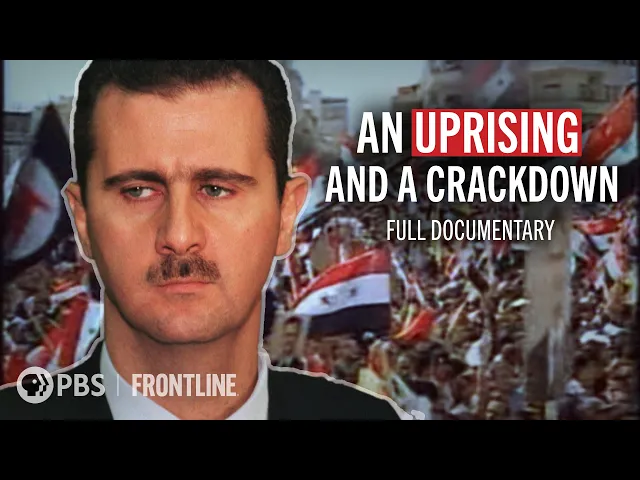
How Assad Moved to Crush Syria’s Uprising | The Regime (full documentary) | FRONTLINE (PBS)
FRONTLINE PBS | Official
0:13 What kind of government turns so
0:15 fiercely on its own citizens?
0:17 [music] What kind of man is its leader?
0:22 And why does what happens here matter?
0:30 I think it would be easy to make the
0:31 argument that Syria's rebellion is the
0:33 most important of all the rebellions
0:35 happening in the Arab world.
0:38 Syria is so embedded in the
0:39 relationships in the region.
0:41 Its long-standing alliance with Iran, its
0:43 long-standing alliance with Hezbollah,
0:45 uh the border it shares with Israel, the
0:47 border it shares with Turkey and Iraq.
0:49 And the idea that something could spiral
0:51 out of control very quickly is not
0:53 beyond the realm of possibility.
0:58 The Syrian rebellion began in a small
1:00 farming town 60 mi south of Damascus.
1:04 On March 6th, 15 young boys painted
1:08 messages on these school walls.
1:13 They were copying what they've been
1:15 listening to in El Jazzer and other TV
1:18 channels covering the Egyptian uprising
1:21 and the Tunisian uprising.
1:24 Soon after, the boys were rounded up by
1:26 the government's secret police, the
1:28 Muhabarat.
1:31 Their fathers went to see the police
1:32 chief, a cousin of Syria's president,
1:36 Bashar al-Assad, and begged him to
1:39 release their children.
1:41 He refused, and he said, "Forget that
1:44 you have these kids.
1:46 Go and make other
1:47 ones." And if they were not men enough
1:50 to make children, then bring us your
1:53 wives and we will make children for you.
1:57 One boy was never returned.
1:59 He is presumed [music] dead.
2:02 Images of another circulated on YouTube.
2:05 Several of the children had their
2:07 fingernails pulled out.
2:08 They were beaten.
2:09 And there are even reports of
2:12 rape being committed against these
2:14 children.
2:15 And in a close-knit tribal
2:16 society like that, there was only one
2:18 thing they could do.
2:19 Be rioted.
2:22 [cheering] That very instance of repression, of
2:26 torture seemed to galvanize the town
2:28 itself.
2:28 Here were the children of the
2:29 town being mistreated by a government
2:31 that was distant, that had neglected
2:32 Dada.
2:33 Uh and almost from that moment, uh
2:35 the uprising seemed to gain momentum.
2:41 It led to a major demonstration that was
2:44 put down brutally by force with the
2:47 killing of several civilians.
2:52 And it snowballed from there.
3:00 Many Syrians who hoped that President
3:02 Bashar al-Assad might intervene felt
3:04 betrayed.
3:06 Those who believed in President Bashar
3:08 Assad lost all that faith when the first
3:11 bullet was fired at a civilian in a
3:13 street in Syria.
3:23 For over four decades, the Assads have
3:25 ruled Syria, a fractious country of many
3:28 tribes and religions.
3:33 The Assads come from a long persecuted
3:35 minority Muslim sect, the Alawites.
3:39 The Alawites had traditionally been the
3:41 repressed and oppressed in the country.
3:43 In fact, a famous uh Sunni medieval
3:46 philosopher by the name of Iban Ta once
3:48 declared that the Alawites were worse
3:50 than Jews and Christians and were
3:51 infidels and there should be a holy war
3:52 carried out against them.
3:55 But Hafa al-Assad found a path to power
3:58 through the military.
3:59 Under French colonial rule, Sunnis had resisted
4:02 serving while Alawites like Hafes found
4:06 opportunity.
4:08 The young Assad was also a rising star
4:10 in Syria's socialist bath party.
4:14 At age 40, he engineered a coup to seize
4:16 the presidency.
4:19 Hafazles had rose to power from the
4:21 bottom up.
4:22 He had to fight the battles
4:23 that came with the coup d'etas that came
4:25 with trying to corral the different
4:26 forces of the country into his camp.
4:29 He ruled by putting trusted family
4:31 members in high government posts.
4:34 The brother is in charge of security,
4:36 the cousins of the banking system,
4:38 in-laws uh in security as well and
4:41 military.
4:41 So the reality is this is a
4:43 family business.
4:44 And like Tito in Yugoslavia or Hussein
4:47 in Iraq, Assad also knew how to use
4:50 force.
4:51 His Bath party repressed any
4:53 ethnic or religious challenges.
4:55 The Bath party promised to get rid of
4:58 sectarianism.
4:59 He demanded and for the
5:00 most part the Syrian population was
5:02 receptive to this Fostian bargain that
5:05 the Syrian people would accept a little
5:06 bit less freedom and liberty in return
5:08 for stability.
5:11 Assid also secured his power by taking
5:13 in millions in Soviet military aid and
5:17 welcoming thousands of Soviet advisers.
5:20 But in 1979 there was a revolution in
5:23 Iran.
5:26 The dynasty of the sha was replaced by
5:28 an Islamic state under Ayatollah Kamei.
5:32 In Syria and across the Middle East,
5:34 Islamic fundamentalists rose up
5:37 and there were attacks against the
5:38 regime.
5:39 It was essentially almost a
5:41 civil war.
5:42 A bombing campaign targeted government
5:44 buildings and Alawite military officers.
5:48 The attacks went on for several years
5:50 and in 1982 the regime basically said
5:53 that's it.
5:53 That's enough.
5:54 We have to deal with this once and for all.
5:56 We have to show that we're in control.
6:03 Their chief target was the stronghold of
6:05 Syria's Muslim Brotherhood, [music]
6:07 Hama.
6:08 In 1982, the Syrian regime launched one
6:12 of the worst massacres in the history of
6:13 the [music] Middle East.
6:14 The regime used artillery to level large parts of the
6:17 town.
6:18 Between 10 and 30,000 people were
6:20 killed or were disappeared by the
6:22 regime.
6:24 [music]
6:24 Bodies were buried before these pictures
6:26 were taken.
6:28 I just remember there was a lot of
6:30 rubble [music] and a lot of destruction.
6:32 It looked like a war zone.
6:34 Amar Alazam was studying archaeology.
6:37 On his way to a dig, he drove through the
6:40 city.
6:40 And the other thing I remember
6:42 were these neatly bulldozed areas where
6:45 where where areas had been cleared and
6:46 bulldozed as we drove through the city.
6:49 These were probably also the mass graves
6:51 that everybody talks about.
6:53 That was a very stark moment in which
6:57 the Alawi dominated regime, the Bath
7:00 party um made it clear to Syria that it
7:03 would not brookke any opposition.
7:06 It was a ruthless obviously makiian way to deal
7:08 with the problem but it did deal with
7:10 the problem from the perspective of the
7:12 Syrian regime because uh until recently
7:14 you really haven't had uh any serious
7:17 Islamist opposition uh to Hafas al-Assad
7:20 or his son when he came to power in
7:21 2000.
7:23 A phrase was coined the hama rules the
7:27 idea that you quash rebellion by making
7:29 sure that your citizens know that you
7:31 play by no rules at all.
7:36 [cheering] [applause]
7:42 Almost 30 years later, President Bashar
7:45 al-Assad faces a similar test in Hama.
7:48 [cheering]
7:56 Hama looked like Cairo.
7:58 It looked like Tunis.
7:59 This was a popular uprising and
8:00 the government was very threatened by
8:02 that narrative.
8:05 I think there's a sense out there within
8:07 the government that what they're facing
8:08 right now is reolent of what they faced
8:11 in the late 70s and early 80s [cheering]
8:14 and it helps feed that [music] notion
8:16 that we can deal with this by security
8:18 and security alone.
8:20 The regime has a playbook.
8:22 If you're faced with a crisis, go back to the
8:24 playbook and see what we did the last
8:26 time we got through a crisis.
8:28 So the last time they got through a similar
8:30 crisis was hammer.
8:32 So you have a
8:33 protest, you have an uprising, you
8:35 suppress it.
8:36 The playbook does not say
8:37 negotiate with the protesters.
8:39 So there's no negotiation.
8:46 One very high-ranking Turkish official
8:48 told me that what's going on inside the
8:50 leadership is that Bashar's mother
8:51 herself is telling him that these are
8:53 the same events that they remind her of
8:54 what happened in the late '7s and early
8:56 80s.
8:57 And her advice to him is that he
8:58 has to act like his father.
9:00 He has to be
9:01 strong.
9:01 He has to be decisive and he has
9:03 to crush this element of rebellion
9:04 against him.
9:08 Bashar sent in tanks, armored vehicles
9:11 and snipers.
9:15 This is how the Assad, both father and
9:17 son, deal with domestic threats.
9:20 They retreat into their Alawite fortress uh
9:23 and there's this convulsive reaction
9:26 to put down any sort of domestic threats
9:28 and to put them down ruthlessly.
9:32 Many Syrians had hoped Bashar would be
9:34 different than his father.
9:37 During the first massacre of Hama,
9:39 Bashar was studying medicine at the
9:41 University of Damascus.
9:43 The studious 17-year-old expressed no political
9:46 ambitions.
9:47 After graduation, he moved to
9:49 London.
9:51 He was not earmarked for the presidency.
9:53 He was going to be an opthalmologist and
9:55 he was prepared to do that for the rest
9:56 of his life.
9:58 The heir apparent was
9:59 Bashar's older brother, Basil.
10:02 But in 1994, he was killed in a car
10:04 accident.
10:06 Bashar was ordered to come
10:07 home.
10:09 He joined the Republican Guard and was
10:11 sent to serve in Lebanon.
10:13 Preparing for the day he would take
10:15 office.
10:18 We all knew he was going to take over.
10:20 We all knew that Hassad was on his last
10:23 legs, if you want.
10:24 Um, you know, he was
10:25 close to death.
10:26 It was very clear that
10:26 he was very ill and the question was
10:28 always how well-groomed has Bashar been.
10:33 President Assad has closed.
10:34 He was inaugurated in July 2000.
10:37 The young doctor with his fashionable
10:39 Britishborn Syrian wife, a former banker
10:42 at JP Morgan promised reform.
10:45 People were giddy with the idea of
10:48 reform.
10:48 Early on in Bashar's reign, he
10:51 opened up the country to the internet.
10:53 He lifted uh exit permits which were
10:55 required for Syrians to travel and he
10:58 allowed more trade in the country.
11:00 He said we can open up.
11:02 We're going to have some private newspapers, private
11:04 press, internet.
11:06 And he believed that he
11:08 could win the hearts and minds of the
11:10 people through modernization and let a
11:14 lot more light in.
11:19 He had allowed what became to be known
11:22 as the Damascus spring.
11:24 He promised reforms and he promised political
11:27 reforms.
11:28 And so there were political
11:30 salons that began to emerge and people
11:33 began to talk about ideas.
11:35 How is Syria going to meet the future?
11:38 Which path is it going to take?
11:39 And there was an era I
11:41 would say in the 2003 2004 in which
11:46 there was an open debate and a healthy
11:48 one.
11:50 [music] He was genuinely popular amongst the
11:53 young people who hadn't lived through
11:55 his father and who saw him as potential
11:57 reformer and he kept on telling them
11:59 that life was going to get better and
12:02 they could see fairly dramatic changes
12:04 at least for the wealthy.
12:06 In Damascus and Aleppo, the two largest
12:09 cities, the transformation was evident.
12:12 There's been a great deal of
12:13 infrastructural improvement in both
12:16 cities.
12:16 That's very noticeable to anyone
12:17 who's been to Syria over the years.
12:19 Uh there's been a nuvo ree that has been
12:22 created.
12:23 There was a sense of commercialism.
12:25 People felt that they were seeing things
12:27 in the street that they might see in
12:28 Beirut, a much more prosperous city in
12:30 some ways.
12:32 But the regime's old guard watched the
12:34 Damascus spring with fear.
12:36 They urged Bashar to stop his political reforms.
12:40 They told him it would undermine the
12:42 regime.
12:43 The political establishment, the Bath
12:45 party.
12:46 And those in the senior ranks of
12:48 authority uh decided that if this free
12:51 political debate was going to continue,
12:54 they were going to lose their heads.
12:57 Uh and so uh there was a sudden clampdown,
13:00 it was the return of authoritarianism.
13:05 In 2005, hundreds of activists and
13:08 intellectuals were arrested.
13:10 The Damascus spring was over.
13:14 For the next several years, as Syria
13:16 faced drought and high unemployment,
13:18 especially in the countryside, President
13:21 Assad's popularity eroded.
13:26 [cheering] This year, a popular revolt in Tunisia
13:33 toppled a dictator.
13:37 [cheering]
13:39 Egypt was next.
13:43 It was unclear if the Arab Spring would
13:45 spread to Syria.
13:47 There was a sense that there was going
13:48 to be a contagion that this unrest might
13:50 spread to other parts of the Arab world.
13:53 But even at that moment, I think there
13:54 was a sense that Syria was too
13:56 authoritarian.
13:58 Syria wasn't at the point
13:59 where it would have fed a rebellion.
14:00 And I think that's why until now we've seen
14:02 this uprising focused in the countryside
14:04 rather than the big cities.
14:07 This is a movement of the rural parts of
14:09 Syria, this disenfranchised countryside
14:11 that was stricken by drought, neglected
14:12 by the government, and that had a lot
14:14 less to lose, say, than the bigger
14:16 cities like Damascus and Aleppo.
14:21 At first in rural towns like Dra homes,
14:25 Latakia and Hama, workers and farmers
14:28 were timid in their demands.
14:31 Initially when the protest went out,
14:33 people were asking for dignity.
14:35 They were asking for housing to subsidize
14:38 heated fuel.
14:39 We want jobs.
14:40 We want cheap bread.
14:41 And it is only when uh the
14:44 authorities turned brutal on them deadly
14:47 uh that they began to chant that they
14:49 want a change of regime.
14:59 [applause] A month after the uprising began,
15:11 President Assad came before Parliament.
15:15 Syria's business and political elites
15:17 applauded him.
15:19 He walked in and it was
15:20 all very jovial.
15:22 There was a lot of
15:23 clapping and cheering every time he
15:24 spoke.
15:25 At one point, one of the members
15:26 of parliament stands up and says, "Sire,
15:29 you are such a brilliant leader that you
15:32 should not just be the leader of Syria,
15:33 you should be the leader of the world."
15:36 The expectation, not only the popular
15:39 exploitation, but the expectation of
15:41 those circles of power or that Bashar
15:44 Assad was going to stand there and
15:46 introduce a package of reforms that
15:48 hopefully would allay these grievances
15:51 and would meet with the popular demands.
15:54 Instead, he stands up there uh to accuse
15:59 this entire uprising of being a foreign
16:02 conspiracy.
16:09 There was no sense of remorse.
16:11 That's what shocked people.
16:13 There seemed to be
16:14 a complete detachment as if everything's
16:16 going to be okay.
16:17 My people love me and
16:18 look, my car was being mobbed as I leave
16:21 the parliament.
16:25 [applause]
16:32 Outside Damascus, the calls for Bashar's
16:34 resignation were only getting louder.
16:41 As the uprising spread, demonstrators
16:44 picked up a song written by a brick
16:46 layer from Hama.
16:50 Then it was recorded by a popular Syrian
16:52 singer Ibrahim Kash.
16:57 It became the people's anthem.
17:01 [cheering] It's kind of a popular song and the
17:19 lyrics was carefully chosen and
17:21 sometimes funny, sometimes humor,
17:23 sometimes uh very deep and it was soon
17:28 all over the country.
17:32 But in July, the singer was silenced.
17:36 Eventually they got hold of him.
17:39 and they uh tortured him brutally
17:42 uh to a limit that they took off his uh
17:46 his throat and they ditched him in a
17:49 river.
17:52 When he was discovered his throat was
17:54 obviously caught out uh just to send a
17:57 message that whoever dares to chant
17:59 against Bashar Assad will face a similar
18:02 destiny.
18:05 The regime also organized mass rallies
18:08 of its own in Damascus and Aleppo.
18:12 Government workers were called to the
18:13 streets.
18:20 There is a very strong well of support
18:23 for the regime in those cities.
18:25 And this is vital for the regime because the last
18:28 thing they want to see is a situation
18:30 that occurred in in Egypt in Tahir
18:32 Square in in the center of of Cairo.
18:35 Uh you know if that happens if there are
18:37 large-scale protests in Damascus and
18:39 Aleppo that's when it becomes uh you
18:42 know almost a certainty that the regime
18:44 will will fall.
18:45 Today it's the upper
18:46 class Sunnis from the cities who are
18:50 hanging with the regime and feel like
18:53 things were going in the right direction
18:55 and they don't see any alternative and
18:56 they're frightened of the countryside
18:58 getting too much power and taking over
18:59 and perhaps being too fundamentalist and
19:02 other things for them.
19:04 [cheering]
19:04 For now, months after the uprising
19:07 began, Bashar al-Assad is holding on,
19:11 even declaring victory.
19:13 Most people thought this regime would
19:15 have crumbled and fallen by now.
19:16 They gave it Ramadan.
19:18 Everybody was saying in
19:19 Ramadan it's going to do it 6 months.
19:21 This sort of thing.
19:22 And now we're in the
19:23 seventh month and the regime is
19:25 confident.
19:26 [cheering] There's no question at this point that
19:30 the Syrian government thinks it's won.
19:33 There's a sign in Damascus these days
19:34 that says it's over.
19:36 Another sign says congratulations Damascus, we won.
19:38 I think there is a mindset in that
19:40 government.
19:40 It does believe it's won.
19:47 But the opposition is not conceding.
19:50 They have formed a political party and
19:52 called for outside help.
19:56 Defecting military officers have [music]
19:58 established their own militia.
20:01 Syria's neighbors now worry that a
20:03 Syrian civil war is imminent [music] and
20:06 may overflow its borders.
20:10 When the Arab revolts began at the
20:12 beginning of the year, there was so much
20:13 hope.
20:14 But what we're seeing with Syria
20:15 is the danger is the flip side of those
20:18 Arab revolutions.
20:20 [cheering] Civil war in Syria is going to have
20:22 reverberations immediately in the rest
20:24 of the region.
20:26 And I think everyone's
20:26 bracing themselves for that.
20:32 Syria is the hub of this tinder box and
20:36 a region which is extremely unstable.
20:38 And should it fall and there be civil
20:41 war, it could ignite flames of
20:45 revolution and undermine regimes which
20:48 are extremely important.
20:51 So it's hard to see where this ends.
20:57 [music]
21:26 [music]
21:33 for more on this and other Frontline
21:34 programs, visit our website at pbs.org.
21:48 Front lines Syria Undercover is
21:50 available on DVD.
21:52 To order, visit shoppbs.org
21:55 or call 1 800play PBS.
21:58 Frontline is also available for download on iTunes.
22:16 [music] [music]