2025 Was Nut(s): A Canadian CIO's Review
Ben Felix
0:00 This year was nuts, both in markets,
0:02 which I'll get into in a minute, and personally for me.
0:05 I had testicular cancer, down to one testicle now.
0:08 I had surgery on the same day in January that PWL Capital,
0:12 the firm that I've worked for for 12 years,
0:14 announced it had been acquired by 1 Digital.
0:17 We were previously a small privately owned Canadian firm,
0:20 now owned by a much larger American firm.
0:23 As a PWL Capital shareholder and employee,
0:25 the acquisition was actually good news and it's unleashed
0:28 PWL's potential to improve our offering and expand across Canada,
0:32 which has been a ton of fun.
0:33 Okay, my personal news aside, 2025 was a wild ride.
0:37 Early in the year, it looked like we were in for a bad time,
0:40 but things turned around and returns in stocks, gold,
0:44 Bitcoin, and real estate were not what anyone was expecting.
0:47 I'm Ben Felix, Chief Investment Officer at PWL Capital,
0:50 and I'm going to tell you what we can learn from 2025.
0:57 I want to say a quick thank you to everyone watching this channel.
1:00 It had by far the most views and largest increase
1:03 in subscribers since I started posting videos here back in 2017.
1:07 I'm grateful that you all like to nerd out
1:08 with me and hope we can keep it going in 2026.
1:12 In this video, I want to talk about some of the unexpected
1:14 things that happened in 2025 that I think investors can learn from.
1:19 I was having a lot of conversations in late 2024 with people
1:22 who wanted to go all in on the US stock market,
1:24 either abandoning international diversification
1:27 entirely or reducing their exposure
1:29 to Canadian and international stocks in favor of more US exposure.
1:34 This wasn't really surprising.
1:35 At the end of 2024, the US market had been crushing other markets for years.
1:40 For example, for the five years ending December 31st, 2024,
1:44 the US market had outperformed the Canadian
1:46 market by nearly five percentage points annualized.
1:49 And it outperformed international developed and emerging
1:52 markets by an even wider margin, all measured in Canadian dollars.
1:56 And that's just five years.
1:57 Go back further, 10 years, it was still a big outperformance in the US.
2:01 In addition to that, there was plenty of doom
2:03 and gloom about Canada's stock market and Canada's economy.
2:07 We had a productivity crisis.
2:09 We had a proposed hike to our capital gains inclusion rate.
2:12 Uh capital was fleeing the country when Trump was elected as the 47th President
2:17 of the United States and started threatening
2:19 tariffs that could damage Canada's economy further.
2:22 All of those concerns were exacerbated.
2:25 I'm not suggesting these are not real economic issues.
2:27 They are.
2:27 But if you had read these headlines and then
2:30 not looked at the stock market all year,
2:32 you would probably assume the Canadian market went on to have a terrible year.
2:36 That assumption would be wrong.
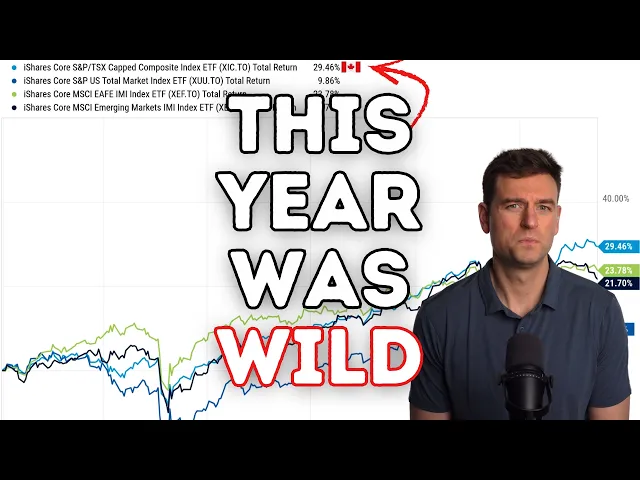
2:38 As of December 17th, 2025, the Canadian stock market index fund
2:42 had returned 29.46% since January 1st, 2025,
2:48 placing it ahead of international developed and emerging markets and more than
2:51 tripling the Canadian dollar return on a US total market index fund.
2:55 Missing a big year like that is hard to come back from.
2:58 I think there are a couple of important lessons here.
3:01 One is that the stock market is not the economy.
3:03 The stock market prices forward-looking information about
3:05 the expected future cash flows of businesses.
3:08 The economy does affect those expected future cash flows,
3:11 but economic data are backward-looking.
3:14 By the time we hear a headline about Canada's economy,
3:16 the market has likely already priced it in months prior.
3:19 If economic data end up being bad,
3:21 but better than what the market had been expecting,
3:24 we can even see a rise in stock prices on bad economic news.
3:28 It's crazy to think about.
3:30 This makes basing investment decisions on economic news
3:33 a pretty bad idea most of the time.
3:34 The other related lesson is that while the future is hard enough to predict,
3:38 future stock returns are probably even harder.
3:41 Some news, like unexpected tariffs, can affect stock prices in the short term.
3:46 Looking back to early 2025, it seemed like tariffs would be putting
3:50 significant downward pressure on all stock markets.
3:53 Again, the market is always looking ahead.
3:56 A shock like tariffs can result in stock prices falling on the news,
4:00 but as new information about the actual
4:02 impact of tariffs become known, markets adjust.
4:05 The US stock market was down more than
4:07 16% in Canadian dollar terms in April 2025.
4:11 One of the things I said in a video earlier this year, around that time,
4:14 looking at historical data for the US stock market,
4:17 was that negative intra-year returns don't
4:19 always predict negative returns for the year.
4:22 It's not uncommon for stocks to enter
4:24 negative territory at some point during the year,
4:27 while then finishing the year with positive returns.
4:29 And that is exactly what we saw in 2025.
4:32 This is one of the many reasons that sticking
4:34 to your long-term plan is generally much better than trying to get
4:37 in and out of the market or otherwise changing your portfolio
4:40 based on whatever might be happening in the world around you.
4:43 I think the other big lesson here
4:44 is that international diversification is still not dead.
4:48 There's been an increasing perception that the US stock market
4:51 is the only market that anyone needs to invest in.
4:53 I and many other people smarter than me have been saying for years now
4:56 that international diversification continues to be one
4:59 of the most important principles for long-term investors,
5:02 despite the recent outperformance of the US market.
5:05 2025 was a good reminder of why this is true.
5:08 A single country stock market, including the US market,
5:11 can go through both short and long periods of poor performance.
5:15 The US lost decade wasn't all that long ago, but it's easily forgotten.
5:19 In those periods, international diversification often pays off,
5:23 as it did this year.
5:24 Canada's incredible stock returns this year seem to have largely gone unnoticed.
5:27 The other story that I've not seen mentioned much
5:29 is the returns of Canadian value and small-cap value stocks,
5:33 which have had an even bigger year than the Canadian market as a whole.
5:36 The iShares S&P TSX Small Cap Index ETF
5:39 returned 47.94% from January 1st through December 17th,
5:44 2025, and the iShares Canadian Value Index ETF returned 33.63%.
5:50 I know it doesn't make sense to focus on one year of returns,
5:53 but the crazy thing here is that if we looked at the data a year ago,
5:56 the 10-year returns of Canadian value and small-cap stocks trailed the market.
6:01 Value stocks were only a little bit behind.
6:03 Small caps were way behind.
6:05 Fast forwarding to December 17th, 2025, so now we're looking at just under 11
6:09 years of data from the same starting point,
6:12 Canadian value has now outperformed for the full period,
6:15 and while small caps are still trailing the market,
6:17 it's a lot closer than it was.
6:19 The lesson here is that if you believe in an investment strategy,
6:22 staying in your seat is extremely important.
6:25 Returns often come in short spurts.
6:27 Missing out on them is easy to do if you don't stay invested,
6:30 and missing out is very hard to recover from.
6:33 It's kind of like getting up to pee during a hockey game and missing a big goal.
6:36 The small cap and value examples are of particular interest to me.
6:40 While I am a big believer in total market index funds,
6:43 and I talk about them on the on this channel all the time,
6:45 that is not how I invest my money or the money of most of PWL Capital's clients.
6:49 We use funds from a company called Dimensional Fund Advisors,
6:52 which look a lot like total market index funds,
6:55 but they tilt toward small-cap, value, and highly profitable companies.
6:59 That approach has struggled at times in recent history,
7:02 but the Dimensional Canadian Equity Funds similarly had
7:05 a big year in 2025 due to their exposures.
7:08 People get annoyed when I bring up Dimensional Funds because
7:11 they're not available directly to DIY retail investors in Canada,
7:15 but on that point, I have some really good news.
7:17 Avantis Investors, a direct competitor to Dimensional Fund Advisors,
7:21 is partnering with CIBC to launch a suite of Canadian-listed ETFs.
7:25 Like Dimensional, Avantis Funds are very similar to index funds in principle.
7:29 They're low cost, broadly diversified, and tax efficient,
7:32 but they have a more flexible implementation approach,
7:35 and unlike a total market index fund,
7:37 which holds stocks at their market capitalization weights,
7:40 Avantis uses financial economic theory and evidence to tilt toward small-cap,
7:45 value, and highly profitable stocks.
7:47 These tilts are designed to increase expected long-term returns.
7:51 The big development here is that while Dimensional Funds
7:53 in Canada are only available through advisors like PWL Capital,
7:57 Avantis ETFs will be available directly to retail investors.
8:01 I used US-listed Avantis ETFs in my old model portfolios that were designed
8:06 to give retail investors in Canada a way to implement this investment approach.
8:10 I will definitely make a dedicated video
8:12 when I have something more to talk about.
8:13 We do know the fees listed in the preliminary prospectus,
8:16 which look very reasonable.
8:18 The Avantis CIBC All Equity Asset Allocation
8:21 ETF has an annual management fee of 0.28%.
8:25 This is not the MER, to be clear,
8:26 the management expense ratio, which includes other costs and taxes in it.
8:30 For example, XEQT has a management fee of 0.18% and an MER,
8:36 management expense ratio, of 0.2%.
8:39 Even if the Avantis fund comes in at 0.35% uh for the MER,
8:44 it still looks pretty good for what you're getting.
8:47 It's like uh like an asset allocation fund that looks a lot like VEQT or XEQT,
8:52 but it's got built-in tilts toward small-cap,
8:54 value, and high-profitability stocks.
8:57 Based on the preliminary prospectus,
8:58 it will have a long-term strategic asset mix of 45% US stocks,
9:02 32% Canadian, 15% international developed, and 8% emerging markets.
9:07 Again, very similar to an XEQT or a VEQT.
9:11 This is definitely a development to watch in 2026
9:14 if you're as much of a nerd as I am.
9:16 To be clear, I'm not affiliated with or being paid by Avantis,
9:20 and I gain nothing from you using their products in Canada or in the US.
9:23 I just think this is good news for the nerdiest of us Canadian
9:26 investors who want an easy-to-use evidence-based
9:29 alternative to low-cost total market index funds.
9:32 Gold has had an incredible year.
9:34 The iShares Gold Bullion ETF returned 57.53% in Canadian
9:38 dollar terms from January 1st through December 17th, 2025.
9:43 I have never been a proponent of holding gold in portfolios for the simple
9:46 reason that it's not a productive
9:47 asset with a meaningfully positive expected return.
9:51 Gold has long-term returns.
9:52 By long-term, I mean 100 years or longer,
9:55 roughly in line with inflation, maybe a little higher.
9:58 Short-term returns will fluctuate wildly around its real value and a mixed
10:03 track record as a hedge against bad markets and inflation.
10:06 Its place in a portfolio is not obvious to me unless you
10:08 have a belief that its price will go up while you hold it,
10:11 which to be fair worked out great for people who were holding it this year.
10:15 As Warren Buffett has said, what motivates most gold purchases is their belief
10:19 that the ranks of the fearful will grow.
10:21 It makes sense to buy gold if you think other
10:24 people are going to want to buy gold in the future.
10:27 I don't love that reason to invest in something,
10:29 which is why I don't hold it or suggest holding it.
10:31 The question I keep getting based on gold's returns this year is
10:34 whether my views on gold have changed in light of its recent performance.
10:38 I am totally open to updating my beliefs when I receive new information,
10:42 but I would not consider high short-term returns to be sufficient new
10:45 information to update a prior belief that gold has low expected returns.
10:50 Academic research using huge amounts of data and applying economic theory
10:53 suggests that gold has an expected return of around 1% above inflation.
10:57 And that's on the high end of the estimates I've seen,
11:00 which is roughly what its historical return has been,
11:02 at least over the sample period in that paper.
11:04 When we look back through history, gold has had big jumps in price before,
11:08 and the most common outcome of the resulting
11:10 high gold prices is lower future gold returns,
11:13 bringing its real value and its long-term returns
11:16 back in line with its long-term historical performance.
11:19 I'm not predicting a gold crash, but I think the data on this do warrant
11:24 caution for anyone who's enticed by its recent returns.
11:27 If you have been holding gold, congratulations on a great year.
11:31 If you're looking at gold's recent high
11:32 returns and just now considering buying gold,
11:35 I think it's worth remembering that investors have a tendency to buy
11:37 things after they have done well and sell after they have done poorly,
11:41 leading to bad investment outcomes.
11:43 I don't mean that nobody should invest in gold right now,
11:46 but I do mean that you should have a very good
11:48 understanding of why you want to invest in gold right now,
11:51 other than the fact that it's gone up a whole bunch recently,
11:54 and keep in mind that the base rate
11:56 expected long-term return return for gold is low.
12:00 Bitcoin went in the opposite direction this year.
12:02 The Purpose Bitcoin ETF dropped 13.09% in Canadian
12:06 dollar terms from January through December 17th, 2025.
12:10 For similar reasons to gold,
12:11 I've never been a proponent of including Bitcoin in long-term portfolios.
12:16 This one bad year doesn't prove anything.
12:18 It doesn't mean I was right.
12:19 Obviously, Bitcoin's gone up a ton other than this year so far.
12:24 Uh but Bitcoin's divergence from gold over
12:26 a period with lots of geopolitical uncertainty,
12:29 where Bitcoin's kind of meant to shine, was pretty interesting to see.
12:32 We'll We'll see what happens in the future.
12:34 Another story from 2025 that I don't think is getting enough attention is
12:37 the continued drop in real estate prices
12:40 and rents in some of Canada's largest cities.
12:42 It was not that long ago that real estate going up seemed
12:46 like a constant fact of life in Canada and rents going up.
12:50 But things like changes to our immigration policies and a rise in interest rates
12:53 have put a ton of pressure on the demand for housing in some cities.
12:57 From the 2022 peak, composite real estate prices in Toronto,
13:01 that's combining all types of housing in Toronto,
13:03 had fallen nearly 26% through November 2025.
13:08 From January through November 2025, so just this year up until November,
13:12 that drop was 6.5 percentage points.
13:14 A common narrative that I've heard here is that most of this drop
13:17 is coming from the tiny shoebox apartments that were overbuilt in Toronto,
13:21 but the peak to trough drop in single-family homes has actually
13:24 been a larger in percentage terms than the drop for apartments.
13:27 Prices in other cities have been more resilient,
13:29 but 2025 was a tough year across the board.
13:32 An interesting related topic is the status
13:34 of hypothetical renter and owner wealth across Canada.
13:38 Earlier this year, I did a video and a paper comparing a hypothetical
13:41 renter and owner in 12 Canadian cities using real data on rents,
13:46 house prices, inflation, and stock returns from 2005 through 2024.
13:51 So, I had this hypothetical uh renter who was deciding,
13:54 do I keep renting or do I buy a house?
13:56 And if they kept renting, they invested in the stock market.
13:58 If they bought, they they bought the house.
14:01 And then they saved and invested.
14:02 The renter saved and invested the cost
14:04 difference between renting and owning over time.
14:06 Then I just tracked how did their wealth evolve over this full period?
14:10 The analysis at that time showed mixed results,
14:13 with renting leading to more wealth in some cities, but not in others.
14:16 And on average across all cities that I looked at, it was basically a tie.
14:20 There was a tiny tiny advantage for owning.
14:22 I measured the outcome as the ratio of renter wealth to owner wealth,
14:26 so a number above one means the renters were better off,
14:29 and below one means the owners were better off.
14:32 The average owner uh the average renter to owner wealth ratio,
14:35 as you can see, is uh was 0.99 at the end of 2024.
14:40 And then so far in 2025, real estate is down, as I mentioned.
14:45 Rents are flat or maybe down a bit, and stock markets are way up.
14:49 I will do a full update once I have
14:51 the year-end data for 2025, but as of November,
14:54 renting is beating owning on average across the 12 cities,
14:57 with an average renter to owner wealth ratio of 1.14.
15:01 Again, above one means renters have more wealth
15:05 than owners on average across these 12 cities.
15:08 In some cities that previously had a huge
15:10 advantage for owners over renters in the sample,
15:13 uh like over the original 2005 to 2024 sample,
15:17 uh Victoria and Kitchener being the big
15:19 Kitchener-Waterloo being the biggest examples, that gap,
15:22 the the uh wealth gap between owners and renters, has narrowed to close to zero.
15:28 I want to be clear that this does not mean that owning a place to live is bad.
15:31 I own my house.
15:32 I've probably taken a beating financially recently, too.
15:36 I'm okay with that because I like my house.
15:38 My point on renting and versus owning has always
15:40 been that renting is not a bad financial decision
15:42 as long as the renter saves diligently and and invests
15:46 in a portfolio with sufficiently high expected returns,
15:49 like a total stock market index fund portfolio.
15:52 2025 has put an exclamation point on that point.
15:56 Right now, as the year comes to a close,
15:57 investors seem to be mostly worried about the high
16:00 valuations and market concentration in the US stock market.
16:04 The top seven stocks in the US market make up 32% of the market's total value,
16:09 which is the highest level of market concentration going back to 1927.
16:13 I don't think that market concentration is something to worry about.
16:15 Many other countries around the world have
16:17 had and currently do have more concentrated
16:20 stock markets than the US market without
16:22 it resulting in poor returns for those countries.
16:25 Even within the US market,
16:26 the historical relationship between current market concentration and future
16:30 returns is weak at best and statistically insignificant.
16:34 High stock valuations could be more of an issue.
16:36 Historically, looking at 10 developed countries,
16:38 there is a clear relationship between
16:40 high current valuations and low future returns.
16:44 The relationship is not statistically reliable, but it's clearly there.
16:47 You can see in the chart.
16:49 The thing is, even if valuations do have some information about future returns,
16:54 they do not predict the future.
16:56 It's possible for high current valuations to be followed by high future returns,
17:00 as the US market has proven in recent
17:02 history and other countries have demonstrated in the past.
17:05 I don't think high stock valuations are a market timing signal.
17:08 They They don't say you should get out of this stock market right now,
17:11 but they should lead to more moderate expected returns for that stock market.
17:15 When you're thinking about what returns do
17:17 I expect from this part of my portfolio, a country with high stock valuations,
17:22 you might want to use lower expected returns,
17:24 but that doesn't mean that the future returns are actually going to be low,
17:28 so I wouldn't suggest trying to time the market based on that information.
17:31 The last comment I have as we close out 2025 is
17:34 that investors are being increasingly inundated with what I'm calling ETF slop.
17:39 Issuers ETF ETF issuers are launching a ton of complex and risky ETFs
17:45 and marketing them really aggressively to retail
17:48 investors through influencer campaigns and social media ads.
17:51 I'm pretty confident saying that most investors don't need Buffett ETFs,
17:56 which I will do a video on next year,
17:58 single-stock covered call ETFs, leveraged single-stock ETFs,
18:02 or leveraged covered call ETFs.
18:04 Like, what are we even doing?
18:06 The ETF industry needs to make money, which is fine.
18:09 Low-cost index funds are not a profitable business for most ETF issuers.
18:13 Index funds are literally available for free,
18:16 at least in one case, from Fidelity.
18:18 The result is that issuers who want to make money need to come up
18:21 with products that they can charge higher fees
18:23 on and that investors will want to buy.
18:25 We end up with a whole bunch of ETF products
18:27 designed to cater to the emotional and cognitive biases of investors,
18:32 not to give them the best chance at meeting their long-term financial goals.
18:35 I'm Ben Felix, Chief Investment Officer at PWL Capital.
18:38 Enjoy the holidays and I'll see you in 2026.