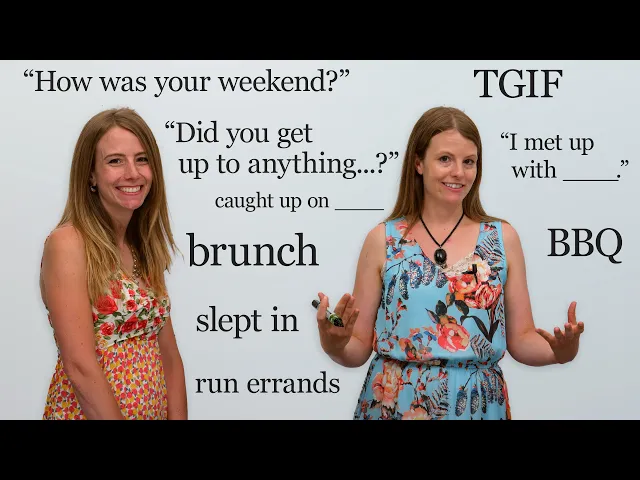
EASY ENGLISH CONVERSATION: Talk About the Weekend!
English with Emma · engVid
0:00 So, Audra, what'd you do this weekend?
0:03 Well, on Saturday, I had a family barbecue, and everyone came over.
0:09 We had burgers and steak and lots and lots of cake.
0:14 Wow.
0:15 Hello.
0:16 My name is Emma, and today I am going to teach
0:19 you some very important expressions and vocabulary about the weekend.
0:26 I love the weekend.
0:29 When I'm talking about the weekend, I'm talking about Saturday and Sunday.
0:34 So, a lot of the times on Fridays and Mondays, people talk about the weekend.
0:40 So, it's very important to know vocabulary and expressions about
0:45 the weekend because it's such a common part of conversation.
0:50 So, let's look at some examples of weekend vocabulary.
0:55 So, on Friday- and notice I have "on".
1:00 A lot of students make mistakes with this, but the preposition
1:03 we use with days of the week is the word "on".
1:07 So, on Friday, people often ask this question.
1:13 Do you have any plans for the weekend?
1:18 Do you have any plans for the weekend?
1:24 Or they might not ask, "Do you have", they might just say,
1:28 "Any plans for the weekend?" It's a very common question people ask on Fridays.
1:34 And what they want is for you to talk about your plans for the weekend.
1:38 What are you going to do on Saturday?
1:40 What are you going to do on Sunday?
1:43 Now, another thing you might see on Friday is sometimes people say "TGIF",
1:49 or they might write it somewhere.
1:53 My sister Audra, who's going to help us in a little bit,
1:58 and I often text each other this- TGIF.
2:02 Every Friday we write each other this.
2:04 What does it mean?
2:06 It means "thank goodness" or "thank God it's Friday".
2:13 We say this because we are so happy it's Friday.
2:17 No more work, it's the weekend, we can relax.
2:21 So TGIF.
2:24 Another expression we might talk about on a Friday is the word "long weekend".
2:30 A long weekend is a weekend that is three days.
2:35 So it might be Friday, Saturday, and Sunday where you have it off work,
2:40 or it might be Saturday, Sunday, Monday.
2:44 So if you have a three-day weekend, we call that a long weekend.
2:51 Long weekends are my favourite.
2:54 I love long weekends.
2:58 So, we talk about this on Friday, we do our thing on the weekend,
3:03 and then on Monday most people go back to school or work.
3:08 And this is often one of the first questions you will hear on Monday.
3:14 You'll hear "So, what'd you do this weekend?" And notice
3:19 I have "what" with an apostrophe and a "d".
3:23 The "d" here stands for "did".
3:25 So, this can also be "What did you do this weekend?"
3:32 But in conversation we often use contractions or we shorten words,
3:37 so "What did you do this weekend?" actually becomes "What'd you do
3:42 this weekend?" And this is really hard for English language learners because,
3:48 you know, they hear this and they don't realize the "what" means "what did".
3:55 Okay?
3:56 So be careful about this.
3:58 "So, what'd you do this weekend?" You might hear somebody ask
4:03 "How was your weekend?" You might hear this question "Did you get
4:08 up to anything this weekend?" The word or the expression "get
4:14 up to" is a very common expression and it just means "do".
4:19 Okay?
4:20 So, we use it when we're talking about activities we did in the past.
4:25 So, "Did you get up to anything this weekend?"
4:28 means "Did you do anything this weekend?" So, they have the same meaning.
4:34 "Did you get up to anything this weekend?" "Did you
4:38 do anything this weekend?" If you hear somebody ask this question,
4:44 one thing you can say is you can use "get up to" in your response.
4:48 You can say "I didn't get up to much".
4:52 This means I didn't do anything, really.
4:55 I didn't do a lot.
4:56 Nothing special.
4:58 So, "I didn't get up to much this weekend." It's funny
5:02 with this expression because we only use it in the negative.
5:06 We do not say "I got up to a lot".
5:10 We would say "I did a lot",
5:13 but in terms of when we use "get up to", we only use it in the negative form.
5:19 "I didn't get up to much this weekend." So,
5:22 now we are going to look at some common activities we do on the weekend,
5:27 and we are going to do a listening activity with my sister, Audra.
5:32 Okay, so there are many things you can do on the weekend.
5:36 I'm going to give some examples of some things I like to do during the weekend.
5:41 Before I begin, I just wanted to say one thing.
5:45 There is a difference between British English
5:47 and American English when we're talking about the weekend.
5:51 In British English, we can say "at the weekend".
5:56 In North American English, we say "on the weekend".
5:59 So, both "at" or "on" are correct,
6:02 depending on where you live and where you're speaking English.
6:06 So, let's get started on common plans we talk about...
6:09 Or, common plans for the weekend.
6:13 Now, the first thing I wanted to talk about is brunch.
6:18 Brunch is very popular in North America and other countries as well.
6:23 Brunch is a meal.
6:25 People often have brunch at restaurants.
6:29 And if you notice, I've put equals- breakfast plus lunch.
6:33 So, brunch is between breakfast and lunch.
6:37 It's usually around 10am or 11am, and people,
6:42 especially on Sundays, people often go for brunch.
6:47 Okay?
6:47 So, you can say "On Sunday,
6:50 I had brunch with my family." On Sunday, I had brunch with some friends.
6:56 So, you'll hear people talk a lot about brunch in North America.
7:01 Another thing people often do, and I do this a lot during the weekend,
7:07 is we binge on TV shows.
7:10 So, some people have Netflix, some people have Hulu,
7:13 some people have maybe DVDs or some show they're watching.
7:18 When we binge on something, it means we do too much of something.
7:23 So, if you binge on a TV show,
7:26 it means you watch a lot of episodes of a TV show back to back.
7:33 So, for example, when I was watching Game of Thrones,
7:37 I binged on Game of Thrones.
7:40 Sometimes I watched four episodes in a row,
7:44 and my whole Saturday was spent binging on Game of Thrones.
7:49 So, this is a common expression you might hear
7:52 people talk about when they're talking about the weekend.
7:56 Another thing people often do on the weekend is they run errands.
8:01 So, the past tense of "run" is "ran".
8:04 So, on Saturday, I ran some errands.
8:08 What does this mean?
8:10 Well, "errands" is a big term that covers many different activities.
8:16 "Errands" include doing groceries, you know,
8:20 maybe getting a new cell phone charger.
8:23 It's those little, small tasks you have to do, so those are errands.
8:29 Maybe you have to pay a bill and you have to go somewhere.
8:33 Instead of saying what each task is, you can just say "errands".
8:37 Okay?
8:38 So, "errands" is another word for "task".
8:40 What do you have to do on the weekend?
8:43 "I ran some errands." A lot of people meet up with their friends or family,
8:50 so this means that they see their friends or family.
8:54 So, I can say, "On Saturday,
8:56 I met up with some friends." "I went to a BBQ", or a "barbecue".
9:04 "BBQ" is the short form of the word "barbecue".
9:10 We often talk about things we get caught up on.
9:15 So, this might be a new expression.
9:17 Sometimes in life, we feel like we're behind.
9:21 Our week is very busy, and so we need to have some time to catch up,
9:27 or to get things done that we didn't have time to get done during the week.
9:33 So, let's look at some examples of things we get caught up on.
9:38 We can get caught up on schoolwork.
9:40 So this means during the week, I didn't have time to do some schoolwork,
9:45 now I have time, so I get caught up on schoolwork.
9:49 I get caught up on housework,
9:51 so maybe during the week, I couldn't do my laundry.
9:55 Now I can, I have time, so I get caught up on housework.
10:02 Maybe you have a job where you have to do projects during the weekend.
10:06 You can say, "I got caught up on work." For some people,
10:10 during the week, they only get five hours of sleep,
10:14 so maybe they like to sleep late or take naps on the weekend, so they can say,
10:20 "I got caught up on sleep." Many people like to sleep in on the weekend.
10:28 This means they do not wake up early, they sleep late.
10:33 So, on Saturday, I like to sleep in, and "slept" is the past tense of "sleep".
10:40 Finally, some people just say they relaxed on the weekend.
10:44 Okay, so now we are going to practice what we learned.
10:48 I'd like to invite my sister Audra over here to help us with our conversation.
10:53 So come on out, Audra.
10:56 Thank you for being here today.
10:58 No problem.
10:59 So, Audra, what'd you do this weekend?
11:03 Well, on Saturday, I had a family barbecue, and everyone came over.
11:09 We had burgers and steak and lots and lots of cake.
11:14 Wow.
11:15 Did you do anything else on Saturday?
11:17 I did.
11:18 I actually went out for coffee with my best friend Christine,
11:21 and we did a bit of shopping, and it was really, really lovely.
11:26 Great.
11:26 And what about on Sunday?
11:28 What'd you get up to on Sunday?
11:30 So, on Sunday, I did something a bit exciting.
11:32 I went to a sewing class, and I made a fabric basket.
11:37 A fabric basket.
11:38 Okay.
11:39 So, Audra is going to show us her creation.
11:42 Let's see what Audra made.
11:46 Ta-da.
11:49 Not only is she beautiful, but she is very talented.
11:52 Thank you.
11:53 Did you do anything else on Sunday?
11:56 I think that was about it for Sunday.
11:59 I do have some errands to do when I get home.
12:01 I will be doing laundry.
12:04 Okay.
12:04 And what about...
12:06 What time did you wake up during the weekend?
12:08 Did you sleep in?
12:09 I did not sleep in.
12:11 I woke up around 7.30 in the morning, which is quite early.
12:15 I wish I could have slept in until 11am.
12:18 That would have been much better.
12:20 Do you usually sleep in on weekends?
12:22 I do not.
12:23 I get up quite early.
12:25 I normally wake up at 6am during the week.
12:28 On weekends, I could say I sleep in until 7.30am.
12:34 Ideally, I would like to sleep in until 11am.
12:37 Wow.
12:38 So, my last question for you, Audra, is about brunch.
12:42 I know my sister Audra loves brunch.
12:47 Sometimes we go to brunch together.
12:50 So, when do you usually do brunch?
12:53 My friend Lou and I often do brunch on the weekends.
12:57 On Sunday morning, we go out for brunch and we try different places,
13:03 and we get to try many different types of food.
13:06 All right.
13:07 Well, thank you so much, Audra.
13:08 Thanks for telling us all about your weekend.
13:10 No problem.
13:11 Thank you for having me.
13:12 So, thank you for watching.
13:14 I want to invite you to check out our website at www.EngVid.com.
13:19 There, you can actually do a quiz where you
13:21 can practice everything you learned today in this video.
13:25 So, thank you for watching, and until next time, take care.