A Stream of Stars (Abell 1795) - Deep Sky Videos
DeepSkyVideos
0:00 I have Abel 1795 which is this collection
0:04 of little faint fuzzy things in the middle
0:11 here so the center of it is that relatively big bright blob and but then
0:15 actually most of these little orange slightly fuzzy dots you can see are what
0:18 make up a 1795 it is a cluster of galaxies so each of those little
0:23 fuzzy dots is a whole galaxy and it's an enormous distance away it's about
0:28 a billion light years away amazing isn't
0:30 it just you know this little faint smattering
0:33 doesn't look like anything very much but that's
0:34 thousands of galaxies you're looking at there
0:37 all clustered around this one big bright galaxy in the middle there's got to be
0:40 stuff living in there you would certainly
0:42 think so wouldn't you that many galaxies
0:44 each with that many stars we don't live in a rich cluster we live
0:47 in a poor group so most galaxies don't
0:48 live in complete isolation few do but actually
0:51 most live in groups so maybe four five 10 20 galaxies the the rare things
0:56 are where you get thousands of galaxies all in one of these clusters the AEL
0:59 C was put together in the 1950s by George Abel there was a survey
1:04 of the sky had been put together I think called the Palomar Sky survey and he
1:07 literally went through all the photographic plates
1:09 by eye identifying objects like this I think
1:12 in his original catalog that's getting on for 3,000 of these clusters that he
1:16 found all across the sky or the northern sky because the the survey he had
1:19 actually only covered the northern sky so
1:21 they're all Galaxy clusters all clusters of galaxies
1:24 there was an extension called the Abel
1:26 Corwin uh catalog which did the southern hemisphere
1:29 as well so we now actually have these clusters all across the sky so if
1:32 you want a really long set of deep sky videos you know there's like two
1:36 or 3 thousand of these we can do and then you could do each Galaxy
1:39 within the cluster absolutely yeah all right so
1:42 here's a nice paper called mmt FH Alpha
1:45 and HST fuv Imaging of the filamentary complex in Abel 1795 this is kind
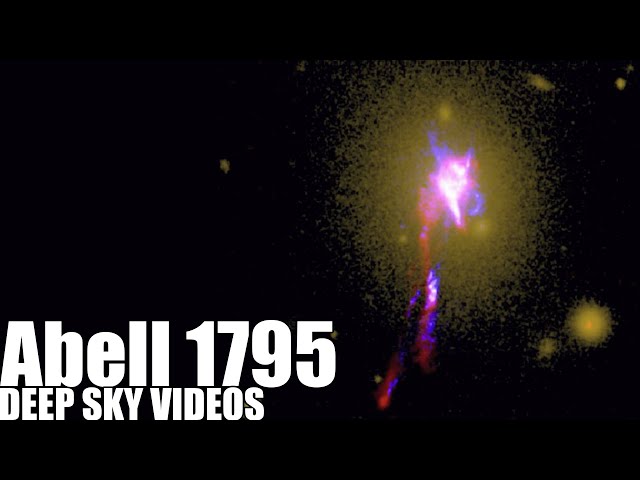
1:50 of a zoom in of the picture I showed you before so actually the orangey stuff
1:54 you can see here is exactly the same as the orangy stuff we were looking
1:57 at before but kind of zoomed in on that Big Bright galaxy in the middle
2:00 and then the pinky red stuff that's this H Al for emission and then
2:03 the blue stuff here is far ultraviolet emission
2:07 both the H for emission and the far
2:09 ultraviolet emission are the signature of young
2:12 Bright Stars so young Stars Bright Stars heat
2:16 up the gas which make it Glow to produce the H Alpha and then the Stars
2:19 themselves are actually so hot that they emit in the far fire ultraviolet so
2:23 this is actually the signature of star
2:25 formation going on within this cluster but you
2:27 can see that the star formation is actually nothing to do with the Galaxy right
2:30 it's you know I mean some of it's in the Galaxy but there's this whole
2:32 strand of star formation going on out here I mean that's on a galactic scale
2:36 that filament and Beyond right it's it's bigger than the Galaxy so how is it
2:40 that there's star formation going on quite
2:41 intense star formation going on that's nothing
2:43 at all to do with the galaxies somehow there has to be a whole L gas
2:46 that's being brought together to make stars
2:49 outside the Galaxy but let's complete this multi-wavelength
2:52 view of this cluster by looking in the X-ray part of the spectrum so
2:54 I have another paper here called a very
2:57 deep Chandra observation of a 1795 chander
3:00 is an x-ray satellite still currently doing its thing up there in space and they
3:03 pointed at it a 1795 for a very long time so here it is
3:07 in X-rays and it's a very bright x-ray
3:09 source so there masses of x-rays coming out
3:12 and actually superimposed on top of it the blue Contours here are the H Alpha
3:16 observations I was showing you before so
3:17 this is where that star formation is going
3:19 on the existence of the X-ray emission tells you there's a whole load of gas
3:23 there because the process by which x-rays
3:26 are emitted is a thing called Brimstone which
3:29 is breaking radiation which is if you have a plasma so you got if you
3:32 just think about hydrogen gas to keep life simple you got a whole load of once
3:36 you've ionized it you've got a whole load of protons and a whole load
3:38 of electrons the the electrons are no longer
3:41 bound to the protons because it's all been
3:42 ionized it's all been ripped up into this plasma but once in a while one
3:46 of these electrons will go somewhere near one of the protons and in the process
3:50 it may be decelerated so it'll scatter past it and it'll lose energy
3:54 and as with a lot of processes in physics when that when energy changes way you
4:00 kind of make sure that energy is
4:01 globally conserved is that a photon gets emitted
4:04 now these are such energetic processes
4:05 that this breaking process ends up producing x-ray photons
4:09 and the fact we see so many x-ray photons tells us there's a lot
4:12 of hot gas there so you can actually do a calculation of saying okay we got
4:16 all this x-ray emitting gas sitting there how long would we expect it to stay
4:21 there for how long does it take
4:22 to cool down and that's a reasonably straightforward
4:25 calculation to do because we can figure
4:26 out how much energy is being lost through
4:28 this brim stoling process how much energy is going away in photons and that if
4:32 you take that energy away that means the gas kind of cools down over time
4:36 and if you make the gas dense enough then the cooling time gets quite short
4:41 at least in astronomical terms um so
4:43 actually the gas that hot x-ray emitting gas
4:46 stops being hot and x-ray emitting and cools down to a point where it turns
4:50 back into normal hydrogen gas and that's what we're seeing here in this tail so
4:54 here they've kind of they they've taken
4:56 this original x-ray image and kind of remov
4:59 the smooth distribution of x-rays to see
5:01 what's left and if you remove that smooth distribution of hot gas you find there
5:06 is still x-ray emitting stuff on the scale
5:09 of this Hal Alpha filament and actually lying in kind of the same place
5:12 when you see kind of an excess of X-ray emission uh like they found when
5:16 they kind of subtracted off this smooth
5:18 stuff that's telling you that that's a place
5:19 where the the gas is particularly dense
5:22 and the fact that it's emitting more x-rays
5:25 um actually means it's going to cool down faster so this feature is cooling down
5:29 suff ly quickly that some of it's just turned into normal hydrogen gas and some
5:33 of that normal hydrogen gas is now turned into Stars this is a thing
5:36 called a cooling wake it's gone all the way from being this hot glowing diffuse
5:41 x-ray emitting gas all the way down to cooling down into clumps that then turn
5:45 into Stars it must be something to do with the fact that this galaxy is
5:48 moving through the core of the cluster so you've got this hot x-ray emitting
5:52 gas that permeates the cluster and then
5:55 you've got this galaxy moving a bit relative
5:57 to it which means that actually it's kind of dragging a wake behind it creating
6:01 this wake behind it as it's moving
6:03 of that cooling gas that physics of figuring out
6:06 the time scale on which gas cools down you can apply it to any cluster
6:11 of galaxies and what you find is that the time scale for the central parts
6:15 of clusters to cool down is relatively
6:17 short remember I said that the the cooling
6:20 time how quickly it cools down depends on the density squared so actually if you
6:24 go to the center of the cluster where there's a whole load of gas
6:27 that means that its cooling time becomes quite
6:28 short because the these emission processes become strong
6:32 and in fact they become much shorter than
6:33 the lifetime of the universe so this effect
6:36 that we see in this weird wake in AEL 1795 by a simple argument you
6:42 should see the same phenomenon in every
6:43 cluster of galaxies going on in the middle
6:45 because the cooling time is sufficiently short
6:46 that they should be turning into stars
6:49 and to some extent that's happening but not
6:51 anywhere near the extent we expected it to happen and what that's telling us
6:55 is that there's some process that's actually heating
6:58 the gas back up again stopping it from cooling down so that we end up
7:02 with loads and loads and loads of stars
7:03 forming and it's thought that the process
7:05 the main process that's heating the gas back up again is that at the center
7:09 of that massive galaxy in the middle
7:10 there's a super massive black hole that super
7:13 massive black hole once in a while becomes an active and it starts throwing out
7:17 very energetic Jets of material and so
7:19 on and that those Jets of material smashing
7:22 in to the gas that surrounds it Heats it all back up again so it's
7:26 thought that the reason why you don't see phenomena like the one one in a 1795
7:30 all over the place is that the the clusters
7:33 of galaxies themselves have their own
7:34 heating mechanism to stop it from happening too much if you look at clusters
7:37 of galaxies you actually find that as well as that sort of diffuse x-ray Mission
7:41 you actually find that there's Optical light
7:43 on large scales as well there's this thing
7:44 called intracluster light and it's thought that is
7:46 just stars that are permeating the cluster
7:49 rather than living in individual galaxies now
7:51 for the most part most of those stars are things that got ripped out of galaxies
7:55 so they probably just formed in normally
7:56 in a in a in a galaxy but that gal interacted with another galaxy
8:01 and as part of that process some of the Stars got kicked out into the cluster
8:04 space so most of that intercluster light
8:07 is probably stars that started their lives
8:09 in galaxies and then got kicked out but at least some of it would have
8:12 formed through processes like this so those are
8:14 stars that were never in a galaxy there's
8:16 something so romantic about stars not in a galaxy I think like I love
8:20 the idea of those yeah it's a it'd be a sort of it' be a sad
8:24 and lonely life wouldn't it really and look I know this probably isn't going
8:29 to win any Astro photography awards but here's
8:32 Abel 1795 photographed by Professor marfield himself
8:37 in his backyard in Nottingham with his beloved
8:40 EV scope and while I have your attention can I take this opportunity to thank
8:45 everyone who supports deep sky videos on patreon
8:49 you can see them now their names
8:51 floating through space thanks everyone you can join
8:55 them by going to patreon.com deepskyvideos I'll
8:59 put a link Link in the video description