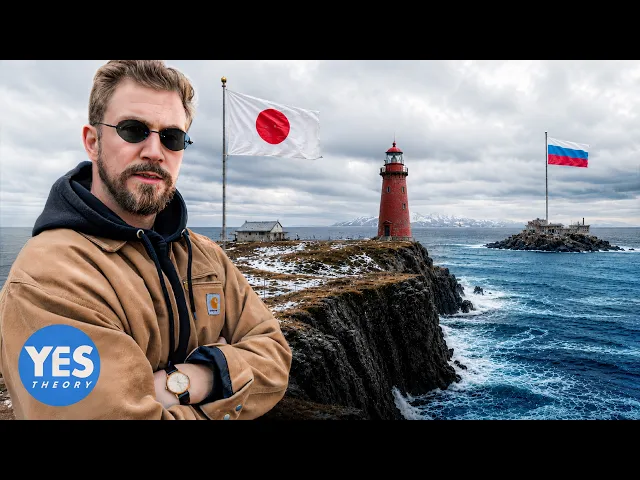
Exploring Japan's Remote Border with Russia (no one comes here)
Yes Theory
0:02 We are currently heading north alongside
0:04 the border between Russia and Japan to get
0:07 us close to the contested islands that very few people have ever heard of.
0:12 If we would drive out there, we would get shots.
0:16 I've got a confession.
0:18 I've got a slight obsession with maps.
0:22 And an odd pastime of mine is to roam on Google Maps,
0:26 zooming into strange and unusual part of our globe,
0:29 searching for our world's hidden stories.
0:31 And as we were preparing for our trip to Japan,
0:34 I found something that surprised me.
0:37 Russia.
0:38 Just a few kilometers away from Japan are a mysterious
0:42 stretch of islands oddly close that I'd never heard of before.
0:46 The deeper we looked, the more confusing it became,
0:49 as neither of the two countries have been able
0:51 to actually agree on who these islands belong to.
0:55 But today, they are fully in the hands of Russia.
0:59 Yet, Japan does not agree, meaning that on this little corner of our planet,
1:03 a dispute that dates all the way back to World War II never fully ended.
1:07 With lots of questions about this stretch of islands,
1:12 but initially feeling very unclear what we would find in this unexplored region,
1:16 we decided to simply book our flights and head
1:19 straight into this mystery at Japan's Wild Northern Edge.
1:22 Here in yet another of the least populated places in the country,
1:27 we'll explore three locations along this coastline with the mission
1:30 of finding someone with direct stories and experiences from these islands,
1:34 asking the question, what happened here?
1:39 And what stories hide in this strange and unexplored part of Japan?
1:54 Over the next few days, we're going to be going along this wild,
1:57 untamed coastline to see what we can find and who we can meet.
2:02 And we're starting with seeing how close we
2:08 can get to these islands from this little ship.
2:16 This is as far as we can get while still being in Japan.
2:20 Once we cross past a certain amount of kilometers off off the coastline,
2:24 then you cross the border.
2:26 And you can see just how massive one of the contested islands right here is.
2:34 The people who live along this coast have to look at it every day.
2:49 After getting back to dry land,
2:51 we headed down the coast from Rausu to the coastal town of Shibetu to see if we
2:55 could find some locals that could help us
2:58 understand more about how these islands became so contested.
3:01 But as we began to walk around, the town seemed almost completely deserted.
3:15 We are in a tiny little fishing town smack in the middle of the U
3:21 that surrounds these these islands on the map that we want to explore.
3:26 This entire street here are closed restaurants.
3:29 It just feels like used to be a life here that no longer exists.
3:33 We're not too sure which direction we should go,
3:36 but the real end point is going to be getting
3:40 to the very last cape on the other side going south,
3:44 getting as close as we possibly can to the border.
3:48 That's a bit trippy.
3:49 It's a bit strange to know that these disputes and conflicts are
3:53 going on and people wanting to go there but not able to.
3:58 This is going to be a bit challenging to find the right
4:03 people to talk to, but uh we're going to be on the search.
4:19 Oh my god, we are so close.
4:25 These islands that we're looking at right now, Japan claims are theirs.
4:30 Yeah.
4:31 People were sent away from there.
4:33 Yeah.
4:33 17 20,000 people.
4:34 So close to close to the home, you know, like people over here.
4:41 Some of them lived over there.
4:46 Yeah.
4:46 Do you live here or where do you live?
5:13 Byebye.
5:13 Byebye.
5:14 Imagine kids.
5:15 They would never ever argue, fight disputes about like things like this.
5:20 Don't kids fight over like toys all the time though?
5:23 Oh, true.
5:24 No, that was more you, man.
5:25 Not me.
5:26 Here we share.
5:27 You were a mature child.
5:34 We see a man bird watching.
5:43 So, we're going to slowly and steadily
6:13 Do you feel these islands belong to Japan?
6:20 This is a place that clearly very few people come to.
6:23 There are barely any hotels, restaurants,
6:26 and locals are confused by what we're even doing here.
6:28 And to be honest, I'm not quite sure we even know.
6:32 As we continued searching these eerie, empty streets,
6:35 we suddenly experienced firsthand some
6:39 of the tension that lies in these neighborhoods.
6:46 I have no idea.
6:47 She doesn't like foreigners.
6:48 Maybe very like cute older lady.
6:50 She just like screamed.
6:51 I got so mad.
6:52 just uh yeah, just by just by seeing me and didn't didn't say or do anything.
6:57 Was not in her way or anything.
6:59 Just got like really really mad.
7:01 I wonder if it was because yeah, she thought that I was Russian or or something.
7:11 Ladies and gentlemen,
7:12 we have now reached the absolute eastern point that we could possibly get to.
7:18 And this is the closest to the Carl Islands that we can get.
7:23 And we are at the very final lighthouse at the edge
7:26 of Japan and what feels like the edge of the world.
7:29 And it is pretty wild.
7:30 They're just a few kilometers away.
7:32 You can literally see the coastline.
7:34 We've made our way to the entire U.
7:37 We've been told that Nimro, where we are now,
7:39 is sort of one of the center points of this conflict.
7:42 And everywhere we've been driving,
7:44 there's been signs written in Japanese saying,
7:46 "Give us back the islands." Maybe one day the people
7:50 of this area will be able to return back to their islands.
7:54 Look at how close we are to that those ones.
7:57 Oh, wow.
7:57 You can literally We are right in front of them.
8:00 I can see a house on the other side.
8:02 You can?
8:02 Yeah.
8:03 That's a house on a contested island.
8:05 Yeah.
8:05 We don't know if there's any civilians left there, right?
8:08 As far as I know, it's basically military.
8:11 There were civilians at one point,
8:13 but are there people that actually live on these islands these days?
8:17 It's hard to say, right?
8:18 When you look at Google Maps, there's nothing on these island.
8:21 There's no road.
8:22 There's nothing.
8:23 It's just land.
8:24 Oh, wow.
8:24 Wow.
8:25 It's a house straight by the water that looks towards Japan.
8:29 Yeah.
8:30 We got the dad zoom in this one.
8:33 That's how you know we got a dad on our hands.
8:36 Getting out here to this part of Japan has been one
8:40 of the more logistically wild trips we've done in a while.
8:44 Researching what was even possible.
8:45 Booking things in a language we don't speak.
8:48 Hopping between cafe Wi-Fi and hotel Wi-Fi or whatever
8:51 random network we could find along the way.
8:54 It was a lot.
8:56 Which is actually the perfect moment to bring
8:58 in the sponsor of today's video, Surf Shark,
9:00 because they have been genuinely a part of how we put this whole trip together.
9:04 Surf Shark is a VPN and whenever you're
9:06 jumping between random Wi-Fi networks like we've been, hotels,
9:10 airports, cafes, it encrypts your data so no one
9:13 else on that network can see what you're doing.
9:16 Passwords, bank information, messages, all of it.
9:18 When you travel the way we do, that peace of mind is not a small thing.
9:23 It's also the tool we use to stay connected to services from home.
9:27 Pick a location, hit connect, done.
9:29 One account covers unlimited devices,
9:30 so the whole crew is protected on the same subscription.
9:34 And the app is genuinely one of the simplest ones we use on the road.
9:38 Go to surf shark.com/y Theory or use code yes theory
9:40 at checkout to get four extra months of Surf Shark.
9:43 There's also a 30-day money back guarantee, so there's no risk in trying it.
9:48 Being able to focus on the actual adventure
9:50 rather than worry about whether the Wi-Fi of some
9:53 random guest house is going to compromise
9:55 our accounts is literally what this is all about.
9:58 Okay, now let's get back to exploring
10:00 this very strange and unique part of Japan.
10:03 After exploring this entire coastline in search of answers,
10:07 we really only uncovered more questions.
10:09 What was the logic behind this territorial dispute?
10:12 And why did the Japanese still
10:14 believe these islands rightfully belonged to them?
10:16 It felt like we weren't getting very far by approaching strangers.
10:20 So, after returning to the main fishing village,
10:22 we headed to the front desk of our hotel in search of new leads,
10:27 which ended up sending us on a bit of a wild goose chase around town.
10:38 Let's go to this uh place next door.
10:41 Hi, thank you.
10:43 This guy here said there's a city council where we could go and we
10:48 could potentially find someone who actually lived
10:50 on this island before but were sent here.
10:57 Let's do that.
11:02 Until eventually we found a promising lead.
11:11 Wow.
11:12 10 minutes.
11:13 It's like one of those video games where you
11:16 meet one character that introduces you to another character.
11:22 Yeah.
11:22 Slowly, we're making progress.
11:25 Oh, wow.
11:30 We are inside the Northern Territories Museum.
11:40 Where are you born?
11:44 if we can ask.
11:48 He's like, I'm from the Northern Islands that you
11:51 guys are trying to take away from us.
11:55 No, no, we're not Russian.
11:58 We're on your team, sir.
12:01 We're on your team.
12:03 You, too.
12:04 You as well.
12:05 You, too.
12:06 You, too.
12:07 Legend.
12:07 Legend.
12:07 This explains why this woman was pissed at us before.
12:11 She thought we were Russians.
12:12 We have walked into a lecture right now of a man
12:16 who thought we were trying to take these islands.
12:18 This man is dedicated.
12:19 He has waited for this moment, I think, for a while.
12:24 He's had a whole box of things prepared here.
12:28 Though we started to get a general idea
12:30 of the island's history from some of the locals,
12:32 we'd finally found a historian who had
12:34 had firstirhand experience with the conflict who
12:36 could give us a full lecture to explain exactly how these islands ended up.
12:45 the way they did.
12:48 The Coral Islands sit in a geographically strategic
12:51 location and have a long history of habitation, conflict, and colonization.
12:55 The original inhabitants of these islands were
12:58 an indigenous ethnic group known as the Inu people.
13:02 For centuries, their homelands stretch across the northern islands of Japan.
13:06 They lived in fishing and hunting villages while also trading
13:09 with some communities across the seas in Japan and Siberia.
13:13 But by the 1700s, the Inu found themselves caught between two expanding empires.
13:18 Japan pushing northward and Russia expanding eastward.
13:22 Both powers saw the islands as strategically valuable for fishing,
13:29 trade, and military control.
13:36 By the 18th and 19th centuries,
13:39 Russia and Japan were increasingly competing politically and diplomatically
13:42 over control of the Kural Islands and Sackland.
13:45 Eventually, Japan fully incorporated Hokkaido and the Kural
13:49 Islands into the modern Japanese state,
13:51 subjecting the indigenous people to aggressive
13:54 assimulation policies as their land
13:56 was taken and communities displaced by the Japanese settling across the region.
14:15 Wow.
14:16 How many people lived on the island?
14:32 During World War II,
14:33 the islands became a critical part of Japan's military strategy in the Pacific.
14:37 In 1941, ships from the Imperial Japanese Navy gathered in the remote
14:42 waters of the Kurls before launching the surprise attack on Pearl Harbor.
14:46 The event that would pull the United States into the war.
14:50 But in the following years, the war turned against Japan and control
14:53 of the islands would once again change hands.
14:56 In the final days of World War II, the Soviet Union invaded the Coral Islands
15:00 as part of its offensive against Japan.
15:03 And following Japan's surrender in 1945, almost immediately,
15:06 tens of thousands of Japanese residents across the region were abruptly
15:11 displaced from their homes and forced to relocate to mainland Japan.
15:34 Today, many decades later, most of the people never got the chance to return
15:38 to the homes they left behind on the islands
15:41 now under Russian control and are forced to live
15:44 with the memory of a homeland still visible on the horizon.
15:48 yet completely out of reach.
15:49 Why did the Russians take these islands?
15:52 Cuz it feels as a set of islands,
15:55 it's a little hard to understand why they would
16:01 siege them when they had so much land already.
16:25 Following the Soviet takeover,
16:27 life on the Coral Islands changed almost overnight.
16:30 Japanese communities that had existed on the islands for generations were
16:34 dismantled as Soviet authorities forced
16:35 the remaining Japanese population to leave.
16:38 Homes were abandoned, villages were repopulated,
16:41 and the islands that had once been a part
16:49 of Japan became absorbed into the Soviet Union.
17:02 So they came in and destroyed people's family homes.
17:07 Yeah.
17:07 Yeah.
17:08 And yet despite the tensions between the two nations,
17:12 there was still one small concession that remained.
17:15 In later years, Japan and Russia agreed to allow
17:18 limited visa-free visits for former residents and their families
17:21 to return to the islands to visit the graves of loved ones they had left behind.
17:25 For many, it was the first time seeing their homeland
17:32 again since being forced to leave as children after the war.
17:43 However, after the outbreak of the war in Ukraine,
17:46 those visits were suspended indefinitely.
17:48 And today, nearly 80 years after the end of World War II,
17:51 the islands remain at the center
17:55 of a dispute that has never truly been resolved.
18:05 Does he hope to one day get to go back?
18:43 What's your name?
18:49 I get very touched by the fact.
18:51 You can tell that we get very touched by the things that he's sharing.
18:55 He has a very beautiful way of seeing life and seeing
18:57 how we shall see each other as brothers and sisters.
19:02 He's the best professor we ever had.
19:06 Thank you very much.
19:08 What a beautiful human being.
19:10 Yeah.
19:11 To think that he didn't seem to have much resentment shows his character.
19:15 And it also shows that he's just focused on what matters,
19:18 which is being able to go home.
19:20 There's no envy or sentiments of revenge.
19:22 It's just as simple as wanting to have his childhood home back.
19:28 That's what it's about for him.
19:32 He wishes you guys were girls.
19:35 Nice.
19:40 Homestead.
20:00 Could be cool to see that.
20:04 That would be amazing.
20:07 Okay.
20:18 Okay, we are getting into the car now.
20:20 Is there anyone in this fishing village that would
20:22 have been better to meet than this man?
20:24 I don't think so.
20:24 He's got photos at the museum.
20:28 I think he's the guy.
20:32 I think he's the one guy.
20:38 Oh my god.
20:44 Oh wow.
20:48 When he said that he has a Russian room, he really does.
20:52 Even though Russia is the country that displaced him from his home,
20:56 he hosted Russians that came to visit here
20:59 and built a room from the souvenirs that they brought.
21:02 That is insane.
21:04 That is incredible.
21:20 and she was his girlfriend.
21:28 Oh man.
21:40 because he likes them.
21:48 Oh, that's the house on the island.
21:53 That's him.
21:55 No way.
21:56 Wow.
21:57 The legend.
21:59 Wow.
22:04 Do you like he doesn't seem to have any resentment at all towards Russians?
22:26 Is there a reason for that?
22:49 You can tell him you wish to be like him when we grew up.
23:01 This is not what I expected at all, but um I feel like I learned a lot.
23:06 My perspective is like totally different.
23:14 Yeah.
23:15 An executive decision have been taken by Mr.
23:18 Peacemaker.
23:18 We're going down to the ocean.
23:19 We're going to look at the water together.
23:22 So, Oh my god.
23:24 To be honest, we weren't fully sure what we
23:27 would find when we first embarked on this journey.
23:29 But Fukus Aawasan opened our eyes to something
23:31 we had never been exposed to so vividly before.
23:35 A compassion despite the pain.
23:38 An acknowledgement of our shared humanity despite disagreements and conflict.
23:42 Pretty amazing that we walked around
23:44 this village looking for someone this morning.
23:47 Yeah.
23:47 And here he stands.
23:49 And here he stands.
23:51 that they said this is the island.
23:53 Yeah.
23:53 There are some moments on certain trips where we don't really
23:56 know what we're looking for, but we know when we found it.
24:00 And sitting in this room with this man,
24:02 hearing about his rare perspective felt like
24:08 finding the diamond that we've been looking for.
24:21 legend.
24:21 We literally picked this town by looking at Google Maps before boarding
24:26 the plane being like this town looks like kind of in the middle.
24:31 Let's go there.
24:32 Well, to all the people asking what well what's your favorite country?
24:37 Well, it's Japan.
24:38 It's Japan.
24:38 So, I've officially decided.
24:40 Me, too.
24:41 This, at least for now, is another story without a happy ending.
24:45 These islands, despite meaning so much for those who were once displaced,
24:49 seem so far down the priority list of both nations.
24:52 But instead, our lesson is one to simply endure, to keep our heads high,
24:59 and to, in our best efforts, build bridges with those we may disagree with.
25:08 Thank you for watching and we'll see you next week.