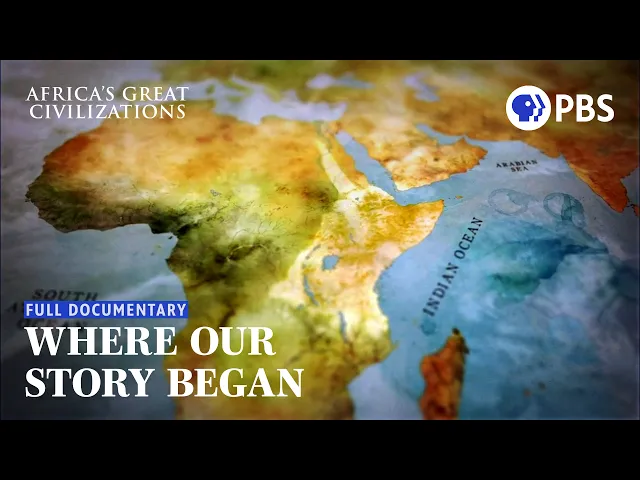
The Real History of Africa They Never Taught You | Full Documentary | Africa's Great Civilizations
PBS Documentaries
0:22 Host: No matter what we look like today,
0:24 we're all directly descended from ancestors
0:27 who evolved on the African continent.
0:31 The oldest human population emerged in Africa.
0:36 Africa is the home of the world's most ancient civilizations.
0:41 Far too often, Africa has been thought of as isolated and static,
0:46 but nothing could be further from the truth.
0:49 The roots of every family tree trace here to Africa.
0:55 And so does the history of civilization.
0:58 In this series, we'll be going on a journey through 200,000 years of history.
1:06 We'll explore great cities built along Africa's extensive trade networks,
1:11 discover art of unparalleled beauty and technical brilliance,
1:16 and marvel at thousands of years of breathtaking architecture.
1:21 Driving all this were Africans who prospered, created,
1:26 and suffered through their rich,
1:28 sometimes tragic, yet endlessly fascinating history.
1:34 This is a seldom-told story of how Africans,
1:37 by shaping their own worlds, shaped the larger world as well.
2:17 Africa's Great Rift Valley.
2:20 This is where humanity's story most likely begins.
2:30 Homo sapiens, anatomically modern humans,
2:33 have lived here for about 200,000 years.
2:40 This great geological fault,
2:42 stretching 3,000 miles through Africa, from Ethiopia to Malawi,
2:47 with its great lakes and savannas full of animal life,
2:50 gave our ancestors the perfect environment in which to evolve.
2:58 Man: The Rift Valley, it's like a crucible,
3:02 like in a chemistry lab, where humans have been tested.
3:07 Because nature constantly tests different parts of the species.
3:12 Those who can fit the environment
3:14 or the situation that is around survive and continue,
3:19 and the others, you know, get replaced.
3:26 [Thunder] Host: In 1997,
3:30 the rains fell heavily in Ethiopia's northern Rift Valley.
3:35 Layers of sediment dislodged, revealing an extraordinary find— a human skull.
3:43 It's one of the oldest Homo sapien remains to be found anywhere in the world.
3:49 Scientists named the skull Idaltu, meaning firstborn,
3:53 and Idaltu walked these valleys 160,000 years ago.
3:58 Dr.
3:58 Berhane Asfaw was one of the scientists who made the discovery.
4:03 This is one of the few specimens that we found almost complete.
4:10 The whole, the face and the brain case.
4:13 And the most impressive thing about this is even at this early age,
4:19 the face is modern Homo sapien, the brain case is modern Homo sapien,
4:24 the shape from the back is a modern Homo sapien.
4:27 It's exactly us.
4:32 Host: The anatomy and age of Idaltu's skull provided
4:36 the strongest evidence yet that anatomically modern humans emerged in Africa.
4:43 Man: Each stage of the evolution toward modern humans, it takes place in Africa.
4:49 Asfaw: When we found Homo sapien Idaltu,
4:51 it's very important because it pushes the time far back.
4:56 It means anatomically modern Homo sapiens started walking
5:00 on this planet much earlier than we thought,
5:05 and the interesting thing Is at the same time,
5:09 Europe was packed with Neanderthals,
5:12 which are completely different from Homo sapiens.
5:18 Host: One of Africa's most respected paleoanthropologists is Dr.
5:23 Richard Leakey.
5:24 He and his colleagues have made groundbreaking discoveries
5:27 about how our species evolved on the African continent.
5:31 I've come to meet him at his institute in Nairobi, Kenya.
5:35 How do we know that the first human beings evolved on the African continent?
5:42 The fossil evidence and the archaeological evidence
5:45 that's come to light in the last 20,
5:47 30 years is very, very substantial, testable, and real.
5:51 Why do you think this idea was so disturbing in some quarters?
5:56 Historically, the science of paleoanthropology
5:58 or anthropology came into existence at a time when we really knew very little.
6:05 Africans were considered primitive, heathen, who knows.
6:08 And the origins of the subhuman status of Africans begins,
6:14 really, in the 18th century.
6:16 In the Enlightenment, ironically enough.
6:18 They weren't really considered to be one of our species.
6:23 Host: Continuing archaeological finds and now major scientific breakthroughs
6:28 have confirmed that Africa absolutely was the cradle of humanity.
6:34 Man: It's like if we're exploring our past
6:36 and looking at where our roots are sunk down,
6:39 we'll find that they're the deepest in Africa,
6:41 and that's where we get most of our genetics.
6:45 Host: Geneticists have identified an astonishing link
6:48 to our earliest human relations through our DNA.
6:53 Every living person shares a common direct maternal ancestor.
6:57 She's known as Mitochondrial Eve.
7:00 We believe that she was part of a small group of humans who
7:04 lived in this region of Africa around the time of the Idaltu skull.
7:09 Man: Our common ancestry through the Mitochondrial Eve
7:12 means that our genetic differences are literally skin deep.
7:17 That at the bottom, we are all descended from the same family.
7:22 Host: Mitochondrial DNA, found in our cells,
7:25 is the genetic signature passed down through females from mother to child.
7:30 What it means is that this was a woman,
7:32 hypothetically, who lived 200,000 years ago,
7:35 who had enough daughters in a continuous chain,
7:38 straight back so that her mitochondrial DNA survived.
7:41 Absolutely right.
7:45 And all of us today,
7:46 no matter what we look like, are descended from Black ancestors?
7:51 Yeah, that is exactly, that's what happened.
7:54 All the humans, all the Homo sapiens all over the world,
7:59 be it yellow, white, Black, we are descended from a common ancestor in Africa.
8:06 What would life for human beings 200,000
8:09 years ago have been like in this valley?
8:12 200,000 years ago, I would imagine the groups were quite small.
8:16 Mm-hmm.
8:18 The dangers around, we had predators,
8:20 things like hyenas and groups of carnivores all around.
8:24 Mm-hmm.
8:25 It's difficult for us to imagine prehistoric
8:28 life or a world without any trappings
8:32 of the things that have come to define humanness over the last 10,000 years,
8:38 and so, in the modern zeitgeist, the only thing that comes close is
8:42 actually the post-apocalyptic zombie shows, for example.
8:47 You have small bands of people roaming the landscape,
8:52 working together, fighting off predators that are trying to eat them,
8:56 and worried about the other groups of humans that they might bump into.
9:01 So, there are a lot of interesting parallels that could be drawn.
9:05 Host: Modern Homo sapiens initially lived only in Africa,
9:09 slowly spreading across the continent over 120,000 years.
9:16 But between 80,000 and 50,000 years ago,
9:18 they began successfully to populate the rest of the world.
9:25 Host: So, what happened 80,000 years ago?
9:27 Leakey: Well, I wish we knew what happened,
9:28 but there's no doubt at all that a very small population somewhere
9:32 in that time zone caught some adaptation that gave them a huge advantage.
9:35 I have a feeling it might have been speech.
9:38 I don't know what it was.
9:39 But they spread very quickly out of Africa.
9:41 So, 80,000 years ago, the human community was Black.
9:46 Wherever they were in the world.
9:49 Host: But when those early human beings migrated out of Africa,
9:52 they weren't traveling alone.
9:55 They were carrying something within them.
9:58 And that something had developed slowly, over millennia.
10:02 it was culture.
10:04 That culture would develop to include
10:06 the greatest achievements of human creativity,
10:10 and it began here on the African continent.
10:18 In 1991, archaeologist Christopher Henshilwood,
10:23 exploring his grandfather's land,
10:25 discovered the opening to a cave on a cliff face
10:29 above the crashing waves where the Atlantic and Indian Oceans collide.
10:35 Today, we call this the Blombos Cave.
10:39 Inside is evidence of over 140,000 years of human habitation,
10:45 and signs of the first form of human creative expression.
10:50 Before this discovery, we thought the earliest examples of artwork
10:54 were found in the Lascaux caves in France, dating back only 35,000 years ago.
11:00 Hawks: When people began making discoveries in southern Africa,
11:03 like at Blombos Cave, they realized that actually,
11:07 this record of artistic production goes back much further than anyone guessed.
11:12 In France, cave paintings 30,000 years old, 35,000 at the oldest.
11:17 In southern Africa, we're talking about 90,000, 100,000 years.
11:22 Woman: Blombos Cave is a relatively recent discovery, so,
11:26 the more research we do in Africa, and also the more dating we conduct,
11:34 this will change people's minds of how we saw human history,
11:40 and the evidence shows they were already assessing the cognitive behavior
11:46 that we see as defining the modern human before they left Africa.
11:53 Host: Small ochre blocks found in the Blombos Cave
11:57 completely changed how we understand the development of human creativity.
12:03 One of these blocks, covered in curious markings,
12:06 is now housed in the Iziko Museum in Cape Town.
12:11 Woman: It's unique in terms of firstly where
12:14 it was found and the date— it's pretty old.
12:17 77,000 years ago.
12:18 Mm.
12:19 What is interesting is the etching.
12:21 It's almost a hashed etching on the one edge, and that is done with purpose.
12:27 I've often thought that if pigment was put on it,
12:30 you could use it as a stamp, which to me screams artistic expression.
12:35 Mm-hmm.
12:36 Meaning.
12:37 Meaning.
12:37 Symbolic meaning.
12:39 So, this would make it one of the earliest artistic artifacts that we have.
12:45 This is a sign of a group of people who had
12:49 managed to emerge above immediate concerns for food and basic human survival.
12:57 That says something about Africa and Africans.
13:00 I think so.
13:01 It shows that these people were cognizant of their surroundings.
13:06 They were socially aware.
13:09 It shows the birthplace of a very rich cultural
13:13 heritage that has in the past not been recognized.
13:18 This is artwork.
13:21 Host: Alongside the ochre block, a painting kit was found.
13:26 That ochre block was not only decorated, it was ground down,
13:30 mixed with water and minerals, and used as paint.
13:35 Lewis: Once a group is into symbolic expression,
13:39 whether it be via beads or using colorants to paint the body or to paint walls,
13:44 that's gonna be another very important behavior
13:47 to use for communicating complex sets of ideas
13:51 about group identity and also to help transmit
13:54 information to other members of your immediate group.
13:57 Host: Much of this early art has perished with time,
14:01 but cave art provides us with the only
14:04 snapshots of how early human beings lived, hunted, and even loved.
14:09 Hawks: We just get the durable element, but when you're painting your skin,
14:13 when you're painting hides that you might be wearing,
14:15 when you're using feathers and other kinds
14:18 of really special objects but perishable objects,
14:22 you know, when we look at societies today,
14:24 they have this incredible range of things
14:27 that would never survive in the archaeological record.
14:31 Host: Deep in the Libyan desert,
14:33 in a remote cave at Wadi Sura, miles from any lush vegetation today,
14:39 a stunning visual record reveals a quite surprising picture
14:43 of daily life in the Sahara 7,000 years ago.
14:48 The walls of the cave teem
14:50 with depictions of people swimming and animals grazing,
14:54 glimpses into a long-lost landscape.
14:57 Mire: You have the Cave of Swimmers.
15:00 There you have your history recording, if you like,
15:04 where we are getting an idea of a place
15:08 where we today cannot even imagine any life surviving.
15:12 we have lakes and the depictions of the swimmers
15:17 and very abundant wildlife thriving in the Sahara,
15:23 a place now we know for sand dunes.
15:29 Host: However, the Sahara was once a completely different environment,
15:33 capable of sustaining these emerging human communities.
15:37 Today, the Sahara is very barren and dry, but from rock art,
15:40 we find that there are a lot of aquatic fauna, hippo, crocodile, giraffes.
15:45 A very vibrant biodiversity.
15:47 Host: So, in this case, art verifies archaeological evidence.
15:52 Yes.
15:52 It tells us more about how the landscape
15:55 has changed or how the environment has changed.
15:59 Abaka: Over 10,000 years ago, the Sahara was actually a green savanna.
16:04 There were animals, fishes, lakes, rivers,
16:09 and right across what is now the Sahara, the environment was green.
16:15 Ehret: This was the kind of environment that attracts the great herbivores,
16:19 the large herding animals.
16:22 The hippopotamuses, rhinos.
16:24 This would have been a time when those were the important animals.
16:27 Host: Although early humans continued to be hunter-gatherers, over time,
16:32 they began to cultivate plants, and around 10,000 years ago,
16:37 across Africa and the Middle East,
16:39 they began to breed animals as livestock and domesticate cattle.
16:44 The Sahara became this band where these people spread their livestock grazing.
16:49 Mire: Everywhere across the Sahara,
16:51 you have vast scenes of paintings of these animals, but also, I think,
16:57 it kind of also shows that this is them going
17:02 towards the domestication of animals and settle in a sedentary society.
17:09 Hawks: When you look at Africa, it's the cradle of mankind,
17:12 but looking into the development of agriculture,
17:16 it becomes a cradle of civilization.
17:19 [Man speaking native language] Ehret: Between 4,800 and 4,200 B.C.,
17:24 more than 1,000 years before the rise of ancient Egypt,
17:28 in the areas west of the Nile, the first complex African society forms.
17:35 It's not a settled society of towns,
17:38 but it's people who raise great herds of cattle.
17:43 Host: For 3,000 years, these communities,
17:46 and the world around them, continued to evolve.
17:50 Farming developed, and populations grew.
17:54 But by 4,000 B.C., vast areas of the lush savanna had turned into desert.
18:02 Life for the people of the green Sahara is brutally transformed.
18:05 Everything changes, setting civilization in Africa on a radical, new path.
18:14 Woman: There was a slow change in climate,
18:17 thus making traditional pastoral ways of life far more difficult for people.
18:26 Host: In the face of this climate change,
18:28 the populations of the Sahara dispersed.
18:32 And many people migrated towards the fertile lands of the Nile Valley,
18:38 becoming the ancestors of both the Egyptians and the Nubians.
18:45 Abaka: The verdant valley of the Nile
18:48 was an attractive place for communities to settle.
18:51 Hawks: The Nile is like this green river through the desert,
18:55 and the regular floods create this incredible soil,
18:59 so that once you have the domestication of plants,
19:02 this becomes the breadbasket of the Mediterranean basin,
19:06 and you've got that happening as people are developing villages and states.
19:13 Ehret: There's pressures that arise as population grows
19:16 that leads to foundation of more complex societies.
19:20 Bradshaw: The population becomes divided between
19:23 the food-producing groups and the non-food-producing groups,
19:26 and what we see with the non-food-producing groups is that they become artisans,
19:30 professional builders, so they have a surplus of food,
19:34 and this is the point at which we
19:36 start seeing things that we might call civilization.
19:40 Host: Burial pits in the Nile Valley have been the source
19:43 of rare and unique artifacts dating back more than 6,000 years.
19:49 They show a rich, creative culture.
19:52 These prestige items were crafted by artisans to be enjoyed by elites.
19:59 Host: How old is this?
20:00 So, this dates about 3,600 B.C.
20:04 Really?
20:04 This is 6,000 years ago.
20:07 Yeah.
20:08 So, the brothers and sisters back in the Nile
20:12 Valley were combing out their hair with an Afro comb.
20:14 Yes.
20:15 Just like Afro combs, these long,
20:18 thick combs would've been perfect for African hair,
20:21 and this is an item that would
20:23 proclaim status and identity and make a statement.
20:27 They're often found in the burial still in the hair,
20:30 very prominently placed, so these symbols would've been visible.
20:34 Just the way Black people wear them today.
20:36 Absolutely.
20:38 Black people were combing their hair with Afro combs.
20:40 I thought we invented this in the sixties.
20:42 [Laughter] Amazing.
20:43 So, the burials at that date were pit burials.
20:47 In the dry sand, often it preserves organic materials.
20:51 We can actually do an archaeology of hairdos and hairstyles.
20:55 Oh, what kind of hairstyles?
20:56 They've got all sorts.
20:57 They've got the use of henna and fake hair and big bouffants.
21:01 There's even a suggestion we've got some Mohawks as well.
21:04 That's astonishing.
21:05 So, the people who made this were highly-skilled craftspeople.
21:09 They were making beautiful pottery.
21:11 Very skilled at making stone vessels.
21:13 All up and down the Nile Valley
21:15 at this time you see groups creating very vibrant,
21:19 personal culture that they would wear and display.
21:22 Mm-hmm.
21:24 Ehret: You get this coming in of people from the Sahara,
21:26 bringing ideas that even more complex, larger-scale institutions can be built,
21:32 and then development of little, tiny kingdoms.
21:37 Man: Different groups are uniting under powerful figures
21:40 or perhaps local deities or fetishes or emblems,
21:43 and then these groups consolidate.
21:45 One is victorious over another.
21:47 They get larger and larger and smaller in number.
21:52 Host: In 1988, archaeologists discovered a tomb at Abydos,
21:57 300 miles south of Cairo.
22:01 The tomb is thought to contain one of Egypt's earliest rulers,
22:05 credited with consolidating the lands that would become ancient Egypt.
22:11 He's known as the Scorpion King and is believed
22:14 to have ruled at the end of the fourth millennium B.C.
22:21 little is known about him or his reign,
22:24 but his royal tomb housed 150 small ivory tags covered
22:29 in carved symbols that helped to rewrite the history of civilization.
22:36 These simple ivory tags revealed something astonishing.
22:40 Something that overturned what archaeologists
22:43 believed about how our ancestors communicated.
22:46 The symbols on these tags aren't artworks.
22:50 They are in fact the world's first writing.
22:54 Man: Egyptian writing as we know it,
22:57 as in fully developed Egyptian hieroglyphs, appear first around 3,250 B.C.E.
23:03 and some of the earliest pieces are these little labels,
23:07 these little ivory tags from Tomb U-j at Abydos.
23:13 Host: Similar tags from this burial complex are
23:16 now kept at the Petrie Museum in London.
23:19 This is a formative stage of hieroglyphic writing.
23:22 So, what does it say?
23:24 It's been suggested that it might be a place name.
23:26 This is a prestige item.
23:29 And what was it used for?
23:30 So, you can see there's a hole just drilled through there,
23:33 and that would have been tied to a box or a bag, indicating property.
23:39 So, this would've said, "This property belongs to Alice"?
23:43 [Laughter] It could've done, or it could've said,
23:46 "This material comes from this part of Egypt." And do you
23:50 have any idea what the function of this property identification system was?
23:56 This object is only being used by the elite, by royalty,
24:00 and it's about royal ownership of parts of Egypt,
24:05 parts of labor, over materials.
24:10 Host: We used to believe the first writing began in Mesopotamia,
24:13 modern-day Iraq and Syria.
24:16 But these small tags proved that writing
24:18 developed simultaneously and independently here in Africa.
24:23 as to which language is older, there's a huge debate that continues to rage.
24:28 Darnell: I think we can say that ancient
24:31 Egyptian writing develops independent of writing in ancient Mesopotamia,
24:38 and develops really almost at the same time,
24:41 although this Egyptian writing appears to be in some frequent
24:46 use a little bit before we seem to get true, fully developed cuneiform.
24:55 The concentration of resources led to a concentration of power,
25:00 resulting in the first kings ruling over wide areas.
25:03 Maintaining that power required the ability to communicate,
25:08 and maximizing the capacity to communicate led to the development of writing.
25:14 Abaka: And so, writing became a tool for organizing society.
25:18 Also became a tool for domination in that sense.
25:21 It became a tool for ruling over people.
25:26 Host: The evolution of writing enabled Egypt's rulers
25:29 to maintain power and established a system of royal ascendancy.
25:34 Darnell: It looks as though Tomb U-j,
25:36 that has this earliest Egyptian writing in it,
25:38 it's also the first tomb that can be followed in a line
25:44 of development that leads us right to the pyramids of the Old Kingdom.
25:48 Woman: From the first king of the First Dynasty
25:50 until the pyramids is a relatively short period of time.
25:53 So you have the creation of an Egyptian bureaucracy and within a few centuries,
25:59 you have the construction of the pyramids.
26:03 Host: And the most spectacular pyramid of all is the Great Pyramid of Giza.
26:10 It's the most famous and the most iconic building in the entire world.
26:15 A triumph of scientific innovation and artistic imagination.
26:20 Built for the Pharaoh Khufu, who came to the throne around 2,600 B.C.
26:25 and ruled for about 27 years,
26:27 the Great Pyramid took his entire reign to complete.
26:31 The project required 2,300,000 stone blocks,
26:37 each weighing an average of 2 1/2 tons.
26:42 The pyramid would remain the tallest building on Earth for nearly 4,000 years.
26:48 The Great Pyramid is an African construction,
26:50 and we shouldn't forget that, and I find it fantastic
26:53 to think about Khufu and his courtiers sitting around and saying,
26:58 "We're going to do something "that no one else has conceived of.
27:01 Let's make something bigger,
27:03 more impressive." Colleen Darnell: With the ancient pyramids,
27:06 we really see all of the strong suits of ancient Egypt come to the fore.
27:10 So you have their geological wealth of limestone and you also have
27:15 the advanced Egyptian mathematics and engineering
27:18 skills alongside this very large labor force.
27:22 Der Manuelian: You don't pull that off with Hebrew slaves
27:24 and all of these myths that really have no basis in reality.
27:27 The pyramids were built by Egyptians.
27:30 They were conscripted from all parts of the country.
27:32 When the Nile is in flood, that, of course, plays a role, too.
27:35 Colleen Darnell: During those months,
27:37 farmers could do very little with their fields,
27:40 and they could be employed to build the pyramids,
27:42 and that was also part of the ways
27:44 that you could pay your taxes in ancient Egypt.
27:50 But while Egypt would dominate northeastern Africa, further south,
27:54 on the banks of the Nile in modern-day Sudan,
27:58 another center of power was growing.
28:02 It was the capital of the ancient kingdom of Kush--Kerma.
28:09 Digging in the Sudanese sand between 1913 and 1916,
28:13 archaeologists led by Harvard professor George Reisner
28:17 stumbled across a pit filled with human
28:20 bones and the burial mound of one of the last kings of Kerma.
28:24 Bradshaw: Around 322 remains of humans were found
28:28 in one elite burial in the eastern cemetery.
28:32 This, of course, initially was thought to be human sacrifice.
28:36 Host: Reisner estimated the bodies dated back to about 1,500 B.C.,
28:41 but evidence in other burial sites shows
28:43 the practice of human sacrifice dates back even further.
28:47 Bradshaw: Death in Kerma, particularly for the elite,
28:50 seemed to be something of a spectacle.
28:52 However, these may very well have been retainers who would have
28:56 served the king in life and thus would serve him in death.
28:59 Even the idea that these were slaves captured in foreign
29:03 wars and killed as a sort of triumphal act.
29:10 Host: The earliest settlement in Kerma has been dated to 4,000 B.C.
29:16 Settlements in Mesopotamia formed into the earliest cities.
29:21 But recent archaeological finds show that Kerma was
29:25 developing into a complex society at the same time.
29:29 By 2,500 B.C., it's estimated that the city's
29:34 population had grown to over 10,000,
29:37 and its power and wealth rivaled that of its Northern neighbor Egypt.
29:45 Today, little remains of what was once a magnificent planned city,
29:50 built around monumental architecture as grand as that of early Egypt.
29:54 Bradshaw: The archaeology of the city itself centered
29:57 around what seems to be a vast structure.
30:00 This is known as the Deffufa.
30:02 Different scholars have different ideas about what it could be.
30:08 In terms of mud brick architecture,
30:10 it certainly seems to be the largest and earliest in Africa.
30:14 Host: The Nubian kingdom had its own distinct culture
30:17 and religion and was renowned for its deadly archers.
30:52 Host: For over 2,000 years, the kingdoms of Kush and Egypt prospered and grew
30:58 as kindred civilizations at opposite ends of the Nile valley.
31:02 By 1,500 B.C., Egypt was the world's greatest power,
31:07 controlling trade routes to the Middle East.
31:10 But Egypt's gateway to the precious resources
31:13 of the interior of Africa was Kush.
31:18 Kush supplied luxury items such as gold to Egypt's flourishing 18th dynasty.
31:24 From Tutankhamen's face mask to the trading expeditions led
31:29 by Hatshepsut and the wealth amassed by Queen Nefertiti,
31:34 Egyptian pharaohs required endless supplies of exotic
31:38 goods to help their passage into the afterlife.
31:41 It's difficult to imagine any people anywhere who resisted
31:45 the finality of death more lavishly than did the Egyptians.
31:50 The king's sacred tomb would be filled with every
31:54 conceivable luxury to accompany him through the afterlife.
31:59 Leopard skins, ostrich feathers, ivory, precious stones,
32:04 and gold from Nubia's bountifully laden mines.
32:08 Darnell: Gold is the skin of the gods.
32:10 The goddess Hathor, as face of the sun,
32:13 is the woman's face en face with the cow ears as gold.
32:19 Colleen Darnell: It is a metal that never corrodes,
32:22 and so they recognized this as being the perfect material for funerary goods.
32:31 Bradshaw: We see the royals being adorned with gold and we find from myriad,
32:36 even lesser elite houses, we see gold objects.
32:40 Darnell: the gold mining regions of the eastern desert really force the ancient
32:45 Egyptians and the ancient Nubians to continue
32:48 the close associations they already culturally had.
32:51 It's one of the reasons why Egypt can't let go of Nubia
32:56 and it's one of the reasons Nubia
32:58 is both so attractive and potentially dangerous.
33:01 The relationship between Egypt and the Kushite kingdom was one of intimacy,
33:06 proximity, and bitter rivalry.
33:10 The Egyptians felt threatened by Nubia
33:12 and wanted to control the gold mines themselves.
33:16 Bradshaw: The kingdom of Kerma and Egypt seemed
33:18 to have had what you might call a difficult relationship.
33:21 At this point, the Egyptians were writing of Nubia as "vile Kush," so
33:25 we know there was certainly a lot of venom from the Egyptian side.
33:29 Eventually, rivalry led to conflict, culminating in a war that would bring
33:35 to an end 15 centuries of independent Kushite rule.
33:42 Hawks: Every time you have civilizations develop in the world,
33:45 what you have is warfare and bloodshed.
33:48 Because other people want the stuff that you've got.
33:51 And that becomes a part of the history of civilization.
33:55 Host: Around 1,500 B.C., standing at the prow of a flotilla of ships,
34:00 Pharaoh Thutmose I led his troops to war against the Kushite kingdom.
34:07 Thutmose I, not born of royal blood,
34:11 had served as a general to the previous pharaoh
34:14 and earned a reputation as a formidable military strategist.
34:22 For the Egyptians, Nubia was a very strategic location.
34:26 Bradshaw: What we see is Thutmose is going very determinedly to the south.
34:31 He sacks the city of Kerma.
34:33 To sack the capital city of this kingdom was truly a feat.
34:38 The Nubians were well-Known warriors and fighters.
34:42 There are stories of thousands of captured prisoners
34:45 of war being executed in a variety of different ways.
34:49 Lest anyone doubt the finality of the conquest,
34:52 Thutmose strapped the body of the fallen Nubian King to the front of his ship.
34:58 "Egypt is the chief," he declared,
35:01 "while peoples across the whole Earth are her servants." Colleen Darnell:
35:08 Nubia became a second part of Egypt.
35:10 Bradshaw: The 18th Dynasty is really a period
35:12 of time when the Egyptian presence in Nubia expands.
35:16 Host: For 400 years,
35:18 the people of Kush would struggle under and against Egyptian
35:22 rule while Egypt plundered the kingdom's gold mines through annual tribute.
35:27 Kushite royal traditions survived, South of the regions that Egypt ruled.
35:34 Darnell: All of Nubia is incorporated into Egypt more fully than ever before.
35:40 Nubia gets a shadow government that mirrors pharaonic Egypt.
35:45 You get a viceroy of Kush, the king's son of Kush,
35:49 who, like pharaoh, is in charge of all of Nubia.
35:53 Host: The Egyptians also brought along their culture and their gods.
35:59 Colleen Darnell: We know that already in the 18th dynasty,
36:01 the ancient Egyptians were building temples in Nubia to Egyptian gods,
36:06 but Egyptians gods that had a local relevance for the Nubians.
36:11 Host: Amun, god of gods in Egypt for 400 years.
36:17 700 years later, the Kushites made this all-powerful deity their own,
36:23 incorporating him into their pantheon alongside their lion-headed god Apedemak.
36:30 The Egyptians built an awe-inspiring temple to Amun at the southernmost
36:36 tip of their Nubian empire at the holy site of Jebel Barkal.
36:41 This would also become a sacred place for the Kushites.
36:45 Man: For the ancient Egyptians and the ancient Kushites,
36:47 this pinnacle symbolized a serpent that was a protective deity on the crown
36:53 of the pharaoh that spit fire and poison at the pharaoh's enemies.
36:56 So, this is what gave Jebel Barkal its mystical association that led Egyptians
37:02 and Kushites to build and rebuild and expand their temples over the centuries.
37:07 Host: But after 1,100 B.C., parts of Kush regained their independence,
37:12 and by 750 B.C., Egypt,
37:15 following invasions by Libyan tribes, was greatly diminished and fragmented.
37:21 Around 750 B.C., Piye, a new Kushite king, came to the throne.
37:28 He was brilliant and ambitious,
37:31 driven in part by his fervent worship of the god Amun.
37:36 Emberling: He clearly made Jebel Barkal an important place.
37:39 Uh, he built a palace here, he very significantly expanded the temple,
37:44 and, uh, Barkal was very clearly
37:46 the center of his symbolic assertion of kingship.
37:52 Host: Piye turned his sights northward to Egypt,
37:55 portraying Kush as the champion of Amun.
37:58 Darnell: Nubia appears to see itself as the real
38:03 Egypt because they're the real worshippers of the Egyptian gods.
38:09 Colleen Darnell: It's remarkable that the Nubians adopted Egyptian
38:13 culture and religion and civilization to the point that they
38:18 believed that they were better Egyptians than the Egyptians
38:21 who were currently in control of the Nile Valley.
38:23 So, when Piye invades Egypt, he does so in the name of the god Amun.
38:30 Piye essentially casts his invasion of Egypt as a holy war,
38:34 of the re-establishment of the proper worship of the god Amun.
38:41 At the head of a powerful army, Piye set sail north down the Nile,
38:46 ready to invade the once impregnable empire of Egypt.
38:50 He ordered his men to purify themselves in the river.
38:54 "I shall let Egypt," he said,
38:57 "taste the taste of my fingers." In a campaign that lasted nearly a year,
39:05 Piye's army conquered Egypt as far north as the Nile Delta.
39:10 Triumphant, Piye was crowned pharaoh of Nubia and Egypt
39:15 and founder of the 25th Dynasty of Egypt's pharaohs.
39:19 The Kushites, once the conquered, now became the conquerors,
39:24 reuniting fragmented Egypt under their rule.
39:28 Colleen Darnell: We can see the Nubian conquest of Egypt
39:31 as both a holy war and a strategic expansion to the north,
39:34 and obviously, it was a great prize to rule both Egypt and Nubia.
39:39 Ehret: They're ruling over an empire that runs from Meroe down in the south,
39:44 clear up to the delta, larger than any territory Egypt itself ever ruled.
39:50 Darnell: In some ways, it can be seen as a turning of the tables that Nubia,
39:53 who's always the underdog, now has Egypt as the underdog.
39:57 It simply shows, I think, over and over again,
40:01 how Upper Egypt and Nubia are so closely associated, ideologically.
40:09 Host: This was the start of a new era in Egypt which would see
40:13 it ruled by a dynasty that historians call the Black Pharaohs of the Nile,
40:20 restoring prosperity and stability back to Egypt.
40:30 But across Africa, in the lush forest of modern-day Central African Republic,
40:36 new radical technological innovations were
40:39 laying the foundation for other civilizations.
40:43 Sometime between 1,800 B.C.
40:46 and 1,500 B.C., small communities of craftspeople gathered to stoke furnaces,
40:52 intending to fire ceramic.
40:56 But in the lateritic African soil, the craftsmen discovered a by-product--iron.
41:04 Iron is one of those inventions that actually has a tremendous impact.
41:09 Ehret: We suspect the first usages were for decoration, for ornamentation.
41:14 But very quickly, people began to see, "Oh, hey, we can shape this." Woman:
41:19 Each metal has a certain quality— iron for its strength,
41:23 and the kind of tools that one can create with it.
41:26 Fourshey: In terms of converting economies
41:30 from hunting and gathering to agriculture,
41:33 iron began to be used particularly as currencies,
41:36 but also in terms of agricultural production.
41:39 Host: We previously thought that iron had
41:41 been discovered in Turkey, around 1,500 B.C.,
41:45 but new evidence reveals that iron working emerged at the same time in Africa.
41:51 Bradshaw: For a long time, the idea that iron could be
41:54 smelted in sub-Saharan Africa was completely dismissed.
41:58 Ehret: The new evidence is that ironworking begins right in the heart of Africa.
42:04 We find dates of around 1,000 in the Lake Chad area.
42:09 900 as we get towards the middle of Nigeria.
42:13 700 B.C.
42:13 to 500 B.C.
42:14 over in Mali.
42:16 Showing the spread of iron coming out of that area.
42:19 Fourshey: Even with the kinds of technology that we have today,
42:22 it's incredibly difficult to produce a smelt in the way that people would have,
42:29 you know, 3,000 years ago.
42:30 People talk about civilizations,
42:33 and they think everything new and exciting begins in the civilization.
42:37 Turns out when you look at history,
42:39 human beings create advanced new technologies out of their own experiences.
42:46 They don't have to live in this kind of society or that kind of society.
42:51 Host: The ironworking communities of Central Africa
42:54 left little tangible evidence of their existence behind,
42:58 but they did leave their technological legacy,
43:01 together with the sophisticated artistic heritage unique to this part of Africa.
43:08 Near the center of modern-day Nigeria during the first millennium B.C.,
43:13 a remarkable artistic tradition of terracotta sculpture emerged.
43:17 These pieces are highly sophisticated,
43:19 intricately detailed, and technically accomplished.
43:23 Yet much of the culture from which they were created remains a mystery.
43:27 They're known as the Nok terracottas and they are sublime.
43:33 In 1943, a farmer from a village called Nok
43:38 gave archaeologist Bernard Fagg the head of a scarecrow.
43:42 On closer inspection,
43:44 Fagg estimated that the finely sculpted head dated back to around 900 B.C.,
43:50 making it, outside of Egypt, the earliest sculptural art found in Africa.
43:55 They have this very elaborate hairstyles
44:00 and every heavy jewelry around the neck.
44:04 So, we assume it depicts people,
44:07 maybe high ranking people, in ceremonial attire.
44:13 Preston Blier: The current thinking is that it was probably
44:15 traveling artists who were moving around creating these works for individuals.
44:20 It could have been courts or distinctive religious traditions.
44:23 That certainly makes a lot of sense simply because
44:26 of the breadth of the distribution of these works.
44:31 Ehret: The height of the Nok period is during the last thousand years B.C.
44:35 this is the period in the archaeology we
44:37 know the iron working is reaching this area.
44:42 Host: Throughout Central Africa, new communities were taking shape.
44:46 From 3,000 B.C., an incredible movement of people
44:51 and technologies unfolded that would change the face of Africa.
44:55 It's known as the Bantu migration.
44:58 Fourshey: The migration is particularly significant because about
45:01 2/3 of sub-Saharan Africa is populated by Bantu speakers.
45:06 By 1,000 B.C.E., Bantu have entered into eastern
45:11 Africa and societies like the Swahili society
45:13 that we know of and the Zulu that we know in southern Africa start to emerge.
45:19 Host: While the people of Central Africa
45:21 were building new societies based on iron,
45:24 this great technological advancement was also
45:27 transforming the civilizations along the Nile,
45:30 and nowhere more so than in Meroe.
45:34 Built on what was once a fertile green island
45:36 on the banks of the Nile, Meroe by 500 B.C.
45:41 had become the new capital of the independent Kingdom of Kush.
45:46 Woman: It was an area that supported agriculture, that had the royal city there.
45:51 So, life was probably relatively comfortable
45:54 for most of the population at Meroe.
45:58 Host: The rulers of the Third Age of Kush created a powerful kingdom,
46:04 evidence of which can still be seen in their monumental legacy at Meroe.
46:11 These pyramids were burial chambers for the kings and queens of Meroe.
46:15 More than 100 dot the skyline on this island.
46:21 The wealth of Kush had been founded on its abundant reserves of gold,
46:25 which it could trade with the ancient world.
46:28 But there was another resource that would generate wealth
46:31 for the state and would come to define Meroe.
46:35 Yellin: It's long been known that Meroe
46:36 was an ironworking center because there were
46:39 these enormous slagheaps in their urban part
46:42 of the town that was used for weapons, iron blades, iron spearheads.
46:49 Host: And those weapons would be needed to defend
46:51 Kush in the face of a new threat.
46:54 In 31 B.C., Cleopatra's Egypt— once the greatest
46:59 empire in the Mediterranean— was defeated by the Romans.
47:04 The Roman military machine was the most powerful in the ancient world,
47:09 annexing territories from Britain to the Middle East and Africa.
47:14 Now it turned its sights onto Kush.
47:17 Yellin: One of the things the Romans did is they
47:20 pushed the southern boundary of Egypt further into Meroitic territory,
47:24 and what we do know is that the Meroites started to push back.
47:30 Host: Halting this Roman advance would call
47:33 for strong and decisive leadership from Meroe.
47:37 One of the most unusual things about the Kingdom
47:39 of Kush is the surprising number of queens that ruled.
47:43 They were known as Kandakes.
47:45 Yellin: In about 100 years, we have 4 of these tremendously
47:50 powerful Kandakes and they are terrifically effective.
47:55 Host: Without doubt the most famous
47:57 of those queens was a one-eyed warrior named Amanirenas,
48:02 who risked her life in battle to defend her kingdom
48:06 and make sure that her people could live securely.
48:10 Amanirenas reigned from 40 B.C.
48:12 to 10 B.C.
48:14 said to have the figure of a man by the Greek philosopher Strabo,
48:18 she had a fearsome reputation as a military leader and strategist.
48:23 For 5 years, Amanirenas led attacks into Roman Egypt,
48:28 preventing the Romans from invading Kush.
48:31 These battles were recorded in Roman documents,
48:34 but a firsthand account written by the Kushites
48:37 themselves was recorded in their own Meroitic script.
48:41 Host: When does this stela date from?
48:44 Man: It dates from the second half of the first century B.C.
48:48 so...
48:49 during the reign of the Queen Amanirenas.
48:51 In the case of Meroitic,
48:53 the writing system has been deciphered already a century ago,
48:57 but it is the language that is a problem.
49:01 So, why with all...
49:03 computer technologies,
49:04 why can't we crack the one African written script from the ancient world?
49:10 It is a bit as if I was asking you
49:13 as an English native speaker to read me a text in Polish.
49:16 You would be able to read it perfectly,
49:19 but probably you won't be able to understand it, except place name and names.
49:23 This is where we are with Meroitic script.
49:26 Well, it's about a particular battle with the Romans.
49:28 Exactly.
49:28 So, this is giving us the narrated version
49:32 of the story of the war against the Romans.
49:34 Unfortunately, we are not able yet to see what they are saying.
49:39 Host: Amanirenas showed her utter disdain for the Roman emperor
49:43 Augustus Caesar by capturing his bronze bust during an attack
49:47 on his forces and placing it beneath the threshold of her grand
49:51 temple to be trodden under foot by all who entered.
49:56 So, all the people in the kingdom are
49:57 stepping over the great Caesar Augustus, is that it?
50:00 Man: Yes.
50:01 According to the archaeological evidence we have, it's, uh, clear.
50:07 She brought back the head of Augustus, of his bronze statue.
50:13 Host: Despite the might of the Roman empire,
50:15 Amanirenas' clever military tactics eventually brought
50:19 both sides to the negotiating table,
50:22 where the formidable Nubian queen successfully brokered
50:25 a peace treaty with Augustus Caesar himself.
50:29 Host: Are you telling me a one-eyed Black woman was able to defeat
50:35 the most powerful army on the face of the Earth in 23 B.C.,
50:40 here in the Kingdom of Kush?
50:42 Yes.
50:43 Yeah, that's what happened.
50:45 Host: Amanirenas, the victorious African queen,
50:48 would ensure the independence of the Kushite kingdom
50:51 and its splendid culture for another 400 years.
50:56 Human history was born on the African continent,
51:00 which makes Africa the well spring from which all of the world's history flows.
51:08 Africa is the birthplace of art and music,
51:11 the first writing, agriculture, and systems of laws.
51:17 Africa gave us the blueprint for civilization itself.
51:21 These records speak to us across millennia as profound refutations
51:25 of the claim that Africans lacked a history before Europeans arrived.
51:31 This is the true history of Africa, and it's only just begun.
51:38 In the following centuries, the world's great religions, Christianity and Islam,
51:44 molded in their infancy in Africa,
51:47 would grow and transform the fate of the world.
51:50 Great empires would prosper and cultures would blossom as a result,
51:55 but they would also draw the continent into bloody conflict.
52:09 "Africa's Great Civilizations" is available on Blu-ray and DVD.
52:13 To order visit shoppbs.org or call 1-800-Play-PBS.
52:18 This series is also available for download from iTunes.