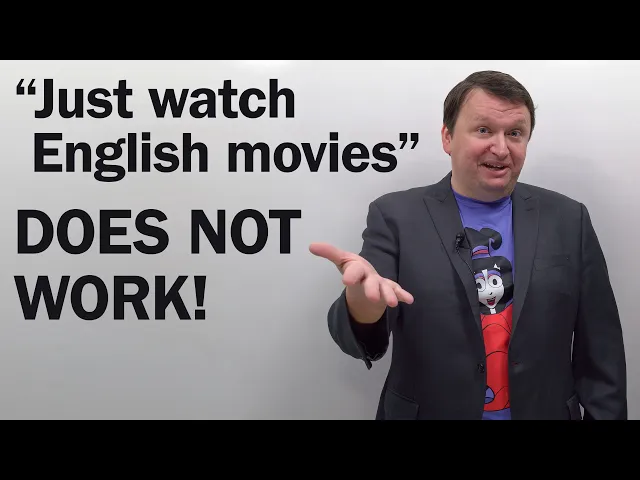
Want to Learn English with Movies? Here is What You Need to Know
English with Alex · engVid
0:00 How often have you heard to improve your English?
0:04 Just watch English movies.
0:05 This advice is given by other English learners
0:09 and by English teachers just like me to students like you.
0:14 Now, this is not bad intentioned advice.
0:17 We give this advice because I genuinely believe that movies
0:22 are a good way to help people improve their vocabulary,
0:27 their pronunciation, their grammar skills.
0:29 There are many, many benefits to watching films,
0:33 to watching media in your target language, in this case, English.
0:39 However, this advice, just watch movies, is not really complete.
0:45 There are two reasons for this.
0:48 Uh number one, when you watch a movie in your first language,
0:54 it is a passive practice, right?
0:56 You don't watch movies when to hyperfocus
1:00 on something because you want to learn something.
1:04 You watch movies because it's pleasurable, it's entertainment,
1:07 and you want to be taken on an emotional journey or to experience a story.
1:15 The other issue with this is that today's modern movie
1:19 watching is much different than it was in the past.
1:23 Most people today when they sit down on the couch to watch a movie usually have
1:29 their phone in their hand and they might have a bag of popcorn in the other.
1:35 So they're not really focused 100% on the movie unless the movie is really good.
1:42 Uh, so does that sound like a good way
1:45 to improve your language skills in a second language,
1:48 to be passive and to be distracted?
1:51 I don't think so.
1:52 So, the point of this video is for me
1:56 to teach you how to watch movies the right way.
2:00 And today, I really want to show you why just
2:05 watch English movies doesn't work unless you do these things.
2:09 First of all, if you are watching a movie or a show,
2:14 you need to give it your full attention.
2:18 So, this means remove distractions, right?
2:21 Put your phone away.
2:23 Put that granola bar away so you're not focusing on chewing and eating.
2:29 Focus on the content.
2:31 Listen actively to what characters are saying and pay attention to the context.
2:38 what is happening in the movie?
2:41 What are the relationships between the characters?
2:45 Basically, don't just have it on in the background while you are washing
2:50 the dishes or vacuuming the floor or if
2:54 you're doing something else around the house.
2:56 You need to give a movie if you are using it for learning,
3:00 you need to give it your full attention.
3:05 Next, you need to pause and rewind.
3:08 Remember, you are engaging with the movie not
3:12 as a source of entertainment but as a learning resource.
3:16 So, think of the movie as a text.
3:19 If you read the text and you don't understand something,
3:23 usually you go back and you read it again.
3:27 Maybe you use a translator to figure out what was said.
3:32 So, when you pause and rewind, you can use this as an opportunity to listen.
3:38 actively and repeat what you heard.
3:40 Repeat what characters say.
3:42 Um, I do this when I watch Stranger Things on Netflix, for example.
3:47 I will pause, I will go back and I will
3:51 try to say what the characters say because I heard
3:55 something that I understand the majority of, and I can
3:59 try to figure out what they mean first through context.
4:03 So, yeah, learn through context.
4:05 that is the next point.
4:07 Uh, I kind of understand the situation and I think, "Ah,
4:11 maybe this word means this," and if I don't understand it then I grab my phone,
4:17 not distracted but using it as a tool,
4:20 and I look up the translation of a word for example.
4:24 "Oh that's what that means.
4:26 Okay, let's watch this scene again," even if it's
4:29 just 5 seconds or 10 seconds of a conversation.
4:32 Basically, when you are watching movies in a new language,
4:37 you try to get the big picture.
4:40 You won't understand everything and that's okay.
4:43 It is not realistic for you to understand everything in a new language.
4:49 It's a new language, right?
4:52 So, there is something else you can do.
4:55 If it's really tough for you
4:57 to understand what characters are saying, use subtitles.
5:00 If you have to.
5:03 So sometimes the material that we are watching is honestly too difficult for us.
5:10 Uh this is a separate problem.
5:13 I can address this in another video,
5:15 but you should be watching stuff that you mostly understand.
5:21 If you don't understand 90% or 95% of a movie, it's the wrong movie.
5:28 Okay?
5:28 So try to find something where you understand
5:31 the majority of the context and the majority
5:35 of what is happening even if you only understand 50% 60% of the language.
5:43 So if you use subtitles, I love subtitles by the way,
5:48 especially at the beginner, low, intermediate level.
5:52 You still have to listen to how people speak.
5:57 This goes with my third point.
6:00 Subtitles help you link text to sound.
6:04 Right?
6:04 So don't just read.
6:06 Keep your ears open and try to basically make the connection.
6:11 Ah wait this person is saying this word but it doesn't sound like this word.
6:18 Maybe they are using a reduced pronunciation.
6:21 Um maybe they are eliminating a letter in casual pronunciation.
6:26 So for example the word sandwich instead of the word sandwich,
6:32 right, with the D for example.
6:35 Okay.
6:36 So basically, subtitles or subs, they boost comprehension.
6:41 They help you understand better what is happening.
6:45 Most of us are better readers than we
6:48 are listeners when we are learning a new language.
6:52 This is definitely the case for me.
6:55 I mentioned that I am watching Stranger Things.
6:58 I am watching it in French because that's the language
7:02 that I am trying to learn and slowly succeeding at.
7:06 Um, and I find that subtitles are a great way to, you know,
7:12 improve my comprehension of what's going on, but also to see
7:17 how sentences are structured and what common phrases are used.
7:22 So, I'm still though listening and trying to repeat what characters are
7:26 saying as they say them or right after they say them, for example.
7:33 Okay.
7:33 So, we use subtitles and we are actively listening and all of this stuff.
7:40 We are pausing, we're rewinding.
7:41 But what what can we do with that to make sure that we
7:46 remember this information and we can review it again in the future?
7:50 You take notes.
7:51 So, wow, magic.
7:53 You have a journal.
7:54 You can use a translator to tell you the meanings of new words,
8:00 of new phrases that you don't know,
8:02 and then write them in a physical notebook or you can open up a digital file.
8:08 If you use the cloud,
8:10 you can always just write things in a digital document as well.
8:14 I like the old school um paper and pencil approach, right?
8:20 And you can also review and rewatch.
8:23 So you review your notes and you rewatch
8:27 the things that you took the notes from.
8:30 So for me, I have uh Stranger Things in French in here.
8:35 I have Peppa Pig.
8:37 I have Llama Llama, which is another kids show on Netflix.
8:42 So I write stuff that is interesting to me.
8:45 even if I know what most of the words mean,
8:49 it's just good just to practice the flow, to practice the sentence structure.
8:54 So, uh, Stranger Things season 4, episode two,
8:57 I wrote it at the top of my this journal page.
9:03 I just wrote random stuff.
9:06 So, now I will read some French for you.
9:10 [speaking French] Very dramatic.
9:19 This is a very dramatic scene.
9:21 I know exactly where this is from in the show.
9:24 So, um, write things like this down and then rewatch those scenes in English,
9:30 uh, that you, you know, took that stuff down.
9:33 And please let me know, uh, how is my French?
9:36 Okay, one more piece of French.
9:38 Peppa Pig.
9:39 The narrator says, Peppa aime bien s'occuper de son petit frère George.
9:44 Allez, George!
9:45 On va chercher un autre flaque de boue!
9:49 Good?
9:49 Not bad?
9:50 Okay, tell me in the comments.
9:52 Uh, Peppa is actually a great show for something like
9:56 this and it's a great example of my next point.
10:00 Just watch three to five minute clips.
10:02 You don't have to watch a full 2-hour movie.
10:07 If you use a manageable learning chunk, right, a chunk of 3 to 5 minutes,
10:14 you can greatly reduce your stress level
10:17 and you can reduce your fatigue and frustration.
10:21 If you watch a 2-hour movie and you don't understand,
10:25 you don't understand, you don't understand, you will feel tired.
10:30 And when you are tired, you are not paying attention anymore.
10:36 So this actually benefits your learning.
10:39 You don't have to watch the full movie.
10:42 It's okay if you don't watch the full movie and if you
10:47 just use a 3 to five minute chunk as a learning resource.
10:52 If you want to watch movies and use them as a source of learning,
10:57 you need to remove distractions.
10:59 You need to pause and rewind.
11:02 Use subtitles if you have
11:04 to, especially for beginners and intermediate students.
11:07 Take notes, have a journal, and watch short sections.
11:11 You don't have to watch the whole movie.
11:15 Now, one more important point before we finish this video.
11:20 I said, you know, watching movies is a passive practice.
11:24 And this is true.
11:26 There is a benefit to passive listening, right?
11:30 Passive listening does have benefits.
11:32 It does keep your connection with the language, right?
11:36 It it helps you to still hear English even if you are not actively watching.
11:43 And that's good because even if you hear like basic sentences that you know,
11:48 you're still keeping that connection.
11:50 You're still keeping that language closer to your heart,
11:54 your spirit, your ears, your mind.
11:56 And that is a good thing.
11:58 So passive listening, it helps you keep the connection to the language.
12:02 It can help you, you know, review the stuff you already know.
12:07 But if you actually want to use movies to learn a language,
12:11 try using these strategies.
12:12 Uh, let me know if they work for you.
12:15 They have been working for me with my French.
12:19 So until next time, saloo.
12:22 Goodbye.
12:23 Keep learning and keep practicing.
12:25 Bye.