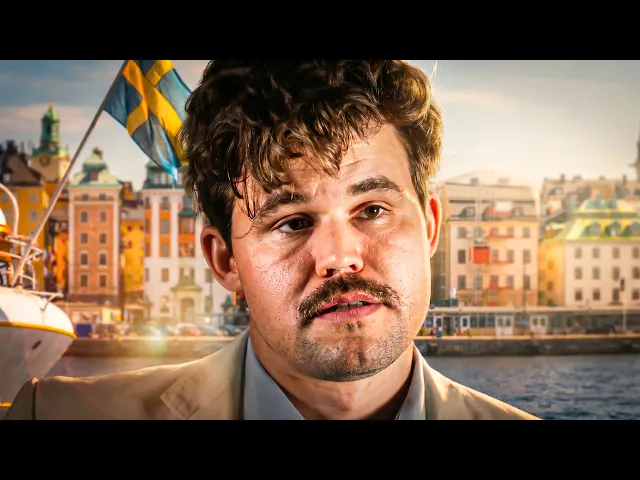
Why Magnus retired from classical?!?
GMHikaru
0:02 Welcome back everyone.
0:03 For today's video, we are back with round number one
0:06 from the TA Sigman tournament which is being held in Malmo, Sweden.
0:11 Now, the fivetime world champion Magnus Carlson is returning from a very,
0:16 very long absence of classical chess.
0:18 In fact, the last classical tournament that Magnus
0:20 played was Norway chess back in June of 2025, so nearly one full year ago.
0:26 Now, additionally, this is Magnus' first
0:28 time playing this tournament since he played
0:30 it all the way back in 2004 at the age of 13 years old.
0:35 My understanding or assumptions that Magnus is playing
0:37 this tournament because it's a fun event to play in.
0:39 It's a tournament he's never won.
0:40 And of course, Sweden is very close to his home country of Norway.
0:44 So, we have Magnus back in his classical chess tournament
0:46 and in the first round he's playing against Arjun Aragi from India.
0:50 Now, Arjun who is a player who has had many ups and downs.
0:53 He was ran ranked number three in the world just last year.
0:56 He struggled recently.
0:58 He's now down to number 10.
0:59 But he is a player who is always dangerous
1:01 and there is no doubt in my mind that he is a player who will return to his true
1:04 form and potentially reach the top five once again.
1:08 So first round of classical chess for Magnus in a long time.
1:11 He has the white piece against Arjun.
1:12 And off we go.
1:13 So Magnus opens with the move E4.
1:16 Arjun plays E5.
1:17 We get the move knight F3.
1:18 And here Arjun plays the move knight F6.
1:21 Now, this of course is what is known as the classic Petrov's defense.
1:24 It is probably the most solid opening being played these days.
1:28 It is the it was I should say the main opening that we saw in the recent
1:32 Canada tournament when players decided to play E4
1:34 and it's has a reputation as being very solid.
1:37 Additionally, in some world championship matches as well,
1:39 Magnus had to face it against both both Fabiano
1:42 Caruana from the United States and Janapi from Russia.
1:46 So, Argent plays this classic Petro's defense.
1:49 It's one of many openings he plays,
1:50 but he decides he's going to be as rock solid
1:52 as he can be against the greatest player of our time.
1:55 So, we get knight takes E5 from Magnus.
1:57 Arjun plays D6 here.
1:58 Knight takes E4 is the move that's playable.
2:01 I myself have played this.
2:02 This, of course, is what is known as the Damiano Gambit with this move D6,
2:06 but instead we get the standard pawn to D6 first.
2:09 So, after D6 attacking the knight, Magnus goes knight D3.
2:13 And this is already a first move
2:14 which is considered to be not particularly testing.
2:17 Now, normally white will play the move knight f3 and after knight takes e4,
2:21 there are many different variations.
2:22 There's d4, there's d3, there's bishop d3, there's knight c3.
2:26 Many, many different possibilities.
2:27 But Magnus decides he's not in the mood for this theoretical battle.
2:30 I suspect that he didn't know exactly what Arjun's prep was.
2:33 Maybe thought that if Arjun chooses to play something like the Petros,
2:36 he just wants to keep it very calm and quiet.
2:39 We get knight to d3.
2:40 Arjun grabs a juicer.
2:42 We get queen e2, queen to e7.
2:44 Both queens attacking and guarding the knight.
2:46 We get knight to f4 and now we get the move knight to f6.
2:49 Now the move knight to c6 I believe is playable.
2:52 In fact, I think this was played by Fabiano against Magnus
2:55 in their world championship match all the way back in 2018.
2:58 I don't remember remember exactly how the how the game went.
3:01 I I want to say it was something like knight d5 knight d4.
3:04 And I don't I don't remember exactly what exactly what happened.
3:07 But at any rate in this game Arjun plays move knight to f6.
3:11 So Magnus goes knight c3.
3:13 Arjun plays C6 here trying to take advantage of this knight on C3.
3:16 Arjun's plan is to play D5 down the road
3:19 building the classic chain of pawns in the center.
3:22 And this knight really doesn't have any squares
3:24 available because the pawns prevent the knight from jumping.
3:27 Now Arjun of course could simply trade and play something like knight C6.
3:30 But here I think that in this position after knight C
3:33 D5 takes takes king D8 guarding the pawn and the move C3,
3:37 white might end up being a little bit better.
3:39 So we get C6.
3:41 Magnus decides to play D4.
3:42 Arjun trades the queens and now we get the move bishop to F5,
3:46 developing this bishop and attacking the pawn on C2.
3:49 Here Magnus plays move bishop to D3.
3:51 We get the trade and now we get the move knight to A6.
3:54 Now at this point we've reached a middle game.
3:57 Queens have been traded off the board.
3:59 This is a position that's very very dry.
4:01 I could also say it's an endgame without queens on the board.
4:03 Objectively very very balanced.
4:05 But Magnus in my view figures he's reaching an endgame.
4:08 He's going to be able to play
4:09 on and on and on and Arjun's going to have to defend.
4:12 And as we know, Magnus is bread and butter
4:14 for the last probably 15 years are endgames.
4:16 He is the best endgame player in the world and he is someone who finds ways
4:20 to create chance in positions where seemingly the game
4:22 looks like it's headed towards an immediate drop.
4:25 So we get the move F3 from Magnus here.
4:28 Arjun moves the king.
4:29 Magnus goes king to F2.
4:31 And now Magnus has basically mirrored this pawn on C6.
4:34 So this pawn on f3 basically stops the knight
4:36 from me being able to jump to any of these squares.
4:39 So this knight is kind of dominated by the pawn
4:41 while this knight is dominated by this pawn on c6.
4:44 So both of these pawns kind of dominate these knights.
4:47 So here we get the move g6 from arjun trying
4:49 to fianto the bishop maybe hit some stuff on this diagonal.
4:53 And Magnus plays move pawn to a4.
4:55 Arjun goes bishop g7.
4:56 We get the move bishop to d2.
4:58 And now arjun plays move h5.
5:01 Magnus plays move knight to E2
5:03 retreating the knight potentially guarding this pawn.
5:05 Say the knight moves pawn's not under under attack.
5:08 So after takes he captures the bishop.
5:10 He moves the knight guarding against the threats towards the pawn.
5:13 And now Arjun plays move bishop H6.
5:15 Now this is what I like to call a lazy man's move.
5:18 Now, there's nothing wrong with this bishop H6 move,
5:21 but it reminds me of so many games that I've played against
5:24 Magnus or games I've recaped or seen other players play where they
5:27 they have this sense where it's an equal position against Magnus
5:30 and they immediately try to trade off the pieces as quickly as possible.
5:34 And in this position, bishop H6 is actually a serious mistake here.
5:37 What Arjun should play is move like knight to D5.
5:40 If white goes C4, you have knight E7,
5:42 rerouting the knight to F5 to hit this pawn and black is fine.
5:46 You can also play something like rook A to E8,
5:48 but bishop H6 is actually a mistake here because
5:50 this dark sword bishop for white is not super active.
5:53 And this bishop on G7 is potentially very
5:56 well placed on the diagonal down the road.
6:00 So Arjun plays bishop H6.
6:02 Now this to me it feels like again like so many Magnus games I've seen,
6:05 Argentin figures, well I trade the bishops.
6:07 Less piece on the board, no chance I can end up worse.
6:10 But now as we're about to see, you can end up worse.
6:13 And Magnus is about to prove it.
6:15 So we get the move pawn to B4.
6:16 And the reason that white is now better
6:18 is that white is going to create this great
6:19 wall of China on the fourth rank by pushing
6:22 all these pawns forward to create the wall.
6:24 White can play B5 here.
6:25 And without any pressure towards the center, no bishop G7 to hit this pawn.
6:29 White simply has a free hand to start pushing on the queen side.
6:32 And it's already in the situation where Arjun has to be very careful.
6:36 So Arjun plays knight C7.
6:38 Magnus goes B5.
6:39 Another excellent move.
6:40 We get the move rook H8.
6:42 Not pawn takes pawn because after takes takes,
6:45 white can play the move rook H to B1
6:47 attacking the knight and potentially the pawn behind it.
6:50 If you move the knight after rook after rook takes pawn here,
6:53 let's just say A6 to preserve the pawn where it's guarded.
6:56 White can go C4.
6:57 And with these split pawns here,
6:58 white being able to jump with these knights every which way.
7:01 This terrible rook on the king side that's just doing absolutely nothing.
7:04 White is in great shape and should win the game.
7:07 Additionally, if you were to play A6, trying to guard the knight on B5,
7:11 white will sack the rook with rook takes knight.
7:13 And after takes, rook takes rook,
7:15 white has one extra pony on the board, and white will win once again.
7:19 So, we get the move rook H8.
7:21 Now, Magnus plays C4 here.
7:23 He's got these great pawns on the queen side here.
7:26 No pressure in the middle of the board.
7:27 This knight can't jump anywhere.
7:28 And this is already starting to feel like a situation
7:31 where we're headed for another classic Magnus endgame victory.
7:35 So Arjun plays move knight to E6 and now
7:38 Magnus plays the move rook a B1 preparing to potentially
7:41 trade the pawns and infiltrate with rook B7 creating
7:44 the classic kebab with the rook on the seven.
7:48 So after rook B1 Arjun plays move C5 here
7:51 trying to stop anything from happening on this B file.
7:54 Now, this move is also probably a mistake here,
7:56 but I actually hesitate to say it's a big mistake because it's
7:59 already a situation where the most natural human move or natural computer move,
8:03 rook H8, looks a little bit strange because after takes takes,
8:06 you're worried about something like rook B7 and rook B1 here.
8:08 And with white controlling this open B file,
8:11 it just looks like white should be better.
8:13 And in fact, even here, say white were to go check and rook B2.
8:16 This also looks very unpleasant after rook
8:18 HB1 with white having the double stack.
8:20 No way to trade the rooks.
8:21 White always potentially pushing the pawns and with the knights,
8:24 white has everything in the world to play for.
8:28 So Arjun goes C5 here and now Magnus makes a mistake with this move D5.
8:33 Now Magnus spends nearly four minutes on this move before playing it.
8:36 But this effectively throws away any chance
8:39 of having a major advantage in the game.
8:41 Now the computer wants white to trade
8:43 the pawns and after knight takes takes takes
8:45 and the move knight c3 here for example
8:47 rook d8 and a5 probably magot black just moves
8:50 the king to c8 and black should be fine you have rook d2 maybe white is
8:54 play like rook d1 here you figure takes
8:56 takes something like rook d8 and you think it's
8:58 going to be a draw now objectively that would be a draw but I believe
9:02 that if white throws in this move b6 first with b6 to a6 and now rook hd1
9:08 or maybe not rook h e1 sorry I should say with the idea of rook to E7
9:11 here black is maybe still okay but it is going to require a lot of precise play.
9:16 Now if we go back just to make sure on this also here
9:19 computer says that after rook D1 takes just to be clear takes rook D8
9:23 even this end game maybe with takes and king D8 and king to E3
9:27 with knight E4 knight A4 maybe white has chance to win um it's not
9:31 like this is winning or anything but this is going to provide the bre
9:34 best practical chances but instead Magnus goes D5 and now after knight G7 we
9:39 end up in a situation with a completely clogged toilet all these files are
9:43 clogged if you go B6 A6 there's no way to use the rook here.
9:46 So with both both this A file, this B file,
9:50 the C file, and the D file completely closed.
9:52 Now the game hinges around the only open file on the board,
9:56 which is this E file.
9:57 So if either side can claim this E file, they can have an advantage.
10:00 But objectively here, I would say this already should be a draw.
10:03 So Magnus goes to A5.
10:05 Arjun plays rook E8.
10:06 We get A6, B6, and now we get the move knight to C3.
10:10 Arjun goes knight to F5 here.
10:12 Now this knight can hit D4, potentially jump to E3 or rook E3 as well.
10:17 Magnus plays rook E1.
10:18 And now we get the move knight to D4.
10:20 It would be very easy to become a little bit scared here and think, well,
10:23 let's just trade off the rooks and let's trade off the rooks and play
10:26 something like rook to E8 here and try to make an instant draw.
10:29 But after takes, king takes E8 and knight to A4, white
10:32 now has some potential threats on the queen side.
10:34 Say you play a move like knight D4.
10:35 After knight takes B6, it's the uh oh spaghettiio moment because takes
10:39 A7 a queen and you lose the game.
10:42 So you would have to go knight D7 guarding the pawn.
10:44 And now after this move G4, as you guys can tell,
10:47 black is actually starting to suffer here.
10:49 This is still a draw, I think, with perfect play.
10:51 But you have to be very,
10:52 very careful here because if you trade and go knight E7 after H4,
10:55 now you have this problem to deal with on the queen side.
10:57 White's also threatening to create pass pawn,
10:59 a pass pawn on the H file, on the king's side.
11:02 And this position according to the computer is already very close to lost.
11:06 But Arjun doesn't do that.
11:08 So instead here he plays move knight to d4.
11:11 And now Magnus plays this move H4.
11:13 Now here computer still wants white to trade the rooks and play rook to E1.
11:17 But after a move like rook to G8 or rook to F8.
11:20 Computer says should be a draw.
11:21 I think even takes is still likely a draw because after G5,
11:25 you're never going to be able to push the pawns
11:26 and create some outside P here on the king side.
11:28 So it should still be a draw.
11:30 But I I would suspect that it's simpler just to move the rook away.
11:34 Instead, after knight D4, Magnus plays the move H4.
11:37 And now Arjun plays knight C2,
11:39 forcing Magnus to do something with this tower that's under attack.
11:42 Magnus trades.
11:43 He goes rook C1.
11:45 And now we get the move knight to E3, attacking the pawn on C4.
11:48 Magnus plays knight D1.
11:50 We get knight to F5 attacking the pawn on H4.
11:53 We get G3 guarding guarding the pawn.
11:55 Now Arjun plays king D8.
11:57 And here Magnus plays move knight D3.
11:59 And after knight to E3, we we get a draw by repetition.
12:03 We get knight D1, knight F5, knight C3, knight E3, knight B2, knight F5,
12:08 and now Magnus plays the move knight D3, forcing the game to end.
12:11 Now, the main reason I think Magnus chose to make
12:13 the draw is that he saw these bishops like knight to B2.
12:17 But after a move like knight D7, for example,
12:19 your pawns are really fixed on the king side.
12:20 If you ever go G4, I swap and win the pawn on H4.
12:23 So, you can't really push this pawn.
12:25 At the same time, your king is also stuck guarding the pawn.
12:28 So with the knight attacking both these pawns,
12:30 Magnus figured there was no way to play for more and that's
12:32 why he ends up making the draw by repetition with knight to D3.
12:36 So in the first round of the event,
12:38 Magnus Carlson draws with the white piece against Arjun.
12:41 Felt like Magnus maybe he was perhaps a little bit rusty in my view.
12:45 I felt that playing this move D5 was not necessarily bad per se,
12:48 but playing this move in three minutes to me felt like
12:50 a situation where where normally Magnus would spend a little bit more time.
12:54 He still might reach the same conclusion,
12:56 but I think he would he would perhaps take a bit longer to think.
12:59 So overall, pretty solid game from Arjun.
13:02 Very I'm sure he's very happy.
13:04 Plays rock solid games of black pieces.
13:06 Makes a draw against Magn.
13:07 And now he'll get to move on to the next round where
13:09 none of the opponents he will have to face will be as difficult.
13:12 So we spoke about the Magnus game against Arjun,
13:15 but there are of course six other players in the tournament.
13:18 There's one other game that we're going to cover.
13:20 Now, that game is going to feature
13:22 the young American superstar grandmaster Andy Woodward.
13:26 To speak about Andy, he recently crossed the 2600 mark.
13:29 He's had some very solid performances in the US
13:31 Championship in the Grand Swiss as well.
13:33 He is also a player who I spotted as having exceptional talent a few years back.
13:37 I played him in the Lee chess
13:39 qualifier for the Fisher Random World Championship,
13:41 which was eventually held in Iceland.
13:43 I did beat Andy an hour match, but even at that time as a young kid
13:46 around 2400 or a little bit above, he showed great.
13:49 He showed great potential and I actually sponsored him
13:52 financially for the better part of a year after that.
13:56 So Andy's been rising, playing good chess,
13:58 and Andy is paired against the Swedish number one, Neils Grandelius.
14:03 Now Neils is someone who is one of my helpers for the candidates tournament.
14:06 He was one of the people who I worked with for this event,
14:09 someone that I've known for a long time.
14:10 He helped me for the candidates in 24 also this year in 2026.
14:14 And I think it's going to be abundantly apparent to everyone
14:16 as we go through this recap of what's going on.
14:19 So Andy has the white piece against Neils.
14:21 We get the move D4.
14:22 Neiels plays D5.
14:24 C4 E6.
14:25 Knight F3.
14:25 Knight F6.
14:26 Knight C3.
14:27 And lo and behold, we get this move pawn to H6.
14:30 Now, anybody who's followed my recaps over the last month even
14:33 probably is aware that I played this H6 variation not once,
14:36 not twice, but three times in the candidates tournament.
14:40 I played it against Yavok, Cinderov, Anish Giri,
14:43 and I also played it against one other player.
14:46 That would be Matias Blueb if I'm not No.
14:48 Was Matias Bluebomb the other player?
14:50 Of course, we're doing this recap live on the fly,
14:52 but I play this in three different games.
14:54 And I believe yes, it was Matias, Yavok, and Anish who I played against.
14:57 So, it should come as no surprise when you see this move H6 on the board
15:00 as it stops white from putting this bishop on G5 to pin the knight on F6.
15:05 Now when I play this in the cannons I with relative ease I would
15:08 say I drew all three games and actually to fact check myself I'm wrong.
15:12 Anish was different.
15:13 Third game where this occurred was the last game against Prag.
15:15 So I had it against bluebound Cinderov and Pragnetto.
15:19 Anish was a different version of H6 on move number three.
15:22 So we get H6 being played and now Andy plays G3.
15:26 Bishop E7 bishop G2 castles.
15:28 Castles takes knight E5.
15:29 Knight C6 takes takes takes and the move queen to E8.
15:34 Now, up to this point, I had h I I'd had this position
15:38 in the candidates tournament um against against Cinderov.
15:41 And we get and here we get this move knight takes E7 being played.
15:44 So, we get knight E7, queen E7, and now we get the move bishop B3.
15:48 Now, Cinderov against me, of course, played the move queen to A4.
15:51 And then the game continued with this move pawn
15:53 to A5 after takes and bishop A6, queen C5, takes, takes, rook D8.
15:57 The game would eventually end in a draw.
16:01 So, Andy plays bishop E3 instead.
16:03 Neils plays a5 here and now we get to move pawn to f3.
16:06 Now what's going on here is that white
16:08 has given up this fiance cheito bishop on g2.
16:11 But the argument is that black can't really take advantage because the pawn
16:14 on f3 if you ever put a bishop on b7 the diagonal is completely closed.
16:18 The bishop isn't super active.
16:20 Even if you get e5 for example with a bishop
16:23 say on h3 potentially it's still very very hard to attack.
16:26 Ignore the valuation bars.
16:27 I'm just explaining general concepts here.
16:29 But even if you got the bishop on H3 with these pawns around this white king,
16:32 it's very very hard to take advantage
16:34 of this light of the light square weaknesses.
16:37 So we got the move f3.
16:39 Now what white's aiming for here is white
16:41 would love to play something like bishop to f2
16:42 and e4 building this big white center
16:45 and a snake like formation with the five pawns together.
16:48 Black on the other hand has this compromised structure with the pawns
16:51 and black really has to make a decision very quickly.
16:54 Now here Neils really surprised me by playing this move rook to D8.
16:57 When I saw the position at the time when the game was live,
17:00 I was sure that he would play this move knight to D5,
17:02 forking the knight and the bishop at the same time.
17:05 And after a move like queen D2 and rook D8,
17:07 let's say rook D1 for example, black can play A4.
17:10 I think even F5 here is reasonable.
17:12 It's a very very rich position, but black should not be worse.
17:16 Instead, Neil goes rook D8.
17:17 We get queen C1.
17:18 And now we got the shocking move E5.
17:20 Now, this move in and of itself is not a terrible move per se,
17:24 but in my view, this is simply Neil's
17:26 misunderstanding the pawn structure and what you're playing for.
17:29 Now, there are a lot of systems in these Catalans.
17:32 For example, if you go back to start just to set up a normal
17:34 position where often times you'll get something
17:37 like this and if you can after castles, you will play this move C5.
17:41 You can also play E5 depending on the situation.
17:44 But if you can try to play C5, you always know that it's acceptable.
17:47 E5 can be okay, but it's very situation dependent.
17:50 whether it's good or it's bad.
17:52 So we get back to the game here.
17:54 Black can never really play C5,
17:56 but after pawn takes pawn, the bishop simply guards the pawn.
17:59 So you can't play for C5,
18:00 which means either you play E5 or you play the move knight to D5.
18:04 Now it is very much a 50/50 in my view what you do.
18:07 But I was surprised because based on my own understanding of the Catalans,
18:10 this E5 move is extremely committal and it's either completely fine or you
18:14 end up in a lot of trouble once you play this move.
18:17 So Andy trades the pawns.
18:18 He plays move bishop to f4 attacking the queen and the pawn behind it.
18:22 Neiels plays queen c5.
18:24 And now we get to move queen to e3.
18:26 And at this point this opening has worked perfectly for Andy
18:30 Woodward because once we reach this position Neils pretty much has
18:33 to trade the queens because if you go queen c6 here
18:36 after a move like queen to e5 attacking the pawn on c7.
18:39 Let's say you play rook a7 and rook a d1.
18:42 White has great queen in the middle of the board.
18:44 It's almost like the classic sunray.
18:46 You have the rook in the middle of the board and white is
18:48 doing very very well here as you can see from the evaluation bar.
18:52 So Neil's trades the queens but now we're in a situation
18:55 where you'll never be able to attack the king.
18:56 So even though there light square weaknesses,
18:58 even if you put the bishop on H3, nobody cares at all.
19:01 There's no threat on the king side.
19:02 So you don't have the kingside threat.
19:04 You have double pawns on the C file.
19:06 White can also claim the D file.
19:08 And at this point, while it should still be a draw with perfect play,
19:11 this is very easy to play for white with no risk whatsoever.
19:14 And I have a feeling that Andy is going to turn turn it on.
19:19 So we get the move knight to D5.
19:20 Now here Andy plays rook D1, pinning the pony on D5.
19:24 We take the bishop, lose the rook in the game.
19:26 Neiels goes bishop E6 guarding the knight.
19:29 And now we get the move bishop D4.
19:31 Here Neils plays move F6.
19:33 This move is apparently a serious error according to the computer.
19:37 I I think it's an error because white can
19:38 start to move the knight around to like C5 here.
19:41 But again, very very computerish.
19:42 not something that I think would occur in a game.
19:44 So, we get to move pawn to G4.
19:46 Now, the main reason that black is in trouble here,
19:48 if we look at this position is if you trade the knights,
19:50 for example, you get this position.
19:52 You'll notice that all the pawns are glued and white always has
19:55 a free hand to start pushing the p on the king side.
19:57 So, you go king f7, white goes king f2,
19:59 you play a move like c6, white plays a h4, lifted rook b8.
20:02 Now, white can play a move like rook g1 and g5 here.
20:06 And already white is much much better
20:08 here because the queen side is completely frozen.
20:10 The bishop guards the pawn.
20:11 It targets diagonal.
20:13 It stops rook to D2 as well.
20:15 And white is just free to move these rooks
20:16 to the king side and crash through and win the game.
20:20 So it's already a very very critical situation for Neils.
20:23 He's going to have to be very precise.
20:24 Plays move king F7.
20:26 We got the move knight takes knight, rook takes.
20:28 And now Andy goes bishop C3,
20:30 planting the wooden shield here, targeting the pawn, guarding the pawn,
20:33 covering this diag covering this square on the second rank and of course
20:36 keeping an eye on this diagonal towards the black king side.
20:40 So we get the move rook takes rook.
20:41 Rook takes A4 played A3.
20:43 Of course if black is able to get A3 here,
20:46 black will be completely fine because now if you play
20:48 rook D2 takes and rook A3 the bishop is not secure.
20:51 You can play rook C2 but the bishop has to be guarded by something here.
20:55 Whereas back here when you play this move
20:57 A3 the bishop is permanently fixed here.
20:59 Bishop guards the pawn.
21:00 Pawn guards the bishop.
21:02 Black never dislodges this bishop for the rest of the game.
21:06 So we got king E7 here.
21:07 I actually think king to E8 would have been a better
21:09 move based on what Neiels's plan was in the game, but he goes king E7 instead.
21:14 We get king to F2.
21:15 And now Neils makes a fatal error when he plays his move rook to D8.
21:20 Now based on what happens in the game,
21:21 king to D8 would have made more sense because after king F2,
21:24 you can now play the move rook D8.
21:26 I will say after rook D8, rook to G1 with H4,
21:28 G5 still in the air and pre massive pressure on the king side.
21:32 It's a long way to go to save this game,
21:34 but black should draw with precise play.
21:37 But instead we get the move rook D8 here.
21:39 And now after bishop B4 tickling the king on E7 with the check.
21:43 King moves trade and go bishop F8.
21:46 And even though we have an endgame
21:48 with opposite color bishops here at this point white
21:50 is winning because white is going to win one of these pawns on the king's side.
21:54 And one of black's set of pawns.
21:55 These C pawns are double.
21:57 So in effect once we get G5 and takes here,
22:00 white is up two pawns because these pawns are on top of each other.
22:02 If this pawn were on the B file, for example, it's one pawn.
22:05 But this means that white is up two pawns
22:07 here with the four pawns on the king's side.
22:09 One, two, three, four to push the p here versus the two.
22:12 Black should be losing in this endame.
22:14 So Neil goes king e7.
22:16 We get king g3.
22:17 Neils decides to sack this c pawn here to try
22:20 and open up activity for the bishop on the diagonal.
22:22 But after e4 and bishop to e2.
22:25 Now we get the move e5.
22:26 A very very precise move from Andy.
22:29 It's not the only way to win.
22:30 Even f4 would have been good enough.
22:32 But E5 is a really nice way to create a situation where white
22:35 wants to do is get two connected pass pawns on the king side.
22:38 So we get pawn takes pawn, bishop takes, king E6.
22:41 And now Andy plays king F2, bishop D1, king E3, C6.
22:45 And with move H4 on the board, these two connected pass pawns here.
22:49 White should be technically winning.
22:51 So Neils goes king D5.
22:53 Andy pushes his T.
22:54 We get king E6.
22:55 And now we get the move bishop to H4, bishop C2, and the move bishop G3.
23:00 Now, I really like this finesse from Andy.
23:01 There are many ways to win the position.
23:03 But by moving this bishop, first of all,
23:04 you free free the file so the pawn can start pushing.
23:07 But then when you go bishop G3,
23:08 you put the bishop on the optimal square to target the pawn
23:11 as well before doing anything over here on the king's side.
23:14 It's not particularly difficult, but it is still nice technique.
23:17 So, we get the move king to F6.
23:20 Andy plays C4.
23:21 We get bishop to B3.
23:23 And here Andy plays this move H6,
23:25 pushing this pawn further up the board closer to Queenie.
23:28 Now here Neiels plays the move bishop C2.
23:30 At this point the game is over after the move king G6 guarding the pawn.
23:34 There are many ways for white to win but probably
23:36 the cleanest is to take this pawn on E5.
23:38 If black takes on C4, you go bishop G7.
23:40 And with three connected pawns just barreling up the board here.
23:43 Black cannot stop all three of these pawns.
23:45 The P will simply be too much.
23:48 So if black takes on H6, which is the other option here,
23:51 white can simply go C5, fixing these pawns on the opposite color of the bishop.
23:55 And now after bishop d1, king f4 and king g3, let's just say bishop e2.
24:00 This endame is very simply winning because you now go f5.
24:03 If king g5, you check.
24:05 King f4, g5, bishop c3.
24:08 And here once you get king g5, bishop d3 and f6,
24:11 black will have to sack a bishop for a pawn or the pawns.
24:14 And after you sack the bishop here
24:15 with the two pawns on the board and the bishop,
24:17 this is a very easy win for white.
24:20 Now, of course, you'll probably notice that if black were somehow
24:22 able to get this endgame where he wins this pawn on C5,
24:25 say you get to like this position, for example,
24:28 this would be a draw because it's
24:29 the wrong color bishop relative to this queen square, which is a light square.
24:32 But the two pawns on the board, there's simply no way to do it.
24:35 Um, in this position after the move C5,
24:38 the two connected pawns here, black will have to sack the bishop.
24:40 White will win the game, and that's all she wrote.
24:43 So, Neils plays bishop C2 instead.
24:45 And now Andy correctly sacks his bishop for the pawn.
24:48 It's not the only way to win once again,
24:50 but it's the quickest and most effective one.
24:52 He sacks the bishop for the pawn, we got king takes bishop, f4, king f6.
24:57 And after the move f5, Neiels resides in this position because he really
25:00 doesn't have a way to use his bishop effectively.
25:03 Even if somehow the pawn were on c5 here,
25:05 there's no way the bishop can target these pawns on the queen side.
25:08 So the whole queen side dies.
25:09 It just becomes a three pawns versus
25:11 bishop game because nothing can happen over here.
25:13 And white just moves the king and pushes the p.
25:15 A sample line would be after F5 where the game ends.
25:18 Say black plays, I don't know, bishop B1.
25:20 Get king F4.
25:21 Now you go G5, bishop C2.
25:24 White will go for the move G6 here checking the king.
25:27 Let's say king F6, H7, F6, F7,
25:30 and white will push one of these pawns through the black king when it moves up.
25:34 White promotes, makes a queen, and the game ends.
25:36 So really is no way to to do anything here.
25:38 If you play king G5, the H pawn runs through.
25:41 You go back.
25:41 Same thing.
25:42 King F4, G5, G6.
25:43 With these three connected pawns rolling up the board,
25:46 black has no way to survive.
25:47 And that is why Neils resigned this game after the move F5.
25:52 So a very nice technical game from Andy
25:54 Woodward with the white pieces to beat Neils, the Swedish number one.
25:57 That means that Andy is tied for the lead after the first round,
26:00 I believe, with only notic Abdul Satarov who beat Zujaneire from China.
26:05 But Andy's off to a great start.
26:06 Arjun and Magnus have a very very uh very typical first round draw.
26:10 So exciting first day of games in the TA Sigma tournament being held in Sweden.
26:14 I definitely enjoyed doing this recap.
26:16 I think we'll we're going to want to watch Andy.
26:18 We'll definitely do some recaps involving Yagiz
26:20 Erdom Khan from uh from Turkey as well.
26:22 So it's going to be an exciting tournament.
26:24 But that is going to do it for our recap from round
26:27 number one of the TA Sigman tournament being held in Malmo, Sweden.
26:30 So hope you guys enjoy the recap.
26:32 Before we go, if you're not already subscribed to the channel,
26:35 make sure that you smash that subscribe button below.
26:38 And we'll be back with a recap after
26:40 the second round tomorrow of this very exciting tournament.
26:43 Hope you guys enjoyed it.
26:44 Have a great rest of your day and I'll see you very soon.
26:46 Bye.