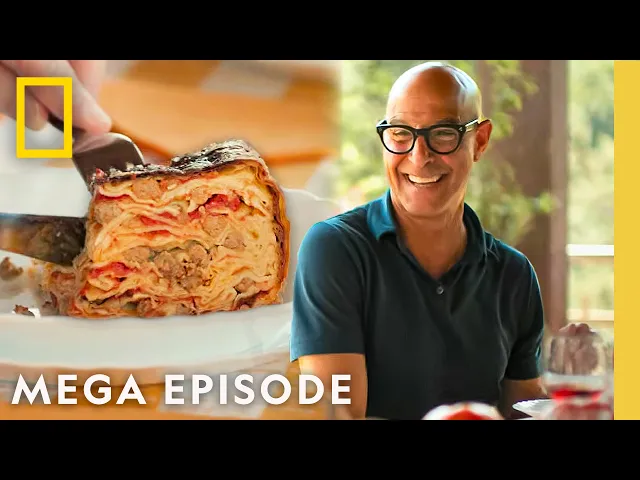
Stanley Tucci's Savory Journey Through Italy | Tucci in Italy S1 MEGA Episode | National Geographic
National Geographic
0:02 [bird tweeting] [Stanley Tucci] I'm in a region that I've never been to before.
0:11 It's rustic.
0:13 It's wild, it's mountainous, it's rough.
0:18 And I'm in a part of it that the locals call Little Tibet.
0:24 I'm in Abruzzo.
0:26 [sheep bleating] [laughing] There's my ride.
0:32 I believe that the best way to understand what makes
0:35 a country and its people unique is through their food.
0:39 This is incredible.
0:42 Oh, man!
0:43 And this is true nowhere more than Italy.
0:45 [speaking Italian] Okay.
0:48 Nice.
0:48 Do you smell that?
0:49 Mm, mm, mm!
0:51 Where even the shape of your pasta and the sauce
0:53 you serve it with speaks directly to identity.
0:57 -You like it?
0:58 -I love it.
1:00 -Oh, my God, it's so good!
1:01 -[laughing] [Stanley] And differentiates the character and history
1:05 of each region sharply from the next.
1:08 It's just not what you expect.
1:09 I'm Stanley Tucci.
1:12 And I'm exploring the complex connections between the land, the people,
1:16 and the food they eat in order to discover
1:19 the essence of each region in the country I love, Italy.
1:27 bright music playing] [Stanley] Abruzzo is right in the center of the peninsula,
1:35 midway down the calf of the boot, separated from much of Italy by the Apennines,
1:40 an impenetrable mountain range that forms the backbone of the country.
1:49 It's among the least densely populated parts of Italy.
1:55 How does this brutal,
1:57 yet glorious geography impact upon the people and their food?
2:05 I'm starting in a remote mountain village called Senarica.
2:11 [bell tolling] It's Sunday.
2:20 [speaking Italian] -Welcome to Senarica.
2:23 -Grazie.
2:24 [Stanley] And Chef Danilo Cortellini has invited
2:26 me to a traditional lunch with his family.
2:29 [Danilo] Sun is not shy today.
2:31 [Stanley laughing] [rooster crowing] [Stanley]
2:36 Senarica is small and hidden away, little influenced by the outside world.
2:41 Danilo, however, has been cooking internationally for 25 years,
2:45 12 of those as head chef at the Italian embassy in London.
2:51 Despite his global pedigree,
2:53 his Mother Lucia doesn't trust him with today's lunch,
2:57 a traditional feast day dish called timballo.
3:07 [speaking Italian] Stanley.
3:13 Stanley.
3:17 -Mom is making crespelle.
3:18 -Yeah.
3:19 We can call them crepes, but she might not like it.
3:21 So, let's call it crespelle.
3:22 Let's call it crespelle.
3:23 Because there's a French influence here.
3:25 -Right, isn't there?
3:25 -There is.
3:26 If you think about the French invasion,
3:28 they arrived here with Napoleon, the French.
3:31 -With Napoleon, right.
3:32 -Yeah, that was Regno d'Italia.
3:34 It was the— the kingdom run by the— by Napoleon in Italy.
3:38 And, um, it's quite easy to spot this is very similar to crepes.
3:42 -[Stanley] Sure, yeah.
3:42 -And then— -[Stanley] What is it made with?
3:45 -It's like a crepe but instead of butter, there's— there's olive oil.
3:48 -Uh-huh.
3:48 -And instead of milk, there's— -there's water, so it's lighter.
3:51 -Okay.
3:52 That's why they come out so thin.
3:54 [Stanley] Yeah, they're very delicate, yeah, right.
3:56 [Danilo] But I like to say better than crepes.
3:57 Of course.
3:59 You can say that, it's alright, go ahead.
4:01 So, one of the reasons that I wanted to do this story...
4:05 was because my family makes this— what we call timpano.
4:09 It's round, it has a dough on the outside,
4:13 almost like a pizza dough kind of like, ish, thing.
4:15 Inside is, um, pasta, and meatballs, and salami, and then baked.
4:21 -Baked.
4:21 -And then, like with this...
4:23 -Flipped over.
4:24 -Flipped.
4:26 [Danilo] That sounds like a lot of work.
4:27 [sputtering] It was days of work.
4:31 [Stanley speaking] It's egg wash with milk.
4:59 By putting a little bit of egg wash in the middle of each layer,
5:01 it serves the same purpose as a bit of a soufflé effect.
5:04 -Oh, I see.
5:05 -So, every— every layer will rise a little bit -because of it.
5:08 -Ah.
5:08 Yes, it is sort of French, isn't it?
5:11 You can see the influence.
5:13 We just don't want to tell the French.
5:14 No, no, no, no, don't ever tell the French anything.
5:19 [Lucia speaking] [Danilo] Many places of Italy,
5:22 we share the concept of mini meatballs.
5:24 Everybody says spaghetti meatballs is not an Italian dish, it's an American.
5:28 -But actually, no.
5:29 -Yeah.
5:29 [Danilo] It stems from, uh, something that we do.
5:32 Well, in America, everything did get bigger,
5:35 and saucier, and meatier, and— because there was more.
5:40 You had so much meat, you had a lot of bread, you had a lot of wheat,
5:43 so everything became bigger, and that's why Italian-American cuisine is
5:48 so distinctly different from Italian cuisine.
5:51 How many layers are in here?
5:59 Top of the tray, or we finish the ingredients.
6:01 -Yeah.
6:01 -Depends.
6:02 -[laughing] -Then— then you stop.
6:07 [Danilo, Lucia speaking] This is a case when we stop because we reach the top.
6:12 [Stanley] [chuckles] Yes, I see that.
6:14 We can make another one, but maybe later— -later tonight.
6:16 -Well, it's a bit— the show's not that long, I'm afraid.
6:20 [Stanley] The crew is incredibly grateful,
6:22 as this timballo is destined to become their lunch.
6:26 But first, it must cook, then rest, a process that takes just shy of two hours,
6:31 whereas Lucia made this timballo earlier today.
6:35 It's now ready to serve, but not before a moment of pure suspense.
6:43 A little bit.
6:44 Yeah, I must say.
6:45 [Lucia laughing] We're about to flip this.
6:51 The moment of truth.
6:52 Ready, steady?
6:52 Yes.
6:59 -[Danilo] Ole.
7:00 -[Lucia] It's okay.
7:03 -Don't just say it's okay.
7:04 -Ahh, yeah!
7:05 -No?
7:06 -Ohh!
7:07 [Stanley] It's more than okay.
7:13 -Yeah.
7:14 -[laughter] Oh, I'm so pleased.
7:16 -That's great.
7:18 -[sniffing] Here we go.
7:21 The timballo is ready.
7:24 -[Stanley] The heavy timballo.
7:25 -[Danilo] It's a heavy timballo.
7:26 But I didn't drop it.
7:27 [Stanley] Danilo's wife, Gaia, daughter Mia,
7:30 and father Pietro join us at the table.
7:33 Papa.
7:38 2-She doesn't like timballo?
7:39 -[Danilo] No.
7:39 -No?
7:39 Alright.
7:40 -[Danilo] Not much, yet.
7:41 -Yet.
7:41 -[Danilo] Shall I slice?
7:43 [Stanley speaking] Oh, yeah.
7:53 [Danilo speaking] -Okay, here we go.
7:57 -[laughing] -[Gaia] I'm sorry.
7:58 -[Danilo] Here we go!
8:01 [Stanley] Eh...
8:02 -That's for you.
8:04 -Oh!
8:04 Grazie.
8:04 -That's a big one.
8:05 -That's huge, yes, thank you.
8:07 [Danilo] That's the half portion here.
8:09 [laughing] [family chattering in Italian] Wow.
8:28 [Stanley] Whoa.
8:29 This is incredible.
8:32 The butter and tomato together is so sweet.
8:36 -This is delicious.
8:38 -[Gaia] Mm.
8:38 [Stanley] Delicious.
8:52 [Stanley] Si.
8:54 Si.
9:22 Si.
9:24 That Senarica could only be reached by foot
9:28 until the mid-1960s is not unusual in this region.
9:33 She's eating it!
9:34 She's eating it!
9:35 Wow!
9:36 New influences don't easily reach cut-off places,
9:40 but perhaps that increases their impact when they do.
9:43 That is amazing.
9:46 I'm— I'm serious.
9:51 But what might be the purest form of Abruzzesi cuisine?
9:55 [laughing] For that, I'm heading somewhere even more sparsely populated.
10:03 light music playing] [birdsong][♪ light music playing] [Stanley] Senarica sits
10:20 at the edge of the region's largest National Park, Gran Sasso.
10:25 The expansive landscape is dominated by Corno Grande,
10:30 the highest peak in the Apennines.
10:37 It doesn't look like Italy.
10:40 It's a very, very unusual, uh, landscape, beautiful landscape.
10:45 It's vast and peaceful.
10:47 [wind whispering] [motorcycle revving loudly] Save
10:58 for the hordes of motorcycle enthusiasts,
11:00 drawn here by the views and an iconic barbecue joint called Ristoro Mucciante.
11:09 -[people chattering] -[dog barking] Stanley.
11:22 Si.
11:28 jazz music playing] [Stanley] I'm here
11:35 to meet food and motor journalist Cristina Bachetti.
11:39 She says this is the place
11:42 to experience Abruzzo's ultimate culinary rite of passage.
11:46 [people chattering] -Hi, Cristina.
11:52 -Stanley.
12:06 Panorama, si, si.
12:30 [Stanley] This is and always has been sheep country.
12:34 For centuries, these elevated plains were home
12:37 to a custom known as the transumanza,
12:40 where shepherds based down in Puglia would drive
12:43 their flocks over 150 miles north to graze here.
12:47 The less fortunate animals became arrosticini.
12:58 Si.
13:03 [Stanley] Arrosticini are simply skewers of cubed mutton.
13:08 The shepherds' tradition of grilling the meat
13:10 in the open air continues to this day.
13:18 -[Rodolfo] Si.
13:19 -[Stanley] Oh, wow.
13:25 No.
13:26 Si?
13:37 I know, I know.
13:42 [Cristina speaking] [Stanley] In the 17th century,
14:10 over 4 million sheep summered on this lush mountain plateau.
14:14 Used for meat, milk, and wool, they generated huge wealth for this area.
14:31 -Si.
14:32 Si.
14:35 Oh, yeah.
15:05 [Cristina chuckles]♪♪ -[Stanley] Cheers.
15:36 -Cheers.
15:36 -Cheers.
15:36 -[Cristina] Cheers.
15:38 [Stanley] This is so good.
15:40 Everything.
15:40 Super.
15:44 [Rodolfo speaking] Si?
15:55 -Delicious -[Stanley] Delicious.
15:56 Delicious.
15:57 [chuckles] [Stanley speaking]♪♪ I know!
17:17 No!
17:19 -No!
17:20 -Si.
17:20 [chuckles] Cin cin.
17:26 [Stanley] Such rustic food, forged from Abruzzo's shepherding roots,
17:29 seems appropriate fuel in this vast, unchanged landscape.
17:36 Yet this region doesn't always lend itself to preserving traditions.
17:44 [birdsong] [Stanley] Located at the bottom of dramatic slopes in a lush valley,
17:55 Villa San Sebastiano is found at the westernmost edge of Abruzzo,
18:00 and is known for a tragic natural disaster.
18:03 somber music playing] On September 5th,
18:07 1955, a landslide wiped away the village.
18:10 Four were killed, dozens more were injured.
18:14 The villagers had two options.
18:16 They had to decide whether to leave or to rebuild.
18:19 They chose the latter.
18:24 Starting with the church.
18:26 Then, the next most important thing.
18:28 [people chattering] The communal bread oven that had fed them for centuries.
18:40 Chef Lucia Tellone looks after it today.
19:07 [Stanley] This place helped to rebuild the community after the landslide,
19:11 but gradually, convenience culture meant
19:13 that those traditional methods fell out of favor.
19:17 Eventually, the bread oven closed,
19:20 taking the social heart of the village with it, until Lucia came along.
20:08 Okay.
20:09 [Stanley laughing] [Stanley] Lucia resolved to teach the village to bake again,
20:22 and it turns out that the children are her best students.
20:47 Si.
20:55 [birdsong] -Si.
21:17 -Si?
21:27 [laughing] [Stanley] They don't just bake bread.
21:32 This local ancient grain also gets made into pan pizzas.
21:46 [child sneezing] -[child speaking Italian]
21:54 -[Stanley laughing] [Stanley speaking][♪ light
22:20 music playing] [Stanley] Lucia lights the bread oven once a week,
22:26 on a Saturday, and the community gathers to cook and share lunch.
22:42 Okay.
22:43 [Stanley] Whoa.
22:46 Yes!
22:48 -Mm!
22:48 -[Lucia] Okay.
22:49 [Stanley speaking] -[child] Yes!
22:54 -[Stanley] Mm-hmm, si.
22:58 [Lucia speaking] [laughing] [Stanley] The bread
23:22 oven feels as relevant now as ever,
23:24 providing warmth, nourishment, and community to the locals.
23:33 But the food that has really put Abruzzo
23:35 on the world map isn't a staple, it's an indulgence.
23:42 light music playing] [Stanley] Though isolated,
23:54 sugar and spices were brought to Abruzzo
23:56 by the trade routes that connected Italy to Asia.
24:01 Years ago, the town of Sulmona was an important stop on the spice trail,
24:06 being strategically located between the port of Pescara and Rome.
24:11 whimsical music playing] The people of this remote provincial
24:16 town met this influx of luxurious produce with real flair...
24:22 creating what are probably Europe's first ever candies...
24:26 sugar-coated almonds.
24:28 Known as confetti.
24:33 Established in 1783, Confetti Pelino is an institution.
24:38 [door bell jingles] Today, seventh generation candy magnate Mario Pelino is
24:47 giving me a tour of the factory.
24:52 -This hasn't changed.
24:53 -Hasn't changed?
24:54 It hasn't changed.
24:55 -Nothing changes.
24:56 Nothing.
24:56 -Si.
24:57 Nothing— -[laughing] -Nothing changes.
25:00 whimsical music playing] [Stanley] Almonds once grew
25:14 profusely in the hills surrounding the town.
25:16 The original confetti were made of these almonds.
25:20 They were toasted and then covered in a sugar shell.
25:24 They're being made in the factory today
25:26 in a process little altered since the 18th century.
25:31 -We are inside the hall.
25:33 -Mm-hmm?
25:33 That is the beginning of the process.
25:36 -Okay.
25:36 -Where they do the peeling -of the almonds...
25:38 -Uh-huh?
25:39 ...the roasting of the almonds, and the selection of the almonds.
25:44 So, they go through them by hand?
25:46 They do everything by hand, yes.
25:52 It's not really industrialized.
25:58 -[Stanley] Can we taste?
25:59 -[Mario] Yes, yes.
26:05 -It's— it's hot.
26:05 -Tell me.
26:06 -It's hot.
26:06 -It's hot.
26:07 Oh, I see, it's steaming.
26:10 -Mm.
26:10 Oh, yeah.
26:11 -Questi sono buoni.
26:12 -Very nice.
26:12 -Very good, they are very good.
26:17 This is the row of the copper machines installed by my great-grandfather.
26:27 This is the beginning of the history of the Alfonso Pelino factory.
26:37 [Stanley] Sugar panning is the technical term
26:40 for what happens in these beautiful old machines.
26:43 [Mario] That is a thick solution of sugar.
26:47 75% of sucrose and 25% of water.
26:51 She puts about five spoons -of, uh, solution.
26:55 -Right.
26:56 And those inside are the almonds.
26:58 [Stanley] The sugar solution is repeatedly ladled onto the tumbling
27:02 almonds over the course of a couple of days,
27:05 slowly building up the shell one thin layer at a time.
27:09 It's at this point a vast array of different flavors can be added,
27:13 including the exotic spices that were passing through here once upon a time.
27:25 That is lemon, I think, the lemon.
27:27 Lemon?
27:29 What I'm gonna show you now is
27:31 the copper pan that is producing the cinnamon candy.
27:36 It is a very old product,
27:37 because as you know, the cinnamon -was an important spice.
27:42 -Yeah.
27:43 -Imported from the Middle East.
27:44 -Right, yeah.
27:44 [Mario] Okay?
27:47 -You taste the cinnamon?
27:49 -Oh, it's delicate.
27:53 I like that.
27:57 [Stanley] These little candies are an inescapable part of being Italian.
28:02 In the workshop, they're crafted into bouquets and trinkets,
28:05 which appear at almost every celebration across the country.
28:10 So, I will introduce you now to Marina.
28:12 -Mm-hmm.
28:12 -Because she's the person -in charge.
28:14 -Oh, Stanley!
28:14 [Stanley ]Hi, hi, Marina, how are you?
28:19 [Stanley] How many do you make a day?
28:31 [Stanley] They're so beautiful.
28:32 And then, do people— people give them as gifts?
28:34 -[Mario] They give it as a gift.
28:35 -[Stanley] Yeah.
28:36 -They take it as a souvenir.
28:37 -Yeah.
28:38 Because they're made only in Sulmona, no other place.
28:41 -Nobody else makes them.
28:41 -Nobody else make it.
28:42 [Stanley] They're used for weddings, 'cause I know...
28:44 -these are always used...
28:45 -They are used for weddings.
28:46 -...for Italian weddings.
28:46 -Yes, they are used for.
28:47 -In America too, when you're...
28:48 -In America.
28:49 In America, always you— when you go to an Italian wedding...
28:51 -Yes.
28:52 -...you always get the little.
28:53 [Mario] Bomboniera, a favor, a favor.
28:54 [Stanley] Yeah, a favor, yeah.
28:56 Confetti over there means totally something different.
28:58 -Confetti's...
28:59 -This is what they throw.
29:00 -It's what you throw.
29:01 -But you know why?
29:01 -Why?
29:02 -Because they came here, they saw the confetti in different colors,
29:06 thrown out of the church in the— in the ceremonies.
29:10 -Oh, really?
29:11 -At the weddings, they used -to throw the confetti.
29:12 -You mean, the— the candies?
29:13 -Yes, outside.
29:14 -Oh, that's why -it's called confetti?
29:16 -Yeah.
29:16 That's why it's called confetti.
29:17 I always wondered why it was an Italian word.
29:19 That's the reason.
29:20 The reason.
29:21 -You see how fast she is?
29:23 -[laughing] -Si?
29:23 -You're like a magician.
29:36 Being a father to young children,
29:38 returning home empty-handed from a visit to a candy factory is not an option.
29:43 Thankfully, the store stocks upward of 50 different flavors,
29:46 from cappuccino to champagne, in a bemusing array of shapes, sizes, and colors.
29:58 [Stanley] Delicate little treats like confetti are the last
30:02 product you'd expect to come out of this wild region.
30:05 Generally, Abruzzo has a reputation for being tough
30:09 to live in, due to its very rugged landscape.
30:12 Its craggy Adriatic coast being no exception.
30:22 [Stanley] Head east of Sulmona, go as far as you can,
30:25 and you hit a 24-mile stretch
30:28 of treacherous shoreline punctuated by jagged rocks.
30:31 This is known as the Trabocchi Coast
30:34 because of these distinctive wooden fishing platforms,
30:37 that use a complex system of winches to hoist fishing nets up and down.
30:55 [Stanley] Chef Gianluca Di Bucchianico runs
30:58 a restaurant on one of these trabocchi
31:00 and he has agreed to show me the ropes, quite literally.
31:37 [Stanley] The product of desperation,
31:39 these amazing platforms were built by peasants facing famine,
31:43 a last-ditch attempt to pull what protein they could from the sea.
31:50 A history that's reflected in Gianluca's menu.
32:11 Si.
32:38 Okay.
32:39 [laughing] [Stanley] The torcinello, or mutton offal, is served with prawns,
32:48 a little liquid from their roe,
32:50 and a reduction of the region's eminent red wine, Montepulciano d'Abruzzo.
33:00 [Stanley] Wow.
33:02 -Bonne Appetit.
33:03 -Come here.
33:04 Who's got that— give me that— get over here.
33:08 You got it?
33:09 I want to eat this right here.
33:18 Oh, man.
33:19 Oh, man!
33:21 Who would put lamb intestines— I know it sounds gross...
33:26 coupled with shrimp and two different—
33:29 like an emulsification of— oh, [bleep], sorry.
33:46 [Stanley] The second antipasto is a pancotto,
33:49 or bread soup, inspired by Gianluca's ancestors.
34:24 -Bonne Appetit, Stanley.
34:25 -[both laughing] Bravo.
34:43 -[speaking Italian] -That's amazing.
34:44 That's amazing.
35:06 -The old bread, stale bread.
35:08 -Okay.
35:34 Si.
35:37 Si.
35:39 [Stanley] With his restaurant not yet open for service,
35:41 Gianluca is going to join me at the table for some pasta.
35:46 A simple spaghetti with olive oil, garlic,
35:49 and sweet chili pepper, elevated by the addition of lobster extract.
35:57 It's pretty here, isn't it?
36:11 No.
36:15 Bonne Appetit.
36:21 Oh, wow.
37:06 [both laughing] [Stanley] Trabocchi are incredible inventions, part madness,
37:14 part genius, not unlike serving shrimp with mutton.
37:19 This ingenuity defines the Abruzzesi spirit,
37:22 and there's further proof of it out in the wildest pocket of this region.
37:34 [Stanley] Like many other villages across Abruzzo,
37:36 the hamlet of Castrovalva has been hit hard by population decline.
37:41 It sits surrounded by mountains, a long journey inland from the coast.
37:48 I'm heading up above the village with Chef Davide Nanni.
37:52 [jeep rumbling] [sputtering] Yeah.
38:09 Beautiful.
38:11 [Stanley] Si.
38:12 Si.
38:15 gentle music playing] [Stanley] Davide is going
38:26 to make the defining dish of his childhood.
38:31 [Stanley] A recipe that evokes Abruzzo perhaps like no other,
38:35 pecora al cotturo, or mutton stew.
38:53 [Davide] Okay.
39:43 [Stanley] Despite its natural beauty, the population has long been in freefall.
39:49 [water fountain babbling] The economy was left
39:52 in tatters by the Second World War.
39:54 That, combined with the challenging topography and a series
39:58 of devastating earthquakes prompted many to leave.
40:22 [Stanley] Davide emigrated from here like many before him,
40:25 but he's back permanently.
41:06 Oh, look at that.
41:08 Mm.
41:15 [Davide] Okay.
41:26 Ah.
41:26 Si, si, si, si.
41:34 Thank you.
41:39 Wow.
41:47 -Yeah.
41:47 Really, yeah.
41:48 -[chuckles] [Stanley] After simmering for about an hour and a half,
41:58 the mutton stew is ready.
42:02 Beautiful.
42:08 Ah, yeah.
42:08 Si.
42:09 [plane engine rumbling] Mm.
42:20 Delicious!
42:22 [Stanley] It's amazing.
42:56 [Stanley] No, no.
42:58 It's okay.
43:21 -Si.
43:22 Cheers.
43:22 -Cheers.
43:28 gentle music playing] [Stanley] All throughout Italy I've
43:34 met so many people who emigrate only to return.
43:39 Like Davide, they're drawn back by Italy's unparalleled food culture,
43:44 and compelled to write its next chapter.
43:48 I can understand the appeal that Abruzzo has.
43:52 Isolated from external influences by its uncompromising geography,
43:57 and a cuisine that is robust and pure.
44:06 [bell tolling] [Stanley Tucci] I'm in Rome.
44:15 I was here last year making a major motion picture,
44:18 and at the end of my two months' stay, I happened upon a little eatery,
44:24 in which I ate one of the most delicious sandwiches I've ever had in my life.
44:31 I'm taking you there now, so that you can watch me eat it again.
44:36 melodic piano music swells] I believe that the best way to understand
44:40 what makes a country and its people unique is through their food.
44:44 This is incredible.
44:47 Oh, man.
44:48 And this is true nowhere more than Italy.
44:51 [speaking Italian] -Okay.
44:52 -Nice.
44:53 You smell that?
44:54 Mm, mm, mm!
44:56 Where even the shape of your pasta and the sauce
44:58 you serve it with speaks directly to identity.
45:02 -You like it?
45:03 -I love it.
45:05 Oh, my God, it's so good!
45:07 And differentiates the character and history
45:10 of each region sharply from the next.
45:13 It's just not what you expect.
45:15 I'm Stanley Tucci...
45:17 and I'm exploring the complex connections between the land, the people,
45:22 and the food they eat in order to discover
45:24 the essence of each region in the country I love, Italy.
45:36 peppy upbeat music playing]♪♪ [softly] Mmm.
46:31 These are the brothers Trecastelli.
46:34 Nicoló and Manuel.
46:36 They're responsible for this creation that has
46:39 redefined my idea of what a sandwich is.
46:43 [speaking Italian] [speaking Italian] [Stanley] Mm-hm.
46:55 Uh-huh.
47:20 [Stanley] The Trecastelli brothers' sandwich reinforces
47:22 the reputation of Lazio as Rome's larder.
47:29 The region is halfway up the shin of Italy.
47:33 Rome is the beating heart at its center, the Tiber River its crucial artery.
47:42 The rolling countryside cradling the capital boasts quaint villages,
47:48 wide green fields and abundant produce which fuels the city.
47:54 Rome, of course, is rather different.
47:57 majestic orchestral composition swells] This was
48:00 once the capital of a huge empire.
48:04 Now it's a layer cake of ancient history...
48:07 [horns honking] ...and modern chaos.
48:11 orchestral music continues] But throughout time,
48:16 the city has been fed by the incredible seasonal produce of the region,
48:21 creating distinctly Roman dishes, such as carbonara and cacio e pepe.
48:28 And in this city, "Un buon rapporto
48:31 qualita prezzo" or, "Value for money," is essential,
48:35 which is why my first stop is a humble eatery.
48:38 So the trattoria you have regional dishes, family recipes, nothing fancy.
48:45 Right, it's just a place where you go...
48:46 It's a local, a local restaurant.
48:49 Lavinia Martini is Roman born and bred.
48:53 After studying Latin and Greek,
48:54 she devoted herself to writing about classic Roman food.
48:58 You have one trattoria in every good neighborhood.
49:02 In every good neighborhood, yeah.
49:03 -More than one.
49:04 -At least one, yeah.
49:05 -At least one.
49:05 -Yeah.
49:06 Yeah.
49:06 Maybe you can choose the, the neighborhood to live, the neighborhood to live...
49:11 -By the trattoria.
49:12 -Yeah, if they have a good one.
49:14 And is this the one you used to go to as a kid?
49:16 -Yes.
49:17 -Yeah.
49:17 This is a really nice place and I love it.
49:20 [bell dings] -[Stanley] Frizzante?
49:22 -[Lavinia Martini] Yes.
49:25 -[indistinct chatter] -So nice.
49:27 -This is the menu of the day.
49:29 -Uh-oh.
49:29 I thought you were gonna sit down.
49:31 [laughter] Thank you.
49:34 Oh, my God, look at that menu.
49:36 That's a big...
49:37 [laughs] That's a big menu for a very small restaurant.
49:39 -[Lavinia] Yes, it is, it is.
49:40 -Yes.
49:40 And it changes every day.
49:41 -What?
49:42 -[Lavinia] Huge, yes.
49:44 [laughter] [Stanley] The menu, like all good trattorias,
49:49 changes with the seasons to feature the best of what's available and fresh.
49:54 We've ordered two springtime vegetable dishes,
49:57 artichoke alla Romana and zucchine alla concia.
50:02 [Lavinia] I can have, like, a kilo of this.
50:04 I know, and it's good, it's just olive oil.
50:06 [Lavinia] A little bit of vinegar.
50:07 -A little bit of vinegar.
50:08 -[Lavinia] Parsley.
50:09 [Stanley] Maybe a little garlic, and then, and you fry it.
50:11 [Lavinia] A little bit, and a little bit of spicy.
50:12 Yeah.
50:16 [Lavinia] Yes, a little bit of menta.
50:18 This is a dish that actually you can make at home, you can cook at home.
50:22 But it's so good if you eat outside because it's made with love, really.
50:27 By the people who know how to make it.
50:29 Yeah, really, how to make it in the proper way.
50:32 [Stanley] [mouth full] Like this.
50:33 It's so good.
50:34 Yes.
50:34 Artichoke, it's like our religion.
50:37 -And pasta.
50:38 -Yes, of course.
50:39 Speaking of...
50:41 Grazie.
50:42 Oh, boy.
50:43 I'm having pajata, and Lavinia's having cacio e pepe.
50:47 Spaghetti with cheese and pepper.
50:49 This is one of my favorite dishes ever.
50:52 -[Lavinia] La pajata?
50:53 -[Stanley] Yeah.
50:53 It's not easy to, to explain it, it's a part of the intestine of the veal.
50:59 That still has the mother's milk.
51:01 [Lavinia] Yeah.
51:01 And it's uh...
51:02 -Inside of it.
51:03 -[Lavinia] Inside of it.
51:04 I know for a lot of people, they don't...
51:08 But it's delicious, but it came out of...
51:10 A culture of, uh, no waste.
51:14 -No waste.
51:15 No waste.
51:16 -No waste.
51:21 [Stanley] Mm.
51:23 This is really good, because you get the sweetness of the tomato and then
51:28 the slight sourness of the, the milk in the intestine.
51:33 It's really good.
51:38 So, they serve traditional Roman dishes.
51:41 Yes.
51:41 And the reason why I love this place
51:44 is that it's so familiar, it is comfortable.
51:47 You feel at home but you are not at home,
51:49 and it's crucial for the neighborhood to have
51:52 a place like this, to meet your friends.
51:55 [Stanley] Like, in England you'd have your local pub that you'd go to.
51:58 It's a place that everybody congregates.
52:00 Those places are absolutely crucial to making, like, keeping a society healthy,
52:06 and in Italy it takes the form of a trattoria.
52:11 [Lavinia] Yes.
52:13 [Stanley speaking] [Stanley] This is unpretentious,
52:28 down-to-earth food which showcases the high
52:31 quality and variety of Lazian produce.
52:34 Something it has in common with one of my other favorites...
52:40 Roman pizza.
52:43 No one really knows why,
52:45 but the Roman version is thin and crispy unlike its fluffier Neapolitan cousin.
52:52 Some of the best are served in A Rota in the suburb of Tor Pignattara.
53:01 Owner Sami El Sabawy learned his skills from his dad, Ramadan.
53:06 Grazie.
53:12 [laughter] [Stanley] Si.
53:40 [Stanley] Ramadan and Sami are just two
53:42 of 20,000 Egyptian pizza makers in Italy.
54:03 [Stanley speaking] [Stanley] Si.
55:01 Si.
55:02 [Sami speaking] [Stanley] Mm-hm.
55:30 Aah!
55:33 [Sami speaking] Yeah, yeah, yeah.
55:39 [Stanley] [whispers] Stop it.
55:43 Look at that.
55:55 [Stanley laughs] [Stanley] Thank God for the Egyptians.
56:00 The smell too.
56:02 soft peppy music playing] Oh, Sami!
56:21 Mm.
56:22 Mm!
56:23 [mouth full] It's so simple, and so crispy.
56:42 [Stanley speaking] [laughs] Ingredients allowed to speak for themselves.
56:55 This is essential to Roman cooking.
57:00 But so many people who come to Rome have never really ventured beyond the city,
57:05 myself included, until now.
57:14 bright, spirited orchestral music swells] [Stanley] My first stop into Lazio is
57:20 a town that once vied with Rome in terms of power and influence.
57:27 Roughly 20 miles southeast of Rome lies Ariccia,
57:31 one of 16 towns and villages called the Castelli Romani.
57:38 Ancient Romans came here to sacrifice pigs to the gods.
57:42 Later, it was a hunting ground for well-heeled nobles.
57:46 Today, tourists pass through sampling what Ariccia's expert
57:50 butchers learned to do with all that pork.
57:56 Local winemaker and restaurateur Remigio Sognatesori is taking
58:01 me to one of the best porchetterias in town.
58:05 [speaking Italian] [Stanley] Si.
58:35 [Stanley speaking] Shh!
59:15 [Stanley] What Eleonora reveals is that it's a mix of garlic,
59:19 rosemary and other herbs that fill it with flavor.
59:25 [Stanley] Mmmm!
59:27 Oh, my God, look at that.
59:29 Mm.
59:31 That is so beautiful.
59:42 I don't even know what to say, it's so [bleep] good.
59:47 -[Remigio Sognatesori] The skin.
59:48 -The skin.
59:48 [Eleonora Mancini] For you.
59:52 Oh, man.
59:54 Oh, man!
59:58 [Remigio and Eleonora laughing] Oh, my God, it's so good!
1:00:04 That crunch.
1:01:03 [Stanley] You might think that a light red wine is best with pork,
1:01:07 but the people of the Castelli Romani instead pair
1:01:10 theirs with a glass of the local fizzy white,
1:01:13 which is said to remove the fat from your palate.
1:01:17 Cheers.
1:01:25 [bread crunching] [Stanley] Incredible.
1:01:42 Oh, that bread is beautiful.
1:01:44 You're right.
1:01:45 Mm.
1:01:46 Mm.
1:01:59 -A cuddle?
1:02:00 Mm, I like that.
1:02:01 -Yes.
1:02:01 -But for your soul.
1:02:03 -For your soul?
1:02:04 -Oh, yes.
1:02:04 -Yeah.
1:02:05 -And for your stomach.
1:02:06 -[both laugh] Ariccia's porchetta shows what can be achieved when
1:02:13 you decide to do one thing and do it really well.
1:02:18 It's a lesson the neighboring town of Frascati has also taken to heart.
1:02:29 gentle piano music playing] [Stanley] Remigio's hometown
1:02:34 has been famous since antiquity for its wine.
1:02:38 Made from the grapes grown in the south-facing vineyards that surround it.
1:02:44 Almost as celebrated are the shops called fraschette,
1:02:47 where thirsty day-trippers can sample it.
1:02:51 Remigio is taking me to one that's very close to his heart.
1:02:55 It's been in his family for over 100 years, and where he was born.
1:03:10 Ahh.
1:03:11 Sì.
1:03:17 [Stanley] No.
1:03:39 [speaks Italian] ...Stanley.
1:03:45 [Stanley] Okay.
1:03:57 [Stanley] The fagotto Remigio is assembling is a combination
1:04:01 of the tastiest products from the surrounding towns.
1:04:07 An homage to the days when visitors would bring
1:04:10 their own food from home to accompany the wine.
1:04:25 That's nice.
1:04:27 Mm.
1:04:28 It's very good.
1:04:29 [laughs] Okay, so...
1:04:35 [Stanley] Uffa.
1:04:36 But in the past the food came from their house.
1:04:41 Ah, ah!
1:04:42 Imagine that you came here, with your food and our wine.
1:04:47 It's...
1:04:48 It's brilliant.
1:04:52 I love those, yeah.
1:04:54 Mm.
1:05:00 Oh, my God.
1:05:01 Wait.
1:05:01 What?
1:05:02 The handcrafted morsels keep coming.
1:05:05 Buffalo mozzarella, and what may look like French fries but are
1:05:09 actually roast potatoes with breadcrumbs prepared with Remigio's own recipe.
1:05:16 Oh, my gosh.
1:05:28 [Stanley] Ah!
1:05:33 [Stanley] Buforino?
1:05:37 Oh, my gosh.
1:05:38 This is amazing.
1:05:42 Are you a chef?
1:06:10 Also, your porchetta is really good.
1:06:12 -Yes.
1:06:13 -I'm an expert now.
1:06:14 [laughter] To share.
1:06:29 Sharing.
1:06:45 -Yes.
1:06:46 But...
1:06:46 [chuckles] -Yes.
1:06:49 [laughter] [Stanley] These signature products are a testament
1:06:53 to a tradition of true artisanship in these villages.
1:06:57 They're local specialties that have become famous throughout Lazio and beyond.
1:07:02 -Thank you.
1:07:03 -You're welcome.
1:07:04 [Stanley] But outside the reach of the big city,
1:07:07 the flavors aren't quite as familiar.
1:07:15 cheerful, soothing melody playing] [speaking Italian] Okay.
1:07:30 Daniele Papi has been a fisherman all his life, here in Marta.
1:07:34 Near the borders with Umbria and Tuscany.
1:07:37 Where Lakes Bracciano, Vico, and my destination, Bolsena.
1:07:42 are nestled in the hills.
1:07:44 They were created tens of thousands of years ago when
1:07:47 a string of collapsed volcanoes filled up with rain and spring water.
1:07:52 They've long been famous for the quality
1:07:54 of their fish which once graced tables across Italy.
1:07:59 Today, this freshwater catch can be found in discerning kitchens around Europe.
1:08:19 Okay.
1:08:24 Sbroscia traditionally uses only the fish left
1:08:27 behind after the most prized have been sold.
1:08:33 Buongiorno.
1:08:34 Today, as every day, it's being made for the fishermen by Giuliano Rocchi,
1:08:40 the president of their cooperative.
1:08:46 soft symphonic music playing] [speaking Italian] [Stanley] Giuliano
1:08:54 has already started the base of the stew,
1:08:57 which is oil, lard, onion, garlic, and chili.
1:09:07 So a lot of people don't eat pike, I, I've eaten pike, I like pike.
1:09:18 [Stanley] Sì.
1:09:22 Ah.
1:09:44 [Stanley] The name "sbroscia" means slops, or dishwater but, ironically,
1:09:50 the original recipe calls for the purest water, from Lake Bolsena itself.
1:10:17 [Stanley] Wow.
1:10:18 [speaks Italian] [laughs] Oh, wow.
1:10:29 That's incredibly aromatic.
1:10:36 [Stanley] The aroma is somewhere between mint and marjoram.
1:10:45 [Stanley speaking] [Stanley] Si.
1:11:32 slow, tender piano notes ring softly] [Stanley] Oh, yeah.
1:11:41 piano notes continue] Wow.
1:11:45 The final ingredient isn't something that goes in the sbroscia,
1:11:50 but where it's eaten.
1:11:55 [speaking Italian] [Stanley] This unique stew can only
1:12:00 be found in this little corner of Lazio.
1:12:21 [grunts] [Stanley] Mm.
1:12:31 Mm.
1:12:32 Delicious.
1:12:33 Delicious.
1:13:12 Yeah.
1:13:19 Yeah.
1:13:19 Yeah.
1:13:24 Sì, sì, sì.
1:13:49 [Stanley] That's so good.
1:13:51 These men delight in underrated ingredients.
1:13:55 [faint conversation in Italian] Their tastes are proudly rustic,
1:14:02 something they share with some unexpected neighbors.
1:14:06 quiet, tranquil music playing][♪ soft joyful melody playing]
1:14:18 [Stanley] If you're searching for the good life,
1:14:20 the views alone make the village of Trevinano an appealing place to start.
1:14:24 Or for some, restart.
1:14:29 It floats in a sea of green, in the most northwesterly corner of Lazio,
1:14:34 surrounded by some of Italy's most beautiful countryside.
1:14:38 [thunder cracks, rumbles] Not that you can see it today.
1:14:44 It's too cold and windy.
1:14:47 Some might even say miserable.
1:14:49 I would.
1:14:51 They make marvelous wines here,
1:14:53 but I'll have to visit the vineyards another time.
1:14:57 The good news is that somewhere in these cobbled
1:15:00 streets is a restaurant called La Parolina.
1:15:07 Iside de Cesare and Romano Gordini got tired of running
1:15:11 restaurants in Rome and relocated here on the frontier.
1:15:17 Today they harvest the flavors of the countryside to make classic Lazian dishes,
1:15:21 with an elegant twist, like hazelnut steak tartare.
1:15:26 This approach won them a Michelin star.
1:15:31 So beautiful.
1:15:35 delicate piano music resonates softly] Delicious.
1:15:47 Another of Iside's signature dishes is an elegant pasta.
1:15:52 One that is transformed by the addition
1:15:54 of a refined take on the fisherman's rustic sbroscia.
1:16:07 Si.
1:16:08 Let me smell it.
1:16:11 Yeah!
1:16:19 [Stanley] Sì.
1:16:41 [Stanley] Hmm.
1:16:45 You want me to do it?
1:16:46 Okay.
1:16:47 -[Iside de Cesare] Yes.
1:16:48 -Okay.
1:16:48 -You are a perfectionist.
1:16:49 -Yeah, well, you know...
1:16:50 [Iside] So, please.
1:16:55 -[Iside] Yes.
1:16:56 -[Stanley] Tagliolini.
1:16:59 -Yeah.
1:16:59 Oh.
1:17:00 No.
1:17:00 -Oh, yes, please.
1:17:02 It's a big honor for me.
1:17:03 It's an honor for me.
1:17:05 Are you kidding?
1:17:10 -You want to taste?
1:17:11 -Look at how beautiful that is.
1:17:13 Yes!
1:17:18 Oh, my God.
1:17:20 So now me move and we go to prepare the— Oh, we go over there.
1:17:24 Okay.
1:17:25 gentle, dulcet piano chords playing] -[Iside] So we are ready.
1:17:29 -[Stanley] So...
1:17:30 Sbroscia.
1:17:34 chords continue playing] [Stanley] Beautiful.
1:17:58 [Stanley] Mm.
1:17:59 Now you move.
1:18:09 [Stanley] [mouth full] That...
1:18:10 Sorry.
1:18:12 That...
1:18:15 I love that.
1:18:17 triumphant orchestral music reverberates] Iside and Romano
1:18:21 aren't the only Romans in town.
1:18:23 Their neighbors, Giuliano and Simona,
1:18:26 left IT jobs in the city to come here and make wine,
1:18:30 despite having no previous experience.
1:18:36 Who's having what wine?
1:18:38 [Simona speaking] [Stanley] They're joining us
1:18:41 for lunch with their daughter Maia.
1:18:44 grand orchestral symphony swells majestically] [Stanley] I mean, delicious.
1:18:52 [Iside speaking] [Stanley] So tell me about why you're here.
1:18:55 So, we had a very stressful life in Rome.
1:18:58 Everything was very comfortable, but we wanted some discomfort.
1:19:02 -[Stanley] Oh.
1:19:03 -[Simona] Yeah.
1:19:03 We were looking for something...
1:19:06 more authentic, more genuine.
1:19:07 We wanted to, you know, be cold in winter, and-and have trouble lighting a fire.
1:19:13 And then to be a farmer.
1:19:15 It's, it's a lot of physical work, but of course it's very rewarding.
1:19:19 -[Stanley] Yeah.
1:19:19 -We're pioneering the area.
1:19:21 But we're trying to revive something that was lost.
1:19:25 So tell me, when you opened the restaurant, how many years ago?
1:19:29 -Nineteen years ago.
1:19:30 -[Stanley] But why here?
1:19:32 [Iside] For the beauty.
1:19:33 We had the, the dream to bring people from the city,
1:19:37 to share the beauty with them, that's why.
1:19:40 [Stanley] Because this landscape, I would think I was in Tuscany.
1:19:43 Yeah, this is Radicofani.
1:19:44 You see the tower?
1:19:46 -[Stanley] So that is Tuscany?
1:19:47 -Yeah.
1:19:47 Oh, no wonder why I feel like I'm looking at Tuscany.
1:19:49 -[chuckles] Yeah.
1:19:50 -[Stanley laughs] So, Maia, for you growing up here,
1:19:54 how do you feel about this place?
1:19:56 It's a beautiful place to live but, like,
1:19:59 there isn't a Chinese place here which I'm very sad about.
1:20:03 [laughing] And, uh, when we take like a day and we go to Rome,
1:20:11 I'm very happy because there is, like,
1:20:13 big stores and, uh, the choice of, of food is so...
1:20:18 -[Stanley] Yeah, yeah.
1:20:18 -The variety of food is...
1:20:20 -Incredible, yeah.
1:20:21 -[Maia] Yeah.
1:20:21 But every time I come back here,
1:20:23 I realize that usually people never have the chance
1:20:26 to come here and see all of this.
1:20:29 So, I'm really happy to live here but in the future, I will have to move.
1:20:34 -I need to have some experience.
1:20:37 -Yeah.
1:20:38 [Maia] But, uh, I will come back.
1:20:39 I will come back.
1:20:40 -[Stanley] Yeah.
1:20:41 -We come here, the dreamers.
1:20:43 We had the dream to bring people to share the beauty.
1:20:48 Because here we can have the inspiration.
1:20:51 Sì.
1:20:52 To the beauty and to the dreams.
1:20:56 -Thank you.
1:20:57 -Salute.
1:20:57 [laughter] [Stanley] These enterprising Lazians are culinary pioneers.
1:21:05 But no matter where you are in this region,
1:21:07 there's one food that brings everyone, city or countryside dweller, together.
1:21:13 epic orchestral music plays] [birds chirping] [sheep bleating] [Stanley]
1:21:27 Lamb is a delicacy that Lazians have always cherished.
1:21:31 Especially in springtime.
1:21:43 delicate, soothing music playing] [Stanley] I've headed back
1:21:49 towards Rome and the rich pastures of Castel Giuliano.
1:21:58 Giancarlo Gentili had a successful career in economics
1:22:01 in the city but escaped back to his flock.
1:22:11 [Stanley] Wow.
1:22:32 [Stanley] Ah.
1:22:56 [Stanley] Sì.
1:23:09 [Stanley laughs] [bleating] [Giancarlo Gentili] Okay.
1:23:33 [rooster crows] [Stanley] Today is Sunday, so Giancarlo and his brother Giuseppe
1:23:45 are cooking a classic Lazian springtime dish.
1:23:48 Okay.
1:23:49 This is abbacchio scottadito.
1:23:51 Abbacchio is freshly slaughtered suckling lamb.
1:24:09 -[speaking Italian] -The ribs, yes.
1:24:31 [Stanley]" The word "scottadito" means scorched fingers.
1:24:36 Grilling the meat in this way one can see how that name came about.
1:24:40 Oh, look at that now.
1:24:44 -Oi.
1:24:44 [bleep].
1:24:45 -[laughter] Well, y-yes, that is its name.
1:25:11 [Stanley speaking][♪ delicate,
1:25:15 tranquil chords playing] [Stanley] Three generations
1:25:25 of the Gentili family live on the farm.
1:25:29 I'll sit here.
1:25:30 Most of their produce is destined for Roman tables...
1:25:35 but today it's destined for us.
1:25:55 [Stanley] Mm.
1:26:04 [indistinct chatter] [Stanley speaks Italian] Yeah, it is.
1:26:31 Oh, wow.
1:26:32 [indistinct chatter] Delicious.
1:26:35 Oh, thank you.
1:26:37 Everything on this table is a glimpse into Lazio's past as well as its present.
1:27:06 [Stanley] Ah, sì.
1:27:16 [laughter] [laughter] [indistinct chatter] [Stanley] Rural
1:27:39 Lazio was unknown territory to me.
1:27:43 Its reputation as Rome's larder is well deserved.
1:27:49 But more than that, the capital and the countryside share a joint culinary soul.
1:27:56 A passion for the uncomplicated yet delicious food that I know
1:28:02 will draw me and many others back time and time again.
1:28:07 [sheep bleating]♪♪ [wind] [Stanley] I saw the angel
1:28:18 in the marble and I carved until I set him free.
1:28:22 That's what Michelangelo said, a long time ago.
1:28:26 He was talking about this marble here in Carrara, which is in Tuscany.
1:28:38 I believe that the best way to understand what makes
1:28:41 a country and its people unique is through their food.
1:28:44 This is incredible.
1:28:47 Oh, man!
1:28:49 And this is true nowhere more than Italy.
1:28:53 -Okay.
1:28:54 -Nice.
1:28:54 Do you smell that?
1:28:55 -Mm, mm, mm, mm.
1:28:57 [Stanley] Where even the shape of your pasta
1:28:59 and the sauce you serve it with, speaks directly to identity.
1:29:03 -You like it?
1:29:04 -I love it.
1:29:05 Oh my God, it's so good.
1:29:07 And differentiates the character and history
1:29:10 of each region sharply from the next.
1:29:14 Which is not what you expect.
1:29:15 I'm Stanley Tucci and I'm exploring the complex connections between the land,
1:29:22 the people and the food they eat in order to discover
1:29:25 the essence of each region in the country I love, Italy.
1:29:34 -Good evening.
1:29:36 [Stanley] Good evening.
1:29:39 Well, that looks good.
1:29:50 And it tastes good too.
1:29:53 Every region of Italy is beautiful, but Tuscany is a masterpiece.
1:30:01 The cradle of the Renaissance.
1:30:04 [church bells] Tuscan art and ideas have shaped the way we see the world.
1:30:10 But while this historic artistry is so clearly present in the region's grandeur,
1:30:15 how is it reflected in Tuscany's food?
1:30:22 I'm starting my journey in the capital, Florence.
1:30:28 A city where I spent a memorable year of my childhood.
1:30:35 This is the David, but it's not the David.
1:30:37 This is where it stood originally.
1:30:39 I just thought I'd tell you that.
1:30:41 Just so you didn't get confused.
1:30:44 He doesn't have a twin.
1:30:46 Florence blossomed in the 1400s under a family
1:30:49 of impossibly wealthy bankers known as the Medici,
1:30:55 whose opulent tastes transformed the city into an epicenter of art and culture.
1:31:01 But despite the city's affluence,
1:31:03 many of Florence's surviving recipes are peasant dishes, like lampredotto.
1:31:09 It's universally beloved by the locals and inexplicably eaten for breakfast.
1:31:16 -Lampredotto is something only Florentines seem to cook with.
1:31:20 Nobody else wants to touch it.
1:31:21 [Stanley laughs] [Stanley] Australian-born food writer Emiko Davies has
1:31:25 spent the last two decades writing about Florentine food.
1:31:28 [Emiko] This is the spot.
1:31:31 The best lampredotto I think, in Florence.
1:31:32 -The best Lampredotto?
1:31:33 -The best lampredotto hands down.
1:31:49 [Stanley] Sergio Pollini's kiosk has been here for 25 years,
1:31:52 serving this Florentine dish, popular since the Dark Ages.
1:31:57 So what's the history of Lampredotto?
1:31:59 -So lampredotto is fourth stomach of the cow.
1:32:03 -The fourth stomach?
1:32:04 -The fourth.
1:32:05 The Florentines, you know,
1:32:06 historically have been pretty ingenious at using let’s say
1:32:10 leftovers and things that would otherwise go to waste.
1:32:17 [Stanley] Gorgeous.
1:32:18 Gorgeous.
1:32:21 [Emiko] This is the bit I love,
1:32:22 they dip the top of the bread into the broth, so it’s super juicy.
1:32:26 -Ooo.
1:32:27 -Look at that.
1:32:29 And only, only Florentine bread does this, because it’s, it’s really crunchy.
1:32:32 [Stanley] Wow.
1:32:38 [Emiko] We need some of these.
1:32:41 [Sergio] Eccolo.
1:32:42 [Emiko] We brought our girls up on these.
1:32:44 This is how they- [Stanley] Oh really?
1:32:45 [Emiko] We weaned them on lampredotto.
1:32:46 -They went from, from milk to lampredotto.
1:32:48 -To Lampredotto.
1:32:49 -That only makes sense.
1:32:50 -Natural progress.
1:32:50 -Of course.
1:32:51 [Stanley] Yeah.
1:32:52 Alright.
1:32:52 Ready?
1:32:53 -Cheers.
1:32:53 -I’m going in.
1:33:00 -What do you think?
1:33:01 -I think it’s delicious.
1:33:03 I think it’s amazing.
1:33:04 [Emiko] It’s so different to what people think tripe is.
1:33:06 -It’s so soft and, and I don’t know, and there’s a sweetness to it too.
1:33:11 -Yeah, yeah.
1:33:12 [Stanley] It’s like you’re eating a pastrami sandwich— -But juicier.
1:33:17 -Juicier.
1:33:18 I love tripe, I love it, but I was a little afraid, I don’t know why.
1:33:23 It’s named after an eel right?
1:33:25 -Oh yeah.
1:33:26 -The lamprey eel?
1:33:26 -So these eels they used to live in the Arno River they’re...
1:33:29 -Right.
1:33:29 -...no longer there.
1:33:30 You won’t find them anymore there.
1:33:31 -I can imagine.
1:33:32 Yeah.
1:33:32 -But eels were reserved for nobility and aristocrats, um so this was like,
1:33:37 a, this is the poor people’s version of that special fancy eel dish.
1:33:41 Everyone can have lampredotto.
1:33:46 [Emiko] So the, the darker part is the lean
1:33:48 meat and then the whiter part is fattier but tastier.
1:33:52 So he chops it all up together, on the board right there,
1:33:56 and he spices it up so you get a bit of everything.
1:33:58 [squeaky bike approaching] -Can somebody get
1:34:02 a little olive oil for that guy’s bike?
1:34:08 [Sergio] Chin Chin.
1:34:17 [Stanley] Though the Florentine nobility took
1:34:18 the best cuts of meat for themselves,
1:34:21 the poor became adept at imitating the food of the rich.
1:34:25 A tradition that's proudly continued to this day.
1:34:31 On the other side of town, in the working-class neighborhood of Santo Spirito,
1:34:36 there's a restaurant that is unashamedly
1:34:38 celebrating this creative type of cuisine.
1:34:41 -Hi.
1:34:42 -Hi.
1:34:42 -Nice to meet you.
1:34:43 -Nice to meet you too.
1:34:45 Chef and owner Matilde Pettini comes
1:34:47 from a family of respected Florentine restaurateurs.
1:34:52 But in 2021, she opened her own place, Dalla Lola.
1:34:59 -So.
1:35:00 -So.
1:35:01 -This is our tiny kitchen.
1:35:04 Chef.
1:35:05 -Hi, Stanley.
1:35:06 -Hi Marteen.
1:35:06 -Nice to meet you.
1:35:10 [Chef Marteen] Today we have quite a bit of Tuscan specialties,
1:35:12 we have the Francesina di lingua.
1:35:14 Which is a very cool dish, it’s basically a stewed beef tongue.
1:35:19 [Matilde] It’s the best.
1:35:20 [Chef Marteen] We use a lot of onions to stew it,
1:35:21 and that’s why it’s called the Francesina.
1:35:22 Because the French they love to use a lot of onions, basically.
1:35:25 [Stanley] Oh yes it’s true.
1:35:26 They do yes.
1:35:26 [Chef Marteen] Now we have a very funny dish, which is the fake tripe.
1:35:29 [Stanley] Oh yes I’ve heard about fake tripe.
1:35:31 -It’s already a poor dish and we decided to make it even poorer.
1:35:34 -Make it poorer.
1:35:34 Yeah, yeah, that’s great.
1:35:35 Pretty soon, they’ll be nothing on the plate.
1:35:37 [Chef Marteen] No, no.
1:35:38 Have a nice lunch.
1:35:39 [Stanley] See you later.
1:35:41 See you later.
1:35:46 Matilde's idea is to revive long forgotten peasant recipes,
1:35:50 that to her, represent true Florentine cuisine.
1:36:23 [Stanley] Yeah.
1:36:28 -This is the tongue?
1:36:29 -Yes.
1:36:30 -Ah, okay.
1:36:32 -May I?
1:36:33 -Sure.
1:36:33 -It’s my favorite dish over here.
1:36:36 -Really?
1:36:36 -My favorite.
1:36:38 It takes like 24 hours.
1:36:39 -It does.
1:36:40 -From cooking and cool it down and cooking again.
1:36:44 -Oh man.
1:36:46 And it’s so delicate.
1:36:48 All the things that we think are so gross, tongue, trippa.
1:36:54 But it’s all so delicate.
1:36:56 -Super delicate.
1:36:57 -When it's made properly.
1:36:59 Matilde's signature dish, fake tripe, is an ancient recipe,
1:37:04 prepared by Florentine housewives when even offal was unavailable.
1:37:13 -Only the Florentines would think of fake tripe.
1:37:15 -Only the Italians.
1:37:16 -Yeah, I know.
1:37:18 Okay, let’s eat this.
1:37:20 This is so exciting, I can’t bear it.
1:37:42 -That’s amazing.
1:37:43 -I’m so proud.
1:37:45 -You are yeah.
1:37:46 Can we, can we.
1:37:57 -Thank you.
1:38:00 Elevating the poorest of foods into these beautiful
1:38:03 creations is a Florentine art form, still practiced today.
1:38:09 But elsewhere in Tuscany, this craft is being taken to even greater heights.
1:38:21 [Stanley] In the Northernmost part of the region lie the Apuan Alps,
1:38:24 the marble mountains that have built cities all over Italy.
1:38:31 500 years ago, Michelangelo would have traveled up here,
1:38:35 looking for the finest stone to carve his masterpieces.
1:38:40 I've retraced his steps to this secluded mining town of Colonnata
1:38:43 to learn about the people who make Tuscany's white gold.
1:39:02 [Stanley] Fabrizio Cattani comes from a line of Colonnata quarrymen.
1:39:07 Their family owns one of the local mines.
1:39:25 [Stanley] Really?
1:39:33 [Stanley] But marble isn’t all they do here.
1:39:36 Fabrizio also helps run a local butchery where
1:39:39 he produces one of Tuscany’s most inspired dishes,
1:39:44 the most decadent of Tuscan cold cuts, Lardo.
1:40:06 -The house of lard.
1:40:08 -The House of Lard.
1:40:11 Lardo di Colonnata has been made here since the earliest days of marble mining.
1:40:22 [Stanley] In fact, the same marble used to create those Renaissance
1:40:25 masterpieces plays a vital part in its unique curing process.
1:40:51 [Stanley] A technique likely born in the mines,
1:40:54 salting the back fat and resting it in marble, helped preserve it for longer.
1:41:14 -I didn’t know that’s how you did it.
1:41:57 [Stanley] Wow.
1:42:07 [Stanley] Every lardo making family has their own
1:42:09 closely guarded spice recipe that usually includes cinnamon,
1:42:13 allspice and nutmeg.
1:42:41 [Stanley] Yeah you couldn't do it no.
1:42:45 Carlo carries on this process until the basin is full
1:42:48 to the brim and leaves it to age for up to 10 months,
1:42:52 while the naturally insulating marble keeps it cool.
1:43:07 [Stanley] These marble mountains inspired creativity for centuries.
1:43:11 But perhaps, the quarrymen’s greatest invention
1:43:14 was learning to craft food from stone.
1:43:25 [Stanley] Beautiful.
1:43:53 [overlapping Italian chatter] [Stanley] Like in many of the local recipes,
1:44:03 the marbled lardo complements whatever modest meat
1:44:05 the quarrymen could get their hands on.
1:44:08 [Stanley] Oh wow who did this?
1:44:41 [Stanley] Beautiful.
1:44:56 [Stanley] I’m getting hungry just looking at it.
1:45:21 [Stanley] But clearly,
1:45:22 the men derived some of that strength from the women who were feeding them.
1:46:08 [Stanley] While Roberta lets the rabbit stew for another hour,
1:46:12 Fabrizio, Carlo, and I take the time to chew the fat.
1:46:19 Were you born here?
1:46:35 [in Italian] Yes?
1:46:41 [Stanley] Oh my God.
1:46:44 [Stanley] Woah!
1:46:45 [in Italian] Thank you.
1:47:09 [Stanley] Gorgeous, gorgeous.
1:47:16 Woah.
1:47:17 How come when I make rabbit, it doesn’t come out like that?
1:47:21 Man, that’s good.
1:47:22 It’s so moist.
1:47:49 [Stanley] It might seem less grand than carving angels from marble,
1:47:54 but food that melts in your mouth like this is just as worthy a creation.
1:48:00 Cheers.
1:48:01 -Cheers!
1:48:03 [in Italian] Thank you.
1:48:06 [Stanley] It's little wonder that the people here
1:48:07 take such pride in these humble artisan traditions.
1:48:11 But a very different kind of artistry
1:48:13 is required to create Tuscany's most prized ingredient.
1:48:26 -I'm in the Maremma, which is a part of Tuscany that is rather flat and dry.
1:48:34 And I'm going to meet some cowboys and eat some cows.
1:48:44 The Southernmost corner of Tuscany, the Maremma, is Italy's wild west.
1:48:59 Tenuta di Alberese is a 900-year-old ranch, once owned by that Medici family.
1:49:09 And home to one of the most ancient Tuscan cattle breeds.
1:49:13 -Yah!
1:49:14 Yee!
1:49:18 Yee!
1:49:24 [Stanley] These are Maremmana cows, reared for their incredible steaks,
1:49:29 which were once reserved exclusively for Tuscan royalty.
1:49:34 Today, they're still looked after by a group
1:49:36 of unconventional cattle ranchers known as Butteri,
1:49:41 who rear this majestic beef according to centuries-old traditions.
1:49:57 [Stanley] Stefano Pavin is the head Buttero.
1:50:00 The leader of these Tuscan cowboys.
1:50:16 [Stanley] Unlike most modern beef farming, The Butteri are out here every day,
1:50:21 moving cattle around this 11,000-acre farm, in search of the best pastures.
1:50:27 A meticulous practice which ensures the high quality of this artisan beef.
1:50:53 [Stanley] Yes, right, yes.
1:51:19 -Wow.
1:51:24 This ancient form of cattle ranching may be a dying art,
1:51:28 but in the past, there was great
1:51:30 respect for this skilled and dangerous profession.
1:51:33 For centuries, these local cowhands were
1:51:36 iconic figures of this frontier landscape,
1:51:38 admired like heroes in a Hollywood Western.
1:51:44 Though their pride in their work hasn't wavered, Stefano, Alessandro,
1:51:47 Luca, and Sara have more responsibilities as Butteri than ever before.
1:51:55 They train horses, mend fences, and even perform basic veterinary operations.
1:52:04 And today, they're showing me the product of their hard work.
1:52:08 Oh, look at that steak.
1:52:30 [Stanley] Yeah.
1:52:33 [Stanley] Shall we?
1:52:34 The modern technique of dry aging means these steaks are more tender than ever.
1:52:39 [Stanley] And still amongst the most prized cuts of the region,
1:52:42 fetching up to $100 apiece.
1:53:11 [Stanley] Oh I love that.
1:53:59 [Stanley] Oh my god.
1:54:03 Oh my.
1:54:21 [Stanley] That’s really good.
1:54:24 Delicious.
1:54:25 Woah.
1:54:35 [Stanley] The butteri’s hard work unquestionably
1:54:37 pays off with this incredible meat.
1:54:40 Wow.
1:54:41 But without young people willing to take on the mantle,
1:54:44 this noble profession is at risk of disappearing.
1:55:49 [Stanley] Thank you so much.
1:55:52 [Stanley] Oh my God, thank you.
1:55:57 Hopefully more young people like Sara will keep fighting to preserve the unique
1:56:01 way of life of the Butteri and continue creating something so perfect.
1:56:09 But perfection doesn't always come from playing by the rules.
1:56:13 Sometimes, you have to break them.
1:56:20 [church bells] [Stanley] There's an Italian concept that to me sums
1:56:33 up why Tuscans are so keen to fight for their traditions.
1:56:38 Campanilismo, from the Italian for bell tower,
1:56:42 is a fierce belief that you belong not to your country,
1:56:46 but to the area within earshot of your bell tower.
1:56:50 But the word also carries with it a darker connotation,
1:56:55 a fear of anything that is foreign, be it people, religion, or even food.
1:57:03 [Stanley] Where did you grow up?
1:57:05 In this neighborhood?
1:57:06 [Giulio] Yes.
1:57:06 I grew up in this neighborhood.
1:57:08 And the 'mercato' it's really the heart of Sant'Ambrogio.
1:57:12 [Stanley] Yeah.
1:57:13 I’ve come back to Florence to meet up with restaurateur Giulio Picchi,
1:57:17 whose provocative vision for Tuscan food is challenging the status quo.
1:57:22 [Giulio] This is a market from local people.
1:57:24 [Stanley] For the locals.
1:57:25 [Giulio] It’s used by Florentines,
1:57:27 and this is make it the best, because it’s still authentic.
1:57:29 [Stanley] Yeah.
1:57:30 Located on a discreet side road in the center,
1:57:33 this 16-seater restaurant has been accused
1:57:35 of breaking some of Florence's 800-year-old culinary rules.
1:57:42 [Stanley] Thank you.
1:57:44 Originally, Cibleo was set up by Giulio's father,
1:57:46 the late Fabio Picchi, one of Florence's most acclaimed chefs.
1:57:50 Beautiful.
1:57:58 [Stanley] Yes, thank you.
1:58:00 Today, it's run by Giulio, alongside his chef Masaru Kawai,
1:58:04 and serves a unique fusion of Tuscan and Asian cuisine.
1:58:08 How long has it been here?
1:58:09 [Giulio] 2017.
1:58:12 [Stanley] And how did people react to it?
1:58:13 -It's not easy you know because we have to manage how the Florentines react,
1:58:17 at the restaurant we don't serve bread here.
1:58:20 You know the Italian people without the bread is look, you don't have bread?
1:58:23 Oh my god...
1:58:24 [Stanley] Yes.
1:58:25 [Giulio] Uh, and also when we opened Cibleo
1:58:28 the city came out with this rules, Unesco.
1:58:31 In the center of Florence.
1:58:33 It can’t be open a restaurant, it’s not a pure, Tuscan, traditional restaurant.
1:58:41 -Wasn’t the rule also they had to use a certain,
1:58:44 like a certain percentage of the ingredients.
1:58:46 -Yeah, exactly.
1:58:47 You had to, to, to find a way to demonstrate
1:58:51 that 80% of what you have it’s come from Tuscany.
1:58:56 So what we do is we, we take some like traditional Japan idea,
1:59:01 like gyoza, and then we stuff it with pork from Tuscany.
1:59:05 -I understand what they’re trying to do,
1:59:07 but it doesn’t, in practice it doesn’t really make sense.
1:59:11 You can open a, a Tuscan restaurant that does traditional
1:59:14 dishes but it could just be a bad restaurant, right?
1:59:16 -Yeah.
1:59:17 Exactly.
1:59:19 -Okay, now I'm starving!
1:59:24 First, a trio of reinvented Tuscan classics, including a new favorite of mine.
1:59:47 -Fantastic.
1:59:47 -Thank you.
1:59:49 [Giulio] Go with the spinach.
1:59:50 [Stanley] Go with this, okay.
1:59:52 There we go.
1:59:56 -This is one of the recipes from the beginning of Cibleo.
1:59:59 -Really?
1:59:59 -Indian.
1:59:59 A lot of Indian.
2:00:01 -Yeah, you can taste it, yeah.
2:00:02 -Yeah, for the fried spinach, with chickpea flour.
2:00:05 [Stanley] And what was the red on top?
2:00:07 -Um, raspberry.
2:00:09 [Stanley] Oh my God.
2:00:11 Now I’m, I’m more hungry.
2:00:15 -Me too.
2:00:18 [Stanley] What should I eat next?
2:00:19 [Giulio] The lampredotto.
2:00:20 You know...
2:00:27 [Giulio] You risk to be killed.
2:00:32 -I think it’s incredible.
2:00:34 You know, now I love lampredotto,
2:00:36 but this then takes it to a whole ‘nother level.
2:00:38 [Giulio] The onions and the miso transform the lampredotto it’s a little sweet,
2:00:43 and the meatball is a little crunchy and that’s uh,
2:00:45 we are not scared to propose this lampredotto
2:00:47 to Florentine people because we know it’s good.
2:00:50 -If they don’t eat it they’re stupid!
2:00:52 -Ah right.
2:00:53 -Ok.
2:00:53 So now.
2:00:58 -Its work like, like a prosciutto.
2:01:00 The age, the salt, the smoke.
2:01:03 And I tell, "Are you crazy?
2:01:05 It doesn’t work." Then we tried together and it’s unbelievable.
2:01:10 [Stanley] Okay.
2:01:11 Let's go.
2:01:18 Woah.
2:01:19 I would never put the cheese with fish.
2:01:23 -At the beginning you feel the smoke part, then it’s okay,
2:01:26 it’s ham, then you have the, the back of fish flavor.
2:01:32 [Stanley] Uh-huh.
2:01:33 That's amazing.
2:01:39 By working with local produce Giulio and Masaru
2:01:42 have managed to circumvent the city's red tape.
2:01:47 What's he doing?
2:01:50 [Giulio] I think he have an extra.
2:01:52 -Oh.
2:01:52 -Something like that.
2:01:53 -Really?
2:01:54 -Yes.
2:02:06 -What Masaru wants to do is use everything about this fish.
2:02:17 [Stanley] Wow this is amazing.
2:02:19 Absolutely, I’m completely blown away.
2:02:24 Wow.
2:02:25 Oh wait.
2:02:25 We have to try this.
2:02:28 -This is the, the end.
2:02:30 -Okay, aspetta.
2:02:33 The last provocation on the menu is a Japanese Ossobuco.
2:02:38 Replacing veal shank with raw swordfish bone marrow.
2:02:54 [Giulio] The point is not which type of cuisine you propose,
2:02:58 the point is the quality of what we do.
2:03:01 [Stanley] Yeah.
2:03:02 It’s absolutely delicious.
2:03:03 Everything.
2:03:04 Thank you.
2:03:05 -Thank you so much.
2:03:07 [Stanley] Cuisine like this, that creatively challenges traditions,
2:03:11 yet still embraces them, is a rarity in Tuscany.
2:03:15 Perhaps not surprising when they are so proudly upheld.
2:03:20 But is this fixation with the past stifling Tuscany's creative spirit?
2:03:26 There's an event that may answer that question, quite dramatically.
2:03:42 [overlapping chatter] [Stanley] Before it was united
2:03:57 in the 1500s by the Medici family,
2:04:00 Tuscany was a collection of warring city-states and kingdoms.
2:04:04 None more powerful than the Republic of Siena.
2:04:12 Located in central Tuscany,
2:04:13 Siena is split into 17 separate districts or Contrade,
2:04:19 all centered around the Piazza del Campo.
2:04:23 I've come here to witness a remarkable
2:04:25 spectacle where Tuscan history comes alive.
2:04:29 Siena.
2:04:30 I’ve been here many times, the first time I came here I was about 12 years old
2:04:37 with my family and I was completely awestruck by this incredible piazza.
2:04:47 [Stanley] Twice a year, for four days and nights,
2:04:50 the whole city gathers here for the Palio di Siena,
2:04:54 a medieval celebration that culminates in a dramatic three lap horse race.
2:05:00 The origins of this event date back to the 13th century when the city
2:05:04 first decreed a day of racing and feasting
2:05:07 to celebrate a brutal victory over Florence.
2:05:13 We've been given rare access to film this spectacular
2:05:16 event and see why the locals are so deeply invested.
2:05:25 So today we’re here for the practice run of tomorrow’s race.
2:05:30 The whole race only lasts 45 seconds.
2:05:33 A huge amount of work for 45 seconds, so I guess it’s something they enjoy.
2:05:42 ceremonial music playing] [Bell tolling] [Stanley] Ancient tensions
2:06:04 and rivalries still exist between the competing Contradas.
2:06:08 Some going back centuries to when the Palio was a much bloodier affair.
2:06:14 They're riding bareback,
2:06:15 which as anyone knows who's ever mounted a steed is not an easy thing.
2:06:22 The colors are incredible!
2:06:27 [canon blast] They're off!
2:06:35 [Stanley] The Palio's archaic rules may seem confusing to outsiders.
2:06:39 Jockeys can barge into and whip each other freely
2:06:43 and the loser is considered the horse that comes in second place.
2:06:48 A rider got thrown at the very beginning,
2:06:51 so the horse without the rider is in the lead so far.
2:06:58 [canon blast] I don’t know what happened.
2:07:02 Now they’re trying to stop the horse but they can’t.
2:07:06 And this is a race where if the rider is thrown,
2:07:10 the horse can still win the race.
2:07:14 [crowd singing in Italian] [Stanley] Whatever the result though,
2:07:20 these practice races are just that, practice for the big event the next day.
2:07:25 But the real reason that I've come to Siena is to witness an event that, to me,
2:07:31 is even more impressive.
2:07:33 On the third night, it is tradition for all the competing Contradas to take
2:07:37 back the streets of Siena and throw
2:07:40 an auspicious feast in celebration of their district.
2:07:44 So I'm heading now to the, to the dinner that is being
2:07:47 done by the Contrada who were kind enough to let us film.
2:07:52 That we just passed through, all that stuff we just passed through is
2:07:55 another contrada and that's a dinner for probably,
2:07:57 I don't know 1,000 some people.
2:08:05 In the upper part of medieval city at Contrada Valdimontone,
2:08:10 the Contrada of the Ram, a small army of cooks has been up since dawn,
2:08:15 to get the preparations going for tonight's feast and spirits are high.
2:09:19 [Stanley] No!
2:09:20 What?
2:09:21 Not only is it impressive to pull off cooking risotto for thousands of people,
2:09:26 many of these volunteers have never worked in professional kitchens.
2:09:48 -I’m a dentist.
2:09:50 Yeah.
2:09:50 [Stanley] Really?
2:09:51 -Yeah, really.
2:09:52 -Good because I have a pain, right here.
2:09:54 I’ll show you later.
2:09:58 -Not tonight.
2:09:59 It’s dangerous for you.
2:10:01 -Yes.
2:10:02 -Very dangerous.
2:10:11 [Stanley] Today each Contrada funds itself via donations and dinners like
2:10:15 this one and reinvests those funds into activities that benefit the community.
2:10:43 [Stanley] Amazing.
2:10:46 Outside thousands of people are getting ready to toast their Contrada.
2:10:50 Although these feasts are a relatively new tradition,
2:10:53 one of the Contrada Chiefs tells me that they've
2:10:55 become as meaningful to the locals as the race itself.
2:11:42 [singing in Italian] [Stanley] Despite the ancient rivalries,
2:11:50 it seems clear to me that the Palio is a unifying event.
2:11:59 It's a living monument to the ability
2:12:01 of Tuscans to walk between past and present,
2:12:04 finding inspiration in ancient traditions
2:12:07 and creating things of extraordinary beauty.