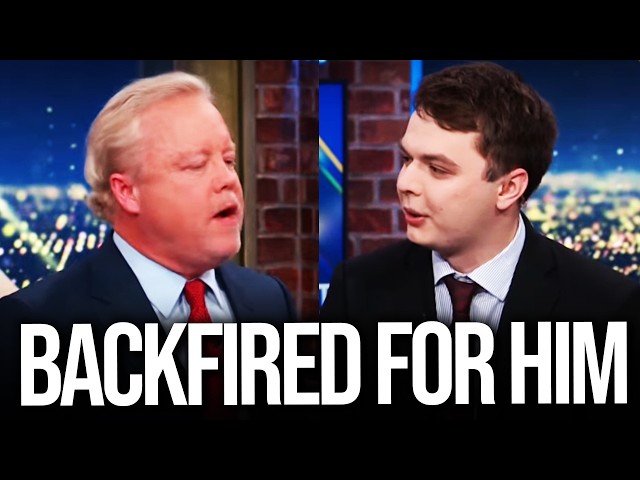
MAGA ATTACKED Me on CNN... it BACKFIRED!
Adam Mockler
0:00 And the massive inflation under Biden was definitely embedded
0:02 into the economy to Noah's point, but it went down.
0:04 When we're looking at the trends,
0:05 Donald Trump was handed an economy with 2.9%
0:08 inflation and spiked it on liberation day.
0:10 Was handed an economy with 2.4%
0:12 there's a difference between shooting yourself in the foot
0:14 like Trump did versus having extrinsic factors.
0:16 in the foot.
0:17 Okay, what do you call liberation day?
0:18 What do you call the Iran war?
0:19 What do you call the fact that he could
0:19 have just been steady-handed and had a better economy?
0:22 look, you don't understand how inflation operate.
0:23 Inflation is from printing money, okay?
0:26 We don't need to get into a whole economics about tariffs.
0:28 Who pays the tariff?
0:29 Well, look, we can talk No, no, I'm not saying that.
0:30 I do understand tariffs much better than you do, okay?
0:34 it?
0:33 So then who pays them?
0:34 Uh actually, it depends.
0:35 All right, everybody.
0:36 So, I went back on CNN for the first time since
0:38 the get your hand under my face viral moment, you know, all that.
0:42 And I was kind of wondering before I went on if I was
0:44 going to have a target on my back with the MAGA on the panel.
0:47 And I want you guys to watch this play
0:49 out in real time because I'm not tweaking here, right?
0:52 They both try to misrepresent what I'm saying and attack
0:55 me right off the bat in almost a coordinated manner.
0:58 Make sure you drop a like if you appreciate the fight.
1:00 Subscribe to the Adam Outler feed.
1:01 Watch until the end and check this out.
1:04 For the reality, at the start of the war,
1:05 Americans were pretty evenly divided in their support for the conflict,
1:09 but now 61% say that the campaign in Iran was a mistake,
1:13 and there is a clear generational gap, too.
1:16 While older Americans are split, 61% under the age of 35 oppose the war,
1:21 and 80% of those under 30 say there were
1:25 no sufficient reasons to attack Iran in the first place.
1:28 While 51% over the age of 65 say that there were.
1:33 Uh so, this generational divide, I think,
1:36 when it comes to war has always been a thing in America,
1:39 but it seems particularly acute right now, Adam.
1:43 Yeah, for my entire life,
1:45 the United States has been at war with some country in the Middle East,
1:48 and young people have constantly been told that this will
1:49 make us safer and make us better off.
1:52 When we look around at the world today, we are less safe and we are worse off.
1:55 Millennials grew up watching all these headlines
1:58 saying that Iraq had been, you know, defeated,
2:01 that we had taken out Saddam Hussein, and we had killed all the bad guys.
2:04 Well, that turned into a grinding counterinsurgency that cost us trillion,
2:08 a trillion dollars, and it was a catastrophe.
2:10 The same thing happened with Afghanistan,
2:12 and now Gen Z'ers are going through the same thing with Iran.
2:15 We are watching the same people who defended these first
2:18 two failed wars go on television and defend another failed war.
2:22 This war is failing.
2:23 We have not gotten any political concessions, and I'm sorry,
2:26 I'm not buying this trust the process line.
2:28 I don't trust the same people who got us into the prior wars,
2:31 amassed trillions of dollars in debts,
2:34 and are not putting America first on the global stage.
2:37 So, putting aside, perhaps for just for a moment,
2:41 even the politics of this current moment, I mean,
2:43 is it fair for young people to have that level of distrust of the people,
2:50 to Adam's point, who maybe defended the last war
2:53 and were wrong and are defending this war, too?
2:55 Yeah, I don't think so.
2:56 I think, honestly, Adam,
2:56 that's immensely ungrateful to American service personnel
2:59 and the people who keep us safe every day.
3:01 After 9/11, it was by no means guaranteed that there would be no
3:04 mass casualty terrorist attack on American soil
3:06 in the immediate aftermath of that attack,
3:07 especially since we had events in Madrid, in London, et cetera.
3:11 And after the attack on Iraq and the elimination of Saddam Hussein's regime,
3:15 we took a terror-supporting enterprise off the map.
3:18 We don't talk about Iraq anymore as a threat
3:19 to our national security because it isn't.
3:21 And those who would pretend as though Iran is not a national security threat.
3:25 As as and and are just frankly dismissive
3:28 of the extent to which American service personnel get up every
3:30 day to stop these people from executing the attacks
3:33 on American and their allies that they plan every single day.
3:36 This is a thorn in our side.
3:37 It absorbs a lot of American taxpayer dollars,
3:40 to say nothing of the energy of our service personnel.
3:42 And I just think it's just ungrateful so grateful.
3:45 the service personnel are not keeping you safe when they are.
3:48 No, I feel less safe due to the actions of our leaders.
3:50 I'm incredibly grateful for our servicemen.
3:52 You're doing
3:52 And your feelings don't make them facts.
3:54 You are doing Hold on.
3:55 Hold on.
3:55 Hold on.
3:55 Hold on.
3:56 You are doing the exact same thing.
3:57 He was talking to me.
3:58 He was talking to me.
3:59 Hold on a second, Hal.
4:00 I'll let you respond.
4:00 No one is saying that that is a problem.
4:02 You are doing the exact same thing that I just laid out in the opening.
4:05 You are telling young people they shouldn't be asking questions.
4:08 They shouldn't be questioning the people in power.
4:09 that they ask great questions about the nature of the world.
4:11 Okay, then what was ungrateful about what I said?
4:13 I said that the leaders are making us less safe, and I can prove that.
4:15 Right now, Iran has control over the Strait of Hormuz,
4:18 and that is a weapon they didn't have control of 2 months ago.
4:21 they did.
4:21 Of course
4:21 They shut down the Strait of Hormuz in the '80s.
4:23 And we opened it up in the '80s.
4:25 But by the way, What was their [laughter]
4:27 with a nuclear weapon?
4:28 You think you think gas prices are high right now?
4:30 Iran with a nuclear weapon, we'd have unlimitedly high gas prices.
4:34 They would take control of the Strait of Hormuz,
4:36 and they would blackmail the world.
4:37 And how much farther away are they from having a nuclear weapon?
4:39 Where is the enriched uranium right now?
4:40 They're they're non-existent.
4:41 is the enriched uranium right now?
4:42 to get the enriched uranium.
4:43 Where is it?
4:44 I want you to answer.
4:44 It's buried right now, but you No, where is it buried?
4:46 You're asking me.
4:47 I'm not in the classified briefings, and neither are you.
4:49 So, just be patient.
4:50 Buried.
4:50 We know it's buried in Iran.
4:51 Let me finish.
4:52 Okay.
4:52 Okay.
4:53 We are we are more safe than we
4:55 were before we took out Iran Iran's nuclear capabilities.
4:58 Absolutely more safe.
4:59 The Strait of Hormuz is going to be open, and Iran's not going to control it.
5:02 It is That is absolutely going to happen.
5:04 It doesn't It doesn't matter if it's 2 weeks or 2 months.
5:06 actually matter because economists are saying if
5:08 it's closed for a few more months,
5:09 then we're going to go into a recession.
5:10 So, it does matter.
5:11 It absolutely does matter.
5:12 predicting that because the markets are at an all-time high.
5:14 predicting that.
5:15 The markets are at an all-time high.
5:16 The markets aren't predicting it.
5:17 The inflation rates The inflation rate has stayed where it is.
5:20 And by the way, unemployment way?
5:22 has stayed low.
5:23 What was inflation at by the way?
5:25 Can you look the average American in the eye?
5:26 Just to be clear, just to be clear, inflation has ticked up.
5:31 Yes.
5:30 not stayed the same.
5:31 But Bobby, you were around for the politics
5:35 and the conflict of the last two Middle East wars.
5:39 Um I mean, what do you make of this generational debate about
5:43 whether it's wise to to going into another conflict in this region.
5:47 Well, I can't fault the logic that when
5:50 you've seen this happen through your lifetime
5:52 and you're still living with the consequences of it in one fashion or the other,
5:56 you're bound to be reluctant to get into the war.
5:59 Nobody's disputing for the fact that for a moment
6:02 that the Iranians are bad the Iranian regime are bad guys,
6:06 but when you when you hear the president and our leadership
6:10 constantly changing the explanation they're giving for why we're at war,
6:14 constantly change the timetable of how long
6:17 this is going to last and then forgetting
6:20 how long it has been going on, then you're right to to push back and say,
6:25 "Kindly give us a clearer explanation for why we're there,
6:28 how long we're going to be there for." It's not enough to say,
6:31 "Sit at this table and say it'll be over and then the the Straits
6:35 of Hormuz will be open." We've got no indication of that being the case.
6:40 When the Straits were closed, we were told this is a matter of days.
6:44 Now it's been a matter of weeks and we're no
6:47 closer to it being open than we were 2 weeks ago, 3 weeks ago, 4 weeks ago.
6:51 me and on top of what you're saying there, I mean,
6:54 I think one of the big problems with where we are in this conflict is that very
6:59 clearly the administration has determined because they've basically
7:03 ended the the kinetic conflict of it all,
7:06 they've determined that the only way to actually get the things that we want,
7:10 which is Iran abandoning its nuclear ambitions,
7:14 um moving away from from funding terrorism,
7:17 is to get to the negotiating table, which is the same truth that existed a year
7:22 ago after they did the first set of strikes.
7:24 So, I mean, I think that's part of the problem is that war has not
7:28 necessarily gotten us the outcome that they say that we are trying to get here.
7:33 No, that and and that's because the rationale
7:36 for the war has shifted multiple times.
7:38 No one here has ever said we want a nuclear armed Iran.
7:43 That is a red herring at this point.
7:45 The only talking point that the pro-Trump folks have because
7:48 they've gotten themselves into a situation that they were unprepared for.
7:53 And what's incredibly ungrateful, you know who's incredibly ungrateful?
7:56 Donald Trump and Pete Hegseth for the men and women who are serving in this war,
8:01 who are on deployments that are extra long,
8:04 who are not getting their their ships resupplied,
8:06 who are the who don't understand what they're doing over there,
8:10 who are being taken for granted.
8:11 Our military is the greatest in the world and the men and women
8:14 who serve are the greatest in the world and they are being taken
8:17 for granted as props in a political effort by Donald Trump to make
8:22 himself feel better till he can distract
8:24 from everything else that's going on domestically.
8:26 And now he's gotten himself into a situation
8:28 where he can't even explain cogently why we're there,
8:31 what's going on, and why the American people
8:33 should have to pay the price for it.
8:34 So, that's what's going on here.
8:36 I mean, I I When I was a Republican for many years,
8:39 we were we absolutely looked at Iran as the threat
8:42 that it is and absolutely were trying to do
8:44 things to make sure that they did not continue
8:46 to be the world sponsor of terror, but this isn't it.
8:49 This is not it.
8:49 you talked about Adam you accused Adam of being ungrateful.
8:54 Um I just want you to look at these charts.
8:56 Look at what happened to public opinion when it came to the war in Afghanistan.
9:00 Was it a mistake for the US to send military forces to Afghanistan?
9:04 The war started out as incredibly popular and then it became much less popular.
9:11 So, about half of Americans said that it was
9:14 a mistake um and about half said that it was not.
9:17 The same is true of Iraq.
9:20 Incredibly popular, right decision, 72% back at the beginning of it.
9:24 And by the by the end of the conflict in 2014, it was down to 38%.
9:30 I mean, are all of these Americans ungrateful?
9:32 I mean, I I imagine many of them um have they they ended
9:36 up tasting the consequences of the war
9:39 including the impacts on their their lives,
9:41 people that they knew,
9:42 people who may not have even lost their lives
9:45 in in theater but came back forever scarred by it.
9:47 I mean, it
9:49 To quote our great friend, what I had said previously is that it is, in my view,
9:54 ungrateful to American service personnel to say that they
9:57 have not kept us safe when we do not measure That's not what he [laughter]
10:04 But I but he didn't say that.
10:05 So, you have to acknowledge
10:07 he's saying that we can't we can measure non-events,
10:10 which is to suggest that the attacks that have not happened,
10:12 which none of us are aware of, were not were not avoidable.
10:17 Because Because of the nature of these conflicts
10:18 and the conflicts themselves are what inspires the attacks.
10:20 It's almost inviting the notion that America is responsible
10:23 He didn't That's not really the argument that he's making.
10:26 The argument that he's making is that um is that the the the people
10:30 who made the arguments to go into these conflicts in the first place misled,
10:35 which is a fact, and and secondly,
10:38 that the conflicts ended up lasting a very long time,
10:41 costing a lot of American treasure, and and that those are also facts.
10:46 He didn't He didn't say it's because it's because they're you know,
10:49 they didn't keep us safe.
10:50 That's not actually what he said.
10:51 Well, that is kind of what he said.
10:53 But let's not [laughter] labor the point.
10:54 I have all the time in the world for criticisms of the president's rhetoric.
10:57 All the time in the world.
10:58 In fact, I think a lot of the reasons why the public is soured
11:00 on this is because the president never
11:01 approached Americans and said solicited their support,
11:04 told them the burdens they were expected to bear,
11:06 and told them why they were going into this.
11:07 But as important as it is to criticize the president's rhetoric,
11:09 it's also important to talk about what's happening on the ground,
11:11 and we are closer today to opening up
11:13 the strait by virtue of what we heard from Admiral
11:16 Brad Cooper today and the operation that was
11:18 engaged over the course of the last 24 hours.
11:19 Very important.
11:25 Okay, and then I want Bobby to have the last word.
11:27 Well, I I covered the war in Iraq.
11:30 Uh, I was there for all the arguments uh, going into that war in Iraq.
11:34 I remember people saying this was the major, uh, sponsor of terror.
11:37 And you point you pointed to 9/11.
11:39 Iraq had nothing whatsoever to do with 9/11.
11:41 And going into Iraq and toppling that regime,
11:44 as much as I, uh, hated the regime as any right-thinking people,
11:48 spawned from the direct consequence of that, the Islamic State,
11:52 also a terrorist group that came directly out of our actions in Iraq.
11:56 So, you know, if we want to look at historic historical precedents,
12:00 we should not cherry-pick little bits out of a larger
12:03 picture and pretend that the larger picture doesn't
12:05 I also want to say it spill over the Syrian To expand on my framework,
12:10 I gave a very good faith criticism of this war
12:13 and of the history of these types of wars.
12:15 And I had one person say that I was ungrateful and then
12:17 another invoked the weapons of mass
12:19 destruction that Iran could potentially be developing.
12:21 What I was trying to say is that getting military successes,
12:25 if you want to call them that, doesn't always translate to helpful,
12:28 uh, outcomes for the American people.
12:30 We've seen this.
12:31 We killed Saddam Hussein.
12:32 We took out the bad guy.
12:33 And it hurt us.
12:34 And war is the most just war since World War II.
12:38 Because Iran has killed thousands of Americans.
12:40 Saddam Hussein hadn't killed thousands Americans.
12:42 Afghanistan hadn't either.
12:43 But he ran on no new wars.
12:44 No, I'm saying I'm saying of course that
12:46 But I'm saying arguably this he should have ran on it.
12:49 It's a 47-year war, I thought.
12:50 to the Congress and the American people if it was so justified then.
12:53 He may do that, but but
12:54 Ultimately, I don't think he did it because he has more powers I can think of.
12:58 When he said it was so justified I'm using
12:58 your own logic where you said it was so justified,
13:01 the most just war since World War II.
13:03 it could be the most
13:04 Then why didn't he go ahead and present it to the American people that way?
13:07 Iran has killed thousands of Americans.
13:09 It's awful.
13:10 It's stupid.
13:10 Okay.
13:11 Iran is a threat to the world.
13:13 Okay, if they get nuclear weapons,
13:14 they would control the Strait of Hormuz anytime they wanted to.
13:17 People wouldn't be able to do anything about it.
13:19 They do not need nuclear weapons to to control You do
13:21 not need nuclear weapons to to control the Strait of Hormuz.
13:25 The Strait of Hormuz are right there.
13:26 You can't change geography.
13:28 They need small speedboats.
13:29 They just need to issue a threat.
13:32 What happened in the last in in the last few weeks?
13:34 They didn't actually They didn't do anything.
13:36 All they had to say was we're going
13:39 to shut the straits and the markets did the rest.
13:41 The insurance companies refused to insure ships.
13:43 Shipping companies refused to go.
13:44 They do not need nuclear weapons to shut down the straits.
13:48 in the Horn of Africa and the Strait of Malacca is resolvable in Hormuz.
13:51 All right, Bobby.
13:52 Thank you very much for being here.
13:53 Appreciate you.
13:54 Next for us, at the end of the day, Spirit Airlines, and by the way,
13:57 their competitors, do not believe that uh
14:01 the government the the alternative here,
14:04 which would have been for Trump to bail them out,
14:07 would have been a good solution to this problem, either.
14:09 Yeah, I mean, you can completely ignore what the CEO said if you want,
14:12 but the reality is these gas and oil
14:14 spikes have completely ruined a lot of companies.
14:17 I mean, bankruptcies overall, you want to talk about Spirit in particular,
14:20 bankruptcies overall among large corporations are
14:22 at the highest point in 15 years.
14:23 Let me finish.
14:24 They had a spike of over 2 months and go up
14:26 Farm bankruptcies are at the highest point, I mean,
14:29 they've gone up 46% since Donald Trump took office.
14:31 Is that because of Biden, too?
14:33 Are the farm bankruptcies up 46% because of Biden, too?
14:35 Uh there there was a lot of fertilizer issues around uh farms, but
14:39 Because Because of what?
14:40 Because of tariffs?
14:41 No, I mean, this is it.
14:41 This We're talking about bankruptcies
14:43 and that that's exactly what we're talking about.
14:44 and we didn't have bankruptcies there.
14:46 The massive inflation under Biden was definitely embedded into the economy,
14:48 to Noah's point, but it went down.
14:50 When we're looking at the trends, Donald Trump was handed an economy with 2.9%
14:54 inflation and spiked it on liberation day.
14:56 was handed an economy with 2.4%
14:58 there's a difference between shooting yourself in the foot
15:00 like Trump did versus having extrinsic factors.
15:02 in the foot.
15:02 Okay, what do you call liberation day?
15:03 What do you call the Iran war?
15:04 What do you call the fact that he could
15:05 have just been steady handed and had a better economy?
15:07 I mean, look, you don't understand how inflation operate.
15:09 Inflation is from printing money, okay?
15:11 We don't need to get into a whole economics of tariffs.
15:13 pays the tariff?
15:14 Who pays the tariff?
15:14 Well, look, we can talk No, no,
15:16 we're not getting into I do understand tariffs much better than you do, okay?
15:19 Who pays it?
15:19 So, then who pays them?
15:20 Uh actually, it depends.
15:21 Uh China paid a lot of those tariffs.
15:23 I know that for a fact.
15:24 And the sound of free economy they
15:26 areas that they are tax on the American consumer and
15:28 well, then then corporate taxes shouldn't be there either.
15:30 That's a tax on the American consumer.
15:32 Do you know about tariffs?
15:33 I wonder if we could return back to the spirit of this for a moment because I
15:36 I do think this is another example of us
15:37 having kind of two things happening at once.
15:39 It is certainly the case that there was a a ruling, but yes,
15:43 the government has the ability to to intervene in various things
15:45 in the economy to regulate whether or not mergers can take place.
15:48 The question is whether or not this merger
15:50 would have helped this company survive these difficult times.
15:53 And it seems likely that it could have.
15:55 the All right, let me know what you guys thought in the comments.
15:57 Again, if you want to see more of these CNN hits,
15:59 all you have to do is drop a like, share this video around.
16:01 I love you all.
16:02 Peace out.