The Bizarre Bases of Antenna Towers
Practical Engineering
0:01 In 1974, a new world record was set for the tallest structure on Earth.
0:07 Soaring to 646 meters or 2,120 feet,
0:11 the Warsaw Radio Mast was built to broadcast
0:15 radio programs to Polish-speaking audiences across Europe.
0:18 If the atmospheric conditions were just right,
0:22 those signals could be picked up from nearly anywhere in the world.
0:25 But like all big infrastructure projects, building it was only half the battle.
0:30 Maintaining a structure that tall—and that slender—was incredibly expensive.
0:35 Over time, the guy wires that held the tower upright began to wear out.
0:40 By 1991, many of them were frayed and overdue for replacement,
0:44 a job that wasn’t just costly, but also fairly complex.
0:49 To replace a guy wire,
0:50 two temporary guys needed to be attached to the mast first.
0:54 Then the old guy could be removed and swapped out for a new one.
0:59 But on August 8, 1991, the sequence got mixed up.
1:03 Reports vary, but it seems that one of the main
1:06 cables was disconnected before the temporary ones were fully installed.
1:10 A gust of wind twisted the tower,
1:13 pulling the temporary cables away, and the unsupported mast collapsed.
1:17 Incredibly, no one was injured in the failure,
1:21 but it was a catastrophic loss nonetheless.
1:24 Usually, the tallest structures in the world lose
1:27 their position because something else is built taller.
1:30 In this case, a tower in North Dakota regained the lead by default.
1:35 It’s actually not an unusual story.
1:38 This particular type of structure, called a guyed mast,
1:42 has some seemingly bizarre structural characteristics that make it possible,
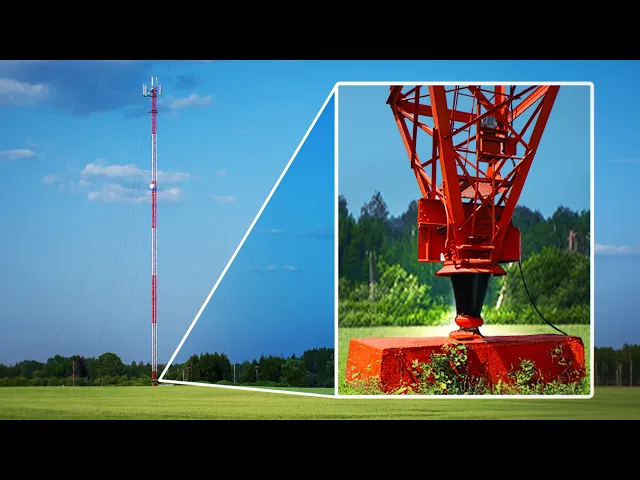
1:46 including the sometimes unusual bases that seem to defy logic.
1:50 But they come with risks, too.
1:53 At least nine guyed masts taller than 600 meters have collapsed,
1:58 mostly in the US, and hundreds of similar
2:01 shorter structures around the world as well.
2:04 They’re pretty interesting structures: cool to look at, incredibly tall,
2:07 just rare enough that seeing one is kind of special.
2:11 So this video is an ode to guyed masts, and of course,
2:15 I built a little demo in the garage to help explain how they work.
2:20 I’m Grady, and this is Practical Engineering.
2:33 Radio communication is a remarkable technology
2:36 that enables a huge variety of wireless devices,
2:40 from garage door openers to cell phones.
2:44 If humans could perceive the full spectrum of electromagnetic radiation,
2:47 even just the human-made stuff, we would be completely overwhelmed by the volume
2:53 and variety of information moving through the airwaves.
2:57 Many of the frequencies used for communication,
3:00 especially those broadcast by radio and television stations,
3:03 require a clear line of sight;
3:06 the path between the transmitter and receiver has to be relatively unobstructed,
3:10 at least by objects that are opaque to radio waves, like the earth.
3:15 That’s why many antennas are mounted at the tops of hills,
3:19 mountains, or (lacking those) gigantic towers.
3:21 The higher they are, the further their signals can extend.
3:26 Antenna towers are some of the tallest human-made structures in the world,
3:30 with many topping out above 600 meters (roughly 2,000 feet).
3:35 At that height, the distance to the horizon
3:38 is more than 50 miles (or 80 kilometers).
3:41 To achieve that has required some very clever structural engineering.
3:44 Let me show you what I mean.
3:47 This is my model antenna tower.
3:49 Pretty basic; just a steel welding rod stuck in a plate.
3:53 "Whoa!" This isn’t going to match the structural behavior of an actual mast,
3:59 but it’s close enough for a garage demo.
4:02 The main load on a tower like this, besides its own weight, is wind.
4:06 So let’s apply some wind and see what happens.
4:18 "That's big!" The tower’s still standing- it didn’t collapse.
4:23 But structural engineering isn’t all about strength.
4:26 A structure can “not fall down” but still fail.
4:30 We also have to address the concept of serviceability:
4:33 does the structure actually do what it’s meant to?
4:36 And in this case, hopefully it’s clear that the answer is no.
4:40 Many antennas are designed to be directional.
4:42 It takes a lot of power to radiate signals,
4:45 so you don’t want to waste it sending them where they’re not needed.
4:49 This varies a lot depending on the end use.
4:52 Radio and TV broadcasts are less sensitive
4:55 to movement than microwave communications, but in general,
4:58 we can’t have antenna towers wobbling around like floppy wet noodles in the sky.
5:03 You can imagine that to adequately stiffen this tower,
5:06 it would have to be a lot wider at the base.
5:09 And that’s just what we do with so-called self-supporting towers.
5:12 They’re designed to be freestanding and stable
5:15 against the wind entirely on their own.
5:18 Self-supporting towers don't take up much space,
5:21 so they are ideal in urban areas where land comes at a premium.
5:25 But, they are expensive to build because of all the extra
5:29 material required for stiffness and stability against lateral wind loads.
5:33 In fact, their cost goes up roughly proportional to the height squared.
5:38 For guyed masts, it's roughly height to the power of 1.5.
5:42 You need more land for a guyed tower since the guys extend so far out,
5:47 so there is more cost there,
5:49 but above a certain height (that depends on those land costs),
5:53 it becomes the most economical option.
5:55 And for really tall towers, it’s really the only technically feasible one.
6:00 They are just so structurally efficient, it's almost unbelievable.
6:04 To give you an example,
6:06 at 324 meters tall (or 1,060 feet) the Eiffel Tower weighs around 7000 tons.
6:13 A guyed tower of the same height would weigh roughly five percent of that.
6:20 So let me add some guys to my tower and we’ll see how it works.
6:24 Of course, you can’t add just one.
6:26 Wind can come from any direction,
6:28 and don’t forget one of the most important adages of civil engineering:
6:32 you can’t push a rope.
6:34 So it takes at least three guys to get some tension in every direction.
6:39 Some towers use four lanes, but most stick with three.
6:43 This seems like a more stable situation, but now we’ve got a new problem.
6:47 Watch what happens when I apply a lateral load.
6:50 It's still just not that stiff, and actually, the tower buckles.
6:54 And here’s why: The guys can’t pull horizontally
6:57 on the tower to resist lateral loads directly.
7:00 They have to be anchored to the ground,
7:02 which means they meet the tower at an angle.
7:05 Any tension in the cable is going
7:07 to necessarily put the tower in compression as well.
7:11 And what happens with skinny compression members?
7:14 They buckle.
7:15 Steel can take a lot of compression.
7:17 Theoretically, this rod is strong enough to hold
7:20 my entire weight without a material failure.
7:22 If it were short, it’d be more than capable of bearing a full Grady,
7:26 but when it’s tall and skinny like this, it can barely hold its own weight.
7:31 When the tower takes a lateral load,
7:33 the guy wires transfer that into compressive force.
7:35 And unless the structure is stiff enough, it buckles.
7:40 If I move the guys out so they’re at a shallower angle,
7:43 you can see it takes a lot more wind load to buckle the structure.
7:47 Less cable tension is needed for an equivalent horizontal force.
7:51 And this is one of the many structural tradeoffs with guyed towers.
7:55 You have to balance the land cost of extending anchors outward against
8:00 the cost of a stiffer tower that can withstand steeply angled guys.
8:04 But you can see we’re not quite out of the woods here.
8:08 Some shorter guyed towers can get away with one level of supports,
8:12 but mine is still pretty flimsy in the middle.
8:16 Lateral forces can still deflect it quite a bit,
8:19 and it’s still prone to buckling under compressive loads,
8:22 like, for example, the weight of an antenna mounted to the top.
8:28 And now this is kind of like a bridge on its side.
8:31 We’ve got supports on both ends and loads
8:33 trying to bend the structure in the center.
8:36 So we can do what the bridge engineers do:
8:39 either stiffen the structure or add more intermediate supports.
8:43 It’s a little more complicated than that though,
8:45 since every guy adds additional compressive load on the tower,
8:49 in addition to providing lateral support to reduce the unbraced height.
8:53 You’re kind of adding to both sides of the equation.
8:56 Luckily, the lower you go on the tower, the shallower the angle of the cable.
9:00 Just as a little demonstration of this, let’s compare the loads
9:04 my little tower can support as we add more guys.
9:10 With just one level, it’s right around 50 grams.
9:13 This can barely support its own weight, let alone any extra on top.
9:17 With a second level halfway up, it’s quite a bit stiffer.
9:21 I could get 100 grams on top with no failure.
9:26 Adding two more levels, now this thing feels rock solid.
9:30 I’m not sure if it comes across on camera,
9:32 but the change in stiffness is dramatic.
9:35 It passes the wind test with flying colors.
9:41 It couldn’t quite hold a kilogram, but Brady could sit on it just fine,
9:45 even if it made him a bit uneasy (since
9:48 his hard hat is still damaged from the last demo).
9:52 One of the other tradeoffs with this is the pre-tension of the cables.
9:56 These guys sag along their length; they’re not perfectly straight.
9:59 Under high wind, they tighten up and add stiffness.
10:03 But in calm conditions, that slack can cause the tower to wobble.
10:07 The obvious solution is to pre-tension the guys to take the sag out, but again,
10:13 that pretension puts extra compression on the tower,
10:16 requiring stronger members or more guys.
10:18 So this is a balancing act as well.
10:21 And then there’s the base.
10:22 You have essentially two choices here.
10:24 We’re used to seeing large columns with a rigid attachment to the foundation.
10:29 I did a whole video on base plates diving
10:32 into this topic deeper if you want to learn more.
10:34 You can see in my model that, with a fixed connection,
10:37 my tower holds itself up just fine without loading.
10:40 Obviously, this rod is solid steel- not a thin latticework
10:44 of individual members- so the behavior is a little different.
10:48 But remember that buckling is a function of the end connections of the column.
10:53 With the bottom fixed, it takes about 140 grams to buckle the rod.
10:57 When it’s free to rotate at the bottom, it buckles at around half that.
11:01 The problem in this case is that fixing such a tall
11:05 tower rigidly to the foundation makes the design a lot more complicated.
11:10 If you want rigid restraint,
11:11 you have to have a way to transfer the loads into the ground.
11:15 So the foundation has to be designed to resist rotation and pullout forces,
11:20 and for not a lot of structural benefit.
11:22 So the other option is to use a spherical bearing or pin support.
11:27 And if you keep your eye out,
11:29 you’ll see that a lot of these masts have these sorts
11:32 of unusual bases where they taper down to a narrow point.
11:35 In this way, you can just rely on the guys to handle almost all the restraint.
11:40 The foundation only has to resist the vertical force,
11:44 and maybe a touch of shear.
11:46 This allows some movement or settlement
11:48 of the foundation without inducing stress into the structure.
11:51 And it just makes the design process easier.
11:55 Removing the restraint simplifies the structural
11:57 response and makes the tower more predictable,
12:01 so you don’t have to be super conservative or spend tons
12:04 of engineering effort and use sophisticated modeling software in the design.
12:08 Finally, some towers aren’t used to mount antennas;
12:12 they are the antennas themselves.
12:14 For lower frequency transmissions like AM radio,
12:18 you need a big antenna, so the tower itself is energized.
12:22 In those cases, the base needs to be electrically insulated from the ground,
12:26 which is much easier to do at a single point.
12:30 If you look closely at some towers,
12:32 you’ll see they’re actually standing on a ceramic disc.
12:35 Beyond structural design,
12:36 these masts come with a lot of other engineering challenges.
12:40 Of course, there’s the hazard to aircraft.
12:45 Aviation regulations often require them to be painted in alternating
12:49 orange and white bands and equipped with warning lights,
12:53 whose color and flash rate are carefully prescribed,
12:57 and can even be synchronized with nearby
12:59 towers to avoid dazzling pilots at night.
13:02 Ice is another big one.
13:04 These towers stretch into colder,
13:06 wetter layers of air where ice can build up on the mast and guys.
13:11 That adds weight, but it also adds surface area,
13:14 sometimes dramatically increasing wind loads.
13:16 When it melts, it can fall and damage anything below,
13:20 so often you’ll see protective structures over the radio transmission lines.
13:25 Lightning is another threat.
13:26 For most towers, it’s not a question of IF,
13:29 but rather HOW OFTEN they’ll be struck.
13:32 Towers are often equipped with lightning rods
13:35 or other protection devices and robust grounding systems
13:38 to keep stray voltage out of the transmission
13:41 lines and sensitive equipment on the ground.
13:44 Obviously, those mast radiators I mentioned earlier,
13:47 where the entire tower services as the antenna,
13:50 can’t be grounded for lightning protection.
13:53 So most use some type of spark gap to keep the tower insulated.
13:57 If lightning strikes, the air in the gap ionizes,
14:01 allowing the surge to safely reach the ground.
14:04 Like all infrastructure, antenna towers need maintenance- painting,
14:07 changing light bulbs, and servicing antenna equipment.
14:10 Technicians with specialized training for heights
14:13 and electrical hazards have to do the work.
14:16 Some tall towers are even equipped with elevators to provide access,
14:20 but most require some manual climbing.
14:23 Although the frequencies used for radio communication are
14:26 non-ionizing (meaning the waves can’t break apart molecules),
14:30 that doesn’t mean they aren’t dangerous.
14:33 Electromagnetic radiation can generate heat;
14:36 it’s the fundamental principle of a microwave oven.
14:38 And if the tower itself is energized, a person can become part of the circuit.
14:44 With so much of our telecommunication happening through the internet these days,
14:48 it’s easy to forget the importance
14:51 of large-scale radio broadcasting and communications.
14:54 The cells for cellular communications are small,
14:57 so we’re used to seeing those antennas relatively close to the ground.
15:01 But you have to look way up
15:04 to remember how critical the other wireless systems are,
15:08 especially in emergency situations where radio and television
15:11 signals can be an essential link to information.
15:15 So next time you pass one of these towers by, take a closer look,
15:19 and I hope you’ll appreciate some
15:21 of the thoughtful engineering that goes into them.
15:25 Funny behind-the-scenes story about antenna towers:
15:28 I plan these videos out in advance,
15:29 and I actually bought a telephoto lens for my camera about a year
15:33 ago so I could get some of the shots in this video.
15:36 So, I went outside to test it out,
15:38 and the first thing I took a picture of was a bird.
15:41 Of course, then I wanted to learn what kind of bird it was.
15:44 And that basically snowballed into a full-on new hobby of birding.
15:48 I’ve got feeders in the backyard, fancy new binoculars,
15:52 and the Merlin app on my phone.
15:53 I try to get out at least once a week, and so far I’ve seen about 160 species.
15:57 But once you start paying attention and learning more about birds,
16:02 it can be a little disheartening.
16:04 For example, I see Loggerhead Shrikes pretty regularly here in Texas,
16:08 but if you live in the northeastern US, they’ve pretty much disappeared.
16:12 The species has lost about three-quarters
16:14 of its population in North America since 1966, and that’s just one example.
16:19 Another is Little Owls- cute little guys who have
16:23 seen major population declines in some parts of Europe.
16:26 My friends at Planet Wild have been working
16:28 with conservationists in Germany to help re-establish the population there.
16:32 Planet Wild is a community-based organization dedicated
16:36 to protecting our natural world, including wildlife.
16:39 It’s basically crowdfunding for nature.
16:42 Every month, all the members fund a new
16:45 project related to endangered species, oceans, or forests.
16:47 And then they produce a video documenting the project so you can
16:51 see for yourself where your money is going and the impact it’s having.
16:55 I love the idea, which is why I’m a member.
16:57 It makes me feel more connected to the causes
17:00 I care about and part of a community
17:02 who are working together to accomplish something bigger
17:05 than any individual could do on their own.
17:07 If you’ve been looking for a neat way to give back,
17:10 I think Planet Wild is a great way to do it.
17:12 And to prove it, for the first 100 people who sign up,
17:16 I’ll cover your first month.
17:17 Just scan the QR code or click the link in the description
17:20 and use my code PRACTICAL10 to get your first month free.
17:24 No catches- you can cancel anytime.
17:26 If you’re not sure yet,
17:28 go check out their project protecting the Little Owl in Germany.
17:31 You can give whatever amount- big or small- that feels right to you.
17:35 Your money will go towards really cool conservation
17:37 projects that you can watch happen here on YouTube.
17:40 I hope you’ll consider joining.
17:42 Thank you for watching, and let me know what you think.