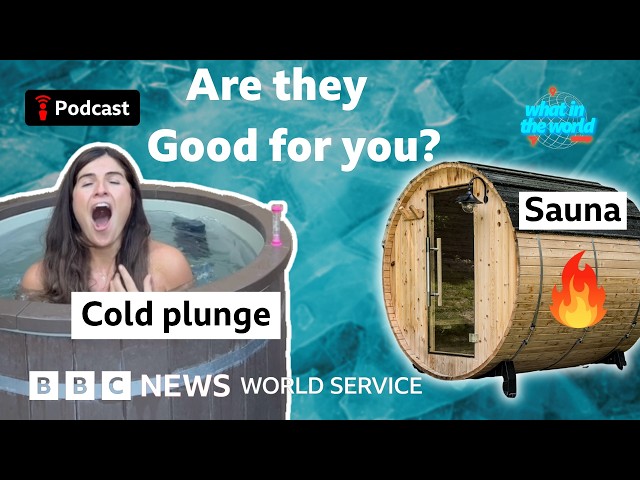
Are saunas and cold plunges actually good for you? - What in the World podcast, BBC World Service
BBC World Service
0:00 Do either of these have a health benefit for the human body?
0:03 Well, when it comes to saunas,
0:04 there's actually a fair bit of evidence they might.
0:06 I was reading about some really important meetings
0:09 that take place in saunas, too, in Finland.
0:11 Yes, we did pioneer sauna diplomacy.
0:14 I'm about to get into what is called the mental plunge- two to three degrees,
0:19 and I'm not very good in cold temperatures.
0:23 Up to the shoulders.
0:25 Up to the shoulders?!
0:29 How long am I meant to stay in?
0:31 Two minutes.
0:31 I'm not staying for two minutes.
0:33 I mean, you signed up for this.
0:36 So people say this is meant to be good for you.
0:38 Apparently, it's meant to be good for your mental health.
0:40 Give you all kinds of clarity.
0:42 Out the ice and into the sauna.
0:45 This already feels so much better.
0:48 I can feel my muscles are just beginning to relax.
0:51 My toes are defrosting.
0:53 Saunas, cold plunges, ice baths, it seems like they're everywhere at the moment.
0:56 And today we're going to have a look at why that is,
0:58 and also what the science says about how good for you they actually are.
1:02 I'm Hannah, and this is What in the World from the BBC World Service,
1:06 brought to you from the sauna.
1:15 I am back in the studio now feeling a little bit warmer.
1:18 And here we have got Emilia Jansson, who is our resident Finn.
1:21 Hey.
1:21 Welcome back.
1:21 Hello.
1:22 It's good to be here.
1:23 How are you, Hannah?
1:24 That looked amazing.
1:25 It was pretty chilly.
1:26 I think I'm more of a warm blooded person than a cold blooded person.
1:29 I couldn't do more than ten seconds in the barrel of ice cold water.
1:32 I am proud of you for doing those ten seconds anyway.
1:35 Yeah, it felt really tingly and stabby,
1:37 like my body couldn't actually tell the difference
1:39 between hot and cold after a while.
1:41 It was a really interesting sensation.
1:42 And that's one of my favorite parts about going to a sauna, actually.
1:45 Obviously, because I am from Finland, I've been going since forever.
1:48 I can't even remember the first time I was in a sauna,
1:51 but that sticky feeling across your skin,
1:53 that's one of my favourite parts actually, of going to a sauna.
1:56 And tell me, why do Finns love sauna so much?
1:59 Finns have always loved saunas.
2:01 It's a huge part of our culture.
2:03 There are over three million saunas in the country, so people joke- well,
2:07 it's also true that there are more saunas than cars in Finland.
2:11 You know, you usually have a sauna in your house, or if you live in a flat,
2:14 you will have a communal sauna in the building that you can book.
2:17 So saunas are a very normal part of our daily lives.
2:20 You can have sauna nights with your friends where
2:22 you have some drinks and snacks with your family.
2:25 You know, Finnish grannies love to, in the winter,
2:27 make a hole in the ice and then they go and take a dip.
2:30 Yes, take a dip and then they go to the sauna.
2:33 This is a very well-known Finnish granny activity.
2:36 Your Finnish grannies must be very healthy.
2:39 I mean, not everyone is as extreme that they
2:41 go into an ice cold sea in the winter.
2:44 Sometimes it's just about stepping outside the sauna for a bit,
2:47 for example, just to get that feeling of the hot and cold.
2:50 So it's not necessarily about sauna and cold plunge,
2:53 it's just more about going to sauna and then
2:54 having the feeling on your body of the difference.
2:58 Contrast, right?
2:58 I was reading about some really important meetings
3:00 that take place in saunas too, in Finland.
3:03 Yes, we did pioneer sauna diplomacy.
3:06 The godfather of this was called Urho Kekkonen.
3:09 He was president of Finland for 26 years.
3:12 And what he would do is, when political leaders,
3:15 especially Soviet ones, would come to Finland,
3:17 he would then take them to sauna and it
3:19 would be this place for informal discussions and negotiations.
3:23 And the most infamous meeting was in 1960,
3:27 when Soviet leader Nikita Khrushchev came to Finland,
3:30 and Urho Kekkonen and Nikita Khrushchev went to sauna,
3:35 didn't come back until five a.m.,
3:38 and afterwards it was announced that the Soviet Union were happy for Finland
3:42 to move more towards the West and to have closer ties with the West.
3:47 So that was something really important that came out of the sauna.
3:51 We wanted to find out what actually happens to the body
3:52 when it's put in these extreme hot and cold conditions.
3:56 So we reached out to James Gallagher,
3:58 who's our health and science correspondent.
4:00 So just a little confession from me.
4:02 I do love going to the sauna, when it comes to cold water therapy, not so much.
4:07 But do either of these have a health benefit for the human body?
4:10 Well, when it comes to saunas,
4:12 there's actually a fair bit of evidence that they might.
4:14 So people in Finland who have been going to saunas for decades,
4:18 they found that those going four to seven times a week
4:21 have a dramatically lower risk of things like heart disease and stroke.
4:26 So it seems as though going to the sauna is good for the heart.
4:29 Now, the reason for that is because when you're in that intense heat,
4:33 your body has to fight to keep its core body temperature the same.
4:36 So it opens up blood vessels all over the skin.
4:39 That's why you go bright pink and that is releasing heat.
4:42 But in order to do that, your heart has to work quite hard.
4:46 So it's like a mini shot of exercise.
4:49 Now, when it comes to cold water therapy, there's lots of ideas.
4:52 Things like improving immunity or mental health or again,
4:55 being good for the heart.
4:57 And the truth is, there's just not the same standard
4:59 and quality of research as there has been in saunas.
5:02 So there's still quite a lot of arguments around
5:04 whether it does have those health benefits or not.
5:06 It's still being debated.
5:07 Now, whichever one you go for.
5:09 There's a couple of things you do need to remember.
5:12 First of all is this is like exercise.
5:14 It's not exercise.
5:15 So if I just whip out my kettlebell, here we go.
5:19 This is great for strength training.
5:20 It's really working my muscles whenever I use it.
5:23 However, you don't get that same benefit as you would do if
5:26 you were going to a sauna or having a cold water splash.
5:28 It's like exercise.
5:29 It's not exercise.
5:30 I'm just going to pop this down.
5:32 There we go.
5:33 The other thing is that you need to think about your current health
5:36 before you jump in the sauna or in a cold water therapy session,
5:40 because they can be risky for some people because
5:43 they are putting a strain on the human body.
5:45 So if you are pregnant, if you have other medical conditions,
5:48 thinking of things like type two diabetes, or if you have heart problems,
5:51 there are more, if you have anything like that, you need
5:54 to have a conversation with your family doctor before you jump in.
5:58 Emilia, these cold plunges and saunas are getting really popular
6:01 in lots of different places outside of Scandinavia now, too.
6:04 I mean, I even saw that there was a sauna rave here in London.
6:08 Why do you think this has caught on?
6:10 And just how big of an industry is it?
6:12 In 2020, Unesco made the sauna an intangible cultural heritage of humanity,
6:17 so recognised it as an important part of Finnish culture.
6:21 But as you said, since then, it's really spread across the world.
6:25 So the business consulting firm Grand View Research estimates
6:29 that the sauna sector is worth around $950 million,
6:33 and that's expected to increase to $1500 million by 2033.
6:38 The biggest market is Europe, with the Nordic countries and Germany at the top.
6:42 But the UK is creeping up that list, and actually,
6:44 by 2033, it will be the largest market in Europe for saunas.
6:49 Maybe it's because we can't control the weather,
6:50 but you can control the temperature of the sauna and the cold plunge.
6:54 And we have been asking you guys why you
6:55 love going to the sauna and the cold plunge.
6:57 Hello, my name is Ray.
6:59 I'm from Singapore, but I'm currently in Lobuche
7:00 on my way to Everest Base Camp in Nepal.
7:02 Cold plunges and saunas and why do I do it?
7:04 My first ever cold plunge was in Solas Reformative in Singapore.
7:08 It was so painful and it took me so long, at least 30 minutes to get to the top.
7:12 But after I got to the top, I felt like I could conquer the world because
7:16 it took so much willpower and mental strength to make
7:20 myself willingly get into that cold plunge tub that I
7:22 felt like once I was inside, I felt so powerful.
7:25 And like, for example, right now it's negative seven degrees.
7:28 All I can think of is it's just a cold plunge.
7:30 I first started doing cold plunges and saunas when I
7:32 started ramping up my training towards my triathlons and hyrox [races],
7:35 and I was just looking for the quickest way to speed up my recovery.
7:38 In terms of the physical effects,
7:39 I do it because I do feel like it reduces the soreness the next day,
7:42 but I really do it more for the mental strength because if
7:45 I wasn't feeling awake before then I would definitely be awake after that.
7:48 It just helps me make sure I signpost my training
7:51 blocks with proper recovery and resets every single time.
7:53 Saunas have a lot of physical benefits,
7:56 recovery, nervous system regulation, all of that.
7:59 But honestly, the real reason people love them
8:01 right now is the social aspect of it.
8:04 So we're seeing this shift where people are drinking less,
8:06 but they still want connection, energy, and a place to hang out.
8:11 And that's where social saunas come in with high energy.
8:15 And it's giving you music, heat,
8:18 guided session and people going through something
8:22 intense together that actually creates a stronger connection.
8:25 We've had saunas and steam rooms, hot and cold for a long time.
8:28 The Romans used to to bathe and use steam rooms and things like that.
8:31 But I think what we're seeing now is the commercialisation of them
8:34 and how they're becoming like this- quite an exclusive experience, aren't they?
8:39 Yes.
8:40 It's been interesting to witness the consequences of the sauna
8:44 becoming more popular worldwide because as you say,
8:46 for example, here in the UK, if you want to build a sauna in your house,
8:50 or if you even want to go to a sauna,
8:52 that can be quite expensive compared to the Nordics,
8:54 where it's a lot more of a communal activity.
8:56 And so there are a few things that I find interesting that have kind
9:02 of popped up as a result that aren't
9:04 necessarily related to the original Finnish sauna culture.
9:07 In some aspects, it can be a bit of a status symbol because, you know,
9:12 you tell others, oh, I go to sauna because you have the money for it.
9:15 And some- And the time.
9:17 And the time.
9:18 And the luxury of time.
9:19 Exactly.
9:19 Whereas the sauna isn't supposed to be a status symbol,
9:23 it's supposed to be something everyone can enjoy.
9:26 And also, as you said, the commercialisation, it's become- in the UK, you know,
9:31 that the sauna is more of a business,
9:33 which means that the people who go there are more are consumers.
9:36 And so some places might tell you need to have this sauna hat.
9:39 You have to buy it, you have to buy this thing or that thing,
9:42 when in reality you just need yourself.
9:44 But that's quite interesting because in the Nordics,
9:47 there is no business consumer aspect that there is
9:50 in other countries where the sauna has spread to.
9:52 And so, for example, when I go to saunas here in London,
9:56 sometimes I will see these gym bros sat in the sauna,
9:59 you know, they've been there for a while.
10:01 You can literally see the sweat, you know, they're red in the face.
10:04 They're checking their watches.
10:06 They just look like they're in pain.
10:08 And the sauna is not meant to be a painful experience.
10:11 The sauna is meant to be something enjoyable.
10:13 And it's like they're competing to see how
10:16 long they can endure being in the sauna,
10:18 when in reality, the whole point of a sauna is the hot and cold.
10:21 So when I go to my summer house in Finland,
10:23 you know, we go to the sauna for a few minutes,
10:25 we go outside, we come back, we go in, and that happens many, many times.
10:29 Yeah, I mean, people see it as an endurance symbol,
10:32 that kind of competitive nature.
10:33 When I went to the cold plunge, there were these little pink timers,
10:36 these little hourglasses, and they went up to like two minutes.
10:39 And I can't believe that some people could
10:41 stay in two to three degrees for two minutes.
10:45 Well, you should meet these Finnish grannies, then.
10:48 They're harder than anything I'm ever going to be.
10:50 Saunas are really interesting because they're dry heat,
10:52 but hammam, steam room, they use wet heat.
10:54 That's obviously been around for for ages.
10:57 And also when you go to the Turkish baths, to the hammam,
11:00 they like, scrub you really hard and like, smack you around with some branches.
11:05 Do they do, like, skin treatments like that too?
11:09 Yes we do.
11:10 So we will have these leaves that we put together like branches,
11:14 and then you'll dip them into some water
11:16 and then you'll whip each other on the back.
11:19 And that is actually because it helps
11:21 with blood circulation and it's very healthy.
11:23 So it's for the health aspects.
11:24 And obviously saunas aren't suitable for everyone.
11:26 So please do enjoy them responsibly.
11:28 Thanks so much, Emilia.
11:30 Thank you for having me.
11:31 So we heard from some of you, but I want to hear from more of you.
11:34 What do you make of saunas and cold plunges?
11:36 Do you love them?
11:37 Do you hate them?
11:38 Let us know in the comments.
11:40 And I also want to read some of your comments
11:42 on an episode we did on getting rid of screens in schools.
11:46 So one of you said that I think it's a good idea to go back
11:49 to pens and paper in school without
11:51 the constant distraction of push notifications and messages.
11:54 Students can focus more on their teachers and learning.
11:57 Besides, most AI tools come with clear instructions and children
12:00 can learn how to use them quickly when needed.
12:03 We also got this from Jorge,
12:04 who said that I think the problem is not the use of digital books,
12:07 for example, it's the use of high dopamine spike apps.
12:11 People can't do slower tasks like before,
12:13 and I really do feel that like my patience has definitely decreased since
12:18 I've been on Instagram and TikTok and seeing all of this short form video.
12:23 And lots of you said that it's actually about striking a balance
12:26 and schools do still need to use devices for subjects like computer science.
12:31 It is always so interesting to hear your thoughts
12:33 on debates like this, so please do get in touch.
12:36 You can leave us a comment right here below.
12:38 You can send us a message on WhatsApp or on Instagram.
12:41 We're at @bbcwhatintheworld.
12:42 For now I'm Hannah, this is What in the world
12:46 from the BBC World Service and we'll see you next time.
12:50 The things I do for this programme, I don't even like the cold.