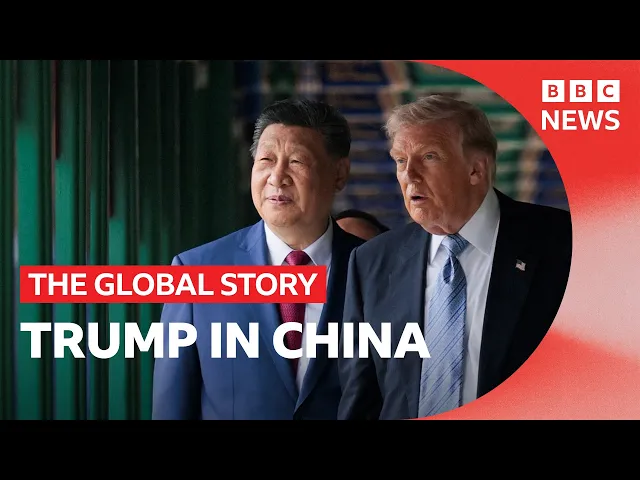
Did Trump and Xi get what they wanted? | The Global Story
BBC News
0:00 Has Donald Trump's China visit left
0:03 his relationship with Xi Jinping stronger or weaker?
0:07 The US president has often sounded like this on China.
0:12 We have been ripped off by China.
0:15 An evacuation of wealth like no country has ever seen before.
0:19 In Beijing this week, he sounded more like this.
0:23 Here he is speaking to the Chinese leader Xi Jinping.
0:26 We're going to have a fantastic future together.
0:31 Such respect for China, the job you've done.
0:34 You're a great leader.
0:35 I say it to everybody.
0:36 You're a great leader.
0:37 Does Xi Jinping feel the same?
0:40 From the BBC, I'm Tristan Redman in Paris,
0:43 and this is the global story on YouTube.
0:50 And we're joined today, I'm very pleased to say,
0:53 by the BBC's China correspondent Laura Bicker.
0:56 Laura, so good to have you with us.
0:58 Nice to be with you.
1:00 Nice to be with you.
1:00 I mean, it's such a quiet time here in China.
1:04 Absolutely.
1:05 I mean, you've had a you've had a What's it been?
1:07 48 hours now?
1:09 Since since the president arrived?
1:12 Yeah, we've been quite a whirlwind.
1:14 Lots of pomp, lots of pageantry.
1:16 Well, what have been the big moments for you?
1:18 Talk us through the scenes.
1:21 So, let's start with that handshake.
1:22 14 seconds.
1:23 14 seconds for a handshake.
1:25 It didn't just feel like an ordinary greeting.
1:28 It felt like kind of almost a symbol of global power.
1:31 You had these two leaders coming together.
1:33 You had the handshake.
1:34 Donald Trump gave him a little pat on the the hand.
1:37 And then even as the hands separated, there was the pat on the shoulder.
1:41 It did seem that that was the moment.
1:43 Here we have the two leading economic powers in the world.
1:48 The two leaders of the world superpowers together.
1:52 Let's see what's going to happen.
1:53 So, that set the scene.
1:54 And then we had this military parade.
1:57 So, we had this honor guard um which welcomes many visitors,
2:01 but they even had uh a 21-gun salute
2:04 for the United States during the national anthem.
2:07 And uh President Trump was invited to inspect the honor guard.
2:11 So, the two leaders walk the red carpet.
2:15 But as they do so, there is a moment that just
2:18 sits with me every time because the these honor guards,
2:21 they are highly trained and their eyes
2:23 track the leaders [music] absolutely in sync.
2:28 And then as they came down past all the soldiers,
2:31 they came to this crowd of cheering children.
2:34 And they're all there waving their American and Chinese flags.
2:38 And Donald Trump reveled in it.
2:40 You could see he paused twice to wave to the children.
2:43 And I think when it comes to that kind of welcome, it sets the tone.
2:47 It was designed, it was carefully
2:50 choreographed to flatter the US president before
2:53 they even headed into the Great Hall of the People and started those talks.
2:57 Then there was uh the kind of difference
2:59 in tone between President Xi and Donald Trump.
3:02 You you mentioned there what Donald Trump had to say,
3:04 but President Xi started it off very friendly, very cordial.
3:08 But they're very careful with their language here in China.
3:11 President Trump, on the other hand, his remarks sounded unscripted and he,
3:15 you know, really lavished praise on his host.
3:18 For someone who's built his political brand on being tough on China,
3:24 watching that exchange was very,
3:26 very interesting because here we have a a Donald
3:29 Trump who was there almost sounding deferential.
3:33 And for, you know, if you're sitting talking
3:36 to analysts a lot of the time here in China,
3:39 and we're all looking at the balance of power and wondering if it's shifting.
3:43 And I think when I spoke to analysts even before this visit,
3:46 what they were saying is what they were watching for is for the first time
3:51 the US United States is beginning to acknowledge
3:54 they are dealing with a near peer in China.
3:57 When Donald Trump came to the first time in 2017,
4:00 he came to a very different China than
4:02 the one he's been in for the last 48 hours.
4:05 I have to ask you about the banquet because one of the things
4:07 that's really stood out to me uh was these incredibly elaborate place settings.
4:14 There was a table which appeared to have uh a sort of miniature uh park,
4:20 lake, pond with birds in the middle of it.
4:24 Um is this a thing in China?
4:27 You mean you don't have a table at home
4:29 with some some uh birds in the middle of it?
4:32 Uh actually birds are a sign of prosperity here in China.
4:35 Um it used to it used to be a sign uh if
4:38 you owned a bird that you were prosperous and you were well-to-do.
4:42 And so they're a sign of good luck, which is why they appear in so much uh
4:46 Chinese kind of uh embroidery and on table settings.
4:50 Uh so yeah, I mean what a what a place to have a banquet.
4:54 You know, when they were led in and you could see these huge tables.
4:57 These rooms are cavernous.
5:00 But it for dinner, I know I know what you want to hear.
5:04 You want to know what they were eating, right?
5:05 So for dinner there was, of course, Beijing roast duck.
5:09 What else are you going to serve the US president here in Beijing?
5:13 It's delicious.
5:14 Come and try it.
5:15 Uh there was also beef ribs.
5:17 Strangely, there was also tiramisu for dessert.
5:20 Now, I couldn't work out whether that's maybe someone's favorite dessert,
5:23 but there was tiramisu for dessert.
5:25 But it was It's definitely an unexpected
5:27 appearance from the tiramisu, isn't it isn't it?
5:31 [gasps] I think watching Chinese media is also always quite interesting
5:33 because Donald Trump was trending um on Chinese social media.
5:38 And they were all One of the things obviously Chinese people
5:40 are really eager to know is what's the president going to eat.
5:43 What they noticed was that a lot of flavors are a lot milder,
5:47 maybe very well-known Chinese dishes.
5:49 So, there was a feeling that perhaps they were trying to tone
5:52 down a lot of the flavors of the food for the Western palate.
5:57 Um, so there was no hot pot for instance
6:00 on the menu with duck blood intestines and very, very hot peppers.
6:04 Um, but it was all kind of um,
6:06 beef ribs, uh, roast duck, um, stewed beef and buns.
6:12 So, there were some baozi.
6:13 Uh, so these kind of traditional Chinese dishes,
6:17 but not ones that have the real punch with a flavor.
6:21 I mean, it it it does all sound very good.
6:24 Um, I have to ask you about the etiquette of toasting because um,
6:28 there is some video that I saw of Donald Trump raising a glass.
6:31 It looks like it has white wine or maybe champagne in it,
6:35 um, clinking glasses and then it looks like he's sipping from it.
6:39 We obviously don't know whether he he he actually
6:41 swallowed any of what was in in the glass.
6:44 Um, but it does seem unusual to me to be asking,
6:47 you know, maybe the world's most noted teetotaler uh, to cheers with you.
6:52 What's the etiquette on that and how important are these toasts?
6:55 I think when it comes to toast, so even with the etiquette, um,
6:59 that there's there's even more to it although that obviously wasn't in view.
7:03 When you come to clinking, you've got to the most senior person in the room
7:08 and the most junior person in the room.
7:09 So, your glass, if you're senior, your glass stays up and the junior person has
7:13 to clink below the rim of the glass, not above.
7:17 Uh, these are important little details here.
7:20 Uh, but it when it comes to the toast, it may have been apple juice.
7:24 It may have you So, there's, you know,
7:26 but in terms of toasting, in terms of eating together,
7:30 these are important rituals uh, not just in China,
7:33 but across much much of East Asia.
7:35 What was the fundamental hope on each side for what would
7:39 emerge from this meeting and did they get anywhere near achieving it?
7:44 So, both sides had very different priorities,
7:47 but let's start with the big overriding issue, the war in Iran.
7:50 Now, before these talks started,
7:54 I think it would the focus was always hoping to be on trade.
7:57 Remember, we've had a year of a trade
7:59 war where these tit-for-tat tariffs raised over 100%.
8:04 That ended in a trade truce in October when the two leaders met in South Korea.
8:09 Now, the hope was that they could continue that trade truce
8:12 and it does seem that we are hearing that is a possibility.
8:17 Um so, at least we have that, but the overarching
8:20 theme of all of this has been the war in Iran, the war in Iran, the war in Iran.
8:25 And it does seem that every single question and every single answer
8:28 that Donald Trump has given has been on the Middle East conflict.
8:31 Why?
8:32 Because China can play a key role.
8:36 Beijing is a key ally of Tehran.
8:40 Beijing buys most of Iranian oil, about 80% of Iran's oil.
8:45 Beijing is also an ally dating back decades for Tehran.
8:50 There has been a hope within the US administration that President Xi could
8:54 use that economic and diplomatic leverage
8:57 to nudge Tehran towards the negotiating table.
9:01 Now, before he took off and arrived here in Beijing,
9:04 Donald Trump said, "I don't need China's help." Despite those assurances,
9:09 both Marco Rubio and other officials have been saying
9:13 publicly that they hoped President Xi would weigh in.
9:16 Now, within the last few hours,
9:17 I can tell you that we have had a statement from the Chinese Foreign Ministry,
9:21 once again calling for a cease-fire,
9:23 once again saying that the war the conflict needed to come to an end,
9:27 but they have come the closest that I've seen
9:29 to admitting that they are working behind the scenes.
9:32 They say they are working tirelessly to try to bring an end to this conflict.
9:37 It is in China's interest.
9:39 I think there are many reasons for this.
9:41 First of all, China depends on the global economy to survive.
9:45 In terms of exports, that is what's propping up this economy.
9:50 And before, if I'd been just kind of Beijing-based,
9:53 I would have said to you, "Look,
9:55 you know, the war in Iran, diplomatically, politically,
9:58 it's a bit of a win for President Xi." But on the ground,
10:00 it is hurting many factories and many
10:03 producers of things like textiles and plastics.
10:06 So, in terms of getting its economy moving, they need the war in Iran to to end.
10:10 And of course, China depends on the Strait of Hormuz to get most of its energy.
10:14 About 45% of its oil comes through the Strait of Hormuz.
10:17 So, when it comes to that kind of calculation, Beijing will want to step in.
10:23 And it does seem that that has been a discussion,
10:25 and it does seem that they both agree Iran should not have nuclear weapons,
10:30 and that they want the Strait of Hormuz opened.
10:32 So, we'll see how from here how much Beijing
10:35 or how willing Beijing is to wade into that conflict.
10:38 But I think for many analysts,
10:40 what they'll say is the fact that this meeting happened at all is a win.
10:44 Were the words that Xi Jinping used about Donald
10:47 Trump as warm as those that Trump addressed to Xi?
10:53 The words that President Xi used are the ones that I've heard a lot.
10:57 He's talking about the great power competition, how they should be partners,
11:02 not rivals, how it should be win-win competition between the two superpowers.
11:07 So, I think when it comes to President Xi's words,
11:09 they were the same that I'd heard many, many times before.
11:13 It was very, as I said, carefully scripted.
11:15 But what we didn't hear on the tape was
11:18 when we got a read out from Chinese state media,
11:21 President Xi warned Donald Trump and the United States
11:25 that when it came to the issue of Taiwan,
11:27 that is where these two superpowers could collide.
11:30 That is where he said there was a danger of conflict and clashes.
11:34 Now, we've heard this kind of language before,
11:37 but to hear it um in this context and know
11:40 that President Xi said these words to Donald Trump in the room,
11:44 that I thought, considering Donald Trump's tone at the start of the talks,
11:48 I thought that was very, very interesting.
11:50 So, I'm not I don't think the tone was as warm,
11:53 but President Xi is more kind of like a professor.
11:56 And you you saw this um with many of the events.
12:00 He enjoys apparently giving history lessons,
12:03 and he will really have taken pleasure in showing
12:07 Donald Trump around the 15th century Temple of Heaven.
12:10 This is a former sacrificial altar where emperors
12:13 used to go and pray for very good harvests.
12:16 Uh and I think when it comes to this tour and when it comes to this summit,
12:21 President Xi has been careful every single step.
12:25 And I think Donald Trump was unusually quiet
12:28 on the issue of Taiwan when it came to the cameras.
12:32 Um there was a bit of a scramble with the pill feed,
12:34 and a couple of reporters started shouting out to Donald
12:37 Trump at the photo opportunity at the Temple of Heaven,
12:40 "Did you talk about Taiwan?
12:41 Did you talk about Taiwan?" Donald Trump said, "Oh, it's been good discussions.
12:45 China is beautiful." Someone pushed again,
12:47 "Did you talk about Taiwan?" And then Donald Trump stayed silent.
12:51 He knows this is a contentious issue,
12:54 and he knows that he also it has to be careful with his language.
12:59 So, I think when it came to watching the dynamic
13:02 between these two leaders and how it changed in China,
13:05 different to how Donald Trump is when he's traveling in the United States,
13:08 that was very interesting.
13:10 Laura, let's talk a little bit about uh body language.
13:14 In the past on the global story, we've spent quite a bit of time
13:17 talking about uh how Xi Jinping manages handshakes.
13:21 How would you look at uh the body
13:22 language on this trip overall between the two men?
13:26 I think when I've seen them together,
13:29 uh uh I thought when especially the Temple of Heaven,
13:33 I thought it looked like Donald Trump
13:35 was definitely more deferential to his host.
13:38 And that is because President Xi, you know, he's president of China.
13:42 Um he's, you know, and Donald Trump is basically on his turf.
13:46 But there was definitely a lot of kind of nodding, a lot of kind of to the side.
13:51 Um Donald Trump was aware that he was definitely the guest in this country.
13:56 And President Xi is the leader.
13:58 And even he says that a lot, you know, you're a great leader,
14:00 you're a great leader,
14:01 that you've been a great host, China's a beautiful country.
14:04 Very aware that this kind of language helps perhaps
14:09 when it goes in when he goes into talks.
14:12 So I I did think that as well as the tone of the language,
14:15 the tone of the body language was also slightly deferential from Donald Trump.
14:19 President Xi is very hard to read.
14:23 His his facial expressions, his body language barely changes.
14:27 He stays in the same position for every
14:30 single leader and for every kind of shot.
14:33 He doesn't give anything away.
14:35 I think Donald Trump has said in the past,
14:37 especially in Busan, oh, he's a tough negotiator, he's a tough negotiator.
14:41 President Trump and President Xi are two
14:43 opposites when it comes to body language
14:45 and when it comes to the careful choreography and when it comes to scripting.
14:49 Mr.
14:49 Trump is a showman.
14:51 He likes to show off in front of the cameras.
14:53 He likes to kind of um ad-lib.
14:56 He likes to kind of do whether it's his own little dance,
15:00 his own little signature moves.
15:02 President Xi's signature move is very staid, um very kind of professorial.
15:08 He doesn't stray from the kind of staid uh leader that he believes China wants.
15:18 And he's unwilling often to kind of even
15:23 stray from the path of any kind of script, any kind of choreography.
15:30 So, that's why I say they're totally opposites.
15:32 I think on this occasion as well, I thought I mean,
15:35 I thought President Trump really was uncharacteristically quiet.
15:39 Now, I could see that in his body language as well.
15:42 I think it'll be interesting to see what's announced at the end
15:44 of this and if anything comes out from any of the background calls.
15:47 I mean, cuz one of the things as a a correspondent China is also a peak.
15:52 It's also difficult and as you say the thing
15:54 the only things we have are the readouts, the body language, and the pictures.
15:59 Um so, it's very difficult to read
16:00 into what might have gone on behind the scenes.
16:03 Well, Donald Trump may have been on Xi's turf, as you say, but he you know,
16:08 it looks like he made an effort to rectify that imbalance
16:11 in the sense that he brought his gang with him.
16:14 There were 30 CEOs uh who made the trip um along with Donald Trump.
16:19 Why so many?
16:20 Who were they and what did they achieve?
16:23 So, I think to give you the three main ones,
16:25 Boeing was the Boeing CEO was here and I think one of the reasons for that was
16:28 because they are that the US is eager for China to buy more Boeing aircraft.
16:33 And uh when it comes to that outcome,
16:36 President Trump says that China has agreed to buy buy some Boeing aircraft.
16:40 Then there was Elon Musk with his son.
16:43 Um which we were surprised to see.
16:45 Uh Elon Musk is a frequent visitor to China.
16:48 He has a massive Tesla factory uh near Shanghai.
16:52 Um and obviously when it comes to electric vehicles and vehicle sales,
16:55 China is now the leading exporter of of vehicles um around the world,
17:00 which is a real challenge to US manufacturers.
17:03 And then of course, you had the key one and this was the one
17:06 that was trending on Chinese social media
17:08 and that was the Nvidia chief um Jensen Huang.
17:10 Now, the reason he's so important is because China
17:13 is trying to push towards some kind of robotics revolution.
17:18 Artificial intelligence, humanoid robots,
17:20 these are what President Xi terms his new technological forces.
17:24 Now, I've seen this in action.
17:25 I've seen dancing robots, running robots, robots serving me my dinner.
17:30 Um uh when it comes to uh robots, I've seen them in factories.
17:34 There are more robots in Chinese factories than anywhere else in the world.
17:37 But, China's very good so far at building the the body,
17:40 but it needs help with the robot brain.
17:43 They are catching up.
17:44 So, homegrown chip suppliers here in China are catching up,
17:47 but they're not quite there yet.
17:48 China wants access to the high-end Nvidia chips,
17:51 and those have been restricted by Washington for some time.
17:55 Tru- Donald Trump kind of lifted those some of those restrictions, but not all.
17:59 So, I think when it comes to Nvidia chief,
18:01 not only do they want to sell to China, China wants to buy.
18:04 It's a case of if if Donald Trump will let him.
18:08 So, those were the kind of main chief executives I spotted,
18:10 but you obviously had um the Apple CEO, you had others here.
18:15 Many of them tech bosses, because obviously when it comes to technology,
18:18 that is something that China is racing towards
18:22 and could buy a lot of American American goods.
18:25 You alluded earlier on, very briefly we touched on the the subject of Taiwan,
18:30 which is obviously one of the big ones.
18:32 Um what if anything did we learn about the Taiwan
18:36 tensions between China and the United States on this trip?
18:40 As I said, I think the interesting thing was the warning that President Xi gave.
18:44 Um we haven't learned anything uh from the US side.
18:47 We are told that that might be to come.
18:49 Now, remember, the United States provides arms to Taiwan,
18:52 but those aid pack- aid packages have been
18:56 um kind of delayed by Donald Trump so far, perhaps ahead of this visit.
19:00 And those aid packages are something that China believes should stop.
19:05 And we do believe that President Xi has pressed
19:08 Donald Trump into trying to stop arms sales heading
19:12 to the self-governing island that Beijing claims as its
19:15 own and has not ruled out we taking by force.
19:18 So, when it comes to Taiwan,
19:19 we are still waiting to hear from the US side what was agreed if anything.
19:25 Um but there is certainly that very very
19:28 clear warning that when it comes to Taiwan,
19:30 that is where these two sides could come into conflict.
19:33 That is China's deepest, darkest red line.
19:36 How is all of this being reported uh by Chinese media?
19:41 And how are Chinese people on the ground
19:43 that you're speaking to seeing it, Laura?
19:46 I think that So, the Chinese state media newspapers this morning were plastered
19:50 with the pomp and ceremony of yesterday morning's uh kind of military parade.
19:55 Um and they had the headline,
19:57 but all the headline uh said was uh President Xi met Donald Trump.
20:02 Uh they they go into very great detail about
20:05 the Chinese side of uh the statements that are read out,
20:08 which are very long, very full of diplomatic language,
20:12 um and talked about how it may reach a new era of US uh China relations,
20:19 talked about uh the strengthening of cooperation,
20:23 of deepening uh deepening their understanding of each
20:27 other and their genuine understanding of each other.
20:30 And that is how very much how Chinese people see this.
20:34 They see it as important in terms of lowering trade tensions.
20:38 They see it as important in terms of you know,
20:40 the global um issues with regards to the war in Iran.
20:44 Uh and in terms for their terms, they see it in terms of their own pocket.
20:48 What might this mean for me?
20:49 And a lot of people have a lot of investments,
20:52 whether it's in gold or whether it's in um you know,
20:55 whether it's even money stuffed under your mattress.
20:57 They want to know that that money is going to go far.
21:03 And for that, they want one thing, and that's stability.
21:06 I think the word stability was mentioned in one
21:09 paragraph of Chinese state media about five or six times.
21:13 And I think you and I have talked about this on previous podcast.
21:15 When it comes to China,
21:16 the key thing for President Xi is stability to grow this country's economy.
21:22 And that is because when it comes to the Communist Party,
21:26 um I think when it came to the rise of the Communist Party,
21:29 remember where we were maybe just two generations ago here in China.
21:33 You had families who had were struggling to get enough to eat.
21:37 There was incredible levels of poverty.
21:40 And now two decades decades on, it really is the world's second superpower.
21:44 It has President Xi has been welcoming,
21:46 you know, countries from all over the world,
21:48 including Canada, the United Kingdom,
21:50 and Germany all e- here coming here eager to do a deal.
21:55 And so Beijing will see itself as rising.
21:58 And in order to keep doing that, the Communist Party has to ensure
22:03 that it's looking after its own people and that its people are not becoming,
22:07 you know, uh they see it as making
22:10 sure that their people are still becoming rich.
22:12 And right now there are real challenges here.
22:14 Rising unemployment, there's a real estate crisis, real uneven growth,
22:19 which you is ea- easy to see on the streets.
22:22 So people here are eager to know that if there is stability,
22:26 then their own investments, their own money can go further and that's important
22:31 to many many ordinary workers and ordinary business owners.
22:35 Well, Laura, you and I are speaking Friday morning Paris time where I am,
22:41 uh early afternoon in Beijing where you are.
22:43 Donald Trump has just recently taken off from Beijing
22:47 and is on his way back to the United States.
22:49 There is some thinking that maybe some of the main communication
22:53 from the American side might come uh once he has actually left China.
22:57 And we know that Donald Trump is is something of a fan
23:00 of communicating specifically on board Air Force One, the plane.
23:05 But on balance, as we sit here now, Laura,
23:07 what's your report card for both of these two leaders in terms
23:11 of who achieved their aims and how well did they do?
23:17 It depends what those aims were.
23:19 I think for China the aim was Taiwan.
23:22 The aim was to ensure that the United States went
23:24 away and realized that the big issue for them is Taiwan.
23:27 The big red line is Taiwan and I think President Xi has done that.
23:30 I think for Donald Trump he wanted perhaps
23:34 Beijing's help with to end the war in Iran.
23:37 That is a tick.
23:38 But in terms of getting a signature trade deal,
23:40 remember Donald Trump has been trying to get a trade
23:43 deal with China since he first became president back in 2016.
23:47 In terms of getting a lasting trade deal,
23:50 that is still apparently quite far off.
23:53 He also needs China to buy more American goods,
23:57 things like American soybeans, American beef.
23:59 Now there are hints that that may have happened
24:01 and we hope to hear more in the coming hours.
24:05 But again, unless he gets that signature deal,
24:07 that is something that he wants as a win at home
24:10 that he can sell domestically to help his falling approval ratings.
24:15 So in terms of that, until we see that as a win,
24:18 then I would say that Donald Trump I still has work to do.
24:21 But of course there are other opportunities this year.
24:24 In fact, the leaders may meet a total of four
24:26 times and there is that reciprocal invitation them in September.
24:31 So there may be more to come on this.
24:32 Donald Trump may see this as unfinished business and may
24:35 hope to get it done before the end of his term.
24:38 Well, they may be meeting four times, Laura,
24:40 but as you revealed to me just before we started this recording,
24:45 Xi Jinping has another very important visitor arriving in Beijing soon,
24:49 we believe, which I was very surprised by.
24:52 Can you bring in our listeners on that bit of info, please?
24:55 Who's coming?
24:56 Well, Vladimir Putin is apparently coming to China
25:02 on one of his many visits to Beijing.
25:05 Vladimir Putin travels here a lot and he was expected
25:08 to arrive at kind of end of May, beginning of June.
25:11 But the timing is a little bit awkward.
25:14 I mean, obviously this visit by Donald Trump,
25:17 he was supposed to come in March and it's
25:20 been delayed because of the war in Iran.
25:22 So, the timing is not deliberate.
25:24 But, you know, you're saying goodbye to the American
25:26 president and then you're welcoming the Russian one.
25:29 When it comes to kind of rolling out the red carpet,
25:32 President Xi is becoming an expert.
25:34 Thank you so much, Laura.
25:35 Great to have you.
25:36 Lovely to talk to you again.
25:37 Hope to speak to you soon.
25:39 That was the BBC's senior China correspondent,
25:41 Laura Bicker, speaking to us from Beijing.
25:44 And that's it for this episode of The Global Story.
25:47 We're also an audio podcast.
25:49 You can find us every weekday,
25:51 Monday to Friday on bbc.com or wherever you listen.
25:55 Thanks for tuning in.
25:56 We'll see you next time.
25:57 Cheerio.
25:59 [music]