Everything I Thought I Knew About Flavor Was Wrong
Be Smart
0:00 Thank you to AnyDesk for supporting PBS.
0:03 (chips crunching) You're hearing the crunch as I eat these delicious chips.
0:11 But here's what I'm hearing
0:12 through my headphones when I take a bite.
0:15 (gloppy liquid sloshing) This is the grossest experience of my life.
0:20 (gloppy liquid sloshing) Oh, that was the worst chip I've ever eaten.
0:25 Nothing was wrong with it
0:26 except that I heard it make a gross sound
0:29 and that totally messed up its flavor.
0:31 But how can a sense like hearing
0:33 mess with how we perceive flavor?
0:35 Maybe you and I have been thinking about flavor all wrong
0:38 because it turns out it's way more complex
0:41 than just how something tastes and smells.
0:43 So what does flavor really mean?
0:45 How many senses does it actually involve,
0:48 and why is it so tied
0:50 to things like memories from childhood?
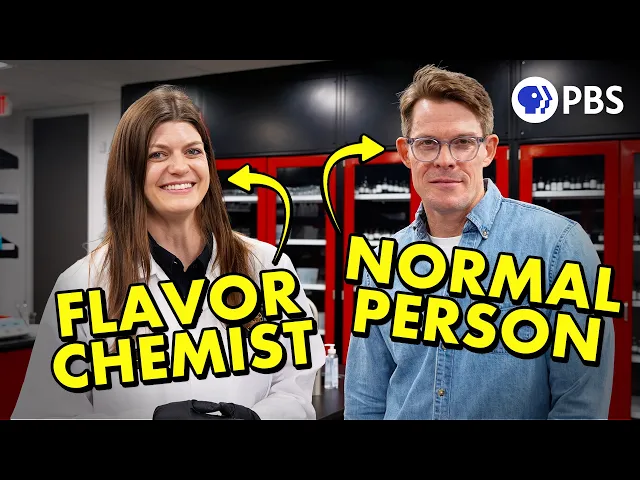
0:53 Today we're visiting a flavor manufacturer to meet one
0:55 of the world's top flavorists,
0:57 and I'm gonna fool my brain into smelling
1:00 and tasting things that aren't even there.
1:02 This is the science of flavor.
1:05 (light playful music) We're at a flavor laboratory in Austin, Texas
1:13 to ask, what is flavor anyway?
1:17 I mean, there's smell, there's taste,
1:20 like, there's crunchiness.
1:22 It's like the feel of things like your memory
1:24 and like, I don't know.
1:25 So this is like the pro sports
1:27 of flavor right here.
1:28 Yeah.
1:29 You're like in the NFL.
1:30 There's less of us than pilots.
1:32 Let's test you and see how good your nose is.
1:36 We're gonna test some raw materials
1:38 and they're for our characterizes, for our flavors.
1:42 We have different notes that happen within a flavor,
1:46 but these are the ones
1:47 that are really going to drive it home what it is.
1:49 So this is like the core fingerprints
1:51 of the flavor.
1:51 This is like-- The identity.
1:53 Quintessential.
1:54 Okay.
1:55 First one.
1:59 Wait.
1:59 Oh, this one I know.
2:01 Okay.
2:02 This tastes like, like baking almond extract.
2:04 This is actually kind of a trick
2:07 because it can be used in almonds and cherries.
2:10 It's very, yeah-- As soon as she said that,
2:12 it's like maraschino cherries.
2:13 I saw that mind explosion.
2:13 It has like that artificial cherry notes.
2:16 Those red cherries that go on top of ice cream.
2:18 Yeah, the maraschino cherries.
2:19 That's amazing.
2:20 How many people on Earth have your flavor certification?
2:25 I am certified through the Society of Flavor Chemists.
2:27 There's about 500 of us.
2:29 You have to not only gain employment with a flavor house,
2:34 but they have to have a certified flavorist
2:36 who agrees to train you.
2:38 You're just like studying
2:39 flavors all the time.
2:40 All the time for seven years.
2:42 Just smelling everything you can get your hands on.
2:45 Yes.
2:46 So you're now like a walking, talking
2:48 encyclopedia of flavor.
2:51 I hope so.
2:52 Okay.
2:52 You ready?
2:53 I think so.
2:54 Famous last words.
2:56 Okay.
2:56 (waves lapping) This is very banana-y.
3:00 I'm getting a lot of, this is a tropical,
3:03 but I feel like there's a trick.
3:04 It can't just be banana, right?
3:05 It is banana.
3:06 It is just banana?
3:06 It is just banana.
3:07 Okay.
3:08 And it's interesting that you said tropical
3:10 because it can go in tropical stuff too.
3:12 It's not just bananas.
3:14 Even if it's not literally banana-flavored.
3:16 It can be a secondary player for something else
3:18 and maybe not the primary.
3:20 And so it's just different amounts of paint
3:22 that you're using for your picture.
3:24 Okay, we're moving to savory.
3:25 (liquid simmering) This is a funky one.
3:29 Cooked vegetables, like soup base,
3:31 like carrots and celery and stuff.
3:33 But kind of porky.
3:34 I get the pork in there now that you say it.
3:36 It's a tonkatsu ramen.
3:38 How do you make something porky?
3:39 Like what?
3:40 What does porky even mean chemically?
3:42 There's more paints.
3:44 And that's what this particular flavorist did
3:46 was build that realism that goes with it
3:50 to give you that illusion
3:53 that you're having tonkatsu ramen.
3:56 (light playful music)- It's garlic, onion.
3:59 It's like french onion soup.
4:01 It's a brown note.
4:02 You're learning.
4:03 If this doesn't work out, you know.
4:05 (laughs) And last one.
4:09 Ooh, roast beef.
4:10 It is beef.
4:12 After experiencing some truly mind-blowing flavors
4:14 in the lab, I have to ask Lauren, what is a flavor anyway?
4:18 Basically, a flavor is aroma materials in a solvent
4:22 that imparts aroma in taste with no nutritional value.
4:27 But a lot of emotional value.
4:29 There you go.
4:30 When we taste something,
4:31 we're experiencing the molecules it's made of,
4:34 those aroma materials.
4:37 If the innate properties of molecules
4:39 were all there was to a flavor,
4:41 Lauren's job would be way easier.
4:43 But these molecules have to be perceived
4:45 by our weird, messy bodies.
4:49 And that makes things way more complicated.
4:51 You might not expect it,
4:53 but eating these chips
4:54 is gonna activate nearly every sensory system in my body.
4:58 Let's start with taste perception, also known as gustation.
5:03 (chip crunching) The little bumps on our tongue called papillae,
5:08 each contain a bunch of taste buds.
5:10 Each taste bud is home to a cluster of receptor cells,
5:13 and each receptor cell responds to a different taste.
5:16 We have receptors for sweet, salty, sour, bitter, umami,
5:21 and possibly even fat as well.
5:23 All these receptor types
5:24 are found in taste buds all over the tongue.
5:26 They are not arranged in distinct little regions
5:29 like that ubiquitous tongue taste map suggests.
5:33 I repeat, this map is a myth, it has been debunked.
5:37 Experts are literally begging us
5:39 to stop talking about the tongue taste map.
5:42 Please stop talking about the tongue taste map.
5:44 As I eat this chip,
5:45 I'm tasting some saltiness, savoriness, a little acidity.
5:49 Each of those receptors in my tongue is getting triggered
5:51 by a different chemical component in my food.
5:53 The salt receptors are responding to dissolved sodium ions,
5:56 the umami receptors to an amino acid called L-glutamate,
6:00 and the sour receptors to dissolved hydrogen ions,
6:03 basically the pH of the chip.
6:05 But just how good am I at tasting stuff like chips?
6:09 Well, there's actually a test for that.
6:11 This is our next test to see if Joe's a super taster.
6:15 I really want to be a super taster.
6:16 You've been itching to know your whole life
6:18 if you're a super taster and now is the moment.
6:21 I'm not gonna be disappointed if I'm not, okay?
6:22 The paper strip contains a bitter tasting chemical,
6:25 but different people have more or fewer receptors
6:27 in their tongue for that bitter chemical.
6:29 The strength of my reaction will tell me
6:31 if I'm a non-taster with no receptors for that chemical,
6:34 an average taster, or a super taster.
6:37 Okay, here it goes.
6:39 Ready?
6:41 Hmm-mm (mumbles).
6:42 Is it super offensive?
6:44 It's not good.
6:45 This is a great way to talk.
6:46 I would say you're a moderate taster.
6:47 You can detect that it's there,
6:48 but you're not pulling it off of your tongue.
6:51 If you were a super taster, it'd be like overpowering?
6:53 So whenever I think about tasting this,
6:55 I get goosebumps because I hate it so much.
6:59 The fact that you can put it back on your tongue
7:01 is alarming.
7:02 Okay.
7:02 So I'm not a super taster.
7:04 I don't think you're a super taster,
7:05 but you can taste well.
7:07 Okay, but I'm not a non-taster.
7:09 You're not a non-taster.
7:10 Super tasters tongues also have denser taste receptors than non-tasters.
7:14 In fact, individual variation in receptor density
7:17 is way higher for taste than for any other sense.
7:20 These little bumps on our tongue
7:22 have the power to make us experience the exact same food
7:25 completely differently from another person.
7:27 Whoa!
7:28 Does that mean that like my nacho cheese chip
7:32 is different from your nacho cheese chip?
7:34 (train steam hissing) Now let's move on to smell perception,
7:37 also known as olfaction.
7:39 Now, who you think would win in a flavor fight?
7:42 Olfaction or gustation?
7:44 Well, let's do a little experiment.
7:45 I'm gonna try to tell the difference
7:47 between foods with similar textures
7:49 while blindfolded and holding my nose.
7:52 My olfaction will be completely cut off,
7:54 but my gustation will work just fine.
7:56 Which one should I go for first?
7:58 This one?
7:59 I think I'll do this one first.
8:00 (chip crunching) Crunchy.
8:02 Literally just clunks, I have no taste.
8:05 Okay.
8:08 All I have is sweet.
8:10 There's nothing else happening.
8:12 Is this the third one?
8:16 This is also just crunchy and sweet.
8:18 Those are different?
8:19 'Cause they're just sweet and crunchy.
8:21 I don't know what this was.
8:23 This had no flavor at all.
8:24 (blows raspberry) These two, they're just sweet.
8:28 I think this is apple and this is pear.
8:31 I'm gonna reveal.
8:33 What?
8:34 This was apple?
8:35 This was pear?
8:36 I would totally have guessed otherwise.
8:40 I was wrong.
8:41 So that test shows us olfaction
8:42 is the real hero of flavor perception.
8:45 It's the dominant sense over gustation.
8:48 So there are actually two types of olfaction.
8:50 If I sniff this chip
8:52 and perceive that distinct cheesiness,
8:54 that's orthonasal olfaction, the scent particles are traveling up my nose.
8:59 But if I eat this chip and perceive its cheesiness,
9:02 that's retronasal olfaction.
9:04 The scent particles are traveling up
9:06 the back of my throat into my nose.
9:08 Retronasal olfaction is what's responsible
9:11 for most of flavor perception.
9:13 The destination of those scent particles
9:14 is the olfactory epithelium,
9:16 a patch of millions of olfactory receptor neurons
9:20 embedded in your nasal cavity.
9:22 One end of those receptors is exposed to air,
9:25 no other neurons in our body do this.
9:28 A scent molecule needs to be the right shape
9:30 to fit its corresponding receptor.
9:32 But that means we need so many different receptor types
9:35 to smell all the smells out there.
9:37 We actually have more genes for olfactory receptors
9:39 than any other type of gene in our genome.
9:42 We have about 350 receptor types that work in combination
9:46 to allow us to detect roughly 10,000 or so smells.
9:50 But about 1/2 of our olfactory receptor genes
9:53 are no longer functional,
9:54 meaning that our ancestors
9:56 could likely discern a much broader bouquet of scents.
9:59 Kinda makes you wonder,
10:00 what would Homo heidelbergensis have thought about these?
10:04 Probably would've loved them.
10:05 Once our olfactory receptor neurons fire,
10:07 they send signals to the olfactory bulb of the brain,
10:10 which is right about here-ish,
10:13 which then transmits them directly
10:14 to the olfactory cortex for processing,
10:16 which is right about, you know what?
10:20 Bring up the diagram.
10:21 After the olfactory cortex,
10:22 smell information goes to the amygdala,
10:24 a key brain region for processing emotions
10:26 and the hippocampus, which is critical for processing memories.
10:30 This is a super different signaling pathway
10:32 than any of our other senses.
10:34 Taste, vision, hearing, and touch signals,
10:37 they all take completely different paths
10:38 before heading to memory processing.
10:40 Because flavor signals pass through those emotion
10:43 and memory centers of our brain
10:45 is precisely why flavor evokes such strong emotions
10:49 and memories compared to other senses.
10:52 Taste and smell are crucial to flavor, obviously,
10:55 but we can't ignore hearing,
10:57 which until recently was the forgotten sense
10:59 in flavor research.
11:00 These days, flavor scientists have come up with an equation
11:03 for the perfect bacon crunch in a BLT.
11:06 They've defined the ideal frequency ranges
11:09 for crispy and crunchy food noises.
11:11 It's these, by the way.
11:13 Scientists have even studied
11:14 how sounds impact our overall perception of flavor.
11:18 Like what happens if you hear a squish
11:21 while you're expecting a crunch.
11:22 But hearings influence on flavor
11:24 can be even more subtle than that.
11:26 In one study, participants rated chips
11:28 as being more stale if a lower frequency crunch
11:32 was played in their headphones while they ate it.
11:34 There are other flavor senses too.
11:37 There's also somatosensory perception,
11:39 which gives us a lot of information
11:41 about what we're putting in our mouths.
11:43 We're talking touch receptors that detect texture,
11:46 mouth feel, even fizziness.
11:48 Thermoreceptors that let us know
11:50 how hot or cold something is,
11:52 and pain receptors that can tell you how spicy a chip is.
11:56 The somatosensory system interacts
11:58 with our other senses to impact how we perceive flavor.
12:02 Sweet things feel more viscous.
12:04 Warm food tastes more flavorful.
12:07 Spiciness decreases our sensitivity to other flavors.
12:11 Finally, we also have to talk about vision.
12:14 It impacts our anticipation of food.
12:17 And this is important because that triggers
12:19 our autonomic nervous system,
12:21 which turns on our salivary glands to get ready to eat,
12:25 but it also impacts our perception of flavor
12:28 and scientists are having way too much fun
12:30 figuring that out.
12:31 They have served wrong-colored foods at dinner parties
12:34 and then watched all the guests all start to feel ill,
12:37 even though the food was totally fine.
12:39 They trick sommeliers into thinking white wines are reds
12:42 just by adding food coloring
12:44 and they mess with the lighting to turn food weird colors.
12:49 Oops, sorry.
12:50 And beyond our senses,
12:51 I mean, things like language and culture
12:53 can even influence flavor.
12:54 If you tell someone a certain smell is coming from cheese,
12:59 they'll have a different reaction to it
13:00 than if you say that smell is coming from sweaty feet,
13:03 even when it's the same smell molecules coming from each.
13:07 Studies of cultural impact
13:08 on flavor perception are fascinating.
13:11 In one example, American study participants
13:13 experience heightened almond olfaction
13:16 when holding a sugar solution in their mouth
13:19 while Japanese participants experience heightened almond olfaction
13:22 when holding an umami MSG solution in their mouth.
13:25 Researchers think it's because
13:27 we have different cultural associations
13:29 about whether something like almond
13:31 should be sweet or savory.
13:32 So yeah, master flavorists have their work cut out for them.
13:37 They have to juggle our senses,
13:39 our very unpredictable interactions,
13:41 and their cultural and linguistic contexts
13:45 all to create a delicious perception in our brain.
13:49 Let's see how this all comes together in the lab.
13:52 When you're actually making a flavor,
13:55 what does it mean to make a well-balanced flavor
13:58 that's a good experience for somebody?
14:00 A well-balanced flavor has to have a front,
14:03 a middle, and an end.
14:04 It's a story that has a great beginning,
14:07 gets your attention, has really great middle notes,
14:10 and finishes off with like a bang basically.
14:12 And that's what we're gonna do here.
14:14 So these are like the individual components.
14:17 Yes.
14:17 And then at the end of this,
14:18 you can tell me what you think the flavor we built is.
14:21 Okay, so this is the first one.
14:24 This is an ester.
14:26 Yeah, it's like a sharp, like it's a chemical fruitiness.
14:29 Different chemical classes have different weights,
14:32 different makeups that allow it to come across in different times.
14:36 So an ester is gonna come in the beginning.
14:38 This is a lactone.
14:40 So this is heavier.
14:42 It is, is earthier.
14:44 Yeah, it's like lower.
14:45 It's like a base note.
14:47 A lactone usually is creamy, fruity.
14:50 Creamy, I get that, yeah.
14:52 And then those two together,
14:53 that's yeah, you can tell, like, one,
14:54 yeah, it's hitting in different parts of my skull.
14:56 This is so fun!
14:57 Okay, hit me with the next one.
14:59 This is an alcohol.
15:01 So this is gonna be one of our front guys as well.
15:04 Oh yeah, very alcoholic.
15:06 Woo!
15:07 It's not quite what mowing the lawn smells like,
15:09 but it's definitely that like wet,
15:11 like, crushed up like leaves grassy kind of thing.
15:15 So the green will add some unripened notes.
15:17 Unripened, I like that.
15:18 I'm glad you're here to give the good words.
15:21 No, you're doing a really great job.
15:22 Okay, so this one is a ketone.
15:26 Ooh, I'm getting candy.
15:27 And it gives like a perception of cooked.
15:28 It's like cooked sugar.
15:30 Yeah, it's perfect.
15:31 Obviously we're making a fruit, right?
15:32 It's telling you, okay, you have those unripe notes
15:36 because fruits can be unripe
15:37 and you have a little bit of those cooked notes
15:39 because as they age, they do create sugars.
15:42 The weirdest game of carbs I've ever played right here.
15:45 [Lauren] So this is another ketone.
15:46 This is actually one of my favorites.
15:48 This one's very sharp, like pointy.
15:50 [Lauren] It's seedy.
15:51 It's like those strawberries
15:52 you get in the pack that are not quite ready to eat.
15:54 Yes, so put that with your group and smell that.
15:57 Isn't it crazy how it's getting more-- Wow!
15:59 And more complex as it's going?
16:01 Yes!
16:01 And we're not even done yet.
16:02 You can feel them, like.
16:04 [Lauren] But they're all working together.
16:05 They're basically singing kumbaya right now.
16:07 Yeah, they are.
16:08 We have a great choir coming in, okay.
16:10 [Lauren] Okay, so sniff lightly, this is an acid,
16:12 so it's another one of our front guys.
16:15 Okay.
16:15 Yeah, that's a little, that's a little funky.
16:17 Very sharp, cheesy, like, there's some aging going on here.
16:20 Like, if I was in fruitville,
16:22 I'd be like, this is not, that one's going back.
16:24 [Lauren] On its own, yes.
16:25 I mean, it's weird, once you put it with the other ones,
16:27 yeah, it like fills out this flavor-- And it brightens it, it lifts it.
16:32 And now that strawberry just became like somehow riper.
16:36 Yes.
16:36 Like fuller in this.
16:38 More realistic.
16:39 What the heck is going on?
16:41 Brains are weird.
16:42 [Lauren] Okay, last one.
16:44 This is a sulfur.
16:45 What does it smell like?
16:46 Rotting is what it smells like.
16:47 It just smells like-- It smells like canned corn.
16:50 Oh my God, it does.
16:51 (both laughing) I get these all together.
16:55 (light tropical music) Oh, this is wild.
16:58 I'm holding a strawberry,
16:59 like, every piece of the strawberry.
17:01 You don't wanna get any one of them too strong.
17:03 There's like ripeness and like almost like fermented
17:07 like vinegary notes in there.
17:08 It's like the whole life of a fruit going on here.
17:11 And the leafy green.
17:13 Yeah.
17:14 The juiciness of it.
17:15 All right, new YouTube feature needed: Smell o vision.
17:18 This is like-- It's witchcraft.
17:21 You're like Willy Wonka.
17:22 Oh, thank you.
17:23 Yeah, this is amazing.
17:24 This has just been such a mind-blowing experience.
17:26 You can tell my brain's kind of melting.
17:28 You're in the matrix right now.
17:30 (laughs) You are tasting these flavors,
17:33 even if it's not that actual strawberry,
17:36 it is the flavor of a strawberry
17:38 and the way that your mind connects it
17:40 to make it real to you.
17:42 It's important to know
17:43 that it is a valid thing to be tasting.
17:46 And even though it is concocted by, you know,
17:49 flavors and everything, it is what a strawberry would be in nature,
17:55 just not from the direct strawberry.
17:57 The brain doesn't lie, people,
17:59 if it thinks strawberry, then it's strawberry.
18:02 There you go.
18:03 Not only are you creating a flavor that tastes good,
18:06 but you're also evoking a memory for somebody.
18:09 Because there's so many other things
18:10 that go into that experience, right?
18:12 We've all had like a meal that just tastes so perfect
18:15 because of like the people you're with.
18:17 Or where you are.
18:18 Yes.
18:18 It could could have been your grandmother's last time
18:20 to create a lasagna for you.
18:22 Or ice cream cone that, you know,
18:25 you and your best friend had whenever you were five.
18:27 People are tasting it, they're seeing it.
18:31 They can pick up like those notes that we talked about,
18:34 but then it triggers something
18:35 and it makes it even more special to them
18:38 that they're having that with the flavor itself.
18:41 If I can bottle one feeling,
18:45 probably just happiness because the flavor should make you feel happy
18:48 whenever you're enjoying it.
18:50 We try to make the world taste better.
18:52 I thought consulting a flavorist
18:54 might reveal some singular truth
18:57 about the definition of flavor,
18:59 but instead I'm kind of wondering
19:01 whether flavor's even real.
19:03 I mean, even experts don't agree on exactly what it is,
19:07 but it's as clear as the crunchiness of a delicious chip
19:11 that the way we perceive flavor
19:14 is a symphony of many senses,
19:17 way beyond just taste and smell
19:19 carefully orchestrated by our brain
19:22 and even etched into our memories.
19:24 It's a deliciously complicated lens
19:26 through which we experience the world.
19:28 And now I can eat chips again
19:31 without it being a science experiment.
19:33 Stay curious.
19:35 (chip crunching) And thank you to AnyDesk for supporting PBS.
19:42 AnyDesk was created to provide fast, secure remote access
19:45 whether you're working from home, on the road,
19:47 or managing systems across multiple locations.
19:49 With AnyDesk, you can remotely access computers
19:51 and servers directly, enabling secure file transfer
19:54 without relying on consumer cloud storage.
19:57 AnyDesk supports remote administration tasks
19:59 like managing servers, monitoring systems,
20:01 and accessing secure isolated devices
20:03 even from a phone or tablet.
20:04 It works across all major operating systems
20:06 and maintains compatibility with older
20:08 and legacy systems, making it suitable for mixed
20:11 or long lifecycle IT environments.
20:13 To learn more about AnyDesk, go to AnyDesk.com/BeSmart
20:17 or check out the link in the description.
20:19 And as always, thank you to everyone
20:21 who supports the show on Patreon.
20:23 We could not make videos like this without your help.
20:26 I know more and more these days
20:27 your feed is full of low effort, sloppy videos
20:31 that are probably made by computers somewhere.
20:34 This show is a hand-carved organic product
20:37 made with real human effort by human brains,
20:41 and that takes a lot of work.
20:44 Thanks to these fine people
20:45 and the rest of our Patrons,
20:47 we're able to bring you some of the fine science
20:48 of communication here on YouTube.
20:50 And if you wanna help us do that,
20:51 there's a link down description where you can learn more.
20:54 We need more shoots with food.
20:55 This is good.
20:57 It's snack time.
20:58 Hey, welcome to Joe Reviews Chips.
21:01 [Speaker] Keep the teleprompter still.