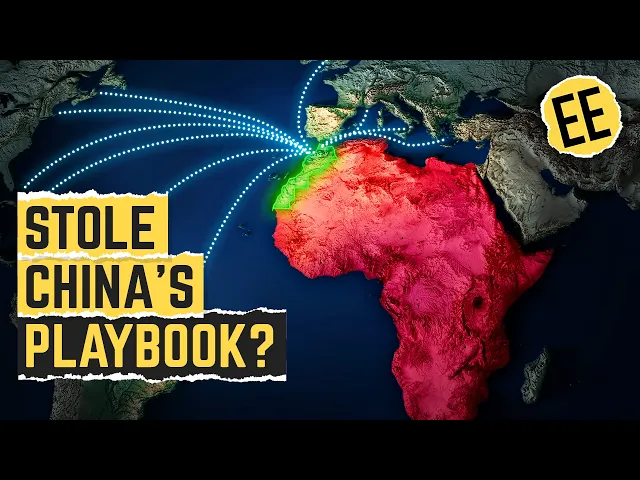
The Simple Genius of Morocco's Economic Rise
Economics Explained
0:00 Every so often, a country makes a move that almost
0:02 nobody notices until it starts reshaping an entire region's economy.
0:06 That's what's happening in Morocco right now.
0:08 For decades, North Africa was largely seen as a region built on farming,
0:12 fishing, and tourism.
0:13 It mainly exported raw materials and agricultural goods like Moroccan phosphates
0:16 or Algerian oil and sat largely outside global manufacturing supply chains.
0:21 But over the past 10 to 15 years,
0:22 Morocco has quietly gone in a different direction,
0:25 turning itself into North Africa's first true industrial economy.
0:28 Today, it's the second largest car producer on the continent,
0:31 accounting for more than half a million vehicles a year.
0:33 Its biggest port now handles close to 10 million containers annually,
0:36 ranking among the world's busiest.
0:38 Companies in the aerospace sector have come to Morocco to set up new factories.
0:42 Factories that once would have gone to Eastern Europe,
0:44 Turkey, or even Asia instead.
0:46 And none of this happened by accident.
0:47 Morocco didn't stumble into industrial success.
0:50 It used the advantages it had and built an economy around them.
0:52 In a region often defined by political instability and sudden shocks,
0:56 Morocco became the safe bet.
0:57 It made itself predictable, dependable, and incredibly easy to trade with.
1:01 That didn't mean there were no setbacks.
1:03 Morocco's economic growth has been uneven with benefits
1:06 concentrated and not everyone feeling the gains right away,
1:09 but the overall direction has remained steady,
1:11 and that consistency is what global manufacturers look for.
1:14 So, as always, we've got some important questions to answer.
1:18 How did Morocco pull this off so quickly?
1:20 Why are manufacturers choosing Morocco now instead
1:23 of the places they once relied on?
1:24 And can Morocco turn this momentum into something bigger?
1:27 Or will its success depend on whether
1:29 it can remain Europe's affordable workshop?
1:32 You're on your way to work.
1:33 You want to check in on the project you just wrapped up on your computer,
1:36 but you can't find it anywhere.
1:38 Endlessly searching on your phone with no sign of it anywhere.
1:41 We have all been there.
1:42 This is why we use Anyesk.
1:44 Anyes lets you remotely access your computer from anywhere.
1:47 Whether you're pulling up a file, troubleshooting a system,
1:50 or even managing complex workflows you just can't run on a laptop.
1:53 With our fully remote team, it's essential.
1:55 We use Anyesk for anything from video editing to running complex dashboards.
1:59 It works on any device,
2:00 so no matter what your team uses, it just connects seamlessly.
2:03 And thanks to its powerful codec technology, connection speed is never an issue.
2:08 It's free for personal use, and there are flexible plans for teams like ours.
2:11 Give Any Desk a try.
2:12 The link is in the description.
2:14 Morocco's industrial rise might look sudden from the outside,
2:17 but nothing about it was improvised.
2:19 In the late 2000s, the country made a clear break with its past.
2:22 Instead of relying on agriculture, tourism, low-v valueue exports,
2:25 or waiting for foreign investors to eventually take interest,
2:28 Morocco adopted a proactive industrial strategy.
2:31 Their goal to build the conditions
2:32 that global manufacturers need before they arrive.
2:35 That shift began with the emergence plan and was
2:37 formalized through the national pact for industrial emergence,
2:40 which focused on building industrial ecosystems where factories, suppliers,
2:44 logistics, and skills would all live side by side.
2:46 Across the country, Morocco developed
2:48 dedicated industrial zones with specialized infrastructure,
2:50 tailored regulations, and direct access to logistics networks.
2:54 Today, more than 150 industrial zones span over 12,000 hectares,
2:58 hosting around 10,000 firms across manufacturing,
3:00 logistics, services, and technology.
3:02 One of the first and most important was the Tangier Free Zone,
3:05 inaugurated in 1999.
3:07 Over time, it attracted more than 500 companies and over $670 million
3:11 in investment producing everything from automotive
3:13 components and aeronautics parts to textiles,
3:16 aggra business, electronics, and software services.
3:18 Some kilometers away, Tangier Automotive City opened in 2013 and has
3:22 now expanded into an 800 hectare automotive ecosystem.
3:26 The place is home to 150 companies and over 20,000 direct jobs,
3:30 which orbit around assembly, stamping, wiring, and parts manufacturing.
3:33 What sets these two industrial zones apart is that they
3:36 sit very close to one of Morocco's greatest assets, Tangier Med.
3:40 Now Africa's largest port, it handles close to 10 million containers a year,
3:43 ranking among the world's busiest container ports.
3:46 More importantly, it's one of the most connected ports on the planet
3:49 with regular shipping links to over 180 ports across more than 70 countries.
3:53 While much of Africa still grapples with congested, less integrated ports,
3:56 Tangier Med places most major European ports less than 3 days away by sea.
4:01 For companies operating inside the zones,
4:02 that proximity cuts hours from shipping times.
4:05 Goods roll out of factories and straight onto global trade routes.
4:08 That's the difference between an industrial zone
4:10 that attracts global manufacturers and one that never scales.
4:13 Across Africa, many industrial parks struggled
4:15 because factories were built far inland,
4:17 where long truck journeys, border delays,
4:19 and port congestion made reliable production impossible.
4:22 In the 2010s, for example,
4:24 Ethiopia built large industrial parks like Hawasa to become manufacturing hubs.
4:28 But the flagship zone sat nearly 900 km from the port of Djibouti.
4:32 This eroded the labor cost advantage and disrupted
4:34 just in time production for apparel suppliers,
4:36 including those producing for brands like H&M.
4:39 That lesson shaped how Morocco structured its entire industrial map.
4:42 Instead of concentrating production inland,
4:44 it stretched industrial zones along the coast,
4:46 keeping factories close to ports and export routes.
4:49 Moving south from Tangier, the Kenetra Atlantic free zone established around
4:53 2011 became the next pillar of that strategy.
4:55 It's the industrial belt feeding Stellantis' PJO
4:57 and Opal assembly lines with suppliers producing seats,
5:00 electronics, and structural components nearby.
5:03 Closer to Casablanca,
5:04 the Mid Park industrial zone emerged as a high precision cluster for aerospace
5:07 manufacturing while Tetwan Park in the north
5:09 built its own ecosystem for light manufacturing, trade, services, and logistics.
5:14 Taken together, these zones function like industrial cities.
5:17 Companies enjoy low operating costs,
5:19 simplified regulations, and customs free exports.
5:21 But the real advantage is the way everything is connected.
5:25 Training centers sit next to supplier workshops.
5:27 Cold storage sits next to customs offices.
5:30 And highways and rail lines run directly into ports.
5:32 If you're a multinational corporation trying to assemble cars,
5:35 aircraft components, or wiring harnesses,
5:37 that infrastructure can shorten production and delivery timelines,
5:40 letting you scale faster and cheaper than in many competing countries.
5:44 Once the zones proved the concept,
5:46 the policy focus shifted to scaling what worked through incentives,
5:49 infrastructure, and workforce development.
5:51 Through the national pack for industrial emergence and subsequent plans,
5:54 especially the industrial acceleration plans from 2014
5:57 to 2020 and again from 2021 to 2025, the government's goal evolved.
6:03 It was no longer just to attract factories,
6:05 but to make sure they could expand quickly,
6:07 operate efficiently, and stay competitive over time.
6:10 To achieve that, Morocco partnered directly with industry,
6:13 expanding industrial zones, offering tax exemptions, and most importantly,
6:17 building training programs tailored directly
6:18 to the specific needs of each sector.
6:20 Renault created a dedicated training center in Tongier
6:23 to prepare workers for assembly line and quality control roles.
6:26 Saffron helped establish the institute demier deer nort,
6:29 a specialized school that trains technicians for engine components,
6:32 composits, and aircraft interiors.
6:34 And Boeing, through agreements with the Moroccan government,
6:36 supported workforce development programs tied to the aerospace cluster.
6:39 Training wasn't limited to heavy industry, though.
6:41 Nearbart, Technopoulos was designed as Morocco's tech campus,
6:44 hosting R&D firms, micro electronics labs,
6:47 media companies, and offshoring operations.
6:49 So far, about $37 million has been invested in the Technopoulos campus,
6:53 which offers plug-and-play offices and hiring
6:55 incentives that subsidize thousands of high-skilled jobs
6:58 across resident firms with training grants of up to roughly $5,900 per employee.
7:03 Morocco also invested heavily in applied
7:05 research and advanced skills through Muhammad I
7:07 6th Polytenic University UM6P which the media
7:10 has described as Morocco's Silicon Valley.
7:12 Built near Marrakesh and backed by the state-owned phosphate giant OCP,
7:16 UM6P was designed as a research-driven institution tightly linked to industry.
7:20 Today, the university works directly
7:22 with international partners and private firms
7:24 focusing on fields Morocco sees as strategic for its continued growth.
7:27 Fields like engineering, data science,
7:29 renewable energy, agriculture technology, and material science.
7:32 Alongside this focus on research and skills, from 2014 to 2020,
7:36 the industrial acceleration plans pushed heavily on infrastructure.
7:40 Ports were expanded and new projects were
7:41 launched to increase capacity across the country.
7:44 More recently, on the Mediterranean coast,
7:45 NA Westmed is being developed as a deep water port and logistics platform
7:49 designed to relieve pressure on Tangier Med
7:51 while anchoring industrial growth in eastern Morocco.
7:53 The project includes a free industrial
7:55 zone and large-scale energy and storage infrastructure,
7:57 reinforcing Morocco's port system rather than
8:00 concentrating all risk in a single hub.
8:02 Further south, the Duckler Atlantic Port
8:04 Project aims to equip Morocco's southern provinces
8:06 with a multifunctional logistics gateway
8:07 and to strengthen trade links with West Africa.
8:10 And on land, mobility has improved just as quickly.
8:13 Morocco's highway network expanded from less than 100
8:16 km in 1999 to over 2,177 km today,
8:20 linking industrial zones directly to ports and major cities.
8:23 That already puts Morocco among the most extensive highway networks in Africa,
8:27 larger than those of Tunisia and far denser than most
8:29 subsaharan economies where logistics still rely heavily on single lane roads.
8:33 And the buildout isn't finished.
8:35 The government plans to push the network past 3,000 km by 2030,
8:39 extending high-capacity roads deeper into inland and southern regions.
8:42 Rail infrastructure was upgraded too.
8:44 The Albarak highspeed rail line opened in 2018,
8:47 cutting travel time between Tangier and Casablanca
8:49 from nearly 5 hours to just over two.
8:52 In connecting the country's two most important industrial corridors,
8:55 Morocco dramatically reduced friction for business, labor, and logistics.
8:58 And it isn't stopping here.
9:00 The government has announced plans to extend the high-speed
9:02 rail network south toward Marrakesh and eventually Agadier.
9:05 This will turn Alberak into the backbone of a national
9:07 transport system with a goal to link more industrial zones,
9:10 ports, and population centers into the same fast, predictable corridor.
9:14 And Morocco has its eyes on the skies as well.
9:16 Through its airport's 2030 plan,
9:18 it aims to more than double national airport capacity.
9:21 This will support tourism, but also high-value trade,
9:23 executive mobility, and time-sensitive cargo,
9:26 especially as the country prepares to co-host
9:28 the 2030 FIFA World Cup with Spain and Portugal.
9:31 Now layered on top of this physical
9:32 infrastructure sits Morocco's trade architecture.
9:35 The country holds free trade agreements with the European Union,
9:38 the United States, Turkey, and dozens of African and Arab partners.
9:41 For European firms in particular,
9:42 manufacturing in Morocco is almost like manufacturing inside the EU,
9:46 but with lower labor costs, faster permitting, and cheaper land.
9:49 Under the EU Morocco Association agreement, most industrial tariffs are removed,
9:53 meaning a car built in Kenetra can arrive
9:55 in Europe without the usual frictions faced by non-EU producers.
9:58 But Morocco's biggest advantage is the one it never built.
10:01 Geography.
10:02 It sits just 14 km from Spain.
10:04 Close enough that some fairies cross the straight of Jibralta in under an hour.
10:08 More than 100,000 ships pass through that straight every year,
10:11 making it one of the busiest shipping corridors on Earth.
10:13 From Morocco's ports, there are direct shipping routes into France, Portugal,
10:16 Spain, Italy, and the UK, all reachable far faster than from Asia.
10:20 That location gives Morocco something most distant competitors cannot replicate.
10:24 Extremely short, extremely safe supply lines into Europe.
10:27 Add to that a level of political stability rare in North Africa.
10:30 While much of the region was shaken by revolutions, civil wars,
10:33 and repeated government collapses after the Arab Spring,
10:35 Morocco avoided regime breakdown and maintained
10:38 policy continuity throughout the 2010s.
10:40 That consistency along with long-term
10:42 economic policies that haven't swung dramatically
10:44 with each new government turned Morocco into what investors crave most,
10:48 a low-risk environment where factories can operate without disruption.
10:51 Put simply, Morocco is close enough to Europe, cheaper than Europe,
10:54 and without the geopolitical risk and long transit times of Asia.
10:58 But even with all of those advantages,
11:00 there's one constraint that has threatened
11:01 to break Morocco's ongoing industrial growth.
11:04 Factories don't just need cheap labor and good logistics.
11:06 They need power.
11:08 And in much of North Africa,
11:09 electricity is either unreliable, expensive, or both.
11:12 In Egypt, for example,
11:13 rolling blackouts linked to gas shortages in 2023 hit industrial cities,
11:17 forcing factories to halt production for hours at a time.
11:20 Morocco tackled that risk early by investing heavily in renewables.
11:24 And while the sector is still modest in GDP terms,
11:26 it has become one of the country's most strategically important industries.
11:30 Over the past decade, Morocco has committed more than $360 million
11:34 to building large-scale solar and wind capacity.
11:36 The most visible symbol of that strategy is Nor Wars,
11:40 an area that used to be an empty stretch of desert,
11:42 but now holds one of the largest solar power plants in the world.
11:44 It provides Morocco with a reliable source of industrial scale electricity.
11:48 Along the Atlantic coast, massive wind farms followed,
11:51 feeding power directly into the national grid.
11:53 For manufacturers, this mattered more than headlines about green energy.
11:56 Energy costs are one of the few variables
11:58 manufacturers can't easily control once a factory is built.
12:01 By stabilizing electricity supply and reducing
12:03 exposure to fossil fuel price swings,
12:05 Morocco removed a major source of uncertainty,
12:07 making it far easier for factories to commit,
12:09 expand, and operate over the long term.
12:12 But that didn't mean factories showed up evenly across the economy.
12:15 Morocco attracted them in a handful of sectors where being close to Europe,
12:18 cheap and reliable, delivered the biggest economic returns.
12:21 The first sector was cars.
12:23 Today, Morocco is the second largest car producer in Africa,
12:26 assembling more than 550,000 vehicles a year.
12:29 It still trails South Africa, the continent's long-standing automotive hub,
12:33 but it's closing the gap fast.
12:35 And unlike South Africa, which exports roughly 68% of its output,
12:38 around 80% of Moroccan production is shipped abroad, mostly to European markets.
12:43 Renault was the first major automaker to commit,
12:45 opening its Tangier plant in 2012.
12:47 It quickly became one of the company's most efficient factories globally,
12:51 producing 1 million vehicles within its first few years
12:53 of operation and supplying small and midsize vehicles directly to Europe.
12:57 From there, Morocco's new industrial model snowballed.
13:00 Stellantis built its Canitra plant in 2019,
13:02 which produces Pujo and Opal models for European markets.
13:05 It later expanded the plant to include electric vehicles like the Citron Ammy,
13:09 turning Morocco into part of its EV supply chain.
13:12 Around these plants, dense clusters of suppliers popped up,
13:14 making everything from seats and wiring
13:16 harnesses to dashboards and exhaust systems,
13:18 often just minutes away from the final assembly line.
13:20 That matters because a modern car contains around 15,000 parts.
13:24 In a fragmented supply chain, each border crossing,
13:26 delay, or customs check adds cost.
13:29 Morocco's zones collapse that complexity.
13:31 Parts are made nearby, assembled nearby, and shipped out almost immediately.
13:35 Also, as wages rise across Europe and even parts of Eastern Europe,
13:38 Morocco has emerged as one of the cheapest places in the world
13:40 to assemble a car at scale on a per vehicle basis,
13:43 assembling a car in Morocco turns out to be cheaper than in Turkey,
13:46 Romania, or Mexico, countries long considered the go-to lowcost options.
13:50 And once Morocco proved it could handle complex,
13:53 just in time manufacturing through cars,
13:55 a second industry was ready for takeoff, aerospace.
13:59 At first, that might seem surprising.
14:00 Aircraft manufacturing is usually associated with rich high-tech economies,
14:04 but modern aircraft production is highly fragmented.
14:07 High-value design and final assembly stay in places like the US and Europe.
14:11 Meanwhile, a large share of the work like wiring systems,
14:14 composite parts, and fuselage sections relies on precision manufacturing.
14:18 And that type of work requires reliability
14:20 and logistics more than cutting edge research.
14:22 Morocco offered exactly that.
14:24 Today the country is one of the fastest growing aerospace hubs
14:27 in the world with around 150 aerospace firms operating inside its borders.
14:31 Suppliers linked to Boeing and Airbus
14:33 manufacture fuselage components and wiring systems.
14:36 Saffron produces engine parts and interiors and companies
14:39 like Collins Aerospace and Steelia build interior components,
14:42 many of which are shipped directly into European assembly lines.
14:44 Aerospace exports now exceed $2 billion a year.
14:47 And over time, Morocco is gradually increasing its share
14:50 by moving from basic wiring into higher value aerospace manufacturing.
14:54 And then there's one final sector
14:55 that plays a critical role in Morocco's economy,
14:58 mining, which centers on one of the most
15:00 strategically important resources on Earth, phosphate rock.
15:03 This rock is the source of phosphorus,
15:05 a material essential for two things the global
15:07 economy cannot function without, food and energy.
15:10 Phosphorus is a key ingredient in fertilizer,
15:13 and fertilizers support around half of global food production.
15:16 Without phosphorus, global crop yields would collapse.
15:19 Phosphates are also becoming critical for the energy transition.
15:22 They're a core component of lithium ion phosphate batteries,
15:24 which now make up roughly 30% of the global EV
15:27 battery market and are increasingly used by companies like Tesla.
15:30 The interesting part, though, is that unlike oil or gas,
15:33 there is no substitute and no synthetic alternative.
15:36 Phosphate can't be engineered in a lab or replaced by another material.
15:39 It can only be mined where it exists.
15:41 And Morocco controls roughly 70% of the world's known phosphate reserves.
15:46 That gives Morocco a massive structural advantage.
15:48 Through its stateowned group, OCP,
15:50 Morocco has built an entire industrial ecosystem around phosphates.
15:53 From mining to processing to fertilizer production,
15:56 today OCP is not only the world's largest phosphate fertilizer producer,
15:59 but also Morocco's largest employer with around 21,000 workers.
16:04 This makes it one of the country's economic anchors,
16:06 providing stable export revenues, foreign currency inflows,
16:09 and giving the country room to invest
16:11 in more complex sectors like manufacturing and technology.
16:14 In 2020 alone, OCP generated $5.9 billion in revenue
16:18 and accounted for roughly 1/5if of Morocco's total export earnings.
16:21 And just as it did with cars and aerospace,
16:23 Morocco concentrated infrastructure, processing capacity,
16:26 and logistics into a single massive hub.
16:28 The result is Jaw LFAR,
16:30 a sprawling industrial complex on the Atlantic coast that has
16:32 grown into the largest fertilizer production hub in the world.
16:36 Taken together, this is what Morocco built.
16:38 Near European manufacturing at scale,
16:40 powered increasingly by renewables and anchored by control over a critical
16:43 resource that underpins both global food security and the energy transition.
16:47 Which brings us to the real question.
16:48 Can Morocco keep moving up the value chain?
16:51 Or will it remain a lowcost extension of Europe's factories?
16:54 For decades, global supply chains were built around one simple idea.
16:57 Produce things as cheaply as possible, no matter how far away the factory was.
17:02 But then co showed how fragile long-distance supply chains really are.
17:05 The war in Ukraine exposed how
17:07 geopolitical shocks can freeze entire industries overnight.
17:10 And rising tensions with China made it
17:11 clear that efficiency alone isn't enough anymore.
17:14 For Europe, in particular, this forced a rethink.
17:17 The new priority became nearshoring,
17:18 bringing production closer, shortening shipping routes,
17:21 reducing dependence on Asia,
17:22 and keeping supply chains inside politically friendly territory.
17:25 And this is where Morocco fits almost perfectly.
17:28 Over the past two decades,
17:29 the country has maintained relative political stability,
17:32 consistent economic policy, and a pattern of gradual reform.
17:35 While neighboring countries went through revolutions, civil wars,
17:37 or repeated political breakdowns, Morocco remained broadly stable.
17:41 Part of that stability is structural.
17:42 Morocco is geographically insulated in a way few countries in the region are.
17:46 Shielded by the Atlas Mountains, buffered by the Sahara,
17:49 and bordered by two seas, so shocks don't spill over easily.
17:52 But stability also comes from leverage.
17:54 Through its control of phosphates,
17:56 Morocco plays a quiet but powerful role in global food systems.
17:59 Fertilizer exports generate revenue but also raise agricultural yields,
18:03 especially across subsaharan Africa,
18:05 creating long-term partnerships and political goodwill.
18:07 And crucially, change in Morocco has tended to be incremental.
18:11 Policies evolved, but rarely reversed overnight.
18:13 Reforms came stepby step, allowing institutions, businesses,
18:16 and investors to adjust without sudden disruptions.
18:19 For global manufacturers, this stability means fewer surprises and fewer reasons
18:23 to hesitate before committing billions to long-term factories.
18:26 It's especially important for industries like aerospace, where certification,
18:30 safety standards, and production take years and cost millions.
18:33 Once a supplier is certified,
18:35 companies want to know it will still be operating under
18:37 the same rules 10 or 20 years down the line.
18:39 But none of this means Morocco's model is risk-free.
18:41 Its industrial success still depends heavily on European demand,
18:44 a demand that is already under pressure as slowing growth
18:47 across the EU has begun to weigh on manufacturing and exports.
18:50 Climate risks are growing too.
18:52 Repeated droughts are putting pressure on agriculture and water supplies,
18:55 which matters not just for farmers, but for industry and energy as well.
18:58 Then there's the most serious internal challenge, jobs.
19:02 Despite rapid investment and modern infrastructure,
19:04 Morocco has struggled to create enough
19:06 meaningful employment for its young population, especially outside major cities.
19:10 Overall, unemployment hovers around 13%, but among young people,
19:13 it rises to well over a third.
19:15 This gap between modernization and inclusion is Morocco's core contradiction.
19:19 The country has built world-class ports, factories,
19:21 and transport links, but the gains are unevenly distributed.
19:24 Most foreign investment and high-value jobs are
19:26 concentrated along the Casablanca Rabat Kenetra corridor,
19:29 while inland and southern regions lag behind.
19:32 The result is what some analysts call a two-speed Morocco.
19:35 Globally connected on one side, undermployed and frustrated on the other.
19:39 And that tension has begun to surface politically.
19:42 Youthled protests over jobs and inequality have spread across major cities,
19:45 echoing a broader pattern seen across the global south.
19:48 For now, Morocco's stability is holding.
19:50 But long-term resilience will depend on whether
19:52 growth translates into opportunity at scale.
19:55 There's one final challenge, too.
19:57 Right now, Morocco excels at assembly components and mid-value manufacturing.
20:01 That's a huge achievement.
20:02 But to sustain growth over decades, it needs more than just production lines.
20:06 It will also need more engineering, design,
20:08 and high-skll work at the local level.
20:10 So, this is Morocco's real test going forward.
20:12 It isn't just about exporting more.
20:14 It's about turning that success into broad-based employment,
20:17 climbing further up the value chain, and making sure new opportunities are
20:20 felt well beyond its main industrial corridors.
20:23 If you want to understand why most African countries never reach this stage,
20:26 and why Morocco might be an exception,
20:28 we made a video breaking down the deeper institutional
20:30 reasons Africa remains poor based on research by MIT economists.
20:34 You should be able to click to that on your screen now.
20:36 Thanks for watching, mate.
20:37 Bye.