Why Does Everyone Think "1984" Agrees With Them?
Jacob Geller
0:01 Gary Varvel had been working as a political cartoonist for over
0:05 25 years before he drew his most iconic piece of art.
0:10 Varvel, who describes himself as a “Christian, conservative,
0:13 cartoonist and speaker in that order,” spent the majority
0:16 of his career drawing cartoons for the Indianapolis Star.
0:21 He lampooned U.S.
0:22 political figures, ideological positions, and cultural moments.
0:25 He published books, won awards,
0:27 made a lot of jokes about who we should or shouldn’t bomb.
0:30 But it was only after he retired from the paper and went
0:35 independent that Varvel created what very well might be his legacy.
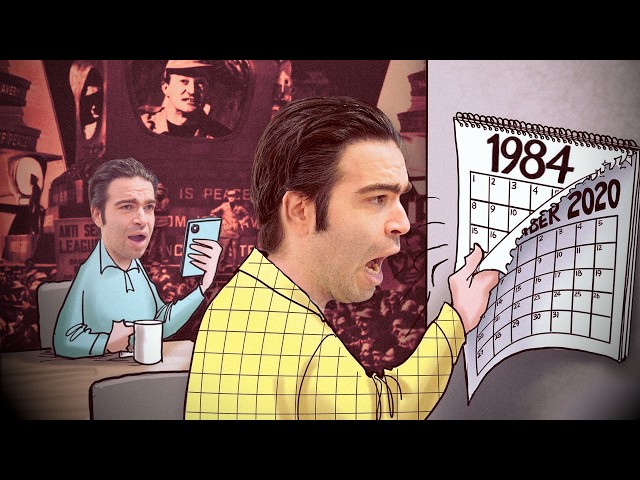
0:39 Sitting at the kitchen table,
0:41 a woman reads an alarming news story from her phone.
0:45 A man, standing in the foreground, turns a calendar page with horror.
0:50 It is not the month he expected to see.
0:53 Instead, it is…JANUARY NINETEEN EIGHTY-FOUR.
0:56 This comic, by Gary Varvel, is one of the very few
1:02 political cartoons to transcend into internet-culture-memedom.
1:06 Perhaps it’s the broad applicability of the comic that made it so appealing,
1:10 with its nearly infinite potential to make
1:13 different jokes in place of its original caption.
1:16 Or, perhaps its staying power is because of the thuddingly obvious original art,
1:21 an on-the-nose invocation of George Orwell’s 1949 book,
1:26 “Nineteen Eighty-Four.” Here’s a question for you— can
1:31 you tell me what the original caption said?
1:34 No, not the Cyberpunk variant, and not the broken calendars variant,
1:38 and not the one where it’s about truckers not
1:41 being allowed to masturbate at the Celina 52 Truck Stop.
1:45 What was the original text that this woman was saying?
1:49 I’ll tell you.
1:51 In January, 2021, Gary Varvel’s original comic read:
1:55 “Twitter banned Trump’s account and Google suspended Parler… what’s
2:00 going on?” Since 2021 was roughly thirty years ago, I’ll refresh your memory.
2:07 During President Trump’s first term,
2:09 many high profile social media platforms seemed to wrestle
2:12 with the question of if they should ban him from posting.
2:17 On one hand, he frequently posted extremely high visibility misinformation,
2:21 racism, and thinly veiled incitements to violence.
2:24 On the other hand, he was…the President of the United States.
2:29 The “Parler” referenced in the cartoon was one of a handful
2:33 of right wing alternative social medias that sprung up around this time,
2:37 which promised to host conservatives without the perceived
2:41 censorship running rampant on more mainstream platforms.
2:44 Finally, the day came that most social medias— and web hosts,
2:49 including Google— decided to boot Trump and affiliates off the platform.
2:54 This is what the cartoon is referencing.
2:57 Here’s an even more difficult question for you.
3:00 What was Varvel’s political cartoon
3:03 immediately before this Nineteen Eighty-Four one?
3:07 It was this, ol’ George Washington on the dollar bill, crying, hand over face.
3:13 Why might this be the comic?
3:16 Oh, because this is his comic about January Sixth.
3:20 Indeed, just three days before Varvel declared
3:22 that we were falling into an Orwellian dystopic state,
3:26 thousands of supporters of the sitting president stormed the country’s capital
3:30 building in an attempt to overturn the results of a democratic election,
3:35 at the behest of said president.
3:37 The failed coup was, in fact, largely planned on Parler.
3:42 And then we “entered Nineteen Eighty-Four” because Trump got kicked off twitter.
3:48 I’ve been thinking about Varvel’s comic a lot recently,
3:51 and not just because I recently saw one that’s
3:54 about the announcement of the Steam Machine (FEBRUARY 1804??).
3:58 No, I think the cartoon is emblematic of the use of George Orwell’s Nineteen
4:03 Eighty-Four as a kind of legitimacy booster
4:06 for… whatever thing a person is arguing for.
4:10 Orwell scholar John Rodden said the writer “fills a hole for anyone
4:14 who wants to establish any kind of intellectual pedigree.” Other than the bible,
4:18 I struggle to think of a book that has
4:21 been used as such an all-purpose cudgel for different ideologies,
4:25 the ideologue always certain that whatever
4:27 position they’re up against is truly “Orwellian.”
4:31 And this has been true for virtually the whole of the book’s existence.
4:36 As soon as it was published,
4:38 nearly all sides of the political spectrum grabbed hold of Nineteen
4:42 Eighty-Four in support of the thing they had already been saying.
4:46 Why is this the case?
4:49 Is it truly universally applicable?
4:51 Is the book so vague in its positioning that it can apply to everyone?
4:56 Or is its legacy one of consistent, aggressive, misinterpretation?
5:00 Is there a “right” way of reading Nineteen Eighty-Four?
5:12 Nineteen Eighty-Four was the ninth and final book published by George Orwell.
5:17 Nineteen Eighty-Four tells the story of Winston Smith,
5:20 a man living in “Airstrip One” (formerly Great Britain),
5:25 under a totalitarian government.
5:27 And let’s actually stop right there.
5:29 I want you to do a little brainstorm and think to yourself:
5:33 what are the things that come to mind when Nineteen Eighty-Four is evoked?
5:37 What are its most indelible concepts?
5:40 Because although the book is 300-some pages long,
5:44 I think you can fit most of its popular conception into a few bullet points.
5:50 Here’s my list Big Brother& Thought Police NewSpeak The Ministry
5:55 of Truth Doublethink and 2+2=5 And to be honest,
6:01 maintaining four bullet points of general awareness, 77 years after publication,
6:06 is way better than most books could hope for.
6:09 Giving four major bullet points is, in fact,
6:12 better than I could do for most books I read in the past year.
6:15 But these points, separated from their text,
6:18 are easily molded into any political narrative or attack.
6:21 When Varvel summons Nineteen Eighty-Four to decry
6:24 the banning of the United States President from Twitter,
6:27 he is positioning Twitter as some sort of Thought Police.
6:31 When Elon Musk invokes Orwell, as he has done (sigh) dozens of times,
6:35 it is usually some reference to a Ministry
6:39 of Truth-like obvious lie from the government.
6:42 Musk has referenced an invented “Orwell’s Law”
6:45 (or “Orwell’s Rule,” he isn’t particularly consistent)
6:48 that any government agency or legislation will
6:51 most likely do the opposite of its name.
6:54 Critics of Musk could then reference Nineteen Eighty-Four again,
6:58 accusing him of Doublethink,
7:00 given that he believed any government institution would
7:03 do the opposite of its name while simultaneously running
7:06 a government institution called the “Department of Government Efficiency.”
7:10 Nineteen Eighty-Four sales spiked in the early Trump years,
7:14 as the populace was presented with terms like Fake News and Alternative Facts.
7:19 They also spiked years earlier,
7:21 when Americans learned of the true scale of NSA surveillance—
7:25 Bernie Sanders called the government
7:27 spying “Orwellian.” [“That most Americans do
7:29 not want to live in an Orwellian society where virtually everything
7:33 that we do is recorded.”] Years before that, as the U.S.
7:38 and Europe entered a manufactured war with Iraq,
7:41 Nineteen Eighty-Four once again took the limelight.
7:43 Michael Moore’s 2004 documentary, Fahrenheit 9/11 ends,
7:46 not with a quote from the book that inspired its title,
7:51 but instead a quote from Nineteen Eighty-Four.
7:54 On Radiohead’s “Hail to the Thief,” released in 2003,
7:58 Thom Yorke howls that 2+ 2 always equals 5.
8:02 And we could keep going back like this.
8:05 Nineteen Eighty-Four was, of course,
8:07 referenced ad nauseum during the cold war— it
8:09 was illegal to own in the Soviet Bloc,
8:12 but it circulated widely underground anyway.
8:14 In 1983, Neoconservative warhawk Norman Podhoretz argued that if Orwell
8:19 saw the success of capitalism and the evils of pacifism,
8:23 he would join the Neocons in opposing
8:27 nuclear disarmament and attacking the left.
8:29 In 1950, only one year after Nineteen Eighty-Four’s release,
8:34 the writer Mary McCarthy coined the term
8:37 “Orwellian,” while commenting on fashion magazines.
8:41 “As an instrument of mass snobbery, this remarkable magazine,
8:44 dedicated simply to the personal cult of its editress,
8:48 to the fetichism of the flower,
8:50 outdistances all its competitors in the audacity of its conception.
8:54 It is a leap into the Orwellian future,
8:57 a magazine without contest or point of view beyond
9:01 its proclamation of itself.” A 2023 study by Imogen Birkett
9:06 found that virtually all parties in British Parliament referenced Nineteen
9:09 Eighty-Four or referred to things as Orwellian— Labour the most,
9:14 as they were the opposition party during the research’s timeframe,
9:18 but also the conservatives, liberal democrats, SNP.
9:20 This was in reference to technology and privacy,
9:24 freedom of speech, propagandistic naming conventions,
9:26 the actions of other governments.
9:29 Ben Bradshaw, Exeter’s MP,
9:30 said that not being able to store one’s bike on a carriage
9:34 with a bike compartment was “Orwellian.” The imagery of Nineteen Eighty-Four,
9:40 too, is spread so widely it’s hard to even grasp its influence.
9:45 There’s the Ridley Scott-directed Apple ad for the Macintosh Computer [Ad:
9:50 Secure from the pests of any contradictory true
9:54 thoughts… we will bury them with their own confusion.
10:03 We shall prevail!
10:06 On January 24th Apple Computer will introduce Macintosh.
10:12 And you'll see why 1984 won't be like '1984.'].
10:18 Then there are the parodies of the already almost self-parodying ad.
10:23 [“You liked the ad, right?
10:24 The commercial 1984.
10:25 You liked it.” “We showed a lot of happy people drinking Pepsi.
10:28 We didn't say the world was going to end if you bought a Dr.
10:31 Pepper!” The Simpsons did it— twice.
10:34 Futurama.
10:34 An unofficial ad for Obama’s 2008 presidential campaign.
10:37 Valve did it to announce that Half-Life 2 would be available on Mac.
10:42 Fortnite did it to rally support in their lawsuit against, ironically, Apple.
10:57 It’s hard to remember, but at one time,
11:00 the concept of capturing one’s whole life on film was
11:03 enough of a pitch to be an entire reality show.
11:07 “Big Brother” debuted in 1999 in the Netherlands, 2000 in the US and UK,
11:12 and the entire hook was built around the ability to surveil
11:16 contestants for every waking and sleeping moment of their lives.
11:20 In 2001, the show settled a copyright lawsuit with the Orwell estate.
11:24 It is a strange feeling then, in the wake of all its references,
11:29 to return to the actual text of Nineteen
11:32 Eighty-Four— a book that does contain its most-cited themes,
11:36 but is so much greater than a bulleted list,
11:39 so much more specific than its citations give it credit for.
11:43 The first thing that happens in the book is Winston Smith,
11:47 a middle-class man living under the regime of Big Brother,
11:51 takes out a diary and begins to write: April 4th, Nineteen Eighty-Four.
11:56 Last night to the flicks.
11:58 All war films.
11:59 One very good one of a ship full of refugees
12:02 being bombed somewhere in the Mediterranean… there was a middle-aged woman
12:06 might have been a jewess sitting up in the bow
12:08 with a little boy about three years old in her arms.
12:11 little boy screaming with fright and hiding his head… the woman putting
12:15 her arms round him and comforting him although she was blue with fright herself,
12:19 all the time covering him up as much as possible
12:22 as if she thought her arms could keep the bullets off him.
12:25 then the helicopter planted a 20 kilo bomb in among
12:28 them terrific flash and the boat went all to matchwood.
12:31 then there was a wonderful shot of a child's arm going up
12:36 up up right up into the air… This is how Nineteen Eighty-Four begins:
12:41 with an extended, horrible description of the bombing
12:44 of refugees being used as entertainment.
12:47 I was surprised to find a description of how Big
12:52 Brother fostered a particular hate and distrust of women within Winston,
12:56 “he disliked all women, and especially the young and pretty ones.” There
13:01 are the public executions and the endless wars,
13:04 the abolition of thought and moralizing campaigns against sex,
13:07 the false confessions from torture and— you see what I’m doing here, right?
13:12 While rereading the book I was shocked to find
13:15 so many things that seemed to speak directly to me, to the things I care about.
13:20 The book is relentless in its depiction of the crushing of human dignity,
13:24 the annihilation of art and the annihilation of hope,
13:27 and I read it and I thought “good god, Orwell has been on my side all along.”
13:33 And we’re back to the title of this video.
13:37 Why Does Everyone Think Nineteen Eighty-Four Agrees With Them?
13:41 In many ways, I do feel a kinship with Orwell,
13:44 because I believe his politics could best be described as “annoyed leftist.” If
13:48 you’ve heard any history of why Orwell wrote the books that he did,
13:54 it probably goes like this: inspired to fight fascism in 1936 Spain,
13:59 George Orwell joined the P.O.U.M, or the Worker’s Party of Marxist Unification.
14:04 During his time in Spain, however,
14:07 he witnessed the various anti-fascist factions fall into infighting,
14:11 as pro-Soviet Communists accused him and his allies of being Trotskyists.
14:15 Returning from the front lines, many of Orwell’s battalion were arrested
14:20 and some likely killed by Soviet agents.
14:22 He eventually fled the country with a new
14:26 distrust of Communism and a skepticism towards state control,
14:29 no matter how beneficially it was pitched.
14:33 This truncated version of events in Orwell’s
14:36 life is not inaccurate— but it is incomplete.
14:40 A fascinating aspect of Orwell’s experience in the civil
14:44 war is his general ideological naivete while entering the conflict.
14:49 He did not join the Worker’s Party of Marxist
14:52 Unification out of any deep connection to their cause,
14:55 he joined because his initial plans to join under
14:58 the Pro-Soviet British Communist party had simply gone awry.
15:02 His alignment with the P.O.U.M.
15:04 was one of chance and convenience.
15:06 I point this out not to diminish Orwell’s experience during the war,
15:10 but to highlight a broader trend in his ideology:
15:14 that his deeply held moral convictions— felt strongly
15:17 enough that he would volunteer for a civil
15:20 war in another country— were often matched
15:23 by a disinterest in the nitty-gritty politicking of individual parties.
15:28 Another element sometimes left out
15:30 of the story of Orwell’s disillusioning experience
15:33 in Spain was that he was shot in the neck by fascists.
15:39 If you were looking for his major takeaway from the war,
15:42 you could read his essay,
15:44 “Why I Write,” in which he says “Every line of serious work
15:48 that I have written since 1936,” (the year he went to Spain),
15:53 “has been written, directly or indirectly,
15:55 against totalitarianism and for democratic socialism.” Yes,
15:59 Orwell was a socialist for basically all of his adult life.
16:04 And you can see this in his writing!
16:07 His decrying of income inequality, for instance:
16:10 “England is the most class-ridden country under the sun.
16:13 It is a land of snobbery and privilege,
16:15 ruled largely by the old and silly.” Or you
16:19 could read his litany of charges against capitalism.
16:23 Here’s one of my favorites: “Private capitalism,
16:25 that is, an economic system in which land,
16:28 factories, mines and transport are owned privately
16:32 and operated solely for profit—does not work.
16:35 It cannot deliver the goods.
16:37 This fact had been known to millions of people for years past,
16:41 but nothing ever came of it,
16:42 because there was no real urge from below to alter the system,
16:46 and those at the top had trained themselves
16:49 to be impenetrably stupid on just this point.” And yet,
16:53 it is because of his deeply held leftist beliefs that he felt
16:58 so outraged over the betrayal by the Soviet Communists he experienced in Spain.
17:03 When he returned home, he was equally outraged that he was discouraged
17:08 from writing about said betrayal by his theoretical political allies.
17:13 His writing was, in large part,
17:15 motivated by personal animus— Dorian Lynskey writes
17:18 that Orwell “didn’t personally know any fascists… but he
17:22 knew plenty of communists… he was still angered
17:25 by their hypocrisy years later.” These stories are,
17:30 undoubtedly, fundamental in understanding Orwell’s
17:33 project in writing Nineteen Eighty-Four.
17:36 What I have found equally revealing, though,
17:39 are the tales of his earlier life— of his disdain
17:43 for, but simultaneous participation in, the British project of empire.
17:47 Orwell was born in 1903 in the British Raj— the British occupation of India.
17:53 His father, Richard Blair— Sorry, this is confusing.
17:57 Orwell’s birth name was Eric Blair.
18:00 Later in life, Orwell would adopt a son who was, also, named Richard Blair.
18:05 Anyway, Orwell’s father, Richard Blair worked for the Opium Department
18:09 of the Indian Civil Service— aka the part
18:13 of the British Empire that regulated opium in India and sold it to China.
18:18 His father was, in a sense,
18:20 engaging in a form of government-led thought control.
18:24 And Orwell, too, maintained the empire.
18:26 In 1922, he joined the Indian Imperial Police in occupied Burma,
18:32 where he enforced colonial rule over the local population.
18:35 His experience in Burma was the source for his first novel,
18:40 Burmese Days, as well as the deeply self-loathing essays,
18:44 “A Hanging” and “Shooting an Elephant.” In these essays,
18:47 he describes the kind of Doublethink that would
18:51 later define the regime of Nineteen Eighty-Four.
18:53 He says that he hated his job,
18:56 that he was “all for the Burmese and all against their oppressors,
18:59 the British.” And yet at the same time he
19:03 describes the rage he felt against the colonized Burmese,
19:06 “the evil-spirited little beasts who tried to make my job
19:10 impossible… Feelings like these are
19:12 the normal by-products of imperialism” Ultimately,
19:15 the stories seem to recognize that the only
19:18 role of the imperial is to enact violence.
19:22 In “A Hanging,” he watches the execution
19:25 of a “puny” bound and helpless prisoner,
19:28 the clumsiness of the act and the immediate
19:31 repression of the experience by all involved.
19:33 In “Shooting an Elephant,” he begins
19:35 the story with “In Moulmein, in lower Burma,
19:38 I was hated by large numbers of people—
19:41 the only time in my life that I have been
19:43 important enough for this to happen to me.”
19:46 The title of this story is not— or at least, not exclusively— metaphorical.
19:50 He is called from his station as a policeman to put down a rogue elephant.
19:56 He doesn’t particularly want to; the elephant
19:58 is simply eating in a nearby field.
20:01 But the promise of imminent violence attracts a crowd,
20:04 two thousand onlookers who expect one thing and one thing only from him:
20:09 the delivery of death.
20:11 Orwell writes that this is the hollowness
20:13 of the white man’s dominion: “He wears a mask,
20:17 and his face grows to fit it.” He does, eventually, kill the elephant.
20:21 He pours round after round into it, as it dies slowly and painfully.
20:26 All this, not because of the danger of the animal,
20:29 but because of the fundamental insecurity of himself,
20:33 as representation of the empire.
20:35 “To come all that way, rifle in hand,
20:37 with two thousand people marching at my heels,
20:40 and then to trail feebly away, having done nothing— no, that was impossible.
20:45 The crowd would laugh at me.
20:47 And my whole life, every white man’s life in the East,
20:51 was one long struggle not to be laughed at.” Orwell had a knack
20:56 for participating in the systems he would
20:58 later incorporate into his view of totalitarianism.
21:01 He returned to India, in a sense, during the second world war.
21:06 In 1941, he began working for the BBC, supervising and creating radio programs
21:12 broadcast specifically to Indian listeners.
21:14 And although he would eventually claim that he never
21:17 said anything on-air he wouldn’t have said as an individual,
21:21 he was, undeniably, creating a form of propaganda,
21:24 sending forth counter-programming to what India might have heard from the Axis.
21:30 He viewed himself, maybe, as a lesser evil— quote,
21:33 “I have kept our propaganda slightly less disgusting than it might otherwise
21:37 have been,” But it’s hard to imagine it didn’t sting to be accused,
21:41 as he was by George Woodcock, of “return[ing] to his old imperialist
21:47 allegiances.” Maybe it was this experience,
21:49 as much as with the communists in Spain, that convinced Orwell that the truth
21:54 could be endlessly manipulated by motivated propagandists,
21:57 broadcasting an eminently malleable version of the “truth” over the air waves.
22:02 Lynskey even identifies a time that Orwell
22:04 mused he could re-edit speeches by Winston Churchill,
22:07 creating a false recording of the Prime Minister declaring peace instead of war.
22:12 When I look at Orwell, his history,
22:15 his path that brought him to writing Nineteen Eighty-Four,
22:19 I see his overwhelming fear that the world was becoming something.
22:23 He writes of the contradictions between his experiences and the reported word:
22:28 “it often gives me the feeling that the very concept of objective
22:32 truth is fading out of the world… In the past people deliberately lied,
22:37 or they unconsciously coloured what they wrote,
22:40 or they struggled after the truth,
22:42 well knowing that they must make many mistakes;
22:45 but in each case they believed that ‘the facts’
22:49 existed and were more or less discoverable.” And yet,
22:53 his sense of what the world had been and what the world would become was locked,
22:58 somewhat absurdly, to his own lifetime.
23:01 Is it reasonable, in the world of his adulthood, to fear that the truth would be
23:08 forever hidden behind ruling parties and propaganda?
23:10 Of course!
23:11 But is it reasonable to assume that the world he was
23:14 born into— a world where his father sold opium for the empire,
23:18 where the same empire gave him the power
23:20 of life and death over an occupied population,
23:24 was any better at identifying the objective “facts” of history?
23:30 I think one of the irresistible things about dystopias,
23:33 of which Nineteen Eighty-Four is one of the greatest,
23:36 is the sense of seeing the road in our everyday
23:39 that will eventually lead us into the nightmare.
23:42 But our sense of what the “everyday” is, what constitutes normalcy,
23:46 what form our pre-dystopic notions of the world, is unshakeably relative.
23:51 Whatever we were born into forms our picture of what
23:55 the world “should” be like, “ought to” be like.
23:58 Our perspective on the dissolution of truth,
24:02 of honor and fairness, inevitably begins there.
24:06 For Orwell to write that “the very concept of objective
24:09 truth is fading out of the world” makes him feel, in 2026, like a time traveler.
24:14 How could he so foresee what would befall us?
24:18 But in fact, the lesson should be the opposite:
24:22 his observations not prophetic but reflective of a perpetual feeling.
24:26 And this feeling, of the world gradually falling
24:30 farther and farther from what it should be,
24:34 is not exclusive to “democratic socialists.” It
24:36 is a politically agnostic impulse— if not,
24:39 I dare say, an outright conservative one.
24:42 You don’t have to look very far at all
24:44 to recognize how much of the conservative appeal is
24:47 built on the promise that the world can be
24:50 put back like you remember it as a child,
24:53 to “return” to a more simple, more agreeable era,
24:56 free of any sociopolitical conflict more complex than “when mom
25:00 makes you go to bed.” An era that, in reality,
25:05 has never existed, except in the mind of an infant.
25:09 In truth, there are two different ways the world can shift towards dystopia.
25:13 One way is built on action, the consequences of leaders and legislation
25:18 and the harm done to populations of people.
25:21 The other way is built on access to knowledge;
25:24 exposure to the truth that leaders and legislation and populations of people
25:29 have not been well for far longer than you’ve been able to grasp.
25:34 The world shifts towards dystopia because you learn to recognize
25:38 the dystopic conditions that have already existed around you.
25:43 These two shifts are happening simultaneously.
25:46 Orwell lived through the first and second world wars,
25:49 trench warfare, death camps, nuclear bombs.
25:52 He was not wrong in identifying the dystopic themes of his lifetime,
25:57 the ability of new technology to exert new forms of control over the populace.
26:02 But was he, I wonder, able to reflect beyond the lens of his own experience,
26:08 have the awareness to know that the first
26:10 time he recognized politically motivated lies
26:13 and propaganda in the reporting around him
26:16 was not the first time it had happened?
26:19 The irony, and the danger,
26:20 of these two shifts towards dystopia is how easily one can be mistaken
26:25 for the other— especially given the inevitable
26:28 nostalgia for the simple world of a child.
26:31 It might be easy to look at today’s protests, for instance,
26:35 and assume that activists’ demands are exclusive to our newly dystopic world.
26:40 If you are, for instance, Roger Severino,
26:42 one of the architects of “Project 2025” and a big fan of Nineteen Eighty-Four,
26:48 you might see these social movements as “Orwellian.”
26:51 He’s said that today’s Left is forcing “people
26:55 to repeat a lie with their own lips.” But, if you learn even a little history,
27:01 today’s activists are easily identifiable as part of a historical continuum.
27:05 Protests against forever wars, against racial supremacy,
27:09 or for queer liberation are not sudden constructions of the 21st
27:14 century— they exist at the long end of a historical timeline.
27:19 And they have, for the entirety of that timeline,
27:22 been protesting dystopic conditions,
27:24 a failure of institutions to recognize people as people.
27:30 Perhaps the book’s political universality is the ease at which its message
27:36 can be reduced to “you’re being lied to.” The ministry of truth,
27:41 doublethink, thoughtcrime, 2+2=5,
27:42 all on their basest level are shaped around “they want to convince you
27:49 the world is a way that it is not.” When viewed this way,
27:53 it’s no wonder the novel could slide so easily into any number of ideologies.
27:59 Crowd sizes, war justifications, paid protestors,
28:02 covid lab leaks, elders of zion— anything and everything.
28:06 The more strongly felt,
28:08 the more the other side is trying to make you believe 2+2=5.
28:14 But it’s not just the idea that “you’re being lied
28:18 to.” When pundits and posters refer to something as Orwellian,
28:21 they are quite often referring to a censorship of dissent—
28:25 that there’s only one thing you’re allowed to believe,
28:28 and any other opinion will be suppressed.
28:31 This is maybe an even more powerful feeling than the sense that you’re being
28:36 lied to— that “they” are trying to stop you from telling others what you know.
28:41 This is the thought process that can absolutely fracture one’s reality.
28:46 One person’s “correction” becomes another’s “thought police”— why
28:50 are those doctors so insistent that vaccines work, huh?
28:54 Is it because they’re trying to keep us safe?
28:57 Or is it because they’re trying to silence the truth?
29:03 (It’s because vaccines work).
29:05 And perhaps the paradox that most separates us from the time
29:09 of Nineteen Eighty-Four’s writing is the number
29:12 of places someone can be “silenced.”
29:14 In an environment when everyone has been given the ability to “publish,”
29:19 to “post,” to create a soapbox upon which to declare their thoughts,
29:23 our questions of free speech are
29:27 often more specifically questions of amplification.
29:30 Yes, technically, you can say something, but where and how loudly?
29:35 In 1949, when Nineteen Eighty-Four was published,
29:39 you could… what, be turned down for a newspaper op-ed?
29:43 Real censorship did exist of course,
29:46 and would accelerate in the years to come with McCarthyism,
29:49 et cetera, but the vast majority of people, no matter their views,
29:53 were simply not visible enough to meaningfully
29:55 run up against institutions that shaped cultural narratives.
29:59 Fast forward 70 years though and any random grandma could have
30:04 the Orwellian experience of being kicked out of a Facebook group for “thought
30:08 crime,” any teenage boy could be banned from a discord server because
30:13 “big brother” took an interest in the messages he was sending other users.
30:17 This is what Varvel’s original comic is about, remember?
30:21 “Twitter banned Trump’s account and Google suspended Parler.” A form
30:25 of censorship that only exists in the modern era.
30:29 The usual response to this is fairly straightforward.
30:32 You can probably say it with me.
30:34 Freedom of speech is not freedom from consequence.
30:37 Freedom of speech does not, in fact, guarantee someone a platform.
30:41 Being banned from Twitter is the action of a company, not the government.
30:45 It would probably represent far more of an overreach
30:48 for the government to define
30:51 the content policies of a non-governmental business.
30:54 But… I actually think Orwell would agree with Varvel.
30:59 In part, at least.
31:01 Orwell was a free speech enthusiast, if not an absolutist.
31:05 He said he was committed to hearing
31:08 the “unfashionable opinion,” “that everyone shall have
31:10 the right to say and to print what he believes to be the truth.” And yet,
31:15 he recognized there were limits— “when one
31:18 demands liberty of speech and of the press,
31:20 one is not demanding absolute liberty.
31:22 There always must be, or at any rate there always will be,
31:27 some degree of censorship,
31:29 so long as organised societies endure.” The full quote,
31:33 about everyone having the right to say
31:35 and to print whatever they believe to be the truth,
31:37 ends with “provided only that it does not harm
31:41 the rest of the community in some quite unmistakable way.” No,
31:45 my hunch— and I have to emphasize, this is a hunch— is that the man would
31:51 be shaken by the unexamined element of Varvel’s cartoon.
31:54 Not that Twitter and Google chose to throw
31:57 specifically Donald Trump and Parler off their platforms,
32:00 but that the modern realm of public
32:03 discourse is monolithically shaped and defined by enormous,
32:08 billion-dollar technology companies.
32:10 That the same industry responsible for the decimation of Orwell’s
32:14 beloved newspaper was now the only place to go for information.
32:18 That the policies of these companies were
32:21 now the de-facto content guidelines for public discourse,
32:25 as determined by solely non-elected executives.
32:30 But THAT SAID, even though I do think Orwell would find
32:34 this aspect of society dystopian… it’s
32:37 still not what Nineteen Eighty-Four is about.
32:39 If Varvel meant to do more with his cartoon
32:43 than simply lampoon Twitter and Google for being
32:46 “woke,” if he meant to draw attention to the outsize
32:49 influence of tech companies on our public discourse,
32:52 he may have chosen the single worst “victim” for that example.
32:56 If anyone, anyone on Earth,
32:58 didn’t need to rely on the communication channels afforded by social media,
33:03 it was the SITTING PRESIDENT OF THE UNITED STATES.
33:07 Nineteen Eighty-Four is a book about the state’s totalitarian control
33:11 of every aspect of society— from industry to press to entertainment.
33:16 From this position, the ability of a non-governmental platform to stop
33:21 hosting the president isn’t an example of Orwellian thought control,
33:26 it’s actually the exact opposite— a demonstration, in a way, of freedom.
33:31 A private company acting independently
33:34 of, and antagonistically towards, the government.
33:37 Which is way more credit than Twitter actually deserves, but still.
33:44 Upon Nineteen Eighty-Four’s original release,
33:49 almost all sides of the political spectrum flocked
33:51 to use its dystopian vision to bolster their own platform.
33:55 The exception was… the Communists.
33:57 Orwell was already known for Animal Farm and his generally anti-Soviet views.
34:03 Stalin was, though not the only, the most apparent analogue of Big Brother.
34:09 Masses and Mainstream, a monthly Marxist magazine,
34:13 (alliteration!) titled its review “Maggot of the Month” and wrote
34:18 that the book’s popularity demonstrated a deep societal sickness.
34:22 Pravda, the “official newspaper of the central committee of the communist
34:25 party of the soviet union,” said that Nineteen Eighty-Four represented
34:30 the “gruesome prognostications… by a whole army of venal writers
34:35 on the orders and instigation of wall street.” It is ironic,
34:40 so many decades and so many waves of influence later,
34:43 that most reviewers treated the book as inextricably
34:46 tied to the moment it was published.
34:48 The Communists could only see it as a condemnation of Communism.
34:52 American Republicans said it was obviously warning against the New Deal.
34:57 Mark Schorer, writing a contemporaneous review for the New York Times,
35:01 said that Nineteen Eighty-Four’s “kineticism” may
35:03 mean “that its greatness is only immediate,
35:07 its power for us alone, now, in this generation, this decade, this year,
35:12 that it is doomed to be the pawn of time.”
35:16 77 years and tens of millions of sales later,
35:20 it does make you wonder: what is it about Nineteen Eighty-Four?
35:23 If a book is written as a “warning,” if it
35:27 literally picks a date in the future to set itself,
35:30 and then that date comes and goes, why do we still cling to it so tightly?
35:36 Well.
35:36 Because it is not, actually, a book of prophecy.
35:40 It is not about the world we’re headed
35:42 into, it is about the one we’ve found ourselves in.
35:46 Orwell wrote Nineteen Eighty-Four only after he started paying more
35:50 attention to how ideological narratives of war and culture were spun.
35:54 Sure, he said, he repeated,
35:56 that he didn’t think the world he wrote about “will” arrive,
36:01 only that it “could” occur.
36:03 But the fears he articulated in Nineteen
36:05 Eighty-Four were not ones yet to arrive: they were already there.
36:10 The world as a stage where superpowers would trade war back and forth.
36:14 History, manipulated and wielded as a weapon.
36:17 Populations taught who to hate and who to worship.
36:21 Perhaps, if he looked back on his life,
36:24 he would recognize that the same forces shaped the world before him.
36:29 Perhaps, if we looked back on ours, we would recognize the same.
36:36 In the terrifying ending of the novel,
36:38 as Winston is held prisoner deep inside the Ministry of Love,
36:42 his will is obliteratated by Big Brother’s torture.
36:45 “You must stop imagining that posterity will vindicate you,
36:50 Winston,” O’Brien, his torturer says.
36:53 “Posterity will never hear of you.
36:56 You will be lifted clean out from the stream of history.
36:59 We shall turn you into gas and pour you into the stratosphere…
37:02 You will be annihilated in the past as well as the future.
37:06 You will have never existed.” The only thing that is forever,
37:11 O’Brien continues, is Big Brother.
37:13 Not the stars in the sky, not the laws of physics, only the regime, only power.
37:18 “If you want a picture of the future,
37:22 imagine a boot stamping on a human face— forever.” And in a way— in one,
37:29 very specific way— O’Brien is right.
37:32 Not that “Big Brother” itself would last forever.
37:35 Regimes change.
37:35 Empires fall.
37:36 Even the appendix at the end of the book is written in past tense,
37:41 as if looking back on a previous era.
37:44 But as each of us begins to perceive the world,
37:47 to recognize the machines much bigger than ourselves,
37:50 to ask fundamental questions of justice and injustice— we find the boot.
37:55 The boot that is always there,
37:58 perhaps worn by one foot or another, but always moving down.
38:02 Always seeking to stamp itself upon the face of humanity.
38:08 In a foreword to Nineteen Eighty-Four written by Thomas Pynchon,
38:11 he writes that one of Orwell’s terrors was
38:14 that “he might one day lose his political anger,
38:16 and end up as one more apologist for Things As They Are.” And moreso,
38:21 that his writing would eventually be claimed by those he opposed:
38:26 “The ability of the ruling element to co-opt dissent was ever
38:31 present.” No one thinks that they are the ones co-opting Nineteen Eighty-Four.
38:36 We all view ourselves at Winston Smiths,
38:38 having finally ripped off his blindfold,
38:41 unable to ignore the horrible elements of the world anymore.
38:45 And I guess if I could make one
38:47 plea to the entire political spectrum reading Nineteen Eighty-Four,
38:50 it would be: look at your targets,
38:53 and ask yourself: is this where power is truly gathered?
38:57 Or are you being misled, by a Big Brother so vast you can’t even recognize it?
39:04 Big Brother is not just someone asking you
39:06 to change your mind— Big Brother is the war profiteer,
39:09 the imprisoner, the torturer, the reality definer.
39:12 Gary Varvel, for as mediocre as I think his comic is,
39:17 did look and identify some of the major powers in our current ecosystem.
39:22 And he did it by himself, and chose to make it into “art,” with only
39:26 the help of one of the most powerful books ever written.
39:30 So I think, I have to hand it to— sorry, what’s this?
39:36 Okay this says— so immediately after
39:39 President Donald Trump was suspended from Twitter,
39:43 the day before Varvel’s comic came out… the president’s son, Donald Trump Jr.
39:49 tweeted “we are living Orwell’s Nineteen Eighty-Four.
39:53 Free-speech no longer exists in America.” So Varvel is just… parroting…
39:59 he didn’t even think of it himself… he just… Motherfuc- You know,
40:20 making these videos takes a long time.
40:22 It takes a lot of research.
40:24 And it is, right now, the most beautiful time of the year in North Carolina.
40:28 It is the blooming springtime.
40:31 And I've just been inside for the last month reading about George Orwell.
40:36 So, this month for the Nebula exclusive companion video that I'm making,
40:41 I, I think I'm just going to do a picnic.
40:44 I think I'm just going to go on a picnic.
40:48 In 1984, actually, Winston Smith,
40:49 the only times that he gets to be like chill and normal is
40:53 when he leaves the city and he goes to the countryside and he's having,
40:57 you know, these kind of picnics
40:58 and these hideaways with his beautiful girlfriend.
41:00 And so I think I'm going to have a picnic
41:04 with my beautiful wife and we're going to make some very good sandwiches.
41:07 We're going to make some very good food.
41:09 We'll go out, I'll probably talk more about 1984 and George Orwell,
41:13 but in a much chiller, much more normal way.
41:16 Nebula, if you're unaware,
41:18 is this premium streaming service that is run by creators like me.
41:22 It provides kind of a healthier home for this type of work,
41:27 free of copyright restrictions, free of toxic algorithms.
41:29 You know, I should have made— I'm making a Big Brother reference.
41:34 That's what this is.
41:36 YouTube algorithm, Big Brother.
41:38 Nebula, not big brother, chill, younger brother.
41:41 And for me, it's a place where I can put work unlike the normal,
41:47 very rigorous, very, you know, scripted essays that I'm putting on YouTube.
41:51 I can do cooking videos, I can do picnic videos,
41:55 I can do interviews, I can, you know,
41:58 talk for 10 minutes about the graphics of Arkham
42:00 Knight and have that just be the whole video,
42:03 about how cool the graphics of Arkham Knight are.
42:05 I have dozens and dozens of exclusive videos on Nebula
42:08 and it's also just obscenely cheap in a way that still kind
42:12 of doesn't make sense to me because everything else is getting
42:16 more and more expensive and Nebula is still $2.50 a month,
42:20 which is so cheap it almost like boggles my mind.
42:24 I've also really been enjoying on Nebula
42:27 how much stuff is coming there early now, as well as the exclusives.
42:31 Tom Scott videos are coming out early.
42:34 Patrick Willems just put out maybe his best video a month early.
42:38 Sarah Z videos early.
42:40 Innuendo Studios has some of my favorite like,
42:42 work on video game storytelling in a video
42:45 that— I think— is still exclusive to Nebula.
42:48 Come to a picnic.
42:50 Come vicariously experience some really good
42:51 sandwiches and then stick around on Nebula
42:54 because there is a truly unbelievable amount
42:56 of good stuff waiting there for you.
42:59 And it is only $2.50 a month for all of it.