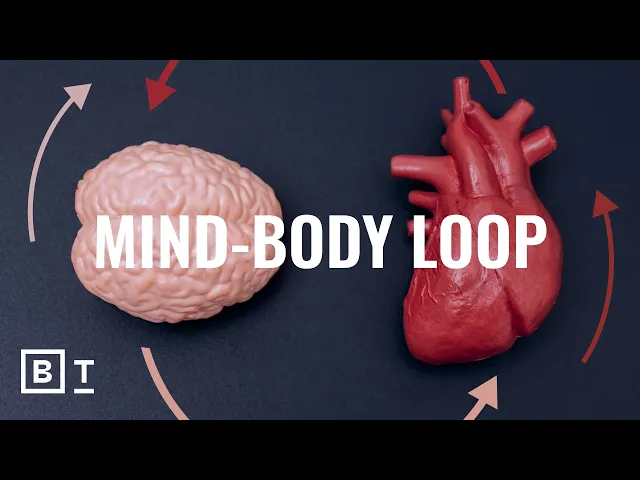
The mind-body connection you never knew you had
Big Think
0:00 We have a brain for a very interesting reason.
0:05 With the brain, we can run the economy of the body in a better way.
0:10 As a result of this, there's a very tight bond between body and brain.
0:26 What you do with your body affects your brain and what you think
0:30 with your brain also has an effect on the physiology of your body.
0:35 Your mind-body connection is working in the background like gravity.
0:38 It's all around you, it's happening to you all day,
0:41 all night, but you're just not aware of it.
0:43 Butterflies at falling in love.
0:44 Your face flushing at an embarrassing moment.
0:47 These are all experiences of your mind-body connection at work.
0:52 And so the idea of mind and body comes from that very peculiar relationship.
1:04 Throughout evolution, you have organisms that are bodies without brains,
1:09 and they do a pretty good job of running their economy and running their life.
1:14 However, with the brain,
1:16 you have the possibility of constructing maps of our own organism.
1:21 And of course those maps exist for a very simple reason.
1:24 You need the maps in order to portray the structure of the body,
1:31 portray the state of the body so that the brain
1:36 can construct a response and generate some kind of corrective action.
1:41 Take for example, what happens if the level of water is diminishing.
1:47 Because, for example, you took a meal that was very salty,
1:50 you will very rapidly develop a thing called thirst.
1:54 Now, thirst is a very conscious expression of the fact
2:00 that there are sensors going like crazy, saying,
2:04 "Water too low, water too low, water too low,
2:07 make a correction." And then you go and drink.
2:10 So what is happening is that the body itself is being the translation
2:17 service that will allow the outside world to come into the brain.
2:22 The body is constantly the broker.
2:25 So there's this beautiful way in which the brain
2:30 through its mind operations creates maps of its own organism,
2:35 some of which are so complex that will actually be
2:39 mapping the outside world that is peripheral to that organism.
2:52 The reason your breath is such a great first step in understanding,
2:56 tapping into, and then influencing your mind-body
2:59 connection is because your breath is the only physiological process in the body
3:04 that is under both voluntary and involuntary control.
3:07 So you and I can sit here and we're just
3:09 hanging out and talking and breathing without thinking about it.
3:12 That's involuntary control.
3:13 Or you can modulate your breath and do certain breathing exercises.
3:17 That's voluntary control.
3:19 Your heart can't do that.
3:20 It just beats as it does.
3:22 Your digestion can't do that.
3:24 Your brainwaves can't do that.
3:25 So you can use your breath as a way
3:27 to tap into your mind-body connection to understand it,
3:31 and then later influence it to serve you.
3:35 This is a three-second exercise.
3:38 Stop, breathe, and be.
3:40 The instructions are in the name.
3:42 The first thing you're gonna do is no matter what you're doing,
3:44 you're just gonna stop.
3:45 Take a beat and take a pause.
3:48 Next, you're going to breathe.
3:50 Take a deep breath in and out.
3:52 And then you're going to be.
3:55 Just ground yourself in the here and now in the present moment.
4:02 Your brain and your body are in constant communication and inextricably linked.
4:07 What's good for your body is good for your brain and vice versa.
4:10 And when you do better, you feel better.
4:15 Physical activity is the most transformative thing that you can do,
4:20 not only for your body, but for your brain as well.
4:25 Every single time you move your body, you are giving your brain what I like
4:31 to call a wonderful bubble bath of neurochemicals:
4:34 dopamine, and serotonin, and noradrenaline, and endorphins.
4:39 And that's really key to the mood-boosting effects of exercise.
4:44 But it also includes what's called growth factors that can
4:48 actually help grow and strengthen two key brain areas.
4:53 One is the hippocampus, critical for long-term memory,
4:56 and the second is the prefrontal cortex,
4:59 critical for your ability to shift and focus attention.
5:03 In fact, we know that even 10 minutes of walking can improve our mood,
5:09 decrease depression and increase focus.
5:12 Move more, it'll benefit your body and your brain.
5:17 Mind is not something disembodied, it's something that is,
5:22 in total essential intrinsic ways, embodied.
5:26 And as you change what you know about the brain and body,
5:30 you change how you're going to control your perception of the world.
5:35 We used to think that your brain,
5:37 what you had at birth is what you have for life,
5:39 but now we are learning that your brain in fact changes,
5:43 grows, and adapts based on life's circumstances, situations, and stimulation.
5:50 The beauty of the mind-body connection is that you can learn to tap
5:53 into it first by understanding what it is and bringing a deeper awareness to it,
5:58 but then tap into it to adapt, recover,
6:01 and grow in the face of life's challenges.