Algebra Basics: What Are Functions? - Math Antics
mathantics
0:06 Hi, I’m Rob.
0:07 Welcome to Math Antics!
0:08 In this algebra basics lesson, we’re gonna learn about functions.
0:12 Outside of the realm of math,
0:14 the word “function” simply refers to what something does.
0:16 But in math, the word “function” has a more specific meaning.
0:20 In math, a function is basically something that relates
0:23 or connects one “set” to another “set” in a particular way.
0:27 A set is just a group or collection of things.
0:30 Often it’s a collections of numbers, but it doesn’t have to be.
0:33 A set could be a collection of other things like letters,
0:37 names, or just about anything.
0:38 Sets are sometimes shown visually like this, but more often
0:42 you’ll see sets written using a common math notation where
0:44 some or all of the members of the set are
0:46 put inside curly brackets with commas between them like this.
0:51 A set can have a finite or an infinite number of elements.
0:54 For example, a set containing all the letters
0:56 of the alphabet has only 26 elements,
0:59 while the set of all integers has an infinite number of elements.
1:03 Okay, so a set is just a collection of things,
1:05 and a function relates one set to another.
1:08 But how exactly does it do that?
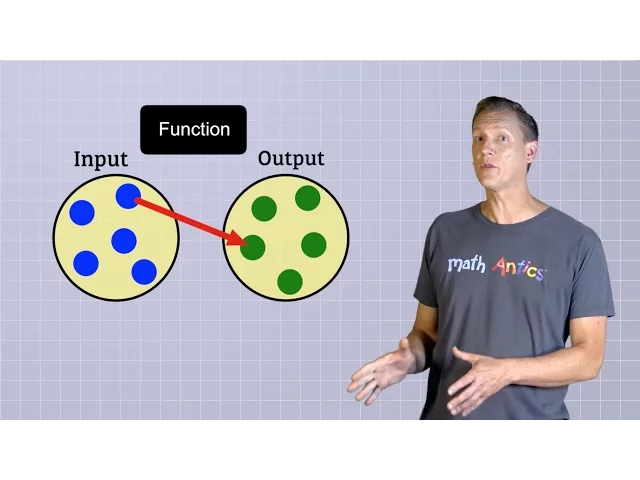
1:10 Well, to understand how functions work it will help if we start
1:13 by naming the two sets the input set and the output set.
1:16 A function is something that takes each value from an input set
1:20 and relates it (or maps it) to a value in an output set.
1:23 And you’ll often hear these input and output
1:25 sets referred to by special math names.
1:27 The input set is usually called “The Domain”
1:30 and the output set is usually called “The Range”.
1:33 And it’s really common to see some or all of a function’s
1:36 inputs and outputs listed in what we call a “function table”.
1:40 A function table normally has two columns: one on the left for the input values
1:44 and one on the right for the corresponding output values.
1:47 The function itself is often written above the function table
1:50 and in the form of some sort of mathematical rule or procedure.
1:54 For example, let’s say that the input set of a function
1:57 is a list of common polygon names like {triangle, square, pentagon,
2:01 hexagon and octagon} The function itself could be a simple rule that says,
2:06 “Output the number of sides.” That means,
2:08 if we input “triangle” into the function, the output will be 3.
2:12 And if we input “square” the output will be 4.
2:15 If we input “pentagon”, the output will be 5,
2:18 and so on… So this function simply relates
2:20 the name of a polygon to its number of sides.
2:23 That’s cool… but most of the functions that you’ll encounter
2:26 in Algebra will be a little more abstract than that.
2:29 They’ll usually just relate one variable to another variable
2:32 in the form of an equation …like this one: y= 2x In this equation,
2:37 if we treat ‘x’ as the set of numbers that we can input (the domain),
2:41 and ‘y’ as the set of numbers that we get as outputs (the range),
2:45 what we have is a very simple algebraic function.
2:48 And just like the polygon example, we can make a function table
2:52 to show some of the possible input-output combinations.
2:55 For this function, we could choose any number at all for the value of ‘x’,
2:58 but to keep things simple, let’s just try inputting 1, 2,
3:01 and 3 as values of ‘x’ and see what outputs we get for our table.
3:05 If we input the value 1 (in other words,
3:07 if we substitute the value 1 for the ‘x’ in our equation)
3:10 then we get y= 2× 1 which simplifies to y= 2.
3:15 And since ‘y’ is our output variable, we put a 2 in the output column.
3:20 Next, if we input the value 2 into our function,
3:23 we get y= 2× 2, which means y= 4.
3:26 So the output value is 4.
3:28 And last, if we input the value 3 into our function,
3:31 we get y= 2× 3, which means y= 6.
3:35 So the output value is 6.
3:37 …see the pattern?
3:38 For each input value, the output value is twice as big.
3:41 Which is what we would expect because the original equation says
3:45 that 'y' (the output) is equal to 2 times ‘x’ (the input) Okay,
3:49 so we’ve seen some examples of functions that relate inputs to outputs,
3:53 but there’s an important limitation about functions that we need to know.
3:56 To understand what that limitation is,
3:58 let’s try to make a function table for the equation ‘y squared’ equals ‘x’.
4:02 Again, the ‘x’ variable in this equation will be our set
4:05 of inputs and the ‘y’ variable will be our set of outputs.
4:08 Since ‘y’ is our output variable,
4:10 it will help if we first solve this equation for ‘y’
4:13 and we do that by taking the square root of both sides.
4:16 But because of negative numbers,
4:17 we need to take both the positive and negative root
4:20 of ‘x’ since there are two possible solutions to our equation.
4:23 But, won’t that mess up our function table?
4:25 If we input an ‘x’ value of 4, the positive (or principal) root would be 2,
4:30 but we also have the negative root as a solution.
4:32 If x= 4, then y= 2 and y= -2 are
4:37 BOTH possible solutions to the equation ‘y squared’ equals ‘x’.
4:41 So in this case, for each value of ‘x’ that we input into the equation,
4:44 we’ll get TWO values of ‘y’ as outputs.
4:46 Can a function do that?
4:48 [whistle blowing] Upon review, the equation gave two outputs for a single input,
4:53 therefore it’s ruled not a function.
4:56 You see, functions aren’t allowed to have what we call “one-to-many” relations,
5:00 where one particular input value could result in many different output values.
5:04 “One-to-many” relations certainly do exist as we can see from this example,
5:08 but we don’t call them functions.
5:10 For something to be called a function,
5:12 it has to produce only one output value for each input value.
5:16 So a function doesn’t just relates a set of inputs to a set of outputs.
5:20 A function relates a member of an input
5:22 set to exactly one member of an output set.
5:25 The equation y= 2x qualifies as function because no matter what number
5:29 you put in, you’ll always get just one number as an output.
5:33 But the equation ‘y squared’ equals ‘x’ does not qualify
5:36 as a function because a single input can produce more than one output.
5:40 Let’s look at another simple algebraic equation
5:42 to see if it’s a function: y= x+ 1.
5:46 Again, the ‘x’ values will be inputs (the domain)
5:49 and the ‘y’ values will be the outputs (the range).
5:52 Let’s quickly generate a function table for a few possible input values,
5:56 like the integers -3 through +3.
5:58 If you watched our last video about graphing on the coordinate plane,
6:01 you may notice that each row of this function
6:04 table is basically just an ordered pair.
6:06 It’s an ‘x’ value followed by a ‘y’ value.
6:09 We could even re-write all the inputs and outputs
6:11 in ordered pair form if we wanted to.
6:13 And that means, you can also GRAPH all
6:15 of these pairs of inputs and outputs on the coordinate plane.
6:18 You can GRAPH a function!
6:20 Here are the points from our function table plotted on the coordinate plane,
6:24 and here’s the resulting graph we get if we connect those points.
6:27 It forms a straight line and it’s
6:29 an example of what is called a “linear function”.
6:32 In Algebra, there are lots of different
6:34 kinds of functions that have interesting graphs:
6:36 quadratic functions, cubic functions, trig functions, and many more.
6:41 These graphs may look like just a bunch of squiggly lines,
6:44 but they’re all functions.
6:45 And we tell they’re functions just by looking
6:47 at their graphs because they all pass the “Vertical Line Test”.
6:51 Remember how functions aren’t allowed to have more
6:54 than one output value for a particular input value?
6:56 Well, the Vertical Line Test helps us see if a graph has
6:59 any of those one-to-many relations that would disqualify it as a function.
7:03 Here’s how it works… Imagine that a vertical line is drawn
7:07 on the same coordinate plane as the graph that you want to test.
7:10 Then, imagine moving that vertical line left and right across the domain,
7:14 paying close attention to the point where
7:17 the vertical line intersects with the graph.
7:20 If that vertical line only intersects the graph at exactly
7:23 one point for every possible value of ‘x’ in the domain,
7:27 then that means there’s only one output value for each input value.
7:31 There’s only one ‘y’ value for each ‘x’
7:33 value so the graph qualifies as a function.
7:36 Okay, so all of these graphs pass the Vertical Line Test and are functions.
7:40 But what’s an example of a graph that doesn’t pass the Vertical Line Test?
7:44 Well here’s one.
7:45 It’s the graph of our equation ‘y squared’ equals ‘x’.
7:49 The domain of this equation doesn’t include any negative input values,
7:52 so there are some places where our vertical
7:54 line wouldn’t interest the graph at all.
7:56 And that’s okay.
7:57 And there’s one place where the vertical line would intersect
8:00 the graph at just one point, which is also okay.
8:03 But, as we move to the right on the ‘x’ axis,
8:06 you can see that our vertical line is now intersecting the curve in TWO places.
8:10 That means this equation is giving us
8:12 two possible outputs for some of its inputs,
8:14 which means that it’s not considered a function.
8:17 Okay… now before we wrap up,
8:19 we need to talk briefly about some common function notation that can
8:22 be pretty confusing the first time you see it in math books.
8:26 So far, we’ve been writing functions like this: y= 2x and y= x+
8:31 1 But you’ll often see these same exact functions written like this instead.
8:36 But Why?
8:37 Why did the variable ‘y’ get replaced by that ‘f’ parentheses ‘x’ thingy?
8:42 And what does that even mean?
8:44 Well, it turns out that a really common way to represent a function is
8:47 this… This notation simply means that a function
8:50 (named ‘f’) takes an input value
8:52 (named ‘x’) and gives an output value (named ‘y’) And you say it like
8:56 this: A function of ‘x’ equals ‘y’ or ‘f’ of ‘x’ equals ‘y’ for short.
9:02 The problem with this notation is that you
9:04 could easily misinterpret it as a variable
9:06 ‘f’ being multiplied implicitly by a variable ‘x’ to give an answer of ‘y’.
9:11 But that’s NOT what this means.
9:13 In this case, ’f’ is not the name of a variable and it’s not being multiplied.
9:17 Instead, ’f’ is the name of the function.
9:20 It would be a lot more clear
9:21 if mathematicians just used the entire word “function”
9:23 as the name and then used the names “input” and “output” instead of ‘x’ and ‘y’.
9:28 These two notations mean exactly the same thing.
9:31 But the first one uses an abbreviation for the function
9:34 name and standard variable names for the input and output.
9:37 These are the most common names, but you could use others if you wanted to.
9:41 Okay, so that’s the basic notation,
9:43 but how did the equation get changed to f(x) instead of ‘y’?
9:48 Well, it comes from the idea that if two things are equal in math,
9:52 you can substitute one thing for the other.
9:54 Since we’ve agreed on this general notation for a function,
9:57 f(x)= y, that means you can use f(x) or ‘y’ interchangeable.
10:02 Either one can represent the output set of a function.
10:06 But if they’re interchangeable,
10:07 why would you use the more complicated f(x) when you could just use ‘y’ instead?
10:12 Well, using f(x) highlights the fact that you’re dealing with a function
10:16 with a specific input variable and not just an equation.
10:20 And… it gives us a handy notation for evaluating functions for specific values.
10:24 For example, you could start off by saying, let the function f(x)= 3x+ 2.
10:30 Then you could then ask someone to evaluate the function
10:34 for the input value 4 by saying what is f(4).
10:37 That means you’ll substitute a 4 in place of any ‘x’s that are in the function.
10:42 For this function, that would mean f(4)= 14.
10:46 And you could do this for other values too.
10:48 f(5)= 17, and f(6)= 20 Pretty easy, huh?
10:53 Alright, so that’s what functions are in math.
10:56 They’re things that relate an input value to exactly one output value.
11:00 And the set of all input values is called the domain
11:02 while the set of output values is usually called the range.
11:06 In algebra, functions typically come in the form
11:08 of equations that can be graphed on the coordinate plane by treating
11:12 the input and output values as ordered pairs.
11:15 Of course, there’s a LOT more to learn about functions,
11:18 but this basic introduction should help you
11:20 get started working with them in Algebra.
11:22 Don’t forget to practice using what you’ve
11:24 learned in this video by doing some exercises.
11:26 As always, thanks for watching Math Antics and I’ll see ya next time.
11:31 Learn more at www.mathantics.com