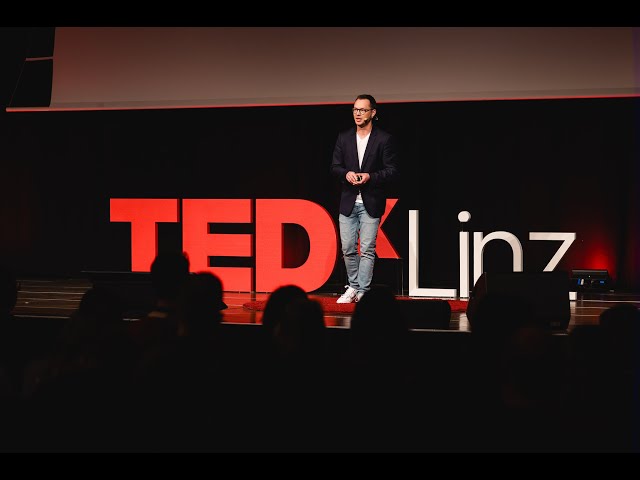
How Social Media Undermines Democracy | Michael Kaufmann | TEDxLinz
TEDx Talks
0:12 We are the most connected generation in history.
0:18 How many of you agree with that?
0:21 Just raise your hand.
0:25 Okay, that's almost everyone.
0:28 But the question is, are we also the best informed generation in history?
0:36 I mean, if information is everywhere, why do so many of us feel confused?
0:43 Why do debates feel so much louder but not smarter?
0:49 Why do we know what's trending worldwide,
0:52 but we don't know what's going on locally?
0:56 So before we talk about social media news deserts and the impact on democracy,
1:03 let me tell you where I'm originally coming from.
1:08 I have been working in the media industry for more than 10 years already.
1:12 I've seen how stories are produced, distributed, and consumed.
1:17 Not from a newsroom desk because I'm not a journalist,
1:21 but from the technical and economically side of media.
1:26 I'm the head of digital at the well-known
1:28 media company based here in Upper Austria,
1:30 and I have been obsessed with how information moves through society.
1:36 I personally started following social media trends back in 2004
1:42 when Facebook was still a closed network for students
1:46 when liking something felt really harmless and when we
1:50 truly believed these platforms would bring us closer together.
1:57 I'm a digital enthusiast and I believe in technology.
2:01 And I'm definitely not here to blame social media platforms.
2:05 But I've also spent years watching how the same
2:09 tools that promised openness slowly reshaped how we talk,
2:13 how we argue, and how we understand the truth.
2:18 And that's the reason why I'm standing here today in front of you.
2:24 So imagine waking up one morning in your hometown.
2:28 You grab your phone, scrolling through your social media feeds,
2:32 and the only thing you see is funny stuff, memes, outrage.
2:38 But you can't find out why the local school lost its funding,
2:42 who decided to cut down the old park trees, or why the new hospital is delayed.
2:50 No newspaper reports it.
2:52 No radio station talks about it.
2:55 The local journalist, she or he was laid off last year.
3:02 That would be what it's like to live in a news desert.
3:05 A place where real journalism has already dried up.
3:10 And the scary truth is these news
3:12 deserts are spreading even in strong democracies,
3:17 even here in the middle of Europe.
3:20 So let me talk about the algorithmic newsrooms.
3:24 The shift in user behavior towards social media
3:27 has fundamentally impacted the business models of publishing houses.
3:33 At first, social media felt really exciting.
3:36 I can get news directly from people.
3:39 I can share my own voice.
3:41 And also for the publishers, it was very interesting at the beginning.
3:45 I can get feedback from my readers.
3:47 I can get in touch with them.
3:51 So yes, social media gave us something really special at the beginning,
3:55 a global conversation.
3:58 But then something dramatically changed.
4:02 These platforms weren't built to inform us.
4:05 They were built to keep us hooked.
4:09 They don't reward truth.
4:12 They reward attention, likes, clicks, outrage.
4:18 The algorithms learned that fear and anger keep us scrolling.
4:23 So the loudest voices rise and the calm, thoughtful ones get buried.
4:31 Social media isn't the public square anymore.
4:34 It's an echo chamber where we stop listening
4:37 to other perspectives and just shout at ourselves.
4:42 These platforms monetize our attention, our use time.
4:48 So in general, you can say we are the product.
4:54 So in an age of constant information,
4:57 the feeling of being informed is often just an illusion.
5:02 Many people say, "I'm on all the time.
5:04 I know everything." But seeing information isn't the same as understanding it.
5:12 Social media floods us with endless updates, but it doesn't really tell us much.
5:19 We know what happened 5 minutes ago on another continent or in another country,
5:24 but we don't know what's going on at home.
5:29 So, democracy depends on informed citizens,
5:32 people who know what's happening around them.
5:36 But when real information disappears,
5:38 when the light of journalism goes out, democracy will die in darkness.
5:46 In the last decade, thousands of news rooms
5:49 have closed due to economical issues in the US,
5:53 in Europe, in parts of in Africa and Asia.
5:57 So whole regions have no local newspapers anymore.
6:02 So why becomes the situation so dramatic?
6:06 When advertisers realized they could reach
6:08 us directly on social media platforms,
6:11 they reduced ad spending in local newspapers.
6:16 According to a momentum study of 2025,
6:20 86% of all digital advertising spent in Austria went
6:25 to big tech companies in the US and China.
6:29 86% of all digital advertising money went to the US and China.
6:37 So the money and the value creation went overseas
6:41 and journalism dried up in some areas of the world.
6:47 Another fact I would like to talk about
6:49 is the problematic screen time we all have.
6:52 Are we addicted to our smartphones?
6:56 According to the latest Deoid smartphone survey,
7:00 the average person in Austria spends more than 5 hours a day on their phone.
7:06 And most of the time we use it to scroll through our social media channels.
7:12 So if you live up to the age of 80 and you
7:15 start to use your mobile phone at the age of 14,
7:19 that's almost 13 years of screen time.
7:22 13 years of your lifetime staring at your screen.
7:27 Isn't that crazy?
7:31 So, we really have to ask ourselves, is this time really well spent?
7:37 Today, smartphones, platforms,
7:39 and algorithms decide what news we see and what we never will.
7:46 As a result of changing user behavior,
7:49 traditional media companies are forced to publish their own quality
7:53 content to social media channels just uh to reach new audiences.
8:00 So it's a strange paradox to feed your competitor
8:03 just to stay visible to the next generations.
8:08 So when local journalism has difficulties,
8:14 several things happen quietly but powerfully.
8:18 First, integrity declines.
8:21 Without reporters, without journalists, organizations become less transparent.
8:26 Fewer people ask critical questions or check the facts.
8:31 Second, fewer people vote.
8:34 When we don't know what's going on locally, we stop caring and we stop voting.
8:40 Third, polarization increases.
8:44 Without trusted local voices,
8:46 we focus only on national fights, left versus right,
8:51 us versus them, and forget the small things that once united us.
8:58 And finally, trust collapses.
9:01 When the only news we see on social media is misinformation or clickbait,
9:07 some people believe that all media is fake.
9:11 Democracy can survive in that.
9:16 And democracy isn't just about voting.
9:18 It's about sharing a common ground, a basic agreement on what's true.
9:26 If everyone lives in their own version of the truth,
9:29 democracy becomes a shouting match.
9:33 And autocratic power, for example, doesn't always come with tanks nowadays.
9:38 Sometimes it comes quietly through confusion and the loss of trust.
9:45 And this confusion often begins on the small
9:48 mobile phone screens we can't stop looking at.
9:54 But here is the good news.
9:55 There is still hope to improve this situation.
9:59 All over the world, people are rebuilding local journalism.
10:03 Small online outlets have started often by volunteers, teachers or retirees.
10:10 They are factchecking, reporting and reconnecting communities.
10:16 Also, some Facebook local Facebook groups
10:18 have turned into citizen journalism hubs.
10:22 Neighbors sharing facts not for likes but for accountability.
10:28 Schools are te teaching media literacy which is very important in my opinion.
10:32 Helping students to question to check and to verify.
10:38 Even some big tech companies support journalism projects.
10:43 So what can we personally do you and me?
10:48 First, pay for quality journalism.
10:51 Every subscription or donation is a vote for truth.
10:56 We pay for movies and music online,
10:59 but not for news that protects our democracy.
11:04 Second, be careful online.
11:06 Before sharing some information, always ask yourself, does it make sense?
11:12 Is it useful?
11:12 Or is it just noise?
11:15 Third, get involved locally.
11:19 Go to community meetings, support local journalists,
11:23 and care about what happens next to your hometown.
11:28 Fourth, teach critical thinking.
11:31 The next generation must know how to check,
11:34 how to verify, and how to ask critical questions.
11:40 Democracy doesn't need passive consumers.
11:42 It needs active participants.
11:46 And maybe it's also time for a new kind of social contract.
11:51 One that protects not only free speech, but also freedom from manipulation.
11:58 A contract where we remember that going viral
12:01 on social media isn't the same as being right.
12:06 where we treat truth like a public resource
12:09 to protect like clean water or fresh air.
12:13 Because when truth is polluted, society gets sick.
12:19 And a news desert isn't just a place without journalism.
12:23 It's a blout connection, without a shared understanding,
12:28 and without sharing a common ground.
12:32 So democracy in combination with independent quality journalism needs people,
12:38 people like you and me who are willing to search
12:42 for the truth even when it's hard to find.
12:46 So let me summarize one last time.
12:49 Pay for quality journalism.
12:51 Get involved locally and think critically and never
12:56 trust social media content without checking the facts.
13:00 Together we make sure that democracy will never gets thirsty again.
13:06 Thank you.