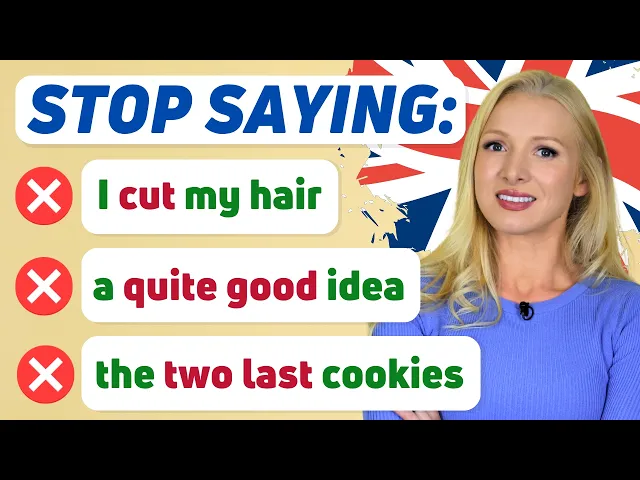
Are YOU Saying it WRONG? 5 Highly Common Mistakes in English
English with Lucy
0:00 Have you ever used sentences like these?
0:03 Probably, I'll go out tonight.
0:06 It's a quite big house.
0:09 Or I ate the three last biscuits.
0:13 If you have, I'm afraid you're making
0:16 some very common English mistakes, but don't worry.
0:20 Today, we're looking at five of the most common ones,
0:23 but more importantly, how to correct them.
0:26 Now, this video is part of a big series
0:29 on my channel that comes with a free ebook.
0:33 So, I need to tell you about something incredible.
0:37 I have created a brand new, completely free ebook.
0:42 It changes everything.
0:44 35 common mistakes English learners make and how to fix them.
0:50 This powerful ebook will help you fix some
0:54 of the most common errors English learners make immediately.
0:59 Inside, you will find everything from today's lesson,
1:02 plus 30 more mistakes that my teaching team and I have seen again and again.
1:08 And yes, for now, I'm offering it to you for free.
1:12 Just sign up to my mailing list using the link
1:15 in the description or scan the QR code now.
1:18 I'll send it straight to your inbox.
1:20 It's genuinely one of the best resources I've ever
1:24 created and I can't wait for you to see it.
1:26 Okay, let's begin.
1:28 Can you spot the mistake in this sentence?
1:31 Probably, I'll go out tonight.
1:34 Now, we don't usually use probably at the beginning of a sentence.
1:40 It just doesn't sound natural.
1:43 But where should it go?
1:45 Well, some adverbs of certainty, like probably, possibly, certainly,
1:51 and definitely, usually go directly before the main verb.
1:57 We call this the mid position.
2:00 So, it should be I'll probably go out tonight.
2:04 Go is the main verb.
2:06 Will is the auxiliary.
2:08 Now, with the negative contracted form won't, the order is different.
2:14 It is incorrect to say, I won't probably go out tonight.
2:20 Instead, it's I probably won't go out tonight.
2:25 I probably won't speak to him again today.
2:29 Try to learn these chunks.
2:32 Try to remember them.
2:34 I'll probably I probably won't.
2:37 Now, a note on pronunciation here.
2:40 It's very important.
2:41 Probably can be pronounced with three syllables, probably.
2:46 But, many speakers will reduce it to just two in fast speech.
2:52 Probably.
2:53 I'll probably go.
2:56 Let's see some more examples.
2:57 I probably need more time.
3:00 We can't possibly finish decorating the flat in 2 days.
3:05 Now, an exception.
3:06 This is English.
3:07 We love exceptions.
3:09 When the main verb is to be, these adverbs usually appear after it.
3:15 As in, this is probably the best restaurant in the neighborhood.
3:20 We can use these adverbs alone in short answers.
3:24 Are you going out tonight?
3:26 Yeah, probably.
3:28 Do you think it'll rain?
3:30 Possibly.
3:31 Who knows?
3:32 Now, take a look at the ebook, the free ebook,
3:35 to learn about the positions of other adverbs of certainty.
3:40 You can scan the QR code there, or the link is in the description box.
3:44 Okay, for our second common mistake, we have another word order problem.
3:48 Can you spot it here?
3:51 It's a quite big house.
3:55 Hmm, well, it should be.
3:57 It's quite a big house.
3:59 Now, I think I understand why my students make this mistake.
4:03 I think they copy the position of very.
4:07 Both of these sentences are correct.
4:10 It's very big.
4:12 It's quite big.
4:14 Very or quite plus adjective.
4:18 But, and here's the issue.
4:20 The words behave differently when the adjective comes before a noun.
4:25 Listen.
4:27 It's a very big house.
4:30 It's quite a big house.
4:33 Quite goes before the article, adjective, and noun.
4:37 Again, it's a good idea to memorize and repeat chunks.
4:42 It's quite a.
4:43 He's quite a.
4:45 That was quite an.
4:47 For example, notice how the t sound at the end of quite joins the vowel sound a.
4:55 Quite a.
4:56 Quite an.
4:57 Now, when you're in conversation and want to add specific details,
5:01 it should be easier.
5:03 He's quite a talented musician.
5:05 That was quite an interesting lecture.
5:08 Very, really, and pretty all follow a different structure.
5:12 A plus very, really, or pretty plus adjective plus noun.
5:17 It's a really good film.
5:19 She had a pretty unusual name.
5:22 Okay, let's move on to mistake number three now.
5:26 We're sticking with word order.
5:28 Word order is tough, but we're really going to focus on it today.
5:31 Can you correct this sentence?
5:34 I ate the three last biscuits.
5:38 Now, I hear things like this all the time.
5:41 But, it should be I ate the last three biscuits.
5:46 That's a tough pronunciation challenge, isn't it?
5:48 Last three.
5:50 The and then r last three biscuits.
5:54 We would actually elide the sound in last and say
5:59 last three biscuits to make it a little bit easier.
6:02 Now, if you say the three last biscuits, there is no communication problem.
6:09 People will understand what you mean, so don't get stressed about this.
6:13 But, if you can correct all of the word order mistakes we're looking at today,
6:17 you'll sound more natural and more fluent.
6:19 [clears throat] I think it's a mistake that's
6:22 worth correcting nice and early so that you
6:24 don't have to correct it when you're at C1
6:27 C2 level and it's embedded in your brain.
6:30 Here's a similar mistake I've heard before.
6:33 The two first chapters are quite slow.
6:37 Perfectly understandable,
6:38 but it should be the first two chapters are quite slow.
6:43 Why?
6:43 Well, in English, words like first, last, next, and past come before a number.
6:49 A couple more sentences.
6:51 I'm booked solid for the next three weeks,
6:54 not the three next weeks, the next three weeks.
6:58 Or she's been to Edinburgh twice in the past six months,
7:03 not the six past months.
7:05 We also use this word order with other
7:07 phrases like the first few or the past several.
7:12 I only watched the first few minutes, not the few first minutes.
7:17 Or it's been sunny for the past several days, not the several past days.
7:23 Take a look at the ebook to see even
7:25 more examples and another word that follows this pattern.
7:30 We're moving away from word order.
7:32 So, what's wrong with this sentence?
7:34 I saw everything which happened.
7:38 Which isn't very natural.
7:40 And if you think it should be what, I'm afraid that's not right either.
7:44 The best choice is that.
7:47 I saw everything that happened.
7:50 Now, after words like everything, anything, nothing, and all,
7:55 we tend to use the relative pronoun that to introduce defining relative clauses.
8:02 These clauses give us essential information.
8:05 We don't usually use which after those words.
8:09 For example, is there anything that I can do to help?
8:13 Or there's nothing that we can do now.
8:18 Or they are all that matters.
8:20 In speech, we can leave out that if it's the object of the relative clause.
8:26 For example, is there anything I can do to help?
8:31 There's nothing we can do now.
8:33 But we can't do it with they're all matters.
8:37 That is the subject of the clause.
8:40 Take a look at the ebook for an exception to this rule.
8:43 You can scan that QR code there or click the link in the description box.
8:47 It's free to download.
8:48 Now, what is not a traditional relative pronoun,
8:52 so we don't use it to introduce a relative clause.
8:55 This sentence is considered grammatically incorrect,
8:59 though you will hear it in some dialects.
9:02 I saw everything what happened.
9:05 I recommend using that unless you're specifically trying
9:10 to use a dialect that uses what instead of that.
9:14 Okay, we're on to the final sentence.
9:17 Is this a mistake?
9:20 I cut my hair.
9:22 Well, the answer is maybe.
9:25 I cut my hair is a grammatically correct sentence that means I cut my own hair.
9:33 I took a pair of scissors and chopped.
9:35 Now, in my case, that would be a big mistake.
9:38 I prefer to go to a hairdresser.
9:41 So, how would I say that?
9:44 I had my hair cut, or I got my hair cut.
9:50 This is called a causative structure.
9:54 Have or get plus object plus past participle.
9:59 To have something done or to get something done.
10:03 It's used when someone else does something for us, usually a paid service.
10:07 Can you repair your own car?
10:10 If the answer is no, use the causative.
10:13 I had my car repaired yesterday.
10:17 A mechanic did it.
10:18 Would you paint your own house?
10:20 I mean, it actually sounds like fun,
10:21 but I'm not sure it would look very good if I did it.
10:24 So, I might say, "We're having the house painted next month.
10:29 A professional painter is doing it." Notice that only have or get change tense.
10:35 We always use the past participle after the object.
10:40 We can use the same structure to say that something bad happened to us,
10:44 usually when we didn't cause the bad thing to happen.
10:47 For example, "I had my wallet stolen last night." Or, "She
10:53 got her car broken into." Someone did these things to us.
11:00 Again, there are more examples with the causative in the e-book.
11:04 It's quite a useful structure to learn.
11:07 It's a really useful structure.
11:11 Okay, we have time for a little quiz before we finish the lesson.
11:15 Some of these sentences contain mistakes.
11:19 If there is a mistake, correct it.
11:22 I'll read them out for you.
11:23 One, "Who ate the two last slices of pizza?" Two,
11:29 "She told me nothing that I didn't know already.
11:35 Three.
11:36 I'm having a tooth taken out tomorrow.
11:41 Four.
11:42 We had a quite good meal at that restaurant.
11:46 And five.
11:48 Probably she'll help.
11:49 I'll give you 5 seconds, but pause if you need more time.
11:58 Okay, number one contained a mistake.
12:00 It should be the last two slices of pizza.
12:04 Remember we put words like last and first before numbers in English.
12:10 [snorts] The second sentence was correct.
12:12 We usually use nothing that in relative clauses,
12:15 not nothing which or nothing what.
12:19 Number three was also correct.
12:21 I definitely wouldn't want to take my own tooth out.
12:24 So, the causative structure, meaning someone else will do it, is right.
12:29 Number four was incorrect.
12:31 It should be we had quite a good meal.
12:35 Remember it's quite plus article adjective noun.
12:40 And number five also had a mistake.
12:42 The most natural way to say this is
12:45 she'll probably help with probably before the main verb.
12:50 So, how did you do out of five?
12:52 Let me know in the comments and don't forget to download the 35 mistakes ebook.
12:57 You're going to love it.
12:57 It is absolutely huge and it's free.
13:01 Scan the QR code there or click the link in the description box.
13:04 I hope you enjoyed today's lesson.
13:06 I hope you learned something.
13:08 I will see you in the next one.
13:09 Bye.
13:10 Mwah.
13:15 [music] [music] Mhm.