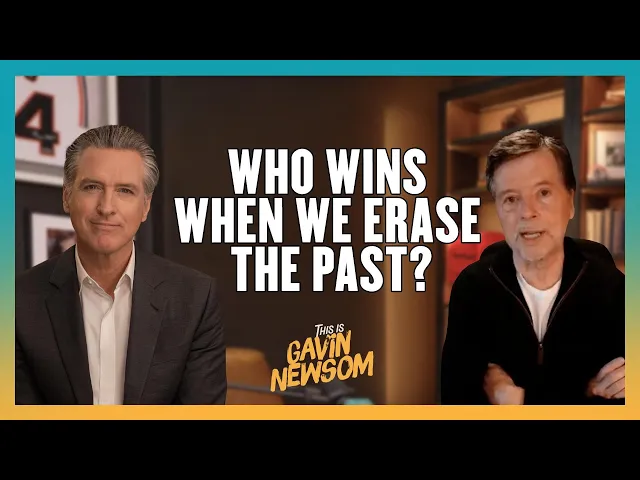
How Filmmaker Ken Burns Preserves American History Even As Trump Rewrites It
This is Gavin Newsom
0:00 We live in a place right now where it it actually pays to promote division.
0:05 I do not think somebody should enrich themselves in office.
0:09 Let's go back to arguing about the things that matter without demonizing.
0:15 This is Gavin Newsom.
0:17 And this is Ken Burns.
0:22 Hi Governor.
0:23 Hey Ken, how are you?
0:24 you.
0:24 I pre- I know that background well.
0:27 Yes.
0:29 I'm I'm I'm sorry to say I think that there are as you know,
0:32 there are 342 million podcasts and I've I've
0:37 I've done half of them and I'm absolutely
0:40 certain not in this case that I'm speaking
0:42 to myself and to the person I'm talking to.
0:45 At least now I know that there's at least a few other people listening.
0:48 God bless you, man.
0:49 I Yeah, I know I I it's I imagine that's got
0:53 to be the biggest change for you since you started this, right?
0:56 20 years ago it'd been a you know, the broadcast work or in person.
1:00 Now it's you know, ubiquity.
1:01 Oh yeah, well we we're still doing all of the old stuff.
1:04 I mean, I've been doing it for it's it's almost 50 years and you know,
1:09 we started off in film and analog,
1:11 you know, with razor blades cutting film and taping them together
1:14 and drawing grease pencils on the film and then you know,
1:17 digital editing and then and video tape and then we we were always
1:22 10 years behind intentionally so that the technological tail didn't wag the dog.
1:27 And and so we're just you know,
1:30 perpetually Luddites catching up with everything,
1:33 but we're doing the old broadcast stuff, too.
1:35 I went to 40 cities, had 80 screenings, you know,
1:39 but also did 75 podcasts from Joe Rogan to you know,
1:44 the whatever the comparable is on the other side.
1:47 The Mark Twain said, "If you tell the truth,
1:50 you don't have to remember anything." So I said the same thing
1:53 to Joe Rogan and Theo Von as I I to the New York Times,
1:56 to inner-city kids in in um Charleston and and Detroit
2:00 and suburban kids in Chicagoland and all the other places.
2:04 And and it it worked out okay cuz
2:06 the story's so compelling that a lot of these divisions,
2:10 which we think are completely clogging our arteries, fall away.
2:15 Cuz if you tell if you tell a good story,
2:17 then you tell a good story and everybody's
2:20 got a got an interest in a good story.
2:22 When you were talking to Theo and Joe and guys like that that maybe,
2:25 you know, perceived on a number of issues lean a little bit more to the right,
2:29 were they surprised by the fact that we are so surprised by this division
2:35 that we have in this country and you're able to contextualize that and say,
2:39 you know, give me a break.
2:40 Uh you know, that particularly with this film which is, you know,
2:42 as much about the Civil War, uh not just the World War.
2:46 Right.
2:47 No, no, no.
2:47 And I think one of the things about the Revolution is that it is a civil war.
2:50 It's a revolution and we've sort of made
2:53 it uh gallant and bloodless uh because I think,
2:57 you know, accepting the violence of the Civil War and the 20th century wars,
3:00 we don't want to have anything take away from the big
3:03 ideas in Philadelphia in '76 and then in 1787.
3:07 But in fact, if you tell the correct story,
3:09 uh those ideas aren't diminished in any way.
3:12 They're actually made even more impressive that we were born in violence.
3:16 So, I think that the divisions that we experience are part of the narcissism.
3:20 It's always the best time or the worst time that we're living in.
3:24 So, I think everybody's less aware of the way
3:26 in which they might contribute to those divisions
3:28 than they want to just sort of repeat the same thing over and over again.
3:31 And I I'd suggest that yeah, we're really divided,
3:34 but not as bad as the Revolution, not as bad as the Civil War,
3:37 not as bad as the period of Reconstruction uh right after the Civil War,
3:40 which I'm working on a film uh on right now called Emancipation to Exodus,
3:44 not during the Depression like the Second W- Vietnam.
3:48 You remember Vietnam, the '69 to '75, hundreds of bombings.
3:53 Hundreds of bombings.
3:54 And um so I I think we the the good thing about the study of history
3:59 is it gives you a little bit of perspective
4:00 and a little bit of um even optimism.
4:03 You know, if if if you accept a priori
4:06 that optimism is not a pejorative or a naive position,
4:10 but in fact a legitimate stake, which it is,
4:13 you know, we'll we'll get through this.
4:14 I love it.
4:15 And as I And as we get through I I want to get
4:17 back to more deeply the the the the current project in in the not
4:22 just the ones you're working on, but the one we're here to to really
4:25 celebrate and at least reflect upon as we reflect on the 250th anniversary.
4:29 But I'm curious, you know,
4:30 just going back to how we began gradually the conversation.
4:33 It's interesting just you talked about I love this no
4:35 sort of razor blade editing back in the day, etc.
4:39 And and and now as you're out on podcasts
4:41 and you're you're sort of battling traditional media,
4:44 uh people in person, and then of course uh online in so many different podcasts.
4:48 But when you were doing those first films, what was I mean what did Ken Burns?
4:51 What was How'd you go out there and promote these things?
4:54 Was it primarily through the platform at PBS or uh you know,
4:58 what was it finding your way onto Oprah as a sort of you know,
5:01 monumental moment and achievement?
5:04 Yeah, so that's exactly right.
5:05 And and it and it still remains the same.
5:07 And still PBS is the broadcast platform is great.
5:10 Only this time the the American Revolution, like you know,
5:14 six parts, 12 hours, comes out in mid-November last year,
5:19 and by the end of the year we've
5:21 ac- accumulated 18 million viewers in traditional broadcast,
5:25 which is pretty damn good.
5:26 But we've hit for the first time in PBS's history the top 10 of streaming.
5:31 And and for me, this Luddite,
5:33 they've got a metric which is at at that moment at the end of November,
5:37 565 million minutes of streaming.
5:40 So you go.
5:41 You know, my my kids can do the divide by 720 minutes that 12 hours is,
5:45 but um now it's well over 4 billion.
5:49 Yeah.
5:49 And that's a big deal.
5:52 And it was a big deal that we broke the top 10,
5:54 but it's even bigger deal that we now
5:56 have something in which we're told that, you know,
5:59 conservatives only like Yellowstone as if
6:01 that's a simplistic story and it's not.
6:04 And that, you know, liberals only like this and it's it's not true.
6:07 The The novelist Richard Powers said something
6:10 that I I've been quoting for years now.
6:13 He said, "The best arguments in the world,
6:15 and that's all we do is argue, won't change a single person's point of view.
6:19 The only thing that can do that is a good story.
6:22 Because in a computer world where everything's a one or a zero,
6:25 in a media culture where everything's red state or blue state,
6:27 young or old, black or white, gay or straight,
6:29 rich or poor, north or south, east or west,
6:31 all the dialectics that we are preoccupied with, which don't actually exist,
6:36 um there's no room for the complexity that we extend to the people we love,
6:41 to the friends that we have,
6:42 to the colleagues that we work with, to the understanding
6:45 that the the the struggles are within us.
6:48 That, you know, we say there no we lament that there no heroes today, Governor.
6:52 You know, and and and and if you go back and say, "Well,
6:55 where does the notion of heroism come from?" It comes from the Greeks.
6:59 And they endowed their gods with these examples for us mortals to study.
7:04 And are those gods perfect?
7:05 No.
7:06 Achilles has his heel and his hubris to go along with his great strengths.
7:10 So, heroism is really a negotiation,
7:12 sometimes a war within a person, over their great strengths.
7:16 So, if you leave George Washington out
7:18 on his marble statue collecting pigeon he seems perfect,
7:22 you know, never tells a lie, cut down a cherry tree, coin across the Potomac.
7:27 But if you examine him and understand that he's a very human character,
7:31 he owns 577 human beings in his lifetime,
7:35 as the writer Rick Atkinson said, "You can't square that circle." He's right.
7:39 He's rash on the battlefield risking the entire
7:42 cause by rushing out into the field.
7:44 Uh if he's killed or captured, it's all over.
7:47 He makes some tactical mistakes that are in some ways inexcusable,
7:52 and yet he's able to convince people to fight in the dead of night.
7:55 He defers to Congress.
7:56 He has great humility.
7:58 He picks subordinate talent,
7:59 generals that are better than him like Benedict Arnold and and Nathaniel Greene.
8:04 Um and he twice gives up power, military at the height of his military power
8:10 and the presidency at the height of his political power.
8:13 And that has set us in motion.
8:15 So you can have in a story that we tell,
8:18 which is as much bottom-up as it is top-down,
8:20 you can have the almost exhilarating, you know,
8:23 off-brand thing that we don't have a country without him.
8:28 And yet, in order to tell the story correctly,
8:31 you know, you have to do all the other things.
8:33 We live in a highlight world, right?
8:35 Yeah, Babe Ruth comes up.
8:37 He hits a home run, right?
8:39 But Babe Ruth struck out many more times than he hit home runs.
8:42 And Babe Ruth only comes up once every nine times at bat.
8:45 So sometimes, as any inhabitant of Los Angeles can tell you,
8:51 sometimes it's the middle infielder.
8:53 Sometimes it's the second baseman that is
8:56 the deciding factor in any given moment.
8:58 So we're obligated to tell a complicated history.
9:02 There's no other word.
9:03 It's almost redundant.
9:05 Complicated history at or complicated human being.
9:08 And that any attempt to simplify it is really just the work of an authoritarian.
9:13 That is to say, we're going to make this simple.
9:15 We're going to keep you uninformed.
9:17 We're going to keep you subscribing
9:18 to superstitions and conspiracy theories that distract you
9:22 from the fact that I have my boot on the back of your neck.
9:26 Did Was that I mean, was that omnipresent, you know, 200 years ago?
9:30 This this no notion of censoring historic facts,
9:33 rewriting history, was you know, was was that constantly present?
9:38 Yeah, I think that you know disinformation's always been I'm sure
9:42 the first conversation between two human beings ever was a lie.
9:46 You know, or at least a lie was part of that.
9:48 And I think that we do a disservice and say,
9:50 "Oh, our time is worse, you know, the Chicken Littles,
9:53 the sky's falling." I remember when you know,
9:55 when new technologies come along like oh,
9:57 say the telegraph in the 1850s, people are are are wringing their hands.
10:01 This is the end of letter writing, it's the end of this.
10:04 And so I think yeah, there's a lot In fact,
10:05 Sam Adams, who we think of as a beer,
10:08 um he he was a failure as a brewer and a tax collector,
10:12 but he's really good propagandist.
10:15 And he said something that reminded me of our current media landscape.
10:18 He said, "There were times when the British would acquiesce.
10:21 Okay, the stamp act, we're done with it.
10:23 We're not going to impose it." And so everybody,
10:25 the Sons of Liberty, disband and and it's all over.
10:28 And Sam Adams is going, "No,
10:29 they're just going to do something bad." And he said,
10:31 "My job was to keep my fellow countrymen alive to their grievances." Mhm.
10:36 Right?
10:37 Sound familiar?
10:38 In which you only have a politics that has to do with them and us.
10:43 And my whole thing is that I've been making films about the US,
10:48 but I've also been making films about us, that is to say,
10:51 the lowercase two-letter plural pronoun,
10:53 all the intimacy of us and we and our and all of the majesty,
10:59 complexity, contradiction, and even controversy of the US.
11:03 But the one thing I've learned if I've learned anything is that there's no them.
11:07 There's no them.
11:09 There's only us.
11:10 And that whenever anyone creates a them, it is for an agenda that is not one
11:17 that is in sync with what a pluralistic democracy is.
11:23 I mean, we now we we now have been over
11:26 the last 50 years have watched the word liberal fall shot dead,
11:29 you you at a firing squad.
11:31 I've watched uh all these sorts of things
11:33 and and and I we just witnessed the end of DEI,
11:36 but, you know, isn't E pluribus unum DEI?
11:40 Mhm.
11:41 You know, that's our Latin motto that we're
11:43 going to figure out how to come together.
11:46 Jefferson says a couple sentences after the second one,
11:49 the great the great one, um he says,
11:52 "All experience has shown that mankind are more disposed to suffer
11:55 while evils are sufferable." It's not a hard to parse.
11:58 It just means they heretofore in the history
12:01 of human beings people have have have been subjects.
12:06 And we're creating something new called citizens.
12:08 And it's going to take an extra amount of energy to do that.
12:11 And human beings will naturally devolve to the camps, to the tribal stuff.
12:15 But they're we're actually going to experiment.
12:17 We're going to put the enlightenment into practice,
12:20 and we're going to call it the United States of America,
12:23 and we're going to be in pursuit of happiness, not things,
12:26 but knowledge and virtue, and we're going to be after a more perfect union.
12:30 It's going to require a lot of coming together, but we live in a place right now
12:34 where it's so it actually pays to promote division.
12:40 Pays to promote division.
12:42 I couldn't agree more with that.
12:43 This interest you know,
12:44 it's interesting that you promised lunar minute this notion,
12:47 you know, in Bible teaches many parts one body.
12:50 One part suffers, we all suffer.
12:51 This this you know, Dr.
12:53 King talked so evocatively about that.
12:55 We're all bound together by that web of mutuality.
12:57 And and but I think about this and I
12:59 think about in the context of what you're you know,
13:01 so much of the work you're doing and so much of the notion
13:04 of myth um and this sort of chiseled notion of a monument, etc.
13:08 and um and and how we sanitize so much of that.
13:12 But the importance of myth at the same time,
13:14 this notion of the things that bind us together,
13:16 not just celebrating our interesting differences,
13:19 uh but how we can be bound together.
13:22 What I mean, how do you Where's that tension between, you know,
13:25 when I you know, I talk about California and it was born into genocide.
13:28 The first governor in California, 1851, Burnett,
13:31 literally talked about the war and extermination.
13:33 It was his first state of the state speech.
13:35 But I use that language and people are immediately offended.
13:39 Uh and and find it shameful and I'm not providing context.
13:43 He was in the vast majority.
13:44 He was truly representative of the time.
13:47 And so, what's that, you know, this notion of myth and the importance of myth,
13:51 the importance of things that we can unite around.
13:54 Uh how do you find that tension or you just try to go straight to the facts?
13:58 Well, you know, we were interested governor in calling balls and strikes.
14:01 So, I'm interested in the facts, however messy.
14:03 I have in my editing room a neon sign.
14:05 It's been there for years and years and years,
14:07 the main editing room, and it says,
14:08 "It's complicated." In lowercase cursive neon.
14:12 And that's what you want to do.
14:13 The mythologies grow up around a desire to simplify and control that history.
14:17 Yeah.
14:18 So, say with the revolution, you inherit something that is really just
14:22 about white men when half the population, women, are deeply involved.
14:25 The The revolution doesn't happen without the resistance that leads
14:28 up to it in the nearly decade of resistance.
14:31 And women are at the heart of it.
14:32 They're the the buyers in each homestead.
14:34 There are among the two and a half to three million Americans in the time
14:38 of resistance and at the beginning of the revolution
14:41 two and a half to three million Americans,
14:42 500,000 of whom are free or enslaved black people.
14:46 There are within those 13 colonies becoming states,
14:50 um native peoples whose land has already been acquired and they've
14:53 either assimilated or they're trying to figure out how to coexist.
14:57 And on the western border, there are dozens of nations um that are as um
15:04 as as individual and as important on a global stage uh economically,
15:10 uh diplomatically, militarily as say France and Prussia are.
15:14 And we don't extend to them.
15:16 We just say them.
15:17 And we also remember,
15:18 we don't call ourselves the uh the the Eastern Seaboard Congress
15:23 who appoints George Washington the head of the Eastern Seaboard army.
15:27 They know what's out there.
15:28 They've heard of California.
15:29 They know what's there.
15:31 And they are Continental Army and they're planning to get it.
15:33 So all of a sudden you have really interesting dynamics of black
15:37 Americans deciding to fight decide with the British or or fight
15:41 with the Patriots or Native Americans doing the same things
15:44 that are sometimes dividing their old
15:47 alliances and confederacies and destroying them.
15:51 There's one woman, a Mohegan woman from I assume Connecticut,
15:54 North Central Connecticut, named Rebecca Tanner who loses five sons.
15:59 Five sons fighting for the Patriot cause.
16:02 And so we have a much more interesting it's a very of a enormous variety people.
16:08 People in my state of New Hampshire where I've lived
16:11 the last 47 years and Georgia feel like they're from different countries.
16:16 They're like totally different.
16:17 The idea that someone like Washington or or Thomas
16:20 Paine or Thomas Jefferson or others that we don't
16:25 know that much about Mercy Otis Warren is the first
16:29 historian of the American Revolution friend of Abigail Adams.
16:33 It's nice when you have Meryl Streep reading off camera
16:35 and bringing Mercy Otis Warren alive but she they're talking about
16:38 how it might be that we could not be a an individual
16:42 thing but a a one thing and that you know,
16:45 it's the first idea that Washington's really great as he's trying to inspire
16:50 men to fight in the dead of night and often their teenagers children.
16:53 It's not all the militia men.
16:55 They're going back to plant their crops or to or to to reap their crops
16:59 and and what happens is the Continental Army becomes
17:02 filled with narrative Wells and teenagers and recent immigrants.
17:05 And so democracy becomes not the intention of the Revolution.
17:09 It becomes a byproduct because all of a sudden you can't
17:12 just win against the greatest power on earth without foreign help
17:16 the French but you also can't win unless you ex- say
17:21 we're going to give you something for the sacrifices that you've made.
17:24 And so, what happens is that you emerge with a kind
17:27 of fledgling democracy out of what was going to be a republic,
17:31 a kind of aristocracy,
17:32 the the right would say the elites who control everything.
17:35 But those elites are the guys that we're supposed to all agree that we like,
17:39 our our our George Washington and Thomas
17:41 Jefferson and Benjamin Franklin and and Patrick
17:44 Henry and James Mason and James Monroe
17:47 and all of the the so-called founding fathers.
17:50 And they are they are a remarkable group of people,
17:54 but you can't tell a complete story without the balls
17:57 and strikes and everybody else who gets to come to bat.
18:00 And when you were and when you endeavored I mean
18:02 was this you said it was a 10-year process from Yeah.
18:06 the idea to the story board?
18:08 Yeah, I looked up from a map that we were doing it while
18:10 we were finishing our Vietnam series and in in in December of 2015,
18:15 Barack Obama, remember him?
18:17 Used to had 13 months to go in his presidency
18:20 and I said we're doing the American Revolution.
18:22 And I knew it would take that.
18:23 No one was talking semi-quincentennial.
18:25 No one was talking 250th.
18:27 About halfway through I thought, man, if we accelerate,
18:31 we could be at the 250th of Lexington and Concord.
18:34 And my co-director, Sarah Botstein, correctly corrected me and said,
18:38 "You will still be mixing it online and you'll be out on the road promoting it.
18:41 It'll be in the fall." I said, "Okay." And then I realized,
18:45 "Oh, well, there's going to be a celebration.
18:47 At least we might be offering something a little bit more substantive
18:52 than what I worried would be kind of fife and drum treacle,
18:55 you know, that you would just devolve to the lowest
18:57 common denominator of a of an unexamined patriotism.
19:01 And and then of course we're in the circumstances
19:04 that we're in where we really have an opportunity in crisis to look back
19:08 at our founding just as an individual would do.
19:10 You'd go to a pastor or a professional and the first thing they'd ask you is,
19:14 "Where did you come from?
19:15 Who are your parents?
19:15 What are your early life like?" So,
19:18 if you go back to your origin story is a way to reset,
19:21 recommit to those ideals that were brand new on on July 4th, 1776.
19:27 We are There's some folks called citizens and there's
19:30 the only place is the Eastern Seaboard of the United States,
19:33 white men of property, mostly, but it's going to grow and the second you break
19:39 out this argument between Englishmen into natural rights saying, "Oh, no.
19:44 We hold these truths to be self-evident." Jefferson wrote it.
19:48 Governor he he wrote,
19:49 "We hold these truths to be sacred and undeniable." Which would be
19:51 a really good enlightenment I want to make an argument to you.
19:54 This is what we believe, right?
19:57 Franklin Gazette and says, you know, "No, no, no, self-evident.
20:01 There's nothing self-evident about these ideas." But, as someone said
20:05 in a film we made about Franklin a few years ago,
20:08 that it's the old lawyer's dodge.
20:09 You know, you just say it's self-evident and then you you make it.
20:13 So, these these are people on the on the outer
20:16 edge of human thought saying, "Oh, yeah,
20:18 isn't this obvious?" And once you break that out,
20:21 as as hypocritical as the tolerance of slavery
20:24 by many of the founders is, slavery's done.
20:28 It may take too long, obviously, cuz 1 minute more and slavery is bad.
20:33 Women will get the vote,
20:34 even though it's a shameful 144 years from that day before they will have it.
20:40 Gay marriage is going to have I mean,
20:41 all of these things get unlocked when you take, no pun intended,
20:46 John Locke's life, liberty, property, we change it to pursuit of happiness,
20:50 not objects, but lifelong learning to be more virtuous.
20:53 When you unlock that human energy, you Look what we created,
20:57 the greatest country on Earth for all the flaws and I'm
21:00 more than happy to spend the rest of our time
21:02 together enumerating those things or to understand that they
21:05 come together and they're they're um they're not mutually exclusive.
21:11 They are actually kind of lawfully bound to each other.
21:13 Just as we make advances um in the mid-18th century,
21:18 Franklin was disturbed by German immigration to Pennsylvania.
21:24 And he said, "I like the lovely white and red."
21:28 Meaning the white English settlers and the Native Americans.
21:33 And he thought the Germans, and this will come as a shock to everybody,
21:37 were worthy and they were you know, they were not befitting the character.
21:41 Then all of a sudden we're letting everybody in.
21:43 German immigrants, Irish immigrants, whatever.
21:46 Then the doors are completely in in the in the early 19th century,
21:50 people are trying to shut it down.
21:51 No, no Catholics can come.
21:52 No, keep the Irish out.
21:54 Let's Let's not do that.
21:55 And then from 1870 till 1920, it's wide open except for as you know,
22:00 the Chinese Exclusion Act attempting to regulate the inflow
22:05 of of uh Asian peoples to the United States.
22:09 And and then in the 1920s, the doors slam shut.
22:13 The Johnson-Reed Immigration Act in '24 sets quotas,
22:17 so it's going to make it impossible for us to respond to the Holocaust
22:20 with only the even though we let in more people than any other sovereign nation.
22:24 I have to say sovereign because
22:25 of the number of people who immigrated to Palestine.
22:28 But we could have saved so many more human beings if we weren't imprisoned,
22:32 locked into this straitjacket of Johnson-Reed.
22:35 And then you'd be making a dent in the 6
22:37 million number that we throw out without thinking.
22:40 Um there are 9 million Jews in Europe in 1933 and by 1945,
22:45 two out of three are dead.
22:46 That's another way of saying 6 million.
22:49 But if we'd knock that down by a million or 2 million or 3 million,
22:53 which we could have easily done, think where we'd be in in in terms
22:57 of our own greatness and our own, you know, thing.
23:00 But we that those impulses towards anti-semitism,
23:03 the impulses to make a them of somebody who's Catholic or black
23:07 or female or different are are always going to be part of the complexion.
23:14 And as difficult as it is to to and I
23:16 don't need to tell you to manage a modern democracy,
23:20 um there's no other you know, and the temptation is to regulate it,
23:25 you know, and say, "Oh, it's got to be this one way.
23:27 We can only have this superficial history." There's no better
23:31 better form of government as chaotic as it is, as uncertain.
23:34 The the great jurist Learned Hand, I mean, Governor,
23:38 could there ever be a better name for a judge than Learned Hand?
23:41 Said said liberty is never being too sure you're right.
23:46 And it and there's a sort of sense now as we try to impose
23:50 our will on chaotic events that the opposite of faith must be doubt.
23:55 No, doubt is central to faith.
23:57 The opposite of faith is certainty.
23:59 That kills faith.
24:01 And yet, we see the damage that is done in the name of faith,
24:06 that my faith is the only faith, you know, that that's why many of the founders
24:11 sort of gravitated to where what's called deism, particularly Thomas Jefferson.
24:15 And that is this idea that there is a supreme being, a supreme architect,
24:19 divine providence, however you do it, but disinterested in the affairs of man.
24:24 And and um make obviously making no distinction between faiths.
24:30 So So, Jefferson has this wonderful line,
24:33 "If my neighbor believes in 20 gods or no god at all,
24:37 it neither picks my pocket nor breaks my leg." I mean,
24:41 just think about how how much we're
24:44 governed by the intolerance of the people who
24:47 want to make distinctions between their correct
24:51 right set of facts and and someone else's.
24:54 Does it I mean, in contemporary terms,
24:56 we're we're talking uh on a day where the Supreme
24:59 Court is hearing arguments on sort of a core construct.
25:03 When you talk about the Chinese Exclusion Act,
25:05 it's origin stories in the the San Francisco Bay Area, Oakland.
25:08 The original, forgive me, Donald Trump, I think was Dennis Kearney,
25:11 who began and ended every speech,
25:13 the Workingmen's Party, with the Chinese must go.
25:16 And I I go down to Chinatown in the museums there,
25:19 and you'll see the virtual walls being built to keep the Chinese out,
25:23 led to the Chinese Exclusion Act.
25:25 Obviously, part of the oral arguments today in the Supreme
25:27 Court were around the Wong decision in the late 1880s.
25:31 What do you make of I mean,
25:32 it just it sounds like I mean, none of this, again, nothing is surprising.
25:36 It's very consistent with that thread of history that we're talking about.
25:40 Well, you know, everybody likes to say
25:41 in a kind of lazy fashion that history repeats itself.
25:43 It doesn't.
25:44 No event has ever happened twice.
25:46 Ecclesiastes, which governs the Old Testament, says what has been will be again,
25:52 what has been done will be done again.
25:54 There's nothing new under the sun.
25:56 It means that human nature doesn't change,
25:58 and it superimposes itself over the seemingly random chaos of events,
26:03 and and we see echoes, patterns, themes, motives,
26:07 or as Mark Twain is supposed to have said, rhymes.
26:09 You know, history doesn't repeat itself, but it rhymes.
26:11 So, all these things are there, and they're lazy ways to approach this subject.
26:16 To be a an I mean, America at its best, you know,
26:22 has always been pluralistic and and like an alloy,
26:26 benefiting from all the ingredients that went into it.
26:30 When it's at its worst is when it's nativist and saying,
26:33 "Oh, there's really only one of us,
26:36 and you're definitely not part of that." And this attempt at at I mean,
26:40 look, my you know, one of my favorite amendments is the 14th.
26:45 And you know, the first really trumps it, but people say,
26:49 "Oh, first amendment, free speech." Or or freedom to assemble.
26:52 Those are number two and three.
26:54 The first is Congress will make no establishment of a religion.
26:57 We're the first country on Earth that didn't have an official religion,
27:01 and it made all the difference.
27:02 The energy it gave us by being able to draw
27:05 in from the people who don't believe in any god or believe in 20 gods has been
27:11 a phenomenal achievement in in the course of human history.
27:15 And and maybe we should just remember,
27:17 starting with the Declaration and the Constitution
27:20 and the Bill of Rights and, you know,
27:23 the Land Grant College Act and the Homestead Act
27:27 and national parks and child labor and antitrust and, you know,
27:34 the the Social Security, labor's right to organize, the GI Bill,
27:41 the Interstate Highway System, a man on the moon, Medicare, Medicaid,
27:47 so I've said Social Security, the up to the Affordable Care Act,
27:52 so many things that we have done which have been
27:56 transforming not only for our own people but for the world,
28:01 and then you find inevitably the retrenchment that takes place.
28:06 The the people, the oligarchs, the former slave owners who who are still unhappy
28:12 of the way the Civil War took out and want to just,
28:16 you know, get back what they had before.
28:19 And you can't go back, you have to go forward.
28:23 You got to go forward.
28:24 When you you speak of, you know, patriotism,
28:28 we talk of nationalism, but what does patriotism mean to you?
28:31 What How do you What's the sort of core essence of patriotism?
28:34 let let If you deal with American patriotism first,
28:37 because I'm I'm I'm I'm not that.
28:39 You know, there's complicated relationships to British patriotism.
28:43 We called ourselves patriots.
28:44 The And and and the British called us rebels.
28:47 Never once said patriot because patriot meant something, you know,
28:52 it something different in Britain and and they
28:55 weren't going to ascribe us any other motives.
28:57 Even when they were surrendering, the British soldiers and the German soldiers
29:01 were forbidden to look at the Americans.
29:03 Only the French were worthy of their attention.
29:05 Right?
29:06 We were still just a rabble.
29:07 And they were so humiliated at having, you know,
29:10 the greatest military power on Earth in the most far-flung empire on Earth
29:14 had to admit that they had just lost to this ragtag bunch.
29:19 Who would have thought a German Hessian, Johann Ewald said,
29:22 "Who would have thought 100 years ago that out of this multitude
29:25 of rabble would arise a people who could defy kings?" So,
29:29 if you accept an American form of patriotism just as a way
29:32 for us to have a conversation for a few seconds,
29:35 then embedded in is a sense of our own exceptionalism, which is reasonable.
29:40 Lincoln says in his address to Congress in what
29:43 we'd call the State of the Union in '62, um, in the middle of the Civil War.
29:47 He's just given the Emancipation Proclamation.
29:50 It won't go into effect for a few weeks,
29:52 but he said, "We're the last best hope of Earth." Right?
29:55 He saw that and I think Americans imbibe that and and have a feeling in the list
29:59 of accomplishments that I made across time and missing
30:02 half of them are are are are spectacular.
30:06 But, if you are the best, if you are the goat of countries,
30:10 do you think Tom Brady said after he won the first well,
30:13 now I can just rest on my laurels.
30:16 There's a kind of um, almost furious self- involvement.
30:22 That is to say, self-reflection, Socratic, know yourself.
30:26 There's an incredible criticism, even more discipline is applied.
30:29 And I think what happens is that patriotism sort of splits off down the road.
30:34 And one way is a kind of lazy thing fills
30:36 of slogans and and is basically used to exclude people.
30:40 And the other patriotism,
30:41 which I think you subscribe to, is one which is energetic.
30:45 It is engaged in process.
30:47 It is in pursuit of happiness.
30:49 It is after a more perfect union, and it involves self-reflection.
30:54 This is what our founders,
30:56 when they said pursuit of happiness, was lifelong learning.
30:58 If you learned all your life, you were then could earn
31:02 this this extraordinary gift and responsibility of citizenship.
31:06 You wanted to become more virtuous.
31:08 This is reaching back over the Dark Ages
31:10 into antiquity and and pulling out these virtues,
31:14 the most important is to be virtuous.
31:17 And that if you did that, this constant
31:19 self awareness and improvement, then you'd be okay.
31:24 I mean, in the middle of the deliberations about the articles of convention,
31:28 while Washington's fighting in in New York City against
31:32 the British and about to lose cuz of a bad decision,
31:36 strategic tactical decision,
31:38 John Adams is going is there enough There's so much ambition and avarice,
31:43 so much lust for profit.
31:44 Is there enough virtue enough to create a republic?
31:48 Those are the questions we should be asking ourselves, not is this group bad?
31:52 Is this Is it blood and soil?
31:54 I mean, if you if you're making a blood and soil argument, to me,
31:58 you're just you're going to say this is the Native American story, right?
32:02 Cuz if anybody has six or 700 generations of experience to our nine or 10,
32:09 it's native peoples.
32:10 And and California, as you correctly pointed out,
32:13 has an unbelievably shameful period
32:15 where you have essentially state-sponsored genocide.
32:18 People were given a bounty.
32:21 Um but you know, we have this um this responsibility to be self-critical,
32:29 to be self-improving,
32:31 to to if we're going to say we're the greatest, then we have to live up to that.
32:34 And that that an incredible amount of self-examination,
32:38 which you find um autocrats do not want to participate in.
32:43 To do that would be to admit a mistake.
32:45 To do that would be to say there's room for me to improve.
32:48 To do that is to apologize.
32:50 To do that is to be sympathetic.
32:52 To do that is to walk a mile in someone else's shoes.
32:55 And um that's what what what people uh are doing.
32:59 You know, as they are now there's a kind
33:02 of muscular patriotism that I'm beginning to sense coming.
33:06 And it's not it's not a Democrat or Republican thing.
33:09 It's go, "Wait a second.
33:10 I did not sign up for this.
33:12 I signed up for something is Yes,
33:14 I I don't agree with you about this taxes or or that or or whatever it might be,
33:19 but but I do believe in these founding documents.
33:23 I do I do not think that um somebody should enrich themselves uh in office.
33:30 I do not think I mean the founders if they
33:32 came as the scholar Yuval Levin told me back in November,
33:36 he said, "They wouldn't be surprised
33:37 that someone was seeking monarchical power." Right.
33:40 What they'd be so surprised and so disappointed in that their first article
33:45 of the Constitution after the beautiful poetic
33:47 preamble written by Gouverneur Morris of New York, the rest of it is code.
33:52 It's just sort of the operating manual.
33:54 It's like, IKEA.
33:55 What the hell am I going to put this thing together?
33:57 And the first article is the legislative.
34:00 co-equal.
34:01 And he they he would be they would be so shocked that the legislated had yielded
34:06 so much out of fear of some kind
34:08 of retribution that they'd ceded the ability to tax.
34:11 It's tariffs.
34:12 That's the province of of Congress.
34:14 The idea that you could change what the White House looked like or build
34:17 a ballroom or slap your name on some That's the province of Congress.
34:21 The second article, the executive,
34:23 would be the managers to carry out what Congress had said.
34:27 And oh, no, we're in too modern an age.
34:29 Things happen too fast.
34:30 So, you can have wars of choice.
34:32 And in and the chaos that's created if you get back to where you were before,
34:36 somehow that's an overwhelming victory.
34:39 You know, you go, "Okay, what Orwellian world are you living in?" Well,
34:46 Ken, when you so much to unpack there.
34:48 I mean, that was and he was a He's
34:50 a conservative historian that you were just referencing.
34:53 Oh, oh, you've 11 a conservative scholar of the Constitution.
34:55 But this is where I'm saying, we're all If you look at Jud Ledbetter, you know,
35:00 um these are people who are stunned at the kind of liberties
35:05 that have been taken in the presumption that this is you know,
35:08 that that the original founders intended a Christian nation.
35:12 They They wanted a God-fearing nation, but they were saying, "No.
35:16 Look what's happened in the whole history
35:18 of of humanity when a when a government, you know,
35:22 a kingdom has said that that we have one way, my way or the highway." You know,
35:27 Protestant Henry VIII or a Catholic Louis XIV, you know.
35:32 And if you, you know, presume that it's it's one thing,
35:36 you've violated the entire spirit of the United States.
35:40 Did you I mean, talk about presumption.
35:43 When you went through this project, I mean,
35:44 was it how revelatory was all of this to you over the last 10 years?
35:48 I mean, for someone that knows his stuff,
35:51 you must have come in with all kind of you were like,
35:53 "I got this." Yes, right exactly.
35:56 You know, well, I actually, Governor,
35:58 I learned years ago to drop that arrogance because,
36:02 you know, when I got my seventh or eighth
36:04 film was a big hit history on baseball.
36:07 And I go, "Well, I've known baseball now." And each
36:10 day was a daily humiliation of what I didn't know.
36:14 And so now I just presume that I've got a kind of working man's purse.
36:17 I'll do all right on Jeopardy.
36:19 It's I'm the guy you want at trivial
36:21 pursuits at at your party, but I know nothing.
36:24 And so rather than think about it,
36:26 rather than tell you what you should know about the revolution,
36:30 why don't I share with you what I just discovered, what we just discovered.
36:35 It's very much a we over the course of the last 10 years and we've
36:39 got two dozen scholars and writers
36:42 and we're not we're taking what they've learned,
36:44 not what their political not what their particular philosophy,
36:48 not political, but their their philosophy,
36:51 what the historians call historiography.
36:53 We don't have to buy into that and so
36:55 you can be strengthened like the spokes on a wheel
36:58 that give the the great dynamic strength
37:00 to a wheel because you've got lots of different perspectives.
37:03 It isn't just one.
37:04 You're not seeing it through one lens.
37:07 You're you're able to and this is where story, narrative,
37:12 which was understandably out of fashion
37:14 by the middle of the of the 20th century,
37:17 is actually still the only way to tell a story.
37:19 Honey, how was your day?
37:21 Does not begin I back slowly down the driveway avoiding the garbage can
37:26 at the curb unless somebody t-bones you and that's exactly the way you do it.
37:30 What you do is you edit human experience and to do
37:32 that, you're going to have to know what that was.
37:35 And so we we studied scholars who knew the Native
37:38 American countries and knew the difference between the Delaware
37:40 and the Shawnee who were actually partners or the Creek
37:43 the Muscogee Creeks or the Cheyenne or, you know,
37:46 whatever the the the I mean the Cherokee
37:49 or the Anishinaabe or the Hodenausonee the the Cayuga um Seneca,
37:56 Onondaga, Tuscarora,
37:58 Oneida and Mohawk that made up the the Iroquois Confederacy.
38:02 This is this this democracy in a way, this union,
38:05 this confederacy that Franklin 20 years before the revolution said,
38:09 "Whoa, this is pretty good.
38:10 We should try it ourselves." And everybody said
38:12 really good idea and every colony said, "Nope,
38:15 we don't want to give up 1 oz of authority
38:18 to anything bigger than than ourselves." And so 20 years later,
38:23 this will will come to a head and we'll be able to figure out on our own that.
38:28 But, it just tells you how much we're bound to each other,
38:31 how much we're dependent on each other.
38:34 We know what the social compact is.
38:36 And unfortunately, we live in a world today in computers where it's one
38:40 and a zero or the media culture where it's one thing or the other.
38:44 And we forget to select for the things that we hold in common.
38:48 I mean, I say this to my daughter I have four daughters, 43 to 15.
38:52 And I just say social media isn't Right?
38:55 Right, it's not social.
38:56 You've been in a room where people are all on their stuff.
38:59 Um you know, how is that connecting?
39:02 It's not.
39:02 I live in a little village in New Hampshire.
39:04 We get together.
39:05 We have a town meeting.
39:06 We decide whether we're going to buy a new bumper.
39:07 It's a big deal, you know, for the for the fire department.
39:11 And that's what civics has gone out of our lives.
39:13 And and so too, I think that artificial intelligence isn't.
39:18 As long as we always I mean, it is.
39:20 Artificial intelligence is artificial.
39:23 So, as long as you keep that in mind that the glory
39:26 is what our founders understood was the primacy of the individual.
39:30 Right?
39:31 This holds primacy.
39:32 It's the it's at the heart.
39:33 The value of each human life is
39:35 at the heart of all religious practices, all of them.
39:39 And particularly the children of Abraham,
39:42 which would include Christians and and Jews and Muslims where that is there,
39:47 but but it's not to slight any other religion which
39:50 all has this sense of the primacy of the individual.
39:54 And when we get away with it, we say,
39:56 well, you know, in Animal Farm Orwell's Animal Farm,
40:00 which is why we have invoked the word Orwellian,
40:04 the adjective Orwellian so much lately is that well,
40:06 some animals are more equal than others.
40:10 Right?
40:10 And then that's the slippery slope in which you just
40:13 go back and you suddenly wake up to do that.
40:16 You know, I I I our our next chapter which I
40:19 think is already begun to being read written is repair and restoration.
40:25 Mhm.
40:25 Like Yeah.
40:26 Like we'll go back to our Let's Let's go back
40:28 to arguing about the things that matter without demonizing us.
40:34 You know, just wondered you know,
40:35 for a long time the Republican Party admirably and nobly
40:39 held to this notion of the threat of communism.
40:41 Sometimes to great expense if you think about the McCarthyism of the '50s,
40:47 but also just the sort of the willingness to say no.
40:50 That's That's what it is.
40:51 But when that system collapsed, unfortunately,
40:55 they there was an absence a surface of ideas.
40:58 And so, what did you do?
40:59 You made Bill Clinton and then by extension all Democrats the enemies.
41:03 And then all of a sudden we have people that I
41:05 meet in the course of my life who believe were pedophiles.
41:08 I mean, the actually the the the stuff is coming out
41:11 that it may not be limited to Democrats or even any political party,
41:16 but just bad actors.
41:18 And we need to get to the bottom of it
41:21 and figure out that we don't need to, you know,
41:23 keep wagging the the dog here by, you know, capturing, you know,
41:29 South American leaders or threatening Greenland or starting another war uh just
41:35 to to to distract from information that I
41:39 believe was supposed to come out in December,
41:41 mid-December by law, by congressional law.
41:44 And not all of the information has come out.
41:46 And I just want to know who's who's being protected.
41:51 Uh God bless.
41:52 Uh Too much there to unpack.
41:54 I want to go back to I'm sorry.
41:55 No, I I No, I appreciate all of it.
41:57 This notion of, you know, being repairers of the breach.
42:00 I I love that.
42:00 I want to And I need We all I think all
42:02 of us need to get back a little bit to that.
42:04 But I'm curious as you went back and and over
42:07 the course and I appreciate how you you
42:09 sort of unpacked this journey that you went
42:11 on with your team uh trying to understand our origin story.
42:17 What were there What were there I mean begs
42:19 the question what What was most revelatory to you?
42:23 What did you come in and just stop you you sort
42:25 of stopped in your tracks like how did I miss this?
42:29 How did I not understand more fully that?
42:32 Well, one of it is the centrality of Washington.
42:35 I mean I just was like not willing to accept
42:38 that notion that he's the father of our country.
42:40 But there's a German language newspaper in Lancaster,
42:43 Pennsylvania the the the spring after the first the Valley
42:48 Forge the horrible Valley Forge who calls him des Landesvater
42:51 the country's father and you begin to realize that invested
42:54 in this person is is the future of this place.
42:59 If it'd been captured it'd been all over.
43:01 But I think it's more the grassroots of this how much it meant to people.
43:05 Remember if you were this is a civil war
43:09 and that means it's not just the British 3,000 miles away.
43:12 We're just trying to throw them off.
43:13 It's our neighbors.
43:14 This is a civil war.
43:15 We're born in violence at least 20% overall but in any
43:19 given place it might be a hotbed of loyalism.
43:22 They're against it.
43:23 They're they believe and we don't make them enemies.
43:26 We they believe quite correctly that the British
43:29 constitutional monarchy is a hell of a good
43:31 form of government and it is their prosperity the land they have their literacy
43:36 their life expectancy their good fortune is based on and and you're asking me
43:41 to give this all up to support an idea that has never been tried before.
43:46 Are you out of your mind?
43:47 The thing that blows my mind governor is that how many
43:52 people said yes to this completely new idea and that it not
43:58 just the declaration and the list of of injuries and usurpations
44:03 18 of them that the king not Parliament was now guilty of.
44:07 It wasn't just common sense.
44:09 It wasn't just later on the American crisis,
44:11 these are the times that try men's souls,
44:13 the summer soldier and the sunshine patriot.
44:16 Already then they know there's a distinction between the people
44:19 who love to wave the flag and then aren't there.
44:23 And at the end of the declaration we mutually pledge to each other our lives,
44:28 our fortunes and our sacred honor.
44:31 It means something.
44:32 You know, George Washington may have been the richest person in the country.
44:36 Certainly was for a time.
44:38 His he he risked his life and his fortune
44:43 and his sacred honor in support of this thing.
44:45 And that's unbelievable.
44:46 And so did a 14-year-old kid named John Greenwood from Boston.
44:50 So did a 15-year-old named Joseph Plumb Martin from Connecticut.
44:54 So did a lot of people that we don't know their stories who just said, "Yeah,
44:59 I'm throwing in with this lot." Um it behooved
45:03 most Native Americans to side with the British cuz
45:06 they think at least they could forestall the onslaught
45:09 into their into their territory of the Ohio Valley.
45:13 It was a short-term arrangement.
45:15 And then many times the British,
45:17 whose empire depended entirely on the wealth that was generated from slavery,
45:22 particularly in the Caribbean,
45:23 they had 13 colonies there that were huge profit centers.
45:27 Only South Carolina and Virginia for the reasons
45:29 you can assume are are are profit centers.
45:32 The rest of the colonies aren't, but we're populated and we are we make things.
45:36 So we're good trading partners and and you know,
45:39 they want to keep us from taking Indian land because they
45:42 can't afford to protect us and we want to take Indian land.
45:45 So it's not just taxes and representation.
45:47 So you begin to see that's like dropping a stone in the water and you
45:51 follow the ripples out and it becomes so
45:54 amazing that we see Lexington Green April 19,
45:58 1775, the chances of success are zero.
46:03 And six and a half years later,
46:05 on the 17th of October in at Yorktown, they're 100%.
46:11 Don't you want to know how that happened?
46:13 And does Washington win every battle?
46:15 No, he loses most of his battles.
46:18 The big victory at Saratoga is is away from him.
46:21 He sent Daniel Morgan and most importantly Benedict Arnold
46:25 who becomes the hero of Saratoga for the Patriots.
46:28 We can get into Benedict Arnold later.
46:30 It's so interesting that for us it means one thing
46:33 and it it it it's actually a much more dynamic,
46:36 complicated thing that teaches an essential lesson about humanity
46:40 and and and the conflicts not only between people but within them,
46:44 just as George Washington is wrestling, Thomas Jefferson is wrestling.
46:48 They know slavery's wrong.
46:49 They know it's wrong.
46:51 And and the the great Harvard scholar Annette Gordon-Reed says,
46:55 "How can you do something if you know
46:56 it's wrong?" And she comes on camera and says,
47:00 "Well, that's the human question for all of us." Meaning,
47:03 she's not taking Thomas Jefferson off the hook and forgiving him.
47:06 She's leaving him on the hook and putting the rest of us for our sanctimonious
47:13 idea of our ability to judge another
47:16 when we ourselves are walking contradictions and flaws.
47:20 So, the fact that we had a success,
47:23 that something was born out of here that turned
47:25 out to be the greatest country ever, right?
47:29 Is just spectacular to me and and is um a wonderful one.
47:34 If you just think that it's only spectacular, then you're you missed the point.
47:39 We had some compromises in the Constitution that were incredibly genius and some
47:46 that were unbelievably tragic that perpetuated
47:49 the institution of slavery even when they knew.
47:52 I mean, they were saying, George Washington said,
47:54 "You know, they're treating us like slaves.
47:56 They're treating us in the same way that we
47:58 treat the Negroes over which we have arbitrary sway.
48:02 So they know they're using the language of slavery and they're going,
48:06 you know, wait a second.
48:07 And you have to find the British going, how is it that this driver of Negroes,
48:11 George Washington, is having success about against us?
48:15 I mean, not that they're opposed to slavery, they're for it.
48:17 But every once in a while they'll
48:19 offer freedom to those enslaved people of rebels.
48:23 As as a scholar pointed out in the film,
48:26 not sure how you tell if you're if you're an enslaved
48:29 person of a of a loyalist and you hear there's freedom promised,
48:34 I would say, oh yeah, my master's a this.
48:37 And you know, and and and so people would just
48:40 we think of it as big ideas and they are, they're really important.
48:44 And they're and we're going to sponsor revolutions for the next 200 plus years.
48:47 When Ho Chi Minh declares Vietnamese independence in 1945,
48:51 he's quoting Thomas Jefferson.
48:52 But the decisions that people make are incredibly local.
48:56 Where is the daylight that I can get to?
49:00 For me, not only me, but my children and my children's children's children.
49:05 Like that's the important thing.
49:06 If you're enslaved, this is the last thing anybody on earth wants to be.
49:12 And and you're going to make the decision which you think is the best.
49:15 Sometimes that's going to the British.
49:17 There's painful painful moments in New York City which doesn't evacuate.
49:21 The British don't leave there until 2 years and a month after Yorktown.
49:26 And what they're doing in those last
49:27 months is they're adjudicating which of the black
49:30 people that are have been with the British get to go and who have to stay.
49:35 So a mother gets to go cuz she
49:37 can prove employment with an officer or a loyalist, but the daughter can't.
49:42 It's it's the reverse of the, you know, birthright citizenship, right?
49:47 So the daughter goes back to Virginia and is enslaved
49:50 and the mother goes to Nova Scotia going what happened?
49:54 And there's two lists, they're called lists of Negroes,
49:57 and every week or so they meet at Fraunces Tavern in Lower Manhattan,
50:00 still there, table still there, and four Brits and three Americans determine who
50:06 gets to go and who doesn't get to go.
50:08 And they're horse trading with human lives in a country that had just proclaimed
50:12 to the world less than 10 years before
50:15 that all human beings all men are created equal.
50:19 Pretty good stuff.
50:20 So so much.
50:21 I mean I and I and I love your language about you know
50:24 this notion of a finished monument versus you know this notion of a unfinished
50:28 responsibility and I you know keep coming
50:30 back this notion of citizenship active not
50:32 inert citizenship that we have agency we
50:35 can shape the future we're not bystanders.
50:37 I think it was Brandeis who said in a democracy
50:39 the most important office is office of citizen.
50:43 So this is what Washington knew, right?
50:45 When he resigns, I think he was tacitly saying even when he resigned
50:50 the military commission I am a citizen and then at the presidency I'm a citizen.
50:55 Of Adams wanted him to take a kind of royal or princely
50:59 title and he goes no president it's okay for me, right?
51:02 And so I'm sorry I interrupted you but I think that's really
51:05 at the heart of it that that this building block is not the top,
51:09 it's the bottom or the bottom is the top,
51:13 the individual agency of each human being and the story
51:17 of us has been the expansion of what
51:20 was a very limited phrase all men are created
51:22 equal all white men of property free of debt.
51:25 We don't mean that anymore and the more we grow and the more
51:28 we expand it the richer we become and that's that's the story of us,
51:34 no them involved but of us.
51:37 The no kings rallies the sense I mean I I you've you've you've started I'm
51:43 starting to feel more optimistic listening to you
51:45 about this moment this sort of this energy,
51:48 this percolation, this notion that the the top is the bottom,
51:51 this notion that we this foundational principles that you
51:56 know have allowed us to endure and endure these moments
51:59 and the fact that these moments are hardly unique in our history
52:02 and and the fact that we've been able to persevere.
52:05 I mean I you are you feeling more or less optimistic in that context?
52:08 I know it's the road question you get every interview.
52:11 So in the context of of this moment
52:13 in particular and I mean quite literally perhaps this moment.
52:17 Yes, Governor.
52:18 I believe in that.
52:20 I I do think that the three great
52:22 crises that we could identify after our founding,
52:26 the Civil War, the Depression and World War II were the great crises.
52:30 I think we are in a fourth.
52:32 I think the existential threats are unprecedented.
52:35 In those first three crises, there were free and fair elections,
52:39 there was a peaceful transfer of power,
52:41 there was an independence of the judiciary, all of which seems in play.
52:48 Mhm.
52:47 And yet I think part of the the the sort of arrogance of the present is
52:52 you think that because you're alive that you
52:55 must know more than those who came before us.
52:58 That that somehow because we've survived our situation
53:02 is so much more bad or worse or great.
53:06 And and I think that we have to Lincoln
53:08 says it in that same address to Congress.
53:11 He says uh the dogmas of the quiet past are inadequate to the stormy present.
53:18 As our case is new, we must think anew, we must act anew,
53:22 we must disinthrall ourselves and then we can save our country.
53:27 That leads to the last best hope of Earth.
53:30 It means that you've got to just sort of say yes,
53:33 it's unprecedented but also have faith in the American people,
53:38 which is something that autocrats don't have.
53:41 They can use them, they can play groups off one another,
53:44 but they have zero faith in in the actual um stuff of what
53:50 it is to struggle to be human and to just you know,
53:53 in economies and families get by, you know,
53:56 with with opioid addictions, with hard work,
54:00 with illness, unexpected illnesses, all of the things,
54:03 not you know, the the disparity of wages.
54:06 I mean, I made a film on baseball and in the '70s um you know,
54:11 it was the same thing with with corporate CEOs that, you know,
54:14 like a CEO of a company made at best like eight,
54:18 nine times what the line guy made.
54:21 And now we're talking about 800 times as much.
54:24 And so we we the proportionality of things and it permits,
54:28 you know, we have great articulators of that um disparity.
54:32 And and we sort of think as politics as a line, it's a circle, you know,
54:35 like a third of Bernie's supporters uh voted for Hillary,
54:39 a third stayed home, and a third voted for Trump.
54:42 So you know that somewhere in this you have to just be
54:46 able to articulate that you understand what is the stuff of life.
54:52 How do you get through?
54:52 How do you put food on the table for your families?
54:55 How do you do that?
54:57 But in incumbent in American dynamic is that you have to exercise citizenship.
55:02 It is no longer convenient to stay home or to say it doesn't
55:07 count because it does count and it does matter and you can't stay home.
55:12 And and it doesn't mean you have to be involved,
55:14 you don't have to go to marches, you don't have to do this, but you can vote,
55:18 you can be engaged in civics, taken out of our curriculum.
55:22 It's been a dirty word for three or four decades.
55:25 Um they don't teach history anymore either.
55:27 They just want uh the automatons of STEM to just go forward.
55:32 There's something missing.
55:33 I remember an executive when I was working
55:35 on my first film on the Brooklyn Bridge,
55:37 executive at AT&T, very senior, said was just lamenting.
55:40 He said, "I just wish you would come to work for me.
55:43 I can teach you what I know.
55:44 I have all these newly minted MBAs, but they can't write a letter.
55:48 They don't know about ethics.
55:50 They don't know about history.
55:51 They don't know about comparative religion.
55:53 And so they're absent something, and I can't teach them that.
55:57 You have that, and I can teach you whatever things,
56:00 and you don't want to do this." I said, "No, I do not.
56:02 I want to go off and make documentary films." And thank you
56:05 very much for introducing me to people who would help us do it.
56:09 But it really stuck with me.
56:10 It was a lament that somehow in our rush for the bottom line,
56:16 we've forgotten to serve the basic instincts of a democracy,
56:19 which is a mechanical question.
56:22 How does it work?
56:24 Who are we?
56:25 What's the ingredients?
56:26 You know, people talk about Machiavelli,
56:28 The Prince says this Machiavellian is a pejorative adjective,
56:33 but it really is the study of how you get things done.
56:35 How you get along with your neighbors.
56:36 How how do you make something?
56:38 How do you compromise?
56:39 How do you say, "Okay,
56:40 you want this." I remember in my film about Thomas Jefferson 20 plus years ago,
56:46 George Will said, "Democracy is the politics of the half loaf.
56:51 You don't get everything.
56:52 Half loaf.
56:53 Half loaf.
56:54 You don't get everything.
56:55 You know, be so suspicious of the 99 to one vote,
56:58 and be rejoice at the 51 to 49 vote.
57:02 You know?
57:03 That's okay.
57:04 That's okay.
57:05 And what you're you know, people argue, "Oh,
57:07 we're just trying to address this you know,
57:09 those two percentage points of independents or soccer
57:13 moms or whatever the new thing is." It's no, it's not about that.
57:16 You're trying to engage everybody in this process,
57:19 and that's where I think you can have a sense of optimism.
57:23 You can have a sense of of purpose.
57:25 You can say, "No, this doesn't sit right.
57:27 I don't like it.
57:28 Somebody's celebrating the death of somebody else
57:31 that I that I That they didn't agree with.
57:34 Or demonizing somebody else that they did disagree with.
57:39 Disagreement is human, right?
57:42 You know, even within ourselves.
57:44 Whitman said, "Do I contradict myself?
57:46 I contradict myself." And it's It's as about as American a catechism as I know.
57:52 So, as we march forward candidate to July 4th and you know,
57:56 here we are uh just a few months out.
57:58 I mean, what you know, if if you could you can write
58:01 the the the next the chapters of the next few months.
58:04 What what I mean, at our best, what would you expect?
58:07 What do you expect of the states and the What do you I mean,
58:09 you obviously you you've you've got the saccharine
58:11 version as you describe it that you know,
58:13 is likely to be portrayed top-down and you know, we we we can anticipate.
58:17 I mean, you know, everything dyed in purple and you know,
58:20 pictures on the side of walls and you know, arches and coins uh that version.
58:25 Uh but what you know, what's what's uh give give me write that story.
58:30 What's what's what should we be doing?
58:31 What can I be doing in the next few months?
58:35 In many of our religious traditions,
58:37 we have there's a phrase as above, so below.
58:40 And you could say, if you want to translate it to something more rational,
58:44 that there is a startling and profound similarity between the architecture
58:48 of an atom and the architecture of the solar system, right?
58:52 So, hold that and say, "I need to be two things.
58:57 I need to be individual.
58:59 I read at at the lake on the porch
59:04 the Declaration of Independence every single 4th of July, you know?
59:08 And my poor kids and our grandkids can't start eating
59:12 the hamburgers and hot dogs until granddaddy gets through with this reading.
59:17 I love it.
59:17 And whatever you do that makes you happy.
59:20 My favorite holiday, without a doubt, before this film, before any conversation,
59:24 has always been the 4th of July,
59:27 followed by Thanksgiving, because of the way we come together.
59:31 So, let's let's have what we always do, that individual thing,
59:35 but then let's try to imagine it as a larger thing.
59:40 So, if if there's an atomic moment on that porch at the lake,
59:44 what's the what's the solar system of this?
59:47 And it has to be a kind
59:49 of righteous re-engagement with the principles of our founding.
59:54 Let's go back and say, "This is what we meant." And you know,
59:58 I I had screenings of the film before it was done.
1:00:00 We're working on it.
1:00:01 We're trying to get better.
1:00:02 And and I go, "Geez,
1:00:03 there's a lot of red meat for MAGA." And then I went and said, "Great.
1:00:08 Great.
1:00:09 You know, this is it." You know,
1:00:10 there's these over mountain men in in the Carolinas that are
1:00:14 have defied the British proclamation that you can't cross the Appalachians,
1:00:17 and they just said, "F you." And went over there and started it.
1:00:20 And then when the British said, "Unless you do this, this, and this, we will
1:00:23 come over and make your lives unpleasant." They go,
1:00:25 "Oh, yeah, we're coming over and making your life unpleasant." So, you know,
1:00:29 where you did not want to be in the revolution was New Jersey,
1:00:33 cuz it's guerrilla warfare,
1:00:35 and it's patriots killing loyalists, and loyalists killing patriots,
1:00:39 or South Carolina, particularly, where it's just un- just fettered slaughter.
1:00:44 But there's some battles in which big battles,
1:00:48 King's Mountain over the border in North Carolina,
1:00:51 in which there's only one British officer.
1:00:53 He's leading the loyalists.
1:00:54 And everybody else is an American killing an American.
1:00:57 And so, I think we have to just disenthrall ourselves,
1:01:01 as Lincoln said, of this obsession with the other, and understand how,
1:01:05 if you want to get things done, you know, you're not making America great again,
1:01:10 you're making America great going forward.
1:01:12 It's always been great.
1:01:14 It has not been diminished except by those moments when
1:01:18 we have pretended that our future is in our past.
1:01:22 Our future is up ahead.
1:01:27 You know, big headline, stop.
1:01:30 You know, documentary filmmaker says future is ahead of us.
1:01:35 It's also inside of us, decisions, not conditions.
1:01:38 Not something that you can You got to manifest it.
1:01:42 You have to manifest it and I think that there's
1:01:44 a way to do it at an individual level.
1:01:46 I mean, obviously, our biggest responsibility is how we
1:01:48 raise our kids and who we are to our neighbors,
1:01:51 you know, the the the content of our character, Dr.
1:01:55 King would say.
1:01:57 Um but it but it then there's a there's
1:01:59 a kind of civic responsibility that we have that says,
1:02:03 however small the orbit of the solar system is,
1:02:06 we have to be engaged in something bigger than ourselves.
1:02:11 I love that.
1:02:12 And Ken, before we leave, I'd be remiss.
1:02:15 Um a adjacent topic, though connected to all things Ken Burns.
1:02:20 And the Ken Burns effect,
1:02:21 today is the 50th anniversary of the founding of Apple.
1:02:26 Um and uh and I know you've you've talked in the past and just you know,
1:02:30 if it just very briefly, I'm curious just sort of reflecting on you know,
1:02:34 you've said some very um very generous things about Steve Jobs,
1:02:38 though uh you weren't generous enough to to give
1:02:40 in to his request that you commercialize or support
1:02:43 Well, you know, it was it was the opposite thing.
1:02:46 He He called me up in in in November of of 2002 and said,
1:02:50 "Will you come and see me?" First of all, I didn't believe it was Steve Jobs.
1:02:53 So, I went out there and I met him and and he led me
1:02:56 into this room with a couple of engineers and he showed me this thing
1:02:59 and I'm still a Luddite and it was how you could download your photographs
1:03:02 or upload your photographs and and pan and zoom kind of like that.
1:03:06 I said, "Oh, great." He said, "And next month, January of 2003,
1:03:10 all Mac computers will have this on it." And I said,
1:03:13 "Wow, that's great." Basically going,
1:03:16 "I have no idea really what he's talking about.
1:03:18 And he says, and so we'd like to keep the working title.
1:03:20 And I said, oh, okay, what's that?
1:03:21 And he goes, the Ken Burns effect.
1:03:23 And I go, I don't do commercial endorsements.
1:03:26 And he goes, what?
1:03:27 I go back to his office and we spend about an hour in which we became friends.
1:03:31 And whenever I was in Silicon Valley,
1:03:34 I would stay at his house and sleep in his guest bedroom.
1:03:36 And we eventually took his famous daughter Lisa as an intern
1:03:40 and got to know his wife and his smaller kids.
1:03:43 And you know, it was wonderful.
1:03:45 Walk endlessly walking to dinner even when he was
1:03:48 sick into Palo Alto from his his his home.
1:03:53 But I walked out of the room an hour later not just with that friendship,
1:03:56 but with a commitment that Apple continued
1:03:58 to honor giving software and hardware to nonprofits.
1:04:04 Which was the only way I could sort of handle it.
1:04:07 And he just couldn't conceive of it.
1:04:09 And it's so funny that when I tell the story people say, oh,
1:04:11 you should have asked him for like, you know,
1:04:13 a tenth of a penny every time we use it.
1:04:15 I said, you don't know Steve Jobs.
1:04:17 He would have just said, um, we'll call it the Pan and Zoom effect.
1:04:20 Goodbye.
1:04:21 Right?
1:04:21 And I but but what he respected was somebody who was just outside him saying,
1:04:28 at one point he came to me and he says,
1:04:30 he calls me and he goes, you don't you're not you're not doing this right.
1:04:34 You're you're being taken advantage of.
1:04:35 And he said, I want your lawyer to talk to my lawyer about
1:04:38 your your PBS deals cuz I'm in PBS
1:04:42 and and they're outside the marketplace, right?
1:04:44 And and then he came back he said, oh,
1:04:47 looks like you're doing like you've got the right thing.
1:04:49 And I said, look, all I want is to be independent.
1:04:51 I want to be able to talk to you or the governor of California and say,
1:04:56 all of these films are director's cuts.
1:04:58 There's not a layer of suits above me that are saying,
1:05:00 longer, shorter, sexier, less sexier, you're more violent, less violent.
1:05:04 But that another way, let me just put it this way.
1:05:07 If you don't like any of those films, it's all my fault.
1:05:10 And that's what I wanted to be, you know?
1:05:14 I love it.
1:05:15 Hey, Ken, just uh just very briefly just preview
1:05:17 on you you've mentioned a couple of films you're working on.
1:05:19 I mean, I think there's an LBJ film as well.
1:05:21 I mean Yeah, we Yeah, we're we're doing LBJ and the Great Society.
1:05:24 You know, we've done the Vietnam thing and LBJ's like Nixon,
1:05:27 one of these great tragic figures,
1:05:29 but his domestic agenda, he was trying to be the next coming of FDR.
1:05:33 In fact, he chooses the initials cuz the first person who
1:05:36 ever had initials in a big way to the population was FDR.
1:05:41 And so, here's LBJ.
1:05:43 And that That was um an interesting thing.
1:05:47 And I I I It's we take care
1:05:48 of his domestic agenda in one sentence in an 18-hour film,
1:05:52 10 episodes on Vietnam.
1:05:53 So, we wanted to reverse engineer it,
1:05:55 to pull the sweater inside out, and be inside the White House,
1:05:58 watch the guns of of of Vietnam get louder and louder,
1:06:01 but see this extraordinary domestic achievement.
1:06:05 He's able to pass a civil rights bill that John F.
1:06:07 Kennedy, who's very late to civil rights, probably couldn't get past.
1:06:11 And a voting rights.
1:06:12 And he knew as a Southerner what the cost would be.
1:06:14 And I think to be able to shed from waking up, you know,
1:06:19 on on on Election Day and knowing you had every
1:06:22 former state of the Confederacy on your pocket is not necessarily
1:06:25 the best thing you want to be in cuz you're
1:06:27 dealing with people who are continued to perpetuate the lost cause.
1:06:32 Um and then he does all this other stuff,
1:06:34 Medicare and Medicaid, public broadcasting,
1:06:37 all these things that are sort of under us, but it's an amazing story.
1:06:40 So, we're just doing that.
1:06:41 We're also doing history of reconstruction called Emancipation to Exodus.
1:06:44 I've had the privilege of interviewing uh Barack Obama uh eight times,
1:06:48 eight 2-hour hour and a half 2-hour interviews.
1:06:51 Um no rush.
1:06:53 Um we want to wait until there's scholarship and whatever.
1:06:56 And we also are saving a couple of interviews
1:06:58 to sort of think about what happened after his presidency.
1:07:01 And until the dust settles a bit, it's going to be hard to talk about it.
1:07:05 We've also been filming people who knew Dr.
1:07:07 King in the service of a big biography on King.
1:07:10 So, those are very much active and we've just begun work on a big history.
1:07:14 We originally thought for years we'd do something
1:07:16 on the Cold War and I just switched it
1:07:19 about a year ago or 6 months ago in my mind to doing a history of the CIA.
1:07:24 And um it just it's just think about it.
1:07:28 You'll get the Cold War,
1:07:29 but you'll get all the intimacies of the stories and you'll
1:07:32 you'll be in every president's Oval Office and you'll be, you know,
1:07:36 in in exotic places all around the world with people
1:07:40 who are putting their life on their lines and big mistakes,
1:07:44 huge mistakes, and heroic unsung successes.
1:07:49 And you know, that's the essence of a good story, right?
1:07:52 Uh and in essence of a hell of a life, Ken.
1:07:54 Look at you.
1:07:55 I mean, decades of of what I mean, you so you you are not hardly slowing down.
1:08:01 No, no, no.
1:08:01 So, I'm 72 and I'm I'm like an idiot.
1:08:04 I've got more on my plate than I have ever had because you know,
1:08:07 if I were given a thousand years to live,
1:08:09 which I will not be given, I would not run out of topics in American history.
1:08:13 So, there's this kind of sense of urgency
1:08:16 of like having to to to get it to done.
1:08:19 There's so many great stories still to be told.
1:08:22 Well, thank you for being such a great storyteller.
1:08:24 Thank you for reminding me it's not just arguments that win the day.
1:08:27 It is storytelling and also they can move people and and and thank you.
1:08:32 a benign Trojan horse.
1:08:34 You let the story in and it doesn't come out in the middle
1:08:38 of the night and slay the populism, burn the city down.
1:08:41 It comes out and it has the possibility of offering
1:08:44 people not the binary that doesn't exist in the real world,
1:08:48 only in computers a one and a zero,
1:08:50 and only an immediate thing, red state or blue state, right?
1:08:53 The So, if you've got a complicated story,
1:08:56 then you have to begin to understand like, oh, I have these two.
1:09:02 And I can't be I can't be convinced that it's
1:09:05 only black or white from what the TV tells me.
1:09:08 It's one It's not one thing or the other.
1:09:10 I have inside me these contradictions, these these flaws and these weaknesses.
1:09:14 And then it makes me a better citizen,
1:09:16 makes me a better parent, makes me a better husband or wife,
1:09:19 it makes me a better politician,
1:09:20 it makes me a better American, and that's all we want.
1:09:24 I love it.
1:09:25 Uh Ken, thanks for joining us.
1:09:27 Thank you.
1:09:29 Thank you, sir.