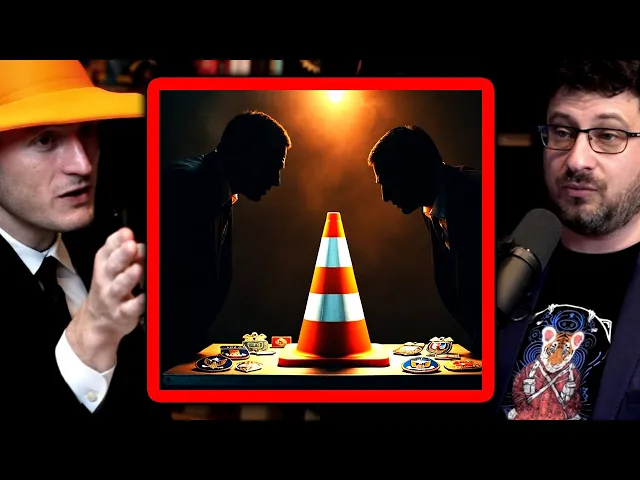
Intelligence agencies vs VLC: "No. We'll never do that" - Lead developer responds | Lex Fridman
Lex Clips
0:02 I mean, is there some paralyzing aspects?
0:05 You know, if I look at the at the case
0:07 of somebody I've become close with, Pavel Durov,
0:11 you know, he was blamed directly by the French government
0:17 for the kind of things his quote platform was hosting.
0:22 I could see the same kind of stuff, basically just as an example,
0:26 VLC being blamed for the kind of videos that people are watching.
0:30 tried, right?
0:31 Like we had we got like we we had issues like like I mean,
0:36 is that that's the pressure that people worry about because if you have
0:39 to think about that kind of stuff when you're kind of just obsessed about the
0:43 think about it and that's that's okay, right?
0:46 But what if they come in what if what if they show up and There is no office.
0:49 VideoLan doesn't have office.
0:51 I mean, this what happened with Pavel, they arrested him, right?
0:53 So they arrested him for particular videos that are
0:56 or or particular content that's being shared on the platform.
0:59 Sure, I don't have any platform.
1:00 Everything is on the client side.
1:02 Yeah, but they they still arrest you.
1:04 On what ground?
1:05 I'm not sharing anything.
1:06 I'm not The content doesn't go through my my stuff.
1:09 For sure, but there's still lawyer fees.
1:11 That's the problem.
1:12 Yes, that's correct.
1:13 Paperwork.
1:14 So like actually, if you had infinite trillions of dollars,
1:19 uh you would win uh easily because you're on the right side,
1:24 but the thing is there is a degree to which they suffocate you with paperwork.
1:28 That's that's the downside of bureaucracy through paperwork, through process.
1:32 Yes.
1:33 You know, it's the Kafka-esque thing.
1:34 You have to to to realize that one of the good things, for example,
1:37 um in France or most of Europe is that the the answering
1:44 to a court order does not make you bankrupt, right?
1:47 It's not like in the US where it can actually bankrupt you, right?
1:51 There is the way the law system work is
1:54 that like I I receive lawyers' letters every week, right?
2:00 And I can tell you that the cost of lawyer
2:04 fees for VideoLan is less than $10,000 per year, right?
2:09 Right?
2:09 So that's not really scary.
2:10 I mean, so with Pavel, did intelligence agencies try to like say,
2:14 "Can you put a back door in VLC?" Yes, two of them.
2:18 What what did you say?
2:19 No.
2:20 Well, I [laughter] was a lot less polite.
2:22 I I see you yeah yeah.
2:24 You're basically saying hell no.
2:26 Like if we had to compromise our software, we would shut it down.
2:29 This is clear.
2:30 And what's the definition of compromise like
2:33 allowing a government to do a back door?
2:36 There is no code that gets into VLC that we don't control.
2:40 And the way we compile VLC, you would call me completely paranoid.
2:45 Like we compile on boxes that are
2:48 offline where we start by compiling the compiler.
2:52 We do everything offline on on on places
2:55 that have never been connected to the internet.
2:58 We the way we do signing, there is double signature.
3:02 And especially because, for example, we've seen and we believe it's a it's
3:06 a governmental agency that is not from the Western
3:10 world to try to push a fake binary
3:12 into our own servers and that scared us a lot.
3:16 And VideoLan is open source.
3:18 How can you kill it?
3:20 Like I move to where, right?
3:22 I move to Malta, I move to I don't know,
3:24 Cayman Islands and I change the domain name and I I start again, right?
3:29 Like VLC is a tool.
3:33 It's a tool that is going to help people doing things.
3:37 We are not a platform and for patents, well, I'm sorry,
3:42 but most of the patents like you shouldn't be able to patent math and matrices.
3:47 Like this is wrong.
3:49 Does VLC ever like censor the kind of videos it
3:52 can play and not based on the content of the video?
3:56 No, never.
3:57 We never do that.
3:59 Because like a VLC is completely offline.
4:02 It doesn't talk to any server.
4:04 So we don't know anything that you're using the software for.
4:06 So again, there's no government that can say you know,
4:11 like the French government come in and say,
4:12 "We don't want uh I think anime is destructive to society.
4:17 We don't want any anime not allowed to be No, they cannot they cannot do that.
4:21 And also what they tried is to say, "Hey, I want to know if that person watched
4:25 that type of video." And the answer is like, "No idea." So no on that.
4:29 So for surveillance, no.
4:31 No, no, because the only infrastructure we have is a downloading infrastructure.
4:35 There is no telemetry in VLC.
4:37 It it would be difficult because of the international nature.
4:40 It would be difficult for you to incorporate
4:42 that code because there would be someone in the UK
4:44 and someone in Germany and someone in in the US
4:47 as part of VideoLan who'd be able to see that.
4:49 It would be extremely difficult.
4:51 thing that we can do which happen is like we had the issue
4:54 we had the case with some police in the US who said,
4:56 "We have a murder case, right?
4:59 And the file is destructed or doesn't play in that version of VLC.
5:02 Could you help us, right?" We never have access to the video.
5:05 It's like a normal support, right?
5:07 Oh, it's really about playing the file.
5:08 Yes, and like I remember in the middle of the Afghan war, right?
5:12 I received an email from someone in the army, right?
5:16 I don't remember the grades, right?
5:17 It was just like, "We have a big issue
5:19 with the latest version of VLC because it doesn't play
5:24 correctly the file on an RTSP server that we have
5:27 where there is all the the movies." And he says,
5:30 "VLC is very important for the moral on the troop on the ground, right?
5:33 Because at night I think it might be boring, right?
5:35 So they have a collection of videos to watch or movies over there,
5:38 right?" And and of course I did an update
5:41 and I broke some support of RTSP, right?
5:44 So I gave them another version just for them, right?
5:47 Because it was important and because VLC is completely open source,
5:51 I think it is allowed on the US Army laptops, right?
5:54 Because I guess someone in in the in the US
5:58 military actually looked at it and say, "Well, okay, this is okay,
6:01 right?" And the way we document how we process, that was okay, right?
6:04 So the only way we we we work with authorities is to help them doing support.
6:10 That's amazing.
6:11 That's really That's amazing story, yeah.
6:13 We don't see anything happening on how people use VLC and this is strong.
6:17 Do you feel the stress of this?
6:20 So first of all, millions of people using it.
6:22 Second of all, military using it, maybe sometimes pressure from governments.
6:28 Does that Does that That's a It's a small team, right?
6:33 Yeah, but is VLC like the core contributor?
6:37 How many?
6:38 Six, eight.
6:40 But and and and everything legally is only me.
6:43 Everything that is legal is only me.
6:45 You are not stressed about this?
6:47 I used to stress about that a lot.
6:49 Yeah.
6:49 But the thing is we're doing what we can for everyone, for the greater good.
6:55 We we work that we make some extremely complex technology easy for everyone.
7:00 We are a tool and every tool is going
7:03 to be used for great things and for bad things, right?
7:06 You you cannot blame a tool, I think.
7:09 And and this is like very important for us.
7:12 I used to be a lot in a lot of stress.
7:16 I'm not anymore, right?
7:17 What's the secret to your zen?
7:18 I mean, over and over in the chats I've had with you
7:24 in the in the conversation today about every even tense topic, you're very zen.
7:28 What's the what's the source of zen?
7:31 I have a a way of thinking about what is the worst case scenario, always.
7:38 Right?
7:39 And the answer is at the end, if I take like like a chess player, right?
7:44 In the end, am I dead?
7:46 Yes or no?
7:47 Right?
7:47 And and I do that non-stop, right?
7:50 And that's also how I do my my startups, right?
7:53 Is that I'm here to get something great.
7:56 What is the worst case?
7:57 It gets bankrupt.
7:58 That's life.
7:59 A company lives, a company dies.
8:01 That's okay, right?
8:02 Like And so my my moral way is always like, am I dying in the end?
8:06 Am I hurting someone?
8:08 If I'm the answer is no, then too bad, right?
8:11 Like oh, some lawyers are not going to be unhappy.
8:14 What are they going to do?
8:15 Take all the money of VideoLan.
8:16 Wow, they're going to get 50 grand.
8:19 Amazing, right?
8:20 What are they going to do with that?
8:21 The code the source code is out there.
8:23 It's not stoppable.
8:25 Also because what we do is good and it's done for everyone.