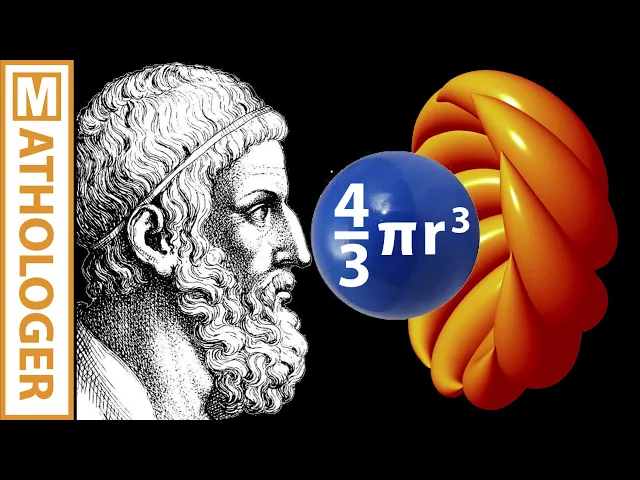
Why are the formulas for the sphere so weird? (major upgrade of Archimedes' greatest discoveries)
Mathologer
0:05 Welcome to an extra-extra-extra-special Mathologer video.
0:09 Why extra-extra-extra-special, three extras?
0:11 Well, first extra, it's the 100th Mathologer video.
0:15 There, the thumbnails for the first 99 videos.
0:19 It's been quite a journey:) Second extra: it's my first crossover episode.
0:25 For the first time, I'm collaborating with another channel.
0:28 Mathematician and 3d printing artist Henry Segerman just
0:31 published a video that complements this Mathologer video.
0:34 I'll have more to say about Henry and his wonderful
0:37 claw contraption down there in the last part of this video.
0:41 Now, most importantly, third extra,
0:43 in today's video we'll make a little bit of mathematical history.
0:48 I'll tell you about a couple of brand new,
0:51 game changing discoveries about the good old sphere
0:54 that so far only a handful of mathematicians know about.
0:58 Yep, you've been invited to opening night,
1:00 a mathematical premier:) Have a look at this.
1:04 You're all familiar with this kind of baggage carousel, right?
1:08 Really ingenious how it flows around corners don't you think?
1:11 What makes this work is that the crescent moon shaped pieces the belt
1:15 consists of have circular sides that can seamlessly rotate one against another.
1:21 Let's steal this idea.
1:23 First create a circle-shaped conveyor belt.
1:25 And then have this conveyor belt perform a figure 8 dance like this.
1:30 Very pretty isn't it?
1:32 On close inspection what is happening here
1:35 is that the circle gets turned inside out.
1:38 Have another look.
1:40 Right, points that originally are close to the centre of the circle
1:44 end up on the outside of the new circle, and vice versa.
1:48 Very nice, but so what?
1:50 Is there any more to this?
1:53 Well, let's put a hemisphere on top of this circle,
1:59 Whoa, that animation really turned out very nice, don't you think?
2:02 Okay, now in the same way as before, let's turn the hemisphere inside out.
2:09 What on Earth is that?
2:12 What's that inside-out-shape?
2:14 Well, on close inspection it turns out to be approximately
2:19 a cylinder with a cone carved out from the top.
2:22 In fact, by using thinner and thinner moons,
2:25 the new shape will get arbitrarily close to a true cylinder minus a true cone.
2:32 There, thinner moons.
2:34 Even thinner.
2:35 Infinitely thin.
2:37 BUT, turning the hemi-sphere inside out like this doesn't affect the volume.
2:42 This means that the volume of the hemisphere is
2:45 equal to that of the cylinder minus the cone.
2:49 Now, finding the volume of the sphere that's a tricky one, right?
2:54 One of Archimedes' great achievements.
2:56 BUT with our baggage carousel trick,
2:58 all we have to do to find this tricky volume is to subtract
3:02 the volume of the cone from the volume of the cylinder, and then double.
3:07 And that's all easy.
3:08 The volume of the cylinder is just base times height.
3:11 AND, with the height being the same as the radius R of the sphere,
3:15 the volume of the cylinder pans out to be pi R^3.
3:18 And pointy things always have one third
3:20 the volume of cylinder things, also pretty easy.
3:24 So we subtract 1/3 pi r^3.
3:28 Then doubling to go from the hemisphere
3:31 to the sphere gives the volume formula of the sphere.
3:35 Tada.
3:35 4/3rds pi r^3.
3:36 From baggage carousel to the tricky volume formula
3:39 of the sphere pretty much at a glance.
3:42 How great is that?
3:44 Definitely made my day when a couple of weeks ago my colleague Andrew Kepert,
3:48 a mathematician at the University of Newcastle here in Australia pitched
3:52 this and a couple of other ingenious sphere related ideas to me.
3:56 And here we are, a Mathologer video featuring Andrew's ideas:) What I'll do
4:01 next is flesh out and milk this baggage carousel idea for all it's worth.
4:06 After that it's on to Archimedes' claw,
4:09 Andrew's second great idea and possibly the climax of this video.
4:13 That's also where 3d printing master Henry Segerman makes his appearance.
4:18 Anyway, prepare for a life changing experience as far
4:21 as all the spheres in your life are concerned:) Enjoy!
5:08 The inverted hemisphere is a cylinder minus a cone.
5:11 Really?
5:11 Well, the animation that I just showed you was very convincing but, of course,
5:16 to be absolutely sure that this really works,
5:19 we need to conduct a proper mathematical check that the shape
5:22 on the right is really a cylinder minus a cone,
5:25 with both shapes of just the right dimensions.
5:28 Okay, is there anything that can go wrong with the cylinder?
5:32 Well, let's have another look at how exactly the hemisphere turns inside out.
5:37 There, the orange arrow points at the highest
5:40 point of the hemi-sphere and the green arrow marks the point around which we are
5:46 figure-8-ting as we turn the hemisphere inside out.
5:48 Focus on what happens around those two special points.
5:53 Ready?
5:53 Go:) Okay, pretty obvious,
5:56 the mantle of the inside-out-shape is that of a cylinder
5:59 of the same radius and height as the hemisphere,
6:02 and the lowest point of the inside-out shape is right in the middle.
6:07 All convinced?
6:08 Great:) So, nothing can go wrong in term of the cylinder.
6:12 But what about the carved out bit?
6:15 Is that really a cone?
6:16 Basically what I am worrying about here is
6:19 that those mantle lines that appear to be straight,
6:21 as in a cone, may actually be a tiny bit curved.
6:26 I'll just quickly sketch one way of proving that looks are really not
6:30 deceiving:) The keen among you can then fill in the details in the comments.
6:34 Okay, for easier tracking of distances,
6:36 let's also display what the vertical cross-sections of our shapes appear to be.
6:42 There.
6:43 Now, cut everything in sight with a horizontal plane at height h.
6:50 Then it is clear that the red cross-section on the left will be
6:53 a circle and that the red cross section on the right will be a ring.
6:57 And it's also easy to see that the circle
6:59 and the ring have exactly the same area.
7:02 Is that clear?
7:03 Right?
7:03 During the inside-out dance, the circle cross section on the left continuously
7:07 turns into the ring cross section on the right,
7:10 and so the circle and the ring must have same area:) Now,
7:14 using this equality, you can then calculate the inner radius of the ring.
7:19 For this hire a couple of middle school kids and put them to work.
7:22 All they have to do is to write down the formulas for the areas
7:26 of the red circle and the red ring and then solve for this inner radius.
7:29 They've done stuff like this in school a million times.
7:33 Piece of cake.
7:34 Eventually they'll report back to you that the inner
7:38 radius exactly equals the height h at which we cut.
7:42 That's a linear relationship.
7:44 And that means that those mantle lines are really straight.
7:51 And so the missing part in the middle is really, truly a cone.
7:56 All good?
7:56 Everybody happy?
7:58 Great!
7:58 Proof complete.
7:59 As I said, just a sketch and as long as you got the gist of what is
8:03 going on here that's good enough to be
8:06 able to appreciate what I am about to say.
8:09 Okay, while Andrew's method of turning the hemisphere into the cylinder
8:13 minus cone shape on the right is definitely brand new,
8:16 and brilliant, the basic idea is not new.
8:20 400 years ago the mathematician Bonaventura Cavalieri
8:25 was the first to realise that the cylinder
8:27 minus cone configuration can be used to derive the volume formula of the sphere.
8:33 Of course, like Archimedes, Cavalieri was not familiar with air travel
8:38 and fancy baggage carousels and so it's
8:40 not surprising that his line of reasoning
8:43 was a bit different from ours:) In particular,
8:46 Cavalieri doesn't motivate why he is comparing
8:48 the two shapes over there and starts by showing,
8:51 from scratch, the crucial property of the two
8:54 shapes that the baggage carousel gives us for free.
8:57 What he does is he starts by showing that the circle and ring cross-sections
9:02 of the two shapes have the same area no matter the height at which we cut.
9:07 Right, we got that equality for free.
9:10 He then finishes his proof using Cavalieri's principle,
9:14 an ingenious idea named after him.
9:17 Cavalieri argues that BECAUSE there are cuts of equal areas at all heights,
9:22 the two shapes must also have the same volume.
9:26 Equal area cuts at all heights implies same volume.
9:31 Makes sense:) Cavalieri considering those two
9:34 shapes was probably inspired by Archimedes,
9:37 the original discoverer of the volume and area formulas of the sphere.
9:42 I won't go into the details of Archimedes' proof.
9:45 But let me at least give you a glimpse of his setup.
9:49 There is also a sphere/cylinder/cone combo at play
9:52 but it's all a bit more complicated.
9:55 If you are interested in more details about
9:57 Archimedes' proof there is a link in the description
10:00 of this video to an old Mathsmasters article by Marty
10:03 and me in which we rave about this proof.
10:07 Anyway, I think Andrew's new way of naturally turning the hemisphere
10:10 into the cylinder minus the cone shape
10:12 is an important upgrade of Cavalieri's discovery,
10:15 which in turn was an upgrade of Archimedes' original proof.
10:19 As I said, we are really making mathematical history today,
10:23 mathematical history that's been in the making for thousands of years.
10:27 You saw it first on Mathologer.
10:29 Pretty amazing, isn't it?
10:31 Okay, before I move on to the next main topic,
10:34 let me just mention one more beautiful insight that arises from Andrew's dance.
10:38 Here we go.
10:39 If we replace the hemisphere by a paraboloid something extra special happens.
10:44 What's a paraboloid.
10:45 Well, that's the solid we get when we spin the graph
10:49 of our good old friend y= x squared around the y-axis.
10:53 Well, to be nitpicky, that's NOT the whole paraboloid but rather part
10:58 of the paraboloid below a certain height and turned upside down.
11:03 Whatever, let's call this bit a paraboloid anyway.
11:06 Now here is what the corresponding inside-out shape looks like.
11:09 And here is the amazing bit.
11:11 The inside-out-shape turns out to be
11:13 the surrounding cylinder minus the same paraboloid.
11:17 Challenge for you and your army of middle school minions:
11:22 Work out the details in the comments.
11:24 Anyway, how great is that?
11:26 And so what do we do next?
11:28 Well, solve for the volume of the paraboloid of course:) The volume
11:34 of a paraboloid is equal to half the volume of the surrounding cylinder.
11:39 Archimedes was also the first to discover this surprising formula.
11:42 Did I ever mention that Archimedes is my no 1 mathematical hero,
11:47 with Euler being a close second?
11:50 Actually, at this point I just have to tell
11:53 you about yet another one of Archimedes' ingenious insights.
11:56 So much great stuff to point out here:)
11:59 For this insight let's spool back to this earlier slide.
12:03 The volume of the hemisphere is 2/3rds pi r cubed.
12:09 Oookay.
12:09 Now, pi r cubed by itself what's that?
12:13 Well, pi r cubed remember we had this before,
12:16 that's just the volume of the cylinder:)
12:18 Let's shuffle this formula around a bit.
12:22 There.
12:22 And there.
12:23 Hmm, okay.
12:24 But now its also clear that the hemisphere fits snugly inside the cylinder.
12:29 And so what our identity says is that the ratio of the volume
12:33 of the surrounding cylinder to the volume of the hemisphere is equal to 3 to 2.
12:38 And of course the same is true if we double everything in sight.
12:42 The ratio of the volume of the surrounding
12:45 cylinder to the volume of the sphere is 3:2.
12:49 How nice it that:) Archimedes was so
12:51 impressed by this simple relationship that he
12:53 had a version of this cylinder/sphere diagram
12:55 over there engraved on his tomb stone.
12:58 In fact, he noticed something else which makes all
13:01 this doubly amazing:) It turns out that the ratio
13:04 of the surface area of the cylinder
13:06 and the surface area of the sphere is ALSO 3:2.
13:10 So both the volumes and surface areas are in the ratio of 3:2.
13:15 Did you know that?
13:16 Faantastic:) Anyway,
13:17 this is our cue to now have a closer look at the surface area of the sphere.
13:30 Okay, so we've mastered the volume formula of the sphere.
13:32 What about the surface area?
13:34 Let me just go for it and power through a simple
13:37 and beautiful argument that gets us there without breaking a sweat.
13:40 I'll start with a quick warm-up exercise that quite
13:43 a few of you will already be familiar with.
13:46 Let's have a look at a disk of radius r.
13:49 We can think of this disk as being
13:51 made up of infinitely many concentric circles.
13:53 Here I've just highlighted a few of these circles.
13:56 Let's cut the circles open at the top and then straighten them out.
14:01 In this way the disk unfolds into a triangle of height r.
14:08 What's its base?
14:10 Well the circumference of the disk of course.
14:13 That's where the base comes from.
14:15 Right?
14:15 And so the area of the circle is equal
14:18 to the area of the triangle which is 1/2 base times height,
14:21 1/2 circumference times R.
14:23 Nice argument, don't you think?
14:25 What's extra nice is that in this way we've discovered a simple relationship
14:31 between the area and the circumference of the circle without any pi in sight.
14:36 Now, of course, once we know this relationship then
14:39 also knowing the formula for either one of these quantities,
14:43 immediately gives us the other formula.
14:45 For example, let's say we know the formula for the circumference 2 pi r.
14:49 Then plugging in we immediately get the area formula.
14:53 Hands up, who's seen this proof before?
14:57 Hm, as expected quite a few of you:) Okay.
15:02 The nested circles that we started with are reminiscent of an onion
15:08 and the argument that I just showed you is often called the onion proof.
15:13 Dad joke alert: Did that proof make you want to cry?
15:17 Yes, I know, that's a bad one, but I couldn't resist:) Now,
15:21 what even those of you in the know may not
15:24 know(:) is that the same argument also works in 3d.
15:27 Let me show you.
15:28 Replace the layered disk by a layered ball.
15:31 There layered.
15:32 Like an onion.
15:33 Ok that's it for onions, I promise.
15:37 Then we can unfold all layers into disks of the same area like this.
15:45 And so the ball unfolds into a circular cone of height r.
15:50 And, of course, the base area is equal to the surface area of the ball.
15:54 And so the volume of the ball is equal to the volume of the cone,
15:59 1/3rd base area times height, and so 1/3 surface area times r.
16:04 As in 2d, in this 3d onion proof pi is nowhere to be seen.
16:09 Cute.
16:10 And now, since we already know the volume formula of the sphere,
16:13 we can figure out the formula for the surface area.
16:19 Tada again:) And so at this point we've proved
16:26 both the volume and area formulas of the sphere.
16:31 And now you also know why these formulas look so
16:34 similar 4/3rds at the top and 4 at the bottom.
16:37 That was not hard, was it?
16:39 And Archimedes definitely looks pretty happy over there and has probably
16:42 pushed the like and subscribe buttons by now:) What about you?
16:46 Actually, although what I just showed you was a pretty quick
16:49 way to derive the the area formula from the volume formula,
16:51 there is an even quicker way.
16:53 If you are a calculus demon, at some point of your career you may have noticed
16:58 that the surface area formula is just the derivative of the volume formula.
17:03 Wait what?
17:04 Yes, quick check.
17:06 The derivative of r cubed is 3 r squared.
17:11 Okay simplify.
17:12 The derivative of the volume formula is the area formula.
17:16 Magic:) You may think that this is a coincidence
17:19 until you try the same for the circle, the 2d counterpart of our 3d sphere.
17:25 Turns out the derivative of the area formula
17:28 for the circle is the formula for the circumference.
17:31 There.
17:31 pi r squared and 2 pi r, the formulas for the circle.
17:35 And, of course, the derivative of pi r squared is indeed 2 pi r.
17:38 Magic again:) Really easy challenge for the calculus demons among you,
17:44 even those of you who are still in high-school:
17:47 Can you provide an onion powered calculus explanation for this derivative magic?
17:52 If so, dazzle the rest of us by leaving
17:54 your thoughts in the comments:) Go on give it a try.
17:58 Otherwise, I'll also link to a brief
18:01 explanation in the description of this video.
18:04 Another challenge.
18:05 Check that Archimedes' 3:2 really also works
18:08 for the surface areas of the cylinder and the sphere.
18:12 Okay back to our formulas.
18:14 Which of the two formulas do you like
18:16 better from a purely aesthetic point of view?
18:19 I think pretty much everybody would go for the area formula 4 pi r squared.
18:24 No fraction in sight and so cleaner, prettier, more beautiful.
18:29 Alright, we are now ready for the second main attraction of this video,
18:33 Andrew's ingenious new way of seeing at a glance
18:35 why the area formula is what it is.
18:44 Does the pi r squared in this formula ring a bell?
18:47 Of course!
18:47 pi r squared is just the area formula for a circle of radius r like,
18:51 for example, an equatorial circle cross-section of the sphere or its shadow.
18:57 In other words, the surface area of the sphere
19:00 is exactly 4 times the area of its shadow circle.
19:03 A couple of years ago 3blue1brown set out to find a nice
19:06 visual way of seeing at a glance why this is true.
19:10 Today I'll show you the ultimate one
19:12 glance way of understanding this relationship from scratch,
19:15 something that I think is even nicer
19:17 than what was shown in that 3Blue1brown video.
19:20 This is the result of another one of Andrew's brainstorms.
19:24 Andrew started by observing that there is a better way to write
19:29 the area formula if you're hunting for a one glance proof.
19:32 There pi times 4 r squared.
19:35 Since 4 is also 2 squared we can pull out the 2s in the exponents.
19:40 And what that means is that the area of the sphere
19:44 is equal to the area of the circle of double the radius.
19:50 And now, that this is true can indeed be seen at a glance
19:53 using an ingeniously weird unfolding
19:55 of the sphere's surface into this larger circle.
19:57 Here is what we do.
19:59 We start with the infinitely many meridians of longitude.
20:02 Here are a few of them.
20:04 Okay so every meridian is a semi-circle that joins
20:07 the north and the south poles of our sphere.
20:10 And, except for the two poles,
20:11 every point of the sphere is contained in exactly one of these meridians.
20:15 Let's focus on one of the meridians, this one here.
20:19 There is a radius of the pink circle right below this meridian.
20:23 There it is.
20:24 We now swivel the meridian 90 degree clockwise around this radius.
20:31 Swivel.
20:32 Fits perfectly.
20:33 So let's do the same with all the other infinitely many meridians.
20:38 I'll just illustrate with the few meridians highlighted over there.
20:42 Okay, after we folded down all
20:45 the meridians they completely fill the pink circle.
20:49 To really get a feel for this unfolding
20:51 let's turn the sphere into an Earth globe.
20:54 Ready?
20:54 There unfold.
20:56 Each individual meridian folds down nicely,
20:59 the meridians all snugly fit together and fill the big circle when folded down,
21:07 without overlapping.
21:08 Wonderful.
21:09 So, there, that's how Andrew's unfolding morphs the surface
21:11 of the sphere into the circle of twice the radius.
21:14 All clear?
21:15 Now, Andrew's simple transformation happens
21:17 to have an incredible, magical property.
21:20 Obviously, the transformation distorts the sphere like crazy,
21:23 but there is one thing it does NOT distort: area!
21:28 To use the jargon, Andrew's magical
21:30 transformation turns out to be area-preserving.
21:33 This means that any region on the sphere will be transformed
21:36 into a distorted region somewhere on the large circle of exactly the same area.
21:42 For example, have a look at Australia on the globe.
21:45 Then the area of Australia on the globe is exactly
21:47 the same as the area of its image on the circle.
21:51 Amazing, isn't it?
21:52 And the same is true for any other region
21:56 on the sphere and its image on the circle.
22:00 In particular, this means that the area of the entire
22:03 sphere is the same as the area of the circle.
22:08 Tada.
22:09 Proof complete.
22:10 Well, not so fast.
22:12 Definitely, everything I said is true.
22:14 And you know me, right?
22:15 Would I lie to you?
22:17 But of course that's not the way things work here in MathologerLand.
22:21 I have to at least sketch a proof.
22:24 First, to see how things could potentially go wrong,
22:28 let's do the same sort of unfolding for a cylinder of height h.
22:33 There this cylinder is of height H.
22:36 Now fold down all the mantle lines.
22:38 This means that the unfolded cylinder mantle is this ring.
22:41 And, so: Are the surface areas of the ring and cylinder mantle the same?
22:45 What do you think?
22:47 The answer is: Definitely not always.
22:49 That's easy to see.
22:50 Just think about it.
22:51 Keeping the height of the cylinder fixed, we can make its area as close to zero
22:56 as we wish by making the cylinder thinner and thinner.
22:59 On the other hand, the ring area will never get smaller than the area
23:04 of the circle whose radius is equal to the height of the cylinder.
23:08 There, basically that's a circle of radius H.
23:11 And so the two areas are definitely not the same.
23:15 Hmm.
23:15 So, why is the sphere so magical?
23:17 Why does unfolding the sphere not distort the area?
23:20 And can it be easily seen why this is the case?
23:24 Well, remember Henry's claw contraption,
23:26 which I showed you at the very beginning?
23:29 Henry's gizmo is a 3d printed version of Archimedes' claw,
23:34 another one of Andrew's ingenious inventions.
23:36 Have a look.
23:37 So, here we have the whole surface area of the sphere covered by special
23:42 3d crescent moons that are thickened up versions of the meridians from before.
23:46 Let's fold down those 3d moons together with the meridians.
23:51 As we fold, the moons keep touching without a gap
23:55 and end up forming a thickened up version of our target disk.
24:00 There again.
24:01 No gaps, completely smooth, magic.
24:03 And then, as we increase the number of moons,
24:06 we are getting closer and closer to the real thing:
24:12 there you have it, the surface of the sphere rigidly turning into the disk,
24:20 without any distortion.
24:22 Tada, NOW the proof's complete, right?
24:25 Well, again, not so fast:) Take my word for it,
24:29 we are getting closer to the true explanation of this area-preserving property.
24:33 However, I am fairly sure that what most of you are thinking here
24:38 is that because the moons approximate
24:40 the sphere and the circle better and better,
24:42 the total surface area of the bits of the moons facing out will
24:46 get closer and closer to the surface area of the sphere and the circle.
24:50 Which then somehow completes the proof.
24:53 Right, seems at least plausible?
24:55 However, that's not quite it.
24:57 Have a close look at the moons.
24:59 Arranged in sphere mode and circle mode we are
25:02 really looking at the moons from completely different perspectives.
25:06 And so, although there are never any gaps between the moons as they move,
25:12 how can we be sure that these different
25:15 perspectives really translate into the same surface areas.
25:18 Not obvious, right?
25:19 Okay, let's have a closer look at where those moons actually
25:24 come from and what is happening here in terms of areas.
25:27 There, the sphere and the circle before and after folding down the meridians.
25:32 The meridians divide the blue and the pink into the same number of regions.
25:37 And so, to show that the blue and the pink have the same area we
25:42 just have to show that a blue region has the same area as a pink region.
25:47 Okay, so to be able to compare these two regions,
25:51 let's fold down the blue region and align it with the pink one like this.
25:56 Okay, now watch this.
25:57 You just witnessed a little miracle.
25:59 Did you notice how the travelling sphere always exactly
26:03 touches the sides of the blue and the pink regions.
26:11 Let's watch that again There one 3d moon served.
26:18 Now let's get rid of the sphere and let's
26:21 focus on the growing moon surface by itself.
26:25 What you are looking at here is a circular
26:31 cross-section of the travelling sphere and the pink
26:36 and blue cross-sections are both roughly diameters
26:39 of this circle and so approximately of equal length.
26:43 And the same is true all along the 3d moon.
26:47 And now we are in a very familiar situation, where two shapes are the same,
26:52 cross section by cross section, at corresponding levels.
26:56 Remember Cavalieri?
26:56 And, as usual, we can conclude that we
26:59 are dealing with surfaces of the same area.
27:02 Well, since corresponding cross-sections are not exactly
27:05 the same in the case of large
27:09 moons the surface areas of the two regions will not be exactly the same.
27:13 However, as we push the number of moons to infinity,
27:16 in the limit we'll have equality which is what we've been chasing:) Okay,
27:21 so the sphere and the large circle have the same area.
27:25 Very, very pretty.
27:26 Also, looking a little closer,
27:28 we can similarly prove that Andrew's transformation is always area-preserving,
27:33 that any country on the sphere transforms to a country
27:37 on the circle of the exact same area.
27:40 To make this argument rigorous still requires quite a bit of detailed fiddling.
27:45 But what you see in front of you really nicely captures the core of the proof.
27:51 And that's definitely good enough for now.
28:01 Okay and that's pretty much it.
28:03 But before I sign off for today I just wanted to thank Andrew for inspiring
28:07 me to make this video and for creating
28:09 most of the fancy animations in this video.
28:12 And this is a Mathologer command: you must check out Andrew's playlist
28:16 of relevant animations linked in from the comments.
28:19 Also thank you to Henry for creating the 3d printed version of the claw.
28:24 Another command: make sure to head over
28:27 to Henry's channel for his video about the claw, plus free 3d printing files.
28:32 Then you can print your own copy of Archimedes' claw.
28:36 As usual, there will be more thank-you-s
28:39 at the very end of this video:) I should mention
28:42 that in terms of Archimedes' claw I've really just
28:45 touched upon a few of the secrets it holds.
28:48 There is definitely enough material for a part 2.
28:51 Just to whet your appetite,
28:53 there is the beautiful explanation and important implications of the fact
28:58 that as the claw opens all its moons will always touch without leaving any gaps.
29:04 Then there is the important connection to Heinrich
29:07 Lambert's famous area-preserving map of the sphere.
29:11 Remember polymath Heinrich Lambert?
29:13 We keep running into him.
29:14 He was the first to prove that pi is an irrational numbers,
29:17 he was one of the inventors of the hyperbolic trig functions.
29:20 Then there are all of Lambert's amazing maps, and so on.
29:23 Anyway, Archimedes' claw, there is a lot more to be said and to be discovered,
29:28 but let's call it a day.
29:30 I'll finish with one more of Andrew's
29:33 stunning animations illustrating a completely different
29:35 moon powered way to turn the surface of the sphere into the circle.
29:40 Enjoy.