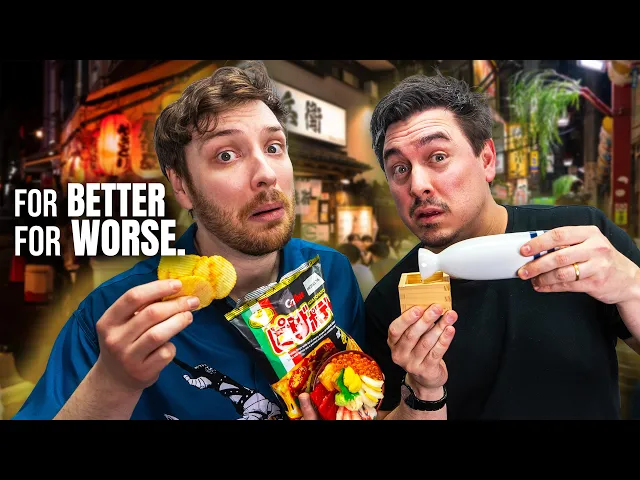
What Living in Japan Actually Does to You 🇯🇵 Ft. CDawgVA
Abroad in Japan
0:00 Living in Japan, does it make you a better person?
0:02 Does it make you a worse person?
0:04 Indelibly, it has some impression upon you.
0:06 And having been here 10 years,
0:07 I want to talk about how it has impacted me, along with my companion.
0:11 He's the biggest thing to leave Wales since the great cholera outbreak of 1849.
0:16 Say hello to C Dog V8.
0:18 All right, how you doing?
0:19 We had a cholera outbreak?
0:20 1849, the great Cardiff cholera outbreak.
0:23 [laughter] Actually, I had it pretty bad.
0:23 Did you just learn of a natural disaster that Wales caused so you could mock me?
0:26 You are the biggest natural disaster to leave us.
0:28 Cheers.
0:29 Give us a kiss.
0:30 See you again, man.
0:30 Cheers.
0:31 Has Japan changed you?
0:33 In many ways, yes.
0:34 We're going to get into that in a sec,
0:35 but this is the annual Connor comes to the studio video where
0:39 we rant about things under the guise of promoting the great cycle tour.
0:44 Which is happening from April 5th all the way till April 19th.
0:47 We'll be cycling for 2 weeks on the bike
0:49 with friends to raise money for charity, for the Immunodeficiency Foundation.
0:53 Once again, the fifth cycle tour.
0:55 Best things come in five.
0:56 Let's be fair, they've been good.
0:58 [music] We'll have hit, I think if we if we do this one,
1:01 we'll have raised nearly $5 million.
1:03 Keep going.
1:03 From all the cycle tours.
1:04 The Immunodeficiency Foundation.
1:05 Yeah.
1:05 They've been making some serious changes [music] in the world.
1:07 But let's talk about other serious changes.
1:09 How Japan has changed us.
1:11 More importantly, changed your life because you wrote a book about it.
1:14 Yes, I've also got a book coming out as well.
1:16 It's a double celebration.
1:18 I have just finished writing after a year.
1:20 It's about a year late, but this is it.
1:23 Journey across [music] Japan.
1:24 You didn't make this, I assume.
1:25 I didn't I didn't do the cover.
1:26 That's why it's good.
1:27 That's why it That's [laughter] why it looks good.
1:29 Covers every single one of the prefectures
1:31 in Japan through different stories, right?
1:33 Am I in any of them?
1:35 Am I in the book in any way?
1:36 It doesn't matter.
1:36 Am I in any of them?
1:37 You are unfortunately in bits of the book.
1:40 Let's go.
1:40 Wonderful.
1:41 A not overly flattering portrait of you.
1:43 The lowlights.
1:44 It's when the book The review's going to be like,
1:46 "It was really great until the Welsh guy came out and made crash him up."
1:49 There's a line in the book about how
1:50 I'm like looking at a [music] beautiful river.
1:53 Mhm.
1:53 And I'm It's like the majesty of the river, the untouched river touched my soul.
1:57 And then Connor went, "Looks like we are going to have too many beers,
2:00 isn't it?" I was Splash Mountain and it's just like
2:03 the book goes downhill [music] when when Connor turns up.
2:06 But you can pre-order it now on the internet.
2:08 And it'll be coming out later on this year.
2:10 Wonderful.
2:11 I'll I'll buy five.
2:12 You would you better.
2:14 You [laughter] got it better.
2:15 But for now, let's jump into it.
2:16 12 ways Japan changed us.
2:19 So, what is number one?
2:21 So, it's kind of awkward.
2:21 I don't really know what to call it.
2:23 So, I'm calling it the sucking noise.
2:26 [laughter] It's good.
2:27 Okay, just just remember that.
2:28 dental So, the technical name dental ingressive sound.
2:31 We go Okay, that's that sounds like some kind of Victorian disease.
2:36 It's not related to Cardiff cholera.
2:37 Okay.
2:38 People don't outright say no in Japan when you want something.
2:41 Like, "Oh, yeah.
2:41 Should I do this?
2:42 Should I do that?" They go muzukashii na, it's difficult.
2:45 Okay.
2:45 But that sucking noise, that dental ingressive sound, I do it for everything.
2:49 When Charles is like,
2:50 "You should probably eat the salad." I'm like, difficult, isn't it?
2:54 Difficult.
2:56 [laughter]
2:56 When you said sucking noise, I thought you meant like ramen or like noodles.
2:59 No, that's the slurping noise.
3:00 Oh my god.
3:01 You're sucking the noodles.
3:02 No, but that's different.
3:05 [laughter] It's different.
3:05 The art of sucking in Japan.
3:06 There are There's a suck for every occasion.
3:10 [laughter] There is.
3:10 And I've noticed you do the the noise, the Do I?
3:13 Yeah, you're like No, maybe difficult.
3:15 Mhm.
3:15 When Paul's like, "Will you cut a pipe my salary?" And you're like,
3:19 difficult, difficult.
3:20 But you you know, often in Japan, you don't say no right out.
3:23 Right.
3:23 Yeah, I get You go I remember every time I
3:25 wanted to do something when I was working at school,
3:27 I'd be like, you know, "Should I do this?
3:28 Should I do that?
3:29 Can I go on holiday for a week?" They were like, Mhm, chotto matte.
3:34 The rule of thumb is,
3:35 whenever you hear that noise, that generally [music] means no.
3:38 Yeah.
3:39 He's either difficult, incomprehensible, [music] or simply undoable.
3:42 Or or they'll do it,
3:44 but they want you to feel like you they you really kicked up a fuss.
3:47 You've really caused some head Caused some sort of trouble, right?
3:50 Yeah.
3:50 Maybe I do do it.
3:51 Maybe it's subconscious.
3:52 do it cuz I've spent time in your company.
3:54 Maybe people ask too much of me Yeah,
3:56 I think I think maybe you're [laughter] like Could we meet before 2:00 p.m.?
4:01 I'm not a bed yet.
4:02 That's going to be difficult.
4:05 [laughter]
4:04 I think being British as well, it's it's pretty I don't know.
4:06 I feel like I'm really at saying no anyway.
4:09 So, it's combining the two cultures.
4:10 You think that there's a similarity between UK and Japan?
4:13 Absolutely.
4:13 I think like Japan and UK should share so much in common.
4:17 Especially like manners and politeness.
4:19 There's there's so much overlap there.
4:21 Well, how do Americans say no?
4:22 How do Americans say no?
4:24 it out.
4:24 I mean, [laughter] Americans are a lot more willing to just say no outright.
4:28 Whereas the UK, we feel like we need an excuse.
4:30 There needs to be a valid reason for no.
4:32 Whereas I I think sometimes,
4:33 at least in my experience, Americans are like, "Nah, no.
4:35 We'll you, man."
4:38 [laughter] "I'm not doing that, man, you son of a bitch."
4:41 Well, there's another thing I do which we'll get to later though, I think.
4:43 Okay.
4:43 Is is sort of actually becoming a bit of a problem.
4:46 Really?
4:47 But anyway, on to your one.
4:48 a list of that one as well.
4:48 Problems Problems that Chris has caused and needs to [laughter] fix.
4:52 25 ways Chris has disadvantaged me.
4:54 You're really at 13 Reasons Why.
4:56 What is point number two there?
4:57 What have you got?
4:58 This is probably the one that makes me the most sad.
5:02 It kills me inside.
5:03 I feel like I have developed an aversion to small talk since living in Japan.
5:07 Because in Japan, you pretty much never small talk.
5:10 And if you do, it's I mean, it's like the most quickest subsurface Well,
5:15 you get the three questions, don't you?
5:17 Like, How old are you?
5:18 Yeah.
5:19 Why are you here?
5:20 And the aim of it is to work out your social standing.
5:22 Mhm.
5:23 If you're like a senpai or kohai,
5:24 are you older or younger because that determines how people can talk to you.
5:27 Even then, I feel like that's more in a work setting.
5:30 All right?
5:30 I feel like in everyday life,
5:32 I you kind of have to go out of your way to do small talk,
5:34 which is what something I do now.
5:35 I feel like I have to go out of my way
5:36 to start small talk with people because I want to chat people.
5:39 I you know, when I go to my local stores or like coffee shops,
5:42 I like to have a little bit of conversation.
5:43 It's nice, but it's quite unusual.
5:45 So, when someone talks to me first in Japan, I'm definitely like,
5:47 "Oh my god." And then whenever I go back to the UK or I go to America,
5:50 and people start talking to me, I'm like, "The Did I Did I do something wrong?
5:54 Did I something up?
5:54 I'm sorry.
5:55 I I I I don't know what I did." Like I just I
5:58 I I kind of like definitely the first time after I went back.
6:01 Obviously, I was in Japan for, you know, 2 years with COVID.
6:04 It was really weird.
6:05 And people just started talking to me in the elevator.
6:07 I was like, "I'm so sorry.
6:08 What have I done?" You know.
6:09 Yeah, no.
6:09 But I like that.
6:10 I miss that.
6:11 And when I go back, I find I overcompensate for that.
6:13 I remember I was in like a a candy shop.
6:18 [laughter] I was in the candy shop, you know.
6:20 I went to the sweet shop in like Ramsgate in Kent.
6:23 A little candy shop by the sea.
6:24 You know, I I wouldn't stop talking to this woman.
6:28 [snorts] I was like, "Oh, the candy's nice, isn't it?
6:29 Oh god, I love candy." Just leave me alone.
6:31 And she was like, "Yeah, yeah, yeah.
6:32 Oh, look, it's time to stop talking now." And I think after like 10 minutes,
6:36 she was like, "Get the out of my candy shop." Yeah.
6:38 For 2 3 years I've been in Japan without coming to to the UK.
6:42 I'm not used to talking to people in this environment.
6:44 And it really like I was like, "Oh, yeah,
6:46 you can talk to people in shops and things." I mean,
6:48 I get excited to do it again.
6:49 It's always like really fun,
6:50 but definitely there's that bit of a period where I land and I'm like,
6:53 I just feel a bit weird about it all.
6:54 a beeline for Greggs and you're like, "Sausage rolls,
6:56 what are they?" [laughter] the staff and start a big old "How long have you been
7:01 working here for, boy?" But there are still
7:03 places in Japan where you can talk to Absolutely.
7:04 Absolutely.
7:05 I mean, like small bars for example, bar culture and izakaya culture,
7:09 those are the places where you can talk to bar
7:11 staff and have a good old chat as well.
7:12 But I think if you're a foreigner,
7:14 there's normally people are going to be a bit hesitant to talk to you.
7:17 [music] And so often times, it's kind of the onus is on you to kind of show
7:21 yourself as being a social person and that you're fun to talk to.
7:24 Yes, you do get the same questions every single time,
7:26 which is, "Where are you from?
7:27 What do you do for work?
7:28 How old are you?" Which is fine.
7:29 Once you kind of get that out of the way,
7:30 you can start having an actual conversation.
7:32 Yeah, yeah.
7:32 And just understand that it is about people trying to quickly evaluate how
7:36 to talk to you cuz that is such a big thing [music] in Japan,
7:38 how you treat your elders and what not.
7:40 Maybe that's why people talk to me nicely cuz they think,
7:42 "Oh, he must be 50 or something." [laughter]
7:45 You look like you were there for the Cardiff
7:46 outbreak of cholera in 18 I remember it well.
7:49 All right.
7:50 Tell us about it, [laughter] Chris.
7:51 Tell us about the cholera outbreak.
7:52 Speaking of decrepit, my next point, point number three, how Japan changed me.
7:57 I I feel comfortable being naked.
7:59 Wow.
8:00 In the bath.
8:01 It must have been my first 2 weeks in Japan.
8:03 All the teachers all the English teachers get together in Yamagata.
8:06 Yeah.
8:06 Like a big seminar.
8:07 And at the end they were like, "It's bath time." And I was like, [laughter]
8:11 "What does that mean?" And uh And it wasn't like a nice hot spring bath.
8:15 It was like a public bath in the middle of the town.
8:17 And it was really small.
8:18 It was like the size of this bit here, right?
8:20 In the bath.
8:21 It was quite And there was about 10 of us.
8:23 So so all of you went to this place?
8:25 When you're in Japan.
8:26 And we got Oh, we're going to the changing room.
8:27 And like I think three quarters of the people in there were new to Japan.
8:30 Including myself.
8:31 We're like looking around like, "Do we Do we have any swimming trunks?
8:34 Do we have any towels or something?" It was really awkward.
8:37 And then we were just like, "Did you see that football game the other day?
8:39 It's It's good, isn't it?"
8:42 [laughter] And then you just sort of we got in the water.
8:44 We're all just sort of awkwardly sitting there like bellends,
8:46 like just idiots in silence.
8:48 I just thought, "What about this is good?" And I didn't enjoy it.
8:51 That was my first ever onsen experience.
8:54 But then soon after that, I started getting into the onsen.
8:56 I realized, you know, nobody cares.
8:58 It's not awkward.
8:59 Nobody cares.
9:00 Nobody has a body that they have in like the movies.
9:02 It's not like six-pack.
9:04 Okay.
9:04 [laughter] Well, unless you're Chris.
9:05 You're Mr.
9:06 Broad.
9:06 Six-pack's coming.
9:07 So, like I think it's just you almost like we have
9:10 these unrealistic body expectations that I think there's a lot of shame.
9:12 And there's a lot of built-in [laughter] guilt.
9:14 Well, I mean, like in the UK especially, we always taught like, you're ugly.
9:17 No one wants to see your scrawny naked body.
9:20 Yeah.
9:20 Don't show it.
9:21 Well, there's no environment in the UK where you would be naked, right?
9:24 Unless you're like on a rugby team or a football team or something.
9:27 So, I I love taking people to the onsen now.
9:29 It's just fun.
9:29 It's like a fun bonding thing.
9:30 And you love being Wacky Weekend naked.
9:31 All the Wacky Weekend.
9:32 It's not a unless you're like half naked in a bathtub.
9:35 So, I'll write my own book.
9:38 [laughter]
9:37 The Chris and Connor story.
9:39 Eat the yakisoba [music] and get naked in the bath.
9:43 [laughter] That's Chris.
9:43 Before that book comes out, what's your next point?
9:45 Point number four.
9:46 I will also say one thing that I I've noticed a massive change is
9:50 that I've become a lot more willing to throw myself into learning a language.
9:55 I like it to try and like learn languages cuz I
9:57 think before I came to Japan I didn't speak any Japanese.
10:00 I only spoke Russian and English but I knew
10:02 those languages both ever since I was like four.
10:04 But kind of having to throw yourself into a language
10:07 and go through all the embarrassing moments of failing it.
10:10 It becomes a lot easier to then, you know,
10:12 if I'm traveling to just pick up a couple of things and try,
10:15 you know, try and speak.
10:16 Mechakucha as you would say.
10:17 I was watching a very good quality video
10:18 where he has like a boyfriend for a day.
10:20 He rented a boyfriend.
10:21 see the clip being used.
10:22 I did rent a boyfriend.
10:23 And they're wondering around and you're
10:24 trying to make really awkward small talk.
10:26 I can't speak Japanese.
10:27 And there's a gust of wind and you're like mechakucha.
10:29 What the There you go.
10:30 Kaze ga mechakucha ga ne.
10:32 Which sounds kind of a bit awkward in Japanese.
10:34 My Japanese is big this like big windy.
10:36 Yeah.
10:38 [laughter]
10:37 My Japanese is still pretty bad but I'm able
10:39 to talk and communicate and watch movies and it's like
10:43 I still think it's been really fun to kind
10:44 of learn that way and just learn through making mistakes.
10:47 I think you know you've you've showed that you're
10:49 making an effort to learn and that's really important.
10:51 Going from good to great at a language
10:53 is like very difficult and maybe the hardest part.
10:55 That's what I've certainly found going into my 30s.
10:58 It They say that it's hard to learn a language
11:00 in your 30s and I definitely grappled with that a bit.
11:02 Like my mind is not as sharp as it was when I first came.
11:05 It's never been sharp mate.
11:06 I don't know what to tell you.
11:09 [laughter] But it's been fun like and and it makes the idea of learning
11:12 a language or just learning little phrases and stuff like really fun and kind of
11:16 Well, I think we need to challenge ourselves.
11:17 I'm I'll do a video with Natsuki soon called
11:20 like I tried speaking Japanese for a whole day.
11:22 We should do something like that.
11:22 Wacky weekend entirely in Japanese.
11:25 Mechakucha.
11:26 Let's do it.
11:27 And then yeah.
11:29 We can laugh at each other.
11:30 Sure.
11:31 Sure.
11:31 We should do I'm down.
11:33 Difficult.
11:33 I'm I'm down to do a full day in Japanese.
11:35 That would be quite interesting.
11:36 Subtitling nightmare.
11:38 Suffering.
11:41 [laughter] What's your next point?
11:41 It goes back to noises.
11:43 You love your noises mate.
11:44 You're just a grunting ball of stress.
11:47 I I had a meeting when I was in the UK with the book people
11:50 and there was like they're like why didn't the book come out six months ago?
11:52 I was like I was busy.
11:53 Difficult.
11:54 And then while they were talking I kept being like like I know I've
11:58 got into this really bad habit and I know I'm not the only one.
12:01 You'll be in a poor meeting in a non-Japanese
12:04 setting but you'll be making Japanese sort of sounding noises.
12:07 They call it aizuchi like back channeling, right?
12:10 So things like so desu ne.
12:11 Obviously I'm not going to say so desu ne in a meeting in the UK
12:15 but I the other noises like the I do the head the head nodding as well.
12:20 Like all this kind of like it's kind
12:22 of like feedback to the speaker saying I'm listening, I'm paying attention.
12:26 Well, we're sort of taught that to be charismatic
12:28 certainly in the west you'll sort of be quite stoic.
12:30 You sort of you sort of nod your head slowly.
12:33 You go all right.
12:35 I see.
12:36 Yes.
12:36 I'm just picturing Patrick Bateman [laughter] getting the business card.
12:40 Imagine if Patrick Bateman was like Kono kado sugoi ne.
12:44 I I'm like I'm overreacting now.
12:46 Yes.
12:47 I mean you have to do it there in Japan.
12:48 Like if you don't do it it's I'm not saying
12:51 it's rude but it seems like you're not paying attention.
12:52 Yeah.
12:53 I've noticed if people speak to me
12:54 in Japanese and I'm just sort of stoically being
12:56 like they get kind of uncomfortable and they
12:58 start [music] looking at other people while they're talking.
13:00 So you have to be like ah so desu ne.
13:02 There there is this moment that you get when
13:04 you've when you've been in so many meetings here.
13:06 I guess if you work here or whatever but you get this moment where you kind
13:09 of zone out and then you're still automatically
13:10 doing the noises and the Have you done this?
13:13 I feel like I'm sometimes I'm like and I'm just thinking about Yeah.
13:17 waffles.
13:17 I think it's a Connor problem mainly but it's a special Connor problem.
13:21 Special Connor What the Special Connor problem.
13:24 What you got next?
13:25 I miss nature so much and I get so excited whenever I see it now.
13:30 I I I don't know people will tell you like wow Tokyo is so
13:33 beautiful but you know there are most parts of Tokyo have no green, no trees.
13:38 There is some phenomenal parks.
13:40 you say this like online that people rip your head off.
13:43 Well, they're just they're stupid.
13:45 They don't Like you know London, greater London 47% of it is green space.
13:49 If you look at a satellite map or whatever
13:51 or flying over it you can see Richmond Park, Hampstead Heath, all these places.
13:55 In Tokyo it's somewhere between it's like 10 or 20% [music] is green space.
13:59 And because it's such a vast city when you look at it from above
14:02 it really is a concrete [music] sea and you certainly feel it here.
14:06 There's definitely pockets of nice places.
14:09 [music] Park like Shinjuku Park or Nakameguro River.
14:11 Even Shinjuku Park it's like a shame that you
14:13 have to pay 500 yen to get in there which
14:14 is like I you know I feel like the people
14:17 need spaces where they can relax that are green,
14:20 that have nature because you know being in a city
14:22 like Tokyo it's already a depressing city at times
14:25 because of the just how concrete it is and how
14:28 narrow everything is but the fact that you don't feel
14:30 like you have a space where you can kind
14:31 of [music] relax which is why you know a lot
14:34 of people will crowd Yoyogi Park in Sakura season [music]
14:37 whereas if there was more parks you wouldn't worry about it.
14:39 Well, how's this changed you then?
14:40 Because now I feel like I'm actively seeking out parks or green.
14:45 But I know it's stupid like a dog.
14:47 I do I feel like a golden retriever.
14:48 [laughter] And then like this the worst part is is that sometimes
14:51 you're you're in Tokyo and you're like oh there's a park nearby.
14:53 I'll I'll go have a look and then you go there and it's like there's
14:56 like two six-story buildings next to it
14:59 and then it's gravel or it's the black sand.
15:01 And there's usually a swing.
15:02 It's it's [music] like so miserable.
15:04 I mean I would say it is sort of a Tokyo problem
15:06 because I never felt that living in the other you know big places.
15:09 When I lived in Sendai yes it's big [music] one of the biggest cities in the UK
15:12 if it was in the UK but you can see mountains, you can see sea.
15:15 There's lots of [music] parks and you get a sense of the nature surrounding you.
15:18 You don't get that in Tokyo unless you're up 200 m skyscraper where
15:22 you can see Fuji in the distance and no nature is over there.
15:25 Yeah.
15:26 It's very much a Tokyo problem I would say but I
15:28 I certainly found the two three years I've been here I've got
15:31 a lot more burned out and stressed than I ever got
15:34 living in Sendai or Yamagata and having an absence [music] of nature,
15:38 you know, always being on loud noisy trains or concrete everywhere.
15:41 That definitely has impacted my health [music] a bit.
15:43 It is a shame cuz a quarter of Japan's population nearly lives in Tokyo.
15:47 And [music] it does feel like it's a city for utility
15:50 and purpose and not for some you know people to enjoy living in.
15:54 But that you know saying that you do drive
15:56 [music] out or like the Arakawa River that you
15:59 got these big banks that are really cool and there's
16:01 all loads of areas where people are doing sports.
16:03 Like there are areas but [music] it isn't as cohesive.
16:05 It feels like there is a place for nature
16:07 and a place for people and they don't intermingle when they should.
16:11 So this actually ties into point number seven that I've got
16:13 and that is that um I find I loiter less outdoors.
16:18 Yeah.
16:18 Um and for different reasons.
16:19 Number one there's less benches generally across the country.
16:23 There are less benches but even then whenever I sit
16:25 on a bench I feel a bit weird in Japan.
16:27 I feel like a sense of guilt like I
16:28 should be doing something like I should be going somewhere.
16:30 Yeah.
16:31 What are you doing?
16:31 Why why why are you taking a chill out?
16:32 What are you what's why aren't you working?
16:33 Yeah.
16:35 And I felt that wherever I've been in the country generally.
16:37 When I lived in Yamagata along the coastline, you know,
16:40 there was some beautiful beaches I'd go to after work and I'd go there.
16:43 There was nobody ever there maybe really appreciating the sea.
16:46 The odd fisherman.
16:48 [music] But there's a sense that looking at nature is time better spent working.
16:51 And I feel this like weird sense
16:52 of guilt towards relaxing outdoors sometimes, you know.
16:56 I find I often pass through parks but I don't sit and enjoy
16:59 them in a way that I would do more in the UK.
17:01 Like I feel like I can relax a bit more.
17:03 There's even there's even parks in Japan that like
17:06 have signs that say don't sit on the benches.
17:09 Which I found Well, you know,
17:10 I was walking through Shibuya the other day Meiji Jingu Park and there's benches
17:14 there and I was like I'll just rest on the bench for a short time.
17:16 But all of them had signs on me like don't sit here.
17:18 Don't sit here.
17:19 Don't sit here.
17:20 Get out of the park.
17:21 And Nakameguro with the with the river as well
17:23 during Sakura season they close off all the benches.
17:25 I mean that's probably probably cuz there's a lot of traffic through there.
17:27 But like still What was the excuse for Meiji Jingu Park?
17:30 Yeah.
17:30 It is weird isn't it?
17:31 They'll have something like oh please don't
17:33 I couldn't see any discernible reason why.
17:35 But then when I was in the UK I was walking along
17:36 the banks of a river and I was like oh there's a bench there.
17:38 I turned up it was rotten and broken anyway.
17:40 Hey benches are overrated.
17:42 What's your next point then?
17:44 Well, we've got it all here for us.
17:46 Food.
17:47 Ah yes.
17:47 I know everyone always tells you about food in Japan is
17:49 the greatest thing ever and I think it [laughter] it is.
17:54 I think like to be honest by far the biggest change I've
17:57 noticed in myself is that I find food really exciting to try,
18:01 to explore, to to cuz you know UK is not known for its food.
18:06 But there are okay look that being said lived in London prior.
18:09 The food scene in London is fantastic.
18:11 I think Japan nice food and and different
18:13 [music] types of food is always accessible.
18:15 It always feels within reach and always it's always a reasonable price.
18:19 [music] You can always get in a you know even
18:20 really nice restaurants will offer a lunch that's always really affordable.
18:23 There's always something you can [music] try.
18:26 There's like a teppanyaki restaurant I often take like important people.
18:30 I like it.
18:31 Uh it's no.
18:32 I think I took Johnny Harris.
18:34 Oh oh okay.
18:35 Cool beans.
18:35 And but it was like dinner it's like 8 billion dollars and this lunch is like
18:39 5 pounds and it's like so if you
18:41 see an expensive restaurant in Japan go to lunch.
18:44 It'll be like a third or a quarter of the price.
18:47 You can save.
18:47 There's there's like sushi places that do the same too.
18:49 The the course will often be the omakase will
18:52 be like ichiman like about 100 dollars but the lunch
18:55 will always be like 20 20 dollars and you're
18:57 getting the same quality just different time of day.
19:00 Before you go in a restaurant in the UK I'm always like stop at the door.
19:03 Wait.
19:03 Wait.
19:03 Wait.
19:04 Let's look at the reviews first.
19:06 [laughter] Whereas in Japan it's like I'm sure it's good
19:08 cuz bad restaurants really don't last long in Japan.
19:10 Yeah.
19:10 And and it's made me excited to try [music] new foods, to try different dishes.
19:14 You should try my cooking.
19:15 Well, I think you you plastic and will taste better than what you've done.
19:21 Yeah.
19:21 It probably does taste better than my cooking.
19:23 What I really like Japan's emphasis on locality
19:25 where they take you to different places, right?
19:27 Yeah.
19:27 To talk about in the book.
19:28 Wink wink.
19:29 Well, every prefecture has a real clear defined dish and it gives you a sort
19:32 of like I'm going to go to which not me which famous in yours.
19:35 I'm going to go to Aomori which is famous for salmon.
19:37 It gives you like an incentive to always travel the country Yeah.
19:40 through [music] food.
19:41 And it's fun to talk about when you're traveling as well.
19:43 You're like oh did you try the famous dish there?
19:44 And you're like I mean your your aforementioned small talk that's what happens.
19:48 It's like oh I went to Sendai and they're like oh good tonde ne.
19:50 it.
19:51 want to master small talk in Japan,
19:53 just know every famous food from every area because if you
19:55 ask someone where they're from and you can name their famous food,
19:57 they'll they always go like
20:03 [laughter] You tried oysters from Hiroshima?
20:05 My goodness, you really are a cultured individual.
20:08 That's a lovely point.
20:09 My next point is sort of along the same
20:11 lines and it is the inevitable convenience store dependency.
20:15 So I'm like trying all the local cuisine, trying all the food.
20:17 Come on, and you're like You eat factory sandwiches more than I do.
20:24 You love a good 7-Eleven sandwich.
20:25 Okay, I didn't I didn't say I didn't but you
20:27 definitely live off convenience store food way more than me.
20:29 I literally just had an egg sandwich from 7-Eleven half an hour ago.
20:32 I don't eat convenience store food.
20:33 I went to two different convenience stores to get the perfectly balanced meal.
20:38 Egg sandwich from 7-Eleven, Family Mart chicken from [laughter]
20:42 Your cholesterol must be That's why I go on cycles.
20:45 We can undo some of the damage from all the convenience store food I eat.
20:48 more convenience store food in the cycle than you do.
20:50 You do all year combined.
20:52 Yes.
20:52 I mean that the cycle fun we go
20:53 to the convenience store three or four times a day.
20:56 And it's And then he spilled beer all down it.
20:58 Sorry.
20:58 I was dribbling thinking of the 7-Eleven egg sandwich food.
21:04 [laughter] But like the whole 24 hours a day thing I really
21:06 did I forgot how good that is until I went back.
21:09 Where do you get food?
21:09 You starve.
21:10 I was really scared.
21:11 I was oh my god, I've got to like [laughter] I've got to like like a squirrel.
21:15 I've got to like assemble food during the [music] day.
21:17 Yeah, you do.
21:18 Cuz I I basically don't keep anything in the fridge.
21:20 I just eat all the day like a queen.
21:22 Cuz you're eating.
21:22 I'm also I'm like I never buy snacks and then
21:25 I'm like who's the in this house who didn't buy snacks?
21:27 Oh, it's me.
21:28 To be fair though, I did lose a lot of weight in the UK.
21:30 Yeah.
21:31 But I like not eating egg sandwiches [music] and Family Mart chicken all day.
21:35 I mean the convenience in Japan and pretty
21:37 much every aspect is kind of off the chart.
21:39 But if you eat too many Family Mart sandwiches,
21:43 you'll need your next point, the inevitable How has Japan changed you?
21:47 invention in mankind.
21:49 It's the bidet.
21:50 The bidet has changed me.
21:51 I I love bidets.
21:54 Just bidet.
21:55 I get very sad when I go to somewhere in Japan they don't have a bidet cuz
21:59 sometimes you go to a place that have
22:01 a toilet and for some reason they don't have them.
22:02 You kick up a storm.
22:03 I do ask the manager.
22:06 [laughter] I just get a water bottle and simulate it.
22:07 I'm just like No, I I mean I I have become dependent.
22:13 Where you have you have your convenience store dependency,
22:14 I have a bidet dependency.
22:16 What's worse to be honest?
22:17 It's it's kind of bad cuz when I go to the UK, I feel disgusting 24/7.
22:24 [laughter] And I You look disgusting.
22:26 [clears throat]
22:27 It's like some kind of Hamlet with like the blood you can't clean.
22:29 It's like I I I can't I I can never feel clean without the water bidet.
22:34 Like oh no, what have I done?
22:36 The sins of my father.
22:39 [laughter] And I'm trying to wipe my bum.
22:40 I just can't get clean.
22:42 It's really miserable and I I genuinely [laughter] feel disgusting 24/7.
22:50 You sell them in England.
22:51 Can't you do something?
22:53 Your new business When the world has given up watching you on stream,
22:57 that can be your new business.
22:58 I was against it for the longest time mainly cuz of you cuz it was so annoying.
23:02 I was like But they are quite good.
23:04 I've I've changed my ways now.
23:06 I've seen the error of my ways.
23:07 And the heated toilet seat.
23:09 I mean you just for that alone.
23:10 The heated toilet seat.
23:11 There's nothing worse than the UK in winter and every
23:14 toilet is like just the surface of the Arctic and you
23:17 sit down and you do the you do the Tom
23:19 and Jerry like [laughter] sound when you sit on it.
23:22 It's ridiculous.
23:23 Just why are people against having technology in the bathroom?
23:28 We're willing to sell all our data to every company
23:30 ever but we're not willing to have a warm bum.
23:32 It's savagery.
23:33 It's savagery.
23:33 Doesn't make any sense.
23:34 He's gone off on a rant, one of his bidet rants again.
23:36 Just saying.
23:37 It's like Man has gone to the moon.
23:39 Why can't we have a toilet with a white water box?
23:40 Exactly.
23:42 Man has gone to the moon.
23:44 [music] Mine's a happier point, point 11, gratitude.
23:46 I'm more I'm more grateful.
23:48 off.
23:49 [laughter] I'm more grateful.
23:49 No, you're not.
23:50 I'm not in wacky weekend, I'm not.
23:51 But in general daily life Maybe in like a 0.1% bum, I'm more grateful.
23:55 You're grateful 7-Elevens.
23:58 He's Explain yourself.
24:00 The way Japanese language works [music]
24:01 aspects of showing gratitude into the language.
24:04 Whether it's otsukaresama for your hard work,
24:07 whether it's like [music] itadakimasu to start the meal,
24:09 whether it's gochisousama deshita.
24:11 Those sort of words, they sort of filter through into your subconscious
24:14 and they make you feel more grateful.
24:16 I think [music] to really change your personality in the long run,
24:19 you have to do these ritual things, right?
24:21 When you leave work in the UK, you go all right, bye.
24:23 Bye.
24:24 It's nice to say like good job today everyone.
24:27 You don't do that in the UK.
24:27 You know, I'm going down the pub, see you later.
24:29 off.
24:30 And then you storm out the staff room.
24:32 Yeah.
24:32 It's nice to have a bit of gratitude.
24:34 Have you found being you become more grateful for the world around you here?
24:37 I suspect the answer is no.
24:39 Yeah, absolutely.
24:41 I feel like it does get kind of ingrained in you
24:43 the more you talk Japanese cuz you you again every
24:46 part of social interaction a lot of the time [music] involves
24:49 being grateful and saying thank you which it never feels forced.
24:52 It feels natural to do that.
24:54 You know, generosity and gratefulness only really comes [music] from a place
24:58 of it should only come from a place of sincerity.
25:02 I think if it if it isn't sincere then it kind of becomes meaningless.
25:05 Yes.
25:06 But I like that it kind of you know,
25:07 a lot of the language pushes you to be more outwardly grateful.
25:11 And finally, point number 12.
25:13 What have you got?
25:14 I have become spoiled.
25:17 I'm I'm too used to Japan's efficiency and everything.
25:21 Yeah, everything works.
25:23 It feels really bad when I leave.
25:26 Right.
25:26 It genuinely makes it harder to live somewhere else
25:29 when you've lived in Japan Yeah, no, I agree.
25:31 There's always a service for something.
25:33 There's always a way to fix a problem.
25:36 You and I did the cycle across the Shimanami
25:37 Kaido a few months ago and at the start of it a nice couple of guys turned up
25:42 and took our luggage and gave us our bikes.
25:43 They're like we'll meet you at the end and give you a back
25:46 rub and beers and it was like so over the top and nice.
25:50 In the UK it'd be like oh, your bike wheel fell off on the way here.
25:53 We might get your baggage to you and sort for you.
25:55 I don't know.
25:56 You don't know.
25:57 It's it's just going to it's like a one
25:58 in two chance you'll get your things later on.
26:02 Yeah, I mean [music] it's it's just everything works.
26:04 Everything is very fast.
26:06 What do you think that is?
26:07 Accountability [music] maybe that exists in Japan that doesn't exist elsewhere?
26:11 Yeah, I mean people are really harsh.
26:13 People are really harsh here if you if you don't provide a good service.
26:16 I think when when it comes to like government and paperwork and this kind
26:19 of stuff there's a lot of there's I
26:21 almost expectation that it's going to be sluggish,
26:24 it's going to be slow but it's very methodical, very thorough.
26:27 Whereas [music] I think when it comes
26:28 to people buying a service or working with something,
26:31 they're very adamant about their money going far
26:34 and they have high expectations I think in Japan.
26:36 So What I noticed times like if it's a service,
26:39 they expect literally perfection.
26:42 Yes.
26:42 And if it's not that then it's not good enough.
26:44 And that's that's across all fields.
26:45 I mean yesterday I went to Ootoya,
26:47 the restaurant chain and I was looking up one it had a really low rating,
26:50 3.1 [music] on Google or something.
26:53 I was like what have they done?
26:54 Why is it so bad?
26:54 And I looked through it and it was like the waitress didn't smile.
26:56 Like she delivered my food after working 50
26:59 50 hours in a row, she wasn't smiling.
27:00 Reviews, you see this all the time.
27:01 Amazon If you want to yeah,
27:03 if you want to destroy your review in Japan as a restaurant, don't like smile.
27:07 Or don't be really happy.
27:09 Like service the service of the staff is reviewed so heavily in Japan, you know.
27:14 I feel bad for the staff working in these places
27:16 cuz they work like 100 hours a day.
27:17 Oh, they work they brutally overworked.
27:19 They work to the bone and then it's like they weren't smiling, one out of 10.
27:23 But stuff like airports, right?
27:26 Like we can really plan things that are
27:28 really like minute minute to the minute, yeah.
27:32 We you know, like there's this weird confidence you have living in Japan
27:36 of like I know that if I'm in like if you drop me in Miyazaki,
27:39 I can just get home in like two hours.
27:41 Like I can figure it out.
27:42 You know what I mean?
27:42 Like there's always a way to to get around
27:45 Japan relatively easy with [music] pretty much zero friction.
27:49 Whereas you know, getting around Italy I [laughter] I really got
27:53 to plan here and I got to really pray this train turns up.
27:56 You need a backup for the backup.
27:57 Germany and and the UK as well.
27:59 Like our trains are just always unreliable and like driving can be a pain.
28:03 Like there's just like every single aspect of planning becomes a little bit
28:07 more you have to plan more like room for things to go wrong.
28:11 Whereas Japan you can just rely on everything to work.
28:14 It's just annoying.
28:14 In Japan it's like the train is only five seconds late and you [music]
28:17 say something.
28:18 And in the UK like the train I tried to get, it didn't show up for no reason.
28:22 What happened to the train?
28:23 They said you know, one of the wheels was faulty or something.
28:25 Like my wheels don't break.
28:27 Why can Japan do it but we can't?
28:29 And it's just like ah.
28:31 Yeah.
28:31 This has affected you in the sense you might have trouble living somewhere else.
28:34 [music] Oh, absolutely.
28:35 I think I would I would struggle.
28:36 Yeah, I'd get annoyed.
28:37 Where's my Where's the train not here?
28:39 Where's my sausage?
28:40 I've got friends that work in like construction in the UK
28:42 and they always tell me stories about how you know, They forgot the bricks.
28:46 It's just the silly things of why they didn't
28:48 didn't work that day or why things didn't show up.
28:50 It's ridiculous, you know.
28:52 But I mean it's just how it is.
28:54 That's how the different cultures work.
28:55 And there's no there's no demerit I think to [music] which
28:58 way it's done but I just am spoiled in the Japanese way.
29:02 So has Japan made you a better person?
29:03 Oh, absolutely.
29:04 [music] I think I would have become a better person [laughter]
29:07 regardless of where I live.
29:08 He would have gone on a journey of self-discovery no matter where he was.
29:10 I would have found the bidet eventually.
29:12 It would It would have made its way into my life one way or another.
29:14 I would have got that bidet.
29:16 Very good.
29:16 Well, cheers.
29:17 Join us and I'll see you on the road for the cycle fun.
29:20 April 5th.
29:21 We'll see you guys there.
29:22 We'll be live every day at 9:00 a.m.
29:23 Japan time and until [music] the evening.
29:26 We'll be cycling all day every day.
29:27 So come on, come watch and put us on in the background while you do your work.
29:31 Watch us crashing on the screen and I will crash into you.
29:35 [music] And of course, check out the brand new
29:36 book in the description box below, coming soon.
29:39 For now, have a good one guys.
29:40 See you on the road.
29:41 See you guys.
29:52 Hey.