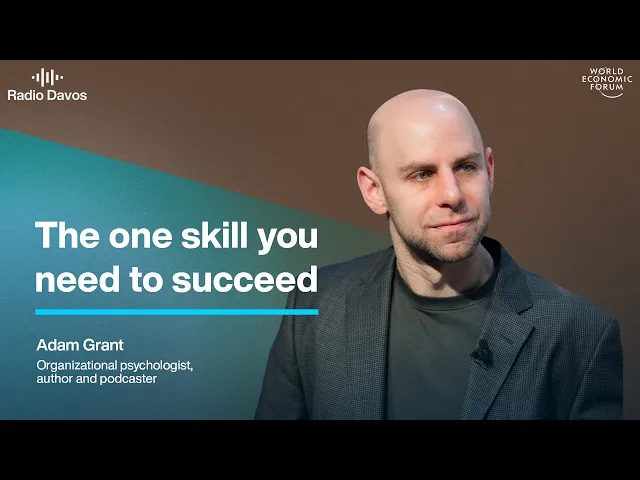
The one skill you need to succeed in your career in a turbulent world - by Adam Grant
World Economic Forum
0:00 We don't live in a stable world anymore.
0:02 We live in a rapidly changing turbulent world.
0:06 And [music] in a dynamic environment,
0:08 intelligence is not just your ability to think and learn,
0:12 [music] it's your capacity to rethink and unlearn.
0:13 Welcome to Radio Davos, the podcast of the World Economic Forum.
0:17 He's a best-selling author, his name is Adam Grant.
0:19 His books include Think Again.
0:22 On the I'm not biased bias.
0:24 [music] I think of it as the mother of all biases, Robin.
0:27 It's it's the belief that you might have
0:29 flaws in your thinking, but I am neutral.
0:31 I'm rational.
0:32 [music] And the danger of that is,
0:34 the better you are at thinking, often the worse you are at rethinking.
0:38 What what do you hope might happen in the world?
0:42 What would you like to see?
0:44 [music]
0:44 One of my biggest hopes, Robin, is that we change what we value in leadership.
0:48 There's a a cluster of personality traits that are called the dark triad.
0:51 They are narcissism, Machiavellianism, and psychopathy.
0:56 And this is the exact opposite of what we should be looking for in leadership.
1:00 I would love to see that tide turn [music] in 2026.
1:04 I would love for, boards of directors when it comes to choosing CEOs,
1:08 voters when it comes to electing politicians, to put their foot down and say,
1:12 "Character matters as much as competence [music] and charisma.
1:15 And if you are not willing to put
1:17 the best interests of the collective [music] above yourself,
1:19 you are unfit to lead." Welcome to Radio Davos,
1:26 the podcast of the World Economic Forum that looks
1:28 at the biggest challenges and how we might solve them.
1:32 I'm Robin Pomeroy, and on this episode,
1:34 which we're recording at the annual meeting 2026 in Davos,
1:38 I'm talking to a just a great guest who is an organizational psychologist.
1:44 He'll tell us what that is.
1:45 He's a best-selling author, his name is Adam Grant.
1:48 His books include Think Again, The Power of Knowing What You Don't Know,
1:53 and Hidden Potential, The Science of Achieving Greater Things.
1:58 You may know him from his podcast Rethinking and Work Life,
2:01 and his monthly newsletter that reaches 200,000 people.
2:05 Adam Grant, it's a joy to meet you.
2:07 How are you doing?
2:08 Hey, it's great to be here, Robin.
2:09 Thanks for having me.
2:10 Now, you've been at Davos several times.
2:13 I've seen you around before.
2:15 I remember the first time I saw you was
2:16 in the Congress Center just out in that kind of atrium area,
2:19 and you were mobbed by people.
2:20 Considering this is a place full of chief executives and heads of government,
2:26 you know, I had to fight my way through to you.
2:28 Everyone wants to talk to Adam Grant.
2:30 My first question to you, what are they asking you?
2:35 Uh I think it stays over time.
2:37 I think when I first started coming,
2:39 people mostly wanted career and leadership advice.
2:42 And now I'm hearing many more questions about how do I drive major changes?
2:48 How do I shift a culture?
2:50 Can I get a selfie occasionally?
2:52 Which I never know why anyone wants that, but uh I think I think people
2:56 are really thinking more globally and more
2:58 macro about how do we fix broken systems?
3:01 And what's the question they should be asking?
3:02 What would you ask yourself if you came
3:04 across you in a in a conference somewhere?
3:06 I I think the I don't know, the question I'm always excited to get is,
3:10 what's something you learned lately that surprised you or changed your mind?
3:14 Adam Grant, what's something you learned lately
3:16 that surprised you or changed your mind?
3:18 You know, one one of my big surprises
3:19 recently was there's this whole debate about attention spans.
3:23 And, you know, in the TikTok generation,
3:25 you know, attention spans supposedly are shrinking.
3:29 Not so fast, says a big meta-analysis, a study of studies.
3:33 Dozens of studies, thousands of people.
3:35 If you look at tests of concentration over a three-decade period,
3:38 adults and children have not gotten worse.
3:42 Uh they're just as good.
3:43 In some cases, they're even better.
3:46 So, what's going on there?
3:47 I I started digging into the research,
3:48 and it turns out it's not our ability to pay attention that's suffering.
3:53 It's our motivation.
3:54 We're used to looking for the next shiny object.
3:56 And the good news is that people are fully capable
3:59 of focusing for extended periods of time if you sustain their interest.
4:03 And frankly, that explains something that's mystified
4:06 me for a long time, which is,
4:07 why are these teenagers who supposedly can't pay attention to anything
4:11 binging eight hours of a show on Netflix that requires sustained attention?
4:16 Why are they sitting playing video games for 14 hours at a time?
4:19 That requires sustained attention.
4:21 And I think what's distinctive about video
4:23 games and great shows is they are motivating.
4:26 They spark our interest, they maintain our interest,
4:28 and I think we need to get better at that.
4:30 Isn't that passive attention, though?
4:33 Are we getting Is it getting harder to you know,
4:36 we all remember our student days,
4:38 anything was more interesting than the studying you're meant to be doing.
4:42 I think I feel like that now,
4:44 and I guess the assumption that you're challenging there is young
4:48 people are even worse than that than I was or I am.
4:52 Is any truth to that, do you think?
4:53 Well, I think there's a nuance here that often gets missed,
4:56 which is, yes, watching TV is passive attention.
4:59 Except if you look at how teenagers are watching TV now,
5:01 and I see this with my own kids,
5:03 they're watching with subtitles on very frequently,
5:06 which means they're not just sitting there lazily consuming.
5:09 They're reading as they're listening.
5:11 That counts as as some degree of active engagement.
5:13 Video games even more so.
5:15 There's a huge body of evidence showing
5:17 that video games actually boost grit and resilience.
5:20 They teach self-control and willpower.
5:22 They force you to grapple with failure in a lot of cases,
5:24 also to try to figure out how to collaborate
5:26 with other people who are potentially competing against you.
5:29 I don't think that's passive at all.
5:30 I see that as active.
5:32 Let's I want to talk to you about talking to people,
5:36 cuz I think you're a really great interviewer.
5:39 You won't Oh, thank you.
5:42 you Everyone Everyone tells you this, and I
5:44 want to delve into your kind of interview technique.
5:46 I want to learn some things from you.
5:48 Before I do, I promised our listeners and viewers you tell us what your job is.
5:53 You know, what is this organizational psychologist?
5:55 I think that's a an American expression
5:58 that doesn't quite translate to British English.
5:59 Is that right?
6:00 Perhaps.
6:01 In Europe, more often we're
6:02 called occupational psychologists or work psychologists.
6:05 Basically, I study how to make work not suck.
6:08 And I started my career studying how
6:10 to make jobs more meaningful and motivating.
6:12 I then transitioned to also looking at team effectiveness,
6:15 collaboration, creativity.
6:17 Now I do a lot of work on organizational cultures as well.
6:19 So, basically, anything that has to do with human
6:21 behavior at work or around trying to achieve a goal,
6:25 that's that's endlessly interesting to me.
6:28 Fun fact about you, I mean, people who follow your work will already know
6:32 this, but before you were a professor at the Wharton School,
6:36 which is the business school of the University of Pennsylvania,
6:39 you had some other interesting career options.
6:42 Were you a magician?
6:44 I was.
6:45 I Yeah, I did I did perform as a magician for a number of years,
6:48 and I was not good enough to quit my day job, but What was your best trick?
6:53 My my favorite trick, my favorite short trick anyway,
6:56 is a trick where I have somebody from the audience pick a card.
6:59 I try to find it in the deck, it's disappeared,
7:01 and then I throw the deck against the wall, and the card is stuck on the glass.
7:06 Usually on a window.
7:07 Okay.
7:08 Good.
7:08 Oh, I gosh, I should have brought a deck of cards.
7:10 We got windows here.
7:12 But, so here's the other one.
7:13 Here's your other career option.
7:15 You know where I'm going, I'm sure.
7:17 You sometimes refer to yourself as the second
7:19 best celebrity springboard diver after Jason Statham.
7:22 Is that Is that correct?
7:24 I'm not a celebrity, but Jason Statham is definitely He was both uh well,
7:30 he's obviously much more recognizable than I am,
7:32 but he's he was also a much better diver than I was.
7:34 He was on the British national team for something like a decade.
7:38 I was a springboard diver.
7:40 I was not good enough to make Olympic trials.
7:43 I kind of peaked by becoming a junior Olympic national qualifier,
7:47 and I I actually think a big part of my interest in psychology and trying
7:53 to apply that to our lives came out of diving when I was afraid of heights,
7:57 and I had to motivate myself to flip and twist in midair,
8:01 and I was worried that I was going to get
8:02 lost or belly flop or end up smacking on my back.
8:05 And transitioning then from diving to coaching,
8:08 trying to get other divers to do the same thing,
8:10 it really made me realize there's a lot
8:12 we don't understand about what makes us tick.
8:15 Having experiences like that, that's quite formative, isn't it, to people?
8:20 Whether that's sporting or some kind of risk-taking activity,
8:25 challenging yourself.
8:26 I wonder if you've ever tried, for example, stand-up comedy.
8:30 Is that something you've ever tried?
8:31 Cuz that's one of those things, standing on a diving board, terrifying.
8:34 You know, addressing a theater full of people, terrifying.
8:38 Stand-up comedy, but these are things having these challenges, pushing yourself.
8:42 Do you think that's something we should all do,
8:45 or is that just too much of a generalization?
8:47 I think So, I've never tried stand-up comedy.
8:50 I think it would be a fun challenge to take on.
8:51 I did do improv for the first time this past year.
8:55 And it it felt actually a lot like teaching or, you know,
8:58 answering questions after a keynote speech or or even a live podcast interview.
9:03 Where, okay, the goal is to you know,
9:05 to make people laugh, but at the end of the day,
9:07 you're trying to to take everything that you've
9:09 learned and make it relevant to the audience.
9:12 I think for me, being in those positions was profoundly uncomfortable at first.
9:17 As a shy introvert, I was afraid of public speaking.
9:19 I didn't want to be on stage.
9:21 And I think early on I learned through diving
9:24 that seeking out and embracing discomfort was actually key to growth.
9:28 And the more I put myself in in situations that I
9:31 really would rather not be in, and might even embarrass myself,
9:35 the more I was forced to stretch my skills.
9:37 And so, I don't know that stand-up comedy is the right option for everyone,
9:40 but I think if we all made a list of, you know,
9:43 the situations that make us nervous, and then forced ourselves into them,
9:46 we'd end up accelerating our own growth.
9:48 And what is it that you advise people to jump off that diving board,
9:55 or figuratively speaking?
9:57 I mean, is it it could be look look everyone else,
10:00 not everyone, but some people can do it, so why can't you?
10:03 Is it that?
10:04 What's so special about that person?
10:06 You give it a go.
10:06 You may work I mean, what is Is there one key bit of advice to say,
10:10 "Go on, give it a go." I mean,
10:11 you literally said it if you were a coach to divers, you literally said,
10:15 "Jump into the abyss." What did you What did you say to them?
10:18 Well, I I was really lucky to have an extraordinary coach, Eric Best,
10:21 who changed the way that I thought
10:23 about motivating myself and also other people.
10:25 I I remember one practice where I was supposed to do uh
10:29 the hard probably the hardest dive I had ever done to date.
10:32 It was a full twisting two and a half,
10:33 so two flips, uh 360 turn, and then a dive.
10:37 And you know, normally as you know, as a diver who faced a lot of fear,
10:41 I would I would stand at the end of the board shaking for a few
10:43 minutes before I I went when it was time to try a new dive.
10:47 This is a whole 'nother level of fear for me.
10:48 I stood there shaking for 10, 20, 30, 40 minutes.
10:53 Finally, at 45 minutes, I'm just frozen.
10:57 Eric has run out of patience.
10:58 And he says, "Adam, are you going to do this dive?" And I thought, "Ever?
11:06 Yes, one day I would love to do this dive." And I told Eric that.
11:09 He said, "Great.
11:10 What are you waiting for?" And all of a sudden, Robin,
11:13 I realized I had the relationship between confidence and action backward.
11:17 I was waiting until I felt confident to take the leap.
11:21 But I needed to take the leap in order to gain confidence.
11:25 And I that's literally true in diving, right?
11:27 But I think it's a great metaphor for risk-taking in life.
11:31 I remember when I got tenure at Wharton,
11:34 I had a group of students tell me I should write a book.
11:36 And I said, "I'm not ready yet." And then I heard Eric's voice in my head,
11:40 "Would you like to write a book one day?" "Yes.
11:43 Great.
11:43 What are you waiting for?" When I got asked to give my first TED Talk,
11:47 I thought there is no way I'm ready to get in that red circle.
11:50 And I heard Eric's voice echoing, "Would you like to do this one day?" "Yes.
11:55 Why not today?" And it's a question I
11:57 found myself asking over and over of myself, but also with other people.
12:01 Um I used it frequently as a diving coach.
12:03 I would ask divers, just like Eric asked me, you know, "Do you want to do this?
12:07 What are you waiting for?" Um but I've also found myself motivating friends,
12:10 family, colleagues the same way, even my own kids sometimes.
12:13 Have you ever had one of those friends,
12:15 family, student ever come back to you and say,
12:18 "Adam, that was the worst piece of advice I've ever had.
12:20 I failed on my backside." Has that ever happened?
12:24 I haven't had that happen yet,
12:25 because normally when people are are grappling with the question of, you know,
12:30 of whether to wait or take the leap,
12:32 they've already built enough skill or enough
12:34 motivation that they they are prepared.
12:37 But I did have it sort of backfire once
12:39 uh when our when our son was he was eight.
12:42 He was waffling about whether to go on his first roller coaster.
12:45 And I said, "Henry, do you want to do this?" And he said, "No, Dad,
12:49 I don't." And that was the end of the conversation,
12:52 and it took another year to get him on one.
12:54 Um okay, I'm going to get to this bit.
12:56 I want you to coach me in interview technique.
13:00 I was listening to one of your many great podcast episodes,
13:04 and this one was with someone called Daryl Davis,
13:08 uh an African American who spends his time
13:10 talking to extreme right-wing racists and white supremacists.
13:15 Not messing about here.
13:16 People who think white people are just much much better than he is.
13:22 And it's extraordinary that he he seeks that out.
13:25 It's not just he's bumping into them by chance.
13:28 And so your conversation with his with him,
13:31 I'll put a link in the show notes to this, so people can go and hear it.
13:34 Absolutely extraordinary to me.
13:36 But you asked him how he did those conversations,
13:42 and how he was able to persuade the unpersuadable.
13:46 And you said, "Oh, I recognize
13:47 your technique." After giving his answer, he said,
13:50 "What you're doing there is motivational interviewing." Can
13:54 you tell us something about what is that?
13:57 And and how how does someone like him use that technique?
14:01 Yeah, definitely.
14:02 Motivational interviewing is one of my favorite
14:05 ways of helping people think about change.
14:08 Uh it comes out of counseling psychology.
14:10 Um originally, a pair of counseling psychologists, uh Miller and Rollnick,
14:14 were working with um people who were struggling with addiction.
14:18 And at the time, the you know,
14:20 basically it was a lot of blaming and shaming uh to say,
14:22 you know, "How could you do this?
14:24 You're ruining your life.
14:25 Uh you're letting your family down." And they
14:28 found that not only was this not effective,
14:31 it just it made people either feel terrible about themselves or get defensive,
14:35 and and change didn't happen.
14:37 And they started wondering if there was
14:39 a a better way to help people think about change.
14:42 And the insight they stumbled onto was
14:45 when people are having a hard time changing,
14:48 the worst thing you can do is just try to argue with them or persuade them.
14:53 The best thing you can do is get curious and interview them.
14:56 And instead of trying to motivate them to change,
14:59 your job is to help them find their own motivations to change.
15:02 And so in the addiction context,
15:04 what they would do is they would ask somebody, you know,
15:06 "Tell me a little bit about uh you know,
15:09 what what are the the effects of alcohol in your life?
15:11 You know, what are the upsides?
15:12 What are the downsides?" They're trying to be very neutral about it, right?
15:15 They're they're not steering you in one direction.
15:17 And you know, then then somebody would say, "Well,
15:19 you know, I love how I feel when I drink.
15:21 But then, you know, I I got in a car accident." And you know,
15:25 instead of saying, "Oh, that's terrible.
15:27 You know you shouldn't do this again." Um Miller
15:29 and Rollnick would would say, "Oh, but you know,
15:32 you survived the car accident, so clearly this is not a big deal in your life.
15:36 Like tell me more." And very often um the client would say, "No, you know,
15:40 actually this is a huge problem." And then
15:43 Miller and Rollnick would say, "Well, why?
15:45 Like what what is the issue it poses for you?" And then what
15:48 what was happening was the clients
15:49 were were basically talking themselves into change.
15:53 And I think, you know, there there have been over a thousand randomized
15:56 controlled experiments showing that this is a a helpful
15:58 way to help people surface their own
16:00 reasons to shift their attitudes or their actions.
16:02 And when I met Daryl Davis, Daryl was one of the stars of of Think Again.
16:06 When I first met him, I was just blown away that this jazz
16:09 musician took it upon himself to confront people who
16:13 believed that he was unintelligent and that he
16:16 was a lesser human being because of his race,
16:19 and then talked them out of white supremacy.
16:21 And so we're doing this podcast, and I want to know more about his technique,
16:24 and I asked Daryl to describe it.
16:26 And he says, "Basically,
16:27 what he does is he he walks up to these white supremacists,
16:30 or sometimes they'll approach him after he's he's performed a gig uh in a bar,
16:35 and they'll come up to him and strike up conversation about music.
16:39 And then, you know, at some point they will disclose, you know,
16:42 'I'm a member of the Ku Klux Klan.' And Daryl will ask just one question.
16:48 He wants to know, 'How can you hate me when you don't even know me?'" I
16:53 think what's so powerful about that question is
16:56 it's a hard one for people to answer.
16:58 And so these white supremacists will say, "Well, you know, your you know,
17:04 your group has done a lot of bad things." And Daryl will say,
17:07 "Absolutely." And you know, then he'll ask them some more questions back,
17:12 and eventually he will help them unpack
17:14 their own reasons to question their beliefs.
17:16 And as he was describing this, I just said,
17:18 "This is This is I mean, this is motivational interviewing.
17:22 It's a master class in how to do that." Because he's not telling them,
17:26 "You shouldn't believe this." He's not saying, "I'm actually as good as you,
17:30 and you were wrong." He's not preaching his beliefs,
17:33 he's not prosecuting their beliefs.
17:35 He's curious, he wants to understand, "How did you arrive at that view,
17:40 and how do you sustain it?" And usually at the end of one conversation with him,
17:44 people are starting to second-guess their views,
17:47 and over time, sometimes it's months,
17:49 sometimes it's weeks, sometimes it's years,
17:51 they will end up abandoning their hate.
17:54 You mentioned uh Think Again, The Power of Knowing What You Don't Know.
17:59 That was the book you wrote.
18:01 Can you just give us in a nutshell, why is it important for us to think again?
18:06 What what was kind of the USP of that book?
18:08 So I think the the basic idea behind Think Again is
18:11 that we we normally see intelligence as the ability to think and learn.
18:18 And that was true in a stable world.
18:21 We don't live in a stable world anymore.
18:23 We live in a rapidly changing, turbulent world.
18:27 And in a dynamic environment,
18:29 intelligence is not just your ability to think and learn,
18:32 it's your capacity to rethink and unlearn.
18:35 Because the assumptions that you held yesterday may not be true today.
18:39 The strategies that you invested in if you're a leader,
18:42 um the vision that you articulated, the decisions that you made in the past are
18:45 not necessarily going to be effective in the future.
18:49 And so I got really interested in how
18:51 do we improve people's skills at rethinking and unlearning.
18:55 And one of the the the bodies of research that that really
18:58 blew my mind was on the I'm Not Biased Bias.
19:02 Uh I think of it as the mother of all biases, Robin.
19:04 It's it's the belief that you might
19:07 have flaws in your thinking, but I'm neutral.
19:09 I'm rational.
19:10 I am objective.
19:11 I am a great thinker.
19:13 Well, it turns out the higher you score on an intelligence test,
19:18 the more likely you are to fall victim to the I'm Not Biased Bias.
19:21 Because you've got a long track record
19:24 of being told you're smart and you're right.
19:27 And the danger of that is the better you are at thinking,
19:30 often the worse you are at rethinking.
19:33 What advice do you give I bet I asked you at the beginning of this interview,
19:38 what do people rush up and ask you?
19:41 What help or advice do they ask you?
19:43 I'm betting a lot of people ask you,
19:45 they'll say, "Adam, when I go home for Thanksgiving,
19:48 I'm going to say it like an an American way,
19:50 cuz it it always seems to be the festival that's talked about.
19:54 You know, my father-in-law is of a completely different political persuasion.
20:00 In a country, and I think it's so true in lot many parts of the world,
20:04 certainly in Europe, that's very polarized.
20:06 So, maybe a generation ago it wouldn't have been so bad if you were, you know,
20:10 one party or another, but now it's very,
20:12 very different in a in a situation where even facts are contested.
20:18 Very clear fact.
20:20 So, how do you Is that uh wisdom that you've just talked about that?
20:25 Is that something you could use when you're talking to someone
20:27 face-to-face who just won't accept something that you know is a fact?
20:32 I mean, you know, I'm not going to rethink the fact because,
20:35 you know, the earth isn't flat.
20:37 The earth is round, right?
20:39 But, you need to deal with that person
20:44 either in business or in a personal capacity.
20:48 What What's the skill we need to not just, you know,
20:52 walk away or punch them in the face or whatever whatever happens?
20:55 Well, I think you have a few options there.
20:57 The first one is to recognize that we actually overestimate polarization.
21:01 There's a a pretty big gap between the assumptions we make about
21:05 people who hold different views from us and the actual views they hold.
21:08 It's called the perception gap actually in in psychology
21:11 and very frequently what you'll find is,
21:14 you know, nobody is defined by their worst view or their most hateful belief.
21:19 And so, it's it's pretty likely that, you know,
21:21 even if you have an uncle that that you think is just way out there,
21:25 that you can find some common ground with them.
21:27 Uh that's one option.
21:29 I think a second option is is to recognize
21:31 that oftentimes the root of polarization is binary bias,
21:35 uh which is the tendency that many of us have
21:37 to to try to come up with a coherent worldview,
21:41 to take complexity and oversimplify it into just two categories.
21:45 We we see this all the time in the US when
21:47 it when it comes to gun safety and gun rights, for example.
21:51 You know, people basically will say, "Well, you know,
21:53 I'm either pro gun rights or I'm pro gun safety."
21:56 And then they will think we're on opposite sides of the debate.
22:00 If you actually look at the data,
22:01 though, there are at least six different camps.
22:03 And over 85% of Americans believe in universal background
22:06 checks before you can get access uh to a gun.
22:10 And so, you could start that conversation by saying,
22:12 "Let's talk about universal background checks.
22:14 Let's talk about whether somebody with a mental illness,
22:17 a diagnosed mental illness,
22:19 should have access to firearms." You start with that, and all
22:22 of a sudden that person that you think
22:24 disagrees with you actually is is much more likely
22:26 to be on the same page with you than you realize.
22:28 And what I love about this is there's some research by Peter Coleman which
22:31 shows you don't even have to start on the issue that you disagree on.
22:35 In one of Peter's um bodies of work,
22:37 he he runs this difficult conversations lab where he has people
22:42 deliberately taken because they hold opposing views on a charged issue.
22:47 And he randomly assigns some of them
22:49 to read an article about a completely different issue.
22:52 And instead of presenting that as one side, the other side,
22:55 he presents it as, "Here are all the different shades
22:58 of gray on that issue." And if you, for example,
23:00 just get an article about the complexity of people's views on climate change,
23:05 then you are dramatically more likely to find common
23:08 ground with somebody who disagrees with you about guns.
23:11 And so, I think the maybe the broader lesson
23:13 here is that we need to complexify our thinking.
23:16 We need to take these issues that are
23:17 oversimplified and look for the nuance in them,
23:19 and that's where we have more thoughtful conversations.
23:22 Do you think there's any evidence that people are doing that?
23:25 Have you seen people do that?
23:27 I [sighs and gasps] I think there is You know, it's funny.
23:31 I think there is I I've seen a lot of people
23:34 doing this, but I also probably hear about it disproportionately because,
23:38 you know, there are Think Again readers and dis- and listeners who,
23:41 you know, who reach out and say, "Hey, I tried this.
23:43 Here's what happened." I think the of everything
23:46 that I have recommended and studied,
23:48 the one question that I've gotten the most traction with is when I ask people,
23:54 like let's say I'm talking even to a flat-earther or somebody who
23:57 thinks that like horoscopes um and zodiac signs are predictive of anything,
24:03 uh which empirically they're not, I'm sorry to say,
24:06 for people who are fans of astrology.
24:09 When I talk with people who who believe
24:11 in things that have just been empirically falsified,
24:13 that are not supported by facts, the best conversation that I have is asking,
24:17 "What evidence would change your mind?" And what I
24:22 love about that is it grounds the conversation in facts.
24:25 Right?
24:25 I want to know, "Okay, what would you have to see?
24:28 What proof?
24:29 What data would you find convincing?" And then I
24:32 can reason with you on your terms instead of mine.
24:35 And I I've just found that to be much more
24:37 fruitful than just arguing with people right off the bat.
24:40 How do you think the world's going?
24:42 Um the [laughter] That's not a loaded question.
24:46 But, well, it's interesting cuz you said earlier that we all
24:51 assume that kids today have got a less of attention span.
24:55 I think in that podcast episode,
24:57 you were using the phrase uh you and your guest were saying,
24:59 "They say." I mean, it's a lovely thing.
25:02 "They say," and you never have to say who it is.
25:04 Who?
25:04 Yeah, who's your source?
25:05 So, they say that we're getting more polarized.
25:10 They say we can't talk to each other anymore.
25:13 I mean, I think it's probably true, but I don't know.
25:16 I don't have any empirical evidence.
25:17 You You study psychology.
25:19 You're looking at evidence and data all the time.
25:22 Are they right this time?
25:24 Well, I I do think empirically we have good evidence
25:27 that polarization has increased over the last decade or two.
25:30 And that there are lots of reasons why that is.
25:33 Well, I I think that one that one does seem to be getting worse,
25:36 but it's not as bad as we think it is.
25:39 I think if you look at most other metrics,
25:41 this is still broadly speaking the best time in human history to be alive.
25:45 If you look at life expectancy, if you look at disease, if you look at poverty,
25:50 if you look at hunger,
25:52 if you look at violence, all trending in positive directions.
25:56 And I think sometimes a mistake that we make
25:58 is we zoom in on one little dot, right?
26:01 And we we kind of over we overindex on, you know,
26:05 the like the particular instances of violence that are in the news.
26:09 And we don't zoom out and say, "Actually,
26:11 the murder rate has fallen year by year in developed countries."
26:16 Even even though we have an ongoing land war in Europe,
26:20 war is down dramatically.
26:22 And I think we need to do more of that zooming out.
26:24 I think yeah, anybody who's read Factfulness or The Better
26:29 Angels of Our Nature or Not the End of the World,
26:32 I think the the data-driven story about the state
26:37 of the world is a little more uplifting than the news-anchored version.
26:42 That's a nice kind of outlook.
26:44 I was going to ask you for your hopes and fears for 2026.
26:47 What would you Let's just do a hope, shall we?
26:49 What would you hope might happen in the world?
26:53 What would you like to see?
26:55 You know, one of one of my biggest hopes,
26:57 Rowan, is that we change what we value in leadership.
27:00 There's a a cluster of personality traits that are called the dark triad.
27:04 They are narcissism, Machiavellianism, and psychopathy.
27:08 And this is the exact opposite of what
27:11 we should be looking for in leadership, right?
27:13 Because narcissists are all about themselves.
27:15 Machiavellians are manipulative and will basically believe that the ends
27:20 justify the means and do whatever it takes to get ahead.
27:23 And psychopaths um tend to not feel a great deal of concern for others.
27:28 And we know that great leaders are the reverse of that, right?
27:31 They put their mission above their ego, not their ego ahead of their mission.
27:36 And, you know, whether we talk about servant leadership or some of the work
27:39 that I've done on elevating givers over
27:41 takers or valuing humility as opposed to arrogance,
27:46 I think I would love to see that tide turn in 2026.
27:50 I would love for, you know, boards of directors when it comes to choosing CEOs,
27:54 voters when it comes to electing politicians, to put their foot down and say,
27:58 "Character matters as much as competence and charisma.
28:01 And if you are not willing to put
28:03 the best interests of the collective above yourself,
28:06 you are unfit to lead." You think that would be our natural state, wouldn't you?
28:09 What Why isn't it?
28:10 Why is it like nice guys don't win,
28:12 and, you know, those things actually can be quite effective?
28:15 Well, I think there are there are a couple
28:16 of mechanisms that that show up in the research.
28:18 One One challenge we run into is superficial charm.
28:21 People mistake confidence for competence.
28:24 And so, you know, narcissists are, you know,
28:27 are often captivating when you first meet them
28:30 or when you see them from a distance.
28:32 And it's only as you observe them over time or up
28:34 close that you start to see their more toxic tendencies.
28:37 I think the other issue is that people
28:40 see oftentimes um this kind of aggressive,
28:44 dominant approach as a sign of strength.
28:47 In times of In times of flux,
28:49 people actually gravitate toward the narcissist or the authoritarian
28:52 leader because they look at that person and say,
28:55 "That makes me feel safe and secure.
28:57 That person's strength is what we need." And ultimately, in the longer term,
29:03 it's not because the moment that leader's personal interests
29:06 diverge from what's good for the company or the country,
29:08 you can no longer trust them.
29:10 And I think people are making a Faustian bargain when they make that choice.
29:13 How can that change, though?
29:15 You know, uh company boards are often like that.
29:19 We've all worked with or for people who are just like you've described.
29:22 I don't know if there's anyone listening to this who's not thought,
29:26 "How on earth did that person get to where
29:27 they are?" How can you break that cycle?
29:30 If you've just explained very clearly why we believe
29:33 in that triad of bad uh personality uh traits, how do you break that?
29:40 You can bring it in yourself, but I could change my mind,
29:42 but that doesn't mean my company or my country
29:45 or my government is going to change.
29:46 What What needs to happen?
29:48 Well, I think I think we have the best data on uh how to fix this in workplaces.
29:52 So, in organizations, one of the mistakes we make is we
29:54 tend to promote people only based on individual results.
29:57 And that allows the narcissist and the Machiavellian to get ahead.
30:01 What we ought to be doing is not just indexing your own performance.
30:04 We should be measuring what is your impact on others.
30:07 There's great research on this on um on sales people, for example.
30:10 Alan Benson and colleagues have studied over 30,000 sales people.
30:14 And what they want to know is who's a great sales manager.
30:16 And the people who often get promoted are the best individual sales people,
30:20 the biggest rainmakers who bring in the most revenue.
30:22 They are not the most effective managers of teams of sales people, though.
30:26 What's the leading indicator that you were going
30:27 to be a great leader of sales teams?
30:29 It's how many assists you gave to other sales people.
30:33 Did you refer clients to them?
30:34 Did you help them solve problems?
30:36 Did you get them access to deals?
30:38 And that's a great example for me of measuring
30:40 what is the value added to your team.
30:42 Let's promote on that basis, not just what did you accomplish yourself?
30:46 There's hope someone's listening in a position [laughter]
30:49 of who's hiring and firing and takes that to heart.
30:52 Adam Grant, thanks so much for joining us on Radio Davos.
30:56 Always a pleasure, Robin.
30:58 We've been recording lots of great interviews here in Davos.
31:02 And to be sure not to miss them,
31:03 follow Radio Davos and our sister podcast Meet the Leader.
31:07 You can get either of them wherever you get podcasts or visit wef.ch/podcasts.
31:13 I'm Robin Pomeroy at the World Economic Forum.
31:16 Thanks for listening and watching Radio Davos and goodbye for now.