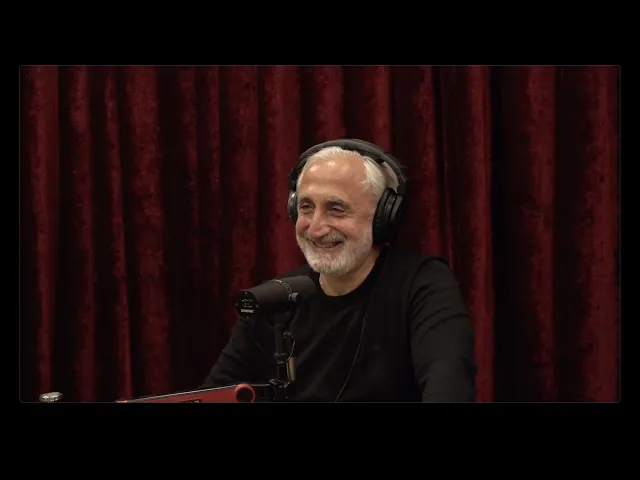
Joe Rogan Experience #2497 - Gad Saad
PowerfulJRE
0:01 Joe Rogan podcast.
0:03 Check it out.
0:04 The Joe Rogan Experience.
0:06 TRAIN BY DAY.
0:06 JOE ROGAN PODCAST BY NIGHT.
0:09 All day.
0:13 Good to see you, sir.
0:14 Oh, so good to see you.
0:15 What's happening?
0:15 How you been?
0:17 Doing great.
0:18 Uh, got big news.
0:20 I'll talk big, very big before I start with it.
0:24 Okay.
0:26 Drops
0:25 the book suicidal empathy.
0:28 quote that we use all the time.
0:29 That's right.
0:30 Yeah, it is a it is a good quote and it is a very accurate quote for the times.
0:35 I like this where they're carrying a sign.
0:37 Free the wolves.
0:38 The lamb is [snorts] carrying
0:39 Well, I wanted the the cover to be as evocative as the the concept, right?
0:45 Dying to be kind.
0:47 There you go.
0:47 And there are just in the last two days,
0:50 there have been so many new cases of suicidal empathy
0:52 that I regret that I couldn't include them in the book.
0:56 But
0:56 like which ones?
0:57 So, did you hear about the one where
0:59 the the guy who tried to assassinate President Trump?
1:02 Oh, yeah.
1:03 The judge then went and said,
1:04 "I am so sorry that, you know, you're not being treated nicely.
1:08 You have a a a room without a window.
1:11 This is just it's mean."
1:13 Oh, see, I don't think that that's suicidal empathy at all.
1:15 I think that's signaling.
1:17 I I think that's signaling that he wishes
1:19 that that man was successful and that he supports his endeavor.
1:23 Fair enough.
1:24 The second example, uh, actually today, uh, Dave Rubin shared it with me.
1:29 Uh, it was the one where a felon
1:33 of color who had just been released ended up pushing right.
1:38 And and the the previous person that he had been entangled with didn't want
1:42 to whatever press charges because she didn't
1:45 want another black man to be in prison.
1:47 Oh boy.
1:48 So, uh, boy, boy, boy.
1:50 So we can so I hope to get into the book in a second.
1:54 But the other big news is that this past year I've
1:57 been a visiting scholar at Old Miss uh University of Mississippi.
2:03 I had taken a two-year leave from my school at in Montreal.
2:07 Starting this uh summer, we are moving permanently to Oxford.
2:13 So the Lebanese, Jews, Canadians are going down to Oxford,
2:17 Mississippi, and we're very excited.
2:19 Wow.
2:19 Yeah.
2:20 Yeah.
2:20 Yeah.
2:20 Um, so you're going to be there for 2 years.
2:22 So, how does that work?
2:23 Do you get a green three years to get a green card or a visa?
2:26 Yeah.
2:26 So, the the previous two years that I did, it was a leave of absence.
2:30 So, I I I only have to get a TN visa.
2:32 But now that we're moving, uh,
2:35 we I applied for an EB1A visa, which gets you a green card.
2:39 It's one they're called extraordinary visas.
2:42 You have to pass certain criteria to demonstrate.
2:44 You are extraordinary, aren't you?
2:45 And rather easy on the eyes.
2:47 Uh [laughter] and so uh and so that went through uh thank God.
2:52 And so yeah, so we're very congratulations.
2:56 Yeah.
2:56 Yeah.
2:56 So and hopefully this will be a fast track to my inner spirit is American,
3:01 but maybe we can legalize it and turn turn the sads into Americans.
3:06 Wow.
3:06 You joined you're going to join the team.
3:09 If if you'll have me.
3:10 I will have you.
3:11 Come on.
3:12 Welcome aboard.
3:13 Yeah.
3:13 Yeah.
3:13 Yeah.
3:13 We need more people that are thinking straight.
3:15 So that's the big news.
3:16 That's awesome, man.
3:17 Congratulations.
3:18 That's a fantastic thing.
3:19 That's beautiful.
3:21 Do you want to get into the book and then we talk about other stuff?
3:23 Sure.
3:23 Whatever.
3:24 So, I I thought maybe I'd give you
3:26 because I know that you know the parasitic mind
3:28 really well and so I wanted to kind
3:30 of contextualize this book in relation to that book.
3:34 Mhm.
3:34 So, we are a thinking and a feeling animal, right?
3:37 Both our cognitive system is important and our affective system is important.
3:41 For example, uh advertisers recognize that if
3:45 I'm trying to sell you a mutual fund, I need to engage your cognitive system.
3:51 Here are the seven reasons why you should buy my mutual fund.
3:53 If I'm trying to sell you perfume, I don't tell you this is what Harvard
3:58 physiologists think about the science of alaction, right?
4:02 I need to engage your affective system.
4:05 So in that case I will show you a pretty girl on a horse with beautiful
4:10 hair and the the brand name will be
4:12 Mist right I'm just engaging your emotional system
4:16 well the parasitic mind was the story of what
4:19 I need to do to hijack your cognitive system
4:23 your your your ability to think rationally and hence there
4:26 were all these parasitic ideas that destroyed your capacity to think
4:30 but for me to completely zombify you and hijack
4:34 you I also need to zombify your affective system.
4:38 That's where suicidal empathy comes in.
4:40 So, if I can hijack both your cognitive and emotional systems,
4:44 you become a wood cricket,
4:45 which we could talk about what that references if you want.
4:48 What's a wood cricket?
4:49 So, the wood cricket is a an an insect that abhores water.
4:53 It wants nothing to do with water.
4:55 But when it is paracetized by a neuroparasite called the brain hairworm.
5:00 Oh, I've seen this.
5:01 Right.
5:01 The hairworm needs the wood cricket
5:03 to happily and merrily commit suicide by jumping
5:08 into the water because that's the only way
5:10 that the hairworm can complete its reproductive cycle.
5:14 So once the hairworm hijacks the the wood cricket's
5:17 ability to think and to invoke its survival instinct,
5:21 it erases its survival instinct.
5:23 then it is owned by the hairworm.
5:25 And so I use that principle to explain suicidal empathy.
5:29 Yeah.
5:29 We've actually shown videos of that.
5:31 It's very strange.
5:32 The cricket really commits suicide.
5:34 It jumps in the water, drowns, and the worm wiggles out of its body.
5:39 Exactly.
5:38 And that's how it's born.
5:40 Exactly.
5:40 And and so many there's so many cases of that in nature.
5:44 Indeed.
5:44 Yeah.
5:45 And so the way that I originally
5:47 had the epiphany to use the parasettological framework.
5:52 So parasettology is just it's just a study of host parasite interactions.
5:56 So a tapeworm is a parasite but that parasetizes my intestinal tract.
6:01 But a sub field of parasytology is neuroparacettology.
6:05 Those are the parasites that need to go
6:07 into your brain altering your circuitry to suit their interests
6:11 including ideas
6:12 including and that's how I came up with the parasitic ideas of the parasitic
6:16 mind but in order to fully tell the story I then had to say
6:20 but but a lot of the the the mechanisms by which people seem to be completely
6:26 hijacked in terms of their ability to think
6:28 critically is really coming from an affective place.
6:31 And so how can I explain that?
6:33 And so what I argue in the book and then
6:35 we we can drill down to endless examples if you want.
6:38 I'm not saying that empathy is a bad
6:42 thing because even though the book is just dropping,
6:44 there's already been maybe 10 articles
6:46 that have been hit pieces against the book,
6:48 which of course people it means people haven't
6:50 read it yet where they say, you know, here comes the the dark Jew who's trying
6:54 to promulgate the idea that empathy is a bad thing.
6:58 He's a neocon right-wing guy, an Elon guy,
7:02 a Donald Trump Trump Donald Trump guy.
7:04 I'm I'm not saying that empathy is bad.
7:07 Empathy is actually a very important virtue to have.
7:11 In order for you and I to have a meaningful conversation,
7:14 I need to put myself in your mind and vice versa.
7:17 That's called cognitive empathy, right?
7:19 Uh theory of mind is something that typically
7:22 autistic children fail on very early in life.
7:25 That's how you diagnose them as being uh autistic.
7:27 So there's nothing wrong with well modulated empathy.
7:30 The problem with empathy like most things in life
7:34 is if there's too little or too much of it.
7:37 Aristotle explained this to us thousands of years ago via his golden mean.
7:41 If if a soldier is not courageous enough, if he's cowardly, it's not good.
7:45 If he's too courageous, he becomes a reckless martyr.
7:48 That's not good.
7:49 There's a sweet spot in the middle.
7:51 I argue empathy follows exactly that rule.
7:54 Too little of it, you're a psychopath.
7:56 too much of it.
7:57 If it's hyperactive,
7:58 if it is invoked in the wrong situations toward the wrong targets,
8:03 you end up with suicidal empathy.
8:05 Yeah.
8:05 I don't even necessarily know if it's empathy at that point.
8:09 It it completely becomes illogical and ideological.
8:14 You just subscribe to whatever the ideology says and you ignore the reality.
8:21 Like this man that pushed that guy in front of the train, right?
8:23 like this is a violent criminal and he had been arrested numerous times.
8:27 I think more than a dozen, right?
8:29 And it was very clear that there's something very wrong with this person.
8:32 He probably shouldn't be just running free victimizing people.
8:35 There was another one where um someone pushed this old guy
8:39 down a flight of stairs into the subway and killed him.
8:43 Yeah.
8:43 Same situation, same kind of person, person that had been in and out of jail.
8:48 You know, every one of these people starts off as a child.
8:51 Every one of these people starts off as a baby
8:53 and I can only imagine what kind of household they developed in.
8:58 I can only imagine what kind of abuse they suffered.
9:00 I can only imagine what happened to them.
9:03 And that's horrible.
9:05 But once they reach adulthood and they start victimizing other people,
9:10 we've got to do something as a society.
9:13 Exactly.
9:13 Now, I don't know what the tools are to rehabilitate
9:15 a person like that, but I know that they're not being employed.
9:18 uh there's not a whole lot of evidence of there's any successful program where
9:21 they're taking a person like that and doing
9:24 something with them that completely changes
9:26 their personality and the way they interact with humans and releases them out
9:30 in the world and they become a much better person than they used to be.
9:33 So I call them in the book I call them
9:35 blank slate felons because if you remember the term blank slate
9:41 it so in the parasitic mind I talk about social constructivism.
9:44 Everything is a social construction.
9:46 It's the tabular raza premise.
9:48 We're born with empty minds
9:50 with with no individual differences in our potentiality.
9:54 And it's only our unique life trajectories and our unique patterns
9:59 of social socialization that end up making us who we become.
10:02 Which in a small sense that's true.
10:04 My life experience and yours is an indelible part of who we are as individuals.
10:09 But there are individual differences that people
10:12 are born with different proclivities eventually
10:15 of committing crimes or of being NBA players or of being the next Einstein.
10:20 It's a very hopeful message though to start with the blank slate premise.
10:23 Yeah.
10:24 It's just not accurate.
10:25 Exactly.
10:25 Because it if you you and I are both parents,
10:28 I would love to subscribe to the idea
10:30 that if only I knew the exact schedule of reinforcement
10:33 of my how to ensure that my child becomes
10:37 the next Lionel Messi or the next Albert Einstein,
10:40 he too can become that.
10:41 That's a lot more hopeful than thinking, you know what,
10:44 I don't think my son has the morphological features that are
10:47 ever going to make make him to be the next NBA star.
10:50 He's too short.
10:51 he doesn't have the right athletic tools.
10:54 And so it's it's easy to understand
10:56 why people can be paracetized by these ideas.
11:00 This this person of color was born into a white supremacist society.
11:05 So he's already been victimized by society.
11:07 And for you to now punish him by having him,
11:10 you know, in the penal system, you're doubly punishing him.
11:13 So shouldn't you give him a second chance?
11:15 And by second chance, we mean 186 chance.
11:18 That's part of suicidal empathy.
11:19 But suicidal empathy doesn't even apply to only that.
11:23 The victims of rape are themselves
11:26 are suicidally empathetic towards their rapist.
11:30 Can I share some of those incredible stories?
11:33 Sure.
11:32 Uh so I start off in the book with an example
11:35 from a Norwegian man who had been sodomized by a Somali migrant.
11:42 uh because the Norwegians are very kind
11:44 and empathetic who they don't believe in long sentences.
11:47 He served maybe I don't know three years or four
11:49 like a pretty short sentence for a rape of another man.
11:52 When he was being released, he was going to be deported.
11:56 the victim of that rape had this huge
12:00 existential angst and guilt because now that you know
12:05 Ahmed was going to be released back to Moadishu
12:08 he wouldn't end up being able to maximally
12:11 flourish that like he should be well our emotional
12:14 system did not evolve to be empathetic toward
12:17 our rapist that would be an example of someone
12:19 who's being suicidally empathetic another great example uh
12:23 what happened in that case uh what in terms of whether he was deported or not.
12:27 I think I don't want to misspe but I think he
12:29 was deported to the screams and lamentations of the of the victim.
12:35 Uh there is a woman who was raped in Germany and when
12:40 the authorities were trying to find out more about who the perpetrators were,
12:46 she lied to them and said that they were uh
12:49 speaking in German even though they were speaking in Arabic
12:52 and Farsy because if she had truly said what
12:56 their language was then those communities would have been marginalized.
13:00 So, and so you know there's just an endless number of like a litany
13:03 of these examples and therefore suicidal empathy is
13:07 is really pervasive once you [snorts] recognize the mechanism
13:11 what when you look at the root of that how
13:12 do how is it so common like what what happens
13:15 so I think that that's a great question I think again it goes
13:18 back to the one-two punch of parasitic mind and suicidal empathy in order
13:22 for the fertile grounds to be available for suicidal empathy to barge
13:29 in I first have to have certain ideas that are implanted in your brain.
13:34 So let me give that sounds very abstract.
13:35 So let me give you a concrete example.
13:37 Cultural relativism is a parasitic idea that I discuss in the parasitic mind.
13:42 It basically says who are you to judge
13:45 the beliefs and the practices of another culture.
13:48 Shut up racist.
13:48 Right?
13:49 So there are honor killings.
13:50 Shut up.
13:51 There are child brides.
13:53 Shut up.
13:54 There are female genital mutilations.
13:56 Shut up.
13:56 Don't judge other cultures.
13:58 Well, if you internalize that parasitic idea that it is
14:02 not appropriate to ever judge the cultural practices of another culture,
14:07 then that renders you impotent when you're
14:10 making judgments about who should be let
14:12 into your country about whether you want an increase
14:16 of people who hold those views or not.
14:19 that therefore that leads to the suicidally
14:21 empathetic position that all immigrants
14:24 are equally likely to assimilate within the American ethos or the western ethos.
14:30 So we started off with internalizing a parasitic idea called cultural relativism
14:34 and that lays the foundation for then the suicidal empathy of open borders.
14:40 Well, there's no pressure at all to assimilate.
14:42 You're more than welcome.
14:44 That's one of the weird things.
14:45 Yeah.
14:45 more than welcome to establish a Somali
14:48 community in Minnesota where no one speaks English.
14:51 Exactly.
14:51 You know, it's it's very odd.
14:52 It's very odd that people want to come here, but when they come here,
14:56 they want to essentially turn it into a smaller version,
14:59 at least their neighborhood of where they came from, right?
15:01 And a lot I mean, if it were only that you don't speak English, I mean, to me,
15:05 that's bad enough and that you're not going
15:07 to be part of the fabric of the greater society.
15:10 But fair enough, that's not an existential threat.
15:13 But if you're then going to be advocating for many
15:17 of the cultural beliefs that are perfectly antithetical to the whole society,
15:22 then we have a problem.
15:24 Yeah.
15:24 And a lot of the cultural beliefs that are illogical,
15:27 they have to be based on something else.
15:29 And generally that's religion.
15:31 Indeed.
15:33 Yeah.
15:32 Uh and you and I have talked, you know,
15:34 very often about, you know, Islam and so on.
15:38 Some people I think I mean I wonder what you think about this.
15:41 Do do you think more Americans are willing
15:43 to have a honest and open conversation about this issue
15:46 or are most still sort of the proverbial ostrich
15:50 and they think it's goch to talk about religion?
15:53 Well, I I think it's really divided in party lines.
15:56 You know, people on the right are more than willing to talk about it.
15:59 There's very few people on the right who are
16:01 empathetic about some of the differences that these religions
16:07 have and hold and some of the rules
16:11 that they would like to apply like Sharia law.
16:14 Whereas there's a lot of people on the left
16:15 that are terrified of being called racist,
16:18 terrified of being called Islamophobic or, you know,
16:21 fill in whatever phobia, transphobic, whatever it is.
16:24 They're just terrified.
16:25 They're terrified of being labeled.
16:26 And it's interesting because that side of the political spectrum,
16:31 the the people on the left are the quickest
16:34 to pull the trigger and accuse someone of being something,
16:38 being racist, sexist, homophobic, whatever it is.
16:41 They're they're the quickest and the most vicious when it comes to attacking
16:45 people based on them not not going
16:50 along with whatever narrative that's been established.
16:53 which is interesting because they're the ones
16:56 that also like to call people fascists, but that is a form of fascism.
17:00 It's not like if you look at fascism,
17:02 it's it's essentially most people think of it as right-wing authoritarianism,
17:07 but it is also, if you look at the definition of it,
17:10 it's also a complete adherence to whatever narrative is being promoted.
17:18 Yeah.
17:18 And you don't think about that when it's a left-wing
17:21 like left-wing progressive like left-wing
17:24 progressive fascism sounds like an oxymoron,
17:27 but it's it's a mindset and [snorts] it's the the problem is
17:30 you're hiding this mindset in an ideology that you think is righteous
17:36 and this is you could say the same thing about religion because
17:40 this is also what people do with religion because it is the right thing.
17:43 It's the right thing to do.
17:45 So throw the gay off the roof.
17:47 Like it's like it's it's really kind of fascinating
17:50 like when you when you see like queers for Palestine,
17:53 you're like hold on like [laughter] like it
17:57 is a wonderful thing to empathize for the Palestinian
18:00 people and to think that they shouldn't be
18:02 bombed into oblivion and I'm with you 100%.
18:05 But when you start supporting Hamas and saying, you know,
18:08 we're queers for Hamas, like and I've seen that.
18:10 I've seen trans people for Hamas and it's like, good lord, what are you saying?
18:15 So, I've got I've got a a whole
18:17 verbatim transcript between a street interviewer,
18:21 you know, these guys that just take someone off the street and they tape it.
18:25 Yes.
18:25 I think his name is Yeah.
18:27 So, we were we just had a little technical glitch.
18:29 So, you were talking about one
18:30 of those guys that interviews people in the streets.
18:33 So, he he goes and intercepts this uh woman who's at a I guess like a you know,
18:39 free free Palestine uh you know rally
18:41 and he says, "Oh, you're you're for Palestine." She goes,
18:44 "Yes." She goes, "Well,
18:45 what do you think about their positions on uh you know,
18:48 queer people?" She goes, "Well, I'm queer." He goes, "Oh, you're queer?
18:51 So, what what do you think about what they would do to you?" She goes, "Well,
18:54 they would kill me." She goes,
18:55 "But then you still support them." She goes, "Yes." He goes,
18:57 "But it doesn't bother you that you're supporting a group
19:00 that would kill you for the way that you are." She goes,
19:03 "No, the fact that they would kill me
19:06 doesn't mean that they don't deserve my support." Well,
19:08 that's the wood cricket, right?
19:10 I mean there is no evolutionary mechanism that says I'm going
19:14 to build an affiliation with a group that I know would kill me.
19:19 But she is so kind.
19:20 She's so empathetic.
19:21 She so transcends the earthly survival instincts that she
19:25 has ascended to a higher plane of suicidal empathy.
19:29 So it literally is straight out of what you said.
19:31 Uber Eats makes lastm minute gifting easy.
19:34 Mother's Day, Father's Day, graduation, you blink and they're here.
19:38 Just because it's snuck up on you doesn't mean your gift has to feel like it.
19:43 The Uber Eats Gift Hub has something for everyone.
19:46 Flowers, perfume, champagne, even their favorite takeout order.
19:51 And it can show up in as little as 25 minutes,
19:54 even if you just remembered 5 minutes ago.
19:56 The best part, you can add a video message and a personal note,
20:01 so it actually feels like you planned it all along.
20:04 Order on Uber Eats today.
20:06 must be 21 or older to purchase alcohol.
20:10 Product availability varies per region.
20:12 See app for details.
20:14 Right.
20:15 But in that situation, what they're doing is they're being motivated by what
20:19 they see as a complete destruction of Gaza.
20:23 Right?
20:23 So it's it's a different situation because if if
20:26 that if like there was no attacks on Gaza and Gaza
20:30 was its own you know autonomous or completely separate state
20:36 and it wasn't controlled by Israel and there was no conflict.
20:40 I doubt they would have the same mindset like
20:43 the mindset is coming out of watching the destruction of Gaza.
20:48 And so then instead of saying, "Hey, we shouldn't just be bombing this city
20:53 into oblivion and supporting this, instead they
20:57 go all the way and support the ideology
21:00 of the authoritarian rulers of this area, which is kind of kooky."
21:08 Yeah.
21:07 But it's like it's but it's much like a religion.
21:10 And it's so you can abandon all logic.
21:15 Yeah.
21:14 As long as you adhere to and you you you
21:16 have to in fact if you want to be accepted.
21:19 And this one of the the things about
21:21 the left is like there's never someone left enough.
21:25 And when you think you're left enough, they move the border.
21:29 They move the boundary lines.
21:30 The goalposts are like a mile further to the left.
21:33 You're like, "Oh god,
21:34 I got to support drag queens teaching kids now by themselves.
21:38 no parental supervision, twerking.
21:41 It's like
21:42 it just keeps getting nuttier and nuttier to where any protest of it is heresy.
21:49 Yeah.
21:49 And that's where it gets very strange and it behaves completely like a religion.
21:53 Yeah.
21:54 Other examples of suicidal empathy.
21:56 Uh so I tell I talk in the book
21:59 about something I introduce as cultural theory of mind.
22:03 Right.
22:03 So theory of mind is as I discussed earlier it's at the individual level for you
22:07 and I to have a meaningful conversation I
22:09 need to be in your mind and vice versa.
22:11 Cultural theory of mind is the same
22:13 principle but it operates at the cultural level.
22:16 So if culture a has a set of values that it adheres to and if it presumes
22:22 that those values are processed in exactly the same way
22:26 by the other culture and that's that's a wrong presumption.
22:29 I argue that that culture then lacks cultural theory of mind because it
22:34 is assuming that its values transcend in exactly the same way to other cultures.
22:39 Now why is that related to suicidal empathy?
22:41 So if you take for example the values that we hold dear in the west magnanimity,
22:47 generosity, kindness, empathy,
22:52 they're interpreted in other societies as weakness,
22:56 weakness, weakness and weakness.
22:58 And this is why I I don't remember if I
23:00 mentioned this to you before on the show or not.
23:03 In Arabic when people would speak to me,
23:05 I mean many years ago before I mean now they recognize me
23:07 so they're they're not going to be as forthright in their positions.
23:11 But 25 years ago they would all tell me the West as a woman to be mounted.
23:17 Well, the reason why they're saying that they would all tell you that.
23:19 I mean not all but it was very but it was
23:21 a it was a saying that is often uh you know uh intimated.
23:26 Was this when you were living in Lebanon?
23:27 No, no, no.
23:28 in in Montreal.
23:29 Montreal.
23:29 In Montreal.
23:30 We should tell people just background.
23:32 Yeah.
23:32 Because it's it's you know it's it's very pertinent.
23:35 Sure.
23:36 Uh so I was born in 1964 in Lebanon.
23:40 My family were part of the last remaining minuscule community of Lebanese Jews.
23:47 Historically there was always a a small
23:49 but you know uh pretty vibrant Jewish community.
23:53 Most of the Jews had left prior to the start
23:57 of the civil war which happened in 75.
23:59 I was 11.
24:01 Uh because they had already read the writing on the wall.
24:04 So most of my extended family, my aunts,
24:07 my uncles, my grandparents had left to various places,
24:11 most of them to Israel, but some of them to Montreal, Canada.
24:14 That's why we ended up going to Montreal ourselves.
24:16 But my parents had refused to leave because
24:18 they were very well entrenched within Lebanese society.
24:22 They had nice business and so on.
24:24 My older siblings, I have three other siblings.
24:27 One is 14 years older, one is 12 years older, and one is 10 years older.
24:31 The one who's 10 years older is the Olympian Judoka
24:35 that that played in the that competed in the Montreal Olympics in 1976.
24:39 Uh so they already had left Lebanon prior to the start of the civil war
24:44 because they had started facing some Jew
24:47 hatred difficulties and even in tolerant progressive Lebanon.
24:52 Unfortunately for me being the last 10 years
24:55 younger than everybody else, I was still a kid.
24:58 We got caught up once the civil war broke out.
25:01 Some really bad things happened during that first year.
25:04 But then we were able, thank God, to escape to Montreal.
25:09 But then my parents kept returning to Lebanon
25:13 uh because they still had business interests.
25:15 So they would go back to Lebanon from 1975 to 1980.
25:21 On one of their return trips to Lebanon,
25:24 they were kidnapped by Abunidal's group Fad.
25:29 And some really, you know, bad things happened during their captivity.
25:33 very much like the stuff that you hear about on October 7th.
25:36 But luckily, they weren't killed.
25:39 They were able to, you know, be freed.
25:42 Uh I mean, they weren't freed through a commando operation.
25:44 They were freed through the connections that my parents had.
25:48 Uh my mother's u best friend was a Syrian woman,
25:52 Syrian Muslim woman who was the personal dresser of Hazel Assad,
25:58 the the the father of Bashir, the one who was recently deposed.
26:05 And so through him uh my my siblings reached out to this woman.
26:11 Her name was Hassan.
26:12 I think she's passed away now.
26:14 Uh she got uh the father involved.
26:17 He reached out to Yaser Arafat who was the head of the PLO back then.
26:22 Uh, as I understand the story, Yasa Arafat said, "Well,
26:26 I don't even know whether they're with one of our groups.
26:29 Let me do, you know, make some calls." But at the time,
26:32 there was sort of a battle between Yas Arafat and Abunidal.
26:36 And he said, "If if he if it's the Abunidal gang that took him,
26:40 you know, good luck." And it was the Abunidal group.
26:43 But I'm guessing there was some money that was exchanged.
26:46 My parents were freed.
26:47 When my father returned,
26:49 he had a a temporary facial paralysis akin to when you have
26:56 a really severe stroke and your face is completely disfigured and asymmetric.
27:04 Gilbar, is that what it's called?
27:04 Uh, but it was it it got resolved.
27:07 And so for about I don't know how long it was,
27:09 maybe a month or two, his face was completely asymmetric.
27:13 probably due to stress the things that happened to him.
27:17 Yeah.
27:16 Uh and actually I I mean some of the stuff
27:18 I may have briefly mentioned on this show,
27:20 but here's a part that I I'm almost certain I didn't mention.
27:25 At one point, the the militia group was trying to get
27:28 my parents to um sign a confession letter that they are Israeli spies,
27:34 which if you met my parents,
27:36 you would know that that's not a very likely reality because it
27:40 turns out that if they signed that, then they could legally execute them.
27:45 And the guy who had started this whole thing was
27:48 the owner of the building where my dad owned the store.
27:51 and if they could now get rid of them, the store would.
27:55 So, it wasn't even like a religious thing.
27:57 It was for one of the seven deadly sins of greed, at least as I understand it.
28:02 And anyways, and so at one point,
28:04 they had separated my parents and they were trying to put
28:08 a lot of pressure on each of them to sign this thing.
28:10 And they go to my mother and say, you know,
28:13 you know, admit that, you know, you're a spy, whatever, Israeli agent.
28:17 And she's like, are you are you crazy?
28:18 I mean, just go ask my husband, you know, and they they kind of mockingly say,
28:23 "Oh, well, your husband has gone to join his god,
28:27 meaning that they've already killed him." So then
28:29 my mother is in her little cell and, you know,
28:32 they're doing bad things to them.
28:34 And she hears my dad late at night
28:37 in some other part of wherever they were keeping him.
28:40 He had a very whooping kind of cough,
28:43 like a like a cough as if like actually I have a similar cough.
28:46 I used to be asthmatic, so I have this very deep and loud cough.
28:51 And so she was hearing that cough,
28:53 but she wasn't sure if she's just hallucinating
28:57 this in her thoughts or whether it was real.
28:59 Well, it turned out that it w they hadn't killed them,
29:02 but they were just trying to lean in on her.
29:04 And so that's the background that I come from.
29:08 Yeah.
29:08 So you are very tuned in to what could possibly go wrong,
29:15 unfortunately.
29:15 Yes.
29:16 And and this is why I mean many times when I've come on the show you know
29:20 I've talked about some of those difficulties that you
29:22 know all religions are not indistinguishable from each other.
29:27 All relig I mean religions have certain features
29:30 that might be transferable from one religion to the other
29:34 right but there are many elements that are very specific to a given religion.
29:38 Sure.
29:38 If you're in extremist chain, then you really take your uh using this uh
29:46 the uh sweeping thing when you you know when
29:49 they walk they use a broom so that they
29:52 inadvertently don't step on an ant and kill it.
29:55 So an extremist extremist in quotes Jane someone who really takes
30:00 his religion seriously is someone who's going to be extremist in his pacifism.
30:06 right now that religion has very very different
30:10 edicts about how to conduct yourself even when you're
30:13 walking on a sidewalk than maybe will an Abrahamic
30:16 faith whether it be Judaism or Christianity or Islam.
30:19 So the idea that ultimately all religions are simply preaching
30:23 the same indistinguishable thing in slightly different ways is simply not true.
30:29 But it feels good to think that, right?
30:31 It's empathetic for us to think that.
30:33 We should never speak amongst mixed company about politics and religion.
30:37 So therefore, if I start saying something
30:40 that might be porative of another religion, that feels icky, that feels go icky,
30:46 right?
30:46 And that's why, by the way,
30:48 earlier you mentioned that when we were talking about this, uh,
30:51 when I asked you, are Americans more likely now to talk openly about Islam?
30:55 You said, well, the Democrats are more terrified to do so than the Republicans.
30:59 But even the Republicans are to some extent suicidally empathetic.
31:03 Because if you watch even the ones who very
31:06 forcefully criticize Islam as being in congruent with, you know,
31:12 American values, they'll always use linguistic coverage to protect Islam.
31:18 So it's Islamism.
31:21 Yes.
31:20 It's radical Islam.
31:22 It's radical.
31:23 Would you agree with that?
31:25 No.
31:27 No,
31:25 not at all.
31:26 So a political Islam and Islamism is a indelible inherent feature of Islam.
31:34 Much of Islam is Islamism.
31:37 So if you do a content analysis of all of the canonical texts of Islam,
31:43 which are the Quran, the Hadith,
31:46 the the deeds and the sayings of Muhammad and the S,
31:49 which is the biography of Muhammad,
31:52 you could do a quantitative analysis
31:54 of how often is it preaching brotherly love,
31:57 how often is it really concerned about the infidels,
32:00 how and so Islam in its nature is political.
32:04 Why?
32:05 There are many reasons why but let me just give you one
32:07 and then if you want to drill down we can do so.
32:10 Islam is a fully procilitizing language um religion meaning that it is incumbent
32:18 in an ideal world to turn the entire world into the one true faith.
32:24 It is a peaceful religion if by peaceful it means the following.
32:29 Eventually the entire globe,
32:32 every millimeter of the globe will be united under the unifying flag of Allah.
32:38 Now let's take for example Judaism.
32:40 And it's not because I'm Jewish, but it's just to compare.
32:44 Judaism is precisely the opposite is it is it is an anti-procilitizing language.
32:50 You're not allowed to procilitize.
32:52 As a matter of fact, if you procilitize,
32:56 let's say I try to convince you, Joe, you know,
32:58 why don't you join the tribe and you say, you know what, I think I'd like to.
33:01 It's a grind.
33:02 It's a grind.
33:02 Exactly.
33:03 Long haul.
33:03 My uncle did it.
33:04 Well, there you go.
33:05 Thank you.
33:05 So the it is literally in the cannons of Judaism to try
33:10 to dissuade the prospective convert to coming into the fold because
33:16 the the idea is to have a costly signal of your commitment
33:21 your your your religious piety to want to join the group.
33:25 So it is a grind.
33:26 It's very hard in Islam.
33:28 You just have to say the one
33:29 proclamation the shahada one sentence and you're in.
33:33 Now try to get out.
33:34 There are apostasy laws against you getting out.
33:38 So the the the circuitry of Islam is one that is expansionist.
33:44 That's why you have two billion Muslims.
33:47 One out of every four human beings is Muslim.
33:50 And it only took 1400 years for that.
33:53 So from a marketing perspective, as someone who studies consumer behavior,
33:56 Islam is a brilliant marketing religion.
34:00 It has found a way to get a lot of customers and adherence.
34:05 Judaism sucks at marketing because the entire circuitry
34:10 of Judaism is meant to keep it very very small.
34:14 And so which one is likely to lead to greater problems?
34:19 the one that is meant to ensure that all of us become Muslim
34:23 or the one that says even if your uncle wants to become Jewish,
34:26 we're going to put the barrier so so high that nobody will ever become Jewish.
34:30 So we still have only 15 million Jews roughly in the world.
34:34 Almost the same as we had before the Holocaust.
34:37 So Judaism sucks as a marketing religion.
34:40 Islam incredibly successful
34:43 in this country.
34:43 The concern with Judaism is the support of the Israeli military.
34:50 Right?
34:49 That's the concern.
34:50 The the concern is the amount of influence
34:53 that it has on the United States government.
34:56 How we got into the Iran war,
34:58 why we give them so much influence over our military,
35:03 over our decision making, over our politicians.
35:07 I mean, Apac famously promotes and supports
35:12 a tremendous amount of politicians in the United States.
35:15 That's that's the big fear is that there's there's
35:17 an inordinate amount of influence that Israel has over foreign policy,
35:22 our our decisions, and even our political structure in the country, right?
35:29 Several ways to tackle this.
35:31 Say the Iran war, take Israel out of it.
35:35 Do you think that the do you think there are multiple countries that would
35:40 share in the recognition that probably a Iranian regime that has an esquetology
35:49 that basically says the end of times requires that there is sort
35:53 of death to everybody before the final uh you know uh imam comes back.
36:00 Would it be a good idea for the Brits or the Romanians
36:04 or the French or some of the other the the Gulf countries?
36:08 Would they be happy if Iran had a nuclear weapon?
36:11 So to to to frame the issue of the US is attacking or is involved
36:17 in the attack on the Iranians as you
36:21 know the United States doesn't have personal agency.
36:24 They're all wood crickets that are being
36:26 puppeteered by this incredibly powerful lobby called Israel.
36:30 That simply doesn't pass the smell test.
36:33 Of course, Israel has shared interests with the United States,
36:37 as most allies would,
36:38 where they both agree that probably an Iranian regime that has nuclear
36:42 weapons should would not be a good thing for word world peace.
36:46 And so because these two countries have
36:49 maybe greater testicular fortitude than the NATO countries,
36:52 it seems as though the the Israelis are puppeteering the the the the Americans.
36:58 But do you really think that Donald Trump is sitting and saying, you know,
37:02 had I not been such a weak guy with no personal agency,
37:05 I wouldn't have fallen sway to the incredibly influential Zionist lobby?
37:11 Well, it's not just incredibly influential.
37:13 It's the amount of financial support they gave his candidacy
37:17 and again all the different politicians that are beholden to Israel.
37:21 That's the concern that a lot of people
37:23 on the right and on the left have here in America.
37:28 So we most people in America do not support this war.
37:31 It's the the the large percentage of people think it was a bad idea.
37:35 What are what are your thoughts?
37:36 I don't think it's a good idea.
37:37 Why?
37:38 But I Well, because first of all,
37:40 it doesn't seem to have a clear resolution, right?
37:42 It's like we went over there because we were told
37:46 that they were very close to developing a nuclear weapon.
37:50 But if you've paid attention to what
37:52 Netanyahu has said over the last few decades,
37:55 it's always been they're a year away,
37:57 they're two months away, they're whatever it is.
37:59 I mean, he's been doing this forever.
38:00 Ever since he spoke at the UN and had that giant cartoon bomb,
38:05 remember the like Looney Tunes bomb?
38:08 Yeah.
38:08 When he spoke with the percentage of I remember that enrichment of uranium.
38:12 He's wanted this for a long time.
38:15 There's also a deep concern that he is only
38:18 in office because of the war and he has corruption charges
38:22 in Israel and that in order for him to stay
38:25 in power and for him to avoid going to trial, he has to continue war.
38:32 Can I comment on that?
38:35 Sure.
38:36 Yeah.
38:36 Let's suppose you go to see your physician and your physician says, "Hey Joe,
38:40 god forbid it looks like your blood sugar is
38:43 very high and I'm going to classify you as now, never mind pre-diabetic.
38:47 I think you're diabetic.
38:48 And if we don't manage your sugar levels,
38:52 there will come a day where I can tell you exactly what's going to happen.
38:56 We're going to have to amputate your extremities.
38:58 You're probably going to lose your eyesight.
39:00 You're probably going to have sexual dysfunction.
39:02 and you're probably going to have some cardiovascular incident.
39:06 That doesn't happen on day two of you having been diagnosed with diabetes.
39:11 Like there is a trajectory and at some point there'll be
39:14 a tipping point where until then none of the diabetes complications happened.
39:20 And why am I saying all this?
39:22 Because I I can't comment as to whether he's been lying all the times when
39:26 he said it's there's two more years left or one more year or six more months.
39:31 But surely we can grant the American uh government enough leeway to presume
39:38 that if they thought that at this point it's the right time
39:41 and it is now intolerable for them to go another day with the current
39:46 reality that they probably had some
39:48 intelligence that suggests that they are close.
39:50 So, I can't comment whether uh Netanyahu was pulling our eyes,
39:55 but surely it can't be that the Israelis are so
39:58 manipulative in their puppeteering that they've pulled the wool over
40:02 the American eyes and really there's no danger that the Iranians
40:05 were posing and we've convinced the Americans to go to war.
40:09 Do you think that it it is that?
40:10 Do you
40:11 Well, I wouldn't say there's no danger, right?
40:13 So, here's here's one thing that we do know.
40:16 They had [clears throat] said that their missiles
40:18 could only reach a certain distance.
40:21 That proved to not be true, right?
40:24 Because of the Diego Garcia missile launch, right?
40:27 So they they have missiles that are capable of reaching Europe
40:31 and that was not something they had said before.
40:34 Um we know that they have enriched
40:36 their uranium beyond what they need for nuclear power, right?
40:40 and that they're within striking distance of developing a nuclear weapon, right?
40:47 But wasn't it true that they had put See this is
40:51 it's hard to know as me as a person sitting
40:54 on a podcast studio in Texas exactly what their ruling
40:59 had been but that they had only done this in order
41:04 to avoid the possibility of them being attacked that they
41:08 would get close to a nuclear weapon so at least
41:12 it would it would deter some some potential attacks
41:18 on them and that they were doing this out of self-interest.
41:21 Um, there's a a large group of American politicians that did not want this war,
41:27 that did not think it was warranted to attack Iran at this point.
41:32 Can I Yeah.
41:33 Okay.
41:35 So I think I've mentioned on the show before
41:37 these this uh distinction between deontological ethics absolute statements.
41:42 It is never okay to lie versus consequentialist ethics.
41:46 It's okay to lie if it is meant to spare someone's hurt feelings.
41:50 Right?
41:50 So if your wife says do I look fat in those jeans?
41:53 You put on your consequentialist hat and you
41:55 say you've never looked more beautiful because
41:57 maybe she's put on a bit of weight but you don't want to hurt her feelings.
42:00 So you lie to and and for most of us we
42:03 go through life in most instances putting on a consequentialist hat.
42:07 Okay?
42:08 And I'm going to link it now to to our discussion
42:11 to have for example a deontological principle
42:14 that says that I am always an isolationist.
42:17 Do you understand what I mean by here?
42:18 Deontological meaning that it doesn't matter what the environment is out there.
42:23 I as America will never interfere in wars over there.
42:29 That can't be an optimal strategy, right?
42:32 Because so for example, if you were a deontological pacifist,
42:35 you say under no circumstances do I believe that violence is the solution.
42:42 Well, what would usually happen to a society
42:44 if it adhered to theological pacifism?
42:47 They'd be attacked.
42:49 They'd be eradicated.
42:50 Right?
42:50 So it can't be that for some of these geopolitical
42:54 issues there is a rule that in its nature is deontological.
42:59 So many of the Americans that are anti- this war are
43:04 very very staunchly steeped in sort
43:07 of a libertarian/deentological isolationist perspective.
43:12 Now, in many cases, I would completely agree with that position in that it's not
43:16 the Americans uh position to have to go
43:20 and be the policeman of everywhere in the world.
43:23 But let's contrast it, say, with with when World War II was about to happen,
43:27 the appeasement strategy of Chamberlain, right?
43:31 This guy with the little mustache has, don't worry about it.
43:33 I absolutely have no design to do anything bad.
43:35 You You swear, Adolf, it's all good.
43:37 Yeah.
43:38 Yeah.
43:38 Don't worry.
43:38 Promise you really don't.
43:39 Even though you're moving all of your stuff, you're a good guy, right?
43:42 I can trust you.
43:43 Yeah.
43:43 Yeah.
43:43 Of course you can.
43:44 So appeasement only works if the other
43:48 person is someone that can be fully trustworthy.
43:50 It is almost incontestable that if the Iranian regime
43:55 in its current form could ever cause great damage to everybody,
43:59 not only Israel, right?
44:00 I mean, the Gulf countries are not exactly putting up barriers
44:04 against this war because they also are the enemies of the Iranians.
44:08 So the it's undoubtable that of course the Americans
44:13 have the Israelis in their ear pushing for their self-interest.
44:17 But that's also called the reality of every nation on earth.
44:21 Every every entity fights for its own interests.
44:26 But that doesn't mean that the Americans are
44:28 so lacking in personal agency, are so gullible,
44:32 are so easy to puppeteer that it there must be
44:35 this Zionist lobby that otherwise is pushing us into an unnecessary war,
44:40 maybe another 3 years, maybe another 5 years,
44:43 maybe another 10 years, it would have resulted in a disaster.
44:48 So if you are a universalist and you
44:50 want the Iranian people to maximally flourish, forget about Israel.
44:54 Don't even mention the word Israel.
44:56 Do you not want these 90 million people
44:59 called Iranians who have a deeply rich historical,
45:04 you know, heritage to flourish?
45:06 I've had many graduate students who are Iranians in my classes and so on.
45:10 There are some of the most modern, secular,
45:13 outwardlooking Westerners that have been choked
45:17 for 47 years by a really nasty regime.
45:20 So maybe we could celebrate that if all if all this goes well,
45:24 90 million people are going to be freed.
45:26 And I could say that statement without ever invoking Israel.
45:30 What do you think of that?
45:31 Well, I think the reason why they're in the situation they're
45:34 in in the first place is because of the United States.
45:37 It's because the United States and the British Petroleum Company.
45:40 It's because they were trying to nationalize oil.
45:42 That's that's what happened in the first place.
45:44 The Islamic Revolution.
45:45 Yes.
45:45 This is how it started in the first place.
45:48 They realized that the British Petroleum Company was making a ton
45:51 of money and they wanted to nationalize oil and we got
45:55 rid of them and they installed this Islamic regime and look
46:01 it there's a lot of consequences for that down the road.
46:05 Obviously the worst side of it was what happened to the Iranian people.
46:10 When you look at the photos and the videos of Tan from like the the 1950s,
46:16 the 1960s, I mean, my god, it looks like a western society.
46:19 Women wearing skirts and everyone looks it looks very modern and western.
46:24 And then it became this fundamentalist religious country that it is right now,
46:31 this Islamic country that it is right now.
46:33 They're they're under a regime that murders protesters.
46:39 Um they famously murdered um some highlevel wrestlers.
46:43 There was an Olympic gold medalist at the United States.
46:45 The UFC tried to get involved and try to keep him from getting murdered.
46:50 Um yeah, they they do horrible things.
46:52 There's no doubt about it.
46:53 It's a terrible regime.
46:55 But there's a really good argument that that terrible regime is
46:58 in place because of the CIA and because of the United States government,
47:01 because the British Petroleum Company,
47:03 because we intervened and we've done that in the past.
47:06 We did that with Libya, right?
47:08 There's a reason why Moar Gaddafi was out.
47:10 You know, we had uh Russell Crowe, who's a brilliant guy on the podcast,
47:15 was like explaining the history of Libya and how great
47:19 it was for Libyan people when Mar Gaddafi was in power
47:23 that if anybody wanted to get an education anywhere they
47:28 had some certain skills or talent in some certain area,
47:31 they would fully pay for their education overseas.
47:33 They gave everyone a house.
47:34 Everyone who lived there had a home.
47:36 I mean, people were educated.
47:37 and he was trying to set up something akin to the United States,
47:41 but the United States of Africa and you know
47:44 and they were like we can't have any of that
47:47 and so they got rid of him and Libya became a failed
47:50 state like we have monkeyied in other countries for our own interest
47:55 for a long time and with horrible consequences for the people
47:59 in those countries and I think Iran is an excellent example of that.
48:02 So how much of the Islamic regime coming into power
48:09 in 1975 if you have a 100 points that you want
48:13 to allocate to either it's the US that causes it versus
48:18 there's an Islamic regime with its theology that is really nasty.
48:23 How would you allocate the points in terms of uh
48:27 you know the the cause of of that reality?
48:29 That's a good question.
48:30 And that's a question that would be answered by historians rather than me.
48:33 But I think there's no doubt that we played a major factor in that.
48:38 Don't you agree with that?
48:40 So I mean yes and no.
48:41 So let me explain why I say yes and no.
48:42 When you have a complicated geopolitical system,
48:48 you can always look, you remember the old butterfly effect, right?
48:52 There's a butterfly flaps its wings in the Amazon
48:55 and then how that reverberates into a cyclone somewhere else, right?
49:00 It's kind of though.
49:01 No, but but I mean the principle of
49:04 it's great if you don't understand how the weather works.
49:06 Fair enough.
49:07 But the idea that there are causal networks is
49:10 such that in this complicated web of causal networks,
49:14 you can always find a particular entity that you can
49:19 try to link back all of the causes to that entity.
49:22 But the overthrow of a foreign government
49:24 and supporting uh an Ayatollah to take their place,
49:28 it's it's a pretty big factor.
49:30 But so that's why I asked you the to allocate the the 100 points.
49:34 I wouldn't be the guy to answer that.
49:36 I'm gonna answer off the top of my head and it's completely speculative.
49:39 So, so the numbers I'm gonna say are not.
49:42 Uh, let's ascribe 10 out of the hundred points to whatever power
49:48 the US wields in that region to have allowed that regime to come in.
49:54 But that regime carries the other 90 points of the 100 because they are the ones
50:00 who for the next 47 years implement the reality
50:05 that the common Persian is going to experience.
50:09 Everything [snorts] in the world can ultimately be
50:11 be linked back to oxygen to the United States
50:16 to the military complex to the Zionist lobby because
50:20 in some very fasile way all of those entities
50:24 are connected in a meaningful way in this causal
50:27 network but is using Okam's razor is does
50:32 it really make sense to blame for example
50:35 people say ISIS is really due to whatever Israel.
50:41 I mean in some fasile way you could draw the causal link of how there was
50:47 a vacuum that was created by the US when
50:50 they debathized you know Iraq that allowed an extreme.
50:54 So, do we blame ISIS on American policy
50:57 or the Zionist lobby or or does ISIS itself have
51:02 any personal agency in terms of what it then
51:06 does for the next 10 years that it's in power?
51:08 Do you see what I'm saying?
51:09 I do.
51:10 So, so this is the old story.
51:12 I I'm I'm going to butcher it, but I quoted in the parasitic mind.
51:15 For the man who has a hammer,
51:18 he only sees the world as being made up of the nails.
51:21 Right?
51:21 So, this is when you're you're presuming that there is
51:25 greater explanatory power to a particular cause than there really is.
51:31 Every look, I'll give you an example.
51:35 Okay?
51:34 Let's suppose that the night before uh an eventual
51:39 dictator that was going to become a dictator,
51:43 his parents felt particularly amorous that night.
51:47 And what made them amorous to then eventually
51:50 conceive that guy who became a dictator who killed
51:54 3 million people is that they played Barry
51:57 White music because Barry White music is babymaking music.
52:01 So it is in a very silly way absolutely true that had
52:07 Barry White not been such a great singer with a deep
52:10 voice that makes the ladies drop the panties then those two
52:14 parents of the eventual dictator would not have had sex that night.
52:19 I will stop you right there because I don't think
52:21 there's sex that's ever been had because only of Barry White.
52:25 I think people have been having sex since the beginning of time.
52:28 I don't believe it.
52:29 It's wonderful music.
52:31 I don't think it causes sex.
52:33 Do not criticize Barry White.
52:34 I'm not criticizing.
52:35 I just say it's great music.
52:37 I don't believe it.
52:38 I think people getting it on from the beginning of time and they probably would
52:42 have done the exact same thing that night if it was Barry White or Barry Manalo.
52:46 I don't think it matters.
52:47 So, let's not put Barry White.
52:49 There was some facilitating mechanism that rendered
52:54 them amorous on that particular night.
52:56 Whatever that mechanism is, it is absolutely true that we can lay the blame,
53:02 some blame of that dictator eventually killing 3 million people.
53:07 He would have never been born had they not had sex exactly at that moment.
53:12 I think that's a bit of a stretch.
53:14 I think it's a bit of a stretch when
53:15 you actively work to overthrow a democratically elected government.
53:20 I mean, so this now we're talking about what when they
53:23 Well, well, and not not even democratically elected
53:25 government because Libya wasn't a democratically elected government, right?
53:28 Like not really like let's be honest, right?
53:31 Like Putin's not really a democratically elected president of Russia,
53:35 but you know what I mean?
53:36 But we 100% funded the rebels 100% to kill Gaddafi.
53:43 We that's it's our responsibility why Libya fell.
53:47 Okay.
53:47 But if okay true in that [clears throat] position 100%
53:51 Gaddafi the way you made him out to be was I
53:53 mean he was Robin Hood right Kaddafi was a pretty nasty guy
53:57 no no no good for the people in many
53:59 ways pretty nasty guy in other ways there is no
54:05 ealitarian beautiful leader out there they've never existed because the cold
54:08 hard reality of running enormous groups of people that are
54:12 in conflict with other groups of people is you're going
54:15 to have to crack some eggs to do terrible things
54:18 especially in those regions of the world where if you don't have an incredibly
54:23 strong armed guy then religion comes in and it becomes the strong guy.
54:27 So you've you have it in Egypt, you have it with Saddam Hussein.
54:32 So in with Assad and then his son.
54:37 So, so those guys are if you're a universalist who wishes
54:42 for individual liberties and freedoms
54:44 to flourish for everybody around the world,
54:47 then you're probably not supporting these guys,
54:49 right?
54:49 Well, okay, we can use Saddam Hussein as an example.
54:52 Sure.
54:52 Look at look at what happened there.
54:54 I mean, it became a complete and total disaster resulting
54:57 in the death of at least a million innocent people.
55:00 Yes.
55:00 and didn't do anything positive in terms
55:04 of turning that into a beautiful western style democracy.
55:08 Yeah.
55:09 But by the way, that last sentence I
55:12 would argue that that's because of the Americans
55:14 lack of cultural theory of mind because they presume that the desire to have
55:20 democracy around the world is exactly what
55:22 everybody wants and therefore they're culturally blind
55:26 to the fact that other places around the world
55:28 may not share our own affinity for democracy.
55:32 Well, not just that, but culturally ignorant to the fact that they're
55:34 Sunni and Shia Muslims and they're going to fight with each other,
55:37 right?
55:38 Yeah.
55:39 Yeah.
55:39 Now, but you Okay.
55:40 So, so the Americans come in, they create a bad
55:44 set of ecosystems that permits for ISIS to flourish.
55:49 At what point would you in your causal link of explanations
55:54 shift from the catalyst of the Americans having done something
55:58 that allowed ISIS to flourish to then saying starting at time
56:02 t my causal weaponry is going to be targeting ISIS moving forward?
56:10 Well, it's a good question because like
56:11 why did ISIS flourish in the first place?
56:13 Was it because of the removal of Saddam Hussein?
56:15 Was it because of the overthrowing of the country?
56:18 I mean, wasn't that It was.
56:20 Yeah.
56:20 So, if that didn't take place, what would Iran and Iraq look like right now?
56:26 Right.
56:26 But so, think about all of the people
56:30 that have suffered horrifyingly as a result of ISIS.
56:35 If you are a individual that's walking
56:38 around who is the recipient of that brutality,
56:43 what would make more sense if you're engaging in statistical inferencing?
56:46 Would it be to say, you know,
56:48 the guy that's about to string me up because I looked at a girl wrong
56:53 and he's going to cut off my penis and my arms because I touched a girl,
56:58 I really can't blame ISIS because really
57:00 it's American foreign policy that intervene in Iraq.
57:04 That's not how people navigate through their How did you get to that?
57:08 I mean, the guy get his penis chopped off and his arms chopped off.
57:11 Where did How did you get there?
57:12 But you know how under Sharia law there are very strict
57:15 uh rules about that govern the dynamics between men and women, right?
57:20 So I was just being hyperbolic, but let's say whatever the punishment,
57:23 you you stole a loaf of bread under Sharia Allah, we cut off your hand, right?
57:27 Mhm.
57:27 So, let's say you're a 12year-old kid who just stole
57:30 a loaf of bread from the souk and the ISIS
57:33 commanders have caught you and they're about to institute Sharia
57:37 Allah by cutting off your hand because you're a thief.
57:40 Would would would it be natural for you or your parents,
57:44 the parents of the 12-year-old who are crying because they're about to see
57:48 their hand the hand of their child cut off, would they say,
57:52 "I really can't be upset at ISIS and their brutality
57:56 because I ultimately ISIS only came in because
57:59 of the geopolitical intervention of the United States." Do
58:01 do you think that that would be a reasonable the whole idea sucks like the
58:08 and that's complete imprisonment of any group of people
58:12 under a totalitarian regime is terrible
58:15 but that's it full stop
58:16 the question is how were they funded how did they get into the position
58:19 that they got into in the first place how did they rise to power
58:22 but nothing can happen
58:23 but how much of it is because of our meddling
58:26 that they rose to power in the first place
58:28 so let's suppose we hadn't meddled we so
58:30 we meddle we meaning the United States, let's say,
58:32 we and I'm glad that I'm now including
58:34 myself with we almost you're close getting there.
58:39 So, we meddled because whatever calculus, some of it was incorrect.
58:42 Maybe there was no weapons of mass destruction.
58:44 I mean, Saddam Hussein was a horrifying guy.
58:47 I think if if you ask me to rank all of them, maybe in terms of pure evil,
58:53 he might have been the biggest of all the thugs, right?
58:56 Uh and and the sons are the sons are even worse, maybe.
58:59 Right.
59:00 You've heard of all the stories that they do.
59:02 It's just really it defies complete serial killers.
59:08 Exactly.
59:06 Okay.
59:07 So now if I am a typical Iraqi who's going about my business,
59:13 I really would like to not live under Saddam
59:15 Hussein's thumb and I probably don't want to live under, you know, ISIS thumb.
59:22 In an ideal world, I could live with complete
59:25 dignity and and, you know, liberty and so on.
59:28 The Americans with all of their miscalculations maybe naively thought that we'll
59:33 come in and then kumbaya we will create a new democracy in Iraq.
59:39 They completely miscalculated.
59:41 But the root cause of the daily evil that the Iraqis
59:46 go through cannot be put on the broad shoulders of the Americans
59:50 because then that removes the personal agency of the actors
59:55 in their daily lives that are causing them all the pain.
59:58 But there is a reflex, and dare I say, forgive me,
1:00:01 a suicidally empathetic reflex that renders
1:00:04 you somehow progressively sophisticated if
1:00:07 you always turn all of the world's ills on your own society.
1:00:12 I agree with you in what you're saying,
1:00:14 but the reason why we were there was not because we wanted to help people.
1:00:19 The whole reason why they came up with this fake weapons
1:00:22 of mass destruction narrative is because they wanted to control the oil.
1:00:26 I I I really can't speak to that.
1:00:28 You pro you you could be right.
1:00:30 Oh, 100% I'm right.
1:00:31 Yeah, there's we're not doing that for to help people.
1:00:35 We didn't go to Iraq to help people.
1:00:37 It didn't even make sense that we're in there.
1:00:39 They weren't involved in 9/11.
1:00:41 The whole idea was nuts.
1:00:43 Okay.
1:00:43 So, let me
1:00:44 I think the whole weapons of mass destruction narrative was complete that was
1:00:48 cooked up to give an excuse to go over there and take
1:00:50 willfully so.
1:00:51 It's not they made an error.
1:00:52 They knew it was Yes.
1:00:54 I mean, I think there's a lot of evidence to that.
1:00:55 There's there's no evidence that they
1:00:57 had weapons of mass destruction as described
1:01:00 by everybody to give the motivation for us to support the war.
1:01:04 Okay.
1:01:04 So, let me maybe as the distinguished professor of the Declaration
1:01:09 of Independence Center for the Study of American Freedom,
1:01:11 I hope University of Mississippi will be happy
1:01:13 that I'm defending the United States uh as a Canadian,
1:01:17 not yet American, but inshallah soon.
1:01:20 Uh [laughter] is it not true that the default
1:01:26 reality of every unit whether it be an individual,
1:01:31 a grouping, a country will typically all other things equal
1:01:37 try to pursue policies that are in its best interest.
1:01:41 Right.
1:01:41 So when when when Trump says America first,
1:01:44 MAGA and all this, that's what he's appealing to.
1:01:47 Yes.
1:01:48 So, does the US ever do things that might be
1:01:53 uh less than savory because they're pursuing their selfish interests?
1:01:58 100%.
1:01:58 And we can come up, right?
1:02:00 But that makes them a country made up of these things called human beings.
1:02:05 In other words, no society has ever been created that is
1:02:09 made up of these utopian machines that as they navigate the world,
1:02:14 they look to the other for their unless they are suicidally empathetic.
1:02:18 So the US is made up of real human
1:02:21 beings endowed with real brains whereby they might say
1:02:24 hey maybe if we take their oil and concoct
1:02:28 a strategy may now is that good or bad?
1:02:31 We can debate it.
1:02:32 But in the grand buffet of societies that have ever held power,
1:02:38 does the U and never mind the the power
1:02:41 asymmetry that the US has visa v everybody else.
1:02:45 Is it the most restrained society ever?
1:02:48 If the United States today said we need more beaches,
1:02:52 all the Caribbeans are becoming the 51st state.
1:02:56 Could anybody do anything about that?
1:02:58 No.
1:02:59 Yet they don't.
1:03:00 So I think it would be good certainly
1:03:03 for Americans and me as a honorary American
1:03:05 to say does does America do sometimes things
1:03:09 that are less than perfect in a utopian world?
1:03:11 100% yes.
1:03:12 You're right.
1:03:13 I can see that.
1:03:14 Does it wield its power in the most gentle ways compared to what it
1:03:19 could do and compared to what other societies if they had that power would do?
1:03:23 I think the America does pretty well.
1:03:25 No.
1:03:26 Am I too am I too rosy about my views of America?
1:03:29 Well, that's a an interesting question because China doesn't meddle in other
1:03:34 countries the way we do and they have a similar military might.
1:03:38 Not quite commensurate.
1:03:41 Yeah.
1:03:40 But pretty similar like you don't see them invading other
1:03:43 countries and doing the type of things that we do.
1:03:45 And I know they threaten to Taiwan,
1:03:47 but they believe that Taiwan is a part.
1:03:49 They call it Chinese Taipei, right?
1:03:51 So I'm going to use here some Arabic words which I'll try
1:03:54 to explain in English but maybe to your Arabic listeners they'll appreciate it.
1:03:58 The Chinese have greater and they are duplicitous in the way they do that stuff.
1:04:07 Right?
1:04:08 They caress they caress you this way while they take right.
1:04:12 So yes, they are using a different modality
1:04:16 to wield their power compared to the brash rah Americans,
1:04:21 but let's not sort of romanticize what the Chinese could do, right?
1:04:26 Well, they're taking advantage of the openness of American society.
1:04:30 They're they've infiltrated universities.
1:04:32 They've infiltrated a lot of tech sectors.
1:04:36 They've sold uh American military a bunch of cell phone towers
1:04:40 that are surrounding military bases that may or may not be transmitting data.
1:04:44 We've had to kick Huawei out of the country because it turns
1:04:47 out that a lot of their equipment could be used for spying.
1:04:50 Yeah.
1:04:50 Like they buy farmland all around military bases.
1:04:54 They're doing a lot of things to take advantage of our silliness,
1:04:57 but that's because we should have better laws to prevent,
1:05:02 you know, what's essentially not our friends from doing that.
1:05:08 Yeah.
1:05:08 I mean, you can call them an enemy nation or whatever you want to call them,
1:05:10 but we shouldn't be allowing uh a foreign nation that we
1:05:15 are in conflict with to control land around military bases.
1:05:20 That's just stupid.
1:05:22 But that's because of our capitalist society.
1:05:24 I mean, you can't even you can't own a business in China.
1:05:28 You can't go over there and buy stuff.
1:05:31 Like, you can't do it.
1:05:32 You can be in business with them.
1:05:34 And then, you know what they do?
1:05:35 They just kick you out and take over it, right?
1:05:37 Change the name of it and take over all the IP and you're gone.
1:05:41 Bye-bye.
1:05:41 And there's not a thing you could do about it
1:05:43 because they don't have an open society like we do.
1:05:45 Well, and think about I mean if if we're
1:05:47 doing the ledger of sort of cruelty and evil,
1:05:50 we could talk about how the US versus China wields power around the world.
1:05:54 But how about internally domestically?
1:05:56 We had a guy called Mount Seong that was kind
1:05:58 of pretty brutal that if we do the history of China
1:06:01 in terms of how many millions of people were killed
1:06:04 by that regime versus anything that's happened in the US,
1:06:08 has the US been perfect in the past 250 years?
1:06:10 Absolutely not.
1:06:11 No, there's never been a perfect regime.
1:06:13 Exactly.
1:06:14 There's no perfect regimes and you know look
1:06:16 at what they did just with their one child policy.
1:06:18 There you go.
1:06:19 I mean there's a lot wrong with the way China does things, you know, but
1:06:23 so to me once I and maybe that's why
1:06:27 University of Mississippi was keen on having me come.
1:06:30 I look at the United States as someone who Thank you
1:06:35 for your earlier question about sort of where do you come from?
1:06:37 God g tell us your story.
1:06:39 Some of the biggest defenders of the United States are typically,
1:06:43 it might sound paradoxical, but if you think about it,
1:06:45 it's not, are usually immigrants who have sampled
1:06:49 from the wide variety of buffets of societies out there.
1:06:54 Therefore, we know that the anomaly called
1:06:57 the United States is truly an anomaly.
1:07:00 Whereas the American wakes up in his life and he thinks that the liberties
1:07:05 and freedoms that you have in the United States are just the default value.
1:07:09 That's just the way it is.
1:07:10 It isn't.
1:07:11 That's what makes the United States great.
1:07:13 So for me, by the way, that that also explains why people think,
1:07:18 for example, that I defend Israel because I'm Jewish.
1:07:21 There is an element of that.
1:07:22 I mean, most of my family is in Israel,
1:07:24 but it's really I defend Israel because many of its values
1:07:30 are congruent with those that we hold dear in the United States.
1:07:34 So given the region of the Middle East,
1:07:37 if I'm going to send my daughter or yours to some university to study,
1:07:42 I would much rather for her to be in a society in Tel
1:07:46 Aviv or Hifa than I would in many of the other places.
1:07:51 So it's in that sense that I'm pro- Israel.
1:07:53 So if you ask me to allocate a 100 points to how
1:07:57 much of my support of Israel is due to the fact that many
1:08:00 of its foundational values are similar to those of the United States versus
1:08:04 the fact that I'm Jewish and Israel is a Isra is a Jewish state.
1:08:08 I would say 8020 in former for the latter.
1:08:12 meaning that I am defending the civilizational values
1:08:16 of Israel in a very very difficult and belligerent neighborhood.
1:08:21 Does Israel always do things perfectly?
1:08:23 No.
1:08:24 Do they have politicians that are corrupt?
1:08:27 Yes.
1:08:28 Uh have have pedophiles who did bad things here tried to go there
1:08:34 and have aliyah meaning get residency there uh and run away from the thing.
1:08:39 Yes.
1:08:40 But it could also be the case that a bank
1:08:42 robber or pedophile goes back to Thailand if
1:08:45 there are no extradition uh you know mechanisms
1:08:47 to bring them back to the to the United States.
1:08:50 So my position of defending the United States or Israel or whomever
1:08:55 else really stems from some foundational values of liberty and freedom.
1:09:00 There is no conceivable place in the world where given
1:09:04 the neighborhood that Israel exists in, one would conceivably defend
1:09:10 any of those other societies instead of Israel if
1:09:13 the metrics that you care about are personal liberties and freedoms.
1:09:17 We could then debate specific policies and you'd be completely in your right
1:09:22 to say I don't like when the Israeli government does this.
1:09:25 But well, let me ask you and forgive me for asking you a personal question.
1:09:29 If let's say your daughter today said, "Dad,
1:09:31 I'd like to go and study one year abroad
1:09:36 and it's going to be somewhere in the Middle East." You,
1:09:39 Joe Rogan, how likely would you be to support her going
1:09:44 in the Middle East to a university other than in Israel?
1:09:48 That's interesting.
1:09:49 Um, when you say the Middle East,
1:09:51 you mean like Saudi Arabia or the United Arab Emirates?
1:09:54 Cuz I think it's pretty safe there.
1:09:56 Okay.
1:09:56 So, I'll get You're right.
1:09:57 That's true.
1:09:58 And and I'm by the way I'm loving
1:10:00 the openness that many of these countries are exhibiting.
1:10:03 And I'll tell you I'll tell you a quick personal
1:10:05 story and then I' I'd love to then hear your your
1:10:09 I was approached by Al Arabia.
1:10:12 Al Arabia is the premier news network from they're
1:10:16 Saudi but they were actually uh located in Dubai.
1:10:22 and RZ Khan who was the anchor that was
1:10:25 flying from Dubai to interview me in Montreal for Alarabia.
1:10:29 He used to be the uh main anchor I think at BBC Global or CNN Global.
1:10:35 I said to RZ, "Are are we going to be talking
1:10:38 about things like Islam and these kind?" He goes, "Yeah, yeah,
1:10:41 feel free to talk about whatever you want." I said, "Well,
1:10:43 I'm I'm not worried so much about me,
1:10:45 but you're going to have to go back to that region.
1:10:47 Are you comfortable?
1:10:48 like can I I mean I'll be very professorial
1:10:50 and proper but I will say some difficult truths.
1:10:53 He goes say whatever you want that aired.
1:10:58 It was a two-hour conversation where we you know we talked about all
1:11:00 sorts of things but we talked about Islam and then he said they loved
1:11:04 you about a month or two later another state another show contacted me
1:11:09 and I went also on and then they even wanted to offer me a show.
1:11:15 Now, the Saudi group is offering the Lebanese Jew who's
1:11:20 often been critical of some of the tenets of Islam.
1:11:24 So, I'm very optimistic about that.
1:11:25 So, I agree with you that if your daughter wanted
1:11:27 to perhaps go to some places in the Gulf countries,
1:11:30 you'd probably condone it and support it.
1:11:32 But that would make it too easy.
1:11:34 So, let me choose which country.
1:11:35 That would be too easy.
1:11:36 But that is the Middle East and the they are Islamic countries.
1:11:40 Well, because those countries are having a revival of modernity.
1:11:44 So, right.
1:11:44 Well, maybe that's what we should talk about because is that possible
1:11:47 with Islam that they could have
1:11:49 a revival of modernity across the entire country?
1:11:51 Like imagine if Iraq, Iran,
1:11:54 all these countries were run like Saudi
1:11:56 Arabia or run like the United Arab Emirates.
1:11:59 You would have a a much more peaceful environment, wouldn't you?
1:12:02 Yeah.
1:12:02 So, I'm going to be now very optimistic.
1:12:05 There is a package of cultural richness in the Middle East like no other.
1:12:13 And I come from the region, Arabic is my mother tongue.
1:12:16 The the spirit of generosity, the spirit of loyalty when you're in the group,
1:12:21 the hospitality is like no other.
1:12:23 Actually, I recently was telling some folks in Mississippi
1:12:27 that the the Mississippians remind me as though they
1:12:30 were honorary Lebanese because they're so it's that southern
1:12:33 hospitality really like overthe-top wanting to make you feel good.
1:12:37 So there are elements of the Middle East that have such a fabric of richness
1:12:43 that if we can mine that and and quell
1:12:46 all of the tribalism associated with religions,
1:12:49 I think it could be one of the most fertile and rich and places in the world.
1:12:55 Now it depends what we do with Islam.
1:12:57 If Islam is something that you practice
1:13:01 privately as part of a long historical narrative, so for example, I'm Jewish.
1:13:06 I'm very wedded to my Jewish identity,
1:13:09 but I don't take many of the edicts of Judaism seriously in the practice.
1:13:15 I I don't light the candle at 4:21 for Shabbat because if 4:22,
1:13:22 God would be upset at me.
1:13:23 But if I went to the rabbi, he'd say,
1:13:25 "It has to be at 4:21." So, I pick and choose cafeteria Jew.
1:13:30 I pick and choose the parts that I wish to
1:13:33 cafeteria Jew like that.
1:13:34 Uh, I don't practice some soft version of Judaism
1:13:39 that allows for the eating of pork and uh, shrimps.
1:13:43 I simply say I'm a glutton that likes to eat
1:13:46 well and shrimps and some pork tastes really good.
1:13:50 So, I'm just going to ignore those parts.
1:13:51 I think I think if Islam could allow for that cafeteria,
1:13:59 which by the way, many Muslims do now, right?
1:14:01 Like not I have friends that are Muslims that do that.
1:14:04 Exactly.
1:14:04 Hundreds of millions of Muslims want to cause zero harm to Jews.
1:14:10 Right.
1:14:10 So the problem is radical Islamism like we were talking about before.
1:14:15 So you kind radical.
1:14:17 It's just Islam and I choose to ignore the parts that I don't like.
1:14:22 You're putting an appellation on Islam that is unnecessary.
1:14:26 Islam is made up of many tenants.
1:14:29 It's not radical Islam.
1:14:30 There is no book called radical Islam.
1:14:33 There's only Islam.
1:14:34 I mean Erdogan said there is no moderate Islam.
1:14:37 There's just Islam.
1:14:38 So is he an Islamophobe?
1:14:40 Right?
1:14:40 So there is a bunch of tenants.
1:14:43 There's the one that says kill kill kill kill.
1:14:45 Take a break.
1:14:46 Continue killing.
1:14:47 that.
1:14:48 I'm going to ignore it because I'm a good person.
1:14:50 Right?
1:14:50 Because there are mean Jews and nice Jews.
1:14:52 Mean Muslims nice Muslims.
1:14:54 So many westernization of it.
1:14:57 Right?
1:14:57 So if there is a way to maintain the Islamic heritage,
1:15:02 there's Islamic architecture,
1:15:04 there's Islamic poetry, there's Islamic philosophy,
1:15:08 there was a period under Islamic rule where
1:15:11 many of the ancient texts from, you know,
1:15:14 Greek uh philosophy were safeguarded by Islam, right?
1:15:18 So it's not as though the that entire
1:15:21 civilization is void of incredibly rich things,
1:15:24 but there are unfortunately elements of the religion
1:15:28 that are not congruent with Western values.
1:15:31 If there is a way for us from this side of our mouth to honor Islamic
1:15:36 architecture and poetry and from this side
1:15:39 of our mouth forget the parts that says kill,
1:15:41 kill everyone, then I think you could have wonderful flourishing.
1:15:45 Right.
1:15:45 For it to evolve then.
1:15:48 Exactly.
1:15:47 Yeah.
1:15:47 I see what you're saying.
1:15:49 You know, there's a really good argument
1:15:50 that the reason why um ISIS and these various radical
1:15:57 organizations exist is because of the United States
1:16:00 meddling in all these countries for decades and decades.
1:16:04 you know, um I don't know if you ever saw it,
1:16:06 but Glenn Greenwald was on Bill Maher show
1:16:09 and Glenn, he's a very brilliant guy and he had
1:16:13 a very balanced take on it and he was arguing
1:16:16 with Bill Maher versus why they behave the way they do
1:16:22 and making the argument that a lot of it was because
1:16:24 of the United States intervening in their countries that we've
1:16:27 been over there and meddling in their countries and being meddling
1:16:31 in their policies and their government for so long that this is
1:16:36 the reason why these things happen in the first place.
1:16:39 And I don't know if you've ever seen it.
1:16:40 It we might it might do a good thing to to play it because it
1:16:44 was kind of interesting to watch Bill Maher kind of push back against it, but
1:16:48 Glenn Greenwald is very well read and really
1:16:52 understands the the history of this region.
1:16:55 I'm not a huge Glen Grimoff fan.
1:16:57 Uh many of the positions he's taken I've really liked.
1:17:00 He does seem to have a bit of the self
1:17:02 flagagillation reflex when it comes to it all
1:17:06 comes down to something that the US has done
1:17:08 that's evil or something that Israel has done is evil.
1:17:11 So to our earlier conversation,
1:17:13 there are features that ISIS believes in that they believe in independently
1:17:19 of anything that the US could have ever done or will ever do.
1:17:23 But if they were flourishing and we hadn't intervened in their country,
1:17:27 do do you think it's possible that the rest of the Middle East could
1:17:30 be in a a similar and not to say that Saudi Arabia is perfect, right?
1:17:35 The Jamaal Kosogible thing is horrific.
1:17:38 I mean that just that alone, this is a big criticism for a lot of the American
1:17:42 comedians that went over there and participated in the Riad Comedy Festival.
1:17:45 Yes.
1:17:46 It's like do you not know what this regime did to an American journalist?
1:17:51 Um but is it possible that these countries
1:17:56 could have evolved in a very similar way and if it for us?
1:18:01 Yes.
1:18:02 No.
1:18:02 No.
1:18:03 You don't think so?
1:18:03 No.
1:18:03 So, so Islam has existed for 1400 years right in those.
1:18:07 So, but why did these countries why does the United
1:18:09 Arab Emirates why do they have a much more open society now?
1:18:13 I mean there are all sorts of reasons.
1:18:14 Maybe the uh their rulers I I can't speak.
1:18:17 It is a lot of the rulers.
1:18:19 They're much more progressive.
1:18:20 Exactly.
1:18:20 So they so they they've they've taken a pill of pragmatism that says that we
1:18:25 can still maintain our unique identity while turning
1:18:29 an open uh arms to the west, right?
1:18:33 And and and it takes courageous leaders to say
1:18:37 this is how we can have these two things coexist.
1:18:40 I could still be fully steeped in my Muslim identity,
1:18:44 but I'm not going to look as at the other as a dirty kufur, right?
1:18:48 the the dirty non-Muslim, right?
1:18:50 And so good for them.
1:18:52 That's great.
1:18:52 But over the 1400 years, so
1:18:55 so we're going to we US is going to celebrate the 250 years soon, right?
1:19:02 Mhm.
1:19:01 Islam has existed for 1400 years.
1:19:03 So we could very easily temporarily just go back 250 years
1:19:08 prior and remove anything that could be due to the US.
1:19:12 Is that true?
1:19:13 I mean empirically.
1:19:15 Sure.
1:19:15 Okay.
1:19:15 And if we want to remove Israel from the story, we just have to go to 1948.
1:19:20 And so that's 70 something years.
1:19:23 And then anything that Islam would have done prior
1:19:26 to 1948 could not be blamed on the Zionist entity.
1:19:30 For sure.
1:19:31 Well, we could go back to the beginning
1:19:33 of the United States where the United States was being attacked
1:19:38 by by the by the the Muslim.
1:19:41 Uh is that what he's talking about?
1:19:42 Thomas Exactly.
1:19:43 Yes.
1:19:43 Thomas Jefferson.
1:19:44 Exactly.
1:19:44 Yes.
1:19:45 So, so my point is,
1:19:47 tell everybody that story.
1:19:48 I don't know it too well, but uh Thomas Jefferson, I think,
1:19:52 was being uh belligerent to some incursions
1:19:55 of Muslim piracy or something like that.
1:19:57 Right.
1:19:58 Where they said that it was their right to do so because we were infidels.
1:20:02 Exactly.
1:20:02 Right.
1:20:02 I mean, Winston Churchill has some really savory quotes about what
1:20:07 he thought about his interactions with Islam that and now he's British.
1:20:11 He's got nothing to do with the United States.
1:20:13 This was well before the existence of the Zionist entity.
1:20:17 It is part of the playbook to try to always blame some
1:20:22 other agent other than our cannons for why we're doing what we're doing.
1:20:27 Right.
1:20:27 I think that's why this is a good conversation, right?
1:20:29 This is very nuanced.
1:20:30 We're kind of laying out both sides of it.
1:20:33 That's why I love coming on the show whenever you have me on.
1:20:36 Um so if you crack a I don't mean
1:20:40 you but anybody who's listening to this crack a book
1:20:43 to say okay let me look at the number of military
1:20:47 conquests where Islam was the offensive party right not we
1:20:54 were the for example people say oh the crusades well
1:20:58 the crusades were a retaliation to hundreds of years of Islamic
1:21:04 aggression it's Not it didn't come out of nowhere
1:21:07 but there's always what's what I call the amnesia of causality.
1:21:11 People always forget what was the original starting point under Islam.
1:21:16 As I said the primary canonical requirement
1:21:20 of Islam is to render the entire world Islamic.
1:21:24 Now again that doesn't mean that every Muslim believes this.
1:21:27 That doesn't mean that every Muslim leader believes this.
1:21:30 But we're talking about what's in the cannons of the religion, right?
1:21:34 It is a violently expansionist ideology.
1:21:39 I mean, nothing could be clearer.
1:21:41 I've explained this previously on the show,
1:21:43 but if you allow me, I'll explain it again.
1:21:45 Islam is has dual logic.
1:21:49 Everything in Islam is broken down into two camps.
1:21:52 There is har and dar Islam.
1:21:55 The house of Islam and the house of war.
1:21:58 Any country that is not yet under Islamic
1:22:02 dominion is classified as under the house of war.
1:22:08 That's literally the words.
1:22:10 Now any country that has ever become under Islamic dominion ever.
1:22:16 And then Islam loses canonically it must revert back to Islam.
1:22:22 So El and Lucia, right,
1:22:25 and Lucia in the in in current Spain was
1:22:29 at one point controlled by the Moors, right, Muslims.
1:22:33 Therefore, when now you hear a lot of these Islam,
1:22:35 Islamic extremist guys saying, "Inshallah,
1:22:39 we will get back als it it must always
1:22:45 belong to us." The same argument applies for Israel.
1:22:49 Even though Israel has thousands of years of lineage
1:22:54 of the Jews to that land as the indigenous ruler,
1:22:58 you know, owners of that land, the fact that then Islam took over that region,
1:23:04 that means it belongs to Muslims.
1:23:07 Now, we may tolerate the Jews to live there,
1:23:09 but there can't be a Jewish state there canonically in the religion.
1:23:15 Okay?
1:23:15 So, those are those are just facts.
1:23:17 You could study the history of Islam to count.
1:23:20 Okay, there are currently 57, well,
1:23:23 if you include the Palestinian territories
1:23:25 in the Organization of Islamic Cooperation,
1:23:27 the OIC, there are 56 or 57 countries
1:23:32 that are part of that block that are Islamic.
1:23:35 Each of those countries once upon a time started with 0% Islam, right?
1:23:42 I mean, it wasn't magical.
1:23:44 So, Indonesia was not Islamic once, right?
1:23:46 Libya was not right.
1:23:48 The many of those countries were Christians by the way, right?
1:23:51 Uh Egypt was Coptic Christian.
1:23:53 Syria was tons of Christians.
1:23:56 Lebanon within my lifetime I was born in a Christian majority country.
1:24:01 Today within my lifetime and yours,
1:24:04 it has completely flipped to Muslim majority.
1:24:07 So wherever Islam goes, sometimes it might take five years to flip it,
1:24:13 sometimes it might take 500 years.
1:24:15 But as the uh Taliban explained to us,
1:24:19 the American soldiers have the watches, we have all the time in the world.
1:24:24 So it's a long project.
1:24:26 So when Islam comes into the United States,
1:24:29 it's not as though suddenly the United States of America
1:24:32 is going to become under Sharia law tomorrow morning.
1:24:35 But if you have the imagination to extrapolate in two 300 years,
1:24:41 if you were to repeat uh Dearbornne and Patterson,
1:24:45 New Jersey and Minneapolis into 20 more cities, 50 more cities,
1:24:51 100 more cities, would you be living in the same United States?
1:24:54 Right?
1:24:54 And if not, is that a good thing or a bad thing?
1:24:57 Well, that's what people are the some people are very fearful of.
1:25:01 What's going on in New York City with Mum Donnie?
1:25:04 think it's a Trojan horse
1:25:06 and that under the guise of progressivism and, you know,
1:25:09 democratic socialism that you're going to open up the door and eventually you're
1:25:14 going to have called to prayer in the middle of Time Square every day.
1:25:17 Exactly.
1:25:18 Well, listen, I I'm wearing right now a Star of David.
1:25:21 Be careful.
1:25:22 Exactly.
1:25:23 uh as soon as I'm in New York and I go to one of those uh I mean I don't as much
1:25:29 anymore because my stomach is a bit more sensitive as I
1:25:31 get older but let's say one of those street vendors
1:25:35 I right away put away my Star of David because
1:25:38 I'd love to have my shawarma without spit in it.
1:25:41 The fact that I now even think
1:25:44 of that and that that's a reflex that I have today.
1:25:47 That's not a reflex I had 15 years ago.
1:25:50 What changed?
1:25:51 Well, what changed are the demographic realities that causes that there's
1:25:55 a greater number of people that are triggered by the Star of David.
1:26:00 Demography is indeed destiny.
1:26:02 So, you and I could fully agree that most Muslims are perfectly lovely.
1:26:07 And I mean, I'm the first one to say this because I come from that culture.
1:26:11 No Muslim has ever killed me.
1:26:13 No Muslim has ever raped me.
1:26:15 But I do know that I've spoken to many Muslims be before I
1:26:19 was known and they knew who I was who say things about the Jews
1:26:24 that would make Hitler and Himmler go look guys we also hate the Jews
1:26:28 but I think this is too much Jew hatred even by our standards.
1:26:32 So there is an endemic feature of Islamic societies
1:26:36 that renders the Jew as the ultimate shaitan, the ultimate devil.
1:26:41 He's demonic, right?
1:26:43 It's everywhere.
1:26:44 It it it dictates every interaction.
1:26:47 I'll just give you a couple of examples in Charm Sheek,
1:26:50 which is a um Red Sea resort area in uh Egypt.
1:26:56 And Jamie is welcome to fact check me if he wants.
1:27:01 And I think in 2010,
1:27:02 there was a spat of uh shark attacks on tourists and Shermash.
1:27:08 Do you remember after the investigation
1:27:10 by the Egyptian authorities what they concluded?
1:27:14 No.
1:27:14 You want to take a guess?
1:27:15 No.
1:27:16 [laughter] It was that there is very very clear evidence
1:27:20 that those sharks were Zionist trained because the what?
1:27:24 Yes sir.
1:27:25 Because because the way that you can harm the Egyptian economy,
1:27:29 certainly in that region,
1:27:31 is to render the tourism activity lesser if you have a, you know, many attacks.
1:27:37 And so I'm I'm not saying every Egyptian thought this, but this was coming
1:27:40 from the author authorities saying that there's really
1:27:43 very clear evidence that those sharks were Jewish Okay.
1:27:47 Well, hold on a second.
1:27:48 Weren't Wasn't there some evidence that [snorts] there was
1:27:51 d like illegal dumping of carcasses of animal carcasses offshore
1:27:58 as specific to that incident?
1:28:00 I think that had something to do with the shark activity.
1:28:03 Israeli conspiracy theory.
1:28:05 The attack sparked conspiracy theories, possible Israeli involvement.
1:28:08 Egyptian television broadcast claims from Salanai government
1:28:12 Muhammad Abdul Fadil Shosha that Israeli divers
1:28:17 captured a shark with a GPS unit planted on its back allegedly by MSAD.
1:28:22 Describing the theory as sad,
1:28:23 Professor Muhammad Hanafi of Suiz Canal University pointed out
1:28:29 that GPS devices are used by marine biologists to track sharks,
1:28:32 not control them remotely.
1:28:34 Okay.
1:28:35 But wasn't there something to do
1:28:37 Yeah, that's what the last sentence speaks to what you said.
1:28:39 Yeah.
1:28:40 Ultimately thought the dumping of sheep carcasses.
1:28:42 There it is.
1:28:42 During the Islamic festival of How do you say that?
1:28:47 How do you say the festival name?
1:28:48 Oh.
1:28:49 uh uh uh adha on 16th November was most likely explanation that makes
1:28:57 sense that that's why there was so much shark activity.
1:29:00 But the fact is somebody somewhere said I
1:29:03 think this got Jewish signature all over it, right?
1:29:05 But there's people in the United States that think the world's flat, you know?
1:29:08 I mean there's not that doesn't make mean it makes sense.
1:29:11 The capacity to be parasitized is hardly restricted to Muslim minds.
1:29:16 Everybody has the capacity to believe.
1:29:18 So I there is a unique feature of the Muslim mind
1:29:24 that tends to find causality in all maladies in the Jew.
1:29:29 So right and and and by the way I have a theory if I can share it with you here.
1:29:35 Okay.
1:29:33 Uh as to this is not just Islamic Jew hatred.
1:29:37 Why is it that so many societies end
1:29:42 up turning their you know animous towards the Jew?
1:29:45 Can I share it with you?
1:29:46 Yeah.
1:29:46 Why do you think that is?
1:29:48 So here I'm going to use some of the my psychological background.
1:29:51 So in in in psychology there's something called the selfserving bias.
1:29:55 The self-serving bias is how we attribute causality
1:29:59 to the wins and losses in our lives.
1:30:02 So most of us will attribute successes internally.
1:30:07 I did well on the exam because I'm smart and I
1:30:10 studied hard and excuse me we will attri attribute failures externally.
1:30:17 I did poorly on the exam because professor sad is an Right?
1:30:22 And you can understand why we would have evolved that rosy prism.
1:30:26 Life is tough.
1:30:27 It's an ego defensive strategy.
1:30:29 I do well because of me.
1:30:30 I do poorly because of the cruel world out there.
1:30:34 Now, imagine if we could find a culprit,
1:30:37 and I'll explain why it is specifically the Jew.
1:30:39 Imagine if we could find a culprit,
1:30:41 a universal culprit for all of our individual and collective failures
1:30:47 and and it's the Jew, but why is it the Jew?
1:30:50 Why isn't it the Armenian?
1:30:51 Why isn't it the whatever?
1:30:54 Here, I'm going to use a term from Amy Chua.
1:30:57 Do Do you know Amy Chua?
1:30:59 No.
1:30:59 Okay.
1:30:59 I I I thought that you she might have been on your show.
1:31:01 Amy Chua is actually the mentor of JD Vance.
1:31:04 She was his um professor of law at Yale.
1:31:08 She's written several popular books including the book
1:31:11 on how to raise children as a tiger mom.
1:31:15 Have you have you heard the tiger mom book?
1:31:18 Sure.
1:31:17 You know this kind of tough parental Asian excellence and so on.
1:31:21 So Amy Chua introduced the term I mean the concept
1:31:25 is not hers but the term is hers market dominant minorities
1:31:30 meaning when you have a small minuscule group of people
1:31:35 in any cultural ecosystem that are boxing well above their weight class.
1:31:41 Now in many cases you'll have for example you have Lebanese
1:31:44 non-Jews Lebanese who are the business owners all over West Africa.
1:31:50 So they are fitting that market dominant minority.
1:31:52 They're a small minority but they carry all the business.
1:31:56 Okay.
1:31:56 So it's not as though it's only
1:31:57 the Jew that's the only market dominant minority.
1:32:01 Wherever you have market dominant minorities you
1:32:04 have animus towards that group because the greater
1:32:06 group many of whom are not being successful
1:32:09 look at that group with animist with envy.
1:32:13 The Jews wherever they are are always by definition short of Israel
1:32:19 are always a minuscule group that is always boxing well above their weight.
1:32:25 Why is that?
1:32:26 There are several reasons.
1:32:27 I think predominantly it's really a punishing cultural of excellence.
1:32:33 And if you want I can share a story from my own personal background
1:32:36 and I don't I don't know if I've ever shared it on this show
1:32:40 when I so I did my undergraduate in mathematics computer science pretty
1:32:44 serious stuff then I did an MBA both at top universities then
1:32:47 I was going on to pursue my MS masters of science and PhD
1:32:52 one of the places that I had been accepted for my PhD
1:32:55 at UC Irvine I ended up going to Cornell at the time
1:32:59 my brother the judo player was living in Newport Beach and he
1:33:02 was keen to try to convince me after my MBA to work
1:33:06 with him and you know put on hold going on for my PhD.
1:33:10 When my mother found out of his design to try
1:33:13 to convince me not to pursue my PhD when I returned
1:33:16 to Montreal to their house she says can I speak to you
1:33:19 in this room and I'm thinking oh am I in trouble?
1:33:22 She goes I want to talk to you.
1:33:23 What's up mom?
1:33:24 She goes I'm hearing that you're thinking of maybe putting your studies on hold.
1:33:28 I said well no.
1:33:29 She goes, "Well, I just before you say anything,
1:33:31 do you want people to know you as somebody
1:33:33 who dropped out of school?" So from now,
1:33:36 that's a very powerful story because in my mother's eyes,
1:33:39 having an MBA and then taking a break before I pursue a PhD was something
1:33:46 that would bring shame to the family as someone who had dropped out of school.
1:33:50 Now, do you think that if a group
1:33:53 of people have internalized that level of excellence,
1:33:57 are they likely to be successful or not?
1:33:59 If another group of people thinks that getting good grades is acting white,
1:34:04 is that a recipe for success or not?
1:34:07 Right?
1:34:07 So, cultural values matter.
1:34:09 For whatever reason,
1:34:11 whatever is in the water of the Jewish home, they tend to excel.
1:34:15 So, now wherever they are, they're doing really well.
1:34:18 Well, I wanted to be an actor and play
1:34:20 in the Avengers and I didn't get the part.
1:34:23 Who controls Hollywood?
1:34:24 The Jews.
1:34:26 I wanted to get a small business loan and I
1:34:29 didn't get it because my numbers weren't quite correct.
1:34:32 Who controls the banks?
1:34:33 It's the Jews.
1:34:35 So, it becomes very easy to attribute or ascribe all of my individual
1:34:40 and collective failures on this minuscule group
1:34:43 of people uh for all of my failings.
1:34:47 Thomas Soul, whom I know you you appreciate.
1:34:49 Yes.
1:34:51 Gave arguably the greatest one-word answer that I've ever heard.
1:34:56 At one point, he was appearing on some show.
1:34:58 This is not too long ago, maybe 20 years ago.
1:35:00 He's now 95.
1:35:01 And I think it's a travesty that he hasn't won the Presidential Freedom Medal.
1:35:06 And I I pray that President Trump gives it
1:35:08 to him before he passes away because he's deserving of it.
1:35:12 He was asked once, "Professor uh Soul, what do you think it will take for people
1:35:20 to stop hating the Jews?" And he gave a one-word answer.
1:35:24 Do you want to take a guess what it is?
1:35:27 No.
1:35:29 Fail.
1:35:29 How did Thomas Soil get this?
1:35:30 Because he's brilliant.
1:35:32 If the Jews were suddenly no longer succeeding in ways
1:35:37 that are that are anomalous to their per capita numbers,
1:35:42 then maybe they wouldn't be as hateful.
1:35:45 Okay, let me give you an argument against that, please.
1:35:46 Asians, Asians in this culture, in this society also box way above their weight.
1:35:54 Extremely disciplined family environment, pushed incredibly hard to succeed.
1:36:00 um but don't get nearly the kind of hate that Jewish people do.
1:36:04 Uh so you're right in the United States that's the case,
1:36:07 but in some of the ecosystems in the Far East where they are a minority I
1:36:13 I think it's the I don't know if
1:36:14 it's the Malays I can't remember the exact groupings.
1:36:16 You have the almost the exact same animous for that group
1:36:19 that succeeds a lot and actually Thomas soil has done those analyses.
1:36:24 So in other words, the point is it is
1:36:27 what I'm describing is not singularly relevant for the Jew,
1:36:32 but it is universally relevant for the Jew
1:36:36 because there is no other grouping of people
1:36:39 that is as successful in as many places and yet minuscule in all those places.
1:36:44 So the Armenians also get that treatment in some ecosystems.
1:36:49 The Lebanese get that treatment.
1:36:51 Indians get that treatments in some ecosystems.
1:36:54 So it is not a unique feature of only animist towards the Jews.
1:36:59 But the fact that in so many societies you
1:37:02 turn to the Jew to to to blame your problems, I think stems from that.
1:37:08 Don't you think you could also make that exact same
1:37:10 argument that those same people that are small in number
1:37:15 but hyper motivated and hyper successful would also be much
1:37:20 better at influencing policy in the country that they live in.
1:37:24 Uh hence meaning that they're more likely to get the ears the lobby
1:37:29 not just the ears but donate money you know fund campaigns get
1:37:34 the ear of the president donate money towards his campaign fund him
1:37:39 I suspect that the answer is you're right yes
1:37:42 most people would say that that is absolutely the case
1:37:45 but also we could say that if we look at the philanthropy Jewish
1:37:50 philanthropy compared to all other philanthropy
1:37:53 we'd probably score very highly if not.
1:37:55 What kind of philanthropy were we talking about?
1:37:57 Art philanthropy, uh, hospital philanthropy,
1:38:01 literary philanthropy for the art, right?
1:38:04 So, in other words, look, my So,
1:38:06 my family, uh, we moved to Montreal from Lebanon.
1:38:09 We moved to Montreal for two reasons.
1:38:11 Well, three reasons.
1:38:12 Number one, Montreal is also French.
1:38:15 In Lebanon, France, uh, Lebanon used to be a French protectorate.
1:38:20 So, you already spoke French in Lebanon.
1:38:22 in in in addition to Arabic.
1:38:23 So that was one.
1:38:25 Number two, the immigration policy for war
1:38:28 refugees was maybe easier to navigate.
1:38:32 Canada was a more welcoming country than say maybe U United States.
1:38:36 But number three is that my mother's sister had
1:38:40 already immigrated to Montreal with her husband and that husband
1:38:46 became the director general of the Jewish general hospital
1:38:51 in Montreal which is the biggest hospital in Montreal.
1:38:54 It's the Jewish general.
1:38:55 Right?
1:38:56 So in other words, it is undoubtedly true probably I
1:39:00 don't have the empirical evidence that probably the the Jewish lobby
1:39:06 does its job really well and effectively but let's look
1:39:09 at all of the other things that they also do well.
1:39:11 They contribute and so for example
1:39:14 well that's wonderful but but that doesn't take away
1:39:16 from the influence that it has on our policies.
1:39:20 Yes.
1:39:20 on our political candidates on like for instance,
1:39:24 one of the reasons why Mum Donnie won in New
1:39:27 York City is because when they had the mayoral debate,
1:39:30 he was the only one that said he's not immediately going to go to Israel,
1:39:35 right?
1:39:34 And a lot of people were shocked by that.
1:39:36 They were like, why is everyone saying they're going to go
1:39:37 to Israel when they win as the mayor in New York City?
1:39:42 It didn't make any sense.
1:39:43 And people were kind of just confused by it.
1:39:45 New York City is a mess.
1:39:46 It's got a lot of problems.
1:39:48 And this one guy said,"I think I
1:39:50 can serve Jewish Americans better by staying here
1:39:54 in New York City and I'm not going to go to Israel." And everybody was like,
1:39:58 "Thank God someone said that, right?"
1:40:00 Because all the other candidates, it seemed, at least to me as an outsider,
1:40:05 were being heavily influenced by the Jewish lobby.
1:40:10 Maybe I So I don't I really don't.
1:40:11 Why else would they do that?
1:40:12 They're not saying I'm going to go to England.
1:40:13 They're not saying I'm going to go to France.
1:40:15 They're saying I'm going to go to Israel.
1:40:17 Right.
1:40:17 I mean, is it is it surprising that if you have a group
1:40:21 of people who have been historically persecuted the way that they have,
1:40:25 by the way, I I don't think
1:40:27 but it's running for mayor of New York City and they're saying,
1:40:31 "I'm going to go to Israel." I think it's totally wrong.
1:40:34 If if there is a conflict between the best
1:40:40 interests of the country that you reside in versus Israel,
1:40:44 you should always side with the former.
1:40:46 Understandably, I I agree.
1:40:48 But I think that the reason why they were saying that is
1:40:51 they were being influenced by the people that were funding their campaigns.
1:40:56 And I think the the people in New York City recognized that and said,
1:41:00 "Hey, there's something where they're not looking out for our best interest.
1:41:05 They're looking out for the best interests of the people that are funding them.
1:41:08 And those people have the best interests of Israel
1:41:10 in mind above the interests of the United States." So,
1:41:13 and this is the same sentiment that people have
1:41:16 for why we invaded Iran and why we funded Israel,
1:41:21 why they're bombing Gaza, the same the same sort of thing.
1:41:23 And I would I would say from October 7th on, you know,
1:41:27 first of all, immediately afterwards, tremendous support for Israel.
1:41:30 I mean, it was a horrific attack, but the response, I think,
1:41:34 has created a lot of anti-Israel sentiment in the United States.
1:41:40 Yes.
1:41:40 Do do you think that other lobby groups that very feverishly lobby
1:41:46 for their self-interest would receive the same animous as the pro-Israel lobby?
1:41:52 So, for example, they're not connected to a specific country.
1:41:55 That's the problem.
1:41:56 This one group is connected to a specific country.
1:42:00 Okay?
1:42:00 So, let's do specific country.
1:42:03 Okay?
1:42:02 Uh I'm I've been a professor for 32 years.
1:42:05 So I care about the ideas,
1:42:08 the bad ideas that flourish within university's ecosystem.
1:42:11 Hence parasitic mind, suicidal empathy.
1:42:13 Right.
1:42:14 If you do a uh histogram of all of the nations that contribute
1:42:22 to try to alter the types of ideas that are promulgated on American campuses,
1:42:29 which lobby or which country scores way higher
1:42:34 than anything you could ever hope for from Israel?
1:42:36 That's a very good question and I think
1:42:37 that's a different thing because I think what you're
1:42:39 talking about is influencing American education systems
1:42:43 and that you could say China and Russia they both like the Qataris.
1:42:48 Sure.
1:42:49 Yeah.
1:42:48 Yeah.
1:42:49 They well they they all there's a lot of people
1:42:51 that from other countries specifically
1:42:54 influencing our education system and doing
1:42:58 it within their best interest by donating a lot of money
1:43:02 by funding programs by having a lot of foreign exchange students.
1:43:07 So that's there's a big impact by other countries for sure,
1:43:10 but they're not representing another country.
1:43:13 Like no one's saying I want to win New York City and then go to Beijing, right?
1:43:19 Anybody who does that in the way you just
1:43:21 said it in my view is is violating its most The crazy thing is they all did it.
1:43:27 They all did it except mom Donnie.
1:43:29 Quuomo did it.
1:43:30 They all did it, right?
1:43:32 They all said I'm going to Israel.
1:43:34 So I can't speak to that.
1:43:35 I really can't.
1:43:36 But do you understand why people
1:43:40 people especially post October 7th this negative
1:43:43 sentiment because of the destruction of Gaza?
1:43:45 Uh be any lobby group viferously fights for its self-interest.
1:43:53 The tobacco lobby spends all their time convincing doctors.
1:43:59 This I'm talking 40 years ago that there is
1:44:01 no evidence that smoking is bad for your health.
1:44:05 pharmaceutical drug companies, Oxycontton and Oxycodone.
1:44:08 Exactly.
1:44:08 So the reflex for a group that has its
1:44:13 own interests to promulgate are going to do exactly that.
1:44:17 That's why they're called a lobby group.
1:44:19 Right?
1:44:19 So if from this side of our mouth we
1:44:22 care about the fact that there is a Zionist lobby,
1:44:27 it cannot be that from this side of our mouth we
1:44:30 don't care about the fact that there are Islamic based funding
1:44:35 to all of the American universities that have paracetized your daughters
1:44:42 and mine in ways that should be problematic because it's your job.
1:44:46 Please explain how they've done that.
1:44:47 So any near east studies program also known
1:44:51 as political science program also known as government program.
1:44:55 So at Harvard you call it the the department of government in this right.
1:45:00 So all those schools will then produce kids.
1:45:05 All those kids are called John Smith and Jethro Rosco.
1:45:10 But yet they are on the front line after October
1:45:14 7th wearing their kafia stopping Jews from going to class.
1:45:19 And that happened at UCLA and at Welssley
1:45:22 and at everywhere and at Concordia University, my my university.
1:45:26 What caused that to happen?
1:45:27 It's because there is one particular viewpoint that becomes the norm
1:45:33 on university campuses when it comes to these geopolitical realities.
1:45:37 So, by the same way that I can be frustrated if Mario Cuomo is
1:45:42 concerned about going to Israel when he is running for mayor of New York,
1:45:46 I should also be very concerned that all of these Islamic countries
1:45:52 are having a free fall free-for-all with all of our children's things.
1:45:56 But yet, I don't see many people concerned about that.
1:46:00 It is that double standard that then makes you go.
1:46:04 Why are you who lives in Iowa so concerned about it?
1:46:08 Maybe there are really valid reasons for you to be concerned
1:46:12 about the pro-Israel lobby and let's have a conversation about that.
1:46:16 But then are you honest enough to have a similar discussion about
1:46:20 other ways by which we tilt our policies and our children's brains?
1:46:25 Probably not.
1:46:26 Could you explain how this is done?
1:46:28 like what do you think is happening in the universities
1:46:29 where they're tilting people towards a a pro Palestinian perspective?
1:46:34 Uh well, I mean several ways.
1:46:36 One, I mean, if it's directly through funding, you fund a $30 million whatever,
1:46:42 uh you're probably not going to have faculty members who
1:46:46 are going to be incredibly viferous in their, you know,
1:46:50 anti-Islamic rhetoric if you have that.
1:46:54 I'll give you an example.
1:46:55 When I was potentially going to come,
1:46:57 maybe they don't want me to hear this, but so be it.
1:47:00 When I was, one of the places that I
1:47:02 was being recruited at was potentially University of Austin, right?
1:47:06 And I came, I mean, they were going to make me an offer.
1:47:09 The University of Austin doesn't have a tenure system.
1:47:12 They have a constitution.
1:47:14 It's a different kind of system.
1:47:15 Of course, what allowed me to not be cancelled,
1:47:19 I would have been cancelled 30 years ago for all the things that I
1:47:22 say and all the things that I write is that I was protected by tenure.
1:47:25 And so I was very concerned about whether the fact that they don't have tenure,
1:47:29 what happens if tomorrow, right?
1:47:32 Okay.
1:47:32 And I remember having a conversation, I won't mention his name to but you can
1:47:36 probably guess who it could be where I said,
1:47:39 "What happens under your constitution if tomorrow you get
1:47:43 a $30 million donation from Muhammad Belali Tilal and he says,
1:47:49 you know that little uh Jewish professor who's going
1:47:53 on Joe Rogan and talking about bad things about Islam,
1:47:56 that has to stop." His answer was,
1:47:59 the gentleman that I was my interlocator was, "Well, we're on the same team.
1:48:04 I I full fully support what you're saying." Well,
1:48:07 you support what I'm saying until money talks, right?
1:48:10 I can pick you a number, a donation number where you'll no longer
1:48:14 support with equal elacrity my criticism of Islam.
1:48:19 Maybe it's 100 million.
1:48:20 Maybe it's 200 million.
1:48:22 Well, just given the people that I know
1:48:24 that are the founders of the University of Austin,
1:48:26 I don't know if that's likely.
1:48:28 You mean there is no reservation price?
1:48:30 It doesn't seem like they would be willing to go against the idea of Israel.
1:48:37 I Well, maybe.
1:48:39 Does that make sense to you, though?
1:48:40 I mean, it does, but it wasn't it wasn't sufficiently uh reassuring.
1:48:48 Reassuring.
1:48:48 Yeah.
1:48:48 Well, I could understand.
1:48:49 I mean, if I was offered tenure or no tenure, tenure is the way to go.
1:48:53 It's it's the only way you could have real intellectual freedom.
1:48:58 Well, and by the way, to to that point,
1:49:00 so when I now got this beautiful position at University of Mississippi,
1:49:04 I don't have tenure there.
1:49:05 I don't really care that much.
1:49:07 But they put a clause in the contract that says that my rights to say, speak,
1:49:14 and write whatever I want will be protected with with the same
1:49:18 staunchness that the first amendment offers me and that tenure would offer me.
1:49:23 So even though I'm not officially there a tenure
1:49:26 professor at this stage of my career, I don't care.
1:49:28 But they they they enshrined it.
1:49:30 So what so to our earlier point I think there is a way whereby
1:49:34 I could put a load of money in front of you and say so how
1:49:37 much do you now support freedom of speech for Gatsad and I'm saying maybe
1:49:41 you're right that the University of Austin
1:49:42 guys would never buckle to that but Harvard
1:49:46 government department did buckle Columbia University
1:49:49 under Edward Edward say do you know
1:49:51 who that is Edward say Edward say was a kind of very pro Palestinian
1:49:55 guy who was kind of a big shot in their political science department all
1:49:59 of his teaching at Colombia University were
1:50:04 rather skewed in terms of being anti-Israel.
1:50:08 And so the students that come out are going
1:50:10 to be a product of what we taught them.
1:50:12 It's not surprising that they're all wearing kafia.
1:50:14 And you think that this is directly because of funding and not
1:50:17 because of what they've seen of the horrors of what's happened in Gaza.
1:50:20 Right.
1:50:21 Well, because I think that's what's turned most
1:50:23 people that have no affiliation with any
1:50:26 university because it's not all university students
1:50:28 that are reacting the way they're reacting.
1:50:30 They're reacting because of what you could see when you see Gaza, right?
1:50:34 I mean, it's obliterated.
1:50:37 You It's true.
1:50:39 But we can go back to a time before
1:50:41 October 7th and I can point you I the difficulties
1:50:45 that I faced at Concordia at not being able to walk
1:50:49 around on campus freely also held true before October 7th.
1:50:54 So we know that we could eliminate the retal in that case.
1:50:58 Right?
1:50:58 So so that goes to our earlier point.
1:51:00 We can blame ISIS for the US,
1:51:03 but then I could take you to a time where the US didn't exist,
1:51:07 which is called 1776.
1:51:09 Who are you going to blame now?
1:51:10 You can blame things in the Middle East on Israel,
1:51:13 but I could take you to 1948 when it's not that.
1:51:16 So the it's a very fasile reflex to always find that culprit.
1:51:21 The reality is that any lobby group is by definition of the word
1:51:27 lobby is going to espouse positions that are in their self-interest.
1:51:32 I understand that
1:51:33 it doesn't surprise me that the pro-Israel lobby does that as do the Qataris,
1:51:37 as do the Romanians, as do the Haitians.
1:51:40 Everybody does it for various dynamical reasons.
1:51:44 Yes, the Israelis are probably more in the ears of the things.
1:51:48 Is that because they're demonic?
1:51:50 No, because they have more power.
1:51:51 Is that weird?
1:51:53 Well, let me ask you this.
1:51:56 Sure.
1:51:55 Do you agree that anti-Israel sentiment has
1:51:58 ramped up since the response to October 7th?
1:52:04 Absolutely.
1:52:04 You may not like what I'm about to say.
1:52:06 I think most of the anti-Israel sentiments ultimately,
1:52:12 if you scratch enough the onion and peel
1:52:15 enough the stuff is rooted in Jew hatred.
1:52:18 Really?
1:52:19 I do.
1:52:20 Really?
1:52:20 So, but you don't think that it's a direct
1:52:22 response to people seeing what happened in Gaza?
1:52:25 No, because you don't think that has an impact on
1:52:27 I've lived in the world before October 7th and the world
1:52:32 that I lived in and the Jew hatred that I face, right?
1:52:35 I don't have Joe Rogan's platform size,
1:52:39 but certainly by the standards of most people, I have a huge platform.
1:52:43 The massive, the orastic, the Himmler level Jew hatred that I have
1:52:49 faced certainly precedes by countless years the October 7th.
1:52:56 So then how would we explain why I'm called a parasite,
1:52:59 a pedophile, a child killer, a rat, a vermin?
1:53:04 Why am I called those things?
1:53:06 I have nothing to do with the Israeli.
1:53:08 Okay, but this is anecdotal, right?
1:53:09 I mean, we're what we're talking about is the general sentiment.
1:53:12 in the United States has changed pretty
1:53:14 radically since the response of October 7th.
1:53:17 I've experienced it.
1:53:18 I've experienced it with people that I know,
1:53:20 experienced it online, people that never talked about Israel,
1:53:23 never had anything bad to say about Jewish people
1:53:26 and now are just furious when they see what's
1:53:28 happening in Gaza and now they see what's happening
1:53:30 in southern Lebanon where their Christian villages are being bombed.
1:53:34 Are were those people also mad at what
1:53:36 happened to the 600,000 Syrians who were killed?
1:53:41 Which which in the Lebanese in the Syrian
1:53:45 civil war about 600,000 Syrians were killed.
1:53:50 I don't know if they knew about that, but I
1:53:53 think this is kind of a case of what aboutism, right?
1:53:55 And I just we could go to that and we
1:53:57 could talk about that and maybe that should be publicized more.
1:54:00 But what I'm talking about is the people that I've encountered
1:54:04 in the United States that really generally didn't have an opinion about Israel
1:54:09 at all have had a very negative opinion about Israel because
1:54:13 of the response to October 7th and because of what they've done to Gaza.
1:54:18 So let let me address the what aboutism.
1:54:20 Okay.
1:54:21 By the way, I'm loving today's conversation has a different timber to it,
1:54:24 but it's it's keeping us sharp.
1:54:26 I like it.
1:54:27 Uh so, thank you for keeping me uh on my toes.
1:54:30 Uh let's suppose that I had a rule in my head that says
1:54:37 I only get incredibly irate and animated if an MMA fighter commits a crime.
1:54:46 But when I see the exact same crime
1:54:49 committed by anybody other than an MMA fighter,
1:54:53 I don't have the reflex to be upset.
1:54:56 Would it be whataboutism for you to say,
1:54:59 "How come you got upset when the MMA fighter did
1:55:01 this, but when the non MMA?" That wouldn't be whataboutism.
1:55:04 Because what you would be saying is, "I want cognitive consistency from you,
1:55:09 Gad." that if you're upset that an MMA fighter commits a crime,
1:55:13 you'll be as upset when a non MMA fighter commits the exact same crime.
1:55:18 Will you could you illuminate me on this Syrian thing?
1:55:22 Yeah.
1:55:22 So, when this when the uh but I I'm only vaguely aware of what happened.
1:55:27 So uh there was a civil war that was started in Syria
1:55:31 I think in 2011 uh that where the various Islamist groups were trying
1:55:37 to overthrow uh Assad and as a result of that dynamic innumerable
1:55:45 people Muslim on Muslim were completely ravaged to the tune of about 600,000.
1:55:54 Okay so let's let's let's put that [snorts] here.
1:55:55 So, so let's not call that whataboutism because
1:55:58 you could easily say I am angry whenever
1:56:03 but it is what aboutism because we were specifically talking about Jew hatred
1:56:07 Jew hatred in this country being ramped up post October 11 or October 7th.
1:56:12 I mean it is what aboutism because we we could address that.
1:56:16 Yes.
1:56:16 But this is one particular thing,
1:56:20 one particular moment in history that has caused this extreme reaction,
1:56:25 this anti-Israel sentiment.
1:56:27 the guy in Iowa who has never heard of the Middle
1:56:31 East but got rightly upset at what he saw in Gaza.
1:56:37 Why wasn't that guy if if he is a honest
1:56:42 purveyor in his moral calculus of any innocents being killed?
1:56:48 I'm asking you, I pose that question to you.
1:56:51 when he sees the thousands and thousands of Yemenes that were killed,
1:56:56 the children that were eradicated,
1:56:58 much more than the tune of whatever happened in Gaza, every single individual.
1:57:02 Let me go on record.
1:57:03 Every This is you talking about the drone bombing in Yemen?
1:57:05 What are you talking about?
1:57:06 There are many, many, there are many,
1:57:08 many different ways by which Yemenes have died
1:57:12 as a result of the conflicts in Yemen.
1:57:14 There are huge number of people that were killed
1:57:17 in the fight between Sudan and the South Sudin.
1:57:21 I mean really in the in the many hundreds of thousands, right?
1:57:24 So if I am just an Iowa guy who
1:57:28 my my moral calculus operates according to the following rule.
1:57:32 Whenever I see innocent people being killed, it it drives me crazy.
1:57:39 I am outraged.
1:57:40 Therefore, if that's the rule by which I navigate through the world,
1:57:44 I will look at the October 7th victims and say, "Those Jews didn't deserve this.
1:57:49 I'm pissed." I will look at the gazins
1:57:52 that were killed who were innocent and I'd say,
1:57:54 "Those gazins did not deserve this." So far so good.
1:57:58 We agree?
1:57:58 Okay.
1:57:59 I will look at the Syrians and say that is not right.
1:58:02 I will look at the Ukrainians that were being
1:58:05 butchered endlessly by Putin and say that's pissing me off.
1:58:09 and on and on, right?
1:58:11 But if it would appear that my calculus
1:58:15 is abiding by the no Jews, no news mechanism,
1:58:20 then I have a right to say how come you're focused only
1:58:24 on when it seems that the mean Israelis are killing the beautifully
1:58:29 peaceful Palestinians and your moral outrage never gets invoked [snorts] across
1:58:35 all of the panel plea of much greater disasters around the world.
1:58:39 Why is that?
1:58:40 Well, I think initially in October 7th, people were very outraged at the attack
1:58:46 on the Israelis that they were horrified at what happened.
1:58:50 The the whole the videos that we saw were terrible.
1:58:54 Videos of people cheering in the streets
1:58:55 when they were bringing the Israeli captives.
1:58:59 But then the difference between the capability
1:59:03 of the Palestinians in Gaza versus the Israeli army,
1:59:07 which is one of the most ferocious and capable armies in the world,
1:59:10 and the devastation that they did to Gaza, the city, just the city alone,
1:59:15 where you see apartment buildings,
1:59:17 hospital, everything just blown to smitherines.
1:59:20 There's there's a complete difference in power.
1:59:24 the what you're talking about in Syria.
1:59:26 I'm assuming this is a civil war between
1:59:28 civil war similarly armed people killing each other.
1:59:31 Well, this the government versus militia, but true, right?
1:59:34 But similarly armed people, you're not seeing that with Gaza in Israel.
1:59:39 With Israel, you're seeing United Statesf funded Israeli military,
1:59:44 which is insanely capable destroying an entire city.
1:59:49 Fair enough.
1:59:49 I I I tough.
1:59:52 I there's no question.
1:59:53 But the reality of the numbers is very tough, too,
1:59:56 because we don't even know how many people are dead.
1:59:59 We could talk about the numbers if you want in a second,
2:00:00 but let me ask you this.
2:00:03 If October 7th hadn't happened, I I'm not I'm not being flippant.
2:00:07 I'm not playing games.
2:00:08 I'm really honestly asking you.
2:00:10 If October 7th had not happened, how many of the innocent Palestinians
2:00:16 that tragically perished would have perished?
2:00:21 That's a good question.
2:00:23 Probably it would have never happened.
2:00:25 There probably would have been a bombing of Gaza.
2:00:27 You know that we could get really dark
2:00:29 here because there's a lot of people that believe
2:00:31 that this it was allowed to happen so
2:00:33 that they could have an excuse to attack Gaza.
2:00:37 But that goes to our earlier point about how
2:00:39 it gets it gets goofy and I'm not the person
2:00:41 to comment on that cuz I don't really know.
2:00:43 But there was standown orders.
2:00:44 We know that.
2:00:45 We know that some of at least some of the army was told to stand down.
2:00:50 Well, I actually had the former director of the Mossad on my show
2:00:56 and his name is Yosi Cohen.
2:00:58 And I was like, Yosi, what the f how how does Right.
2:01:01 How did it happen?
2:01:03 And the best of my understanding in terms of what I've told is that,
2:01:08 you know, happens and someone falls asleep metaphorically speaking, right?
2:01:13 And so it was a gigantic but anyways we there if if you not you
2:01:19 but if someone is of the conspiratorial mind
2:01:22 mindset there's nothing that I could share but speaking
2:01:25 literally to the former Mossad of uh
2:01:28 the former director of Mossad he said it was
2:01:30 a catastrophic you know failure of where everybody
2:01:34 is kind of asleep but my point is this
2:01:37 right but let me stop you there because if I was the former
2:01:40 head of MSAD the last thing I would tell you is that well we
2:01:45 allowed it to happen because we've been wanting to blow up Gaza
2:01:47 for a long time and take it over and turn it into a big resort.
2:01:51 You would never say that.
2:01:52 Right.
2:01:53 Right.
2:01:53 And we also know that on record Netanyahu has said
2:01:56 that they fund Hamas so they can control the size
2:01:59 of the flame because they don't want the democrat democratically
2:02:03 elected people to take over and turn Palestine into a state.
2:02:08 So you don't you don't think there's something Isn't that true?
2:02:11 Well, uh, Israel left, if if I'm getting my history right,
2:02:15 they left Gaza in 2005, right?
2:02:17 Is that is that the right number?
2:02:19 Do I am I getting that right?
2:02:20 So, from 2005 till 2023 or maybe 2007.
2:02:25 So, someone will correct me in the comment section.
2:02:28 For many, many years, Israel left and there was no problem in the region, right?
2:02:33 Is that true?
2:02:35 I don't know.
2:02:35 You would know better than me.
2:02:36 Well, there was no problem.
2:02:37 I mean, there Okay.
2:02:39 Then there was a catalyst.
2:02:41 An event happened.
2:02:42 Now we can debate whether it was proportionate,
2:02:46 whether it could have been, you know, adjudicated differently.
2:02:49 We can discuss all that and all that.
2:02:52 You can discuss it without ever worrying about being called anti-Semitic.
2:02:55 It's totally within the fair bounds of having those conversations.
2:03:00 But what is true is that if Israel wanted to eradicate Palestinians,
2:03:08 it would take them a lot less time than when you
2:03:13 and I have been talking on the show by orders of magnitude.
2:03:16 It would take 15 seconds.
2:03:18 But they didn't do that, right?
2:03:20 They don't do that.
2:03:21 As a matter of fact, John, but they kind of have in Gaza.
2:03:25 Gaza is done.
2:03:27 There's almost nothing left of it.
2:03:29 So the numbers that I'm You've seen videos of it, right?
2:03:31 You've seen what it looks like when they fly overhead.
2:03:33 We We could show some videos.
2:03:35 The most recent videos, they show the drone videos of flying over Gaza.
2:03:40 It looks like a nuclear bomb hit it.
2:03:42 It just they did it slowly.
2:03:43 They did it over years.
2:03:45 Just consistent constant bombing and there's almost nothing left of it, right?
2:03:49 And then there's also been this crazy talk of putting resorts there, you know.
2:03:53 And Trump said yeah he was saying we're going to turn
2:03:56 it into what did he say something of the some you know like Monte Carlo Monaco
2:04:02 something crazy right uh again it's totally fair to discuss
2:04:07 what constitutes proportional thing and so on but I take a broader view which is
2:04:15 Israel exists [snorts] and you have two choices
2:04:18 you can keep creating generations of your people
2:04:23 whose whose entire daily animation of terms
2:04:28 of their objectives is to eradicate that place.
2:04:31 Or you could recognize that every single millimeter on Earth
2:04:35 has at some point been owned by someone else.
2:04:38 Is that is that not true?
2:04:39 I mean, is is is the definition of history
2:04:42 not the accounting ledgering of who owned what when?
2:04:46 Yeah.
2:04:46 Now, in every other conflict that has
2:04:49 ever existed throughout all of human history,
2:04:53 there is a winner of that conflict and a loser.
2:04:57 And people move on.
2:04:59 Okay?
2:05:00 Just just hear me out.
2:05:03 Okay?
2:05:02 I lived in Lebanon.
2:05:04 I grew up in Lebanon.
2:05:05 We had to leave under imminent threat of execution.
2:05:09 It's very unfortunate.
2:05:10 We lost everything.
2:05:12 We moved on.
2:05:13 We made a life for ourselves.
2:05:14 Our home was stolen by Palestinian people.
2:05:18 I never held any animous towards Palestinians.
2:05:21 I moved on with my life.
2:05:23 One day I was interesting enough to have
2:05:25 the privilege of appearing on Joe Rogan's show.
2:05:28 My daily animation is not to go and kill people for things that were done to us.
2:05:34 And very few people have had things happen to them as what happened to us.
2:05:40 Right?
2:05:40 Jews were exterminated in the Holocaust.
2:05:42 It didn't create an endless litany of Jewish
2:05:46 terrorists throughout the world trying to get back.
2:05:48 So in every part of the world, we are now in Texas,
2:05:52 that land was owned by someone else before the United States came along.
2:05:56 We are sitting quote on stolen land.
2:05:59 In Canada, we are sitting on stolen land.
2:06:01 It's called history.
2:06:03 Most people are able to move on and say,
2:06:06 "Hey, the dice went this way or that way.
2:06:09 Let's hold hands and let's build a better future.
2:06:13 You can't do that if canonically the Jewish state should not exist.
2:06:20 Right?
2:06:20 Doesn't Hamas say in their charter every Jew
2:06:24 that is anywhere we will find him and get him?
2:06:27 So did that make sense that they would be the leaders of that region?
2:06:31 Wouldn't it have been much better for them to train
2:06:34 their kids to becoming neuroscientists
2:06:37 and podcasters and classicists and physicians?
2:06:40 But that's not what they chose to do repeatedly for nearly 80 years.
2:06:45 The minute that that clicks and they say, you know what, you have this part,
2:06:50 we have this part, let's shake hand and let's be one family,
2:06:54 the problem will go away.
2:06:56 So I agree with you.
2:06:57 The images are very jarring, right?
2:07:00 I'm I'm also a very empathetic, loving guy, but I also know the reality,
2:07:07 which is I've never heard Jews saying,
2:07:10 "Let's kill all Muslims." I always hear the opposite.
2:07:16 Jews are an existential affront to Islam.
2:07:20 Muhammad on his deathbed said,
2:07:23 "Promise me that you will rid Arabia of Christians, but really the Jews." So,
2:07:30 how could you have a coexistence between two
2:07:33 people when one people wants to eradicate the other?
2:07:38 So, did Israel overreact?
2:07:40 I'll leave future historians to decide that.
2:07:43 What do you think?
2:07:45 I think that given what they were trying to achieve,
2:07:49 they did the best that could possibly be.
2:07:51 So, as you know,
2:07:52 the best they could possibly be would be eliminate the entire city.
2:07:55 No.
2:07:55 And turn it into rubble.
2:07:56 There's been about 70,000 dead.
2:07:58 Is that the right number?
2:07:58 We don't even know.
2:08:00 I mean, that's the number that I've seen.
2:08:01 What's the accounting?
2:08:02 Who's who's to know?
2:08:03 How many?
2:08:04 Well, many of those numbers are coming from the Hamas.
2:08:06 That's true, too.
2:08:07 Okay.
2:08:08 But if you just look at the destruction,
2:08:10 the the buildings that have been leveled, the the sheer volume of destruction.
2:08:15 There were two cities called Hiroshima and Nagasaki.
2:08:20 They were fully nice.
2:08:21 What about and then we didn't have to do that either.
2:08:25 And we could you could say that that was
2:08:27 a horrific thing because Japan was about to surrender.
2:08:31 Well, and we were like the American let's practice.
2:08:33 Let's see how these things work.
2:08:35 Again, that's the least Let's show you that we have nuclear bombs.
2:08:39 That's the least generous interpretation of that.
2:08:42 I think it's a pretty accurate demonstration.
2:08:44 I What have you heard?
2:08:46 I've heard that they did the calculus of if we and by the way it could be
2:08:50 a very cold calcis calculus but what I've
2:08:54 heard is that there is a very clear procon
2:08:58 thing where if we do this this many people would die if we go on in the war
2:09:03 and it takes that much more before they
2:09:05 surrender there'll be this many dead drop those bombs.
2:09:10 It's possible.
2:09:12 Yeah, it's possible.
2:09:11 So, do you think that if Israel didn't kill 70,000 people and completely destroy
2:09:16 Gaza that more than 70,000 people would have died during the same time period?
2:09:21 No, I'm not applying that same calculus of Japan.
2:09:23 What I'm saying is images of destruction are very vivid to our brain, right?
2:09:29 They should be, don't you think?
2:09:31 But that doesn't mean that that's the information
2:09:34 that I use to establish the what is morally righteous.
2:09:40 What else can we use other than information?
2:09:43 We can use what is the existential calculus that animates each society.
2:09:49 One society says, "We'll even help you build a better society.
2:09:54 Just please don't spend all your time screaming about
2:09:57 eradicating every last one of us." The other society says,
2:10:01 "Yeah, I don't think so.
2:10:02 if we're ever strong enough to kill all of Unfortunately,
2:10:06 we were only strong enough to kill 1,200 of you.
2:10:10 And boy, that was orastically pleasing.
2:10:12 But if tomorrow, God willing, hey, maybe the Iranians have nuclear bombs.
2:10:16 We can eradicate all you My god, the world will be.
2:10:20 So, this is Hamas saying that, right?
2:10:22 And the people that live in Palestine that were killed,
2:10:26 these 70,000 plus people, how many of them do you think were Hamas?
2:10:30 Well, the numbers that I hear is that it was one:1 ratio,
2:10:34 which apparently is a pretty good ratio.
2:10:36 I And where are those numbers coming from?
2:10:39 I mean, like, you want me to give you the reference?
2:10:40 I don't know.
2:10:41 No, no, no.
2:10:41 I mean, is it coming from Israel?
2:10:43 Is it coming from Hamas?
2:10:44 Is it coming from Palestine?
2:10:46 So, there's been So, the the the one I'm going to use is from John Spencer.
2:10:50 Do you know who that is?
2:10:53 No.
2:10:52 John Spencer is a war uh urban war researcher.
2:10:56 I think he's at um what's the military uh where where they train the military?
2:11:03 West Point.
2:11:03 He's a professor of urban warfare.
2:11:06 He's come on my show.
2:11:08 Uh and based on whatever analyses that he's done, he's not he's not Jewish.
2:11:12 He's not uniquely pro- Zionist is that he's he's saying and again
2:11:18 I see to whomever knows better about this than I do.
2:11:21 I I don't know all the details.
2:11:22 He said that the ratio of civilian to uh to you know fighters killed
2:11:28 in uh the Gaza war is better than you know most other comparable situations.
2:11:35 So Hamas had 35,000 I think it's 1:1 So Hamas had 35,000 militants in Gaza
2:11:43 if if that if the one to one number is right and 70 that's what it would be.
2:11:48 And so all those buildings needed to be
2:11:50 destroyed because at least one out of one was.
2:11:54 So let me ask you this.
2:11:56 Let's suppose I think it's totally reasonable that you'd
2:11:59 be upset that all these people died innocently.
2:12:02 I think most people that see it would be upset, right?
2:12:05 Fair enough.
2:12:06 What?
2:12:07 Give me the specific details of how you would
2:12:10 go about getting your hostages back given the reality.
2:12:16 So, give me a week.
2:12:17 How many hostages they get back in terms of alive or dead?
2:12:22 Yeah.
2:12:22 I don't know the exact numbers, but is it something in the order of like 30,
2:12:25 40 alive and all the other ones were dead?
2:12:27 Does that sound like the right number?
2:12:29 I don't know.
2:12:31 Whatever it is, it could be 50, it could be 100, could be 200.
2:12:35 So, I am representative of Israel.
2:12:38 I need to get those people out.
2:12:40 Let's suppose that Hamas had said,
2:12:43 "Here are all the people that we have kidnapped
2:12:47 and we are returning them to you and putting
2:12:49 down our arms." Would Israel have caused the destruction
2:12:52 that they would have caused that they did cause?
2:12:55 I don't know.
2:12:55 But what do you think?
2:12:57 Probably not, right?
2:12:58 If they did that, so so nothing happens in a vacuum, right?
2:13:01 It's not There isn't something, right?
2:13:03 But does that just because they wouldn't have
2:13:05 done that, does it justify what they did?
2:13:08 What does it say here?
2:13:09 Final release.
2:13:10 Total returns.
2:13:12 168 hostages were returned alive, including eight rescued by the IDF.
2:13:15 The bodies of 85 hostages were repatriated
2:13:18 after they were killed during their captivity.
2:13:22 Um, US deal broker that landed a ceasefire
2:13:26 of and a swap for nearly 2,000 Palestinian prisoners.
2:13:29 So, they swapped some of them.
2:13:31 Well, let me actually speak about the swap issue.
2:13:33 I discussed this in suicidal empathy.
2:13:35 Sinoir, who was the architect of October 7th.
2:13:39 Do you know his his background, his story?
2:13:42 Sinoir was a ardent militant whose entire
2:13:46 life has been animated with eradicating Jews,
2:13:49 not Israel, all Jews from the world.
2:13:51 Because there's a hadith that says in Islam,
2:13:55 the world will not stop until every Jew that is
2:13:58 hiding behind the tree is found and and killed.
2:14:01 And they they refer to that hadith from Islam, not radical Islam, Islam, right?
2:14:08 He was taken in one of those sweeps of Palestinian militants to prison.
2:14:14 He was diagnosed with a brain tumor, a deadly terminal brain tumor.
2:14:20 the Israelis, you know, the mean Israelis who are killing everybody because
2:14:24 the hypocratic oath in their view supersedes any other calculus.
2:14:30 The the the Israeli neurosurgeon doesn't say, "F this guy.
2:14:35 He's killed, you know, tons of of my fellow co-religionists.
2:14:40 Screw him.
2:14:41 Let him die." They operate on him and they save his life.
2:14:45 Right?
2:14:46 So, let me ask you this, Joe.
2:14:48 If you and I let's put ourselves in the mind
2:14:50 of right I was saved by the hands of the Jewish
2:14:56 Israeli neurosurgeon otherwise I would have died then he was
2:15:00 let go in one of those swaps would that have
2:15:04 not bought you sufficient existential empathy to say probably I
2:15:11 shouldn't then spend the rest of my life being the architect
2:15:15 and repay the less of the Israeli neurosurgeon by doing
2:15:19 October 7th and yet it didn't b him that empathy.
2:15:22 Right.
2:15:23 So he was swapped in an earlier deal.
2:15:25 He was swapped in an earlier deal.
2:15:27 Just you could Jamie could look it up.
2:15:28 You could do Sinoir.
2:15:29 S I N W A R.
2:15:32 He was one of the guys who you saw him in one of those rubbles
2:15:36 and a drone comes in and he's covered in rubble and then they take him out.
2:15:40 Right.
2:15:41 Well, if you and I if if I could put myself in your mind,
2:15:45 if if we had been ardent haters of a group and then
2:15:49 that group had shown us tremendous compassion
2:15:52 and generosity by literally saving our lives,
2:15:56 that might have shut off my hatred to that group.
2:16:00 For example, Bridget Gabriel,
2:16:02 the Lebanese Christian woman who grew up in the Lebanese civil war like I did,
2:16:08 had always been taught as a Lebanese Christian that the Israelis
2:16:11 are terrible and evil and they're the problem for the whole region.
2:16:15 But then she escaped to Israel, was welcomed in Israel,
2:16:20 she completely flipped because she saw that they were nice human beings
2:16:23 that treated her well and and then her brainwashing was no longer there.
2:16:28 Well, if I've literally taken a brain tumor out of your brain,
2:16:33 in that brain of yours,
2:16:34 could I have not bought a bit of existential empathy for the Jews?
2:16:39 It didn't.
2:16:40 What do you think of that?
2:16:42 Well, I think that person was probably
2:16:44 deeply radicalized to whatever their ideology was.
2:16:48 And that wasn't enough.
2:16:49 Like saving them wasn't enough.
2:16:50 It gave them It was probably Allah
2:16:54 giving them another opportunity to kill more Jews.
2:16:56 Exactly.
2:16:57 So don't you think that
2:16:58 but that's just you know that's one person and one person saved them.
2:17:02 I don't think it necessarily changes the relationship between
2:17:05 Israel and Palestine particularly because Palestine was denied statehood.
2:17:10 It's not it's not a country on its own.
2:17:12 It can't do things that other countries can do.
2:17:15 Do you know what Bill Clinton who's
2:17:17 not a Republican said regarding Palestinian statethood?
2:17:21 What he said?
2:17:22 I I'm paraphrasing him.
2:17:24 I killed myself, bent myself backwards
2:17:28 to give them almost everything that they wanted.
2:17:31 This is sort of the Oslo accord.
2:17:34 And Yasafat was not interested in a two-state solution.
2:17:38 Well, let me ask you this.
2:17:39 If you were the head of Israel, how would you handle it?
2:17:43 Uh, you mean moving forward?
2:17:47 Yeah.
2:17:46 In my in my utopia, it would be to try
2:17:50 to catch the brainwashing that happens straight out of the womb where
2:17:57 the type of animus that is shared regarding the Jews is so
2:18:02 outland outlandish that it would make Hitler and Himmler squirm in unease.
2:18:09 If you can get rid of that brainwashing,
2:18:12 you will learn to see the other as an equal human being.
2:18:16 Could I interject there, please?
2:18:18 Do you think that the bombing of Gaza and the destruction
2:18:22 that's so clearly visible to everyone would actually stop that?
2:18:29 Do you think that the bombing of Gaza would maybe make more people radicalized?
2:18:37 that would make more people want to attack Israel that would give them
2:18:42 100% you're right that you are creating a new
2:18:45 generation of terrorists but again it's you're choosing
2:18:49 to decide where to place the causal point Gaza
2:18:55 existed fully peacefully for 20 plus years without anybody dying.
2:19:02 The day that they decided to do what they did resulted in a retaliation
2:19:08 which we can discuss whether it's good or not enough or too much.
2:19:12 That is true.
2:19:13 At the root of the problem is an open
2:19:16 society that allows for the expression of all religions.
2:19:21 When I was in Israel two months ago, I was in uh well all over Israel.
2:19:27 I gave a talk in Tel Aviv and I gave a talk in Jerusalem.
2:19:31 I spoke more Arabic in Jerusalem than I did English or Hebrew or anything else.
2:19:36 To your point, I think Israel is only 73% Jewish.
2:19:43 Exactly.
2:19:43 Look, look at look that up, please.
2:19:44 I thought it was maybe maybe 80%,
2:19:46 but your number would even prove my point even better.
2:19:49 Uh I think I might be wrong, but it's not 100%.
2:19:53 That's for sure.
2:19:54 Um and um there are Arabic Muslim
2:19:58 communities in Israel that are tolerated versus having a Jewish community in
2:20:04 Palestated fully embraced.
2:20:06 So So I can show you the validictorians.
2:20:10 Let's see.
2:20:12 Jewish population the largest in the world.
2:20:14 78.
2:20:14 See I said 80 [snorts] 73.
2:20:17 What?
2:20:17 73% of the population.
2:20:18 So what's the 73 is Jewish including look right there.
2:20:22 Israel Bureau of Statistics.
2:20:23 So I was right.
2:20:24 73% of the population, okay, is Jewish.
2:20:27 503,000 people living in the West Bank beyond Israel's self-defined borders.
2:20:31 Recent updates of December 2025 show total population
2:20:34 at 10,148,000 with Jews and others at 7,758,000.
2:20:42 Right?
2:20:42 So let let's do a few analyses.
2:20:45 Many many validictorians of universities graduate.
2:20:49 They're Muslim.
2:20:51 Some of them are in hijab.
2:20:53 That's happening in Israel.
2:20:54 You go to medical school, the validictorian that's chosen is a woman in hijab.
2:21:00 Does that seem like it's animous?
2:21:02 In the in the in the parliament of Israel, there are tons of Muslims that serve.
2:21:08 Right.
2:21:09 As I was walking around all over Jerusalem,
2:21:13 everybody that I was interacting with was in Arabic.
2:21:16 They were fully Israelis who were Muslim.
2:21:20 Right?
2:21:21 I have tons of pictures with all of them.
2:21:23 Some of them recognize me.
2:21:24 There was no animist.
2:21:26 Why?
2:21:26 Because they've internalized the reality that I am part of a country
2:21:31 that is made up of it's a Jewish majority country,
2:21:34 but it's a place where everybody has equal rights, right?
2:21:38 There are people who serve in the highest judiciary that are Muslim.
2:21:43 Is there an Islamic country where the opposite could be said?
2:21:47 I don't think of course not.
2:21:48 Um, it's also interesting when you look
2:21:51 at the statistics of the polling statistics
2:21:54 of people that support the war with Iran
2:21:58 uh in in Israel versus the United States.
2:22:02 And it's way more people support the war.
2:22:06 And uh, you know, obviously I live in America and I'm immune to the effects
2:22:12 of being surrounded by people that hate me and want to blow me up.
2:22:16 Um, I could only imagine what that's like for the national psyche
2:22:20 of living in a place like Israel being surrounded by paradoxically though,
2:22:26 forgive me for interrupting you,
2:22:28 Israelis score as one of the hap one of the highest on the happiness scales.
2:22:34 So, in a sense, it goes against what you're saying.
2:22:36 And I think I've got an explanation and you know, tell me what you think of it.
2:22:41 When I am spending my entire existence,
2:22:45 to your point, possibly being eradicated tomorrow,
2:22:49 I don't have the luxury to debate what constitutes male or female.
2:22:54 It creates a laser focus about what's important in my life.
2:22:58 my uh kickboxing coach, my old kickboxing coach, Shuki, he's from Israel.
2:23:02 And uh I went over his house once for dinner.
2:23:04 And it was crazy.
2:23:06 Like they're dancing and playing bongo drums.
2:23:09 And I and I was, you know, obviously I'm American.
2:23:11 I was saying to him, I go, "Why?" I go,
2:23:13 "Why are you guys so happy?" I was like trying to figure it out.
2:23:16 I go, "Is this just uniquely you?" He goes, "It's in Israel.
2:23:19 Everybody's happy because you know you could die any day.
2:23:24 So just party, party, party, have a good time."
2:23:26 And so you go there It's his mentality and I I never forgot that cuz
2:23:30 I I remember thinking that like a m and he went back to Israel.
2:23:33 He's there right now.
2:23:34 Have you been to Israel?
2:23:36 No.
2:23:36 You know what I suggest you doesn't seem like a good time to go.
2:23:39 Seems like it's a little dangerous.
2:23:40 I mean, in that sense, yes, but but go there and live live out the vibe.
2:23:45 Look, it's an incredibly gay tolerant place, right?
2:23:49 Tel Aviv, short of San Francisco, New York, Montreal.
2:23:53 It's one of the most queer friendly places.
2:23:56 It's very bohemian.
2:23:57 It's, you know, reggae music playing.
2:24:00 Israelis are in French you say bonv good livers.
2:24:03 But it's also Israel Israeli society doesn't universally support the war either.
2:24:09 Exactly.
2:24:10 But that speaks to the fact that there is a multiplicity of realities.
2:24:14 It's an open society.
2:24:15 Right there.
2:24:16 I mean there are go there are Muslim guys who will go in front of this Knesset
2:24:22 and will say things that would never be tolerated in other in any other society.
2:24:27 So is Israeli society perfect?
2:24:29 No.
2:24:29 But is it the beast and the monster and the demon that you see as a caricature?
2:24:35 I mean nothing could be further from the truth.
2:24:36 But do you think that perhaps the more right-wing
2:24:41 authoritarian aspect of the Israeli government is a problem
2:24:45 in how Israel is perceived in the rest
2:24:47 of the world and this over response in Gaza?
2:24:51 The way they're bombing southern Lebanon that this is feeding into this.
2:24:56 Uh look, there's been there there have been governments
2:25:00 in Israel covering the whole gamut of political orientations.
2:25:04 And while to your point I think
2:25:06 there is greater animous towards Israel today than
2:25:08 maybe in the past I I've always known there to be Israeli animus in many places.
2:25:14 For example at my own university well which I'm will be leaving shortly.
2:25:19 Concordia has been colloially referred to as Gaza University for 25 plus years.
2:25:25 Benjamin Netanyahu in 2002 was not able to speak there.
2:25:31 They shut him down and they cancelled him.
2:25:33 And this is when he was then a private citizen.
2:25:36 Now this is in 2002.
2:25:38 So why did they say they were shutting him down?
2:25:40 Well, because it's the Zionist entity and the same talking points, right?
2:25:45 You just change what is the culprit.
2:25:48 So now we say it's the devastating images of Gaza,
2:25:51 but 20 years ago, it would have been an other story.
2:25:55 So the reality, but that's that university.
2:25:57 I I don't necessarily think that was universally thought of in terms
2:26:03 of like if you went to all the other different schools.
2:26:06 No, you're absolutely right.
2:26:07 But now that I think comes from two sources.
2:26:10 The first source was when I told you earlier that the brainwashing that's
2:26:13 going on American campuses where where Jethro is now also wearing the kafia.
2:26:18 But also the but the demographic realities of the west
2:26:22 in general including the United States are such that we've
2:26:26 let in people from those societies at a much
2:26:30 greater number than in the past right so I mean
2:26:34 you know the Pew survey do you know pew pew
2:26:37 right so they're they're there they're a nonpartisan uh survey company
2:26:42 that if anything tends to lean more towards progressive they did
2:26:47 a survey a global survey of animus towards Jews, not Israel, Jews.
2:26:54 This was, I think, 2010.
2:26:56 And they had a whole bunch of Islamic countries that were pulled.
2:27:01 Now, let's suppose I told you that we pulled people
2:27:03 in Indonesia or in Libya or in Jordan and 10% expressed,
2:27:10 you know, very serious Jew hatred.
2:27:12 That would be an arresting number.
2:27:14 You'd be, "Wow, one out of 10 hates the Jews.
2:27:16 That's a lot.
2:27:17 Do you know what the average numbers were?
2:27:19 Just pick a number.
2:27:20 In which countries?
2:27:21 Uh, so in many, but I'm talking now mainly the Middle Eastern countries.
2:27:25 So not not Indonesia or Malaysia, which also were not loving the Jews,
2:27:30 but were not nearly as hostile towards the Jews.
2:27:32 I'm talking Jordan, Lebanon, Egypt, Syria, you know, those kinds of countries.
2:27:38 What was the average number?
2:27:39 And Jamie can pull it up.
2:27:41 And when when the question was asked, how was it phrased?
2:27:44 I I don't remember the exact words, but it was like do you hate Jews?
2:27:47 Not do you hate Jews, but do do you hold favorable or disfavorable?
2:27:52 It it it's enough that there's animus,
2:27:55 but not I don't think the word hate was used.
2:27:57 And is it Israel or is it Jews?
2:28:00 Just Jews in general.
2:28:01 Guess what the percentage was like?
2:28:02 Just give me like I would 70%.
2:28:11 It's 95 and up.
2:28:14 Whoa.
2:28:13 Right.
2:28:14 So if we sampled a thousand people from Syria and it's hate, they hate Jews,
2:28:19 have a I don't remember because it's negative opinion,
2:28:23 disfavorable, dislike, whatever the whatever it is,
2:28:27 it's it's a it's a measure of your either proclivity,
2:28:31 affinity, or disdain for the Jew.
2:28:33 whatever the wording is.
2:28:36 If you get 95 97 98% of pled people saying that they
2:28:43 don't like the Jews and now you let into your country,
2:28:47 your host country, hundreds of thousands if not millions of those people,
2:28:53 do you think that Jew hatred is going to go up or go down?
2:28:57 So in Quebec for example, as I may have mentioned previously on this show,
2:29:02 Quebec had a very open policy towards Islamic immigration.
2:29:07 And the reason that in Quebec it was so is because the most
2:29:11 important sense of personhood in Quebec
2:29:14 is that you maintain your linguistic identity.
2:29:17 We are French.
2:29:18 We don't want to be subsumed by the mean English language.
2:29:21 Yes.
2:29:22 Mhm.
2:29:22 So therefore, since many of the immigrants
2:29:26 coming from Islamic countries were also franophhone,
2:29:30 in their infinite wisdom, the Quebec government said,
2:29:33 "Hey, you know, here's a great idea.
2:29:34 There was a 1997 civil war between the Algerian
2:29:38 government and hardcore extremist Muslims." The latter lost.
2:29:44 So they were fleeing from getting killed by the Algerian government.
2:29:48 Why don't you open the borders for them to Quebec?
2:29:51 The decapitations will happen only when they say bonjour to you.
2:29:56 So given that they will address you in French before they behead you,
2:30:00 don't worry about it.
2:30:01 Let them all in.
2:30:01 I'm obviously being facicious, but the point is that hundreds
2:30:05 of thousands of Islamic immigrants came to Quebec.
2:30:10 I started seeing the changes.
2:30:12 A lot more women in hijabs.
2:30:14 A lot more dangerous to go to campus.
2:30:17 A lot more requirements for accommodations, prayer rooms, public prayer.
2:30:22 When you say dangerous, in what way?
2:30:25 Specifically to me, dangerous going to campus.
2:30:27 In what way?
2:30:28 Well, I'm somewhat of a known entity who doesn't mince words.
2:30:33 And so I started getting a lot of death threats.
2:30:36 The first set of death threats I got were in 2017 where
2:30:41 for that semester I had to follow a protocol to walk on campus with security.
2:30:47 They would lock the door so that the students could leave but not come back in.
2:30:51 So I had to check in with the security.
2:30:54 That lasted for about a semester.
2:30:56 And I mean literally I would lecture and then I would be ushered out.
2:31:00 my wife would be waiting for me and I would sort of let
2:31:03 out a deep breathe like sigh that thank God I survived another week.
2:31:08 Did you ever experience like people trying to get at you?
2:31:12 So the only So all of those threats were online
2:31:16 that necessitate but then we had to file with Concordia
2:31:19 a Montreal police report so on in 2022 I
2:31:24 had in-person threat so a guy came up to me.
2:31:28 I was walking with my then so 2022 so four years ago
2:31:32 he would must have been nine I was walking with my 9year-old
2:31:35 10-year-old son and this guy looks at me he goes are
2:31:39 you god sad I said yes then he kind of composes
2:31:43 himself to kind of deal with the hatred he feels
2:31:45 and he goes I'm not going to do anything to you out
2:31:50 of respect for your son today and so then the detectives
2:31:54 got the footage of that you know because it was outside Yeah,
2:31:58 I remember you telling me about that.
2:32:00 And then and then by the way, he I couldn't they didn't want to show me a lineup
2:32:05 of things of possible things because it would be racist to do so.
2:32:11 So the process of a police lineup,
2:32:13 which is the most fundamental mechanism of identifying a perpetrator,
2:32:17 was viewed as racist because the guy who
2:32:19 levied the death threat to me was black.
2:32:21 I think he was maybe Somali.
2:32:22 He looked Somali.
2:32:24 So, so I took a two-year leave from Concordia University and I'm
2:32:28 now leaving in large part because it became difficult for me,
2:32:33 if not impossible, to be a high-profile Jewish
2:32:36 professor who supports the right of Israel to exist.
2:32:39 What do you think happens in [clears throat] the future to Concordia
2:32:42 and just to Montreal in general with this influx of people?
2:32:48 It's a slow death.
2:32:50 It'll take you have to have
2:32:51 the imagination to extrapolate into a distant future.
2:32:55 So if you today go to your friend who's got that steak house on that street,
2:33:00 I I don't know if you want to mention it in Montreal, right?
2:33:04 Would you walk around and think that it's all Islamic?
2:33:06 Of course not.
2:33:07 But it's a drip drip drip.
2:33:09 It changes, right?
2:33:10 So for example, until very recently,
2:33:13 the Quebec government was fully tolerating the public prayers,
2:33:18 Islamic public prayers all over the place like recently.
2:33:22 And now they passed a law banning it.
2:33:25 Well, why did you need to wait till then?
2:33:27 Why didn't you listen to me when I was standing on top
2:33:30 of the mountain screaming into the void
2:33:32 saying this is what's going to transpire?
2:33:34 But do you understand that you have more of a an understanding of these things,
2:33:40 more knowledge about these things,
2:33:42 and to these people that are trying to get elected and that are
2:33:46 dealing with their constituents that this is
2:33:48 a politically dangerous thing to bring up?
2:33:50 I get it.
2:33:51 But then you're engaging in suicidal empathy because
2:33:54 well, it's also they're just they have their own personal interest.
2:33:56 They're pragmatic.
2:33:57 I get it.
2:33:58 But, you know, the the the reason why I love I mean,
2:34:01 and I'm going to get threats for this.
2:34:03 The reason why I appreciate Trump is precisely because he implements
2:34:08 things that most politicians wouldn't have the testicular fortitude to do.
2:34:13 But that's what you want in a great leader, right?
2:34:15 Most people come in, do their time,
2:34:18 paracetize the system, and then leave having accomplished nothing.
2:34:22 The reason why Donald Trump has had not one,
2:34:25 not two, but three assassination attempts,
2:34:28 that is a testament to the fact that he is a danger to the status quo.
2:34:33 Why?
2:34:34 Because he does things whether you agree with him or not.
2:34:37 He's bold.
2:34:38 He's fearless.
2:34:39 He doesn't give a To your point, most politicians would rather go la.
2:34:44 I don't want to hear it until it's too late.
2:34:47 The the playbook is very clear.
2:34:49 Depending on the number of Muslims in a society,
2:34:53 you can exactly predict the level of conflict.
2:34:58 And that statement that I just said holds true,
2:35:01 not withstanding the fact that most Muslims are perfectly lovely.
2:35:05 Both those statements are both vertical.
2:35:07 So when you are 0 to 2%, you're just a quiet exotic minority.
2:35:13 When you're 3 to 5%, you become a lot more engaged politically.
2:35:18 when you become 6 to 10% you start creating Sharia nogo
2:35:22 zones we don't want your dogs here this is not tolerated
2:35:26 in our zone look at Britain look at France so
2:35:30 in the same way that I can predict the trajectory of diabetes
2:35:34 and no I'm not saying that Muslims are I'm drawing
2:35:38 an analogy okay I am explaining a trajectory so if you wish
2:35:44 to protect the liberties that make the United States so uniquely
2:35:49 wonderful in the full range of societies that have ever existed.
2:35:53 Recognize that all religions are not equally
2:35:56 likely to be congruent with the American experience.
2:36:00 If you do, you'll survive.
2:36:02 If you won't, your future descendants will ru the day you were born.
2:36:07 All right.
2:36:08 Should we end on that?
2:36:10 Love being with you.
2:36:11 Love being with you, too.
2:36:12 It was a great conversation.
2:36:13 Very lively.
2:36:14 Thank you, sir.
2:36:15 Uh, Suicide Empathy.
2:36:17 It is available now.
2:36:19 Did you read the audio book?
2:36:20 I did.
2:36:21 Yes.
2:36:21 And I constantly said that Joe Rogan would beat the out of me if I didn't do it.
2:36:27 I would not do that, but I would bate you slightly.
2:36:30 But, uh, I'm happy.
2:36:31 I'm happy that you did that.
2:36:32 Thank you.
2:36:33 Always good to see you, brother.
2:36:34 You, too.
2:36:34 All right.
2:36:34 Bye, everybody.
2:36:41 [music]