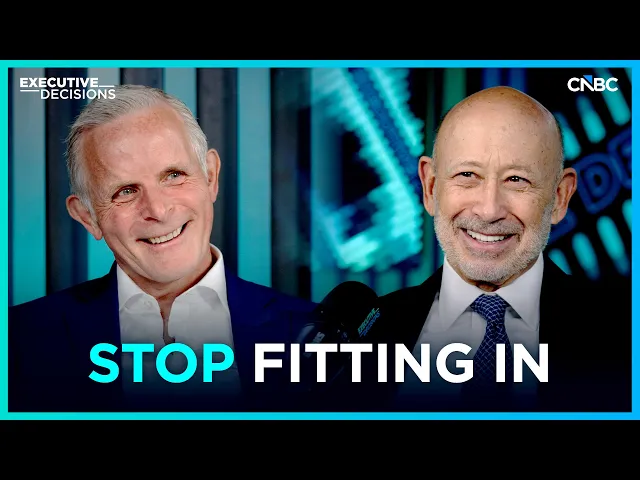
Stop Trying to Fit In | Former Goldman Sachs CEO Lloyd Blankfein
CNBC International
0:00 Early in his career,
0:01 Lloyd Blankfein was constantly judging the room and himself.
0:04 Who shall I be this time?
0:06 How shall I sound this time?
0:07 He grew up in public housing in Brooklyn
0:10 and arrived at Harvard feeling like an outsider.
0:12 Then came the decision that would shape the way
0:15 he carried himself for the rest of his career.
0:17 Somebody put his hand on my shoulder and said,
0:19 "Lloyd, you may think you're changing,
0:20 but everybody knows exactly who you are." And so,
0:22 I decided I might as well go with it because I'm not fooling anybody anyway.
0:26 For the future Goldman Sachs CEO,
0:28 that meant stopping the performance and becoming
0:30 more comfortable with who he was.
0:32 I think what's prized most in the world,
0:34 whether people acknowledge it or not, is, you know, authenticity.
0:37 But as he rose through the firm, Blankfein also had to learn another lesson.
0:41 To be a good teammate, you have to not only take criticism,
0:44 but you have to be a little softer when you give it.
0:46 These are Lloyd Blankfein's Executive Decisions.
0:55 Did you feel growing up, and in your early years,
0:58 whether it was at Harvard, Harvard Law School, J.
1:01 Aron, did you feel like an outsider?
1:03 Well, I did.
1:04 I wasn't a lot like my classmates.
1:07 I came from public housing,
1:09 and I went to Harvard and I had roommates that had gone to private school.
1:13 Yes, I was an outsider, I was a striver.
1:16 And in my experience when I meet other
1:18 people who are in senior positions all over,
1:20 if you unpack their stories, you know they kind of were that way too.
1:25 I think it's helpful in some ways.
1:28 But from a very early age you didn't let that become an issue,
1:31 you didn't let that become something that kept you down.
1:33 Actually, I think reading Streetwise, you used it to drive you on.
1:37 Is that the case?
1:38 It did, and it gives you perspective.
1:41 It also gives you, delivers you a higher EQ, Emotional Quotient,
1:46 about people because you learn to read
1:48 the room better because you're always very conscious,
1:51 less about what you're communicating and really
1:54 what the other person wants to have.
1:56 You know, you become a little bit more of a pleaser and that helps you.
2:01 I'm sure everything has a good side and a bad side.
2:03 I'm sure it's burdensome in some ways and helpful in other ways,
2:07 but can't help myself.
2:08 I go into a room and I'm thinking how am I being perceived.
2:14 I'm conscious you may not hear it as much as other people do,
2:17 I have a kind of an outer borough New York City kind of an accent.
2:23 I once said who shall I be this time?
2:26 You know, how shall I sound this time?
2:28 And somebody put his hand on my shoulder and said,
2:30 "Lloyd you may think you're changing but everybody
2:32 knows exactly who you are." And so,
2:34 I decided I might as well go with it because I'm not fooling anybody anyway.
2:38 Yeah.
2:38 Let me talk a little bit about your earliest role
2:40 models and I think they maybe came from your family.
2:42 You've got this amazing grandmother who you
2:43 were living with at one stage as well.
2:45 You've got your father who worked in the post office,
2:47 but a really hardworking guy and really helped drive you,
2:50 and you've got your mom,
2:52 you've got your sister as well who is I think eight years older than you?
2:54 Nine years older.
2:55 Yes.
2:55 Nine years older and was just a phenomenal person in bringing you up as well.
2:59 Were these the early mentors?
3:01 You know, I hate to say it because it was such a good lead-in, but not really.
3:06 From very early on, I really just wanted to get out of the neighborhood,
3:10 get out of the context that I was in, go.
3:13 And for me, the symbol was to go to an out-of-town school, to get accepted.
3:17 It would mean, in my case,
3:19 having to get a scholarship and go to an out-of-town school.
3:21 And my parents, who I really, really appreciated, had a much tougher life.
3:26 You know, they're blue-collar, blue-collar people, workers, laborers.
3:30 You know, my dad didn't have a lot of opportunity, so I appreciated them,
3:35 but they really weren't that much of a role model
3:37 for me because I was trying to get into a different role.
3:40 You know, you watch television,
3:41 you see how other people live, other people, you know.
3:44 I didn't know anybody who lived in a real
3:46 house as opposed to an apartment in an apartment complex,
3:49 but I aspired to all these things that you saw and I worked towards it.
3:54 So, it was you that drove yourself,
3:56 not anyone particularly in your early childhood or your developing years?
3:59 I felt that way, I can't think of anybody who I aspired to be.
4:03 I didn't know anybody growing up whose father went
4:06 to work in a suit or you know wore a tie.
4:11 I didn't have that stuff, so I always try,
4:14 I mean I didn't affect that stuff, I just wanted to leave where I was.
4:18 I find that phenomenal.
4:20 I've conducted 22, 23 Executive Decisions interviews now.
4:24 People come from all kinds of backgrounds.
4:26 One from a slum in Casablanca,
4:28 another one from rural Kentucky where he was working
4:30 in the garage at 13 and found it really tough,
4:32 but they all had a mentor who said to them no, you can go and do this as well.
4:37 So, for you to get to Harvard and then Harvard
4:40 Law School purely on the back of your own drive,
4:44 that is quite an incredible thing.
4:45 Well, I'm here.
4:46 So, if I didn't have that, I wouldn't be talking,
4:48 there'd be somebody else in this chair talking to you.
4:50 I was always driven that way, yes, I was.
4:52 But I mean it wasn't like, I mean I think I had a perspective on it,
4:55 I think I had a sense of humor, I think if it didn't work out,
4:59 I would have adjusted to it, but I was encouraged by incremental success.
5:05 And so, I did well in school and, I
5:08 mean I had people who helped me along the way.
5:10 My high school didn't have a college office
5:13 that would prepare you to apply to colleges.
5:15 I went to a different high school just to go to their college night and there
5:19 was somebody manning a booth who was
5:21 representing Harvard and he gave me an application,
5:24 he chatted with me and I filled it out.
5:26 I filled it out like you'd filled out
5:28 a landing form when you were coming into a country.
5:30 These were meant to be essays and I just wrote it off my head.
5:35 But I give university a lot of credit because they found me.
5:39 You know, it's not done by statistics, they read your application,
5:43 they give you an interview and I'm lucky they saw something.
5:47 When did you decide you wanted to go to Harvard?
5:50 It doesn't get more blue blood as opposed to blue collar.
5:52 Oh, I decided why I wanted to go to Harvard when I got into Harvard.
5:56 I never saw it before.
5:58 I just applied to all the brand-name schools that I could.
6:03 So, it was a bunch of Ivy League schools and then the state school of New...
6:07 Is it Yale that turned you down amongst others?
6:09 Yes, of course.
6:09 I didn't get into all of them, you know, to this day I still have some
6:14 admiration for them because they were smart enough,
6:15 they turned me down, but I thought I would end up in a state school,
6:19 which wouldn't have been so bad.
6:20 And then, freakishly,
6:21 I got into a couple of these Ivy League schools and that was
6:24 a big moment and there was a lot of apprehension associated with it.
6:28 I hadn't met anybody who'd gone to a school like that.
6:30 And when I went there,
6:32 I'm sure my roommates and friends that subsequently became friends thought I
6:37 was a Martian or someone from someplace far away, but it worked out.
6:42 But you yourself felt like you were trying to fit in.
6:45 You were buying Lacoste T-shirts to fit in.
6:48 You were trying to buy the right suit,
6:49 the right sports jacket to fit in as well.
6:51 And then when you were going to friend's homes,
6:53 you were like, "Wow, this is phenomenal.
6:54 I didn't know people live like this." But when you brought them back,
6:57 you felt very self-conscious, didn't you?
6:58 I did.
6:58 And then I felt embarrassed with my friends,
7:01 and then later in life, I felt embarrassed about having been embarrassed,
7:06 because that was terrible because I felt, you know,
7:10 was I being fair to my family and those feelings.
7:12 And now I decided that I'm not going to be so hard on myself,
7:16 and it's just a kind of a normal thing.
7:19 Right, I'm going to spin forward now.
7:21 You've got your undergraduate degree at Harvard.
7:23 You've done really well in Harvard Law School.
7:25 You've moved on to a great company
7:28 a little bit further down the line, Donovan Leisure.
7:31 You're a successful, hardworking lawyer looking at kind of fairly dull areas,
7:37 tax and what have you and looking at the nuances of tax, but you've made it.
7:42 Why on earth did you look to throw all that away
7:46 and becoming a trader or a salesman at a small brokerage?
7:51 Commodity?
7:51 Well, I was working at that job, but I didn't love the job.
7:55 And for me, it was a chore.
7:58 I was living in New York.
8:00 New York is a very finance-oriented town.
8:03 So, I started applying for other jobs and those were jobs in finance.
8:07 I started interviewing at this small commodity trading firm called J.
8:11 Aron.
8:12 And then during this elongated interview process Goldman acquired them,
8:15 you know that was lost on me,
8:17 I didn't even observe that, and it didn't really matter
8:19 for a few years because it operated separately for a long time.
8:22 But I joined this company, they gave me a job and it turns out in hindsight,
8:27 I found this afterwards,
8:28 they hired 20 people in the hopes that they'll have two at the end.
8:33 And it was a trading environment,
8:34 and you know rough and tumble and people were screaming
8:36 at each other waving their hands and it was sort of like,
8:39 believe me, that was an environment that I had
8:41 grown up in and so I was quite comfortable with.
8:43 So you felt actually that your Brooklyn background, you'd kind of, "I can do,
8:47 this is way better than law just sitting
8:49 there looking at complicated tax judgments as well." Yeah,
8:52 I wasn't as analytic as that.
8:54 In hindsight, yes, at the time I just said,
8:57 "this seems pretty good,", and frankly, the hours were shorter.
9:00 I mean, the one good thing about being a lawyer in those days is that the hours
9:05 were so long and sometimes there was a lot of drudgery associated with what you
9:10 had to do that almost any other job after that would be lighter and merrier
9:14 and would be a better lifestyle for a young
9:18 associate trying to climb the law firm ladder.
9:20 And so, when I went there, it looked better in a lot of different ways.
9:24 I didn't know if I'd be good at it, and it turned out it suited my personality.
9:34 You were 36 years at Goldman's J.
9:36 Aron, and it seems to me that you spent at least
9:39 the first half of that career trying to justify the J.
9:42 Aron operation to what was a very
9:45 well-established investment banking operation at Goldman Sachs.
9:47 You guys were always pushing against a glass-ceiling,
9:50 or the Goldman's guys were on a better floor,
9:52 and you guys were in a different building,
9:53 and you had to convince Goldman's that actually,
9:56 this was the way forward to become a bigger operation.
9:59 Well, there was a bit of a cultural difference between the firm J.
10:02 Aron that I joined, the relatively small commodity trading firm,
10:05 which consisted of a lot of people who were streety,
10:08 not all of them had been to university and it
10:11 was people who would kind of work their way up.
10:14 A good entry-level job at J.
10:17 Aron was to be the driver for one of the senior partners of the firm,
10:23 so that shows you what the kind of career path was in that firm.
10:27 Whereas Goldman Sachs was a very, very establishment kind of firm,
10:30 where people had graduated from all the Ivy League schools and that was
10:33 kind of the entry requirement to get a job at Goldman.
10:36 So, there was a little bit of upstairs downstairs about Goldman Sachs and J.
10:41 Aron.
10:41 Of course, you know,
10:42 I already had a chip on my shoulder and that kind of really reinforced it.
10:47 And so yes, there was a little bit of trying
10:50 to prove that we were good and frankly it didn't hurt us.
10:53 Some of these things that you think of as burdens and disadvantages
10:56 in the long run turn out to be advantages because we worked harder,
11:00 took a little less for granted, were much more curious about learning about
11:04 stuff because we didn't think we knew everything.
11:06 Were you successful sometimes in spite of yourself?
11:08 A little bit later on you had to take on 360-degree performance reviews,
11:12 and time and time again people would say that you were very combative,
11:18 you didn't always listen to them, you talked over- sounds a bit like myself
11:21 at work to be fair- but you talked over them.
11:24 Were you successful in spite of yourself sometimes?
11:27 I put in a review, this is a 360,
11:29 you know 20 different people, some report to you, some are over you,
11:33 comment on you and somehow, they all came up with 20 synonyms
11:37 for this guy really needs to change his behavior.
11:40 Tough.
11:41 I know people who are in very, very high senior places and I think boy,
11:46 that person must have been voted most likely
11:49 to succeed in kindergarten and every year since then.
11:51 And there are some people who are later bloomers and who
11:55 never thought themselves- and I was sort of in that latter category.
11:58 In my life I've met some very, very accomplished, very,
12:00 very smart people, but people throw the word genius around very, very easily.
12:05 I've met people who've worked hard, who've done well,
12:07 who had lucky opportunities and give them credit,
12:10 they took advantage of those opportunities, but they weren't geniuses.
12:13 They just applied themselves, they had their ears open,
12:16 they had curiosity about the environment around them,
12:19 and they saw things and they went through
12:22 little doors that other people wouldn't have seen, and that's a point to make,
12:26 that a lot of these opportunities are more accessible than you think.
12:30 If you think that someone can only get to this spot because
12:33 he's brilliant and genius and had this charmed life at every stage,
12:36 you kind of give up.
12:39 And so, part of this thing, an objective is,
12:43 that my career is not only relatable but accessible.
12:48 Statistically, not a lot of people are going to get those same kinds of breaks,
12:52 but you can go pretty far in this world
12:55 taking advantage of opportunities and working hard.
12:57 My own career in the city started very early on.
13:00 I had a great role model, a man you probably know Jeremy Isaacs,
13:03 who went on to Lehman’s of course, and he was a great role-model,
13:06 and I still speak to Jeremy and get advice off him to this day.
13:09 Who was the best of the best that you listened
13:12 to and used as a role model when you were at Goldman's J.
13:15 Aron?
13:15 Yes.
13:16 You know, and it's funny, little things make very important impressions.
13:19 So, going back to my law firm days when I first went to, I said earlier,
13:23 I never knew anybody who wore a suit.
13:26 I went to the first boss I had in my law firm,
13:29 this is the most useful thing possible, he told me how to dress better.
13:33 I didn't know that you put little tabs in your collars to keep your collar down.
13:39 He told you to go and buy a few Hermes ties.
13:41 Told me to buy these ties and not those ties.
13:43 Save your money.
13:44 No, don't buy ten of those ties.
13:46 Buy one or two of these.
13:47 You know, people take an interest in small ways
13:50 and those are the things that establish a good bond between people.
13:55 I'm sure he taught me things related to the law,
13:58 I probably would have learned those anyway.
14:00 I want to go to 1991.
14:01 Robert Maxwell's ringing you up.
14:03 One of the most important businessmen in the world.
14:05 "I want your advice, Lloyd", as well.
14:06 You got a little bit flattered by him, everyone got flattered by him.
14:10 Couple of months later, he's passed, whether he fell off his boat, no one knows.
14:15 Or pushed.
14:15 But he was a crook.
14:16 Right.
14:16 It turns out that Robert Maxwell was a crook.
14:19 What did you learn from that relationship?
14:20 You know, I learned- well, first of all,
14:23 you're exactly right I was kind of seduced,
14:26 But even if somebody told me I was seduced,
14:27 I'd have been flattered that he took the time to try to seduce me.
14:30 At that point, I was a fairly junior person in the foreign exchange world.
14:35 He was transacting, himself.
14:36 But a lot of people did in those days
14:41 involved in global markets because you know, currencies were very volatile,
14:45 and decisions about currencies were quite consequential to business.
14:48 And there was nothing that he did with me
14:51 that was illegal or should necessarily have raised a big flag.
14:55 but I realized that I was an unwitting instrument on his effort
14:59 to take money from his public company and move it to his private companies,
15:04 because he would do currency transactions and he'd give the back-office
15:07 payment terms that involved moving the money to a different source,
15:11 which he was entitled to do,
15:12 he was the CEO of both entities and he was authorized to do it.
15:16 But when the dust, when this all came out,
15:18 I realized, my god, I was so flattered by him,
15:21 by the fact that he was calling me
15:24 and that I was giving advice to the great man,
15:27 that I realized that as you grow up and you're in a position of influence,
15:31 or the ability to help people, you have to have a certain kind of reserve,
15:35 because you can't allow yourself to be flattered in that way,
15:39 you can't allow yourself to be manipulated and used.
15:41 And the temptation, by the way,
15:43 even among well-intended people who don't have fraud in their in their scope,
15:49 might get you to do things that you don't want to do,
15:53 and if you're a natural pleaser and so impressed
15:55 by your own magnificence because these people want to befriend you,
15:59 you'll do things that you shouldn't do.
16:02 And so, you learn in life, and I understand very senior people very often,
16:06 especially in a banking world where you make credit decisions and you can
16:10 finance someone or not finance them and it's really existential for their lives,
16:15 you have to have a certain kind of remoteness, and you can't be very,
16:20 very good friends and always want to please the people
16:23 you do business with, because you have to make again,
16:26 decisions that are in the best interest of the company
16:29 and the greater world and not necessarily in their interest.
16:33 Goldman slowly realized, got more and more partners on board,
16:36 that you just needed more capital.
16:37 You loved the culture.
16:38 It was culture versus capital at one point- that was how
16:41 it's framed by a lot of partners- but you needed more capital.
16:44 So, you became, you decided to IPO a portion of the company as well.
16:48 That made you a stunningly rich man, didn't it?
16:50 I think something in the region $90 million dollars.
16:52 Well, we maybe have different thresholds for what's stunning.
16:55 It certainly made me wealth- Well,
16:57 compared to where you are now Lloyd, I appreciate that, but...
16:59 It certainly made me a lot wealthier, but I wasn't stunned by it at the time.
17:03 So, the process to end the formal
17:06 partnership and become a listed company as well, that was very interesting.
17:10 Yes.
17:10 Tell me about that.
17:10 So, let me say, Goldman Sachs
17:12 really prized its culture as a private-partnership,
17:14 and it really made a difference.
17:16 Everyone was an owner of it, and owners are different than employees
17:21 because you feel entitled to information, you feel entitled to have influence.
17:24 If the senior partner wants to do something,
17:27 he really has to socialize and listen to comments,
17:30 because you're dealing with your fellow owners.
17:32 That makes sometimes processes are slower,
17:35 but it makes the organization much more stable,
17:37 and you know I think better in the long run.
17:41 So, people were very reluctant to give that up.
17:43 We thought it was a special advantage of the firm
17:46 and to this day I believe it was.
17:48 It was partly the opportunity to do more stuff with more capital.
17:52 But having survived some of those earlier crises,
17:55 partnership is another thing also.
17:57 It's impermanent capital compared to a corporation, which is permanent capital.
18:01 You keep your balance sheet, you keep your capital,
18:04 people can transact shares and get out of their position and leave the company,
18:08 but the capital stays in the company.
18:10 But what is fascinating about that It's too dangerous
18:13 to remain a private partnership And a lot of partners walked.
18:16 And I think this tells a lot about you, if I may say so.
18:19 I think you were stunningly wealthy by the way, and I think you knew it,
18:22 because you knew where you came from, you
18:24 never forgot East New York and Brooklyn as well.
18:26 But a lot of the partners thought,
18:27 I can do other things here, and a lot of them did.
18:29 They went into politics, you talk about, into all kinds of other things.
18:32 I think one of them went into coaching.
18:34 They bought sports teams.
18:35 Sports teams.
18:35 You stayed.
18:36 So, I think that does tell a lot about you and what drives you as well.
18:40 Can you just expand on that?
18:42 Well, yeah.
18:42 I mean that's the answer.
18:44 I just am wired.
18:45 I liked what I was doing.
18:48 You know people also left,
18:50 partly people left because they wanted to really to defend
18:54 their wealth that they had acquired, and they could.
18:57 Look we all suffer.
18:58 You know we all go to work every day,
19:01 and boss does something that annoys us and guess what,
19:04 you go home, you complain to your spouse or, and then
19:07 you come in the next day and you sort things out.
19:10 But when you're well to do, and you sort of get irritated at your boss,
19:14 the next day you go in and you quit, because you can.
19:17 Keeping people at that point was a little bit different.
19:20 People had leapfrogged in wealth.
19:21 People had previous notions of what was wealthy and somehow,
19:25 they leap way beyond that, and so some people decided to leave,
19:29 they were probably making the right decision for themselves.
19:31 It wouldn't have been the right decision for me.
19:32 What would I have done for the next 30 years?
19:35 By the way, in old Goldman,
19:37 it was always figured that people would stay, be a partner of the firm,
19:41 and then leave when you still had more gas in the tank,
19:45 more chapters left, if I mix a metaphor, more chapters left to perform.
19:49 Well, that's how with your public speaking as well,
19:51 you never want to speak too long, you want to leave them wanting more.
19:53 Yes, always leave them wanting more
19:54 and you make the opportunity for someone else.
19:55 But people usually left the firm in their middle 50s and then
19:59 they did something else and every-once-in-a-while
20:01 somebody would stay too long, like me.
20:04 When you became partner of the firm,
20:06 the person that inducted you into the partnership would sit there and say,
20:09 "This is your expectations of you.
20:11 This is what you have to do.
20:12 This is your new role and your new station and a set of responsibilities,
20:16 a role model for others." And he'd say, you know,
20:19 the expectation is you should organize your life,
20:22 so if and when they write an obituary about you,
20:26 no more than three or four paragraphs are about Goldman.
20:28 You should do other things.
20:29 By the way, you should do other things while you're working at Goldman.
20:32 You should be philanthropic.
20:33 You should be on the boards of certain charities.
20:36 And you know, your career should end at a point
20:38 in which you still do other things afterwards.
20:42 And that was a very important part of the Goldman ethos.
20:48 In 2006, you became the CEO.
20:50 You took over from Hank Paulson.
20:52 You became his heir apparent.
20:53 You were like the COO, you liked being the COO because you didn't have
20:56 the same legal liabilities on the result statements as well.
20:59 When did you make the decision, I'm going to be the CEO?
21:02 I became the COO, but working for somebody who was still youngish
21:07 and still was going to stay in the firm for a longer time,
21:11 short of being hit by a bus or something else,
21:14 and then guess what happened, as happened to so many of my predecessors,
21:17 he got tapped to be Secretary of Treasury,
21:20 effectively finance minister of the country.
21:21 So, prior to that weekend when he discussed with me that he was taking the job,
21:26 I thought I would probably retire as his number two.
21:30 You still didn't think you were going to be number one?
21:33 I didn't think I was.
21:34 I knew if there was a call for somebody else to replace him,
21:38 it would probably be me at that point,
21:40 but he was young enough to do that job for a longer time,
21:45 that would make me older than I should be to start in that role,
21:49 and instead of working another ten years in that job, he left that job.
21:52 So, I ended up being CEO of Goldman Sachs for almost 13 years.
21:56 There's a great quote, earlier quote.
21:57 If I knew I was going to go so high in the firm,
22:00 I would have been a lot nicer to people I met along the way.
22:03 It would have saved a lot of time making up to them later on.
22:06 Oh, sure.
22:07 You had to change your personality a little bit as you got higher up.
22:10 As I got more senior, again, you had a chip on your shoulder,
22:13 a certain amount of resentment of people who acted haughtier,
22:16 and then we started to outperform and, you know,
22:20 the recognition of that outperformance lagged the actual outperformance,
22:24 and then at times I had to remind them of, you know, what was going on.
22:28 I could be sarcastic.
22:29 I was never much of a screamer, but I was very,
22:32 very caustic and you know it was very entertaining for a lot of people around,
22:38 but not necessarily for the object of my sarcasm.
22:41 There's a lot of Lloyd-isms out there.
22:43 Sorry I know this is quote-a-rama.
22:45 "I am listening"- This is you in management committees.
22:47 "I am listening.
22:48 I just hear faster than you talk." I mean no wonder people, no wonder people...
22:53 Yes.
22:53 Somebody would say, why don't you let me finish before you disagree
22:56 with me and I said look you haven't said it, but I hear faster.
23:00 I've already heard you and hear...
23:01 No, no, it was difficult.
23:02 And again, I think we all get our personalities are stamped at very young ages.
23:07 You don't become a completely different person,
23:09 but you can kind of lean against character, which I learned to do.
23:14 And the fact of the matter is, I was tough on people and the people I
23:19 was tough on weren't immediately helpful to me thereafter,
23:22 and why would they be and shouldn't be.
23:25 I learned to be more self-deprecating.
23:27 I learned I still had perspective, I still had a sense of humor,
23:31 but I would stop myself before I made somebody else feel bad about it.
23:35 And so, I think I got a lot more better,
23:38 but I think also my basic character was, I was very institutionally oriented.
23:42 You know, I grew up and I wasn't part of anything,
23:45 I felt remote when I went to my fine university, in my early stages in the firm,
23:51 and when I sort of felt part of a big important institution,
23:54 I kind of hugged it, I kind of like it.
23:57 There are some people who are geared
23:59 to be entrepreneurial and want to be by themselves.
24:02 They say they can't work for someone,
24:03 and they don't want to have partners where they have to.
24:06 I wasn't that way.
24:07 I liked being affiliated with an institution,
24:10 and to work well in an institution, you have to be a good teammate,
24:14 to be a good teammate, you know, you have to, not only take criticism,
24:16 but you have to be a little softer when you give it.
24:19 And over time, I learned that.
24:21 So I said, really, I mean I made a good joke out of it,
24:24 but it was actually true,
24:25 I had to make peace with a lot of people who on my way up and their way up,
24:33 didn't enjoy my sarcasm as much as I enjoyed delivering it,
24:37 and I had to make peace with them, and they were right and I was wrong.
24:41 But what went well in Brooklyn and East New York when you're growing up,
24:46 and then worked really well on a trading floor as well,
24:50 doesn't necessarily work in the same way when you're
24:53 talking to top board members or politicians or blue bloods.
24:56 You kind of had to adapt quite a lot, didn't you?
25:00 You adapt, but look, at the end of the day,
25:02 I think what's prized most in the world,
25:03 whether people acknowledge it or not, is you know, authenticity.
25:06 I mean I know who I am.
25:09 It helps to have a high position, because now I walk into a room and people,
25:14 I mean this is shocking to me,
25:16 people are sometimes intimidated of me before they meet me.
25:19 When you're CEO you get taken around to people,
25:21 and somebody at Goldman would say "oh this person really thinks very,
25:24 very highly of you and is looking forward to meeting me",
25:28 and I'd say gosh if they think really highly of me why ever would I meet them?
25:33 You can never be radically different- I would lean against certain tendencies.
25:37 Lean against tendency to be, you know, sarcastic or snarky.
25:41 At some point you realize, why would I have a chip on my shoulder at this point?
25:45 I'm a graduate of excellent schools.
25:47 I've been the head of a very influential firm.
25:50 I've mingled with a lot of very important-
25:53 I think it's time to set that chip aside.
25:56 I don't know if I agree.
25:57 I think if you're authentic and that's who you are, then that's who you are.
26:00 But even, you have to acknowledge,
26:01 even in your, you know also to be authentic is to acknowledge reality.
26:05 And at some point, I remember when I was growing up, we were the recipients.
26:09 my family was generally the recipients of other people's philanthropy.
26:13 I went to my schools, you know I got free lunch in school.
26:17 My college applications were free because our income was below a certain level.
26:21 We lived in public-housing, so rents were very low,
26:23 and you know, that sticks with you.
26:25 And then one day, you know, you realize, my goodness,
26:27 way before I was a partner of Goldman Sachs, you know,
26:31 at some point, that's kind of, not only don't I need other people's help,
26:35 but I should be giving help.
26:37 Lloyd, let me spend a bit of time talking about the GFC,
26:40 the Great Financial Crisis.
26:41 Tell me a little bit about what good decisions you made in the face
26:45 of what was an existential threat for the financial system and, dare I say it,
26:49 for the global economy.
26:50 Well, the best set of decisions were really baked in, and in fact
26:54 it was the earlier crisis that put us in a position,
26:58 because we became very, very,
26:59 very aggressive risk- we were risk managers and processes.
27:03 So, we were always very conscious of risk.
27:06 You know as Goldman's we have a reputation as being risktakers and doing
27:10 well in good times and not suffering as much in bad times.
27:14 But we instituted a lot of processes.
27:17 The most important one was we marked our securities,
27:20 our balance sheet to mark to market,
27:24 very rigorously, very religiously, very often.
27:27 And so other people didn't.
27:29 We would mark to market AAA securities,
27:32 securities that were always presumed to be
27:34 worth a hundred cents on the dollar forever,
27:37 but we would not only market to market,
27:39 we would test it in the market by having people go out and sell them,
27:42 and seeing if there was truly a market to it as opposed
27:45 to marking things to models or marking things to analogies to other instruments.
27:50 And that religious marking to market all the time,
27:55 gave us an early warning sign that something was amiss in the world.
27:59 And when the financial crisis started to go and it
28:03 affected kind of the weakest part of the mortgage market,
28:06 subprime, even people like Ben Bernanke
28:09 and other great central bankers said well,
28:12 this is a temporary phenomenon, transient.
28:15 I agreed with that, that this didn't look like it
28:17 would become as big as we know it ultimately became,
28:19 but we said something is going on here, let's bring our risk down,
28:25 let's stay closer to home, was the language that we always used.
28:28 So, traders and risktakers and market makers continued to make markers.
28:33 If clients wanted to buy something, we sold it to them.
28:36 If they wanted to sell to us, we bought from them.
28:38 Sometimes we'd be long, sometimes we'd be short,
28:41 these kinds of instruments, but we kept it bounded within a very,
28:45 a tighter range than we normally would,
28:47 because we just saw that things were in flux
28:49 even though we didn't know what the outcome was.
28:51 So, you were well prepared.
28:52 Can you think of a decision, a pivotal decision you made in the heat,
28:55 that actually was the best decision you made in that crisis?
28:58 We had to be very, you know, fleet of foot.
29:01 There were things happening all the time.
29:03 Every weekend the government was putting in a new protocol,
29:06 a new set of rules and guidelines.
29:09 And so incrementally, we were always preparing, trying to stay ahead of it.
29:14 What could happen next?
29:15 What could, how could things get worse?
29:17 And we had rooms of people who were
29:20 going out and kind of wargaming the next scenario.
29:24 We didn't always get it right, but it made us much more prepared,
29:27 to the point where people thought we were successful in anticipating things,
29:32 we were just very good contingency planners.
29:35 Another thing that we did that was, well I wouldn't,
29:38 I don't know whether you call this a decision,
29:40 really what I needed to do is get everybody to do their jobs,
29:43 and not to be kind of frozen by what was going on.
29:47 You turn on the TV, and it was like they were watching,
29:51 you know it was like a sporting event that was going badly.
29:54 Yeah.
29:54 It's interesting you should talk about sport,
29:57 because a great cricketer or even a baseball hitter,
30:00 they see the ball large and they see it slow when they're on form as well.
30:04 How did you feel in the depths of this crisis.
30:06 Did you feel a sense of calm?
30:08 I mean I was as nervous and as rattled as anyone,
30:11 but I didn't have the luxury of being able to perform that way.
30:14 You know, I think of an analogy, you're on an airplane and the flight
30:19 attendant you know is having a beatific smile.
30:21 Now I'm thinking, I look at that person I'm saying, is she rattled,
30:26 now I don't mind turbulence but I'm very
30:28 carefully attuned to the sounds of the engine, as long as those sound the same.
30:32 But every once in a while it sounds a little different to me,
30:34 and I look at her face or his face, and I go,
30:37 I mean if they look terrified, I would be terrified,
30:40 but instead it's that beatific smile and you know,
30:44 your position requires it, and so you do that.
30:48 I've never been in combat or in war, but I imagine,
30:51 you know when things are going off, you know,
30:54 your sense of responsibility kind of displaces
30:59 your anxieties and fears, in a way,
31:02 if you're wired that way, and I was kind of wired that way.
31:05 And so, keeping the firm on, I wouldn't say it was an even keel in that period,
31:10 but as even a keel as could be accomplished,
31:13 was a very, very important thing to do.
31:15 Lloyd Blankfein, it's been an honor and a privilege.
31:17 I've wanted to chat for you for years
31:18 and that's a big part of my career pluses now.
31:20 So, thank you very much indeed.
31:22 Steve, thank you.
31:22 I enjoyed it, wish it were longer.
31:23 Thank you, sir.
31:24 Thank you.
31:26 What could I learn from Lloyd Blankfein in this interview?
31:29 A legendary Wall Street figure.
31:31 His career has been well documented,
31:33 not least by himself in his extensive biography.
31:36 He's divisive.
31:37 Some think he's the ultimate example of fat cat Wall Street bankers.
31:41 Others laud him, say, look what this man did in the Great Financial Crisis,
31:45 negotiating Goldman's and the financial system to some form of safety.
31:50 What I really learnt is he's a street fighter,
31:52 a man who came from a blue-collar,
31:54 tough, working background, the projects in Brooklyn,
31:57 dragged himself up through Harvard, Harvard Law School, J Aron,
32:02 Goldman Sachs, and perhaps did it by sheer force of will.
32:06 He saw himself as an outsider.
32:08 He saw himself almost with a chip on his shoulder fighting against the system.
32:12 It's an amazing story of someone who made good.
32:16 It is a very relatable story for many people.
32:19 Thank you very much indeed for joining
32:21 me on the show we call Executive Decisions.
32:23 I would love to hear your feedback.
32:25 Please drop your thoughts in the comments,
32:27 or a review and please hit that follow or subscribe button.
32:31 On the next episode, I'll be speaking to the CEO of Reed Group, James Reed.
32:36 But I think that's a vital part of being an entrepreneur,
32:39 you have to keep trying things,
32:40 and the worst decision would be to stop trying things.
32:43 I'm looking forward to it.
32:45 We'll see you then.