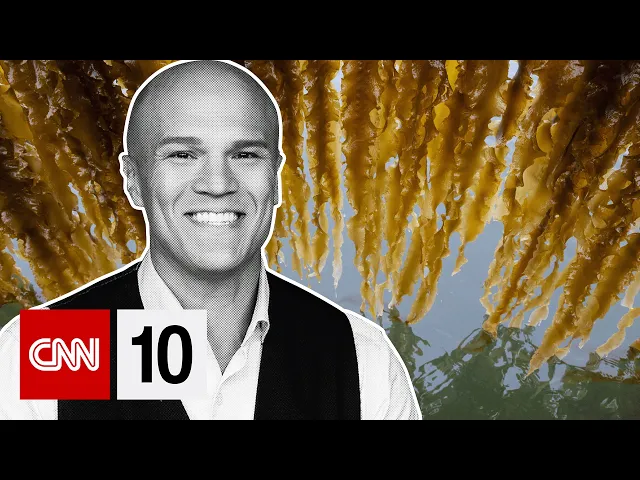
How seaweed could help turn the tide on plastic pollution | March 31, 2026
CNN 10
0:11 Good morning, good afternoon, good evening, wherever you are in this world.
0:14 I'm Coy Wire.
0:14 This is CNN 10.
0:15 I have your 10 minutes of news with stories from all around the globe today.
0:19 But on this final day of the month, March 31st, let's kick it off with this.
0:24 On this day, 137 years ago, the Eiffel Tower was officially completed.
0:30 The iconic landmark was built as the centerpiece of the 1889 Paris Exposition,
0:36 a world's fair marking the centennial anniversary of the French Revolution.
0:40 Construction took more than 2 years.
0:43 The French feat of engineering stands more than 1,000 ft tall
0:47 and contains roughly 18,000 individual pieces of iron weighing about 7,300 tons.
0:53 The tower stood as the tallest structure in the world for more
0:57 than 40 years before being dethroned by the Chrysler Building in New York.
1:01 And get this, the tower was supposed to be temporary.
1:04 The original plan was to dismantle it after 20 years,
1:08 much to the relief of some Parisian elites who saw it as an eyesore.
1:12 But science saved the day.
1:14 The tower proved itself to be an indispensable asset for emerging
1:18 radio transmission technology and it's served as a vital antenna ever since.
1:24 These days, La Dame de Fer, or the Iron Lady,
1:28 continues standing tall above the city of lights offering unparalleled views
1:32 to nearly 7 million visitors from around the world each year.
1:36 I think it's really iconic, you know, like when you think about Paris,
1:39 you think about that, about the Eiffel Tower.
1:42 It's just a symbol of Paris.
1:43 It's a symbol.
1:44 It's a symbol.
1:45 It represents France.
1:46 It's one of the prestigious monuments,
1:48 as you can see with the number of tourists around us.
1:51 The tower's history is as unique as its architecture.
1:54 Did you know it was originally painted red?
1:57 And it was even briefly yellow.
1:59 Or did you know that it's taller in the summertime
2:01 when hot temperatures cause the iron to expand?
2:05 Speaking of metal, would you believe a notorious con man once
2:08 sold the tower to scrap metal dealers not once but twice?
2:13 And get this, the tower even has a unique
2:15 connection to France's most famous gift to the United States,
2:18 the Statue of Liberty.
2:20 The tower's namesake designer, Gustave Eiffel,
2:23 was also the brains behind Liberty's intricate iron framework.
2:27 I fell out of my chair when I learned that.
2:30 From lighting up the skyline when it first
2:32 opened to going dark for a global cause,
2:35 the Eiffel Tower is once again taking center stage
2:37 this time by switching off its lights for Earth Hour.
2:41 In Paris, the landmark dimmed its iconic lights joining cities
2:44 around the world in a symbolic move to spotlight environmental challenges.
2:49 Earth Hour began in Sydney back in 2007 organized by the World Wildlife Fund.
2:55 What started as a local initiative has grown
2:57 into a global campaign encouraging millions of people,
3:00 businesses, and landmarks to turn off non-essential lights for 1 hour each year.
3:05 This year, the movement stretched across continents
3:08 including Greece's iconic Parthenon and the Acropolis,
3:12 the Sagrada Familia in Barcelona,
3:14 and in Hong Kong nearly 4,000 buildings including
3:18 skyscrapers along Victoria Harbor switched off for an hour.
3:23 10-second trivia.
3:24 What is the name of the process that heats
3:26 an aerated cocoa and sugar to make chocolate?
3:30 Fermentation, conching, tempering, or refining?
3:37 If you said conching, you're so smooth.
3:40 It was accidentally invented in 1879
3:43 by Rodolphe Lindt who discovered that mixing chocolate for a long time created
3:48 the melt-in-your-mouth texture we expect today.
3:51 Did you hear about the 12 tons of Kit Kat chocolate bars that were stolen?
3:56 Give me a break.
3:57 Swiss food giant Nestle says that they were stolen
3:59 from a truck leaving its production site in Italy.
4:02 We're talking more than 400,000 candy bars.
4:05 The company reported the heist happened earlier this week.
4:08 The vehicle and chocolate still nowhere to be found.
4:12 But listen to this.
4:13 Nestle said all of its products can be traced
4:16 using a unique batch code assigned to individual bars.
4:19 So officials say the thieves could get caught if they try to resell the product.
4:23 A company spokesperson said, quote,
4:25 "Whilst we appreciate the criminals exceptional taste,
4:28 the fact remains that cargo theft is
4:31 an escalating issue for businesses of all sizes." Unquote.
4:34 The good news, the brand says there are no
4:36 concerns for consumer safety and supply is not affected.
4:40 Well, now it is time for an encouraging update
4:42 about the stranded humpback we told you about last week.
4:45 Rescuers have been helping to free a stranded whale
4:48 off the coast of Germany for 11 days now.
4:50 And as of this taping, they're more hopeful he will swim free.
4:54 According to one aquatic wildlife expert,
4:56 the whale now nicknamed Timmy has been pushed
4:59 to deeper waters where it can hopefully swim to safety.
5:04 He is not stranded on the sandbank.
5:06 He is in water deep enough for him to swim away from.
5:09 And so the animal is being left in peace for now.
5:11 And we naturally hope that he is simply gathering his strength
5:13 there and will be able to swim away on his own.
5:16 And then hopefully eventually find his way out of the Baltic Sea.
5:19 Humpback whales are not native to the Baltic Sea.
5:22 And conservationists say the human influence often plays
5:25 a role in whale strandings around the world.
5:28 Plastic pollution keeps piling up every day.
5:31 About 2,000 garbage trucks worth of plastic ends up in oceans,
5:34 rivers, and lakes around the world according to the UN Environment Program.
5:39 Now one company in Wales is looking to turn
5:41 the tide with seaweed-based packaging to replace single-use plastic,
5:46 showing how something from the ocean itself could help protect it.
5:49 CNN's Leroy Aben has the story.
5:52 How do you take this seaweed and turn it into this biodegradable
5:56 packaging and tackle the scourge of plastics in our oceans?
6:02 I was born in Fiji in the middle of the South
6:04 Pacific where plastics in the ocean are a huge issue.
6:08 And I've always asked myself, surely there must be an alternative to this.
6:12 And while researching that question,
6:14 I came across this company called PlantSea in Wales.
6:17 So, I've decided to go check them out.
6:22 My journey begins here on the rugged coastline of Wales.
6:28 This is where PlantSea is using seaweed
6:30 to create truly biodegradable alternatives to single-use plastics.
6:35 And it starts at seaweed farms like Carreg Emlyn.
6:39 We'll go out to the farm and harvest the seaweed
6:42 and then bring it straight back here and it gets
6:45 spun around and the solid seaweed gets separated
6:49 from the from the liquid and the liquid is our seaweed biostimulant,
6:55 which is being used in agriculture, on farms.
6:58 Like fertilizer?
6:59 Yeah, like fertilizer.
7:01 And then the solid bit that's left over, so our byproduct,
7:04 is what PlantSea will use to make their plastic products.
7:10 Ah, smells quite tasty.
7:11 It's lovely.
7:12 You can eat this.
7:14 PlantSea then brings the seaweed to this innovation center for processing.
7:18 This is where it all starts.
7:20 So, the seaweed that you've just seen at the farm,
7:22 this kind of gets dried and chopped up and flaked
7:25 and and this is where it starts in our process.
7:34 So, today we've processed around 20 kilos of of seaweed, but this should yield,
7:39 in terms of the wet product we get,
7:41 about 40 to 50 kilos of a dry polymer powder.
7:45 They'll turn this into film.
7:48 We should have enough film to do 120,000 of these solid capsules.
7:53 For Plant Sea, seaweed is a natural fit.
7:57 So, the seaweed actually lends itself very well to material innovation.
8:02 It has very a very rich like chemical structure.
8:06 It has um it's full of sugars and polysaccharides,
8:09 so it lends itself itself very well to biomaterials.
8:12 Most people don't realize that these are made from a synthetic polymer,
8:17 which is uh petroleum-based.
8:19 Now, while they do dissolve, they don't ever really truly disappear.
8:23 They create liquid microplastics.
8:26 Our film and our polymer is a natural polymer,
8:29 and it doesn't leave behind any microplastics.
8:34 Plant Sea is already working with major brands, proving this can work at scale.
8:40 So, seaweed is kind of like a wonder material.
8:42 You can eat it, you can use it as fertilizer,
8:45 and now it appears you can use it as an alternative to plastic.
8:49 The question is, why aren't we using it more?
8:59 Today's story getting a 10 out of 10 is stirring something special.
9:03 In the middle of South London, between train tracks and city streets,
9:06 a riding school is giving kids a chance to connect with horses,
9:09 many of them for the first time.
9:11 At the Ebony Horse Club in a neighborhood in Brixton,
9:14 each week about 160 kids are the main event,
9:18 learning to ride, groom, and care for horses free of charge.
9:21 Hey, it's all part of a program focused on supporting local youth.
9:25 Teachers say it behooves the kids
9:27 to participate because riding helps build their confidence,
9:30 and they learn to stay present in the moment.
9:33 So, when I tried it, it was actually great, and I had fun.
9:36 It's a different kind classroom where these young riders are
9:39 learning more than just how to stay in the saddle.
9:41 All right, superstars, couple of shout-outs today.
9:43 This first one goes to Miss Stewart and Miss Sanchez,
9:47 aka Stanchez, at Fifth Street Elementary in Decatur, Georgia.
9:51 They sent us these DIY stickers and I have to tell you,
9:56 I've been putting them on people's backs all around
9:58 the office and I don't think they've noticed yet.
10:00 It's a good thing.
10:00 Thank you for helping us spread the love.
10:03 And a very special shout-out goes to Mr.
10:06 Powers at Manistique Middle and High School in Manistique, Michigan.
10:10 Retiring after 45 years as an educator,
10:13 your students want you to know how much you mean to them.
10:16 Think of how many former students can say the same.
10:18 Salute to you, sir.
10:19 Tomorrow is your Word Wednesday,
10:21 so submit your unique vocabulary word and definition in the comments
10:25 section of our latest post on Instagram at CNN10,
10:29 at CoyWire, and we will choose a winner to work into tomorrow's show.
10:32 Make it a remarkable, marvelous, magnificent day.
10:35 I'm CoyWire and we are CNN10.