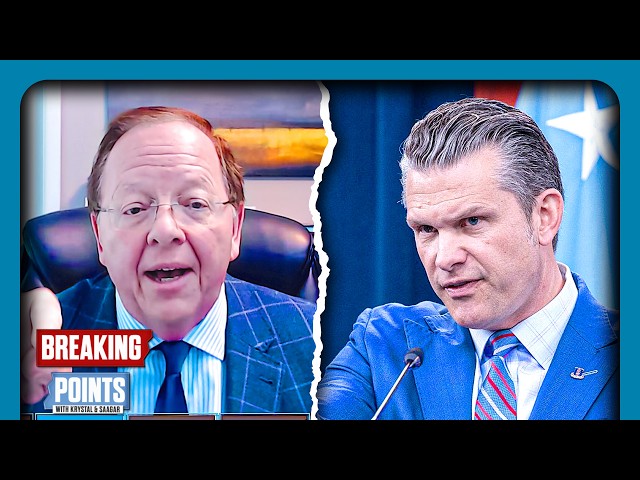
Professor Pape REACTS: Hegseth Says 'Red, White Blue' DOME Over Hormuz Strait
Breaking Points
0:00 Joining us now is Professor Robert Pape of the University of Chicago.
0:03 He also has the escalation trap Substack where he'll be
0:06 doing a live briefing on May 10th at 5:00 p.m.
0:10 Eastern time with the escalation trap, which we always look forward to.
0:14 Link down in the description that you can go ahead and sign up for.
0:16 Professor, thank you so much for joining us.
0:18 As always, we appreciate you.
0:19 Uh yeah, thank you very much for having me.
0:22 Thank uh well, let's go ahead and start, sir,
0:24 with all of these developments in the Strait of Hormuz.
0:27 Initially, we have this announcement from the Secretary
0:30 of Defense this morn- or sorry, Secretary of War this morning,
0:34 Pete Hegseth, about Operation Freedom to try
0:37 and to guide ships out of the Strait of Hormuz.
0:40 Not to get them back in, but at the very least, in the initial time, out.
0:44 Here is his announcement about a red, white, and blue dome.
0:47 Let's take a listen.
0:48 As a direct gift from the United States to the world,
0:52 we have established a powerful red, white, and blue dome over the strait.
0:57 American destroyers are on station supported by hundreds of fighter jets,
1:01 helicopters, drones, and surveillance aircraft providing 24/7
1:05 overwatch for peaceful commercial vessels.
1:10 Except Iran's, of course.
1:12 Which is why our ironclad blockade remains in full effect as well.
1:16 In fact, six ships tried to run the blockade
1:20 out of Iranian ports as Project Freedom commenced,
1:23 and they were all turned around.
1:26 What do you make of this Project Freedom, sir, of this red,
1:29 white, and blue dome and this rhetoric now coming from the Pentagon?
1:33 Uh this is a high-risk bet that the Trump administration is making,
1:38 and it's a bet they really cannot afford to lose.
1:41 Uh the goal here is fairly straightforward.
1:44 Um what you are seeing is an effort by the United States to run the blockade.
1:49 They're trying to break Iran's grip
1:52 on the Strait of Hormuz by literally running ships
1:56 through the blockade and then the bet is and this is the risk, the gamble.
2:01 The bet is that Iran will not fight back.
2:05 That Iran will not shoot back.
2:08 That's the issue here.
2:09 There's a certain lane, that lane is identified and what you are already seeing
2:16 is that Iran yesterday signaled
2:19 quite clearly with essentially demonstration shots
2:23 and even warning shots across the bow of our of our US
2:27 Navy ships that it is going to fight back.
2:31 So, the Trump administration has not lost the bet yet,
2:36 but it is right on the edge of that and if
2:40 in fact as we're hearing from Secretary Hagseth this morning,
2:44 we're going to run that blockade,
2:47 there is an extremely good chance that Iran is going to respond
2:51 and then this will mean if they hit just one ship,
2:55 one US vessel, I don't mean the South Korean, I don't mean the UAE.
2:59 If they hit a US vessel here,
3:03 that is probably going to trigger what you are
3:06 hearing Secretary Hagseth with all of that other force,
3:09 the spiral then of escalation and that's really what
3:13 we're on the on the precipice of here this week.
3:17 It's I'm sorry to say that this is what the escalation trap looks like.
3:22 It's not folks linear.
3:24 So, a lot of people think that that it should be
3:27 happening day by day and just simply progressing day by day.
3:31 History, we need to understand, we're watching history in motion now and when we
3:37 read about history in the past of the past events,
3:41 that kind of smooths out the lumpiness of history.
3:45 History is lumpier and that's why it feels lumpier, you know, not linear,
3:51 but the truth is, when we write about these events,
3:54 it it's going to seem pretty linear.
3:57 Yeah.
3:57 Good Yeah.
3:58 I want to get your reaction to another clip from that press conference.
4:00 This one from General Keane, because to your point, yesterday after our show,
4:05 we were watching these strikes from Iran on the UAE,
4:07 the damage to South Korean ship, and we're saying,
4:10 "Oh boy, this may be we may be looking at, you know,
4:12 back to total war." Um Trump administration seems to have
4:16 taken the decision to downplay the significance of those attacks.
4:20 That trend continued with General Keane.
4:22 Here, let's take a listen to that.
4:23 The map shows the examples and samples
4:25 of Iranian attacks against commercial vessels in the Strait,
4:29 as well as the Gulf of Gulf of Oman,
4:32 and up in the Arabian and Gulf Arabian Gulf.
4:35 Since the ceasefire was announced,
4:36 Iran has fired at commercial vessels nine times, and seized two container ships.
4:42 And they've attacked US forces more than 10 times, all below the threshold of uh
4:48 of restarting major combat operations at this point.
4:52 You can also see the group of tankers and cargo
4:54 vessels in the US blockade line, as I mentioned.
4:57 As a result of Iran's indiscriminate attacks across the region,
5:02 there are currently 22,500 mariners embarked on more than 1,550
5:10 commercial vessels trapped in the Arabian Gulf, unable to transit.
5:15 So, the key line there, he says all of those attacks were quote below
5:18 the threshold of restarting major combat operations at this point.
5:22 What do you make of this type of language?
5:24 Uh so, this is what I was anticipating when
5:27 I said uh an attack on a US Navy ship.
5:30 And also, this is what I published yesterday morning on the Substack before
5:34 all this really unfolded is the key threshold here for the Trump administration
5:41 [clears throat] is likely going to be Iran attacking US Navy ships directly,
5:46 hitting one of those ships.
5:49 Now, of course, they're not oblivious to the attack on the UAE,
5:53 and they're not going to be oblivious to attack on the tankers,
5:56 but in order for this to go forward,
5:58 if we're really going to have this operation run,
6:01 the United States can't accept damage to uh
6:04 the ships and can accept damage to our allies.
6:07 The real where this will get America's attention
6:10 for real is when those sailors are are killed.
6:13 Uh the first time those ships are hit,
6:16 the first time there's a fire on those ships,
6:18 the first time there's actually dead sailors on those ships,
6:22 this is going to be uh as much as we're paying attention to this now,
6:26 you maybe have special sessions here at Breaking Points.
6:29 This is going to create a lot more consternation inside of America.
6:34 Um and so that's why I was specific about the threshold and General Keane,
6:38 I you know, he said it today,
6:40 but it's not a surprise that a military US military, the leading officer,
6:45 would have the number one threshold be don't attack my troops.
6:50 Right.
6:50 And yet, you know, he did say that they had been attacked.
6:52 It's just that, you know, thankfully, they haven't been killed.
6:55 Yeah, that's right.
6:56 It's really about that breaking through.
6:58 Iran, for it what it said was it didn't uh
7:01 it was a warning set of shots it fired yesterday.
7:04 Now, we don't really know.
7:05 We're not in Iran's head in the in the decision loop.
7:08 So, we don't know if they meant to hit a US ship and missed,
7:12 or if it was a warning shot,
7:13 but this is going to become clearer in the in the next
7:16 day or two or this week, very, very likely.
7:20 Uh it really is the case the Trump
7:22 administration has effectively If you play chess,
7:25 what they've done is they've put a pawn in the middle of the board,
7:28 and they've dared the other player to take it when the other
7:32 player has a lot of pieces to go and take it,
7:36 and if it doesn't take that pawn, then more is coming.
7:39 You see what I mean?
7:40 That's the kind of gambit that is uh that's going on, but it's
7:44 a very high risk gambit and it's risky for US troops
7:48 and it's really going to be risky for the world's economy because
7:51 the kind of damage coming is going to be much more longer-term damage.
7:57 Right.
7:57 Sticking to that, sir,
7:59 after the announcement of Project Freedom in Iran, a ship captain,
8:03 an Indian ship captain who is trapped in the Straits of Hormuz reacted and said,
8:07 "There's no way that I'm still going to be going through
8:10 this." Let's take a listen to that and we'll get your reaction.
8:12 My ship is stranded here in Persian Gulf hours since the war started.
8:16 So, so far we are safe and you know Yes,
8:21 we have witnessed various uh various missiles or explosions
8:26 and we heard so many attacks on merchant ships.
8:29 Thankfully, our ship is keeping safe.
8:31 We have a clear written instruction from our company office,
8:35 do not pass the Strait of Hormuz.
8:38 My company would would never take this decision
8:41 at the moment until unless everyone assess the situation.
8:44 They know that it is clearly safe to transit the Strait of Hormuz.
8:49 At the moment, there is no, you know,
8:51 concrete information regarding the safe passage through Strait of Hormuz.
8:55 None of the ships will, you know,
8:58 try to become hero and they will show their courage to pass through Strait
9:02 of Hormuz until unless it is declared officially that it is safe to transit.
9:09 So Yes, it it is going to take time.
9:11 So, nobody would dare at the moment pass through Strait of Hormuz.
9:16 So, the captain there saying that he
9:18 would not go through until hostilities are over.
9:21 So, not really reacting positively or to the reaction of the US that's right.
9:26 This is completely to be expected
9:29 and and you've heard me talk about this earlier.
9:31 It's so civilians here are are not signing up as soldiers in a war to be ordered
9:38 by Donald Trump to take the risk of death
9:43 for whatever project President Trump comes up with.
9:47 Now, the military is a different story.
9:48 They have to obey those orders,
9:51 but civilians both in the United States and around the world,
9:54 they just simply don't.
9:55 And by the way, they have they have they have other reasons.
9:58 This is not simply I don't think it's quite right
10:01 to call them all cowards the way President Trump does.
10:04 I mean, the fact of the matter is he did
10:06 not he dodged the the draft during the Vietnam War.
10:11 So, this is not a simply a matter of I just don't think this is right.
10:15 People who are civilians have not signed up here.
10:18 They're not conscripted and they have families.
10:21 They have other people that depend on them.
10:23 So, if they die, there's consequences to this.
10:26 And what you're seeing with that captain here is
10:29 they're they're just simply not going to do it.
10:31 I think even if their companies order them to do it,
10:33 they they may just simply not obey those orders.
10:36 This is a lot to ask people to die to get oil through a strait in the world.
10:43 This is that's that's a lot to die I mean,
10:46 that's not really a goal worth anybody dying for.
10:49 Yeah, agreed.
10:50 Yeah, and the companies are not going to be anxious to risk their assets there,
10:53 which are incredibly expensive.
10:55 These massive massive ships, massive tankers.
10:59 What do you see as the pressures that are likely to build over
11:03 the coming days that could lead to the next step in this conflict?
11:07 Yeah, so I think you're already have see saw the pressures last week.
11:12 We talked a bit about this on on the breaking points last week that I was on.
11:16 I published again, I'm I'm I'm traveling a lot
11:19 on these airplanes now to do all these mega podcasts,
11:22 which gives you lots of time believe it not.
11:26 And so, I was explaining and amplifying what
11:29 I said on the on the breaking points podcast.
11:32 So, if you look at the pressures on Donald Trump,
11:34 it's not just the pressure of what's happening in the Strait of Hormuz.
11:38 You see the disintegration of NATO right in front of our eyes.
11:42 This is what we were talking about last week with Chancellor Merkel,
11:45 the leader of Germany,
11:47 embarrassing the United States on the world stage in his comments.
11:51 These are quite embarrassing to to President Trump here.
11:55 And then you see Iran is disrespecting President Trump.
12:00 Iran went to Pakistan to negotiate, but not with Americans.
12:04 In fact, the Iranian negotiators left to go
12:06 to Russia before Trump could even get his people there.
12:10 So, this is another big sign of disrespect.
12:12 And then in on May 14th, in just about 10 days,
12:16 you're going to see President Trump is supposed to be meeting with President Xi.
12:19 Well, my goodness gracious,
12:21 the amount of embarrassment here where Trump is a failed
12:25 war going to President Xi almost on bended knee.
12:30 Please do anything to help me a little bit.
12:33 What do you want from Taiwan?
12:34 What can I give you?
12:35 I mean, this is not this is not
12:37 what we would expect out of America's presidency.
12:41 We're supposed to be the strongest country in the world,
12:43 the richest country in the world.
12:45 We're not supposed to be in this groveling position here.
12:48 And this is I'm sure President Trump this must be personally driving him,
12:52 you know, tearing him apart inside.
12:55 Here but it's it's also bad any president would be facing this.
13:00 Even a new president would not enjoy this by any stretch.
13:04 So, these are really I think what was
13:06 underneath why Trump forced the issue, why he started.
13:10 Notice it was last Thursday that he had the meeting for the new options.
13:15 This is after the disrespectful Iranian behavior, disrespectful German behavior.
13:21 You're seeing around the world America's position in the world disintegrating.
13:27 And that is happening in real time.
13:30 On your show I've said NATO is dead.
13:32 We're just writing its obituary and we're just
13:35 adding paragraphs to that obituary week by week.
13:38 And look, I'm I'm just calling it as I'm seeing it and this helps
13:42 us to understand why the trap I talk about is so gripping.
13:47 I'm not saying Trump prefers war.
13:49 That's not what's going on.
13:51 He just prefers losing less.
13:54 That's the problem here.
13:55 And by the way, Iran is also stuck in this trap.
13:58 The idea that Iran is going to lose this new found superpower
14:03 of controlling the Strait of Hormuz without threatening to kill an American?
14:08 I mean, seriously?
14:10 I think this is just not right.
14:11 They're both trapped in the escalation trap, both sides.
14:15 And what is unfortunate here that's it's worse that it's a tragedy,
14:19 really, is the gas price for Americans it's gas prices.
14:24 We're going to blow through $5 gas.
14:27 Here in Chicago it's already $4.99 here where I got my gas.
14:31 This is going to be $6 here in a month.
14:33 I mean, we're blowing through this and it's
14:35 going to have dramatically big consequences as we
14:39 go forward inside of our country and this could lead to violence in the fall.
14:44 This this is not a good situation we're in, but this is the problem.
14:49 The president will not accept that big L.
14:52 Yeah.
14:53 Well, and we've obviously found your framework
14:54 to be incredibly useful and very predictive,
14:57 which is why we continue to have you
14:58 back to help us understand, you know, as things really appreciate it.
15:01 You more than anybody else.
15:03 It's really been an a real honor here because you
15:05 allow and I get all these emails here from people.
15:08 They really appreciate these like weekly updates.
15:11 You you see what I mean?
15:12 Because that's what we're able to do and that helps
15:15 them to make to make real sense of it.
15:17 I I wish, you know, I'm I'm hoping we'll have some
15:21 updates and then you'll probably stop bringing me on but that's okay.
15:23 I'm I'm okay with that.
15:24 [laughter] I got an actual mic here but I'm but I'm just
15:28 saying I'm trying to be positive here and I hope that could happen.
15:32 Yeah.
15:33 Well, but so so let me ask you, what would be some events that could
15:36 occur that you think would falsify your framework?
15:38 Where if such and such were to happen, you'd look at it and say,
15:41 I got to go back to the drawing board.
15:43 I'm I'm missing something here.
15:44 There was some flaw in my analysis.
15:46 Yeah, yeah, absolutely.
15:47 And so I've I've said this before.
15:49 It's like the inverse of my indicators.
15:51 So I keep telling people that the key thing to do is
15:54 try to ignore the rhetoric and look at the behavior of states.
15:58 And one of the things that would be a thing that would be
16:01 going in the other direction would be if President Trump were to withdraw,
16:06 say, all the carriers.
16:08 So let's let's just start with the carriers.
16:10 We now have three carriers.
16:12 One of the three was supposed to be there to help rotate the other two.
16:15 Well, that hasn't happened yet.
16:17 But still, let's say that we he pulls back the three
16:20 carriers here and says he's going to go do Cuba or something.
16:24 Well, that would be that would mean we're not going into the escalation trap.
16:29 He's marching out.
16:30 If he would also move out hundreds
16:32 of the aircraft that he has stationed in the region,
16:35 that would mean we're marching out.
16:37 If he would withdraw troops, the Marines.
16:41 So we've you know, famously moved 10,000 Marines.
16:44 So if we withdraw those Marines,
16:47 and I mean put them back at Camp Pendleton or back in Japan,
16:51 I don't just mean we declare they're they're gone.
16:54 I mean they physically move.
16:56 That's those are really key indicators and that would
17:00 tell me we're on the track of de-escalation, not stuck in the escalation trap.
17:06 All right.
17:06 Well, Professor Pape, as always, we appreciate your analysis.
17:09 Everybody go check out the escalation trap Substack and that would
17:12 enable you to get access to that live briefing this Sunday.
17:16 Thank you so much.
17:16 Great to see you again, sir.
17:17 Thank you very much.
17:18 And also, I love the tough questions here.
17:20 This is the way we should be doing
17:22 this, and I really appreciate your and keep keep them coming.
17:26 We need to have serious conversations here.
17:29 Thank you.
17:29 I agree.
17:30 Our pleasure.
17:30 Thank you very much, sir.
17:31 Appreciate it.
17:32 Okay.
17:32 Bye-bye.
17:33 Hey, if you like that video, hit the like button or leave a comment below.
17:36 It really helps get the show to more people.
17:38 And if you'd like to get the full show, ad-free,
17:41 and in your inbox every morning, you can sign up at breakingpoints.com.
17:44 That's right.
17:45 Get the full show, help support
17:46 the future of independent media at breakingpoints.com.