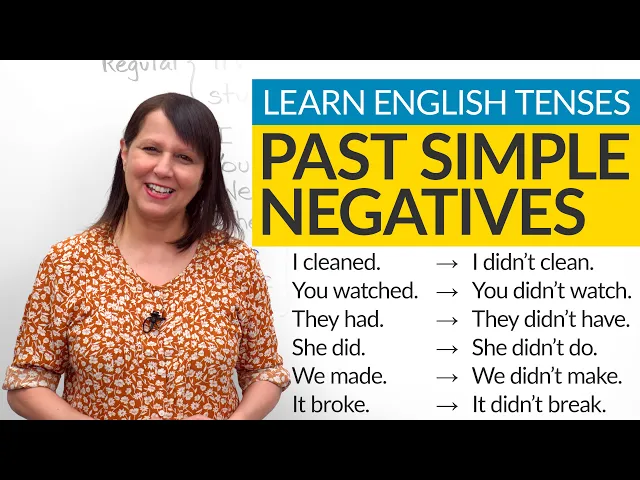
Learn English Tenses: PAST SIMPLE NEGATIVES
Learn English with Rebecca · engVid
0:00 If you're watching this, I know
0:02 that you're serious about becoming fluent in English.
0:06 One of the main ways to do that is by mastering the English tenses.
0:13 That's why some time ago,
0:15 I recorded an entire series of lessons on all 12 verb tenses,
0:20 and you can watch those.
0:23 I'll give you a link to those.
0:24 It's a very strong program, millions have watched it,
0:28 and basically, it takes you through all of the tenses,
0:31 tells you what they are, when to use them, how to use them,
0:36 what mistakes to be careful of, pronunciation, and everything, okay?
0:40 So, if you haven't had a chance to watch it, please do go through them.
0:44 I think you'll find them very, very helpful.
0:47 Now, today, what we're going to be focusing on is the past simple tense.
0:52 Why this one again?
0:54 Because we use this tense more than almost any other tense,
0:59 so we really, really need to use it correctly.
1:03 So, I'm going to show you one aspect of that.
1:06 I'm going to show you exactly how to say the positive sentences,
1:10 and then, most important, how to make the negative sentences,
1:14 because to be fluent,
1:15 you want to be able to move smoothly from the positive to the negative,
1:20 the positive, the negative, also the questions, but today, here,
1:24 we're going to focus on how to go back and forth,
1:27 and what's the secret to that, alright?
1:31 So, let me explain so that you can continue with your journey
1:36 to being more skilled in English and also more confident in English,
1:40 which is, I know what you want to do.
1:43 So, let's begin.
1:45 So, here, you see a lot of writing on the board,
1:48 and everything is for a reason, okay?
1:50 Don't get worried.
1:51 I'm going to explain everything to you.
1:54 So, the first thing you need to know in English is that we have verbs, right?
1:59 Verbs are the words that indicate some kind of action, usually.
2:04 So, there are many ways to classify these verbs.
2:09 One way to separate them is to understand that some verbs are regular verbs,
2:16 and other verbs are irregular verbs, and that's important for this reason.
2:22 I'm going to show you now.
2:24 The regular verbs, like work, live, and study, in the past tense,
2:31 they usually just have an -ed or a -d or an -ied, okay?
2:38 That's how we know, actually, that these are regular verbs.
2:41 We can recognize them.
2:43 If I hear the word "work" or "worked", I know the word, right?
2:48 But you're going to see that on the other side, things are a little different.
2:52 So, let's look at these regular verbs first.
2:55 So, "work" becomes what in the past tense?
3:00 "Worked", right?
3:01 "Live" becomes "lived".
3:04 Here, we just added a "d" because we already had an "e".
3:08 Here we added "ed", right?
3:10 And this word, "study", it happens to end with a "y",
3:14 so we need some spelling changes there.
3:17 So, we have to add "ied" after we drop the "y".
3:22 And we have many verbs that fall into these groups, okay?
3:26 Some with "ed", some with "d", some with "ied", but those are the regular verbs,
3:32 and we're going to see what happens with them
3:34 in a few minutes when we go from positive to negative.
3:38 Let's look now to the other side at the irregular verbs.
3:43 So, examples of irregular verbs are "go", "do", "sleep".
3:49 Why are they irregular?
3:52 Because look what happens when we put them into the past simple tense.
3:57 "Go" becomes "went", "do" becomes "did", and "sleep" becomes "slept".
4:04 Now, they didn't follow any kind of a regular pattern.
4:09 Each one is kind of a little bit different, right?
4:12 So, that's what makes them irregular,
4:15 that the past forms are basically sometimes completely different,
4:20 like "go" and "went", or "do" and "did",
4:23 which is kind of similar, or "sleep" and "slept".
4:27 But they don't follow any basic pattern, they just fall into different groups.
4:32 But you must know them,
4:33 because if you don't know that "went" is the past of "go",
4:36 you won't be able to talk about
4:39 something somewhere that you went yesterday, okay?
4:42 And let's see now how all of that comes
4:45 together when we are making positive sentences.
4:48 And negative sentences, so it's like this.
4:53 Now that you know regular and irregular,
4:56 let's look at what happens first in a positive sentence.
5:01 So we could say, for example, "I cleaned the house",
5:05 but if I want to make it negative,
5:09 all I do is I go back to the base form of the verb.
5:14 So what was the base form of this verb "cleaned"?
5:17 It was "clean", right?
5:22 The base form was "clean",
5:23 I just added the "ed" because it's a regular verb, past tense.
5:28 "I cleaned" becomes "I didn't", what?
5:33 "Clean".
5:33 We go back to the base form of the verb, isn't that lovely?
5:37 It's actually easy, because we don't have to remember something else,
5:42 we just go back to the base form of the verb.
5:45 And that's the same principle you're going to follow all the way through.
5:49 As you'll see, the secret is that even with the irregular verbs,
5:53 you're going to do the same thing.
5:56 Let's look at some examples.
5:58 "You watched TV", let's say.
6:01 Okay, past tense, what's the basic verb?
6:04 The base form of the verb is "watch", right?
6:07 So when I make it negative,
6:09 I go back to that base form of the verb, and the "watched" becomes "watch".
6:15 "You didn't watch the movie." Okay?
6:19 "Checked", "We checked the invoices", or "We checked the payments".
6:26 Past tense, right?
6:27 Go back to the base form of that verb, what's the base form?
6:31 "Check".
6:31 So, "check" becomes "We didn't check the payments".
6:36 "We checked", "We didn't check".
6:39 "We watched", "We didn't watch".
6:42 "We cleaned", "We didn't clean".
6:45 Alright?
6:46 So, what's happening,
6:47 you're always just going back to the base form of the verb,
6:51 the original verb is the base form.
6:54 Got it?
6:55 Okay.
6:56 Now that you understand that principle with the regular verbs,
7:00 you'll see that the same principle works for the irregular verbs, okay?
7:05 You don't have to find anything more than that.
7:08 So, let's look at some examples.
7:11 "They had a good time." Alright?
7:14 Or, let's say, "They had dinner." Okay?
7:16 Now, what's our- what's the base form of the verb?
7:19 "Have" here, right?
7:22 So, here, what happens, it becomes "They didn't have".
7:28 "They had dinner", which is the past simple form of this irregular verb,
7:33 and "They didn't have".
7:35 So, you're going back to that base form still,
7:37 just like you did here, you're doing the same thing here.
7:41 Okay?
7:42 But you must know, with the irregular verbs,
7:45 what you have to master is what is the base form, what is that past tense form.
7:50 Alright?
7:51 Next.
7:52 "He did his homework." "Did" is the past of which verb?
7:57 "Do".
7:58 So, what do we see?
7:59 He did, he didn't do.
8:03 He did his homework, he didn't do his homework.
8:07 Got it?
8:08 Now, when I'm saying "didn't", alright,
8:10 make sure that when you are pronouncing it,
8:14 that you're saying all of that, because if you don't say the ending,
8:18 it'll sound like "He did", "He did do his homework", which means the opposite.
8:23 So, make sure you're pronouncing it correctly also.
8:26 He didn't do his homework.
8:28 Okay?
8:29 Next.
8:30 "She made", "She made an appointment." Alright?
8:35 "She made an appointment", "made" is the past simple tense of which verb?
8:41 What's the base form of the verb?
8:43 It's "make", right?
8:46 So, "She made an appointment",
8:49 the negative becomes "She didn't make an appointment".
8:53 We're coming back to that base form, that's the key, that's the secret.
8:58 Once you know that secret and you apply it,
9:00 it'll work for the regular verbs, it'll work for all your verbs, okay?
9:05 Last, "It broke", let's say the glass, okay?
9:08 It broke.
9:10 "Broke" is the past of which verb?
9:14 "Break", alright?
9:16 So, when we make it negative, what do we say?
9:19 It didn't break.
9:21 Why?
9:22 Because we're coming back to the base form of the verb, alright?
9:27 You're going to know this so, so well,
9:29 you're going to want to teach it to your friends,
9:31 you're going to want to teach it to your children, okay?
9:34 Because it's really easy once you know what the principle is,
9:38 what the rule is, and what we're doing, alright?
9:42 So, now, let's make sure that you've mastered that.
9:45 Now, we'll look at ten different verbs,
9:48 out of which some are regular verbs and some are irregular verbs.
9:53 Here, I've written all of them in the past simple tense.
9:56 What we are going to do together is to make them negative,
10:02 with "didn't", alright?
10:04 So, "He danced", "He didn't",
10:07 we can go back to the base form of the verb, "dance", good.
10:16 "She invited", "She didn't", "invite", okay?
10:25 If you need to, you can pause the video,
10:29 think through them, and then join me or keep going.
10:33 Let's continue.
10:35 "The baby cried" or "The baby didn't cry", good.
10:46 "We wanted", "We didn't want", okay?
10:55 So, what are we doing here?
10:56 What did we do in all four of these regular verbs?
10:59 We went back to the base form of the verb, that's it.
11:03 You've got it.
11:05 Now, let's start with the irregular verbs.
11:09 So, "forgot", okay, "We forgot" becomes "We didn't",
11:13 what's the base form of the verb?
11:16 We didn't forget.
11:20 "We didn't", say it after me, "We forgot", "We didn't forget".
11:26 It's very helpful for you to actually repeat them.
11:29 Repeat it out loud, that way your brain can also hear it,
11:33 not just see it and understand it, okay?
11:36 It's very helpful, and also for pronunciation purposes.
11:40 Next, "They bought a house", negative, "They didn't", yes.
11:49 What's the base form?
11:50 "They didn't buy", okay?
11:53 "They bought", "They didn't buy".
11:56 So, you can just do that, even if you go through a grammar book, right?
11:59 Look at the past tense forms, say the negative.
12:03 "They bought", "They didn't buy",
12:05 "They forgot", "They didn't forget", like that.
12:07 And when you can do that easily,
12:09 then it will come to you easily when you're speaking, alright?
12:13 Next, number seven.
12:16 Be careful of this one.
12:18 "He fell", negative, "He didn't", what's the base form of this verb?
12:26 "He didn't fall", okay?
12:30 So, be careful of that one, I'll show you why in a second.
12:32 Next, number eight.
12:35 "We thought", "We thought they were coming", or "We didn't", what is it?
12:46 "Think".
12:48 Say it after me.
12:49 "We thought", "We didn't think".
12:53 "He fell", "He didn't fall".
12:58 Excellent.
12:59 Now, look at number nine.
13:03 "She felt", "She felt happy", the negative, "She didn't", which verb is that?
13:14 "Feel", okay?
13:15 So, be careful of these two, especially.
13:19 A lot of students make mistakes with these because they're a little bit close,
13:24 so "fell" is the past tense of "fall", and "felt" is the past tense of "feel".
13:32 So, "I feel", then- sorry, in the past, "I felt", "I didn't feel".
13:40 "He fell", "He didn't fall".
13:43 Be careful of those, alright?
13:44 And the last one, "She got an email".
13:48 "She got", in the past, the negative, "She didn't get".
13:57 Say it after me.
13:58 "She got", "She didn't get", alright?
14:02 That's the way.
14:04 Alright, so once you can do this, once you can move
14:07 smoothly and easily back and forth between the positive, the negative,
14:11 also other aspects, like the questions, so for that and for much,
14:16 much more with all of the tenses, you can master them.
14:20 Go watch the course after this, all of the 12 tenses are there,
14:25 special lessons to show the differences.
14:27 Watch and you will learn, and you will master your English.
14:32 Bye for now.
14:33 Take care.