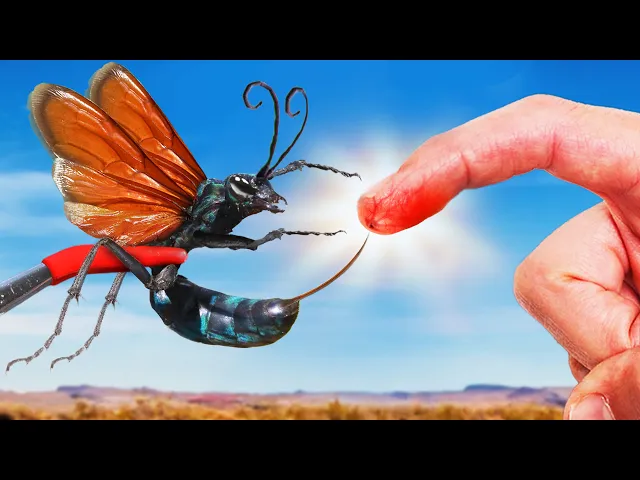
Worst Sting of My Life? Tarantula Hawk Wasp Sting!
Brave Wilderness Top Videos
0:00 You guys ready?
0:01 Got your shots on three.
0:05 One, two, three.
0:13 When it comes to the world of stings,
0:15 there are titans of pain that stand tall above the rest.
0:18 Now, I've already survived the dreaded sting of the bullet ant,
0:22 the warrior wasp, and even the deadly stonefish.
0:28 But there is one titan that has eluded me time and time again.
0:33 So today I am back in the state of Arizona
0:35 to take on the sing of the one and only tarantula hawk.
0:40 Let's get searching.
0:43 The last five times I have come to Arizona,
0:46 I have not been able to catch one of these giant spider wasps.
0:51 But today is different.
0:52 It's different because we've been tipped off
0:55 to a well-known tarantula hawk hot spot.
0:59 Let me explain to you why this is a great location for tarantula hawks.
1:03 Reason number one, water.
1:05 In the desert, water is life.
1:07 And it grows flowering plants.
1:10 Just like this one.
1:12 You see all these honeybees fast at work?
1:14 This is exactly the same type of plant
1:16 that's tarantula hawk is going to be after.
1:18 They eat nectar.
1:19 So, I think the best strategy for us today is to walk laps around this pond,
1:24 keeping our eyes to the sky and our ears open.
1:26 These wasps are so huge that you can
1:29 actually hear them buzzing in through the air.
1:31 They're like little fighter jets.
1:33 If we can find one perched up like this butterfly right here,
1:37 that is going to present the perfect opportunity
1:39 for me to swoop in with the net.
1:41 Here we go.
1:43 Desert's waking up.
1:45 Got the hummingbirds out now.
1:48 I think that was a tarantula hawk actually that just flew by.
1:51 Big one.
1:53 Really?
1:52 Dang.
1:52 Yeah.
1:54 Just saw one.
1:54 Saw my first tarantula hawk.
1:56 It just went way into the desert.
1:59 Like no chance.
2:00 But that was definitely one.
2:02 They really stand out from the other insects and things flying around out here.
2:05 I mean, we're talking about a wasp 2 in long.
2:10 Today's the day.
2:11 I can feel it.
2:12 Today is the day.
2:12 It's going to change.
2:14 It's just a matter of patience and persistence.
2:16 Let's keep hiking around this pond.
2:19 Got one.
2:19 Oh,
2:21 here we go.
2:21 Here we go.
2:21 Here we go.
2:24 Oh, where is it?
2:25 Right here.
2:25 Right here.
2:27 Yeah, there it is.
2:29 Y
2:29 Oh no,
2:31 that is one.
2:32 That is definitely one.
2:33 Oh my gosh.
2:34 I can see it's bright orange wings and it's huge.
2:38 That is really high though.
2:41 That is like 12 ft.
2:42 I just can't I can't get that high.
2:47 It just comes down.
2:52 Dang it.
2:54 The drought continues.
2:56 We just have to find the right one.
3:01 At least this guy's catching stuff out here.
3:10 Whoa.
3:11 Whoa.
3:11 Right here.
3:11 Right here.
3:11 Right here, bar.
3:12 Whoa, that was huge.
3:19 I got one right here.
3:21 Right here.
3:24 Got it.
3:25 Oh yes.
3:27 Yes.
3:30 Oh my goodness.
3:31 And that is a good one, too.
3:35 Oh yeah, baby.
3:37 All right.
3:38 Can't get too excited.
3:38 It's got to get in the jar to be officially a catch.
3:42 Okay.
3:48 Yeah.
3:51 I cannot believe that catch.
3:53 That was so epic.
3:55 What a fitting way to end the drought of catching tarantula hawks.
4:01 Oh my gosh, guys.
4:02 I was like, man, if this doesn't happen today,
4:05 I don't think it's ever going to happen.
4:07 And now, unfortunately, this victory,
4:10 this victorious moment I'm feeling is about to turn
4:13 into a world of pain because I've set the table for me to enter the sting zone
4:17 with one of the colossals of sting, the tarantula hawk.
4:22 Let's go set up the sting table.
4:24 Here we go.
4:24 It's game time.
4:27 Oh my gosh, guys.
4:30 Look at the size of that tarantula hawk.
4:34 That is a massive tarantula hawk.
4:36 And I have to say, I have not been
4:38 this amped for a sting video in a very long time.
4:42 We have put in the work to feature the tarantula hawk on the bite sting index.
4:46 And today it's going down.
4:50 But before we get into that, check this out.
4:55 Not only did I catch one tarantula hawk, I caught two.
5:01 And the reason I want to show you both
5:05 of these insects is because although they look similar, they are very different.
5:11 And it's important for you to know the difference if you're ever
5:13 out here in the Southwest and encounter one of these giant flying insects.
5:18 And the way I'm going to show you how they're different is by demonstrating.
5:26 Here we go.
5:27 You ready?
5:28 You guys ready?
5:30 Yeah.
5:30 Okay.
5:31 And get out the second tarantula hawk from the container.
5:35 Here we go.
5:39 You ready?
5:41 This is one of those moments where you
5:44 really hope you're right about what you've learned.
5:47 One, two, three, no sting.
6:08 And that is because what I'm holding here is
6:12 a male tarantula hawk and they do not possess a stinger.
6:17 Now the reason why the males do not possess stingers and this is true in almost
6:21 all stinging insects is because a stinger is
6:25 really just a modified appendage for laying eggs.
6:28 Now besides not having a stinger,
6:31 the only other way to tell the difference between the male
6:33 and female tarantula hawks are by looking at their antenna.
6:37 Males have straight antenna where females curl at the ends.
6:41 And while side by side, it's also easy to see that females are larger,
6:45 you typically will never see more than one tarantula hawk at a time.
6:48 So checking for those antenna is the best way to know if you're looking
6:51 at a harmless insect versus one that packs
6:54 one of the most intense stings on the planet.
6:57 I'm actually going to transfer her into a bigger glass so
7:01 we can really see so she can spread all the way out.
7:03 You can see how truly gargantuan this wasp is.
7:12 Okay, there we go.
7:14 Wow.
7:16 Oh my goodness.
7:18 What a monster wasp, guys.
7:21 Look at the size of that abdomen.
7:23 This is the biggest tarantula hawk I have ever seen.
7:27 Now, the reason they're called a tarantula hawk is because how they reproduce.
7:33 These enormous wasp, one of the largest wasp in the world,
7:36 feed tarantulas to their young.
7:39 And the way they do that is they will
7:41 fly around the desert looking for these giant spiders.
7:44 Once they find one, they will swoop down like a bird of prey,
7:47 catch it, sting it, paralyzing the tarantula, and then lay eggs inside of it.
7:52 So, when those eggs hatch,
7:55 the very first meal of a tarantula hawk's life is a giant spider.
8:00 And then they will emerge from the burrow
8:02 as a fully grown wasp and feast on nectar.
8:05 I've seen these wasps dragging spiders across the desert 10 times their size.
8:09 It's truly unbelievable just how powerful the tarantula hawk can be.
8:15 And the last thing I just want to note before we get
8:17 into the sting test is look at the legs of this wasp.
8:21 They are extremely long.
8:22 In fact, when you see them flying through the air,
8:25 you can see those long legs dragging down behind them.
8:28 And the reason they need to have such long legs is so they can
8:32 grapple those spiders and inflict that paralyzing
8:35 sting that are also covered in tiny hairs.
8:39 Got some hairy legs there, lady.
8:42 Well, now that we know why it's called a tarantula
8:44 hawk and we've been able to take a closer look,
8:47 I think it's time for the moment that you all came for.
8:50 It's time for me to enter the sting zone
8:52 with one of the largest wasps on the planet.
8:55 Here we go.
8:56 Right.
9:00 I often get questions, Mark, are you just over the fear of stings by now?
9:07 No.
9:09 I always get a lot of anxiety before taking a sting for a first time,
9:14 especially when it's one of the titans of sting.
9:18 The tarantula hawk sting is notorious.
9:20 It's put right up there with the bullet ant.
9:23 And when it comes to stings that I personally witnessed,
9:26 I cannot think of one more terrifying than when
9:29 I saw someone get stung by a tarantula hawk.
9:32 As much as I've been working hard with the team to find
9:35 one of these tarantula hawks for this sting test in this moment,
9:42 buddy, I am feeling the nerves.
9:45 The sooner I take the sting, the sooner I get to healing that I know for sure.
9:51 All right, I'm getting the signal.
9:53 You guys ready?
9:54 Yeah.
9:55 It's go time.
10:00 All right, guys.
10:01 This is going to be one of the biggest stings I ever go through.
10:04 Got essential first aid on standby.
10:07 The epi pen.
10:10 Oh my gosh, I can't believe the moment has arrived
10:13 for me to enter this thing zone with this wasp.
10:16 This is big time.
10:16 Okay, guys.
10:17 Here we go.
10:18 Now, I'm going to rate the sting of this wasp on three different factors:
10:24 intimidation, pain, and aftermath.
10:26 So, at the end of this video,
10:28 this tarantula hawk is going to receive a BSI score,
10:31 and it will rate it against all the other
10:33 stings and bites that I have ever taken.
10:35 Will it top the bullet ant?
10:37 It's time to find out.
10:41 Going to remove the glass.
10:44 Oh, man.
10:45 This is where it would be very easy for me to take the sting too early.
10:48 Those legs are so strong.
10:50 Like if I don't get the right hold right away, it's almost no chance.
10:58 Shaking.
10:59 So nervous right now.
11:02 Gosh, this is always so much harder than it looks.
11:06 Got to hold.
11:10 All right, I'm going to have to use another set.
11:13 Oh my gosh, look at how big that stinger is, guys.
11:16 So strong.
11:18 Got it.
11:19 Good hold.
11:20 I got to go for this thing, guys.
11:21 Ready?
11:22 I'm Mark Vins and I'm about to enter
11:24 the sting zone with the one and only tarantula hawk.
11:27 You guys ready?
11:28 Got your shots on three.
11:31 One, two, three.
11:38 All right, hang on.
11:39 I'm about to I'm feeling lightheaded.
11:42 I feel like I might pass out.
11:44 I feel like I might pass out.
11:46 Sorry, guys.
11:48 Sorry.
11:48 You want me to put a jar on it right now?
11:49 No, I'm just Hold on.
11:50 Just let me get my nerves going.
11:51 My legs are shaking.
11:52 My hands are shaking.
11:55 I feel like my stomach's in my throat right now.
11:57 I've never I've never felt this like this before.
12:00 Sting.
12:01 This is like next level.
12:03 Next level tear.
12:05 Oh my gosh.
12:06 Oh my gosh.
12:07 This is happening.
12:09 All right, here we go.
12:12 All right, guys.
12:13 On three.
12:15 One, two, three.
12:26 Stinger's head.
12:27 Stinger's head.
12:31 Oh god, I didn't get a good sting, though.
12:33 I got to do it again.
12:34 Oh, that hurts.
12:35 It didn't get good.
12:36 It didn't get me good.
12:37 One, two, three.
12:42 Oh.
12:43 Oh.
12:50 Ah.
12:52 It's damaging me.
12:55 Yeah.
12:56 Yeah.
13:07 Yeah.
13:11 Oh my gosh.
13:12 Look how quickly it's swelling.
13:17 It's white hot.
13:18 White hot.
13:28 You all right, man?
13:29 Oh, it's bad.
13:30 It's really bad.
13:31 She got me.
13:32 She got me a bunch of times before the real sting with the real sting went in.
13:34 It was so bad.
13:57 Describe the pain.
13:58 White hot.
14:00 It's like gasoline under the skin, torched.
14:03 It's like someone put a match right on it.
14:08 That's the real deal.
14:10 Look at the swelling already.
14:12 Matter of seconds, it's already swelling up.
14:19 All right, guys.
14:21 I feel like my voice is going.
14:23 All right.
14:24 Well, I've survived so far.
14:28 I don't think I need the epipen, but my voice is shot.
14:31 And I think it's now time for me to recover, endure the aftermath,
14:36 and for you guys to know exactly where
14:40 this red clock rates on the Brave Wilderness Biking Index.
14:43 Roll it.
14:45 For intimidation, it's hard to imagine a wasp
14:48 or any insect more intimidating than the tarantula hawk,
14:51 but just in case I ever find one, I'll give it a 9.9 out of 10.
14:55 For pain, it was way up there compared to the worst stings I've experienced.
14:59 Instant flares of pain rocked my arm and underneath the skin.
15:03 And the only reason I took repeated stings was to make sure I took a full dose,
15:07 which I'm sure glad I did for the sake of this index,
15:09 because that last sting was 10 times as painful
15:12 as the first eight or so warning pops.
15:15 All of that said, I don't feel it was quite as bad as a bullet ant.
15:18 So, it only gets an 8.6 out of 10 for pain.
15:22 For Aftermath, the swelling was severe.
15:25 My arm ballooned up and the redness extended
15:27 from my wrist all the way down to my elbow.
15:29 And the pain lasted for over 24 hours,
15:31 but was much less severe after just about 30 minutes.
15:35 However, it was followed by days of very
15:37 intense itching before it started to properly heal.
15:40 For that, the Aftermath gets an 8.5 out of 10,
15:44 giving the tarantula hawk a grand score and BSI rating of a nine,
15:48 making it the second worst sting I have rated so far and just
15:51 barely falling short of the current king of sting, the bullet ant.
15:55 Needless to say, while tarantula hawks are typically non-aggressive,
15:58 you should never attempt to do what you saw in this video.
16:01 Take it from me, it was a very painful experience I hope to never have again.
16:06 Ouch.
16:09 I see one.
16:10 Got one.
16:10 We got a devil.
16:14 Yes.
16:15 Yes, we got one.
16:19 Oh man, this is the coolest lizard on the planet, guys.
16:25 Oh my gosh, I am so excited right now.
16:27 I cannot believe we found a thorny devil.
16:31 Look at how cool this little dragon is.
16:35 This is one of the top targets out here.
16:39 And unlike their cousins in America and Mexico,
16:43 the horn lizards, these guys are actually super spiky.
16:47 And you see it puffing up its body and pushing those spines out.
16:51 That is one of its defense mechanisms.
16:53 And I could tell you that if you were to grab
16:57 onto this thorny devil without knowing that it was sharp,
16:59 you would get a handful of spikes.
17:02 Look at how cryptic the color patterning is.
17:05 This animal is superior at camouflaging this environment.
17:09 From the sand that's demonstrated in its arms
17:12 to the foliage and the yellow leaf litter,
17:16 this animal is perfectly designed for this habitat.
17:20 You can see that I'm not really doing much to keep the animal here with us.
17:24 They're very docil and slowm moving.
17:26 In fact, they use their tail as a balance to step forward.
17:30 They're almost like a chameleon and they'll do very cautious steps.
17:34 So, look at that.
17:34 Just in a matter of minutes from presenting this animal,
17:38 it's already changed its color to a much more vibrant yellow on the back.
17:43 And that's probably because the sun is really starting to come out today.
17:47 And like most lizards, it is ectothermic.
17:50 The more heat it absorbs in its body, the more energy it's going to have.
17:55 And it certainly has earned its name, the thorny devil.
17:58 It is extraordinarily sharp and spiny and it is covered from the tip
18:05 tip of its tail all the way to its fingers and sharp spikes.
18:11 Andrew, stick your finger out there.
18:12 Tell me what that's like.
18:13 Wow.
18:13 It's like it's like parters.
18:15 It's literally as sharp as the thorns on a rose.
18:19 Just because it has these defense mechanisms doesn't
18:21 mean that this lizard doesn't have any predators.
18:23 There are animals out here that would make a meal out of a thorny devil,
18:27 including species of hawks and of course the predatory goanas,
18:32 the giant monitors that live in this country.
18:34 So that's where this animal will rely on its superior camouflage
18:38 to blend into its environment to not give its location away.
18:41 It also has another unique defense mechanism.
18:44 You see those two horns right at the neck?
18:47 That is a false head.
18:49 And in a defense situation, the thorny devil will tuck in its head,
18:53 offer up that false head to any wouldbe predator,
18:56 so it has a chance to escape if attacked.
18:58 So, let's see if we can actually get it to do that.
19:02 Offering that false head up.
19:04 That is a great display.
19:07 All right, let's pick it back up.
19:10 Gosh, those spikes are sharp.
19:12 Ah.
19:13 Oh, do you see him right there trying to horn me?
19:15 Ah.
19:16 Okay.
19:16 Okay.
19:16 Okay.
19:17 Let's calm down.
19:18 Let's calm down.
19:19 I thought we had an agreement.
19:21 We're going to do this scene and I was going
19:23 to put you back trying to show everybody how cool you are.
19:26 There we go.
19:28 If you ever want to see one in person,
19:30 you have to come here to one of its native ranges.
19:33 Right now, we are in Western Australia,
19:34 but the range extends all the way to the center of the continent,
19:38 but it lives in this specialized desert terrain,
19:40 feeding on ants of a particular variety.
19:43 Now, when I say feeding on ants, I should say feasting on ants.
19:48 This little lizard has the ability to eat up to 3,000 ants a day.
19:53 It will eat up to 1,000 ants in a single meal.
19:57 And because of that, it actually is said that they are super intelligent.
20:00 They have the ability to track through
20:02 their environment to locate different colonies of ants.
20:05 And they make sure that they don't overpredate any specific colony.
20:08 They want to be able to come back to the food
20:11 line to get another meal when they need it.
20:14 These animals all have a very unique color pattern.
20:18 You see underneath there, the patterning on the belly is
20:21 like an individualized fingerprint for these lizards.
20:24 So, scientists will actually take photographs of the underside of a thorny
20:27 devil so they can study the populations in any given area.
20:30 And this one is super cool.
20:33 It's very reticulated, almost like tiger stripes.
20:37 Ah.
20:38 is so sharp.
20:40 Ah, hang on, hang on, hang on.
20:44 In addition to being super spiky, it has another very unique mechanism that has
20:49 developed for life out here in the desert,
20:51 and that's the ability to drink using its feet.
20:55 Now, I've heard that if you actually pour water
20:57 out and place a thorny devil in a small puddle, you can witness this happening.
21:02 So, we are going to try to demonstrate that for you right now.
21:05 I've got a little water here.
21:11 All right, let's see.
21:24 Look at that.
21:26 See all that moisture?
21:29 Definitely have water coming up the back.
21:32 I can see it on the neck.
21:34 It's probably hydrating its eyes.
21:37 And if we stay here long enough,
21:38 it would actually be able to siphon some of that water into its mouth.
21:44 But that is so cool.
21:45 So those scales are adapted to be able to suck
21:50 up moisture from the ground to keep this lizard hydrated.
21:56 It's hard to believe.
21:57 Even holding it here in my hand, seeing it move, seeing it look at me,
22:02 I'm almost in disbelief that this is even a real living thing.
22:06 And for those of you who've been watching to see if the thorny
22:08 devil is indeed sharp enough to draw blood, well, here you go.
22:13 I mean, it is it is spiky.
22:14 It's like holding the thorns of a rose.
22:16 So, I'm going to do this delicately.
22:19 Ready?
22:25 Ah, you're spining me.
22:28 Ah, yep.
22:29 Ah, it's wriggling around and it's so spiky.
22:32 But I think the verdict is in.
22:35 I do not think the thorny devil is sharp enough to draw blood.
22:38 Even though ah, he's spiky.
22:42 Definitely does not feel good when it tenses up those spines.
22:45 Ow.
22:46 From its defense mechanisms and the spines and the false
22:50 head to even the way that it drinks.
22:52 How cool was it to come across the real dragon of the outback, the thorny devil?
22:58 I'm Mark Bins.
22:59 Be brave.
23:01 Stay wild.
23:02 We'll see you on the next adventure.
23:04 So, we're going to have to search this entire
23:06 mountain range to even have a chance at finding one.
23:10 Okay, this looks promising.
23:11 This open area has a lot of sandy, loose material,
23:15 which is perfect for the panda ant because it likes to make burrows.
23:18 And it also allows us to cover a lot of ground fast.
23:22 Covering ground.
23:24 That is the name of the game when you're looking for very, very small creatures.
23:30 The more ground your eyes can scan,
23:34 the more likely it is you'll find what you're looking for.
23:39 We're hearing water down below.
23:41 In the desert, water is life.
23:43 Let's try our luck in a different environment.
23:48 Found the water.
23:49 Ah.
23:51 It looks so good.
23:52 If you were ever stuck out here in the desert,
23:55 this water would be absolutely life-saving
23:57 and perfectly fine to drink running this fast.
24:02 Little bouldering.
24:08 Just seeing water is a boost of energy.
24:15 That feels so good.
24:19 Oh.
24:21 It's good that we're seeing these flowers.
24:23 Panda ants feed on a diet predominantly of nectar.
24:27 So, these flowers, good indication we have a food source.
24:32 There's definitely more life down by this river.
24:34 Finally feels like we're starting to close in on the pan.
24:38 Seeing these smaller wasps, that makes me feel really positive.
24:43 I think the trail is heating up.
24:45 I'm starting to see yellow jackets.
24:47 Good sign for us right now.
24:49 This is the insect watering hole.
24:52 Oh, look at that one.
24:53 See how one is chasing the others off?
24:55 It's got like a pandaike abdomen.
24:57 You seeing this?
24:59 You seeing this?
25:02 The male panda ants have wings.
25:05 Let's keep moving.
25:06 Have to be getting close.
25:08 Oh, wa.
25:09 Look at all these.
25:10 Just got to this trail and there are all these burrows.
25:14 I can't say whether or not these are definitively panda ant burrows,
25:19 but they're the right size and right shape and in the right place.
25:23 Finally feels like we're starting to close in on the panda.
25:30 Pin it right there.
25:36 Woo!
25:38 We got one.
25:40 Holy.
25:41 Oh, we were literally just about to give up.
25:48 It's not a big one, but that is a pandan, baby.
25:53 Let's go.
25:53 Yes.
26:01 Got one.
26:02 But our luck wouldn't end there.
26:04 As we prepped our presentation and captured
26:07 the first ever video of this fuzzy little panda,
26:10 something even more incredible happened.
26:14 Got another one.
26:15 Hold on.
26:15 Hold on.
26:16 Get in there.
26:16 Get in there.
26:17 Go.
26:18 They're so fast.
26:19 So fast.
26:20 This one's kind of small.
26:26 I don't want to get stung.
26:27 Uh-uh.
26:28 Not yet, anyway.
26:34 Yes, two panda ants.
26:37 Holy cow.
26:39 And this one really looks like a panda.
26:43 Wow.
26:45 Not one, but two panda ants.
26:48 This is such a rare opportunity to film this world famous creature.
26:52 There is almost no footage of this species.
26:55 In fact, this is likely the first 4K
26:58 footage the world has seen of the panda ant, the world's smallest panda.
27:14 The first thing I noticed about these creatures were their size.
27:16 They are teeny tiny.
27:18 Look at the little capsules that we had to bring with us for this presentation.
27:22 But not only are they small, they are fast.
27:26 I cannot believe we actually were able to get them into the containers.
27:30 It's not likely that we're going to be able
27:31 to get very much B-roll of them walking around.
27:33 All it would take is a small little hole
27:35 or crack in the ground and they are poof gone.
27:39 They got their name the panda ant
27:40 because of that black and white fuzzy exoskeleton,
27:43 which of course I keep calling them an ant, but they are not an ant at all.
27:46 They are a species of wasp.
27:48 And the wingless ones are actually females.
27:51 The males of this species have wings, but the females do not possess wings.
27:56 But what they do possess is the largest stinger
27:59 to body size ratio of any insect in the world.
28:02 They're related to the cow killer found in the southern United States,
28:06 another species famous for its massive stinger and painful sting.
28:10 Both have fuzzy exoskeletons and are classified as velvet ants.
28:14 However, unlike the cow killer,
28:16 the effects of the panda ant venom are completely unknown.
28:19 And with that, it's time to take a closer look at their defense mechanisms.
28:24 They don't just look like pandas for our amusement.
28:26 They've developed this coloration to ward off predators to say,
28:29 "Hey, I pack a punch.
28:30 I have a lot of defenses and you will regret it." Now,
28:33 let's talk about another defense mechanism.
28:35 Let's bring the microphone in there real close.
28:37 You hear that?
28:40 That's called striulation,
28:42 which is a high frequency warning pitch that these insects are able to emit.
28:47 And we're not just boosting the sound.
28:49 This insect's actually noisy.
28:50 I can hear it.
28:51 Look at that.
28:53 Swinging the abdomen already.
28:55 Might get to see an appearance of that.
28:57 Oh, that stinger's coming out.
28:59 Compared to body size, that is a super long stinger.
29:03 It will have no problem popping the stinger through my skin.
29:07 Now, remember when I said earlier,
29:08 this is probably the first 4K footage of a panda ant.
29:12 Let me also tell you,
29:13 this is about to be the first ever documented sting of this species.
29:17 No one has taken the sting of the panda ant.
29:21 Going into the sting zone with the panda ant is truly the great unknown.
29:25 I have no idea what kind of reaction I'm going to have.
29:28 So, we brought a couple of emergency remedies.
29:31 Of course, our satellite phone if I go into any kind of anaphylactic shock.
29:34 We will use this for emergency distress calls.
29:37 In addition to that, I always bring a first aid trauma kit.
29:40 And in this trauma kit, I always have a nappy pen.
29:44 That's pretty much our only remedies if this sting gets really bad.
29:49 For the first time ever, it's time to go flesh the stinger with the panda ant.
29:54 That stinger is flying.
29:57 That is a very big stinger.
29:59 I would say the stinger is the entire length of the lower abdomen.
30:03 All right, it is time.
30:04 I'm Mark Vins and I'm about to enter the sting zone with the panda ant.
30:10 Here we go to the great unknown of the world of stings.
30:15 One, two, 3.
30:27 Yep.
30:27 Stinger's in.
30:28 Stinger's in.
30:29 Ah.
30:31 Ah.
30:32 Oh, I dropped her.
30:34 Where'd she go?
30:36 I don't see her.
30:37 Definitely stung me.
30:39 Uh, maybe walk.
30:41 Yep.
30:42 Let me see.
30:44 Ah, they're so fast and they blend in perfectly where she can't have gone far.
30:51 Look around here.
30:53 I'm going to look over here.
30:54 All right.
30:54 Yeah.
30:54 Yeah.
30:54 Keep looking.
30:55 Keep looking.
30:56 Oh, no.
31:01 Well, unfortunately, I dropped the ant.
31:07 She definitely gave me a sting before hightailing it out of here.
31:11 We've got two distinct sting marks.
31:13 I would say it's probably similar to that of a hornet.
31:16 But luckily for us, we have one more ant.
31:19 In fact, this is the one that looks most like a panda.
31:23 So, it's time to see if the world's smallest panda packs a potent punch.
31:29 Got to get a good grip.
31:31 I know it looks easy,
31:32 but it is so hard to get a good grip on these tiny little panda ants.
31:38 There we go.
31:39 Okay, stinger's going.
31:41 One, two, three.
31:48 Ah!
31:49 Ooh!
31:49 Yeah!
31:50 Okay, definitely took a really good sting and a bite.
31:53 See this panda's jaws locked into me?
31:55 Ah, I think this panda ant's bite is worse than its sting.
31:59 Ah, definitely getting little micro stings.
32:02 This tiny panda ant just might not be big enough to deliver a full punch.
32:07 Okay.
32:08 Well, you can see here I got two really good stings from the ant that got away.
32:15 And then I probably have I don't know like a dozen little micro stings.
32:18 I left it there for a while,
32:19 but there were there was one or two really good ones.
32:23 Oh my god.
32:24 There it is.
32:27 Got it.
32:28 We just found the first panda ant.
32:31 Wow.
32:32 I cannot believe it.
32:33 What am I supposed to do with you?
32:35 You ran away and now you're back.
32:38 Should we try to get like another walop?
32:41 All right.
32:42 Well, going to go for another sting.
32:44 I don't know if I got a full one that first time around.
32:46 On three.
32:47 One, two, three.
32:53 Ah, yep.
32:55 Got me.
32:57 Ah, it's biting me.
33:00 Ah, and stinging me.
33:01 Got a good one there.
33:03 Ah.
33:05 Okay.
33:06 Yeah.
33:06 All right.
33:07 Mhm.
33:08 Really not a remarkable sting.
33:10 Even though we're getting a lot of redness
33:13 and little micro swelling around those sting sites,
33:16 this might have been the world's cutest sting.
33:18 The sting of the tiny panda ant is no match for its growl.
33:23 All right, let's let this little panda back into the wild.
33:26 While the pain was manageable right after the sting,
33:28 the secondary reaction roared back the next day where I had redness,
33:33 swelling, and a relentless itch.
33:36 The only way to get to Rottness Island is by boat,
33:39 where it's easy to see that spotting a Quoka is
33:42 one of the main reasons that people make this voyage.
33:44 Now, these boats follow a very strict schedule for leaving the island.
33:48 So, let's not waste any time and get right to searching.
33:50 Here we go.
33:51 I've got 3 hours to explore Rottness Island to get that selfie with the quoka.
33:56 Now, of course, they're friendly,
33:58 but there are some rules about encountering the quok.
34:01 It's important to know that we can't actually touch a qua.
34:04 We have to respect them and not give chase if they want to walk away.
34:08 Now, they are curious,
34:09 so hopefully they'll approach us if they're feeling friendly,
34:12 but at the end of the day,
34:13 they are wild animals and we don't want to stress them out.
34:16 But hopefully, I'll be able to get up
34:17 close enough with this camera to snap a selfie.
34:20 What I have here is a 360 camera
34:22 and it's capable of capturing images from any direction.
34:25 So, this will come in handy when trying to get our Quest selfie.
34:33 Throw that in the trash.
34:35 Beautiful place.
34:38 Great view.
34:39 But I think the quas will be closer
34:40 to the bushes and the shrubs off of the beach.
34:42 Those plants are their food source, so that's where I bet they'll be.
34:45 Now, these animals are endangered,
34:48 but are found in their highest concentrations here on Rot Nest,
34:53 and they could literally be anywhere.
34:55 We're seeing lots of qua poo all over the place.
34:58 This is a good indication that we are on the right track.
35:01 This is fresh.
35:03 Do you guys know what that is?
35:05 What do you get when you mix a qua and a poodle?
35:09 Quoka poo.
35:10 So far, no quokas, but we do see one.
35:12 We should be able to get some good video.
35:17 A lot of the quoka are likely taking cover already to retreat from the sun.
35:23 So, looks like this line of trees might be a good bet to get our encounter.
35:29 We are very far south of the equator.
35:32 It's only 9:45 in the morning,
35:36 but the sun has already risen to really high above the horizon.
35:41 And our guess is the quokas are already sheltering for the afternoon.
35:47 So we're going to scan this tree line here
35:50 and see if we can find any huddled up.
35:52 Now these aren't very large creatures.
35:55 Uh they grow to the size of a average house cat.
36:00 But when early settlers first landed on Rottest Island,
36:04 they confused the quoka with giant rats.
36:06 So, that's actually how this island got its name, Rott Nest or Rat Nest.
36:11 Uh, is a uh long-standing term that's held the test of time,
36:18 but of course, it's highly inaccurate.
36:20 The quoka is not a rodent.
36:22 It's not a rat.
36:23 It's actually a marsupial and arguably one of the friendliest
36:27 little furry creatures living on our planet today.
36:31 So, I told myself if I was ever
36:32 going to get the chance to explore Rotteness Island,
36:36 I was going to do it because I want to get
36:39 my opportunity to get up close with the happiest creature,
36:42 the quoka, and get my selfie.
36:47 All right, here we go.
36:48 We're going to have a scan.
36:52 Oh, got one.
36:54 Guys, we got our first cloa.
36:56 Hey, buddy.
36:58 Hello.
37:04 Hi.
37:05 I heard you are the friendliest animal in all of the world.
37:12 Doesn't really care to say hello right now, though.
37:14 Let's see here.
37:15 Let's try going around this way.
37:21 Hi.
37:23 How are you?
37:24 Do you want to come over to me?
37:26 Say hi.
37:28 You like cameras?
37:30 No.
37:32 No.
37:32 You don't like cameras, huh?
37:34 That's okay.
37:35 We'll leave you be and find another quoka for our selfie.
37:38 Let's move on.
37:42 All right, guys.
37:44 We have a quoka.
37:46 Go.
37:46 Go.
37:46 Be calm.
37:48 I'm going in for the selfie.
37:55 There it is.
38:00 Hi, buddy.
38:02 That, ladies and gentlemen, is a quoka and it's hopping away.
38:09 Hi.
38:10 Let me uh let me go with my camera.
38:12 See if I can get my selfie.
38:23 That's a qua.
38:26 Let's see if I can get my selfie.
38:27 Ready?
38:31 Hi.
38:33 Hi.
38:35 Nope.
38:36 Didn't get it.
38:38 This little guy doesn't want us getting super close.
38:40 So, we're just going to have to film with our zoom
38:42 lens and find a happier qua for our selfie.
38:47 Oh, there's one on the other side of this wall.
38:59 Look at this guy.
39:00 He looks like he's smiling.
39:01 Look at that.
39:02 He's just hanging out on the other side of this fence,
39:04 though, so we'll leave him be.
39:07 Hello.
39:08 We're here for a qua selfie.
39:12 Can we hang for a bit?
39:13 Now, these quas in the fall will give birth to joeies
39:17 that will be carried around in their pouch while they're being reared,
39:20 just like a kangaroo.
39:21 But it is nap time.
39:23 Check that out.
39:24 See, this qua's about ready to go down for its afternoon nap.
39:28 I think that means no selfie from this little guy.
39:34 Got to be under these trees.
39:38 All right, guys.
39:40 We have our quoka.
39:42 I'm going to come in, try to get my selfie with the quoker.
39:45 Look at how tiny they are.
39:46 Look at their hind feet.
39:48 Definitely classic marsupial rear leg.
39:51 And they can't hop.
39:53 I don't know.
39:54 No.
39:57 All right, this is becoming tough.
40:01 We are in the last hour of our search.
40:05 Unfortunately, this midday sun is not working to our advantage.
40:09 This is proving to be a little more challenging than I think any of us expected.
40:13 Got to find the friendliest quoker we can and we got to find it fast.
40:20 This makes sense.
40:22 Got a lot of shade and we've got a quoka right there, guys.
40:27 This is our quok.
40:28 Here we go.
40:31 Hi, buddy.
40:34 Hi.
40:35 Approach slowly.
40:37 Go around this way.
40:42 Look at him.
40:44 There he is.
40:47 Going to take off my pack carefully.
40:52 I'm going to grab this GoPro in case we want to run with it.
41:03 Hi buddy.
41:04 You guys come around to the other side.
41:12 having a little lunch.
41:15 Hello.
41:16 How are you?
41:18 Okay, guys.
41:19 We've got one.
41:20 We are so happy to see you.
41:24 Just going to put this here.
41:26 It's okay.
41:27 No.
41:27 No.
41:28 Come back.
41:30 Come back.
41:30 It's okay.
41:31 Come on back.
41:34 Here.
41:38 here.
41:40 It's okay.
41:47 Yum, yum, yum.
41:49 So, the quoka is very difficult to locate in mainland Australia.
41:55 You can see why they would get into so
41:58 much trouble with invasive species or other predators.
42:02 Here on Rott Nest, they do a very good job limiting the amount
42:05 of feral cats and foxes that would make a snack out of a quoka.
42:11 So, it makes complete sense why their population is doing so well.
42:16 And you are so cute and friendly.
42:19 I'm going to get a little closer.
42:20 Okay, just a little bit.
42:23 Just a little bit closer.
42:27 Look at him.
42:28 How cute this animal is.
42:33 There you go.
42:34 You want this?
42:36 Want this?
42:38 I thought you were having lunch.
42:40 Okay, we're going to get ahead just a little bit.
42:45 You can see this qua is about to go down for its afternoon nap,
42:48 but we came all this way.
42:50 Got to get that selfie.
42:54 I don't think I've ever held so many cameras at once.
42:58 We're going to get that selfie.
43:00 All right, let's go, guys.
43:17 Hey, hey, we found it nibbling on this branch.
43:28 There you go.
43:31 Yum.
43:33 All right.
43:36 We're going to let the qua get a little more comfortable.
43:38 Then I'm going in.
43:43 That looks good.
43:44 I'm hungry, too.
43:46 Hungry for a selfie.
43:48 All right.
43:50 Move this over.
44:01 Look at you.
44:02 It's you.
44:04 It's you.
44:12 Dang it.
44:13 All right, we spooked the qua.
44:17 That's not what we needed.
44:24 All right, guys.
44:26 We're so close.
44:29 Gosh, our fair is coming up soon.
44:30 We got to get out of here.
44:33 Just when it started to look like the Quokas of Rott
44:35 Nest Island might be too shy for this selfie mission,
44:39 something unbelievable happens.
44:41 Oh, we have more Quokas.
44:45 I'm going to have to leave these cameras behind.
44:47 Go in with the phone.
44:49 I'm only going to get one more shot.
44:52 Hi.
44:54 Here.
44:56 Oh my goodness.
44:57 This is it.
44:58 We just hit the Quoka motherload.
45:01 This is what appears to be two parents and a little baby Joey.
45:07 Oh my gosh.
45:08 Okay, I'm going to try to get my selfie before I lose my chance.
45:14 Hi.
45:16 Hi.
45:28 There it is.
45:30 Hey, buddy.
45:30 SW for the camera.
45:32 Hey, got it.
45:36 All right, that was it.
45:37 We got our selfie with the quoka.
45:41 Let me check.
45:41 Let me check it.
45:42 Let me check it.
45:44 Hang on.
45:46 Are you kidding me, guys?
45:48 We nailed it.
45:50 Ready to come face to face with the great white shark.
45:56 There it is.
45:57 That's our ship.
45:59 Today is the day we are here in Mexico about
46:01 to go on our first ever great white shark adventure.
46:04 Actually, I take that back.
46:05 This is our second attempt.
46:07 The first attempt didn't go as planned in the Fereralon Islands,
46:10 but I've got a feeling this one's going to be a whole lot different.
46:16 Upon leaving shore, I could feel the hair on the back of my neck stand up.
46:22 Would this be a gateway to the next phase of my adventures,
46:25 or would this be my last?
46:28 I am no stranger to risk.
46:30 I have come face to face and hand to claw
46:33 with some of the most ferocious and notorious animals on the planet.
46:38 But this one was so much more inevitable,
46:42 intentional, imperative to my quest as an explorer.
46:47 Welcome to Guadalupe,
46:49 a remote volcanic island 175 nautical miles
46:53 off the coast of Mexico's Baja Peninsula.
46:56 This towering mountainous expanse of prehistoric earth will serve
47:00 as a backdrop to my greatest adventure to date.
47:02 We made it.
47:03 Because if there's one place on Earth to find
47:06 the world's largest predatory shark, this is it.
47:10 What's cool about Guadalupe is it's kind of like
47:12 the sister to the Fereralon Islands that we filmed at before.
47:16 Unfortunately, we didn't see any sharks in the fereralons,
47:18 but down here, the sharks come in because of the seals.
47:21 They have three different species of pinniped here in Guadalupe.
47:24 They've got their endemic first seal population.
47:26 They've got California sea lions,
47:28 and then of course, they have northern elephant seals,
47:30 all of which are on the menu for the great white shark.
47:33 And the place we are at right now is known as the kill zone.
47:36 This is the space between the feeding grounds where the seals need
47:40 to hunt their food and the shore where they rest during the day.
47:43 And as you can imagine,
47:44 in that space in between is the great white shark's favorite buffet.
47:48 But our goal isn't to see seals getting eaten while we're out here.
47:51 Our goal is to get under the water in the realm of the great white shark so
47:54 we can get the cameras up close and personal
47:56 with one of the world's top marine predators.
47:59 Our home in this mystical place will be none
48:02 other than the Sakura Vortex of the Pelgic Fleet.
48:05 This ship and its crew have been making the voyage to Guadalupe for years
48:09 and have been assisting in shark research and conservation all along the way.
48:14 The very first step to try to protect sharks is to get in the water with them.
48:19 Once you're in the water with them,
48:20 it's a complete different perspective you will get forever.
48:25 So, one of the biggest differences between what we try to do
48:28 in the Fereralon Islands and what we're doing out here in Guadalupe is this.
48:32 We actually get to use attractant, aka bait,
48:34 to draw in the sharks close to the cages and therefore up close to the cameras.
48:38 All right, guys.
48:39 I think it's time to get suited up cuz it's
48:40 about to be our turn to get in the water.
48:43 As I began to suit up, reality sunk in.
48:47 I do need to say this is the point where the nerves start to kick in.
48:51 And it's not because I'm scared.
48:52 It's not out of fear.
48:53 It's healthy because an activity like this is not risk-free.
48:57 Even though we're with one of the best crews in the world
49:00 when it comes to diving in cages with great white sharks,
49:03 we still have to have our wits about us.
49:04 Anything can happen.
49:05 We're talking a ton plus animal that can be ferocious
49:09 in a moment's notice and they can literally rip these cages apart.
49:12 In fact, one of my friends caught footage
49:15 of a shark entering a shark cage and they had
49:17 to pop the top where the divers are supposed
49:19 to come out to release the shark, not the diver.
49:22 So, we definitely have to keep our eyes peeled, be aware at all times,
49:25 watch each other's backs when we're in the cages,
49:28 because literally anything can happen.
49:29 Just because there's bars in front of us,
49:31 that's not any sign for complacency when you're
49:34 in the water with an animal that formidable.
49:39 The few steps between the deck and the shark cage
49:41 created a bridge to the world of the great white.
49:45 My heart began to race, but this time, the nerves I felt were more distinct.
49:50 This was an adrenaline rush from the excitement
49:53 of a life's dream nearing closer with each and every step.
49:57 My moment had finally arrived.
49:59 Here we go.
50:08 As I entered the cool 65° water,
50:10 my eyes began to adjust and I became aware
50:13 of the endless blue void that lurked below me.
50:16 The sunlight danced through the 12,000 ft
50:18 of water surrounding the landscape of the island,
50:21 and there was no bottom in sight,
50:24 meaning the sharks could be anywhere and come from any direction.
50:29 Looking around, scanning for our first shark,
50:32 I was in awe of the clarity of the water and the abundance of fish in the area.
50:38 Our main challenge at this point was getting properly positioned.
50:41 The strong currents threw us around the cages like ragd dolls.
50:45 So to keep the camera steady and our bodies from bouncing off the walls,
50:49 we fixed our feet to the railing and held tightly with our free hands.
50:54 Watching from below the surface, I could see the occasional splash from above
50:57 as the crew tossed bait lines into the water.
51:01 Knowing full well that each attempt could be
51:03 the line to draw the apex predators from below,
51:07 we waited, patiently scanning the blue abyss
51:10 for any shadows or signs of movement.
51:13 Minutes seemed like hours, but then without much warning, it happened.
51:18 From the distance, a dark shape began to appear.
51:21 It crept toward us slowly, and then suddenly, it was right in front of us.
51:30 Wow.
51:30 I couldn't believe my eyes.
51:33 What I've been witnessing for years on Shark Week was right in front of my lens.
51:37 Finally, I was in the presence of a great white shark.
51:42 It thrashed toward the bait and missed.
51:44 But after a quick lap around our cage, it disappeared again.
51:49 As fast as a giant flashed into view, it was gone.
51:53 But this was proof of victory.
51:55 We were going to be seeing sharks today and hopefully lots of them.
52:01 On average, great white sharks will have up
52:03 to 300 teeth in their mouths at any given time.
52:07 And these teeth are arranged in up to seven
52:09 rows with the first two known as their working teeth.
52:13 As you could see by our footage, their attacks are calculated and precise.
52:18 The torpedo shape of their body allows the great white to accelerate up
52:21 to speeds of, get this, 35 mph and strike with a force of 29 gs.
52:28 So, forget about the bite for a second.
52:29 The impact alone is enough to kill prey all by itself.
52:34 As I calmly observe the frenzy of sharks surrounding the cage,
52:38 I am reminded that I am in their world.
52:40 Not only am I observing them, they are observing me.
52:47 Witnessing a strange visitor in a metal cage,
52:49 they would come closer and closer with each pass for a better look.
52:53 And locking eyes with a great white shark is
52:56 something that I'll never forget as long as I live.
53:02 As my time in the cage came to a close,
53:04 I couldn't help but keep my camera rolling.
53:07 We had seen many impressive sharks today.
53:09 But I just had this feeling that something big was about to happen.
53:14 When suddenly, a giant silhouette charged from straight beneath.
53:18 And with its sights locked on the prize, it lunged at full kill speed.
53:24 And how?
53:26 I cannot believe it.
53:28 It's rare to see from the surface, let alone from underwater.
53:31 But what we had just witnessed was a full breach.
53:35 Behold the full fury of the great white shark.
53:42 Now feeling extremely happy with our footage and after hours underwater,
53:46 it was finally time to return to the safety of the boat.
53:54 Woo!
53:56 Oh my goodness, what an epic great white
53:59 shark adventure that was for our very first one.
54:01 I don't think we could have asked for any more.
54:03 The surface cages did not disappoint.
54:05 We had all kinds of action.
54:07 We had encounters right at the cage.
54:08 We had bites at the bait.
54:10 We had surface breaches.
54:12 Huge thanks to the Sakura Vortex crew for helping
54:14 us out and keeping us safe on today's adventure.
54:17 Don't forget to subscribe and hit that notification bell
54:19 so you don't miss a second of the action ahead.
54:21 I'm Mark Vins.
54:22 Be brave.
54:24 Stay wild.
54:25 We'll see you on the next dive.
54:31 It's no surprise that these sharks are referred to as great.
54:35 They are truly a perfected product of evolution and largely differ
54:40 from any of the previous sharks we've encountered on Blue Wilderness.
54:44 Great whites are intelligent creatures, highly inquisitive by nature,
54:48 and as we clearly witnessed today, master hunters of the deep.
54:53 Let the hunger games begin.
54:57 While many leeches are primarily aquatic, living only in the water,
55:01 Australian tiger leeches are both aquatic and terrestrial,
55:05 meaning they can scour the forest floor, leaf litter,
55:08 and plants in search of warm mamalian blood.
55:12 Let's just say these things really suck.
55:17 Oh, got one, guys.
55:20 And look at him.
55:21 He would have come from just this little leaf litter right here.
55:24 Look at this.
55:25 It's sniffing me.
55:27 Let's see if it'll find my foot.
55:31 Oh, here it comes.
55:35 It's so creepy.
55:37 Oh no.
55:37 It's like I've never tried an American before.
55:41 Probably not.
55:42 There we go.
55:43 Oh no.
55:44 Oh, it got me.
55:46 Let's grab our leech off my foot for later.
55:50 Don't worry, you'll get fed.
55:53 Oh, all right.
55:55 And this leech, guys, may not look very big, but I'm going to tell you,
55:59 when it gorges with blood, it's going to become huge.
56:03 Yeah.
56:03 I think after lunch, also known as you, Mark.
56:06 He could be about two or three times the size.
56:08 Really?
56:08 So, yeah.
56:09 Should be interesting.
56:10 We need to get a couple more, though.
56:12 Okay.
56:13 So, you want to like fan out?
56:14 Like maybe you pick a spot over there.
56:15 I'll pick a spot over here.
56:16 This tactic is definitely working.
56:18 Yeah.
56:18 All right, cool.
56:26 Oh, another leech, guys.
56:29 I got one right there.
56:33 Oh, Miller.
56:34 Another biggie.
56:35 Yeah.
56:35 Chuck it in the container.
56:37 Here we go.
56:38 That's another big one.
56:39 Is it?
56:40 Yeah.
56:41 We need at least one more right here.
56:49 Mark, there's two.
56:51 You got two two big ones.
56:52 Big tiger leeches.
56:54 Oh man, those are They're all about the same size.
56:55 These are big.
56:56 Yeah, we found the hot spot.
56:58 Oh gosh, they're everywhere.
56:59 This is like vampires of the forest floor.
57:03 It's like makes your skin crawl just watching them go toward your feet.
57:06 Oh, that one's got you.
57:07 It's got you.
57:09 And that one's got you.
57:10 They're both on my feet.
57:13 Double leech.
57:14 Oh, look at them climbing up my legs.
57:16 Now, how far will they climb before they bite?
57:18 They can climb all the way up.
57:20 Really, big, buddy?
57:20 Yeah, I've had them all the way up here before,
57:22 but we're not going to let these get that far.
57:26 Wow.
57:27 There we go.
57:28 Well, you know what time it is now?
57:30 It's time to set up the bite table and feed these little blood suckers.
57:33 Here we go.
57:36 They look hungry, Mom.
57:37 They do.
57:37 Look at how all of these leeches are just like coming after me.
57:40 Even in the container, they are like ravenous.
57:44 They want out and they want me.
57:46 And I'm going to serve them up this arm right here.
57:50 Hopefully, multiple leeches will latch on and start drinking my blood.
57:54 And then we're going to talk a little bit more about how you
57:57 can remove a leech if you ever find yourself in the same situation.
58:00 Now, I am going to be rating
58:02 this bite for the Brave Wilderness Bite Sting Index,
58:04 the BSI, on three factors: intimidation, pain, and aftermath.
58:08 And I can tell you the aftermath is serious.
58:11 That's why I brought this first aid kit,
58:12 because one of the properties a leech has is anti-coagulant in their saliva.
58:16 When they bite you, it doesn't just numb the bite wound,
58:20 it actually makes the blood flow and flow and flow,
58:22 and it's actually really hard to stop the bleeding.
58:24 So, yeah, this could be a blood bath if all four of these decide to latch on.
58:30 Let's get our leeches here.
58:33 All right, I'm Mark Vins and I am about to feed four hungry leeches.
58:39 All right, here we go.
58:42 Get ready for the slowest bite you've ever seen.
58:45 They are not fast.
58:53 Oh, it's so creepy feeling them crawl on you.
58:58 Oh, look at that.
58:59 Gross.
59:01 Ew.
59:04 All right, here you go, Miller.
59:08 Oh gosh, it does not feel good.
59:11 Ah, the crazy things we do.
59:14 Oh my gosh.
59:17 Yep, that one.
59:18 This one's biting me.
59:19 Yep, I'm feeling something.
59:21 Can feel it sawing.
59:24 Oh yeah, something's happening.
59:26 Something's definitely happening.
59:28 You can feel it.
59:28 It's not painless.
59:29 It's not super painful either.
59:31 It's like It's almost like being pinched by a tiny tiny tiny set of tweezers.
59:35 Like All right, we got one latched.
59:39 See if we can get some more diners.
59:41 Oh, yeah.
59:41 Oh.
59:42 Ow.
59:43 Another one.
59:44 Yeah, I think so.
59:45 Yeah.
59:46 Yep.
59:46 This one.
59:47 That one's got me.
59:48 That's the big one.
59:49 Yeah.
59:50 Okay, we got two.
59:52 About to get even bigger.
59:53 We need one more.
59:54 We need one more.
59:56 Oh yeah, I'm feeling it.
59:58 They're biting me.
1:00:03 So, you can actually feel these leeches soaring a hole in your
1:00:06 I 100% can feel their teeth going like this.
1:00:09 That one looks like it's getting bigger as well.
1:00:11 Definitely this one.
1:00:14 Yeah, they both are.
1:00:14 Oh.
1:00:14 Oh, wait a second.
1:00:17 Might have another Might have another one.
1:00:20 This is actually good, too, because I just got stung by a giant hornet.
1:00:23 And uh maybe they'll help me with some of the venom that's left in my arm.
1:00:27 Oh yeah, I can feel it sawing.
1:00:30 It's so uncomfortable.
1:00:32 They've both gotten so much bigger since they first 100% 100%.
1:00:36 This one's like gorging itself for sure.
1:00:38 All right, that's it's on.
1:00:40 It's on.
1:00:40 Three is good.
1:00:41 Three is good.
1:00:42 Ah, I can feel it sawing the hole.
1:00:49 Oh.
1:00:51 Oh, this is not fun.
1:00:54 Oh, it doesn't really hurt.
1:00:56 It's just really weird.
1:00:58 It's like really weird and uncomfortable and it's itchy.
1:01:01 I just want to like I just itch them off and I can't got to like let them go.
1:01:07 Oh yeah.
1:01:10 So, while I let these leeches feast on my blood, let's talk about leeches.
1:01:16 So, there are really three different kinds of leeches.
1:01:19 There are leeches that have a proboscus where they
1:01:22 stick a needle into your skin and drink your blood.
1:01:24 There are leeches that eat their prey whole that don't have a mouth part at all.
1:01:27 They just ingest their prey whole like invertebrates and other worms.
1:01:32 And then there are the jawed leeches,
1:01:34 which is what we are looking at right here with these three tiger blood suckers.
1:01:40 The reason they're called jaw leeches is because they have a Y-shaped jaw.
1:01:44 this sharp little tooth that'll go and cut a hole into a victim.
1:01:49 And then once they saw that hole open, they will inject an enzyme that has
1:01:53 a numbing agent and an anti-coagulant property to it.
1:01:56 And it allows the leech to just totally fill up and gorge on blood.
1:02:00 You can really see that happening with this front one right now.
1:02:05 Now, there are many different species of tiger leeches around the world.
1:02:08 The reason why people call these tiger leeches,
1:02:11 as you're starting to see here on this front one,
1:02:13 when they gorge up, it looks like they have stripes.
1:02:16 You can actually see it moving at the front there.
1:02:19 Yeah.
1:02:20 Look at his body wriggling.
1:02:21 Look at that.
1:02:23 It's like a little blood balloon.
1:02:25 So gross.
1:02:27 And you can see the one at the back is starting to fill, too.
1:02:30 It's massive.
1:02:31 And I am curious how big these leeches are going to get.
1:02:33 There comes a point where these leeches are full
1:02:36 and they will kind of just let go and roll off.
1:02:40 Totally.
1:02:40 They'll just fall off on their own.
1:02:41 So, we're I think that back one's sort of getting to that point.
1:02:45 Really?
1:02:46 Yeah.
1:02:45 Okay.
1:02:46 So, we're going to let these leeches feast away.
1:02:48 Gorge as much as they can.
1:02:50 And when they start falling off,
1:02:51 that'll be a good point in time to remove the rest.
1:02:53 And I will show you exactly how you should
1:02:56 remove a leech if you're ever in a similar situation.
1:03:00 Let's see how plump they are getting.
1:03:02 They're like little blood sausages.
1:03:03 Look at that.
1:03:05 Just checking in on my guests here.
1:03:07 Everybody doing well?
1:03:08 Happy with the food?
1:03:10 Oh, look at it flexing.
1:03:12 Ah.
1:03:13 Ah, I ticked it off.
1:03:16 Okay.
1:03:20 I can't even look at them anymore.
1:03:23 I hope this is satisfying to watch cuz this is really awful to go through.
1:03:27 Oh gosh.
1:03:29 How much bigger are they going to get?
1:03:31 How much can you drink?
1:03:33 How much can you eat?
1:03:39 Just when you think this nightmare couldn't get any worse,
1:03:42 they're now like oozing.
1:03:44 There's like some kind of clear liquid coming out
1:03:46 of these leeches and it is just dripping down my arm now.
1:03:49 Gross.
1:03:50 See, it's like doesn't smell like anything, but it's super slimy.
1:03:57 It's probably just the water from my blood.
1:04:00 Oh, how long have these leeches been attached to your arm now?
1:04:05 I'm going to say a good 20 minutes.
1:04:08 And they're four times the size from when we first put them on.
1:04:11 And they just keep beasting.
1:04:14 They just keep sucking.
1:04:18 Oh gosh.
1:04:22 It's getting worse.
1:04:24 Oh god, it's getting so much worse.
1:04:26 They're getting so much bigger than I thought they would as well.
1:04:29 Really?
1:04:29 The thing is, I've never let a leech die stay on me for this long.
1:04:32 You just don't let the leech suck you dry.
1:04:35 Oh god.
1:04:36 This is e Ow.
1:04:37 Ow.
1:04:37 That one's really me again.
1:04:39 This is easily the longest bite.
1:04:41 I can tell you that in terms of like length of bite,
1:04:43 it's the longest that you could imagine.
1:04:46 This is painfully slow.
1:04:48 At this point, I've stopped trying to guess how big they're going to get.
1:04:51 I mean, they could they could double in size of cat.
1:04:53 Yeah, they're not going to be able to move.
1:04:56 I've had to I had to stand up now.
1:04:58 I've been kneeling here for like 45 minutes, guys.
1:05:02 This just keeps going and going and going.
1:05:06 Miller, let's get out that other leech that didn't bite.
1:05:10 This is where we started.
1:05:14 Where we started, how it's going.
1:05:17 Look at how big those leeches get.
1:05:22 Look at that.
1:05:23 Look at the size difference, guys.
1:05:25 That is wild.
1:05:27 Sorry, buddy.
1:05:28 No blood for you.
1:05:29 No blood for you.
1:05:31 Oh my gosh.
1:05:32 That one's just like pumping itself with blood.
1:05:35 Whoa.
1:05:36 Look at that.
1:05:38 I'm going to lose it.
1:05:40 I'm going to lose it.
1:05:41 Already there.
1:05:42 I can't keep it together.
1:05:44 I already lost it.
1:05:48 Come on.
1:05:52 All right, guys.
1:05:54 It's officially 1 hour of feasting.
1:05:59 They have to be getting toward the end of their meal.
1:06:02 This one is done, guys.
1:06:05 Look at that.
1:06:06 It's basically like foot has slid off.
1:06:09 You can see these have their feet still firmly attached.
1:06:12 This one just sliding around.
1:06:15 So, to conclude the leech feast,
1:06:18 I'm going to show you three different methods for removing leeches.
1:06:22 Here we go.
1:06:24 First method, just using any kind of card.
1:06:26 This is my Charlie card, public transit card from Massachusetts.
1:06:30 And I'm simply going to go at the head.
1:06:32 You want to make sure you're at the right end.
1:06:33 The front head part is what's really attached right now.
1:06:36 And I'm going to go in and swiftly remove the leech.
1:06:42 There we go.
1:06:42 Look at how fat that sucker got.
1:06:46 Full of my blood.
1:06:48 Look at that.
1:06:50 Let's get the other one out real quick.
1:06:51 I just want to see a size comparison.
1:06:54 Wow, Miller.
1:06:55 That's more than six times.
1:06:56 That's like maybe 50 times larger.
1:06:59 That is unbelievable.
1:07:01 All right.
1:07:02 Well, there's a leech comparison.
1:07:03 Let's put this one back cuz I don't want to get bit by that.
1:07:05 That one's still hungry.
1:07:06 This one's not.
1:07:07 Oh.
1:07:07 Oh.
1:07:08 Uh Miller, can you hand me the first aid kit?
1:07:10 Yeah.
1:07:10 Before we do the second method for releasing a leech,
1:07:14 I have a little clean up on aisle one.
1:07:17 And as you can see, the anti-coagulant really works, guys.
1:07:20 This is just going to keep going and going.
1:07:21 So, I'm going to put band-aids on these before we get out of here.
1:07:23 But actually, look, you get in tight there.
1:07:25 You can see where that tooth solved that Y right into my skin.
1:07:31 That's just going to keep on bleeding.
1:07:32 Just like that.
1:07:35 Okay, time to remove leech number two with the method that I like to use.
1:07:41 This is the one that you're always going to be able to do at any moment.
1:07:43 If you can't find a library card or a credit card,
1:07:46 you can always use your good old trusty thumbnail.
1:07:49 You just take your thumbnail, scrape it with the back edge.
1:07:54 Boom.
1:07:55 And there you have it.
1:07:56 Leech removed.
1:07:59 Okay, now it's time for the third method.
1:08:03 And this is something that we heard about locally here in Australia,
1:08:06 Miller, and you've actually used this method, too, to remove a leech.
1:08:10 Yeah.
1:08:10 What method is that?
1:08:11 So, what we're actually going to do is use some salt.
1:08:13 I'll be interested to see what the reaction of this leech is when we
1:08:17 put some on top of it because you heard that it doesn't actually work.
1:08:22 Yeah.
1:08:22 I I heard that this is sort of a tall tail.
1:08:26 Yeah.
1:08:26 But you think it will?
1:08:27 I think it will.
1:08:27 Okay.
1:08:28 Are we ready?
1:08:29 Method number three, removing a leech using nothing but common table saw.
1:08:34 Here we go.
1:08:40 All right, that should be enough.
1:08:45 Oh, it worked.
1:08:47 It worked.
1:08:48 It totally worked.
1:08:50 Get out of here.
1:08:52 Bleach feast.
1:08:54 Oh my goodness.
1:08:56 All right.
1:08:57 Well, that's going to about do it for today's leech feast.
1:09:00 We have three blood gorge tiger leeches here in Australia.
1:09:05 Some happy customers.
1:09:06 And now it is time to find out the official BSI
1:09:09 rating where the tiger leech rates on our bite sting index.
1:09:12 But before we do that, I just want to thank Miller for helping us.
1:09:16 Elbow bump.
1:09:17 I'm bleeding like crazy.
1:09:19 And now it is time to officially find out
1:09:21 where the tiger leech falls on the bite sting index.
1:09:24 Roll it.
1:09:25 on intimidation.
1:09:26 Growing up in Ohio taught me to avoid leeches and stagnant water.
1:09:30 But out here in Australia,
1:09:31 these tiger leeches seek human blood on land and are relentless.
1:09:34 So for that, I have to award this vampire worm of the forest an 8.5 out of 10.
1:09:39 For pain, the natural anesthetic the leeches
1:09:42 give off in their saliva really kept
1:09:43 the feeling of the blood leaving my body
1:09:45 through that small incision cut to a minimum.
1:09:48 It's rare to encounter a creature that evolved to gently suck your life away,
1:09:52 which makes these leeches perfect for nightmares,
1:09:54 but more itchy than painful during the actual bite.
1:09:57 And overall, it's a very unnerving experience,
1:09:59 which was painful for my eyes to watch.
1:10:02 So, for that, I'm going to give these leeches a generous 2.2 out of 10.
1:10:07 Then, finally, the aftermath.
1:10:09 Once these leeches were off my arm, and after about 20 minutes,
1:10:12 the anti-coagulant wore off, letting my wounds start to close.
1:10:16 And I kept the band-aids on overnight and the next day those tiny
1:10:19 incision cuts turned into small bumps that itch like crazy for about a week.
1:10:24 So for all that, the aftermath only scores at a 3.2 out of 10,
1:10:28 giving the final tally for the Australian tiger leech a 4.6
1:10:32 out of 10 on the brave wilderness bite sting index.
1:10:34 I have to say I did feel a little bit
1:10:36 wrong returning these relentless blood suckers back to the forest floor,
1:10:40 but then again, who am I to get in the way of a future leech feast?
1:10:46 What's going on everybody?
1:10:47 I'm heading off into the rainforest of Costa Rica to find another creature
1:10:50 to bite or sting me to add to the brave wilderness bite sting index.
1:10:55 Now, normally I tell you exactly what it is I'm looking for or what I found,
1:11:00 but this time it to me at least it's a total mystery.
1:11:03 There's so many animals, so much biodiversity in Costa Rica.
1:11:06 Who knows what we're going to find?
1:11:08 I'm super excited to find something to add to the sting index.
1:11:10 Let's go.
1:11:12 Got a leaf cutter ant trail.
1:11:16 Not much action though.
1:11:17 Jeez.
1:11:18 Oh, look at that soldier leaf cutter ant.
1:11:21 No other ones though.
1:11:22 Looks lost.
1:11:24 Ah.
1:11:25 Ah, he's got me.
1:11:27 Ah.
1:11:27 Let me show you guys this real quick.
1:11:28 Ah, that's a soldier leaf cutter ant.
1:11:30 And they can bite really hard.
1:11:33 Ah, I didn't think it was going to get me that fast.
1:11:35 Ah, get off, buddy.
1:11:36 Get off.
1:11:37 Ah, they will not let go.
1:11:39 Let go.
1:11:39 Let go.
1:11:40 Let go.
1:11:40 Come on.
1:11:41 Come on.
1:11:42 Come on.
1:11:44 Wow.
1:11:45 Wow.
1:11:45 Wow.
1:11:45 Wow.
1:11:49 Wow.
1:11:49 That hurts.
1:11:50 Oh, get off me.
1:11:50 Get off me.
1:11:51 Get off me.
1:11:55 I can't get it off.
1:11:56 I can't get it off.
1:11:57 He's stuck.
1:11:57 He's like like a bear trap.
1:11:59 Look at that.
1:12:00 There's only one soldier out today.
1:12:02 I thought maybe it was lost or sleepy, but he is wide awake.
1:12:06 Wow.
1:12:09 Oh.
1:12:10 Ah.
1:12:11 I just keep twisting the knife.
1:12:13 Give me a stick.
1:12:14 Give me a stick.
1:12:15 Get out of there.
1:12:16 Get out of there.
1:12:16 Get out of there.
1:12:17 Get out of there.
1:12:36 Good morning to you, too.
1:12:37 But I've already ranked those.
1:12:40 Yow.
1:12:44 What's this ant?
1:12:46 What is that?
1:12:48 I've never seen an ant like that.
1:12:52 Whoa.
1:12:53 He's got jaws.
1:12:54 Whoa.
1:12:55 Sure does.
1:12:56 Okay, we got to get a closer look at this.
1:12:59 Look at that.
1:13:01 He's got like It's like a hammerhead ant.
1:13:03 You guys see that?
1:13:05 Let me Let me see if I can get him in there.
1:13:07 Okay.
1:13:07 See if we'll just crawl up.
1:13:08 This is a good Got him.
1:13:13 Whoa.
1:13:12 Whoa.
1:13:12 What is this?
1:13:14 Whoa.
1:13:16 Guys, get in here tighter with the camera.
1:13:18 Can you get a shot of those mandibles?
1:13:20 Those are huge.
1:13:21 Whoa.
1:13:21 It looks a lot like a bulldog ant.
1:13:23 A little bit smaller, but like same body shape.
1:13:26 I wonder if it stings.
1:13:28 All right, let me uh let me try something real quick.
1:13:32 Had a feeling I might need these.
1:13:34 Let's see if we can spot a stinger.
1:13:36 If we spot a stinger,
1:13:37 this might be our this might be our creature for this video.
1:13:41 Whoa, look at that.
1:13:44 Oh yeah, I see a stinger flying.
1:13:46 Oh yeah, definitely stinging away.
1:13:49 Like its mandibles go all the way out 90°.
1:13:53 Looks like a ham.
1:13:54 It's like a hammerhead ant.
1:13:55 That is crazy, man.
1:13:57 I think we might have hit the jackpot with this, guys.
1:14:00 Do you hear that?
1:14:01 That thing just snapped.
1:14:05 Uh, let's see if we can get sell signal.
1:14:07 I want to find out what this is, guys.
1:14:08 I don't have service.
1:14:09 We're going to take this ant with us, mark this location.
1:14:12 We're going to head back up with our I'm calling the hammerhead
1:14:14 ant for now to see exactly what it is that we just discovered.
1:14:17 Let's go.
1:14:20 Ah, there we go, guys.
1:14:22 What is it, Mark?
1:14:23 I think we got a good one.
1:14:24 You guys are going to love this name.
1:14:26 Drum roll, please.
1:14:28 What we have found this morning is the trap jaw ant.
1:14:33 And get this, it has the fastest bite of any animal on the planet.
1:14:39 That's what we were hearing this morning.
1:14:40 That clicking sound is because they are able to shut their uh
1:14:44 jaws at such velocity that it makes an audible clicking noise.
1:14:48 I cannot believe I've never heard of this species before.
1:14:50 And I'm I'm reading here that it has
1:14:51 the fastest appendage of any animal, let alone the jaws.
1:14:55 The fastest appendage of any animal, snapping its jaws shut at 145 m an hour.
1:15:02 We were right.
1:15:03 We were seeing a stinger.
1:15:04 It can absolutely sting.
1:15:05 In fact, here's a quick article.
1:15:06 It says top 25 most painful stings in the world right there.
1:15:11 Trap jaw ant.
1:15:12 This is a perfect candidate for today's
1:15:14 mystery creature for the bite sting index.
1:15:16 Let's go set up our table and get into it.
1:15:19 All right, got our table.
1:15:21 Got a few things in my pack that I need to get out.
1:15:26 Okay, don't need that.
1:15:28 Now I want to transfer this trap jaw ant into a little
1:15:32 bit better container so we can get really good footage of it.
1:15:37 Okay.
1:15:40 Come here.
1:15:42 Oh man, they're faster when they want to be.
1:15:45 Hear that click?
1:15:47 Oh man, now we can see you.
1:15:54 What an unusual creature.
1:15:57 It has a super flattened head, almost like a football shape.
1:16:02 Very alien looking.
1:16:04 Its head is so strange.
1:16:06 Oh, and it's got like this spiked mouth
1:16:11 part that it's sticking out like a proboscus.
1:16:14 I wonder if that's going to be able to make the pain of the bite worse.
1:16:18 Whoa.
1:16:20 Super unusual.
1:16:20 And then it has these really long antenna almost making
1:16:24 it look like it has an extra set of legs.
1:16:26 You can easily see how this animal could be mistaken
1:16:29 for a spider if you didn't know what you were looking at.
1:16:32 But I'm ready to get it out of the container
1:16:34 and get a closer look at those jaws.
1:16:36 I mean, the fastest appendages in the world.
1:16:39 Here we go.
1:16:40 This is actually going to be really hard to get a good grip on this ant.
1:16:44 As soon as I get the forceps close, they get really flighty.
1:16:47 Let's see if I can put on the table.
1:16:48 Stay up.
1:16:50 Just don't want to go through the crack.
1:16:52 See how fast it is?
1:16:53 Gosh, it's so fast.
1:16:55 Oh, damn.
1:16:56 Look at that.
1:16:57 Here, get a shot of that.
1:16:58 Look at that.
1:17:01 Okay, got it.
1:17:03 I don't know for how long.
1:17:04 This is very challenging to hold.
1:17:06 This ant's exoskeleton is super tough.
1:17:09 You can definitely see that stinger going.
1:17:11 Look at it fishing around.
1:17:12 Let's talk about how we're going to rank the trap
1:17:14 jaw ant on the Brave Wilderness Bite Sting Index.
1:17:17 It's going to be ranked on three different factors.
1:17:19 intimidation, pain, and aftermath.
1:17:22 So, at the end of this video, we will combine all three of those factors rated
1:17:27 from 1 to 10 into a final brave wilderness BSI,
1:17:30 a bite, sting index for the trap jaw ant.
1:17:34 Starting to get a little sweaty.
1:17:35 The nerves are hitting.
1:17:36 It's time to officially enter the bite and sting zone with the trap jaw ant.
1:17:40 Here we go.
1:17:42 One, two, three.
1:17:50 Ah, yeah.
1:17:51 Oh, that stinger's in.
1:17:52 You see that sting?
1:17:54 Ah.
1:17:55 Oh, yeah.
1:17:56 That burns.
1:17:57 Yeah.
1:17:59 That stinger's stuck in there.
1:18:00 Oh, yeah.
1:18:01 Okay.
1:18:02 Okay.
1:18:02 I didn't take a good bite.
1:18:03 I didn't take a good bite yet.
1:18:04 Hang on.
1:18:05 Let's just just give him Okay.
1:18:08 Yeah.
1:18:09 Ah.
1:18:09 Yeah.
1:18:11 Okay.
1:18:11 Yeah.
1:18:12 Okay.
1:18:12 Got a bite.
1:18:13 All right.
1:18:14 I know what it feels like now.
1:18:15 Okay.
1:18:17 Hang on.
1:18:19 Hang on.
1:18:20 You okay, Mark?
1:18:22 It's building.
1:18:24 That burns really bad.
1:18:30 So, these stings have three distinct phases.
1:18:33 One, when you first get hit, there's like an instant searing.
1:18:36 definitely feel the stinger go in and the immediate burn,
1:18:40 but then the burning starts to build.
1:18:43 That's really phase two.
1:18:45 And that's get that's when it gets a little scary because
1:18:47 you don't know how high that flame is going to rise.
1:18:51 You can see there's a little bit of blood coming to the surface.
1:18:54 I definitely took a good pop from the stinger.
1:18:56 I intentionally took another bite at the end so I could test the bite.
1:19:00 And I think we're ready.
1:19:01 It's time to put the trap jaw ant on the bite sting index.
1:19:04 Here we go.
1:19:05 On intimidation, the trap jaw ant is super bizarre, but is quite small.
1:19:09 That said, those snapping jaws do look capable of slicing through skin,
1:19:13 and the popping sound it can make is very alarming,
1:19:16 knowing that this is ranked as a top 25 sting in the world,
1:19:19 which definitely put me on edge.
1:19:21 All things considered, I give it a 5 out of 10 on intimidation.
1:19:24 For pain, the sting proved to be worse than the bite.
1:19:27 This ant sting burned immediately, injecting my forearm with searing heat.
1:19:31 At first, it was a similar feeling to the bullet ant, but not nearly as painful.
1:19:35 As for the bite, it was just a very sharp pinch.
1:19:38 In total, for pain, I give it a 6.5 out of 10.
1:19:41 The aftermath of the trap jaw ant was painful, but manageable,
1:19:44 leaving behind only mild swelling and redness 2 days later,
1:19:47 and falling far short of the bone crushing pain of the bullet ant.
1:19:51 So, for that, I only give it a 4.5 out of 10.
1:19:54 All things combined, this ant ranks at a 5.3 on the Brave Wilderness BSI
1:19:58 because its snap turns out to be much louder than its bite.
1:20:02 In today's video, we are searching deep
1:20:04 into the jungles of Borneo on the other side
1:20:06 of the planet looking for some of the most
1:20:08 prehistoric creatures that still are alive today.
1:20:11 I'm talking about creepy crawly animals that could
1:20:14 have lived right next to the dinosaurs.
1:20:16 And if we're lucky enough, we might even come across the grail animal,
1:20:19 the animal that I want to find the most, the trilobyte beetle.
1:20:23 All right, you guys ready?
1:20:24 Cool.
1:20:25 Let's get into it.
1:20:26 Come on.
1:20:28 I'm going to be looking for stumps, old rotten logs, flat rocks,
1:20:33 things that we can flip that might conceal
1:20:36 some of the creatures that we're trying to find.
1:20:38 Let's make our way down here to this creek.
1:20:42 Three.
1:20:44 Nothing.
1:20:45 Let's go over here.
1:20:49 really thought when that started to move that was going to be a home run.
1:20:53 All right, so we're making our way deeper into the rainforest here at Kabalu.
1:21:01 Oo, big earthworm.
1:21:04 Wa.
1:21:04 Oh, that's a monster.
1:21:06 Yeah, hefty.
1:21:08 It is not squishy at all.
1:21:09 It is really like super tough here, Andrew.
1:21:13 Feel the It's getting slimy.
1:21:16 Wa.
1:21:15 Isn't that crazy?
1:21:16 Super slimy.
1:21:18 Oh no.
1:21:19 What is that?
1:21:20 This worm just took up Oh, look at this grub.
1:21:24 Even better.
1:21:25 Check out that bad boy.
1:21:26 Oh yeah.
1:21:30 Oh gosh.
1:21:33 Thanks, buddy.
1:21:34 All right, I think we're done with this grub.
1:21:37 This was one gross log.
1:21:38 Yeah, let's keep going.
1:21:47 I know the trilobyte beetle is out here.
1:21:50 We've just got to find it.
1:21:57 If you're ever out flipping in any environment,
1:22:00 whether it's rocks, logs, leaves, whatever it might be,
1:22:05 always be considerate and try to replace the environment just how you found it.
1:22:11 Watch your step there.
1:22:12 Major roots.
1:22:14 Oh.
1:22:15 Oh.
1:22:16 Oh my goodness, guys.
1:22:18 Look at the size of that millipede.
1:22:21 Hang on.
1:22:21 Let me see if I can get it.
1:22:24 Now, some of these can emit a really nasty odor, so I don't want to spook it.
1:22:31 Let me see if I can get it crawling on my hand.
1:22:32 Look at the length of that millipede.
1:22:36 Probably approaching 5 inches in length.
1:22:39 And millipedes, of course, get their name because of all those legs.
1:22:44 Millipede means 1,000 ft.
1:22:47 Borneo is actually home to the longest millipede in the world.
1:22:52 Now, I don't need to worry about this millipede biting me.
1:22:56 The only thing you really need to worry
1:22:57 about when it comes to millipedes are their toxicity.
1:23:00 Some of them are poisonous,
1:23:02 but they do feel really strange feeling all
1:23:04 those little legs grip onto my fingers and crawl across.
1:23:10 Andrew, stick your hand out real quick.
1:23:11 I want to show you what this is like.
1:23:13 Let's put it on your finger.
1:23:14 Don't worry, it won't bite.
1:23:15 There you go.
1:23:16 What's that like?
1:23:18 Whoa, that's crazy feeling.
1:23:21 They have amazing grip and they use that grip to climb
1:23:27 up and over logs and terrain out here in the rainforest.
1:23:32 Well, that's a good start to our adventures here in Borneo.
1:23:35 Let's go find something truly unique.
1:23:38 Come on.
1:23:40 All right.
1:23:42 So far so weird.
1:23:45 We are finding all kinds of cool stuff.
1:23:48 This environment is perfect for a trilobyte beetle.
1:23:51 They love tropical forest just like this with tall tree
1:23:54 canopies that allow very little light to reach the ground.
1:24:00 Nothing.
1:24:02 No trilobyte beetles yet.
1:24:03 I really thought we'd see one by now.
1:24:05 Covering a ton of ground.
1:24:06 Probably hiked at least four miles already.
1:24:09 Oh man, look at this snag.
1:24:14 Oh, here we go.
1:24:17 Another kind of millipede.
1:24:18 This one's even cooler than the last one.
1:24:20 What you're looking at is an armored millipede.
1:24:24 They're called armored millipedes because you can see the segments of its
1:24:28 body have these pronounced ridges making it look like body armor.
1:24:34 This is something that you could imagine seeing in the time of the dinosaurs.
1:24:39 Looks like a living fossil.
1:24:41 And here's something really cool about these armored millipedes.
1:24:44 Let me show you.
1:24:45 If if there's ever a situation where this millipede feels threatened,
1:24:50 look at what it'll do.
1:24:51 It rolls itself into a tight little ball.
1:24:56 And you can see how all those armored plates
1:24:59 that are really rigid can protect the soft underbelly.
1:25:03 Starting to must smell.
1:25:04 Smell that.
1:25:05 Actually doesn't smell that bad.
1:25:06 Whoa.
1:25:07 It smells sweet, right?
1:25:09 Like cherries.
1:25:11 I'm not kidding, guys.
1:25:13 This millipede smells like those red cherries that come in the syrup.
1:25:17 What are they?
1:25:18 Marishino.
1:25:19 Marishino cherries.
1:25:20 Marishino cherries.
1:25:22 That's exactly what it smells like.
1:25:23 I can't believe that.
1:25:24 I expected it to smell like musty and foul, but it actually smells kind of good.
1:25:30 If anybody knows, tell us in the comments why this millipede
1:25:34 is putting off an odor that makes it smell like cherries.
1:25:38 So weird, but so cool at the same time.
1:25:41 All right, guys.
1:25:41 Well, I would say this adventure is heating up.
1:25:43 Every creature we're finding is getting more and more bizarre.
1:25:47 Let's put this armor millipede back and keep heading down trail.
1:25:55 Sometimes when you're flipping, you forget to just look.
1:26:00 So, I try to always make a rule of like three flips, observe.
1:26:08 Oh, wow.
1:26:10 Got a bit of a break in the canopy here.
1:26:12 A lot of light.
1:26:15 Oh, look at that hole.
1:26:16 Bet something lives in there.
1:26:22 Whoa, look at this log slag.
1:26:29 Oh, guys, I got something right there.
1:26:34 Here, can you uh throw this in my backpack real quick?
1:26:36 I'm going to need both hands.
1:26:37 Put your cameras right there.
1:26:38 We got a trilobyte beetle.
1:26:43 Hang on.
1:26:46 Nobody move.
1:26:55 Got it.
1:26:57 Got it.
1:26:57 Yes.
1:26:59 Yes.
1:27:00 Oh my gosh.
1:27:01 We got one.
1:27:05 Yes, dude.
1:27:08 Tryabite beetle, baby.
1:27:09 Woo.
1:27:26 Oh man, I am pumped.
1:27:29 If you guys are wondering and if you can't tell, this never gets old.
1:27:34 Finding a new creature for the first time.
1:27:38 This is why I do what I do.
1:27:40 This is what I love about making videos on Brave Wilderness,
1:27:44 discovering creatures like the trilabite beetle.
1:27:49 Wow, I feel like a little kid again, guys.
1:27:51 Okay, first of all, it is a beetle.
1:27:53 I know it looks a lot like
1:27:55 the millipedes that we found earlier on this adventure,
1:27:58 but it is not a millipede.
1:28:00 And it gets its name because it looks like a trilobyte,
1:28:05 which of course trilobytes have been extinct for hundreds of millions of years.
1:28:09 And we only know them by their fossil remains at this point.
1:28:13 Now, I've actually dug up trilobyte fossils in Utah
1:28:16 before that were over 500 million years old.
1:28:18 And I have to say those fossils really do
1:28:21 look like the trilobyte beetle that you see here today.
1:28:25 Especially those upper body segments.
1:28:27 This is nearly a living version
1:28:29 of an animal that looks like something super prehistoric.
1:28:33 Right away, first glance, you're thinking millipede.
1:28:36 Then you see how it slings its body along and you're like,
1:28:39 man, is that some kind of worm?
1:28:42 Is that some kind of larvae?
1:28:43 It kind of looks like a helgrammite like
1:28:45 we've seen along the streams in North America, but it's definitely not.
1:28:49 And then you go to the tip of the head there and you see
1:28:51 that tiny little head with its beady little
1:28:54 eyes and its two little antennas sticking out.
1:28:59 Look at its abdomen, guys.
1:29:01 It almost moves around like a little inchworm.
1:29:04 It has like a little foot at the back of its tail and just inches along.
1:29:10 As it's crawling around, of course,
1:29:12 I feel the little tiny legs making contact my skin,
1:29:17 but I'm also getting this like wet sensation.
1:29:20 And I've noticed if I flip it upside down, that little foot.
1:29:27 Yeah, that little pad right there.
1:29:29 It's wet.
1:29:30 I can feel it slinking across.
1:29:32 And I don't know if it's like laying down a track of pheromone or what,
1:29:36 but it's cold and it's moist and it's weird.
1:29:39 It's very weird.
1:29:41 And they're very rigid.
1:29:42 It's got a cool feel.
1:29:43 Andrew, you got to you got to try it.
1:29:45 Whoa.
1:29:45 See what you think.
1:29:47 Whoa.
1:29:48 It's like she has a suit of armor on.
1:29:50 Totally.
1:29:50 And it is armored.
1:29:51 That is a defense mechanism because look at how slow she moves.
1:29:55 This is not a fast creature.
1:29:57 So, it's going to rely upon that armor to ward off predators.
1:30:01 Also, the aposmatic coloration.
1:30:04 I'm going to guess this insect has a pretty foul taste.
1:30:07 And what's even weirder than its appearance is
1:30:11 how different it is from its male counterpart.
1:30:14 Let's take a look at the male version of this trilobyte beetle right here.
1:30:21 What are you kidding me?
1:30:23 And here's the thing, guys.
1:30:24 Scientists were puzzled by this for over 200 years.
1:30:27 When this creature was first discovered,
1:30:29 they could not figure out what the male of the trilobyte beetle looked like.
1:30:33 In fact, it wasn't until the 1980s that a scientist
1:30:36 actually followed around one trilobyte beetle for days,
1:30:40 days, and days, and days, and it saw them mate.
1:30:44 That was the only way scientists were able to find out
1:30:46 the male version of this species because the female is just so unique.
1:30:53 And not anything against the male version of this insect.
1:30:56 Cool looking beetle, right?
1:30:57 But nothing is gonna top the cool factor of this female trilobyte beetle.
1:31:03 And this is probably going to go down as one of the strangest
1:31:06 creatures I will ever get to present to you on Brave Wilderness.
1:31:10 The trilobyte beetle.
1:31:12 Yes.
1:31:13 I hope you guys enjoy this one as much as I did.
1:31:16 I'm Mark Vins.
1:31:17 Be brave.
1:31:19 Stay wild.
1:31:20 We'll see you on the next adventure.
1:31:22 All right, let's go.
1:31:24 Let's go.
1:31:24 Put this beetle right back where we found it.
1:31:32 Oh, wants to bite me.
1:31:34 I'm actually going to get chomped.
1:31:37 Ready?
1:31:38 One, two, three.
1:31:45 Ah, he's biting me.
1:31:46 Oh, he's got me good.
1:31:49 He's He's He's latched.
1:31:50 He's latched.
1:31:51 Ah.
1:31:52 Ah.
1:31:53 Oh, he won't let go.
1:31:54 I won't let go.
1:32:03 Oh, got one.
1:32:05 Oh, yeah.
1:32:07 Woo.
1:32:07 Yeah.
1:32:08 This, believe it or not, is one of the most famous creatures
1:32:13 ever featured on the Brave Wilderness channel.
1:32:16 That's right.
1:32:17 The original bloodworm video now has over 73 million views.
1:32:23 But in that original adventure,
1:32:25 we did leave a few things on the table that are definitely worth revisiting.
1:32:29 Namely, the venomous bite of this creature.
1:32:32 Actually, did coyote take a bite?
1:32:38 Yay.
1:32:38 Did it bite you?
1:32:38 He got me.
1:32:40 I got that.
1:32:41 He got me.
1:32:41 I felt it.
1:32:42 It was a little pinch.
1:32:43 Let me see.
1:32:44 Where'd he get you?
1:32:45 Right there.
1:32:46 right in the crux of my finger.
1:32:49 I think we can do better than just
1:32:51 a pinch for one of the world's only venomous worms.
1:32:54 In fact, we learned something very
1:32:57 important about this creature between the last
1:32:59 adventure and today that's going to help us achieve a bite on camera.
1:33:03 But before I go getting myself chomped for this new bloodworm experiment,
1:33:08 we need to find a whole lot more worms than just this one.
1:33:11 Let's keep digging.
1:33:12 Bloodworms hunt for prey in the tidal mud flats of both
1:33:15 the Atlantic and Pacific coasts of the United States and Canada.
1:33:19 They have also earned the nickname sludgeworm since their habitat consists
1:33:22 of thick mud and quicksand that can easily swallow your boots whole.
1:33:27 To find these slimy predators,
1:33:28 worm diggers use special rakes to quickly peel back mud and reveal
1:33:32 worms on the move that could be sold as prized fishing bait.
1:33:36 And while they can be difficult to find,
1:33:38 some of the best worm diggers in Maine can collect up to 1,000 worms a day,
1:33:42 with the largest ones growing up to 15 in long.
1:33:46 After hours of digging and covered head to toe in mud and sweat,
1:33:50 we filled the bucket and set the stage
1:33:53 for one of the worst bites we've ever filmed.
1:33:56 Welcome to the blood worm bite table.
1:33:59 What I have in front of me here are five very large blood worms.
1:34:02 No, these are not your granddad's nightcrawlers, folks.
1:34:06 These are naturalb born killers.
1:34:08 Armed with four venomous fangs and an appetite to match,
1:34:11 we have been told that these worms pack one heck of a bite.
1:34:15 Some people say that it's like a beasting,
1:34:17 and locals have even told us that they've seen worm diggers crawling out
1:34:20 of the mud flats and near tears from being bitten by these carnivorous worms.
1:34:25 But there is one key piece of information
1:34:27 that we learned from the original bloodworm video to today.
1:34:31 And that is you can actually head a bloodworm.
1:34:34 Similar to how a herpatologist would head
1:34:36 a venomous snake to keep it from biting them,
1:34:38 I will actually attempt to grab the proboscus once
1:34:40 it shoots out and then intentionally inflict my first bite.
1:34:44 And yes, I said first bite.
1:34:45 There's going to be more than one.
1:34:46 Now, what I'm going to try to do is head the proboscus.
1:34:49 And while I'm attempting to do this, let's review some
1:34:52 of the most interesting facts about this bizarre marine oddity.
1:34:56 The blood worm is a venomous segmented
1:34:58 worm that hunts invertebrates and other marine creatures.
1:35:01 Armed with four razor sharp fangs and a projectile mouth called a proboscus,
1:35:05 they are voracious predators and are as aggressive as they are bizarre.
1:35:09 One of the most shocking things about these worms
1:35:12 is how normal they can appear and then in a split second transform into one
1:35:16 of the most alien looking life forms you've ever seen.
1:35:19 And as if this wasn't creepy enough, things get even worse.
1:35:23 Once the blood worm has its prey ins snared in those hooked jaws,
1:35:26 it will inject it with a paralyzing venom that incapacitates
1:35:30 the victim so it can be digested and eaten alive.
1:35:34 This venom is chemically similar to that of a scorpion
1:35:37 and is known to cause severe reactions in humans,
1:35:40 including burning, tissue damage, and anaphylactic shock.
1:35:44 Please do not attempt what you're about to see.
1:35:47 Oh, almost got it.
1:35:49 Ah, I missed it.
1:35:50 Oh.
1:35:50 Oh.
1:35:51 Oh, come on.
1:35:53 All right, I got it.
1:35:57 Oh, wants to bite me.
1:35:58 That is the proboscus of one of the biggest blood worms I have ever seen.
1:36:04 Holy moly.
1:36:06 That's over a foot for sure.
1:36:09 Okay, time to get bitten by one of the only
1:36:12 venomous worms on the planet, the blood worm.
1:36:15 Got a good hold on it.
1:36:16 Here we go.
1:36:18 One, two, three.
1:36:24 Ah.
1:36:29 Oh god, he's on me.
1:36:31 Oh, look at that.
1:36:34 Ah, he won't let go.
1:36:35 Ah, he won't let go.
1:36:40 Ah.
1:36:42 Oh, he's in.
1:36:44 Go.
1:36:44 Oh, he's really on there, guys.
1:36:45 I can't get him off.
1:36:50 Ah, he's biting me.
1:36:51 Oh, he's got me good.
1:36:57 Yeah, he got me.
1:36:59 Oh, man.
1:37:00 Didn't break the skin.
1:37:01 It was definitely latched into me, but it's fangs, I don't think,
1:37:04 are long enough to break the skin of my finger.
1:37:07 I wonder if I try on a softer part.
1:37:11 Let's try my wrist.
1:37:13 It's a little bit thinner there.
1:37:14 Uh, a little bit softer.
1:37:16 All right, here we go.
1:37:17 Let's go in for the second bite on three.
1:37:20 One, two, three.
1:37:27 Oh, yeah.
1:37:27 Oh, yep.
1:37:28 See him tug on the skin.
1:37:29 Ah, he's he's he's latched.
1:37:31 He's latched.
1:37:32 Ah, yeah.
1:37:36 I can't get him off.
1:37:39 Yeah, he's got me.
1:37:40 You see that?
1:37:41 Ah, keep rolling.
1:37:42 Keep pulling.
1:37:42 I'm going to try to pry him off.
1:37:44 He's really latched on.
1:37:48 Come on.
1:37:48 Let go.
1:37:49 Let go.
1:37:50 Ah, he won't let go.
1:37:51 I won't let go.
1:37:52 Got to get him off.
1:37:53 Ah.
1:37:57 Oh, yeah.
1:37:59 That was a full-on blood worm bite.
1:38:02 Boy, that burns.
1:38:04 Gosh.
1:38:04 You get that shot?
1:38:06 Got it.
1:38:06 Those fangs were all the way latched in.
1:38:09 Oh.
1:38:14 Oh, that burns.
1:38:17 Man, yes.
1:38:19 You can see that there wasn't much blood produced from the bite,
1:38:22 but I've got blisters forming,
1:38:24 and that's likely due to all the inflammation and swelling.
1:38:27 I feel it in the nervous system.
1:38:29 My wrist is screaming right now.
1:38:31 Super painful burning sensation, a lot like a wasp or a bee sting.
1:38:35 Those fangs are like little talons and it just grabbed
1:38:39 right through the skin and did not want to let go.
1:38:41 They were like barbs on a fishing hook.
1:38:43 They were just in there.
1:38:44 And really, I wasn't able to get the worm off until
1:38:47 it decided to relax a little bit and I pried it back.
1:38:49 But those fangs are definitely sharp enough.
1:38:53 Yikes, that hurt.
1:38:55 Now that we've witnessed what a single blood worm is capable of, let's
1:39:01 see what happens when I submerge my hands in over a hundred of them.
1:39:05 Do blood worms hunt in packs?
1:39:07 We're about to find out.
1:39:09 Before I attempt to feed my hands to these four fang terrors,
1:39:12 let's take a look at what they did to some normal prey from the wild.
1:39:16 While related and very similar looking to blood worms,
1:39:18 the sand worm is not nearly as formidable.
1:39:21 And after a short time in a small aquarium,
1:39:23 we can see they are also very much their food.
1:39:28 The venomous blood worms attacked and broke down the sandworms quickly.
1:39:32 And what you're seeing now are signs of both chewing and dismemberment.
1:39:36 A clear sign of active predation.
1:39:42 If you thought one blood worm bite was bad.
1:39:48 Wow.
1:39:47 Check this out.
1:39:52 Whoa.
1:39:55 Look at all these worms.
1:39:57 That is a container filled with over 100 blood worms in this tank.
1:40:03 And I'm going to attempt to submerge my hands
1:40:06 into this tank of blood worms for 2 minutes.
1:40:09 All enough to figure out do blood worms hunting packs.
1:40:14 Ready?
1:40:14 On three.
1:40:16 One, two, three.
1:40:23 Oh, that feels so weird.
1:40:27 Ah, I just took my first bite.
1:40:29 Hit me on the Hit me on the pinky.
1:40:31 It was a bite and release.
1:40:33 Oh, I could feel them.
1:40:34 Ah, yeah.
1:40:34 I could feel more proboscus going.
1:40:36 It's like you could feel them tense up and then poof, it fires out.
1:40:40 Ah.
1:40:42 Ah, the anticipation's killing me.
1:40:44 If you could see them wriggling,
1:40:46 they they have their little sensory tips sensing their environment
1:40:50 for anything that they can eat or get those jaws on.
1:40:54 Oh, I can see a lot of them are shooting their proboscus out already.
1:40:58 They sense something foreign in their environment.
1:41:01 I got to look away.
1:41:02 This is like too much anxiety just looking at this container.
1:41:06 This has got to be the creepiest thing I have ever done in my entire life.
1:41:12 Just so disgusting feeling all those worms wriggling around my fingers.
1:41:16 One thing that we noticed earlier is
1:41:17 that as soon as one of them fires their proboscus,
1:41:20 it seems to create a rapid fire effect.
1:41:23 They all do it at the same time.
1:41:24 They're going crazy.
1:41:25 They are.
1:41:26 Feel them wriggling around my fingers.
1:41:28 Oh man.
1:41:29 Oh yeah.
1:41:30 Got another one.
1:41:31 M.
1:41:34 Oh my goodness.
1:41:36 So creepy.
1:41:38 All right.
1:41:38 How much time left?
1:41:40 30 seconds left.
1:41:41 All right.
1:41:42 This has got to be the longest 2 minutes of my life.
1:41:44 2 minutes feels like an eternity.
1:41:47 Ah.
1:41:50 Oh, the blood worm bite tank.
1:41:52 Oh, this is horrible.
1:41:55 Give me a countdown.
1:41:58 Five.
1:41:58 Ah, got me again.
1:41:59 Three.
1:41:59 That's three, two, one.
1:42:01 Ah, definitely got nailed on the pinky on this side.
1:42:07 And I got two nips between my fingers here and here.
1:42:12 Definitely got nipped three times.
1:42:16 Wow, that was weird.
1:42:19 What a crazy day on the Brave Wilderness channel.
1:42:24 Well, I don't know if we can definitively
1:42:25 say that blood worms like to hunt in packs,
1:42:27 but I'll tell you this, they sure don't mind sharing a meal.
1:42:31 But man, that original bite, that was a serious,
1:42:36 serious chomp from a blood worm.
1:42:38 It is absolutely swollen and very tender to the touch.
1:42:42 I have a feeling I'm going to be in pain for quite a while on that one.
1:42:47 And I was absolutely correct.
1:42:49 The bite of a blood worm was no joke and ended
1:42:52 up becoming one of the most painful experiences I've endured so far.
1:42:57 Overnight, the swelling increased dramatically and the burning around
1:43:01 the bite spread through my hand and up my arm, nearly locking my wrist.
1:43:07 Then days after the initial pain subsided,
1:43:10 I had a secondary reaction where the bite zone flared up
1:43:14 with an aggressive rash and itched at least twice as much as poison ivy.
1:43:18 In all, it took 3 weeks to heal from the bloodworm venom.
1:43:22 And I'm here to officially say the scary rumors of blood worms are 100% true.
1:43:28 So, while these creatures are an important part of the inner
1:43:32 title ecosystem and a valued resource for fishing towns across Maine,
1:43:36 you absolutely want to avoid their bite at all costs.
1:43:43 Ouch.
1:43:51 If you enjoyed that episode,
1:43:52 make sure to search for the Brave Wilderness channel on YouTube
1:43:55 so you can join me and the crew on our upcoming adventures.