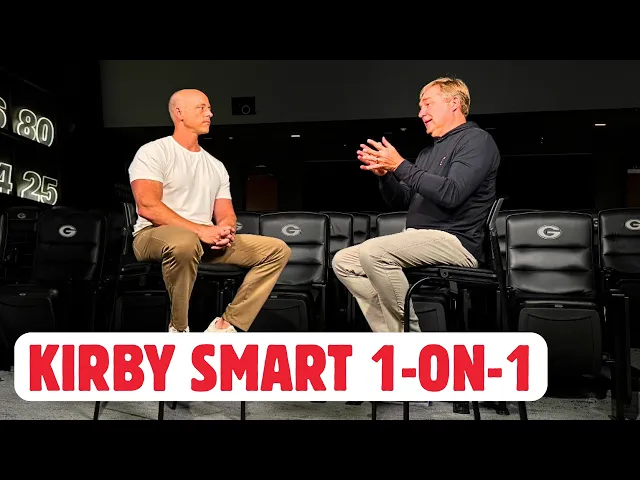
Kirby Smart Joins Josh Pate - Pate State Speaker Series
Josh Pate's College Football Show
0:00 You and I are sitting right here this time last year
0:02 and we were talking about all the changes happening and you were like
0:04 the one thing I would love to just know is I would
0:06 love to know who's going to be on my team in spring.
0:09 So now we're at the place where we don't have the whole postspring portal.
0:13 Uh how has that changed the dynamic around your program?
0:16 It's interesting you you say individually to to our program.
0:19 I think it's changed very little because we didn't lose many guys
0:22 in the second portal and we did not take many guys in the second portal.
0:26 We have not been a big second portal team.
0:28 I think it changed a lot in college football because some
0:32 teams uh tried to revamp their roster at that point in time.
0:35 So, um I think going into January from the point
0:39 I don't know the exact date that the portal closed.
0:41 Let's call it January 10th or 15th, whenever it actually closed.
0:44 From that point on, man, you could dig deep.
0:47 You could actually have uh connection meetings.
0:50 You could do all these things to build your team
0:52 because you knew that your team was your team.
0:54 Now, you didn't know about injuries.
0:55 You didn't know about this and that.
0:56 We had some new guys on our roster.
0:58 We had 26 new freshman.
0:59 We had eight new portals.
1:01 So, like with all that going on, we had new people,
1:03 but at least we knew they were ours.
1:04 And going through spring practice to me was much more enjoyable cuz you didn't
1:09 have this uh big dark cloud brewing of was he going to be here?
1:14 Is his agent going to is he is agent going to shop him around?
1:18 Is he going to leave?
1:19 Is he going to lose transfer hours and not graduate?
1:21 Like, it scares me to death dealing with that second one.
1:24 And I do have some deficiencies in my roster
1:26 that we would have gone out and gotten other people.
1:28 So, we gave up something to to gain a little continuity.
1:32 And I think the players have better relationship with each
1:34 other because they know they don't have the the worry,
1:36 Josh, of man, should I go?
1:38 Should I call mom and dad?
1:39 Like, coach, where am I going to be at on the depth chart?
1:41 Like, quit worrying about that and just get better because running
1:44 to another school is not going to just save you by doing that.
1:47 Well, that's what I was going to ask you.
1:48 I mean, there are a lot of places, Georgia,
1:50 but pretty much every place probably just went through
1:53 spring and at some point on the roster said,
1:56 "Man, I wish we were a lot better here."
1:57 And I know if we had a post spring portal, we could get a little better there.
2:01 But, you know, you're sitting here telling me, "Yeah,
2:03 I know all that, but then I got to remind myself, hey,
2:05 the alternative sucks a whole lot more than me
2:08 maybe not quite having the depth at outside linebacker,
2:10 left tackle that I want." Exactly what I'm telling you.
2:12 And I'm also telling you the sanity of knowing that now
2:16 it's you coaching against me and me coaching against you.
2:20 Who makes their players better?
2:22 That's what the word coach is.
2:24 Like it's it derived from stage coach where
2:26 you took somebody from one place to the other.
2:28 So like where are you taking your players
2:32 instead of shipping them off and importing them?
2:36 And to be honest, we did a big study on a lot
2:38 of the portal exchanges in the second
2:39 portal and there was very little effective movement.
2:43 Meaning, I call it swap and spit.
2:46 You you just took somebody else's two or three and they took your two
2:49 or three and then you you traded and all you got was a new person.
2:52 You didn't necessarily get somebody that now
2:54 there's guys that maybe made an impact.
2:56 People can go out and say, "Well, he's wrong.
2:57 They had two or three people that made these huge
2:59 impacts and look at the totality of who moved." Okay,
3:03 I'm going to tell you now in our study, over 80% of the people had no impact.
3:08 So, all they were doing is moving to move.
3:10 They were just moving to move.
3:11 And we're like, let's let's make our players better.
3:13 And let's say the ones we lifted and practiced all last winter
3:18 that they're ours now and they're better now because they stayed here.
3:21 You know what I have a lot of trouble with is
3:22 you got the whole piece of what should and shouldn't be.
3:25 And that's what people waste most of their time arguing about.
3:28 But if you take that and set it off to the side,
3:30 just what is is what is right now.
3:31 now.
3:31 So, you got a lot of movement, you got a lot of churn in the sport.
3:34 I wonder if we hit fast forward 15 years.
3:36 It's 2040.
3:38 I'm pretty sure we're going to have a large group of players
3:42 who were 15 years removed from their career who never really
3:45 planted developmental roots anywhere and they moved around a lot and they
3:48 probably made a little bit of money relative to your lifespan.
3:51 A little bit of money,
3:51 a few hundred,000 that's long since been burned by that point.
3:54 And you're going to have documentary after documentary of guys doing
3:58 what we're doing right now saying to whoever's talking to him, "Man,
4:01 I wish that I would have had 40-year-old me's perspective and I could
4:06 have just stuck it out a little bit." But at the same time,
4:09 it's really hard to have that conversation with a 19-year-old person who
4:11 has at that time life-changing money being put in front of them.
4:15 Everything you said is true and I wrestle with it all the time because
4:18 I am not a person that believes kids should not be able to transfer.
4:23 The kids should not be able to move.
4:25 They're more transient than ever.
4:27 They can up and go.
4:28 They have uh they have a vehicle to so many schools through social media.
4:32 They have friendships with all these kids at all these places.
4:34 So, it's a completely different world we're in now.
4:37 But I promise you in 15 years there's going to be if
4:40 you just take the body of of I'm not talking about student athletes.
4:43 You just take the body of the the highest
4:46 NIL guys and they had an earning power.
4:49 Whatever that earning power was of x amount of money for a short amount of time,
4:53 they need to maximize that was what people will say.
4:55 That's their earning power.
4:57 You shouldn't apologize for what they make.
4:59 The mental health issues that will come out of this 15 to 20 years from now.
5:03 That that doesn't mean it's right or wrong.
5:05 Doesn't mean that they should be capped or they should not have this or that.
5:09 I'm just telling you, I'll watch it.
5:10 We have more kids now living by themselves.
5:12 We have kids who, you know,
5:14 live in a dorm or an apartment their first year on campus.
5:16 That's what most schools do.
5:17 90% colleges start you off, you know,
5:19 on campus and you have friends, you have roommates.
5:22 They go out and buy apartments because they can.
5:25 Number one, that's very wasteful.
5:26 Number two, it's not good for your mental
5:29 state of mind to not live with someone.
5:31 I mean, your hardest years of college will be your first two or three
5:34 when you're out there struggling to play and now you're dealing with self-doubt,
5:38 living by yourself, questioning things.
5:40 I have watched it go through all these kids and I'm just I I worry.
5:44 So I don't worry about the money the money they make.
5:46 Most of them have financial managers.
5:47 Most of them will have people put that money away.
5:49 I worry about when they get in the real world and they don't make that.
5:53 And the argument against it is well that's good.
5:55 That's their earning power.
5:56 They had that opportunity.
5:57 It makes you feel like a failure when you go out and you're you made more
6:01 in your first three years of college than you do the next 20 years of your life.
6:05 Yeah.
6:05 And the other thing is if you're older than like 30,
6:10 you've kind of grown up if you're a college football
6:11 fan and your perception of the head coach of a major
6:14 program is like this general who uh you know
6:18 gives a command and everyone in the building follows it.
6:21 There's some realities to that.
6:23 But then what you're talking about is you could probably, you know,
6:26 disseminate messaging and wisdom all you want
6:29 to, but then there's the reality if guys have money,
6:31 they're going to do what they want to do outside this building.
6:34 And at the same time,
6:35 you're not even sitting here talking about the morality of it,
6:37 the right and wrong, the legal ease of it.
6:39 You're just talking about things that you technically can
6:43 do that maybe it's not the wisest thing to do.
6:46 And I got to imagine that's a tough message.
6:47 It's a tough message to get across to full grown adults,
6:50 much less 18, 19, 20 year old kids.
6:52 Really hard to because I don't think they have the foresight
6:56 to know that income is probably not going to be sustainable.
7:00 Like it's it's just not.
7:01 He's like, "Well, they're going to make the NFL." Even if they make the NFL,
7:04 it's two or three years, right?
7:05 And there are players taking pay cuts to go to the NFL.
7:08 You know, we know what league minimum is in the National Football League.
7:11 So, it's like, okay, they might make that for four years of college.
7:14 They might make that for three years in the NFL, but long term, they're not.
7:17 So, we're trying to teach financial wisdom.
7:19 Sometimes it goes in one ear and out the other.
7:21 I have I have convinced myself we have got
7:24 to show them uh realistic ways to invest and make money.
7:28 And we bring speakers in to do that.
7:30 I mean, we all talk about tax education, financial education.
7:32 We're all like, we're so invested in that now
7:35 than we ever were before because we see the pitfalls.
7:38 We see what they're some of these kids are spending that money on.
7:41 And that's the part I feel like, man,
7:43 I'm failing these guys if they don't invest
7:46 in real estate with that money they make.
7:48 They don't go in with maybe an alumni and say,
7:50 "Hey, this guy's building a apartment.
7:52 He wants you to be part of this.
7:53 You know, you graduate.
7:54 You should jump in with him and and and and make
7:57 your money make money." Then I feel like we did a good thing.
8:00 But so many of the kids move so quickly
8:02 that they don't have an attachment to a university.
8:04 I mean, what's going to be home 10 years from now?
8:07 Where are you going back to when you went to three different schools?
8:10 Well, that's the other thing.
8:10 If I played right guard for you for four years,
8:14 hopefully I made it to the league.
8:15 But even if I didn't,
8:16 I know there there are some folks that I've known from the time
8:19 I was a sophomore in high school to the time I was
8:20 in school to the time I was out of school in that alumni
8:22 network that I could probably call for the rest of my life.
8:25 And that that that who you know over what you know is way more important.
8:30 Okay.
8:30 Now people say, "Well, no,
8:31 you could never you could never make that kind of the people you meet
8:34 in alumni and you go out and use those resources at any school you're at." Huge.
8:38 Oh my god.
8:39 They they put you in one deal.
8:40 They give you one opportunity and that opportunity makes money far
8:43 greater than we're talking about on the the average median NIL guy.
8:47 Now, there's kids that are making generational money in college football now.
8:50 More power to them.
8:51 and those make hard decisions,
8:53 but for the most part that all the kids aren't making that kind of money.
8:56 Yeah.
8:57 How have you seen the relationship,
8:58 the concept of the relationship change over let's say your last 20 years?
9:02 Um, you're at VA, what 07, something like that.
9:06 So, so we're coming up on 20 years of just
9:08 that kind of run where you've been at two
9:10 programs and it was back in the day
9:12 in recruiting all about relationships and you know the kid
9:15 and you know the kid's entire extended family and I
9:18 know there's still a version of that but also
9:20 the other version is sometimes it just comes
9:23 down to a bottom line conversation a transactionalbased conversation.
9:26 Well, where does the balance of the concept
9:28 of the relationship fall in all that?
9:30 Yeah, it used to be I mean let's be honest it was all relationship.
9:33 If I would have said 90% relationship,
9:35 like 10% development all those years at Bama
9:38 and then the early years at Georgia,
9:40 my role was different cuz now I was head coach, not defensive coordinator,
9:42 but it still was relationship based and NIL definitely changed
9:47 that, but it didn't change it to a 9010 flip the other way.
9:50 You know, it's still interesting to me when you start recruiting someone
9:54 and some of our coaches that have been with me for four,
9:57 five, six years, they figured out I can figure out within the first
10:00 two months of recruiting a junior sophomore if they're a relationship family.
10:04 Now, everybody's a financial family.
10:06 Everybody, I mean, it doesn't matter what kind of money
10:08 where you come from and come that does matter, but maybe it's 50/50.
10:12 And I tell our coaches all the time,
10:14 get me at least 50% relationship and then 50%
10:17 the other because once it teeters on the other side,
10:20 uh, it doesn't end well because they're also the first to look for raises.
10:23 They're also the first to look in the portal.
10:25 They're also the first to leverage to leave
10:27 with a with an agent and leverage you to get more money.
10:29 So like if we can get it to 50% relationship starting off and stay there,
10:33 then that's pretty good.
10:34 But it has changed definitely.
10:36 But it's not like people think where it's like it's only the bottom line number.
10:39 There are families, there are people out there that want the development.
10:43 They want the relationship.
10:44 I mean, I got a nephew going through recruiting right now and the first thing,
10:48 my sister said to me was like, "Well, I don't want it to be just a number.
10:51 I want it to be a relationship, you know,
10:53 and and that matters to people." I watched
10:57 Indiana do what they did last year and I
10:59 watched in amazement and I it's similar like
11:01 in my world when a when a show blows up.
11:04 I can't help but view it through the lens of what
11:06 I do and view it a little bit comparatively not
11:09 in a sense of I'm measuring myself against them but I'm
11:11 wondering are they doing things that I need to be doing?
11:14 Are are they with some advanced practices maybe or whatnot?
11:18 How do you watch something like Indiana happen last year?
11:22 Like how do you view that?
11:24 Yeah, I think it's I didn't I couldn't really view it in the season.
11:26 You're so engulfed.
11:27 I'm worried about, you know, Alabama.
11:29 I'm worried about everybody we're playing and uh I don't get to really
11:33 watch it and then you step back and kind of in the playoff run,
11:37 you start looking back going, "Wait,
11:38 they're doing something different here." Like, woo, woo!
11:41 Everybody doubted and doubted and doubted
11:42 and they didn't doubt, they never doubted.
11:44 They had complete confidence and they played really well.
11:46 I think what you're seeing in college football right now,
11:48 at least among the people I talked to, everybody's like,
11:50 "Well, well, what did they do?
11:52 What are their practice faces?" I mean,
11:54 coach Signetti is very open about being short fast,
11:57 not being on the field long, being really sharp.
11:59 That's interesting to me because um we try to be short,
12:02 but we try to be really high energy and go really fast,
12:06 not be on the field more than two hours.
12:07 They were less than that sometimes.
12:09 Yes, they were an old team.
12:10 Everybody's like, "Well,
12:11 they're an old team." It's going to be a great study to see how that how
12:15 that how that moves forward because a lot
12:17 of people are going to copy that model.
12:18 Do they have Fernando Mendoza?
12:20 Do they have uh some of the players?
12:22 They have great scheme, too.
12:23 I mean, you talk to the coaches they play against,
12:25 defensive coordinator, offense coordinator, do an incredible job.
12:27 Kurt is a incredible game manager.
12:30 I mean, he worked for Nick like I did.
12:32 He knows the ins and outs.
12:33 So, it's very interesting to see is that going to continue?
12:37 Was it the was it the magic formula or was it a really good group of players?
12:42 Because I mean, they did things defensively, they did things offensively.
12:46 They they didn't just like win close games, they beat people.
12:50 Yeah.
12:50 I think what stood out to me the most is they got a guy that wins
12:53 the Heisman Trophy and then probably plays
12:54 his best ball after winning the Heisman Trophy,
12:57 which is pretty synonymous with whoever's winning these days.
13:00 They're peing at the right time.
13:01 And so there's a weird way to ask
13:05 this question cuz it almost sounds like I'm saying, "Well,
13:08 man, do you back off a little bit
13:09 to start the season and then hit the gas late?"
13:12 There's this fine line of wanting to enter the season full speed,
13:14 but also understanding the ones who are playing their best at the right
13:17 time are the ones who are going to win national championships.
13:21 Back in the day, you couldn't afford to lose a game, right?
13:23 Now you can afford to.
13:24 There's a little bit more safety net under you.
13:25 How does that change the way you as a coach prepare
13:29 and and how you like structure organizationally how you approach a season?
13:34 Yeah, I think it's starting to take more and more shape.
13:36 We're figuring this thing out, right?
13:37 We're at 12, expecting to maybe go up in years in the future,
13:40 but we're still trying to figure the 12 out.
13:42 And I can tell you when you start looking at the 12 and you're like,
13:46 "Okay, um, two times we've gone and lost the first game.
13:50 Both times after winning uh the the SEC championship,
13:54 you have to start saying, are you peing too early?
13:57 Are you uh complacent?" Like you look in intrinsically to say,
14:01 "What are we doing wrong?
14:02 What could we do better?" Then you look at everybody else and you're like,
14:04 "Who's the hottest team?
14:05 Who's playing well?
14:06 Who's got this and that?" The common denominators me are crazy.
14:09 I mean, it's a lot of portal quarterbacks um
14:11 that have won or been in the final four.
14:14 Um it's a lot of peing is playing well.
14:16 Um I don't know in our conference that you can take
14:19 the approach of let's grow into it cuz there there's a you
14:24 know there's there's game one sometimes game three in our league game
14:27 four that if you missed out you can be out of the
14:30 you're Texas last year.
14:31 Yeah.
14:31 I mean you can't do it.
14:32 You get to the point where you can't lose
14:33 anymore because of the way the committee bases things.
14:36 They're going to base it on to just losses.
14:38 They're not looking at the total body of work.
14:39 They're going to look at the loss column.
14:41 And when you get near that number, you have to win.
14:43 You better be peeking in or you're not going to have a chance to.
14:46 Where basketball, baseball, th those those those tournaments in the NCA
14:49 have played out differently than ours has.
14:51 Now, it's not what it was because when it was four, it was over for sure.
14:56 Like you mentioned, we've been a part of that where we
14:58 got bumped two or three times because of the SEC championship game.
15:01 But now it's like, well,
15:02 you really just need to save up and be hot when you need to be hot.
15:05 And uh I don't know, we've been a better team in our weekly rhythm
15:09 of having to play on the I say short
15:11 weeks on a regular week than we have
15:13 on the buildup for the last couple last couple times.
15:16 And I do think there's a totality of playing that SEC, you know,
15:20 eight game schedule and going on the road and playing
15:23 that you are you can become physically beat up.
15:26 I mean, we lost the center.
15:27 It was a really good player in the uh
15:31 actually in the Georgia Tech game leading up
15:33 to the SEC championship and that was after
15:35 a five six week SEC run that was really tough.
15:38 You were I'm going to get back to the playoff thing in a second.
15:40 You were talking about um the whole the whole concept of adding a ninth game.
15:45 I remember being at the SEC Championship game
15:47 last year knowing both teams are beat to death
15:51 and you're watching the game and it it does not feel like a game that's being
15:54 played at the speed the SEC championship game
15:57 is normally played at and afterwards you won it.
16:00 You stepped to the podium and you kind of said,
16:02 "Guys, this is the entire SEC next year.
16:05 Everyone's playing the ninth game next year." Now,
16:08 people outside the gate will look at that and say,
16:10 "He's baking in an excuse." people inside the gate
16:13 will say I I agree with anything Kirby Smart says.
16:16 I happen to think like there's a lot of reality to it because it's one thing if
16:20 you know you're going to be favored by double digits in 10 out of your 12 games,
16:23 you can afford to kind of ramp up, but if you take that approach maybe
16:28 against teams you're still probably better than, but the gap's a lot smaller,
16:32 you just end up a three loss team in November and you
16:35 know full well you could win that tournament if you get into it,
16:37 but the committee ranks 15th and you're out.
16:39 That's exactly the way it goes.
16:40 And and I I I will forever be an enthusiast
16:43 and people can criticize all they want about other conferences.
16:46 I welcome them.
16:47 If they thank you, let them come join.
16:49 Just come on in and join and water ours down a little bit
16:51 and give us some some games that maybe you can win with a breather.
16:54 But it doesn't happen in our league.
16:56 I mean, look at the the best people to ask.
16:58 I always say this is don't ask me.
17:00 Don't ask somebody in the Big 10.
17:01 Don't ask somebody in any other conference.
17:03 Just go to the NFL scouts.
17:04 Don't go to the NFL coaches.
17:05 A lot of the coaches have a bias.
17:07 A lot of the coaches only watch a player, but the scouts go watch the practices.
17:12 They go all across the country.
17:13 Go poll the national scouts for each NFL team and and you you tell
17:18 them where the best competition is and you ask them where the best competition,
17:21 not necessarily always the best team, but the best competition as a whole,
17:26 best players, and the wear and tear right now in our league.
17:29 And with us playing that extra SEC championship game,
17:32 that was like the ninth game.
17:33 I'm glad we're in that game.
17:34 I love playing that game.
17:35 But now that we're going to go to nine and then have an SEC championship,
17:39 I saw last year because even coming out of the Georgia Tech game,
17:42 we were beat up, banged up.
17:43 Alabama comes out of the Auburn game, beat up, banged up,
17:45 and the injury reports going to the game, I was like, "Oh my gosh,
17:48 this is a shell of itself." Well,
17:49 if we took our rosters from 2012 and 2015 and done those, we'd have been fine.
17:55 It's the combination of everybody's leaving.
17:58 Your sophomores are your freshman actually or your twos in a lot of places.
18:02 I mean, we started two freshman linemen.
18:04 I've never done that.
18:05 Was it because they were that much more talented or we were that less depth?
18:10 And when you take the depth away and look, we practice different now.
18:13 People are like, "Well,
18:13 you can't practice as hard." We don't practice as hard as we ever did now.
18:17 We cut back.
18:18 It's the volume games and the number of uh quality players we have is less.
18:23 And so those two end up with more injuries and you get probably a little less.
18:27 You know, we're not as good as we've been in years past,
18:29 but I don't think anybody else is either.
18:31 Yeah.
18:31 Here's the rough part to me is you've
18:34 never probably played more young players than you do,
18:36 more inexperienced players than you do.
18:38 We were just talking a second ago about peing at the right time.
18:40 To me, the hallmark of a lot of those teams
18:42 is they're continuing to get better during the season.
18:46 Well, if you're talking about shaving or maybe scaling back
18:49 what you do in practice now relative to what you used
18:52 to, it makes it a lot tougher to improve as much
18:55 as you would have over the course of a season.
18:57 And so, you add all that in with the schedule
18:59 you're playing and you make a lot of money.
19:01 So no one feels bad for you.
19:03 But I mean, is that is that not something that I'm looking at?
19:05 I'm saying, well, we'll just get better over the course of a season.
19:07 That's a lot harder said than done.
19:09 Yeah, a lot harder because you don't you don't
19:11 actually get the work that you used to get qualitywise.
19:13 You do a lot more walkthroughs, you scale back things,
19:16 but you're trying to get a younger
19:17 player that you're paying more money ready faster.
19:21 So, at the end of the day,
19:22 there's this dilemma among coaches of do I pay uh the bottom part of my roster,
19:27 let's call it the new guys, a lot of money,
19:29 and I got really good young players, but they they they can make mistakes,
19:33 or do you go with this old model,
19:34 which has been the three last national champions now.
19:36 They've almost been the oldest team in college football each year,
19:40 the Michigan, Ohio State, and and and Indian.
19:42 I'm not going to say they're the oldest, but they're close to it.
19:44 All right?
19:45 And you can take that model and say, I'm going to get older players.
19:48 I'm going to age and I'm going to beat
19:49 your younger players with my veterans who are stronger, probably more reliable,
19:53 maybe not as talented, but at the end of the day,
19:56 you're having to make a decision as a coach.
19:58 Are we paying the bottom part of our roster?
19:59 Are we trying to get somewhere in the middle?
20:01 I mean, some people have taken through, they're only going to pay 60 players
20:04 because in the in the college football playoff,
20:05 they did a bunch of studies and, you know, 54 to 55 guys played in each game.
20:09 Yeah.
20:10 And so if that's the case, let's just pay them a lot of money and and save
20:14 the rest to sprinkle in some money for the rest.
20:16 Almost like walkons and I'm going to have more quality play,
20:19 not more quality players,
20:20 I'm going have less quality players, but the quality I have is really good.
20:23 But you have no depth, you know, and when you lose somebody,
20:25 you can't go pick them up like you can in the NFL.
20:28 Do you find that you have a quote unquote portal philosophy,
20:31 a quote unquote revenue share philosophy, or do things change so quick
20:36 that the thing evolves like 30 or 40% year-over-year?
20:38 Yeah, I think it evolves quick.
20:40 I don't think we could say we have a true philosophy.
20:41 I mean, obviously what we need, we needed some wide outs a year ago when we went
20:45 and got Zack Branch and some of the guys we picked up.
20:48 That was a need, but every year it's different.
20:50 And it changes so fast cuz it's changing so fast in the in the money department,
20:54 you know, the revenue share department.
20:56 How you chop up your rev share,
20:57 how you get outside money, how other people get outside money.
21:01 Um, a lot of schools have just taken the approach,
21:03 I'm going to go pay whatever I got to pay for a great player.
21:05 There's only so many five stars, right?
21:07 and whether they're fivestar or not is debatable,
21:09 but there's only so many of them and they're right most of the time.
21:12 So, if you go buy enough of those and then
21:14 weed out the ones that don't work out,
21:16 meaning by year two or three, I get them off the books,
21:18 they're gone somewhere else, they're not playing,
21:20 they're pissed off, they're disgruntled,
21:22 that's the model that gets you the best player at the end of the day,
21:25 where we've been a much more developmental.
21:27 we've been a much more, hey,
21:28 we think this guy's a really good player and we feel comfortable paying him,
21:33 but we don't have to pay him the most money and then
21:36 he's just going to get better by being in our program.
21:38 And that's that's a developmental route versus a purchase route,
21:41 but it changes fast.
21:42 Like you mentioned, you've also got,
21:44 and I don't know to what degree this is true,
21:46 but I've always viewed you and maybe a few others out there as having
21:51 a little bit of a hometown discount baked in because you've proven yourself.
21:55 And guys know even if I take a little bit less to stay here,
21:58 the exchange rate is what I'm getting while I'm here.
22:00 Ohio State could pitch that.
22:02 Like a few places could pitch that.
22:03 How true is that?
22:04 How true is it where you said you said
22:06 a number and say I'm not going beyond this.
22:07 I know you could get twice this somewhere else.
22:10 Make your decision.
22:11 And the decision is Georgia.
22:14 I would like to believe that.
22:15 And I hear people say that and it used to like our coaches
22:18 after the first two national championships and NI was just in its infancy.
22:22 I would say there was this hometown discount or this, you know,
22:26 UG uh I'm going to get um NFL status discount.
22:30 I don't I think people take offense to that when
22:33 you're talking to the to the agent or the recruiting world.
22:36 They they they they want a value for their son.
22:39 They want a value for their representative.
22:41 The agent represents the player and they're not looking for that.
22:44 Well, we we spend money.
22:46 People people come all the time and say we're
22:48 probably fourth or fifth in the SEC in spending money.
22:52 We just want to find like we want
22:54 to find the best value along with the best kid.
22:57 And sometimes in our state,
22:58 there's a player that's X and this player over here is demanding X.
23:02 And the players aren't that far apart,
23:04 but they're that far apart in money that we choose to say,
23:07 you know what, he knows who he is.
23:09 He knows what he wants and he's going to develop well.
23:11 And we think he's an undervalued player
23:13 because he's been on our campus four times.
23:15 He's from Atlanta, Georgia, and we're going to bring him over here.
23:17 And I'm not going to go out and pay some crazy
23:19 premium on a risk because at the end of the day,
23:22 every player we bring in here is a risk.
23:25 Okay?
23:25 It's an investment.
23:26 We're putting a lot of money, a lot of universities money into these kids.
23:29 I want a more solid investment.
23:31 And it's hard to say the difference in these kids is 200,000, 400,000.
23:36 But if you ask mom, dad, an agent, it's how do you value my son?
23:40 It's not about value for me for your son.
23:42 It's about we're going to pour into them.
23:45 We're going to put so much into them.
23:46 So much effort, energy, toughness, practice,
23:48 development, all the things they want.
23:50 Off the- field education, for life education,
23:52 like that's what I want you to see you're getting a value on.
23:55 And I don't want you to have to take a discount.
23:56 Okay?
23:57 A discount might be a little less than year one or two.
24:00 We have tra we have traditionally paid our players junior
24:04 and senior year as much as anybody at those positions.
24:07 We don't on the start because I want you to earn it and work your way up.
24:10 And you know that that's been a people hear that all the time in recruiting.
24:13 They want to use it as a negative to us.
24:15 And I just let it go.
24:16 I say, "Look, we're going to find the right people.
24:17 We only need to find 25.
24:19 We only need to find 22.
24:21 And there's thousands of them good enough out
24:22 there." Like the difference in the top thousand players,
24:25 I just need to find 22 that want to be here.
24:28 I was just in here thinking, you've been here like 11 years now.
24:30 If I were to frame the last two and a half minutes of your answer
24:33 and put it on a screen and play it for you in 2016,
24:36 this is how you're going to be talking in 10 years.
24:39 Just imagine the last answer you gave.
24:41 You're talking about a full payroll scale.
24:43 Payroll scale.
24:43 Yeah.
24:43 And just openly talking about it.
24:45 It's crazy.
24:45 It is crazy.
24:46 And it to think where it's going is is is scary for me.
24:49 I I just I want I want these kids to to I mean, they work hard.
24:54 They they earn a lot of money for the university.
24:56 They get great TV deals.
24:57 I want them to have the opportunities they want to have.
24:59 I want them to be compensated for it.
25:01 I just want to protect their mental health and protect
25:03 their ability to graduate and protect like their investment strategies.
25:08 And if we put more checks and balances in for that, I'm great with it.
25:12 I have no problem with what these kids make and what they do.
25:15 I just want them to make good decisions with it.
25:17 And we don't have control over that.
25:19 I'm going to switch gears a little bit.
25:21 You don't say this much, but I've heard you say a few times over the years,
25:25 usually in a loss, you'll step to a podium post,
25:28 you'll say, "Look, we got out coached today." Normally,
25:31 a fan or someone in media just says that when you lost.
25:35 They don't ever we don't have to back it up.
25:36 They just say it.
25:37 When you say so and so out coached us today,
25:41 what specifically other than the final score are
25:43 you seeing that indicates they out coached us today?
25:46 Well, use of their personnel, how they did things defensively.
25:49 I mean um I'm thinking about last year, you know,
25:52 we we we we lost to Alabama uh you know,
25:55 at home and uh they they they played better than us.
25:58 They just played better than us.
26:00 Um they had a good plan.
26:01 Um, they really executed well on third down,
26:04 meaning we brought pressure at times, didn't get home in time,
26:07 the quarterback executed at a high level, made some big time throws.
26:10 Um, and you know, if you turn the ball over,
26:13 I don't think that you got out, coach.
26:16 That's just not true.
26:16 I mean, if you you do certain things
26:18 that you don't do in your characteristic of your team,
26:21 that's just a circumstance.
26:22 They they beat us.
26:23 Sometimes you physically get beat, but sometimes I do think you get out coached.
26:27 And I don't think that all our losses at Georgia since I've been here,
26:29 we've been out coached.
26:30 I I don't think that at all.
26:31 But I do think that's happened some people do a good job.
26:34 They they have answers for what you do.
26:36 Um they respond to something you do well
26:38 and maybe you don't have an answer for that.
26:40 It's just chess and somebody's one step ahead of you and you
26:43 feel like you're always right just behind in what you do.
26:46 How would you describe the playoff game against Old Miss?
26:49 Is it the former or the l?
26:51 How' you feel when you were leaving that venue
26:53 about the job your staff did getting ready for that?
26:56 Good and bad.
26:57 I mean, they look there were there were two
26:59 or three calls we made defensively that were the perfect call.
27:02 When you bring a a corner cat and they don't pick it up
27:04 and the quarterback runs 20 yards back
27:06 and runs around and then then finds a completion, that's not out coached.
27:11 That's either out recruited um or just outplayed um by the kids.
27:16 They they made tremendous play.
27:18 They they played with tremendous passion in the second half, tremendous belief.
27:22 Um, so, you know, that's not that's one play that there's two plays there
27:26 in a row that kind of defined
27:27 our our game where their quarterback made elite plays.
27:30 I mean, he just played unbelievable.
27:32 Um, but, you know, there's things we did well offensively.
27:34 You scored on defense.
27:36 When you score on defense, scoop and score, you're not supposed to lose games.
27:38 You know, you fake a punt and you're not supposed to lose games.
27:41 Um, but they did a great job.
27:43 I, you know, I think Pete and his staff did a tremendous job in that game.
27:46 I wouldn't say it was necessarily out coaching.
27:48 I would say that they definitely outplayed us when it mattered most.
27:51 They won critical moments.
27:52 The red area in that game was critical.
27:55 What is it like when you're watching a guy
27:56 like Trinidad Chamblas who I don't even know
27:59 that he's on your radar when the season
28:00 starts and you may end up playing that team.
28:03 You know Austin Simmons, you know who their starter is.
28:06 I mean, as far as you know, as far as I knew,
28:08 most people were paying attention to the fact
28:09 that Lane went and got a kid from from D2.
28:11 Yeah.
28:12 to maybe be a depth provider and then he's pressed
28:15 into action and then you watch what he does and I
28:17 I thought he was the most dangerous player in the entire
28:20 tournament by the time the tournament started last year.
28:23 What is that like to watch and then what does it say
28:25 in your mind about I wonder if any of those are out there right now.
28:29 I wonder if there's some more of them out there.
28:30 Everybody in the country is trying to find one of those.
28:32 I mean, it was a great job by them and their staff.
28:35 I don't know who to give the credit to cuz I'm not really involved in it,
28:38 but to say I even knew who he was at the start of the season, hell no.
28:41 I didn't know who he was at the start of the season.
28:42 How would he was the backup quarterback Austin Simmons had come in against
28:45 us the previous year and had an unbelievable drive down the field.
28:48 All we were talking about was him, you know,
28:50 and then when when we were getting ready to play them,
28:52 we still were watching tape on them the first game where also was playing.
28:56 He played in the Kentucky game and and he got injured.
28:59 And uh you know, sometimes as coaches,
29:01 you learn a lot that it's very similar for us with Stson
29:03 Bennett because we did everything we could to not start Stson Bennett.
29:06 He was on the bench for a lot of games and he
29:08 was probably the best quarterback when he was on the bench.
29:11 And had things not happened like they did, maybe we don't ever start him.
29:15 Maybe when Carson Beck was getting ready to start
29:17 before Stson Bennett and then he got a little injured,
29:19 Stson got to go out there and play and he took off and went.
29:22 That's really the story what Trinidad
29:24 did and everybody's looking for that story.
29:26 Yeah.
29:26 But it's funny because I go to our guys all
29:28 the time like can we not find a guy that's like athletic,
29:31 got another year left and you know bring him in here to compete and you know pay
29:34 him some money and it's like everybody's looking
29:36 for I mean everybody's looking for that that magic story.
29:40 You uh so you you've talked a whole
29:41 lot about future of the playoff size recently.
29:44 I always hate anytime someone talks 2014 playoff.
29:47 However, if I were probably an SEC head coach, I'd probably advocate for it.
29:51 So like I get the stance.
29:53 What do I have to do to talk you off of that?
29:55 basically is what I want to know.
29:57 What's your what's your I'm not I'm not pro 16 or 24.
30:00 I'm I'm pro more than 12, but what what is your stance against the 24?
30:05 Well, watering it down.
30:06 It is season it basically.
30:08 Last year we had multiple teams.
30:10 Miami is an example.
30:12 I watch them lose against Louis or Louisville.
30:15 Yeah.
30:15 Watch them lose against SMU.
30:18 I'm okay with a tournament that's just big enough where
30:21 that can be allowed and you still got a shot.
30:23 Anything more And I'm watching early season
30:26 games and they're they're more television products
30:29 than they are something that I have to be tuned into, something with urgency,
30:33 something that puckers you a little bit in the fourth quarter.
30:36 I I think expanding frankly beyond 12, but especially way past 16 does that.
30:41 Now, the I know the counterpoint to that.
30:44 The counterpoint is well, I mean, if if the currency is playoff access
30:47 now and we're trying to sell playoff access,
30:49 then the bigger the playoff the better.
30:51 The more fan bases are invested.
30:53 I know we're a little ways down that road.
30:55 I don't think we're so far down that road is my is my whole point
30:58 that you have to just forever expand the thing
31:01 because essentially you are ignoring value and scarcity.
31:04 I still think there's some value and some scarcity.
31:07 I agree with all those.
31:08 I just don't know where that line
31:09 of demarcation is cuz you're saying okay we got
31:11 four now we're 12 and now you're saying okay is it 16 24 is too many?
31:17 I don't know where the line is drawn on that because for Miami who
31:23 legitimately now I won't say should have
31:25 won but could have won the national championship.
31:27 They could have won it.
31:28 They had two losses to teams that are really competitive.
31:31 I mean they're competitive to them in their conference
31:33 but maybe they're better than they shouldn't lose those games.
31:35 They had two games they shouldn't lose.
31:36 And I feel like for 10 years I've been
31:38 here if you lost two games you shouldn't lose.
31:41 You're gone.
31:41 You're out.
31:42 But they were good enough to win it.
31:44 Why does that not stand for basketball and baseball?
31:46 because they lose games they shouldn't lose all the time.
31:49 It's a different sport.
31:50 They play way more often.
31:51 Their games are less meaningful than our games.
31:56 And I don't think that we're I do think that we're
31:58 going to make our or some of our games maybe less meaningful,
32:01 less impactful, but they will still matter in the grand scheme of things,
32:05 especially towards the end of the season.
32:07 Um, so I I'm a I'm a I'm a fan of 16 to 24 because of what you said,
32:12 the currency and what we're measured by as coaches.
32:14 I want to get my team in there.
32:15 embarrassing opportunity.
32:16 I want my fan base to be engaged.
32:18 And it's gotten to the point now that if you're not in there,
32:20 there's no value in a good old bowl game.
32:22 Let's go play over in this bowl game and let's
32:24 send out the seniors and let's give them a, you know,
32:26 whatever the name of the bowl is and nobody cares about that anymore.
32:29 We've made it that way.
32:31 So, if we're going to make it that way,
32:32 we might as well put more in it and get everybody in and let them go play.
32:35 And then, you know, does anybody even play a game outside the playoffs?
32:39 Because the kids are disinterested past the playoffs.
32:42 the fans are disinterested past the playoffs.
32:45 Now, the value for you is you got a lot more meaningful games during
32:48 the year when that thing's 12 or 16
32:51 because somebody's getting bumped at the end.
32:53 Yeah.
32:53 I just always looked at it like some
32:55 people's philosophy is we should have the bubble
32:57 big enough where any team that's capable of winning it if they get in is in.
33:03 I've always looked at it and said, I don't really view it that way.
33:06 If you're good enough to win it and you earned your way in the bubble,
33:09 then I'm fine with it.
33:10 Otherwise, you're just reinforcing my point that man,
33:13 they lost some regular season games they shouldn't have lost.
33:15 That's why there was maximum urgency on that.
33:17 But see, the difference with me is I I
33:19 don't view the playoff as the nucleus of the sport.
33:21 I'm a regular season guy and whatever the playoff
33:23 is is more the cherry on top for me.
33:26 But I I I agree with that.
33:27 And I think in our model, our program, I mean,
33:30 I don't want to say this cuz you say this and it'll come back to haunt you,
33:33 but we we've had a model of consistency.
33:36 Okay, we we lose games,
33:38 but we haven't lost a lot of games we're not supposed to.
33:41 And so, if you're that kind of program, you want that thing nice and tight.
33:45 You don't want these outsiders getting in that could get hot.
33:47 I've always told people like some of these teams,
33:49 they can play with anybody on any given Saturday,
33:51 but they might not get up for every Saturday.
33:54 And that that to me is like that that that airs
33:58 on the side of well you wanted to be 12.
34:00 You wanted to be less than 12,
34:01 you wanted to be four because you're not letting somebody in that could
34:04 go in there and just win the thing and take off and get hot.
34:06 But I I am a fan of of of a little more access.
34:11 You just wrapped up spring a few weeks ago.
34:13 I look from the outside.
34:14 I say, man, I think tight end's like the deepest position on that team.
34:17 So I'm not going to really ask you about tight end,
34:19 but outside of tight end, I know there were a couple of injuries, guys out.
34:23 Feels like most of them may be back by summer or fall camp.
34:27 What was your feeling coming out of spring ball?
34:29 Very pleased.
34:29 Uh was happy to get the the the amount of work we got.
34:33 We did some things different this spring than we've ever done in our practices.
34:36 We uh we tried some different drills competitively to try to grow our depth.
34:41 We gave more reps to our threes,
34:43 which you know, people like, I don't have threes.
34:45 Well, our threes are like freshman um sophomores.
34:49 uh some freshman moved up during that process,
34:51 but like we dedicated more time to them and if
34:55 you were a two-year starter or had played over,
34:58 you know, 3 400 snaps in games, SEC games,
35:01 then we we we had a little lighter load on those guys.
35:03 And uh I was very pleased with the work we got.
35:06 There are some positions that I wish we could go out and say,
35:09 "Oh man, I wish I get a veteran here,
35:10 a better leader in the room here." But we have uh we have good
35:14 players and I think it's all relative to who we're going to play, right?
35:17 But I feel good coming out of the spring about the injuries and things.
35:20 Well, what's wild is if I'm sitting in Georgia, if I'm you,
35:23 I've got 2021 me to compare my modern-day self against.
35:27 So, you you're probably coming out of spring.
35:28 I know cuz I've talked to you the past few springs and you're like,
35:31 we got deficiencies here, here, here.
35:33 And then you end up winning the SEC and you're like,
35:35 I guess we didn't really have to compete against ourselves 5 years ago.
35:38 We just had to play the teams we line up against.
35:40 That's the key.
35:40 You got to play the teams you line up
35:41 against and you got to be able to beat them.
35:43 And you get you get worried that, oh man, well, they beat us on this kid.
35:46 that beat us on that kid and you're going
35:47 to play somebody that beat you on these kids.
35:49 At the end of the day, concern yourself with what you have, not what you don't.
35:53 And we try to really focus hard like we're going
35:56 to develop our players better than they develop their players.
36:00 We're going to be tougher with our players than their players.
36:03 And in the fourth quarter, when you have to stop the run to win the game
36:07 or you have to run the ball to win the game, that's how we're going to beat you.
36:11 And we've been good at doing that, but in really tight margins lately.
36:15 All right, last question here.
36:16 Uh, we got like 3 months, I guess, or so until the season starts.
36:20 How many days will you spend completely detached from this place?
36:25 And when you're when you're somewhere, maybe you spend 5 minutes on a beach,
36:28 are you a throw the cell phone in the water kind
36:31 of guy or are you checking it every 5 minutes kind of guy?
36:33 Oh yeah, I'm on my phone.
36:35 I have my phone all the time.
36:36 I won't say I'm on it all the time, but I'm accessed to my phone.
36:38 There's never a time.
36:39 And I'll step away.
36:40 We'll have three weeks uh in July where I'll get reports of like,
36:45 okay, this is what's going on.
36:46 You know, coaches will be in the office, but I'm not physically here.
36:50 I'm not mentally like checked out a little bit other than I'm recruiting.
36:54 Got to be on my phone, right?
36:56 Updates of what's going on with our players and how
36:58 they're doing conditioning wise and what's going on with those guys.
37:00 That's important to me.
37:01 But outside of that, get some time with the family,
37:04 enjoy time, but I'm never without a phone.
37:07 And I'm not throwing that phone away just because of uh
37:09 how fast things happen and how much information gets digested quickly.
37:13 Are you a believer that the more sunburn the coach is at media days,
37:17 the better the season's going to be.
37:19 I don't know if I could say that cuz uh I don't I don't enjoy being sunburnt.
37:23 So uh there probably some of those guys that get it from golf
37:25 or on the beach and uh sometimes they fake and they get the fake spray.
37:29 We got a few of those guys in our league, too.
37:31 You probably know who they are.
37:32 Um but I I don't uh I don't care for that.
37:35 I think it's measured on um how good your players are
37:38 and less about how much time you spend in the sun.
37:40 Got to be smart.
37:40 We appreciate it.
37:41 Thank you, Josh.
37:41 Thank you.
37:41 Appreciate it.