The Hidden Engineering of Niagara Falls
Practical Engineering
0:01 Niagara Falls is one of the most spectacular waterfalls in the world.
0:05 With a vertical drop of more than 50 meters or 164 feet and a flow
0:11 rate that often exceeds 2800 cubic meters
0:14 per second or 100,000 cubic feet per second,
0:17 it’s one of North America’s crown jewels.
0:20 Roughly ten million people visit the falls every
0:23 year just to catch a glimpse of the curtains
0:26 of water pouring over the edge and the constant clouds of mist at the bottom.
0:31 But Niagara Falls isn’t just a tourist attraction.
0:34 The special geology and hydrology of this region,
0:38 situated between Lake Erie and Lake Ontario,
0:41 have resulted in some fascinating feats of infrastructure,
0:45 from shipping to electricity to water control.
0:47 It’s basically a microcosm of all the things I love.
0:51 The falls themselves have required quite a bit of engineering over the years,
0:56 and they’ve even been shut off for maintenance.
0:59 Let’s take a little tour of the Niagara
1:01 Peninsula (even though it’s really an isthmus),
1:03 and I’ll show you some of the things that aren’t usually listed in a guidebook.
1:07 I’m Grady, and this is Practical Engineering.
1:21 Let’s get oriented first.
1:23 This is a map of the isthmus.
1:25 We’ve got Lake Erie to the south, Lake Ontario to the north,
1:29 Buffalo and western New York to the East, and Ontario, Canada, to the west.
1:34 The Niagara River runs northward, connecting the two great lakes.
1:38 And right in the middle,
1:40 it plunges off the Niagara Escarpment, creating the famous falls.
1:44 On the US side, there are the American Falls and the smaller Bridal Veil Falls.
1:49 And on the Canadian side is the Horseshoe
1:51 Falls where a majority of the river flows.
1:54 It’s pretty impressive to see in person,
1:56 but it’s actually not entirely a benefit.
1:59 Because these falls pose a major problem for shipping.
2:02 The Great Lakes form the largest
2:04 inland freshwater transportation system in the world.
2:07 Since the 19th century, they’ve served as the backbone for moving iron ore,
2:13 coal, grain, and manufactured goods between
2:15 the American heartland and the Atlantic Ocean.
2:18 Ore from Minnesota and grain from the Midwest can travel by ship
2:22 all the way to steel mills or export terminals on the East Coast.
2:26 Barges and freighters are efficient at moving bulk
2:29 cargo in a way rail and trucks can’t match.
2:32 For a time, the Niagara Escarpment was
2:35 a natural bottleneck between Lake Erie and Lake Ontario,
2:38 preventing goods from moving directly between the upper lakes and the Atlantic.
2:42 Freight had to be offloaded and portaged around
2:45 the falls before it could continue its journey.
2:48 The Erie Canal solved the problem somewhat,
2:50 starting in 1825, bypassing Lake Ontario.
2:53 But it could only accommodate smaller vessels,
2:56 and even before the Canal opened, another solution was being planned.
3:01 The Welland Canal runs through the peninsula west of the Niagara River,
3:05 connecting two massive areas by shipping traffic for the first time in 1829.
3:10 The canal fueled the early growth of cities along the Great Lakes and St.
3:15 Lawrence River- including Cleveland,
3:16 Detroit, Milwaukee, Chicago, Toronto, Montreal,
3:18 and Quebec City- and it’s been rebuilt and moved several times over its life.
3:25 The Welland Canal is really a titanic engineering achievement and, were it
3:29 not positioned next to one of the natural wonders of the world,
3:32 it would probably be famous in its own right.
3:35 Because of the huge difference in elevation
3:37 between the two lakes created by the escarpment,
3:39 eight separate locks are required to allow ships to traverse between them.
3:44 And all different kinds do- from personal leisure
3:47 craft to the lakers that stay in fresh
3:50 water to the salties that travel between the lakes and the ocean through the St.
3:55 Lawrence Seaway.
3:55 Starting on the upstream, Lake Erie side of the canal,
3:58 the first lock isn’t really for lifting
4:00 or lowering ships so much as for control.
4:03 The level of Lake Erie actually fluctuates throughout the year,
4:06 and there are longer-term trends as well.
4:09 Wind storms also raise the level locally similar
4:12 to the way storm surge works during hurricanes.
4:14 The control lock does just that: it controls the level in the downstream canal.
4:19 It prevents excess water from rushing down the canal when the lake is high,
4:23 kind of like an airlock on a spaceship keeps air
4:26 from rushing out when astronauts step outside for a spacewalk.
4:30 Downstream of the control lock, the canal splits in two.
4:33 The original pathway of the canal flows through the eponymous town of Welland,
4:37 while the larger and newer section of canal,
4:40 the Welland Bypass… well, it bypasses Welland to the east.
4:44 If you look carefully, you’ll also notice a small river,
4:48 the Welland River, which passes underneath both the original and bypass canals.
4:52 On the way downstream from Lake Erie to Lake Ontario,
4:55 shipping traffic passes over aqueducts that pass over a natural river.
5:00 A hydrological wonderland!
5:02 Continuing downstream from the aqueducts,
5:04 the remaining seven locks are lift locks,
5:06 more like what you think of when you imagine a lock.
5:09 Notice how they’re clustered tightly around the terrain
5:12 and not distributed evenly along the length of the canal.
5:15 That’s the Niagara escarpment,
5:17 the same geological feature that the water cascades down at the falls.
5:21 This is the elevation diagram of the entire Great Lakes and St.
5:25 Lawrence Seaway system from Lake Superior to the Atlantic Ocean,
5:29 and you can see that this drop is the biggest one of the whole thing.
5:33 And that’s pretty important for another
5:35 part of the infrastructure on the peninsula.
5:38 The power available from a moving fluid is directly proportional
5:42 to the flow rate multiplied by the height of the drop.
5:46 In most hydropower applications, that height is created artificially by a dam.
5:50 There aren’t that many places in the world where you have both
5:54 a large volume of flowing water and a significant natural drop in elevation.
5:59 But that combination made Niagara Falls the birthplace
6:02 of large-scale electric power in North America.
6:07 In 1895, the Niagara Power Company opened the Edward Dean Adams Power Plant,
6:13 built with Westinghouse AC generators based
6:15 on the ideas and patents of Nikola Tesla.
6:18 The plant served as the basis for the modern electrical grids we have today,
6:22 and many of the fundamental concepts are basically unchanged.
6:26 But the power infrastructure at Niagara Falls definitely has changed.
6:30 Where the Adams Power Plant put out about 40 megawatts of power in 1895,
6:35 now the combined capacity from the region is in the neighborhood of 5 gigawatts.
6:40 But in both cases, it wasn’t as simple
6:42 as putting a turbine at the base of the falls.
6:45 While it might be technically possible to generate power by placing a water
6:49 wheel directly in the stream of a waterfall like a kid’s bath toy,
6:52 it’s not the most efficient way (plus it would take away from the beauty).
6:56 The water used to power the hydroelectric plants on both the US and Canadian
7:01 sides of the Niagara River is water that never actually flows over the falls.
7:06 Instead, it’s diverted into five massive tunnels- two
7:09 on the US side and three on the Canadian side.
7:12 Like most tunnels, you can’t really see
7:14 the extent of the hydro tunnels at Niagara Falls.
7:17 There are a few conspicuous clues though, like these gigantic buildings.
7:22 These interesting protrusions from the landscape house enormous steel doors,
7:27 nearly 60 feet tall, that can drop down into the tunnels
7:31 and close off the flow for inspections and maintenance.
7:34 Both the Ontario and New York sides of the river feature similar structures.
7:38 From the tunnels, water flows into major
7:41 hydropower plants on both sides of the border:
7:44 the twin Adam Beck stations on the Canadian
7:46 side and Robert Moses station on the US side.
7:49 Then it’s released into the the lower part of the river below the falls.
7:53 When you add them up,
7:54 that’s 39 turbines with a combined capacity of more than 4000 megawatts.
8:00 It’s a tremendous amount of power generation in one place.
8:03 But actually, that’s not all of it.
8:06 These tunnels divert 50-75% of the flow of the Niagara River.
8:10 That wide range in percentage of diversion isn’t
8:13 because we don’t know how much is diverted,
8:16 but because we actually control how much water is diverted,
8:19 depending on the tourist requirements agreed upon in a treaty by both nations.
8:24 During the day in peak tourist season,
8:26 more water is allowed to flow over the falls to ensure the grandeur of the falls
8:31 is on full display for the huge crowds of tourists that visit every year.
8:35 At night and during the winter, more of the flow is diverted to generate power.
8:40 That’s all managed by this structure upstream of the falls:
8:44 the international control dam.
8:46 I’ve always thought this is an interesting dam,
8:47 since it doesn’t even go all the way across the river.
8:50 But it doesn’t need to.
8:52 This structure’s not meant to create a reservoir;
8:54 it just subtly adjusts the level in the river to control
8:58 how much water flows over the falls versus into the hydropower intakes.
9:02 The US side of the Niagara River is pretty shallow,
9:05 so that side acts kind of like an uncontrolled spillway.
9:08 Then, the gates on the Canadian side can be adjusted
9:11 to balance the competing demands on water between tourism and power.
9:16 But there’s one big problem with those competing needs:
9:19 they both have the same timing.
9:21 We want thunderous cascades of water over
9:23 the falls during the day when tourists are visiting,
9:26 but daytime is also when the demand for electricity is highest.
9:30 It’s like if solar panels only worked at night.
9:33 To accommodate this, both the US and Canada have pumped storage plants.
9:38 At night, excess electricity is used to pump diverted water into reservoirs,
9:44 essentially storing both the power and the extra
9:47 water that’s available during off-peak hours.
9:49 Then, during the day,
9:51 the water is released back into the forebay of the power plants.
9:54 You get a little extra power from that drop
9:57 out of the reservoir into the forebays,
9:59 so both sides have small hydropower facilities to capture that.
10:02 But more importantly, you get a lot more water during the day than
10:07 would otherwise be available to run through the big plants,
10:10 making more power when it’s needed most.
10:12 And there’s just something funny to me that the infrastructure
10:16 is duplicated on both sides of the river,
10:18 like neither country was willing to be one-upped by the other.
10:22 All of this diversion noticeably reduces the flow of water over the falls.
10:26 Even when they are at ‘full blast’ during the day in the tourist season,
10:30 only 50% of the flow of the Niagara River makes it over the falls.
10:34 You can imagine how powerful the falls would be
10:37 if 100% of the flow were to cascade over.
10:40 It might seem like this diversion detracts from the majesty of the falls,
10:44 but in another sense, it actually preserves it.
10:47 All waterfalls undergo some degree of erosion as the water
10:51 and sediment suspended in it scours away the rocks and soil underneath.
10:55 Without any diversion, Niagara Falls would be receding towards Lake Erie
10:59 at a rate of about 3 feet every year.
11:02 At the end of the last ice age,
11:04 the falls were right at the edge of the Niagara Escarpment,
11:07 but thousands of years of erosion have caused them to work their way upstream.
11:11 You can actually see how far it’s
11:13 already progressed by looking at this elevation map.
11:16 Over the last 12,000 years or so,
11:18 the falls have migrated by erosion to their current location.
11:22 By diverting a significant portion of the flow,
11:25 the power plants have actually slowed the rate
11:27 of erosion to approximately one foot per year,
11:30 which will help preserve the falls for a longer period.
11:33 While flow on the falls is downregulated by diversion for hydropower,
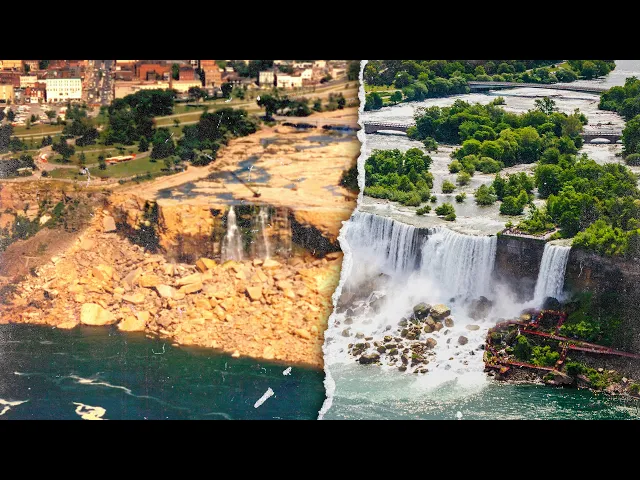
11:37 the falls are never ‘turned off’...except for the one time in the 1960s.
11:42 The smaller American Falls (and nearby Bridal Veil
11:45 Falls) have a pile of loose rocks and boulders, called talus, at their base.
11:50 This pile of rocky debris actually extends
11:52 a good fraction of the way up the falls,
11:54 and officials worried that the falls might ultimately transition into a series
11:59 of rapids cascading down the slope
12:01 of talus rather than remaining a majestic waterfall.
12:05 So, in 1969, the Army Corps of Engineers built
12:08 a temporary cofferdam between the New York shoreline and Goat Island,
12:12 diverting the water over the Canadian Horseshoe
12:15 Falls and leaving the American Falls dry(ish)!
12:18 After the engineers got a chance to inspect the situation,
12:21 they determined that the best course of action was
12:24 just to leave the majority of the talus in place,
12:27 since it seemed to be stabilizing the cliff face.
12:30 Sometimes, doing mostly nothing is a decision you make as an engineer,
12:34 even if you have to do a monumental amount of work to come to that conclusion.
12:39 So the cofferdam was taken out,
12:41 and water has flowed continuously over all the falls since then.
12:45 It really highlights the complexity of Niagara Falls.
12:48 On the one hand, you have one of the natural wonders of the world,
12:53 an absolutely enormous set of waterfalls that inspire awe and wonder
12:57 in the countless travelers who are lucky enough to take in the view.
13:01 The same thing that makes it impressive for tourists (the big
13:04 drop) makes it valuable for power and a major challenge for shipping.
13:09 And out of that comes all kinds of fascinating infrastructure,
13:13 not only to facilitate the tourism but the other stuff too:
13:17 a major canal with locks and aqueducts, the international dam control gates,
13:22 pumped storage reservoirs, epic tunnels, towering gates,
13:26 massive hydropower plants, and so much more.
13:29 It’s really a pretty remarkable place for engineering.
13:33 My wife and I actually visited the falls back in 2018,
13:37 and even crossed the Rainbow Bridge to the Canadian side for coffee with a view.
13:41 Like I always do when I’m in unfamiliar territory,
13:44 I turned on a VPN at the coffee shop before connecting to their WiFi.
13:48 This is kind of wild,
13:50 but I’ve been using today’s sponsor, NordVPN for 7 years now.
13:54 Life’s changed a lot, but my VPN provider hasn’t.
13:58 Most web traffic is already encrypted these days, but not all of it is.
14:02 Plus, not all my internet traffic goes through a browser-
14:05 just about every program I use on my computer,
14:08 not to mention the apps on my phone, rely on an internet connection,
14:11 and I don’t always know if they’re using encrypted protocols.
14:14 In addition, some internet service providers can collect your data and sell it
14:19 or adjust the speed of your connection based on what you’re doing online.
14:23 You can also be charged higher prices or blocked
14:27 entirely from sites and services depending on your location.
14:30 NordVPN helps me avoid all that.
14:32 I mostly prefer an internet where the websites don’t know anything about me.
14:37 And a Nord subscription gives you more than just the VPN.
14:41 They monitor the web and notify you if
14:43 your credentials show up in hacks or leaks.
14:46 The Threat Protection Pro feature warns
14:47 you about fake webstores and phishing links.
14:50 And they provide a dedicated IP address.
14:52 All of it works on all major operating systems for phones,
14:56 tablets, and computers.
14:57 And, they have a 30-day money-back guarantee if you decide it’s not a good fit.
15:02 That makes it easy to give it a try.
15:04 And what makes it easier is the deal they’re offering right now.
15:07 Sign up for a two-year plan at the link in the description,
15:11 and you’ll get four additional months totally free.
15:14 That’s http://www.nordvpn.com/practicalengineering.
15:14 Thank you for watching, and let me know what you think!