The "AI Bubble"
Ben Felix
0:00 One of the benefits of index investing is supposed to be broad diversification,
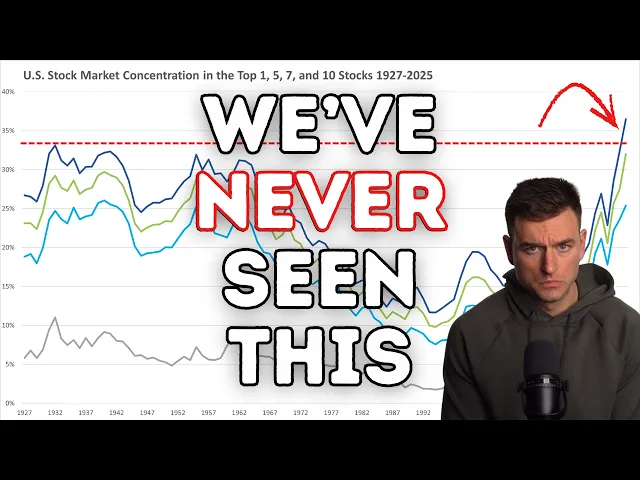
0:04 but right now 36% of the S&P 500 index consists of just seven stocks.
0:11 If we look at the total US market, that number is 32%.
0:15 That is the most extreme level of index
0:17 concentration in US market history going back to 1927.
0:21 US stock market valuations are also nearing their 1999 peaks,
0:26 which were of course followed by a decade of flat at best US stock returns.
0:32 I get it.
0:33 This does seem concerning.
0:35 If that handful of stocks declines in value,
0:37 the effect on the overall market could be substantial.
0:41 This is a movie we have seen before up here in Canada.
0:44 In July of the year 2000,
0:45 one stock made up about 36% of the entire Canadian market index,
0:51 subsequently crashing, eventually becoming worthless,
0:54 and dragging the market down with it.
0:56 The good news is that mitigating the worst
0:58 of these situations is not actually that hard.
1:02 I'm Ben Felix, chief investment officer at PWL Capital,
1:05 and I'm going to tell you how to prepare for the aftermath of the AI bubble.
1:11 [Music] All right, I've got to come clean up front.
1:15 I don't actually know if there is an AI bubble.
1:18 Nobody does.
1:19 That's only knowable in hindsight.
1:21 That being said, some wild stuff has been happening in the US stock market.
1:25 Companies have been spending at a blistering rate to build
1:28 out the infrastructure needed to capitalize on the supposed AI revolution.
1:32 This type of spending often coincides
1:34 with the development of revolutionary technologies.
1:37 Railroad and internet stocks followed a similar
1:39 path of high asset prices, massive investment,
1:43 and an eventual painful fall in asset prices,
1:46 which we might describe as a bubble after the fact.
1:49 Stock price bubbles or periods of unusually high stock prices followed
1:53 by much lower prices are an age-old feature of financial markets.
1:57 They are often, but not always, sparked by some new technology that promises
2:02 huge profits for those developing it.
2:04 The history of technology bubbles goes back to at least the 1700s
2:08 and has followed a similar pattern
2:10 with each successive major technological innovation.
2:13 In this video, I want to talk about the two main features
2:15 of the current US market which seem to be causing some investors to worry.
2:19 One is market valuations, the other is market concentration.
2:23 These are two loosely related measures.
2:24 Market valuations measure how expensive it is
2:27 to buy the expected future earnings of companies,
2:29 and market concentration measures how concentrated the market's
2:33 total value is in a small number of stocks.
2:35 High market valuations are generally associated with a lower future returns,
2:40 while market concentration has a much noisier relationship,
2:43 if there's any relationship at all.
2:45 Market valuations and market concentration may both increase
2:48 around the development of new technologies simply due
2:51 to the fact that as some companies rise
2:53 in value due to their association with the new technology,
2:56 they will make up a larger portion of the market.
2:59 Bubbles are exciting on the way up, often inducing FOMO,
3:02 fear of missing out, that may further feed into the bubble dynamics,
3:06 and then they are painful on the way down,
3:09 both psychologically and often economically or financially
3:12 for the people who invested in them.
3:14 Bubbles are not all bad, though.
3:15 High stock prices that arise from speculation
3:18 about the profitability of a revolutionary
3:20 technology can help to facilitate that technology's
3:23 development and deployment into the economy.
3:26 Classic examples are the massive spending on installing fiber optic cables
3:30 in the late '90s and on installing railway track in the 1840s.
3:33 In both cases, many of the companies involved were able to raise a ton of money
3:38 and achieve temporarily high stock prices as excited
3:42 investors piled in, but their share prices subsequently crashed.
3:46 Bubbles do tend to come with waste, too much unused fiber optic cable,
3:50 too much redundant railway track, but despite the waste,
3:54 the infrastructure for the respective technologies does get created,
3:58 paving the way for a potential economic golden age to follow.
4:01 These productive bubbles are probably on net a good thing for the economy,
4:05 even if they can be painful for investors.
4:08 The pattern of investor excitement and high stock prices surrounding
4:11 technological revolutions or potential technological
4:14 revolutions goes back hundreds of years,
4:16 and it always follows this similar path.
4:19 Stock prices are driven up by some combination
4:21 of high profit potential from the revolutionary technology,
4:24 and once it starts rising,
4:26 speculation that the associated stocks will continue rising.
4:30 Eventually, prices do come back to earth,
4:31 resulting in a low returns for anyone who bought near the top.
4:35 Whether that's what we're seeing in the US right now,
4:37 again, can only be known in hindsight.
4:40 Prices could remain high.
4:41 The rapid rise in prices of the top US
4:43 stocks has also been accompanied by rapid earnings growth.
4:46 It's not pure hype.
4:48 There is some economic substance here.
4:50 What we do know is that a large portion of the US market's return,
4:53 earnings growth, and capital expenditure has come
4:55 from AI-related stocks since the launch of ChatGPT.
4:59 A September 2025 report from JP Morgan explains that AI-related
5:03 stocks have accounted for 75% of S&P 500 returns, 80% of earnings growth,
5:09 and 90% of capital spending growth since ChatGPT launched in November 2022.
5:15 We also know that US stock market concentration,
5:18 which was already high, has shot up even further.
5:21 Stock market concentration and high stock valuations are,
5:24 again, different issues, but they can be related by the fact that a rapid rise
5:28 in valuations for a small number of firms can also lead to market concentration.
5:32 To be completely clear, in case I wasn't already,
5:34 I am not taking a position on whether we
5:36 are witnessing a bubble in the US stock market,
5:39 but I think it's useful to look at past instances of high
5:42 stock market valuations and market concentration
5:45 to understand the potential implications and lessons.
5:48 The Canadian example that I mentioned earlier is even more
5:51 extreme than what we're currently seeing in the US market.
5:54 Northern Electric and Manufacturing Co.
5:56 was spun off from Bell Canada in 1895.
5:59 In 1998, it was renamed Nortel Networks.
6:03 During the dot-com bubble,
6:04 Nortel's early work in optical networking technologies propelled
6:08 it to the forefront of the internet infrastructure revolution.
6:11 It was making truly useful stuff that the world needed or thought it needed.
6:16 Its stock price soared, creating huge amounts of wealth for investors
6:20 and for the many employees who received stock-based compensation.
6:24 Incredibly, the company peaked at over 36% of the Canadian stock market index,
6:29 at the time called the TSE 300.
6:32 Nortel, and thus the Canadian stock market,
6:34 had extremely high valuations in August of the year 2000,
6:38 peaking at a Shiller cyclically adjusted price-earnings ratio of 60.6,
6:42 far surpassing the peak valuation of the US
6:45 stock market during the same dot-com period.
6:47 The Shiller cyclically adjusted price-earnings ratio measures market
6:50 prices against the index's 10-year average real historical earnings,
6:55 on the assumption that long-term earnings growth tends to be steady.
6:58 A high Shiller PE means that investors are paying a lot
7:01 more for future earnings and should therefore expect lower future returns,
7:06 unless earnings end up being unusually high in the future, which can happen.
7:10 Nortel's downfall started with a string of unprofitable internet-related
7:14 acquisitions and was accelerated by the dot-com bubble popping.
7:18 The result for the Canadian stock market was devastating.
7:20 The Canadian TSE 300 index dropped
7:23 by 43% between September 2000 and September 2002.
7:27 That obviously hurts.
7:29 There are two lessons that I think are important to explain here.
7:31 First, well this drop was definitely painful,
7:34 I don't want to minimize that, the market recovered by July 2005,
7:38 and it went on to deliver strong returns, while the US market,
7:42 as I'll detail in a minute, struggled for more than a decade.
7:45 Despite having been more concentrated,
7:47 the Canadian market was more resilient than the US market.
7:50 The Nortel crash was, in hindsight,
7:52 a short blip in a long track record of strong performance for Canadian stocks.
7:56 Second, while the Canadian market as a whole was hurt by its exposure to Nortel,
8:00 Canadian value stocks, a Canadian value stock index,
8:04 so stocks with low prices relative to their fundamentals,
8:07 did not crash when the overall market did,
8:09 and it actually delivered even stronger returns than the market on the recovery.
8:13 This will come up again in my next examples, too.
8:16 The US market did not have such extreme concentration in 1999
8:20 as it does today or as Canada did back then, but it did have high stock prices,
8:24 which were, in hindsight, mostly unjustified by fundamentals.
8:28 Some companies like Microsoft and Amazon came through the other side
8:32 and proved that there was real transformational potential in the internet,
8:36 but the vast majority of companies
8:37 that tried to capitalize on the internet failed.
8:40 This led to the famous dot-com bubble
8:43 and the subsequent lost decade for US stocks.
8:46 The US market crashed starting around March of 2000,
8:49 and measured in Canadian dollar terms,
8:51 remained flat or below flat until July of 2013.
8:55 That is another brutal period of technology-induced high prices,
8:59 leading to the low realized stock returns for investors who bought at the peak.
9:04 In this case, unlike with Nortel, the recovery was not so swift.
9:07 Part of the problem is that the great financial
9:09 crisis intervened as stock prices were starting to recover.
9:13 Either way, this technology bust was painful for US investors,
9:16 or investors in US stocks,
9:19 in general, and even more so for investors focused on US technology stocks.
9:23 It would have taken them even longer to recover.
9:25 Similar to the Canadian example, an investor in US value stocks,
9:29 and to an even greater extent US small-cap value stocks,
9:32 fared much better over this long period
9:34 of poor performance for the market as a whole.
9:37 They earned positive returns while the market was
9:39 flat at best for an extended period of time.
9:42 It's also worth reiterating that Canadian
9:44 stocks performed reasonably well over this period.
9:47 Diversification is known as the only free lunch in investing for good reason.
9:51 The main problem with diversification is behavioral.
9:54 It inherently means that you always own the stuff
9:56 that's performing well and the stuff that's performing poorly,
9:59 which is not always so easy to do.
10:01 Okay, so these two examples, the Canadian and the US example,
10:04 they had high market valuations in common,
10:06 but the Canadian market became much more concentrated than the US market.
10:10 In the past, the US market has reached high
10:13 concentration levels without going on to deliver poor future returns.
10:17 Not quite as high as today, but still high.
10:19 I looked at this within the US market going back to 1926.
10:22 I sorted 10-year future returns on the starting
10:26 level of market concentration in the top seven stocks.
10:29 There's a very slight negative correlation
10:31 between market concentration and future returns,
10:33 but it's not statistically significant,
10:34 meaning there's a good chance it's just noise in the data.
10:38 But statistical significance aside, it's still a weak relationship economically.
10:42 A point that often seems to get lost in discussions of the US
10:44 market's concentration is that many other markets
10:46 around the world are far more concentrated.
10:48 I mean, I gave you guys the Canada example,
10:51 and yet they still managed to deliver positive returns,
10:53 in some cases even more so than the US market.
10:56 Looking back at the last 10 years of returns, just as an example,
11:00 the weight of the top seven stocks in the 10 largest stock markets,
11:04 excluding the US, was 40.94%.
11:07 So, higher than the US.
11:09 In November 2015, so we're looking back 10 years in history.
11:13 Switzerland was the most concentrated market at 60.11% in the top seven stocks,
11:18 and Japan was the least concentrated at 16.91%.
11:22 The return from November 1st, 2015 to November 26, 2025,
11:27 measured in USD, was 8.44% on average for all of these countries.
11:32 That does trail the US market return,
11:34 but still delivers a meaningfully positive equity risk premium.
11:38 Taiwan was one of the most concentrated markets in November 2015,
11:41 and it outperformed the US market over the subsequent 10-year period.
11:45 The overall relationship between market concentration and future
11:48 returns across countries seems to be noisy at best.
11:52 An interesting, sort of anecdotal perspective is AT&T,
11:55 which was broken up into smaller companies starting in 1982.
11:59 It was the largest company in the US market at that time and in prior decades,
12:02 not when it was broken up, but in prior decades,
12:05 it made up a larger portion of the US market than Nvidia makes up today.
12:08 The interesting question is, was the US market less risky after the breakup?
12:13 I think that would be pretty hard to argue.
12:15 You could maybe even argue the opposite.
12:17 Something that does appear in the data, at least post-1950,
12:20 is the returns can suffer over periods where concentration is falling.
12:24 I think this again makes sense.
12:25 If concentration comes from rising valuations for a handful of firms,
12:29 falling valuations for those firms would lead to lagging returns.
12:33 But even then, we're talking about less positive returns, not a total disaster.
12:38 The relationship between market valuations and future returns is stronger,
12:42 at least economically, both across markets and within the US market.
12:45 To illustrate this, I looked at the relationship
12:47 between the starting cyclically adjusted price-earnings ratio,
12:50 the CAPE ratio, and the 10-year return for the 10
12:53 largest developed stock markets going back to 1982.
12:56 I looked at rolling periods with a 1-month step.
12:59 I acknowledge that there are potential problems with this setup,
13:02 like difficulties in comparing the CAPE ratio across countries,
13:06 and from a statistical perspective,
13:07 the fact that I'm using these overlapping samples,
13:09 the rolling periods of the 1-month step,
13:12 it does make any conclusions drawn from the data statistically questionable.
13:16 Now, that being said, there is a clear monotonic relationship
13:19 between starting cyclically adjusted price-earnings ratio,
13:22 so starting valuations, and future 10-year returns.
13:26 When the CAPE ratio is higher at the start, future returns are lower.
13:30 Again, this does not mean that the market must
13:33 crash tomorrow or next week when valuations are high,
13:36 but it might mean that it makes sense to moderate our expectations for future
13:40 returns from the US market in particular
13:42 due to its currently elevated valuations.
13:45 The Japanese stock market had a crazy run leading up to 1990,
13:49 eventually becoming the largest stock market
13:51 in the world by market capitalization,
13:53 surpassing even the US market for a period of time.
13:56 Japan was viewed as this unstoppable economic powerhouse,
13:59 and its stock market valuations reached levels rarely seen elsewhere in history.
14:04 I'm not saying the US is today's Japan,
14:07 but I think it's an important example to think about.
14:10 At the end of 1989, the Japanese market did crash.
14:13 So, it had these crazy high valuations,
14:14 and then it prices do start to come down.
14:17 The market really does crash.
14:19 The crazy thing about the Japan example, though,
14:21 is that it has not recovered in real terms,
14:23 so if we adjust for inflation, to this day.
14:25 So, it crashes in the end of the end of 1989, and now we're in almost 2026.
14:31 And if you adjust for inflation,
14:32 the Japanese market is still not recovered from the crash,
14:34 or it's it's flat after the crash.
14:37 Now, two things would have saved an investor in Japanese stocks in 1989.
14:42 Diversification across markets,
14:43 a globally diversified investor did just fine as the US market kind of took
14:48 the torch of stock market dominance back from Japan with a a vengeance.
14:53 The US went on to absolutely uh perform exceptionally well,
14:57 as Japan had done previously.
14:59 And then the other thing that would have
15:00 helped is diversification within the Japanese market itself.
15:04 Despite Japan's stock market struggles over this long period of time,
15:07 as with my previous examples, Japanese value and small-cap value stocks
15:12 have actually performed fine over this period.
15:15 Now, again, this does not mean that I'm
15:17 suggesting getting out of the US stock market.
15:20 I we could have had a very similar conversation to what
15:23 we're having now in 2021 when US market valuations were high again.
15:28 Uh not quite as high as today, but still high.
15:30 Uh that would have been a mistake.
15:32 US stock returns have continued to be very positive since then.
15:35 But what it does mean is not expecting the same rocket-ship
15:39 returns that the US market has been delivering to continue forever.
15:43 The US stock market currently has these two
15:45 defining features that are causing some investors to worry:
15:48 high stock valuations and high market concentration.
15:51 Market concentration,
15:52 while seemingly problematic due to the potential impact of a few
15:55 large firms faltering and bringing the market down with them,
15:59 has not historically been as much of an issue as you might expect.
16:02 Anecdotally, the Canadian market recovered from extreme
16:05 period of market concentration and high valuations during the dot-com bust more
16:10 quickly than the less concentrated US market.
16:13 Looking more broadly at the 10 largest
16:15 non-US stock markets for the last 10 years,
16:18 the relationship between concentration
16:19 and future returns is seemingly nonexistent.
16:22 Looking at US returns from 1927 to 2024,
16:26 there is a weak economic relationship that is
16:28 not statistically significant between market concentration and future returns.
16:33 Stock market valuations, on the other hand, are more impactful,
16:37 and that is another concerning aspect of the US market right now.
16:40 High current valuations, while not a perfect predictor of future returns,
16:44 do seem to be at least somewhat related.
16:46 This relationship, while it's economically strong,
16:49 doesn't really hold up to statistical scrutiny for the simple reason
16:52 that we don't have that many independent samples to draw conclusions from.
16:56 Past market valuations tell us only a little bit about the future.
17:01 It's always possible, as the US market has demonstrated in recent history,
17:05 for high valuations to be followed
17:07 by high returns and continued high valuations.
17:11 Even if history tells us that that isn't an unlikely outcome,
17:13 it is what we have seen.
17:15 The main lessons from the information in this video,
17:17 I think, are diversification and discipline, which I think are related.
17:22 A properly diversified investor should be comfortable sticking
17:25 with their portfolio through good times and bad,
17:27 knowing they will always hold the losers.
17:29 You have to accept that.
17:30 Whatever's not doing well, if you're diversified, you probably own that.
17:34 But you also own the winners.
17:35 And people who are comfortable with their investment
17:38 strategy understand that the winners that they
17:41 own are going to have an edge over the losers in the long run,
17:44 which is something that has been true throughout history.
17:47 Thanks for watching.
17:48 I'm Ben Felix, Chief Investment Officer at PWR Capital.
17:50 If you enjoyed this video,
17:51 please share it with someone in your life who's concerned about the AI bubble.