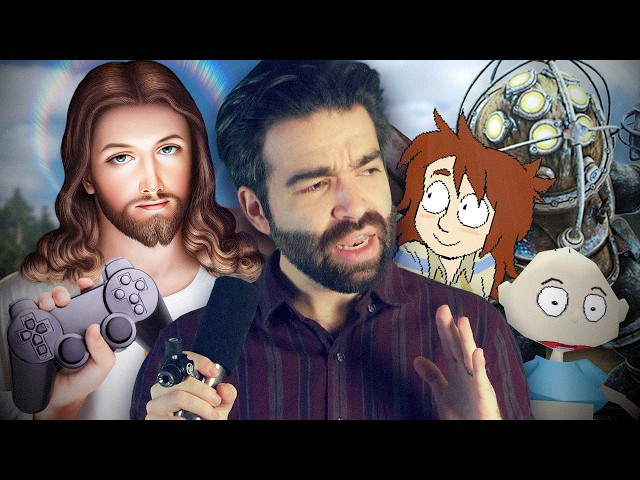
"I am Jesus Christ" and Other Games About Jews
Jacob Geller
0:01 Just before Christmas in the long-ago year of 2019,
0:05 the gaming world was rocked by an announcement unlike any other:
0:10 Jesus Christ was coming to PC.
0:14 In a minute-long trailer for a game called
0:18 “I Am Jesus Christ,” the player-as-Jesus heals the sick,
0:22 produces a dozen fish, and quells the stormy sea,
0:26 all with first-person, magical hands action.
0:29 In a classic example of the preview revealing too much,
0:34 it also shows us the climax of the story– Jesus crucified,
0:39 alongside the good and unrepentant thieves.
0:41 In the logo reveal, Jesus himself forms the “I” in the game’s title:
0:47 “I” am Jesus Christ.
0:49 We even get a sneak peek at his hands
0:52 rolling open the door of his would-be tomb.
0:55 No wonder this trailer has seven million views, it’s a greatest hits collection!
1:02 There were…a variety of reactions to this trailer.
1:05 Most of the comments on YouTube are laughing at its obvious absurdity–
1:09 one of them says “can’t wait to see where the story goes,
1:13 hopefully one of my party members won’t betray
1:16 me near the end.” On a Christian subreddit,
1:18 reactions are largely negative —“cash grab,” “blasphemous,”
1:21 “an opportunity for the hardened to bitterly
1:24 mock and repudiate the gospel and the Lord.”
1:27 But I saw this trailer and thought…hey,
1:31 they’re finally making a video game about a guy like me!
1:34 Sorry no, not the messiah— they’re finally making a game starring a Jewish guy!
1:39 Eight months before I Am Jesus Christ was announced,
1:42 I made a video called “Judaism and Whiteness in Wolfenstein,” which— among other
1:47 things— discussed the Jewish Identity of BJ
1:51 Blazkowicz in MachineGames’ modern Wolfenstein series.
1:53 Towards the end of that video, I said “there aren’t many Jewish game characters,
1:58 almost none,” and showed this user-made list
2:01 from GiantBomb’s website –the description of the list reads,
2:05 and I quote, “If you ever know if there are jewish characters in videogames
2:10 that this list is for you.” The first three entries on the list are biblical,
2:15 the next ten are mostly x-men,
2:17 and then the list descends into hilarious entries like Ron Stoppable,
2:21 Tommy Pickles, and Willow from Buffy the Vampire Slayer–
2:24 all of whom are technically characters in video games.
2:28 Determining Judaism in games often stems from technicality:
2:32 Gaige, a DLC character from Borderlands 2,
2:35 will occasionally say “it’s like chanukah” when opening a chest,
2:39 and so she’s been permanently given a spot
2:41 on the short list of Jewish game characters.
2:44 There are times when Judaism can exist as more
2:47 than a throwaway line in a video game.
2:50 B.J Blazkowicz is one example.
2:51 An even higher profile character might be Dina from The Last of Us 2.
2:55 That game features a whole level in a synagogue
2:58 that spurs multiple conversations about Dina’s identity.
3:01 We learn that, despite not being much
3:03 of a “believer,” Dina still thinks of herself
3:06 as coming from a long line of survivors– which is a very Jewish feeling to have!
3:12 But for every Dina, there’s also an Otacon from Metal Gear Solid,
3:17 who is apparently Jewish based on the 1998
3:20 “Metal Gear Solid Official Mission Handbook,” and nothing else.
3:24 The more interesting question than simply “are there Jewish characters” is,
3:29 does it mean anything in-game?
3:31 Dina’s Judaism isn’t core to The Last of Us’ narrative,
3:35 but it does clearly influence how she thinks of herself.
3:39 But Otacon, the otaku dork who pisses himself?
3:43 What depth does his character gain by being silently, invisibly Jewish?
3:49 Which brings us back to I Am Jesus Christ,
3:52 a game where the protagonist is not just a Jew,
3:56 but probably the most famous Jew of all
3:59 time— or at least tied with Adam Sandler.
4:02 The only problem, at least based
4:04 on that first trailer is…what is the game, exactly?
4:08 Although the scenes of Jesus performing miracles are
4:11 accompanied by some sort of meter going down,
4:14 everything we’re seeing is obviously pre-rendered;
4:16 if this was at a major games conference,
4:19 it would have “not in-game footage” slapped on the bottom of the screen.
4:23 This preview really feels like the beginnings
4:25 of a thought experiment “what if someone made a game
4:28 about Jesus,” turned into a commercial without any
4:32 further consideration of what the mechanics would be.
4:35 But Me of Little Faith, a mere three years after that initial trailer,
4:41 “I am Jesus Christ” became available on steam!
4:44 Well, the prologue did, at least.
4:48 There have, in fact,
4:50 been two different prologues for “I am Jesus Christ.” The first,
4:55 released in 2022, has since been delisted.
4:58 The second, rising again in 2025,
5:00 contains similar content to the first but features an entirely new map,
5:04 gameplay mechanics, and— judging by the banner
5:07 image and voice-acting— a newfound love of AI.
5:11 [“When they had seen him,
5:12 they spread the word concerning what had been told them about this child”] Each
5:16 demo gives you the ability to play a surprisingly hefty chunk of Jesus’ life,
5:22 complete with far more mechanics than I expected.
5:25 “I am Jesus Christ colon Prologue” features dialogue choices,
5:30 an open world, missions, combat, a hunger meter, a fishing minigame.
5:35 Much like Rock Band or Watch Dogs 2,
5:39 completing missions awards Jesus Christ with new followers.
5:42 Much like Geralt or Batman,
5:44 Jesus Christ can shift into detective vision to follow a blood trail.
5:51 And uhh, don’t worry gamers… everyone is white.
5:55 Mary looks like she’s about to doubt your commitment to Sparkle Motion.
6:00 It is weird, in the way that a game
6:04 about Jesus Christ would necessarily be weird.
6:06 It’s also cheesy in the way that gamifying miracles would necessarily be cheesy.
6:12 In maybe the silliest section,
6:14 immediately after resisting Satan in the desert for 40 days,
6:18 the player-as-Jesus arrives at a wedding, only to learn of a CRISIS!
6:23 The guests have already drunk all the wine.
6:26 “Please, use your powers for good,” Mary begs you.
6:30 The wedding party only has these big jugs of water,
6:34 but as a popup tutorial informs us, you can turn water into wine by first
6:39 pressing right click and then holding left click!
6:42 Do it three times in order to complete the miracle!
6:47 After playing this section I was flabbergasted
6:49 that the game had contextualized one of Jesus’ most
6:52 famous miracles in this way— and then I
6:55 went and read John 2:1 and realized that, oh,
6:58 this is almost exactly beat-for-beat what happens in the book.
7:01 Many of the sections of the game are like this, goofy
7:04 in the same way that the bible can be goofy.
7:07 I haven’t found the verse that details Jesus’ skill
7:11 at solving minor physics puzzles by controlling gravity and hurling cubes,
7:15 but maybe an extension of his carpentry?
7:18 Who’s to say?
7:19 With this in mind, the weakest part of the game is, forgive me,
7:24 the weakest part of the Jesus story writ large— that is,
7:28 how little we know about him.
7:31 After briefly touching on the manger, the game immediately skips ahead 30 years,
7:36 fast forwarding to just before Jesus’ baptism by John the Baptist.
7:41 So much for character development!
7:43 Stephen Mitchell’s book “The Gospel According to Jesus”
7:46 grapples with the challenge of understanding who Jesus was,
7:50 stripped back from thousands of years of additions and translations.
7:54 “We know so little about his life,” Mitchell writes,
7:58 “A very few facts and no more.
8:00 He was baptized by John the Baptist.
8:02 He taught.
8:03 He healed.
8:04 He was crucified by the Romans.
8:06 The rest is silence, probabilities,
8:08 and hints…we know nothing about Jesus’ enlightenment experience,
8:13 which changed him from carpenter to Master,
8:15 from ‘son of a whore’ to a son of God.” What that means for the game,
8:21 a game as bluntly titled as “I Am Jesus Christ,”
8:25 is that the player controls a character with essentially no interiority.
8:29 Although levels may send Jesus on Magic School Bus-esque adventures,
8:33 to heal the son of a royal official
8:36 by zapping the virus inside him with holy power,
8:39 it only succeeds in telling us what Jesus did,
8:42 without giving us any insight into what being the “son of god” might have,
8:47 you know, felt like.
8:49 Which you’d think would be what an interactive
8:52 version of the Jesus story might excel at.
8:56 The contradiction that “I am Jesus Christ” faces is that creating an engaging
9:00 game in which you play as Christ is going to require some interpretation,
9:05 a “take” on the son of god.
9:07 But “I am Jesus Christ” is intensely uncurious about the man at its center,
9:12 content to play those greatest hits over and over.
9:15 In fact, a 2023 communication from its
9:18 developer advertised that you can now buy quote,
9:21 “a beautiful book based on the stunning images from the game,
9:24 along with AI-generated quotes from the Bible,” perhaps
9:28 the single most creatively bankrupt sentence ever written.
9:33 A year later, the developer’s official Discord was overrun with pornbots.
9:41 To state the obvious, despite starring a Jew,
9:44 “I am Jesus Christ” is not a Jewish game, nor is it made for a Jewish audience.
9:50 Finding Judaism in “I am Jesus Christ” is an exercise
9:53 in the kind of interpretation the game refuses to do.
9:57 You could see Tikkun Olam, the Jewish concept of repairing the world,
10:01 in Jesus’ drive to heal and help the people around him,
10:05 but even that is an assumption of motivation
10:08 beyond anything the game actually gives us.
10:11 Instead, I Am Jesus Christ exists in the same realm
10:15 as “The Brick Bible,” “Veggie Tales,”
10:17 or “Chick Tracts;” utilizing a popular medium
10:20 in an attempt to make classic Christian teachings exciting for “the youth.”
10:26 This is not the first time video games have attempted such a thing.
10:29 In fact, “I am Jesus Christ” follows in the footsteps of some
10:33 of the most famous— or, infamous— games of the 20th century.
10:37 A short history lesson: Back in the days of the NES,
10:41 Nintendo controlled access to their megahit console in a very physical way–
10:46 every game cartridge for the system had to include a special microchip,
10:51 only known to Nintendo.
10:53 This meant that it was impossible to produce any NES
10:56 games without Nintendo’s blessing and outside of their content guidelines.
11:01 Or I should say, almost impossible.
11:05 In 1988, two men– James Chan and Dan
11:09 Lawton– developed a second kind of NES cartridge.
11:12 Instead of including the special microchip,
11:15 their design literally shocked the authenticator with a voltage spike,
11:19 momentarily disabling it and letting non-Nintendo
11:21 Approved games be played on the NES.
11:25 Dan Lawton used this workaround to make unlicensed games about Jews.
11:31 Although Lawton’s original development company,
11:34 “Color Dreams,” published a few unremarkable unlicensed titles for the NES,
11:38 its fate was ultimately set in motion by a joke.
11:42 According to Gabe Durham’s reporting on the subject,
11:44 one day Lawton riffed that they ought to “make
11:47 a game with Jesus jumping around.” A year or two later,
11:51 “Bible Adventures” for the NES hit store shelves,
11:54 and sold hundreds of thousands of copies.
11:56 [“Do you ever wonder if they’re playing too much Nintendo?” “Oh, not anymore.
12:01 See, Matt has Bible Adventures.
12:02 They’re actually learning bible stories while they’re playing Nintendo.” “Quick,
12:05 get that bible quote,
12:07 before you run out of power!”] The success of Bible Adventures
12:10 is inextricably tied to its bizarre status as an unlicensed NES game.
12:15 It is, on its face, ironic that a game theoretically espousing the virtues
12:20 of the bible would use an electric shock to bypass content censors.
12:24 But those unlicensed cartridges weren’t technically breaking any laws.
12:29 It was just heavily frowned upon by Nintendo.
12:33 Most game stores, afraid of losing Nintendo’s good graces,
12:37 only stocked licensed games.
12:39 But you know who didn’t care about the good graces of a video game company?
12:44 Christian book stores!
12:45 Lawton and co.
12:46 rebranded their development studio to the appropriately devout-sounding “Wisdom
12:50 Tree” and started marketing their games directly to Christian retailers.
12:55 And yet, despite Lawton’s original joke about Jesus jumping around,
12:59 the most famous of Wisdom Tree’s games are firmly old-testament.
13:04 Bible Adventures, released in 1991 for the NES,
13:09 is actually a collection of three games.
13:11 The first game, according to biblical chronology,
13:14 is “Noah’s Ark,” in which the player-as-Noah holds large stacks
13:18 of animals above his head and throws them onto the ark.
13:21 There’s not much else that happens in the game, and more importantly,
13:25 Noah is technically pre-Abraham and thus not actually Jewish,
13:29 so I am DISQUALIFYING Noah’s Ark from further conversation.
13:33 Next up is “Baby Moses,” which is maybe the most conceptually interesting
13:38 of the three because you don’t actually control Moses but his mother, Jochebed.
13:43 Set within Exodus, “Baby Moses” takes the two biblical sentences
13:47 about hiding Moses among the reeds on the Nile and blows
13:51 it out to a daring escape scene in which Jochebed
13:54 holds the infant Moses above her head and sprints through Egypt,
13:59 dodging guards, dive-bombing birds, and piles of spiders.
14:02 Much like Noah could lift and hurl animals,
14:05 Jochebed can lift and hurl her own son,
14:08 even chucking the baby prophet directly into the river.
14:12 There is, for the record, no reason to do this.
14:15 But the option is available!
14:17 In fact, the game doesn’t even end if you prematurely
14:20 drop Moses in the Nile— you can finish out the level,
14:24 only to be informed “Good work,
14:26 but you forgot baby Moses.” Ascribing overt intentionality
14:30 to the situations picked for Bible Adventures would be a mistake.
14:34 Developer Dan Burke said, in conversation with Gabe Durham,
14:38 “It was like doing a game about Cthulhu.
14:40 What’s the Cthulhu lore?
14:42 They would just crack open the Bible and there was your story.
14:46 Noah’s Ark.
14:46 There’s a story right there.” But I
14:48 do find it interesting that, however accidentally,
14:52 Bible Adventures is engaging in something almost like Talmudic commentary.
14:56 Jochebed is mentioned by name only twice in the Old Testament,
15:02 both in those long lists of family trees the Torah is so good at.
15:06 Even when she births Moses, she’s described only as a “Levite
15:10 Woman.” Additional information about Jochebed– for instance,
15:13 that she was “conceived on the way to Egypt”– is extratextual writing,
15:18 added by biblical scholars like the illustrious Rashi.
15:21 “Baby Moses,” as a game,
15:23 teaches almost nothing about the literal text of the Old Testament.
15:27 But its incidental fleshing out of Jochebed as not simply a “Levite
15:31 woman” but a mother with some level of agency and sense of responsibility,
15:37 feels…almost Jewish?
15:38 I mean, of course it’s a stretch but look at what I’m working with here.
15:43 In the last game in the collection, “David and Goliath,” you play as David,
15:47 the young Shepherd who kills Goliath and eventually becomes King.
15:51 Finally, an exciting story for a game!
15:53 I can only imagine the boss fights that– oh,
15:56 it’s a game about carrying animals again?
15:58 Alright.
15:59 You do get to throw a rock at Goliath at the end, at least.
16:05 What I haven’t said explicitly yet is
16:07 that Bible Adventures is not a good video game.
16:11 You could call it terrible.
16:13 It controls poorly, the levels feel near-random,
16:16 there’s very little interesting design.
16:18 The most fascinating thing about Bible
16:20 Adventures— and the later Wisdom Tree games,
16:23 which include the trivia-based “Bible Buffet,” a Zelda-esque
16:27 “Spiritual Warfare,” and the infamous first person shooter,
16:30 “Super 3D Noah’s Ark,” is the fact that they exist at all.
16:36 A key difference between Judaism and Christianity
16:39 is the Christian directive to convert nonbelievers,
16:42 to evangelize, to spread the good news.
16:44 Even though many of these games star Jews, they are games based in Christianity,
16:49 purchased by parents and churches in the Christian hope of using
16:53 faith-based pop culture to grab the attention of the young and non-converted.
16:58 Although there is plenty of Jewish pop culture,
17:01 vanishingly little of it is actually made
17:03 with the intent of converting the goyim.
17:06 No one jumped in the mikvah because of Mel Brooks.
17:10 Instead, what defines Jewish media is more nebulous,
17:13 the indefinable idea of a Jewish perspective,
17:16 one of those things that often boils down to “I know
17:19 it when I see it.” In the realm of video games,
17:23 it’s often easier to “see it” when the project
17:26 comes from a single person or small team.
17:29 In my own vibes-based research,
17:31 I’ve found the most commonly cited “Jewish video game” might be
17:36 “The Shivah,” a 2006 indie point-and-click
17:38 detective game from developer Wadjet Eye Games.
17:41 And I just want to say that again, the most commonly cited example is
17:46 an independent point-and-click detective game from 2006.
17:50 That is not a combination of words I associate with popularity.
17:55 But The Shivah’s impact as a game is due
17:58 as much to its subject matter as its genre— it is,
18:03 undeniably and completely, a very Jewish game, one of the only of its kind.
18:09 In The Shivah, you play as a rabbi-turned-private eye in a sort
18:13 of noir-pastiche set between two synagogues
18:16 and various other locales in New York City.
18:19 It feels very basic, especially in the context of today’s indie games.
18:24 The environments are small and static, the puzzles feel a bit random,
18:28 the voice acting leaves a lot to be desired.
18:31 [“Today in my sermon I’d like to discuss suffering.
18:35 Why do bad things happen to good people?”] But there’s
18:38 also stuff in The Shivah that, for some reason,
18:41 I just didn’t think could be in a game.
18:44 Things like “Adon Olam,” being sung with the tune I recognize from my synagogue.
18:48 Or a computer in the game that just gives you an endless stream of Jewish jokes,
18:53 and not jokes about Jews but jokes that I tell to my non-Jewish friends
18:58 and they go “wait what’s the punchline?”
19:00 There’s the entire conversation shtick of the game,
19:04 in which one of the dialogue options available to you is always
19:08 “the rabbinic response,” which just means
19:10 answering a question with another question.
19:13 The game, in its 2013 re-release,
19:15 even features a bonus commentary track from its director,
19:19 Dave Gilbert, in which he provides
19:21 additional insight on its creation and meaning,
19:23 which is such a hilariously Jewish impulse that it
19:26 also describes both the Talmud and my own book, How a Game Lives, available now.
19:31 It’s also a great genre match.
19:33 For a culture like Judaism,
19:35 so obsessed with asking questions and finding meaning,
19:38 a detective game makes a ton of sense.
19:41 Also, like many detective stories and many Jewish stories, it stars…an asshole!
19:48 You play as Russell Stone, a gruff rabbi in charge of an ailing synagogue.
19:53 You’re tasked with investigating the murder of a former congregant,
19:56 an investigation complicated by the fact that Rabbi Stone himself
20:01 threw out this congregant years prior for getting an interfaith marriage.
20:07 It’s a decent story, one that grapples with the familiar Jewish
20:10 themes of what one owes to their faith,
20:13 their own community, and the outside world.
20:16 It’s nothing groundbreaking though,
20:18 except for the fact that, as previously stated,
20:21 it has become the go-to example of a “Jewish video
20:25 game.” Dave Gilbert— the game’s creator— seems uncomfortable with this status.
20:30 He’s posted since that he didn’t want it
20:32 to be the go-to example of a Jewish video game,
20:35 that he feels like he got a lot of things wrong,
20:37 that he himself isn’t that religious and is only culturally Jewish,
20:40 and I hate to say it Dave but that’s kind
20:42 of the most Jewish thing you could feel about your video game.
20:46 Fortunately and despite its reputation The Shivah
20:49 isn’t the only overtly Jewish game ever made.
20:52 A venture into the fiercely independent and unpolished
20:56 archives of itch.io uncovers many more Jewish games, of all different sorts.
21:01 On one hand we have something like “Who
21:04 Shall Wander,” in which you navigate a desert,
21:07 avoiding Christian missionaries and answering quiz questions on Jewish values,
21:10 in order to earn “mitzvah points.” This is
21:13 a game I could imagine playing at Hebrew school,
21:17 silly and light but technically more fun than a lecture.
21:20 On the other hand, there’s the game “From the Earth.” This is
21:24 a horror retelling of the Golem of Prague story in which you,
21:29 as the Rabbi, rip out your eyes, teeth, lungs,
21:32 and heart in order to animate the clay protector.
21:36 It is cool and gnarly and distinctly
21:39 something we would not play in Hebrew school.
21:43 And then there are the personal explorations of Jewish culture and history,
21:48 like “Hineini,” a story of an awkward
21:51 teen boy wrestling with ideas of queerness, family, and faith, or “Onthecht,”
21:55 a documentation of the developer’s great-grandparents
21:57 being torn from their home in Amsterdam and killed in Sobibor.
22:02 These are beautifully small and specific games,
22:06 interested more in a sense of legitimacy than broad appeal.
22:10 But the best versions of this style that I’ve
22:13 played do not bill themselves as Jewish games at all.
22:17 They are the point-and-click memoirs “Perfect Tides” and its sequel,
22:21 “Station to Station,” which depict the trials and tribulations
22:24 of a fictionalized version of the game’s director Meredith Gran.
22:28 The first game, Perfect Tides, takes place on a small east-coast island
22:33 while protagonist Mara Whitefish is in high school.
22:36 But despite being literally named Whitefish,
22:39 Judaism is not a huge part of Mara’s life.
22:42 It is mainly something that happens to her— like her fear that Hitler may
22:46 have faked his death and escaped to the woods of her island where he,
22:50 now over 100 years old, waits to ambush her.
22:53 Or her rage that her brother’s new insistence on celebrating
22:57 Sukkot is interrupting her plans [“Since when do WE celebrate Sukkot?
23:03 The holiday NO ONE cares about, even more useless than Purim?”].
23:07 Judaism is something inherited from her dead father,
23:10 a cocktail of identity and traditions that only exist to inconvenience her.
23:15 When she tells her friends that she can’t hang,
23:18 she IMs “it’s a long story but basically I’m Jewish.”
23:22 The island itself has the same sense of fading identity.
23:26 A long defunct hotel on the island was once a “haven
23:30 for the Jewish population of the state,”
23:32 but now it’s a beautifully graffiti’d husk,
23:35 a place to sit and think about what’s slipped away.
23:38 The game ends with the first night of Chanukah,
23:41 a full recitation of the prayers by Mara’s brother.
23:44 You get the sense that he is attempting
23:46 to absorb the role of his father and his faith.
23:49 Mara can’t find it— “If only you didn’t stand outside belief,
23:54 looking in from this lonesome void,” the narrator commiserates.
23:57 But there is something she finds in the tradition,
24:01 a comfort despite her feeling of alienation.
24:04 Mara is 16 in the first game.
24:07 In the next, Station to Station, she’s 18.
24:10 She’s going to school in the city— in essentially New York.
24:14 There are similar ways Judaism “happens to her” here— discussions of who
24:19 is or isn’t “goyish,” a story about her brother hiding the afikomen,
24:23 an acquaintance who goes on birthright and gets, like, way too into it.
24:28 But where Perfect Tides was largely a game where
24:31 Mara struggled to decide what to think about herself,
24:34 Station to Station is a game where Mara is learning how to think,
24:38 how to think as an adult and a writer and an independent person.
24:42 How to think about love, about art, about the wider world.
24:46 And in this pursuit, the threads of Judaism re-emerge in her life.
24:51 In Station to Station, you will read many books— real books,
24:55 books by Freud and Ursula le Guin, Camus and Langston Hughes.
24:59 These texts will expand your ability to understand and interact with the world,
25:04 and improve your skill at getting your own thoughts down on paper.
25:09 I understand what I’m describing is basically just
25:11 the concept of going to school— I get it.
25:14 But in Mara’s drive to learn and understand,
25:18 her close readings and her skepticism of foundational texts,
25:22 I see my own passion…and I see a Jewish way of understanding the world.
25:27 An eagerness to support yourself with tradition
25:30 while simultaneously questioning those same principals.
25:34 I don’t know if Mara is able to see it this way.
25:37 At the end of the game,
25:39 she visits her father’s grave in a noticeably Jewish cemetery,
25:42 and she expresses similar frustrations and guilt as the end of the first
25:47 game— that sometimes she doesn’t know if she’s a Jew at all,
25:50 that she doesn’t believe in God and feels
25:53 nothing in common with people who go to synagogue.
25:56 “Sometimes,” she says, “I think the only thing uniting us is the grief.
26:01 The impossible sense of loss… I can’t carry it with me all the time,
26:05 Dad.” But she carries more than that.
26:08 In the most beautiful moment of the game,
26:10 she gazes out into the sunset and wonders,
26:13 “is home nothing more than a place from the past?” No, she concludes.
26:17 “Surely there is a home within you,
26:20 waiting to be known.” Surely there is a way to find
26:24 one’s own spot in this cloud of other people’s beliefs.
26:28 “If you never had another day…Dayenu.” Judaism leaps
26:32 to express what could otherwise only be felt.
26:38 Perfect Tides: Station to Station is one of my favorite memoir games ever,
26:42 and one of the most legitimate-feeling ways I’ve experienced of weaving personal
26:47 struggles with Judaism into much larger
26:49 questions of identity and finding oneself.
26:52 It’s also a minor indie release,
26:55 currently sitting at well under a hundred Steam reviews.
26:58 And sometimes I wonder if this is the only realm for Jewish games— niche,
27:04 personal, probably unprofitable.
27:06 We’ll occasionally get a character like B.J.
27:09 Blazkowicz or Dina, but a whole big game?
27:12 Something AAA, something high-budget,
27:13 something worked on by dozens or hundreds of people?
27:17 Is there anything that could survive this process and emerge
27:21 with a perspective on what it means to be Jewish?
27:25 Well, I can think of one.
27:28 But I can’t quite decide how I feel about it.
27:32 Bioshock, developed by 2K Boston and 2K Australia, is a game about Rapture,
27:39 a dystopian art-deco underwater city crumbling
27:42 under some truly terrible political ideology.
27:45 Since its release in 2007, it has largely been considered one of the best,
27:50 or at least most influential games of the 21st century.
27:54 It is also a game about Jews.
27:57 Pound for pound, Bioshock almost certainly has the most
28:02 Jewish cast out of any AAA game ever made.
28:06 Andrew Ryan, Dr.
28:07 Steinman, Sander Cohen, Brigid Tenenbaum, Samuel,
28:10 Mariska and Masha Lutz are all Jewish.
28:12 I mean, my god— Bioshock is one of the most talked-about games of all time.
28:18 Why hasn’t the Judaism of its characters
28:20 been part of the conversation all along?
28:24 Well, part of the answer is how “official”
28:28 and “canon” the Jewishness of these characters actually is.
28:31 While it’s easy enough to read several of these names– Steinman,
28:36 Cohen— and assume Judaism,
28:38 the “canon” of Bioshock’s Jewish characters has largely been
28:42 confirmed in extratextual interviews with the game’s director, Ken Levine.
28:46 “I don’t think I was conscious of how Jewish it
28:50 was until afterwards,” he said in an interview with Cody Mello-Klein.
28:54 In fact, the words Jew, Jewish, and Judaism,
28:58 aren't even present in the game’s script.
29:00 Tenenbaum is the only character that states
29:03 her personal connection to the religion— and even then, only by implication.
29:08 Rapture, the city, is explicitly an atheist haven,
29:11 a place where science and art won’t be held back by the petty rules of religion.
29:17 So what’s going on here?
29:19 Is Levine just retconning Bioshock into a Jewish game,
29:22 a sort of “Dumbledore was actually gay” to an entire theme?
29:28 No.
29:28 I don’t think he is.
29:30 Though later Bioshock games would struggle
29:33 much more with appropriately addressing identity,
29:36 I am sympathetic to how hard it is to work through your own
29:40 feelings and history about Judaism— let alone present those ideas to the public.
29:46 To state the obvious,
29:47 most of Bioshock’s Jewish characters are more or less insane;
29:53 deranged doctors, unhinged artists, violent and self-deifying oligarchs.
29:56 To add in text directly stating something like “hey,
30:01 that plastic surgeon that grew bored of the human form
30:04 so he started making picassos out of people’s actual faces?
30:07 Yeah, he’s Jewish” would invite exactly the wrong kind of attention.
30:14 I mean, take the main antagonist, Andrew Ryan.
30:17 Ryan shares his pre-Rapture history
30:20 with his obvious ideological model, Ayn Rand.
30:23 Rand, as much as I hate to admit it, was a Jew!
30:28 Both she and Ryan were bourgeois Jews who
30:30 immigrated to America in response to Russian Bolsheviks.
30:33 Rand stayed in America,
30:35 Ryan started an underwater city, both became insufferable writers.
30:40 I think they would enthusiastically agree
30:43 that their politics do not reflect Jewish values.
30:47 And yet, Ryan can’t help but frame his personal narrative religiously,
30:52 saying that his journey to Rapture was his quote
30:56 “second exodus.” His abandonment of his first home,
30:59 his desire to create his own promised land,
31:02 is a recurring motif in the history of Judaism.
31:06 And Ryan isn’t even the prickliest representation of Judaism
31:09 in the game— that honor has to go to Brigid Tenenbaum.
31:14 Tenenbaum is the closest the player gets to an actual friendly face in Rapture—
31:20 she begs you not to kill the “little
31:23 sisters,” girls that host valuable genetic resources.
31:25 She leaves you gifts around the city, helps you defeat the big bad of the game,
31:30 and is one of the only characters that doesn’t ultimately betray you.
31:35 Tenenbaum is also a holocaust survivor.
31:37 BUT, we learn she survived the camps
31:41 because she literally volunteered to help Dr.
31:45 Mengele, took part in administering Nazi medical experiments.
31:49 She lived because of her collaboration, and even afterwards, in Rapture,
31:54 she continued her inhumane experimentation,
31:57 creating the horribly mutated girls she now wants us to save.
32:02 Tenenbaum’s story is not a heroic one of Jewish resistance— it is a much colder,
32:08 much bleaker story of someone who was forced
32:11 to become something less than human in order to survive.
32:14 Her support throughout the narrative of the game does not come
32:18 from the warmth of her spirit but an unshakeable guilt in her own complicity.
32:24 Bioshock, especially viewed through the lens of Tenenbaum,
32:28 is a piece of post-Holocaust fiction
32:30 that refuses to valorize its characters’ suffering.
32:33 Cody Mello-Klein, in his piece on the game, points out that this history deepens
32:39 the game’s central motif of agency and control.
32:42 “If the trauma of the past still controls our present,” he writes,
32:46 “how much control do we really have?” Bioshock
32:49 remains famous for challenging players on their agency
32:52 within a video game narrative— but how
32:55 much more complex is this question for Jews,
32:57 our list of traditions framed by near-misses with annihilation?
33:01 There is no glamor in Bioshock’s Jewish representation,
33:06 no valorization of the religion’s tenacity.
33:09 And this deeply uncomfortable introspection is possible
33:13 because of the game’s near-invisible use of Judaism.
33:17 Because the culture is deployed as an unconscious
33:20 connecting theme rather than an explicit plot point,
33:24 Bioshock is able to create characters that don’t
33:27 have to serve as a beacon of representation.
33:30 They are deeply broken people and their personal
33:34 histories and culture are wrapped around that brokenness.
33:38 What feels most Jewish to me about Bioshock though,
33:41 more than its individual characters or individual creators,
33:44 is the fact that I continue to wrestle with it.
33:48 In asking “what is a Jewish video game,” an equally important question is “what
33:52 is a Jewish way of playing a game?” Judaism is a religion of close-reading,
33:57 a tradition of creating new allegories and connections
34:01 from stories written thousands of years ago.
34:03 When I think about how I approach art,
34:06 how I approach games, it is in this same tradition.
34:09 We tell and retell the Passover story every year
34:12 and still manage to find new things to talk about.
34:16 Just because we’ve been yapping about Bioshock for nearly
34:20 two decades now doesn’t mean there’s nothing left to say.
34:25 Because when I play Bioshock today,
34:27 I find my modern struggles with Judaism reflected right back at me.
34:32 In the wake of the Holocaust, Andrew Ryan builds a purported promised land,
34:37 and yet that promised land only perpetuates the violence
34:40 it was meant to be a shelter from.
34:43 How could our tradition possibly have brought us to this?
34:46 Can I point at the unspeakable violence and cruelty and say “this isn’t
34:51 Judaism?” Or must that inhumanity be understood as a part of us too,
34:57 not so easily excised from our cultural self-image?
35:00 In one sense, a religion and a video game are both about following rules.
35:07 The torah has commandments, a game has objectives and limitations.
35:11 You wanna be good?
35:13 Just follow those rules, they’ll get you where you need to go.
35:17 But this is a dull, incurious way of viewing both those things.
35:21 The Judaism that I connect with is one that is made to be interrogated.
35:25 Nothing should be taken for granted— not those rules,
35:28 not the goals of its institutions, not even a belief in God.
35:33 And this, not coincidentally, is how I connect to games as well,
35:37 not as a strict set of parameters but as a new
35:41 possibility space in which anything could be built.
35:43 The past is there to be learned from, but not blindly followed.
35:47 The future can— the future must— continuously re-examine what we’ve done,
35:52 in order to learn how to be better.
35:55 The “best” Jewish video game is the one not yet made,
36:01 but one we have to believe is possible.
36:11 While this essay took quite a long time to put together,
36:14 it is not– by any means– a complete history of games about Judaism.
36:18 One of the most notable exceptions is a game called Train by Brenda Romero.
36:23 But Train is not a game you play on a PC or console,
36:28 it’s a board game… about the Holocaust.
36:31 And I am not really a board game guy— so I’ve called in an expert.
36:37 Exclusively on Nebula,
36:38 you can watch a companion video to this one where I’ve pulled in Quintin Smith,
36:44 better known as Quinns, of People Make Games and Quinn’s Quest.
36:48 We have a wide-ranging conversation on Train,
36:51 the ability of a board game to communicate ideas about culture,
36:55 other games that do this, the strange controversy
36:58 with the book Tomorrow and Tomorrow and Tomorrow, and more!
37:01 I mean, come on.
37:02 It’s Quinns.
37:03 You know the chat is good.
37:05 [“I think the paragraph you just said, like,
37:08 took minutes off my life.” “This is just where
37:12 the metaphor of playing the game with history gets really complicated,
37:18 really fast” “I’ll just tease it by saying
37:21 it’s a fascinating roleplaying game that has the most
37:24 awkward rule of all time.”] If you like the kind of work I do here on YouTube,
37:29 it’s hard for me to imagine you wouldn’t enjoy Nebula.
37:32 It is a place where I’m free to explore other,
37:35 more flexible types of videos— interviews,
37:38 mini-essays, cooking shows, travelogues,
37:40 without the ads or crushing algorithmic pressure of YouTube.
37:45 Nebula features many of my favorite essayists,
37:48 who consistently release early and/or exclusive stuff there,
37:51 AND it is a fraction of the price of other streaming services:
37:56 just $3 a month with my URL, well under a cup of coffee a month at this point.
38:03 Listen: in the lessons about how to be successful as a video essayist,
38:08 no one really recommends spending months making
38:10 a thing about being Jewish and point-and-click adventure games.
38:14 I am talking about this stuff because I care about it,
38:17 and I can afford to do that because
38:19 of the support Nebula provides me as a creator.
38:22 So if you appreciate this kind of thing, if you want to see more,
38:26 if you just like giving me the time and flexibility
38:29 to pursue topics like this, I really think you should consider Nebula.
38:33 It’s a video platform that doesn’t make me feel guilty when I use it!
38:38 In 2026!
38:39 How about that?
38:40 Use my code for a big discount and see what you’ve been missing.