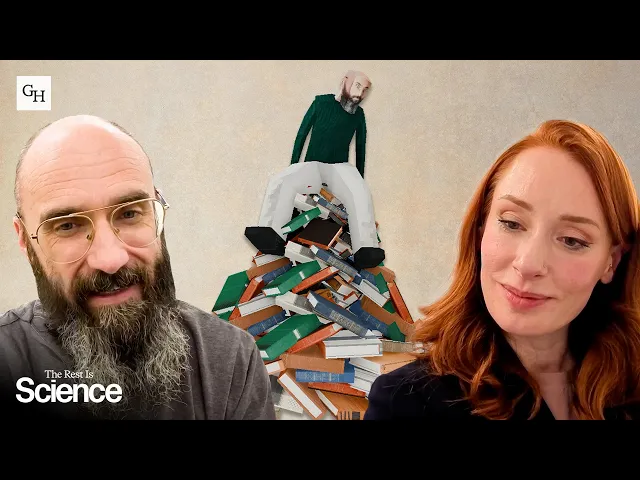
Michael's Favourite Science Books
The Rest Is Science
0:00 I've brought a lot of things.
0:02 Look at that stack.
0:03 And that's only some of it.
0:04 I know.
0:05 I'm finally answering a question that I get asked all the time.
0:08 And I was sick of not having a good answer.
0:11 So, I put the work in and I've I've got an answer.
0:14 Just turn it around one more time.
0:15 I want to see how well leafed through they are.
0:17 Okay.
0:19 Couple of those are very loved.
0:20 Some of them Some of them listeners rather than
0:23 viewers look like they've only been read in digital form.
0:27 And this is the hard copy that sits on a shelf to prove I'm not sure.
0:31 That's interesting that you bring that up because
0:34 that is not true at all for these books.
0:39 Okay.
0:37 I love physical books so much that I and I and I
0:41 dislike reading on a screen so much that I read the hardbacks.
0:46 So these have all been completely read every page of them.
0:50 And the ones that look cleaner,
0:51 I think they just look cleaner because they are after all
0:54 like really highquality hardcover books that stand up to wear and tear.
1:00 Um, I used to buy paperbacks and this is why I don't anymore.
1:03 Like this paperback,
1:04 it's all getting browned and yellowed and the pages already feel brittle.
1:08 So, what I focus on nowadays is acidfree archival copies and they're often
1:14 cheaper than the new paperback because it's just like an old used book.
1:19 It's not even a first edition.
1:21 And so it'll be like 23 bucks for the paperback version or $9 for this used
1:27 copy from a little bookstore in Indiana that is
1:30 printed on archival paper with a hard binding.
1:33 And I'm like, it's a no-brainer.
1:35 And they also look nicer.
1:37 They look nicer.
1:38 And a lot of times though, you you are going to have like old library binding.
1:42 Um, and I love that.
1:44 I like having the little sticker on it that has
1:46 it's like Dewey decimal number and it says like,
1:49 you know, Wasuka County Public Library and then there's got
1:52 a big stamp on it that says, you know, removed.
1:55 And I love that it's got this whole story.
1:57 Sometimes there's little pe like people's notes.
1:59 I'm wondering if I have No, not here.
2:01 But a lot of people have made their notes in it
2:03 and I can like respond to their notes and be like,
2:06 "You are you not understanding this book or yes, who are you?
2:10 You're brilliant." And I never find out.
2:12 Well, this was supposed to be a hook and tease for our second half,
2:14 but um but I think we've given it away now
2:16 that we're going to be talking about Michael's favorite books,
2:18 but that's okay because we haven't given away any of the titles.
2:22 Michael's favorite science books.
2:24 I mean, I I am not surprised that this is
2:26 a question you've been asked multiple multiple times.
2:28 Yeah, I'm asked it a lot and I finally got good good answers because it came
2:32 to a head when I was waiting for a a sushi
2:35 order for takeaway and the the waiter asked,
2:40 "What book would you recommend?" And I was like,
2:42 "Oh my gosh, I don't know who the heck you are." Like, I don't want to say, "Oh,
2:48 you should read The Illusion of Conscious
2:50 Will." Because that's like an academic book, but maybe that is what you want.
2:55 And like I had to figure out what's an answer
2:57 I would tell to anyone regardless of their background,
3:00 regardless of what they're used to, and also
3:03 regardless of like what they have access to.
3:05 Because a lot of the books I would recommend might be like,
3:07 "Okay, there's a copy on eBay right now for $800.
3:10 Mine belong to my father, but I want to be able to say, "Look,
3:13 you can get this on Amazon for five bucks if
3:15 that's what's going to be easy for you or or Kindle.
3:18 I think a lot of people want to read them on on a screen.
3:27 This episode is brought to you by Cancer Research UK.
3:30 If you wanted to type out the entire human genome,
3:34 you would have to type at 60 words a minute
3:37 for eight hours a day for about 50 years.
3:41 Okay, that's the scale of the DNA rule book inside each one of your cells,
3:45 telling it when to grow, when to divide, and when to stop.
3:49 And different tissues read that same rulebook in different ways.
3:52 So, a skin cell doesn't behave like a lung cell.
3:55 And cancer can begin when those instructions change.
3:59 not one dramatic moment, but through small gradual edits over time.
4:04 Now, cancer isn't one disease.
4:06 It is more than 200 types shaped by where
4:09 those changes to the rule book happen and how cells respond.
4:14 Cancer Research UK is the world's largest charitable funer of cancer research,
4:18 backing studies across all types of cancer.
4:21 Work that takes years of very careful,
4:24 steady progress to deliver each breakthrough.
4:27 For more information about Cancer Research UK, their research breakthroughs,
4:31 and how you can support them, visit cancer research.org/therest is science.
4:39 [music] Okay.
4:45 Well, that is coming up in the second half of this episode.
4:48 But as always in Field Notes on our Thursday episode,
4:50 we uh we start off by taking a dip into some of your questions,
4:54 our mailbag as it were, the things that have been troubling you,
4:57 the things that have been on your mind.
4:58 And as ever, we have some amazing questions that have come in from you,
5:01 including this one for you, Michael.
5:03 This is from Larden Marovich, who asks,
5:06 "How much time do you think passed between the invention
5:09 of the laser and a laser pointer being used to play with cats?"
5:13 I'd never considered this, so I had to look it up.
5:16 And it's almost exactly 21 years.
5:18 So by the time lasers were old enough to drink alcohol in the United States,
5:23 [laughter] they had become cat toys.
5:26 That's obviously a bit of a guess,
5:29 but it's based on the fact that the first laser was operated in May of 1960.
5:34 It had of course it was resting on the shoulders
5:37 of work that went back to Einstein and before.
5:41 But the first laser which used a ruby was operated in in 1960 and it
5:47 was the very early 80s like 198182 maybe is the first time you started
5:52 to see consumer laser pointer devices and I've got to imagine that as soon
5:58 as someone opens up their laser pointer
6:00 that they ordered a cat starts playing with it.
6:03 Like I don't think it's very long between the availability
6:05 on the market to hey my cat enjoys this.
6:09 I haven't been able to find any reports
6:11 like an oral history of laser pointers in cats,
6:14 but I I cannot imagine it was more than a couple weeks before someone noticed.
6:20 But then hold on, because there were
6:22 lasers that existed before they were commercially available.
6:25 I mean, are you ruling out the idea that a scientist
6:28 wouldn't have just uh pointed it near a cat before that point?
6:32 I guess that's a big flaw in my approach.
6:34 I'm assuming that the laboratories were cat-free environments.
6:39 [laughter]
6:39 These lasers would have been in development, the ones that were sold in the 80s,
6:42 some of the first laser pointers,
6:44 they would have been in development for a long time.
6:47 And did the the R&D teams like not have a cat around at some point?
6:52 Like you would bring it home, you'd show, you know,
6:55 you'd show your spouse and then oh my gosh,
6:58 you know, boots or socks is really in love with this pointer.
7:04 And by the way, socks and boots, those are great names for cats from the 80s.
7:08 Today, cats are all named things like Theodore,
7:11 Jessica, Tiffany, but back then, we just had socks.
7:17 I think there's something nice about that question, though.
7:18 The distinction between between hard science and play is
7:23 actually much uh much much fuzzier than you might imagine.
7:27 Um because I agree with you that as soon as there
7:29 is an object that that can be used for joy,
7:33 I think inevitably it does become so.
7:35 Inevitably it does.
7:36 And and oftentimes it's the opposite where
7:38 an item used for joy becomes a scientific tool.
7:41 Well, there's lots of these, right?
7:42 I mean, I'm thinking about the James Web telescope,
7:45 the way that they launched that was based on an origami fold.
7:50 Ah, yes.
7:51 also computer graphics which required a particular type of processor
7:55 so that you could when you're playing when you're
7:57 kind of moving around and gaming so that the worlds
8:00 appear as rich and visual as quickly as possible.
8:03 It required a very particular type of computer processor
8:06 and that is now the reason why we have artificial intelligence.
8:08 I mean it ended up having this extremely important scientific purpose after all.
8:12 So then what what cat toy what current cat toy
8:16 is going to become the seed of the next scientific revolution?
8:20 Maybe the little dangly fish on a stick.
8:23 The fish on a stick is going to unlock some orbital
8:26 mechanics technique or some sort of unification of macro and microphysics.
8:34 Of course, I'm going to get working on that after the podcast if you could.
8:38 Here's a question for you, Hannah, from Dwayne Chory.
8:41 Dwayne says, "I have two German shepherds
8:43 who shed aggressively while driving on the highway.
8:46 I wondered whether there is an optimal way to use air flow
8:49 and pressure differences to remove dog fur from a car while driving.
8:53 Which windows should be open by how much?
8:56 And is there an optimal speed?
8:57 Okay, first of all, you have become the fluid dynamics goto of the cues.
9:06 I know this this is great.
9:08 Do you know what?
9:09 I had such a fun afternoon thinking about this question.
9:11 I've done more fluid dynamics for this podcast
9:13 than I have in the preceding 10 years.
9:15 It's absolutely great.
9:15 I'm loving it and I've got answers for you.
9:17 Right.
9:18 So, I'll tell you what the bad ideas are.
9:19 If you're in, you know, you're going down the motorway,
9:22 you want to get as much fur out as possible.
9:24 Bad idea is to open one window.
9:26 Don't do that.
9:27 That's just it's just terrible because um what happens when you do
9:31 that, it's a bit like when you blow air over a bottle neck.
9:34 So, what happens is this this hunk of air that's right
9:37 by the the one open window essentially starts acting like a plug.
9:42 Um, and as air rushes past it from the outside,
9:46 it compresses the air inside the cabin, inside the car, uh,
9:50 which then decompresses and you end up with what is effectively
9:54 acting like a solid block of air that's wobbling back and forward,
9:57 which is why when you're driving, you open one window,
9:59 it goes like that's what you're hearing.
10:03 It's called a Helmholtz resonance.
10:04 That's essentially what you're hearing.
10:06 Don't do that.
10:07 The best thing that's going to happen in that scenario
10:09 is the dog hair is going to float up into that um into that trapped block
10:15 of air and just vibrate next to your head.
10:17 Bad idea, right?
10:18 That's that's not going to work.
10:19 The other thing that you might be tempted to do
10:21 is to just just wind down all of the windows.
10:24 Okay, don't do that.
10:25 Also a bad idea.
10:27 This happened actually.
10:28 I was in um Florida last summer doing some filming.
10:32 Um and I don't know if you spent much time in Florida, Miami in particular.
10:36 the mosquitoes.
10:38 I could not believe I could not believe the level of mosquitoes.
10:42 But we were in a car with a local and he said, "No problem.
10:46 Here's what we do.
10:47 We'll wind down all the windows and we'll just drive
10:49 along with all the windows open for a few seconds.
10:51 It'll blow them out and then we can close
10:53 the windows safely." And I sat there and was like,
10:56 "No, [laughter] no, local man with your with your knowledge.
11:01 The fluid dynamics of this situation is uh is all you're going to do
11:05 is you're just going to create loads of pockets of turbulence if you do that.
11:08 You've got wind coming in and out in all directions.
11:10 You're going to have little eddies,
11:12 especially near the surfaces where the mosquitoes are sitting.
11:15 They're going to be boundary layers.
11:16 You know, you're you're going to give
11:17 the the mosquitoes a little roller coaster.
11:20 Sure, they're going to have a wild ride,
11:22 but you're not going to you're not going to kick all of the air out.
11:24 This is a bad approach.
11:26 Bad approach.
11:27 So, what's what's the best approach,
11:29 right?
11:29 There's two there's two different approaches you can use.
11:31 So, what you want here is you want you want slick, fastm moving laminina air.
11:37 All right?
11:37 That's what you want.
11:38 You want you want the slippy stuff.
11:40 How do I get that?
11:40 Cuz I don't I don't have a dog, but I do sometimes fart in the car and I
11:45 [laughter] don't want my family to to notice or even suffer.
11:50 And rolling down one window seems to it just
11:52 produces a a bad smell and a bad sound.
11:56 So, what do I do?
11:58 If you know in advance that it's coming, okay,
12:00 then then then what you can do is you you know
12:03 that high pressure always is looking for low pressure areas, right?
12:06 So what you can do, keep the keep the windows closed,
12:10 turn on the air con full whack,
12:12 make sure that it's drawing in air from the outside.
12:14 So you increase the pressure in the car and then crack
12:18 both the back windows a tiny amount like one or two
12:20 inches and then you've got high pressure in the front
12:23 of the car and it's pushing the air through to the back.
12:26 That will be good, right?
12:27 that will work.
12:28 But your air con in your car isn't isn't strong enough.
12:32 You know, you don't think it's going to be able to keep up with that.
12:34 The other option is to create this diagonal flow.
12:39 So, you crack your window, the driver's window by maybe 2 cm or so,
12:44 2 in maybe, and then the back passenger window by a similar size gap.
12:50 Maybe maybe another couple of inches there.
12:53 Do them both at the same time.
12:54 And then because you're driving at like 60 miles an hour, say,
12:58 there's this big high pressure area at the front
13:00 of the car that will kind of roll around, enter in the driver's window.
13:05 You got high pressure there, and then at the back of the car,
13:08 as the car's kind of moving through, there's low pressure.
13:10 So, you are you're effectively creating this physical
13:13 bridge between a high pressure area outside the car,
13:16 low pressure area outside the car,
13:18 you're going to get this slipstream all the way through.
13:21 your doggies sitting in the back seat,
13:23 they're going to be bowled by the time you get home.
13:25 Is cracking the window just a little bit.
13:27 Part of it is if you open them all the way, what?
13:29 Too much turbulence.
13:30 Too much turbulence.
13:31 Exactly.
13:32 Right.
13:32 So, this I mean there's something called Reynolds number which basically tells
13:36 you about uh in effect how turbulent the flow is likely to be.
13:41 I'm simplifying slightly, but you can go with me.
13:43 And one of the things in Reynolds number is the size of the of the aperture.
13:47 So, if you uh you you want it to have
13:49 this like a slightly smaller aperture so that it slips through,
13:53 goes too big, you're going to get messy air.
13:56 Do not want messy air from moving fluid through.
13:58 There you go.
13:59 Scientific life hack.
14:00 Next time you fart in the car, your wife and daughter can thank me.
14:04 Okay, they will.
14:05 I'll make sure they do.
14:06 This is also how you get hot air out of the car in the summer.
14:10 By the way, this was actually my most viral video last year.
14:14 You can do that while you're driving, the diagonal thing.
14:16 Or if you want to do it before you take off,
14:18 when you get in the car and it's really,
14:19 really crazy hot, leave your driver's window closed,
14:23 crack the back passenger door a tiny bit and then open and close
14:27 your driver's door and it will take all of the air out.
14:30 Like a bellow almost.
14:31 You're pumping out the air cuz the air
14:33 inside the car is warmer than the outside.
14:36 Yeah.
14:37 I'm always trying to like I need new air to get in here.
14:40 Yeah, exactly.
14:40 That's the quickest way to do like two or three open and close and you're done.
14:43 You're good.
14:44 Okay, we've had two pet themed questions so far.
14:49 Um, but here we go.
14:50 Uh, this is a question from Minori who says,
14:53 "After listening to the recent podcast
14:54 episode where you discussed the Cyclops effect,
14:57 I was wondering what other experiments should I stockpile to do on my child?
15:02 I don't intend on having one anytime soon.
15:04 I just feel like I should be prepared when I do."
15:07 Well, you don't have to experiment on your own children.
15:09 I think other people's children are are
15:12 just as fine to do psychological experiments on.
15:16 Um I I I really wish I had done more on my daughter.
15:21 Um the one I want to try soon is about uh hypotheticals.
15:27 So, if you talk to like a five or six
15:30 year old child and you ask them questions about the world,
15:35 a really famous example I've seen going
15:36 around on social media involves an experimentter saying,
15:40 "Okay, if you hit a glass with a feather,
15:43 what happens?" And the kid says nothing.
15:45 And they go, "Why?" Well, because the feather is soft.
15:47 It's It's not hard enough.
15:48 Okay.
15:49 Well, what if what if there's a new rule,
15:52 which is that if you hit a glass with a feather, it will break.
15:56 If you hit a glass with a hammer, what'll happen?
15:58 A young kid will be like, "Well, it won't break." But a 13-year-old goes,
16:02 "Oh, well, okay, in this madeup scenario,
16:04 it will break because you said that's the rule."
16:07 And it's amazing just how hard it is
16:10 for the younger child to understand that you
16:13 are describing a different fantastical universe with different rules.
16:18 And that that switch to being able
16:20 to understand hypotheticalities happens around like seven years old.
16:26 And you should also test the difference between their ability to understand
16:31 hypotheticals in the future and in the past
16:33 because they don't happen simultaneously.
16:36 Um research has shown that young
16:38 children understand future hypotheticals better.
16:42 Like if it rains tomorrow, what should we do?
16:45 But if you ask them, if it had rained this morning, what would we have done?
16:48 That's a harder question.
16:50 And I still don't know if it's because of the the conceptual
16:54 nature or if it's simply like a language barrier of like,
16:58 yeah, but it didn't or I don't know what conclusions
17:02 to draw from this, but we need we need more studies.
17:05 So, let us know.
17:06 I have one daughter who is younger than
17:07 that and one daughter if you think it happens around seven.
17:10 I have one daughter younger than seven, one daughter older than seven.
17:12 So, I'm going to try that and I'll uh I'll report back.
17:15 Try it out and see if they have different answers.
17:19 Obviously, there's also the famous consistency of matter experiments,
17:25 which my daughter did fail when she was very young.
17:28 I haven't tested her recently, but this is where you take a tall glass
17:32 and a short glass and you fill the short one with water.
17:37 And then you take that glass and you pour
17:40 the water into the taller glass and you say,
17:44 "Which one now has more?" Sorry, does that make sense?
17:47 I should explain this better.
17:48 The tall glass is skinny, right?
17:51 Yeah.
17:50 So, the water level sits the the same water level sits higher
17:54 in this tall skinny glass than it does in the short wide one.
17:57 That's right.
17:57 And you start with the water in the in the short wide glass and you say,
18:02 "Okay, there's there's a certain amount of water here.
18:04 You pour it into the tall skinny glass and the water of course is higher.
18:09 The water level is higher in altitude and you
18:12 say which one has more water in it.
18:15 Was it the one before or this tall one?
18:17 And under a certain age, kids always choose the tall one.
18:21 I think that's so gorgeous.
18:23 I like that so much.
18:24 It's so sweet.
18:25 What I think is so fascinating is that you
18:28 cannot explain the problem in that reasoning to a child.
18:32 You can teach them, look,
18:34 I've poured all the water from the small glass to the tall glass.
18:38 None was added, none was taken away, so it should be the same amount.
18:42 They still will get it wrong.
18:44 The only way children have demonstrated that they
18:48 learn the difference is by experimenting with this themselves,
18:52 by playing with water, with blocks, with Lego, with whatever,
18:57 with sand, and realizing, ah, it's always the same amount.
19:02 because there's a difference between the size of the pile and the amount in it.
19:07 And they have to come to that realization through their own cognitive processes.
19:12 It cannot be taught to them with words.
19:14 I also think it's notable how incredibly well
19:17 tuned small kids are to portion size basically,
19:21 which is what I was thinking as you were describing it.
19:24 You know, if you give two kids two glasses,
19:27 one with slightly more than the other, you bet any amount, you know,
19:32 the kid is going to notice and like pick the one with slightly more.
19:36 They're sort of incredibly tuned to the height
19:38 of a fluid in a glass, for instance.
19:40 There is a book actually that I um whenever I have a friend who has a baby,
19:44 it's uh it's the stock book that I give them.
19:47 You know, I s you sort of do like a congratulations on being a parent box.
19:51 And this is the book that I always put in it.
19:53 And it's called Experimenting with Babies.
19:56 And it's 50 science projects you can perform on your own kid.
20:00 And they're all it's so good.
20:02 It's so good.
20:03 None of them are none of them are Little Albert, okay?
20:06 None of them are like nasty things.
20:07 They're all like very sweet stuff that you can look
20:10 at the reflexes that your kid has when they're born.
20:12 There's one that's particularly memorable about when a when a kid is just born,
20:16 they have this reflex which is where if you lie them
20:18 on their backs facing upwards with their arms in the air,
20:22 so sort of like ready to give a high 10 and turn their head for them,
20:26 they will straighten the arm that they're looking at.
20:29 And it doesn't matter whether you turn their head the other way,
20:31 they will then straighten the arm they're looking at and bend the other one.
20:35 It's called the on guard reflex because it's like you're fencing, right?
20:38 On guard.
20:38 Oh.
20:39 So, and this is this the arms are up like they're above their head.
20:42 Even they're laying flat on their backs
20:44 and their arms are like flat on the floor basically.
20:46 They're not straight up like this.
20:49 Correct.
20:48 Yeah.
20:49 I love all these weird reflexes babies have that they lose.
20:53 I've I've even heard people argue that the fact
20:55 that we lose them is like a little micro form
20:57 of metamorphosis that humans go through where we become
21:00 a different creature with different reflexes after a certain age.
21:05 I got to get this book,
21:07 Experiments to Do and I got I'll have to have another baby, too.
21:10 But I think it's worth it.
21:11 There is another one, Experimenting with Kids,
21:12 which you can do with slightly older kids.
21:14 But yeah, there's a none of them are cruel.
21:17 All of them are fine.
21:18 They're all just very sweet little things
21:20 that you can you can test on your children.
21:22 The marshmallow test where you sort of you see
21:24 if they have got a an ability to delay reward.
21:28 You say you can have one marshmallow now or if you wait, you can have two later.
21:31 And loads of kids fail it.
21:33 Um, yeah, lots of really sweet experiments that you can do.
21:37 I need to look into more about the marshmallow experiment because I've
21:39 seen a lot of videos about it in the last few years.
21:42 I don't know if there's been an updates
21:44 on the conclusions or the results, but yeah,
21:47 I've heard that the younger a kid is,
21:50 if they're able to pass the marshmallow test and say, "Oh,
21:55 I can either have this one or if I wait 5 minutes,
21:57 I'll get to have two." a kid that chooses
21:59 to wait to have two at a early and earlier age,
22:03 it really does show that that child
22:05 will have better outcomes later in their life.
22:08 Yeah, it really does.
22:09 It really does.
22:10 Sort of like a uh it demonstrates a kind of internal resilience,
22:14 I guess, that then shows up in lots of other factors.
22:17 That's right.
22:18 It shows they have a better maybe concept of of planning
22:21 and time and also a stronger veto power over their non-concious urges.
22:28 So yeah, there's a lot of experiments you can do.
22:30 I'm not sure how I feel about having
22:31 a book on my shelf called Experimenting with Kids,
22:34 but it'll make a good conversation piece.
22:36 Cuz we're on the topic.
22:37 Can I just tell you one of my favorites ever, just cuz we're on the topic.
22:40 Okay, so if you if you want to work out what your kids going to be like,
22:43 there are very few things.
22:44 I mean, the marshmallow test is one which it's correlated.
22:47 It's not deterministic, right?
22:49 But it's like there's a chance, you know, sort of is indicative.
22:52 If you want to work out what a kid's
22:53 math's ability is going to be later in life,
22:56 then I mean pretty much everything you can measure,
22:59 how quickly they know their times tables,
23:00 how quickly they learn addition doesn't make a difference.
23:03 Nothing, nothing, nothing makes a difference.
23:05 The one thing that is correlated to future mathematical ability is if you
23:11 take a 5-year-old and you manufacture a toy scene in front of them,
23:19 say a car crash, right?
23:21 and you say, "Oh, look.
23:22 No, what's happened here is that um this car has been driving and what?
23:26 They've crashed here." And then you have all
23:28 of these other toys that are watching on from the scene.
23:31 Ask the 5-year-old to tell you the story from different perspectives.
23:36 So, you say, "Okay, what did what did the guy
23:38 in the car think?" And they'll be like, "Oh, no.
23:41 Whatever." It's like, "Okay,
23:42 but what did Barbie think up the hill?" And some
23:45 kids at five are really able to do that.
23:47 they're really able to just switch their mind
23:49 from one perspective to another to another to another.
23:52 And other kids find it incredibly difficult, just don't really understand.
23:55 It's like they all saw it from the same perspective
23:57 as they themselves saw it from from the child perspective.
24:01 And no one is quite sure, at least last time I checked on this research,
24:04 it may be that it's been updated since,
24:06 but no one is quite sure why this should be
24:08 the thing that ends up connecting to future mathematical ability.
24:13 But there is one idea which is that when
24:16 you take something like the number eight, right?
24:20 The number eight is like this character in a kid's mind.
24:23 But what that character does changes depending
24:27 on what you do with that character.
24:29 You know, you multiply by eight,
24:30 it's doing something very different to dividing by eight or taking away eight.
24:35 Um, and it's sort of like that ability to be
24:39 mentally flexible based on what you see in front of you.
24:43 There's this there's an idea that that's
24:45 the the earliest sign of future mathematical ability.
24:48 Is there a name for this?
24:49 I'd love to know more about how to actually orchestrate it.
24:53 It sounds really similar to the Pia mountain test where
24:58 you give mountain task where you have children look at mountains
25:02 uh little toy mountains on a table and they have
25:05 to answer questions about what various characters in the scene can see.
25:09 I think it's the same thing.
25:10 I think it's the same idea.
25:11 And the other element of that, of course, is the spatial reasoning, right?
25:14 That you're having to change your physical position
25:18 and being able to manipulate that in your mind,
25:21 which also ends up being quite useful as a mathematician.
25:23 Wow.
25:24 Okay, I know what I'm doing tonight.
25:25 I mean, frankly, I've got my own list of experiments lined up as well.
25:28 So, uh, if you too are experimenting [laughter] on children in your lives,
25:32 then let us know how it goes.
25:33 Let us know in the comments.
25:34 Right, we're going to come back after the break with the question that many,
25:38 many, many people over the years have asked you, Michael.
25:41 What are your favorite science books?
25:51 This episode is brought to you by Project Hail Mary,
25:54 the new spectacular space adventure movie coming
25:57 to cinemas from the author of The Martian,
25:59 Andy Weir, and the directors of the Spider-Verse movies,
26:02 Phil Lord and Christopher Miller.
26:03 But here's an even better combination.
26:06 Teachers in Space.
26:09 Hello.
26:09 Thank you.
26:10 Project H Mary stars Ryan Gosling as science teacher Ryland Grace,
26:14 who is sent unexpectedly on an impossible mission into space
26:18 to discover why the sun and the stars are dying.
26:21 And he teams up with an unimaginable ally
26:24 to defy all odds and save the universe from extinction.
26:28 Okay, here's a question for you, Michael.
26:29 What What kind of prep would you hope Ryan Gosling had done
26:32 for this role in order to play the role of a of a science teacher?
26:35 He should have spent a bunch of time with cool teenagers and tried
26:41 to teach things to them so that it wasn't just like a good
26:44 explanation but also kept their interest and made them want to hear more
26:49 and understand it so that they could share it to be cool too.
26:53 See Project Halary now in cinemas and IMAXs everywhere.
27:01 [music] I'm intrigued about this one.
27:04 I want to know how many of these I've read and how many how many wonderful
27:09 things wonderful things there are out there
27:11 in the world that I am yet to discover.
27:13 It's like, you know,
27:14 when you when you feel jealous of people who haven't watched Breaking Bad yet
27:17 because of all of the joy they have ahead of them in their life.
27:19 This is this is how I feel right now in this conversation.
27:22 I've got to be honest with you.
27:23 So, yeah, we're answering the question of, "Hey, Michael,
27:24 what books do you recommend?" Because I think we
27:27 we've got this emailed to us by so many people.
27:29 We can't even name you all.
27:30 I'm sorry.
27:31 you won't get any credit.
27:32 But um I love books.
27:34 I love physical books.
27:35 Um I love the weight of them.
27:37 In fact, I find it hard to even read
27:39 a book if I don't love the book as an object,
27:42 which means I like them heavy and full of like hard covers.
27:47 It just I I don't know.
27:48 I literally my reading list,
27:50 the order that I choose them in is based on how the book looks.
27:54 Like I had a a a a paperback copy of American Psycho, the book,
28:00 and it was just so beautiful because it was just white and it
28:04 had the title way down in the lower left corner and that was it.
28:08 And I just couldn't stop looking at it um
28:10 on the table and I'm like, I got to read this.
28:12 And so I actually read it because I just could
28:15 not stop admiring the objecthood of it, the beauty of it.
28:20 Turns out you really can judge a book guy by its cover then, Michael, huh?
28:23 I do.
28:23 I've got a lot to say about that.
28:25 In fact, covers of books because um it
28:27 it matters a lot what the cover looks like.
28:30 I I generally prefer the UK covers of books.
28:32 They're just so much more cool.
28:34 I I don't know why.
28:36 Um but like you'll have to you'll look this up yourself.
28:38 You'll almost always find that the UK cover is better.
28:42 Why do they do two different covers?
28:44 I don't know.
28:44 And I have had books published in the States and then
28:47 the cover art has come back and I've been like, I'm sorry, what?
28:50 The first time I really noticed this though, uh,
28:53 and I see it now everywhere, was with Katie Mac's book, The End of Everything.
28:57 I think both covers are really good, but the UK edition looked so [sighs] cool.
29:05 And the American version looked like, yeah, it's a space-time book.
29:09 It's It's a great book.
29:11 It's It's I don't I don't want to put down the cover.
29:14 You shouldn't judge it by the cover if you're in America, is what I'm saying.
29:18 It's a fantastic book that deserved to have the cover that the UK gave it.
29:22 So, here here at my office,
29:24 I have all of my u philosophy, math, and science books.
29:30 There's the shelves,
29:32 and a lot of them are really specific to the kinds of episodes I've made.
29:38 So, like I would never recommend it to anyone unless, oh,
29:42 are you doing an episode about how many holes the human body contains?
29:45 because here's a book that helped me when it comes to just
29:48 general like I think anyone would like this and should read it.
29:51 My number one recommendation outside of like a science
29:54 book even though it kind of is uh
29:56 it's it's David Eagleman's sum and this book was
30:00 recommended to me by a mutual connection Jake Chudnau
30:04 who does all the music for Vsauce.
30:06 He's the one who told me about this.
30:08 So you've read it?
30:09 I have.
30:09 Yeah.
30:09 He's he's amazing.
30:10 He's amazing.
30:11 Hold on.
30:11 He's a neuroscientist isn't he?
30:13 He is.
30:14 Yeah.
30:14 Do you know him?
30:15 I know of him.
30:16 Yeah, he's great.
30:16 He's incredibly charismatic.
30:18 He's really good at storytelling.
30:20 Uh, as evidenced by the book, um,
30:23 what he's really good at doing is I don't know,
30:27 some people are just very very good at understanding what draws
30:30 people into a story and he does that with his research.
30:34 It's not just his storytelling, it's his research, too.
30:36 His research is just endlessly fascinating.
30:39 So, for those of you who aren't familiar, Sum, what is it about?
30:42 It is a a book full of 40 different chapters.
30:45 Each one is a little hypothetical madeup version of what the afterlife is like.
30:51 He's not saying that they it is like this, but he's
30:53 saying imagine that this is what happens after you die.
30:57 And it is so wonderful for reflection.
31:00 The one I think about the most is the chapter that's about like,
31:03 you know, uh, when you die, you go to heaven,
31:05 which happens to be just the same world you always lived on, except the only
31:09 people who live there are people that you were friends with in your life.
31:13 And at first, it's really awesome because you've got your best
31:17 friends and your family and all the co-workers that you loved.
31:20 And then you start to realize after a few days, a few weeks,
31:23 a few months that you didn't have a friend who could vulcanize rubber.
31:27 you didn't have a friend who could uh winnow
31:31 a field and it just makes you step back and go
31:35 man we are so dependent on the knowledge
31:38 and the labor of so many people we never talk to absolutely
31:43 so I won't spoil any more of them but each one is
31:45 a little short digestible thought experiment
31:48 on life and uh meaning it's fantastic extremely short book as well
31:55 it's very short yeah so it's a great It's
31:57 a great book to recommend because it's not like, oh man,
32:00 this is a huge tome and if I'm not
32:01 into it after a few pages like I'm gonna hate Michael.
32:04 It's more like after a few pages there's
32:06 another neat chapter and there's another neat chapter.
32:09 So yeah, I love this book.
32:11 Um I'd say the early days of Vsauce were very much
32:15 inspired by books like Bill Bryson's A Short History of Nearly Everything.
32:21 Okay, this is a classic.
32:22 I bet a lot of listeners have already listened
32:24 to or have read uh a short history of nearly everything,
32:27 but the way he writes about everything in this book
32:32 really inspired a lot of ideas for early Vsauce videos.
32:36 And I I actually even referenced this book in my most recent video about ghosts
32:41 and how we're remembered because he has this great
32:43 fact about how rare it is to become a fossil that he's like of all
32:48 the humans alive in the United States today within
32:52 millions of years what will be left and actually
32:54 fossilized will not even be one full skeleton.
32:57 Like not even one of us alive today is going to be a fossilized skele.
33:02 It's it's pretty cool.
33:03 He has this absolute gift for just the lightest
33:08 of touches and like honing in on the joyfulness of absurdity.
33:15 I I am I am endlessly envious of his ability to write Bill Bryson.
33:20 He is phenomenal.
33:21 That's right.
33:21 Yeah, Bill Bryson.
33:22 Any book by Bill Bryson is going to be a good read.
33:25 Home I haven't read yet, but I've got it.
33:27 And I've got a nice hardback cover.
33:29 Tell you what though, the co the cover of that one.
33:31 Let's have a look at the cover of that one.
33:33 I would say that's not a very good cover.
33:35 That's the American cover, isn't it?
33:37 No.
33:38 No, it isn't.
33:39 I bought Oh, yeah, it is.
33:41 I read this in England, but I must have bought it in America.
33:44 You know what?
33:45 Actually, I don't think that the English
33:46 cover is that much better, to be honest.
33:48 The cover of of what I have is it's a paperback with a blue
33:51 cover and it's got a picture of Earth on it with an asterisk.
33:54 and the asterisk uh brings us to this note which is the title of the book.
34:00 So in a way the title of the book is actually a photo
34:02 of Earth and then an interpretation
34:05 of that is a short history of nearly everything.
34:08 I think that might be better than the British cover on on this on this instance.
34:11 The British cover is is half the top half is white, the bottom half is orange.
34:15 There's sort of earth as though it's printed
34:17 out and has a a dashed line around it.
34:20 It's not particularly inspiring.
34:21 Around the same time that I was reading the Bill Bryson,
34:25 which was again I think this is like when Vsauce became an educational channel.
34:28 I also got a lot from this book which is
34:32 called The Seven Mysteries of Life by Guy Merchie and it
34:36 has a very like black and white cover with waves
34:39 on it and then the title is printed in yellow and white.
34:42 Its subtitle is an exploration of science and philosophy.
34:46 And this book is also about everything.
34:49 It's about insects and planets and storms and math and it
34:55 has a much more spiritual bent and everything that I read
34:59 in this book I had to fact check and a number
35:00 of the things were like uh that interpretation is not popular
35:04 but this inspired a lot of questions like how big are
35:08 you like does your body end at the at the hard
35:11 surface or is your is your smell kind of like you
35:16 to a cat I might be as big as my smell.
35:19 and how how widely does my smell travel, right?
35:22 And he he just keeps bringing up weird things like
35:24 that and doesn't really even answer them or attempts to.
35:28 I mean, I don't think that one's actually answered in here,
35:29 but it it it inspired a lot of great thoughts.
35:32 So, I'm really grateful to that book.
35:34 That looks like quite an old book, that one.
35:36 This book is the reason why I get hard covers
35:38 with acid-free paper nowadays because this is not that old.
35:42 I mean, I am old in the sense that I
35:44 think I bought this in like 20 probably 2013,
35:50 so it is like a 13-year-old copy of the book,
35:53 but it's gotten very brown and it's kind of falling apart.
35:57 And as I go back and read it, I'm like, man, this doesn't have a lot longer.
36:01 I want to be able to leave this to my daughter.
36:03 When was it published?
36:04 The '9s.
36:05 Copyright 1978.
36:07 That's fun, though.
36:07 I like the idea.
36:08 I haven't read that one.
36:09 It has really good illustrations.
36:11 This is about the electromagnetic sense, this little section.
36:14 And so I found it very enjoyable.
36:17 Funny enough, do you know who recommended this book?
36:21 Tell me.
36:22 I bought this off of Rain Wilson's recommendation at a TED talk.
36:25 He was like, "You got to read this one." And so I got it.
36:29 I didn't have him down as a as somebody who would
36:32 be particularly good at recommending philosophical
36:34 science books, but there we go.
36:35 How wrong I was.
36:36 Now, you know, let's get really like hard hard science here.
36:40 Physics.
36:40 Um, I very much recommend these two.
36:45 The guy's name is Lewis Carol Epstein.
36:47 Thinking physics blew my mind.
36:50 It's It's kind of a workbook.
36:52 It's just got a bunch of problems, but they're all really strange ones.
36:56 They're they're ones like, okay,
36:58 if the universe was empty except for two pieces of mass, what would happen?
37:02 They would come together eventually,
37:04 but what if the universe was full of nothing
37:06 but matter and there were two empty hollows?
37:10 would they come together?
37:11 Would they have a force on each other
37:12 or would they have a repelling force on each other?
37:15 And he answers them.
37:17 He answers them so well.
37:18 The ability to explain the concept of things like energy,
37:23 momentum, uh it's just leverage.
37:26 Um what do we mean when we talk about
37:28 the pivot point or the lever arm of something?
37:30 This one gets it right so clearly.
37:32 It's so well done.
37:33 Normally, this is sold for teachers to use.
37:36 And photocopies of the pages are like one of notoriously one of the most common
37:42 copyright violations of science teachers because it's just
37:44 it's hard to beat how clear these are.
37:47 And I mean, I'm an adult who I still learn so much from this.
37:50 I crack it open and I go, "Oh, yeah.
37:53 The way a hard hat works is a great way to talk about force." Yeah.
37:58 It's just it's wonderful.
37:59 And then he wrote a book called Relativity Visualized,
38:03 which is the best book I've ever found about
38:06 relativity and how to understand what's being said by Lorent
38:11 contractions and time dilation and all those things that can
38:15 often feel a bit woowoo or a little bit beyond.
38:18 This one has it also has the very best um
38:22 diagrams of of of like how to think of spaceime.
38:25 And a lot of this inspired my Which way is Down episode where
38:29 I talked about different surfaces representing
38:32 different structures of spaceime geodessics and whatnot.
38:37 Right.
38:37 What I will say is this, Michael,
38:39 at the moment um I'm up to uh £54 in my Amazon basket.
38:45 So, thank you.
38:46 Wait, you're buy you're you're buying these as I say them.
38:48 The ones I haven't read.
38:50 Yeah, of course.
38:50 I don't want to I don't want to miss out.
38:52 Okay.
38:52 Now, if you really want to dive into classical mechanics,
38:56 the theoretical minimum books are also really phenomenal at explaining concepts.
39:02 At the end of the day, though,
39:03 I do recommend that if you want to understand a concept,
39:05 you just need to read everything ever said about it.
39:07 You need to hear everyone's different voice on it.
39:10 And that doesn't mean you have to spend hundreds of dollars.
39:13 Um, it it just means like read a bunch of stuff.
39:15 you know, pick up a book uh at a thrift store and just
39:18 read the chapter about the thing that you're interested in or, you know,
39:22 just read a bunch of stuff on on Reddit online.
39:24 Like, you just need to hear everyone try their best at explaining
39:27 it and someone will say it in a way that hits your wavelength.
39:31 Julian Barber's the discovery of dynamics
39:35 is a different approach to understanding mechanics.
39:39 This is a historical approach.
39:41 It's the stories behind the people and the ideas
39:44 and the debates that led to the formation
39:47 of F equals MA the the solar the sun centered view of the um solar system
39:56 and it's this also helps you understand first
40:00 of all that things like energy and force are
40:02 concepts it's not like Newton caught some force
40:06 in the wild in a jar and studied it.
40:09 He just said guys let's do this.
40:11 Let's say that the product of mass and acceleration is force.
40:14 Okay, I made it up.
40:16 Um, but it's weird if you start treating it like a thing.
40:20 And this one has it's just great.
40:22 First of all, he talks a lot about how if if humans had evolved on the moon,
40:26 science would be so much further ahead because friction and air resistance
40:31 got in the way of us understanding dynamics for for a millennia.
40:36 These are great.
40:37 Do you know what's so nice about this is that like
40:40 lots of these books are just not on my radar at all.
40:42 I'd never even heard of this one,
40:44 the Barber one, the the the discovery of dynamics.
40:46 But it's so up my street.
40:48 This is Yeah, I absolutely love it.
40:50 Um and I I will I will take the knowledge I've gotten from some
40:54 of these books I've been mentioning that will be in my video about levers.
40:59 Okay, I'm going to I'm going try to go a little bit more quickly.
41:01 So, when it comes to mathematics,
41:02 I got to shout out uh Nosen Yanowski's The Outer Limits of Reason.
41:07 Notice a lot of my books don't have book jackets on them.
41:09 I find book jackets so annoying.
41:11 I take them off.
41:12 I put them in a drawer.
41:13 Me, too.
41:14 Actually, I throw them away because I just always wind up ripping them.
41:17 I think they [clears throat] look much prettier.
41:18 I much prefer what they look like.
41:19 Like that.
41:20 Okay.
41:20 The Outer Limits of Reason is a book that is
41:23 like ostensibly it's about how far can reason take us,
41:26 but it's not a philosophical work.
41:30 It is a mathematical work about okay here's what reason
41:33 is and here is where we reach problems that we
41:36 know that we cannot solve unless we brute force
41:40 it for you know forever like the traveling salesman problem.
41:44 It talks a lot about the difference between um hard problems and the whole
41:49 NPP distinction and it it explains it in a way it talks about tearing machines.
41:55 It goes through this.
41:56 I didn't know any of this stuff when I started
41:58 the book and I loved it so much I I
42:01 mentioned it in a few of my videos and the author
42:03 sent me an autographed copy of his quantum computing textbook.
42:08 So I'm a big fan.
42:09 He's a proper mathematician, right?
42:11 Like this is this is the kind of person who normally writes textbooks.
42:14 I wouldn't say that that was a book that was written for broad,
42:17 you know, sort of like a it's quite meaty, right?
42:20 Yeah.
42:20 I mean it's from the MIT press.
42:22 So, I wouldn't recommend this to just like a a person
42:27 um I that I don't know who they are.
42:30 They might be like, "Dude, this is so boring." And I'm like,
42:32 "Well, you know, look, I don't agree, but I might to them say,
42:37 you should read some." And and it's it's it's like a a proc.
42:40 It's like a ladder.
42:42 Um I wanted to cover just three little philosophical books.
42:45 I think that Thomas Nagel's Mortal Questions is a a real kind of must-have
42:52 for some of the big questions people ask about all kinds of things.
42:55 This is where the famous what is it like to be a bat comes from.
42:59 Yes, of course.
43:00 That's chapter 12 in the book.
43:02 And uh the very first chapter is about death.
43:06 And unlike a lot of other philosophical books written by true philosophers,
43:10 this one he finishes with like and here's just how I feel.
43:13 you know, he's like, "Look, I don't know.
43:15 I just This is how I get by.
43:17 And here's why." Then, uh, when it comes to consciousness, I've got two.
43:21 One is the user illusion.
43:23 This one is by Tor Nortranders, and it is very much about free will,
43:30 conscious will, and what exactly is going on there.
43:35 But I found Daniel M.
43:36 Wegner's The illusion of conscious will much I don't know how to phrase this.
43:42 it it it's more academic focused whereas
43:44 the user illusion is more for popular audiences.
43:48 But these both really make it quite clear that we don't have as much
43:53 control over our wills and ourselves as we think that we do and that's okay.
44:00 That was an absolute treat.
44:01 Um what I will say is this.
44:03 I uh I had read a lot less of them than I thought.
44:06 So I am now £124.37 down in my Amazon basket.
44:11 But boy, do I have a lot of joy ahead of me in the reading months ahead.
44:15 You sure do.
44:16 You sure do.
44:17 And look, like that's just a little taste of like,
44:19 okay, for a science podcast, what would I recommend?
44:22 I do want to do a special shout out to yesterday.
44:25 I finished reading The Lord of the Rings.
44:29 I'm I'm on a big fantasy kick at the moment.
44:32 Uh I started with science fiction and Ursula Leguin
44:35 and then I wanted to read her Earth Sea books, but I thought, you know what?
44:38 I'm going to go back to like honestly the books that started the fantasy genre.
44:44 It wasn't called fantasy when Tolken wrote them.
44:46 It was like fairy tales is what they called books like his.
44:48 I just finished Let me grab them.
44:51 I finished Lord of the Rings yesterday.
44:53 I read this in two weeks.
44:54 I started it on the 15th of February and I finished it on March 1st.
44:59 So, this is all three of the books combined.
45:02 And uh now that that's done,
45:04 I'm going to move on to Earth Sea, which look at this tome.
45:09 Oh my lord.
45:09 I mean, they both they're both beautiful books, though.
45:12 Talking about judging books by their covers, those they are.
45:15 Uh the Lord of the Rings one has a a black cover on it.
45:18 Red edging on the on the pages.
45:21 Beautiful.
45:22 I don't know what the Middle Earth writing is called,
45:25 but [laughter] beautiful writing etched on the side.
45:27 The language of Mordor, one ring to rule them all, blah blah blah.
45:31 that we got the white book ribbon.
45:33 And so, yeah, I I just last night started the first Earth Sea book.
45:37 You can see from the book ribbon that I'm only a few pages into it,
45:41 but I love the heaviness of it.
45:43 I love that it strengthens my fingers.
45:45 It just makes me feel like I'm I'm I'm moving
45:48 the wheels of the world by diving into someone's mind.
45:51 And that's what I love about the book, too.
45:53 I think if you're going to read something
45:54 like this, you should read it all in one
45:56 sitting as much as possible because you get
46:00 to be inside someone else's head for so long.
46:04 And that's an experience that we don't get
46:05 from reading short little snippets on social media, on forums,
46:10 but to just be like, "Yeah, Tolken,
46:12 take two weeks of my life and just you're a nut,
46:16 man." and I love it and I'm glad that I got to participate in that because so
46:20 many people are like I wanted to get
46:21 the references which you cannot escape in our society.
46:25 What's your Amazon review rating for uh for Lord of the Rings going to be?
46:29 How many stars?
46:30 I mean you got to give it five stars.
46:32 It's the Lord of the Rings.
46:33 I mean it's hard it's hard to to separate it from its cultural impact.
46:38 I started watching the movies last night.
46:41 I got about 30 minutes through the first one and I was just like,
46:44 man, there's not enough in here, [laughter] you know?
46:46 I know.
46:47 I know it's like nine hours of movie,
46:49 but I was just like, "Oh, gee." Was telling my wife,
46:52 "Ah, there's so much." They've cut out
46:54 and and they're they're making things are going so quickly.
46:56 Like the the conversation between uh Gandalf and Sarm.
47:00 Okay.
47:01 In the book, you're like, "Oh my gosh,
47:03 like I think I think this guy might have gone to the wrong side." Like,
47:06 whoa, this is re it's it's there's a lot more mystery.
47:09 In the movie, it's like Sarman is like, "I'm evil now.
47:12 Let's work with the dark lord, please." It's just like,
47:15 "You got to move on." And I get it.
47:17 They're two very different mediums, but the the like I'm trying to understand
47:21 you portion of a book is what's so wonderful.
47:24 I think it's that idea of being able to dip into somebody else's world view,
47:29 you know, walk a mile in their shoes, as it were.
47:31 I think that's what's so And I think I don't know.
47:34 I I I generally read non-fiction, if I'm honest.
47:37 So maybe once or twice a year I will dip into some fiction.
47:40 But I think that's even true when you read really really good non-fiction.
47:44 Um a few of the examples that you gave there
47:46 of people who who have a way of seeing the universe,
47:50 a way of seeing problems that is just totally illuminating.
47:54 Yeah.
47:54 That's what you get from books that you don't get from short snippets.
47:57 Yeah, exactly.
47:58 I've gotten so many ideas out of fiction books.
48:01 Like I didn't expect this, but like let me show you.
48:03 Here's all the notes I took from Lord of the Rings.
48:06 I've got like just pages and pages of wow, you know what this is?
48:10 Is this something about human nature or is it human nature in the 20th century
48:15 and like what does this tell us about
48:17 interiority and what it like what is bravery?
48:20 Why does it matter to us?
48:21 Does it matter to all of us?
48:22 How is it framed?
48:24 There's so many things to learn from from fiction
48:28 even though it's not necessarily pretending to teach.
48:31 Well, I hope that you enjoyed that um
48:34 that absolutely glorious delve into Michael's bookshelf.
48:38 That was um yeah, really wonderful, Michael.
48:40 Thank you so much.
48:41 Um if you have any questions that you would like us to answer,
48:45 um you can send us them at the restiscience goalhanger.com
48:49 and you can join our newsletter at thereis.com/science.
48:54 Bye-bye.
48:54 Stay curious.
48:57 [music]