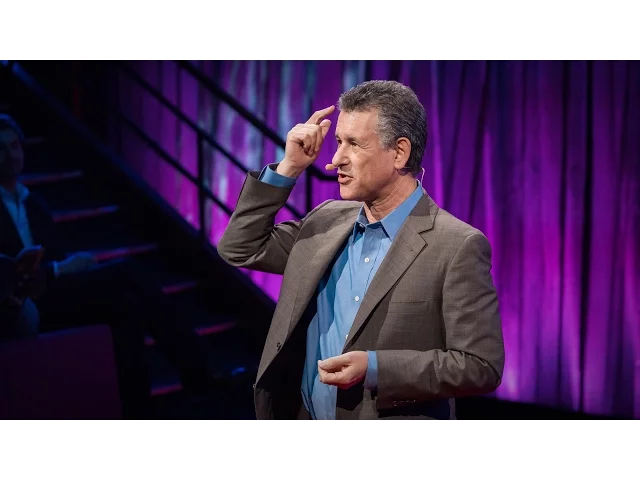
How to stay calm when you know you'll be stressed | Daniel Levitin | TED
TED
0:13 A few years ago, I broke into my own house.
0:16 I had just driven home, it was around midnight in the dead of Montreal winter,
0:20 I had been visiting my friend, Jeff, across town,
0:23 and the thermometer on the front porch read minus 40
0:26 degrees— and don't bother asking if that's Celsius or Fahrenheit,
0:30 minus 40 is where the two scales meet— it was very cold.
0:34 And as I stood on the front porch fumbling in my pockets,
0:37 I found I didn't have my keys.
0:40 In fact, I could see them through the window,
0:42 lying on the dining room table where I had left them.
0:45 So I quickly ran around and tried all the other doors and windows,
0:48 and they were locked tight.
0:50 I thought about calling a locksmith— at least
0:52 I had my cellphone, but at midnight,
0:54 it could take a while for a locksmith to show up, and it was cold.
1:00 I couldn't go back to my friend Jeff's house for the night
1:03 because I had an early flight to Europe the next morning,
1:05 and I needed to get my passport and my suitcase.
1:08 So, desperate and freezing cold,
1:10 I found a large rock and I broke through the basement window,
1:14 cleared out the shards of glass, I crawled through,
1:17 I found a piece of cardboard and taped it up over the opening,
1:21 figuring that in the morning,
1:22 on the way to the airport, I could call my contractor and ask him to fix it.
1:26 This was going to be expensive,
1:28 but probably no more expensive than a middle-of-the-night locksmith,
1:31 so I figured, under the circumstances, I was coming out even.
1:36 Now, I'm a neuroscientist by training and I know
1:40 a little bit about how the brain performs under stress.
1:43 It releases cortisol that raises your heart rate,
1:46 it modulates adrenaline levels and it clouds your thinking.
1:51 So the next morning, when I woke up on too little sleep,
1:55 worrying about the hole in the window,
1:58 and a mental note that I had to call my contractor,
2:01 and the freezing temperatures, and the meetings I had upcoming in Europe,
2:05 and, you know, with all the cortisol in my brain, my thinking was cloudy,
2:10 but I didn't know it was cloudy because my thinking was cloudy.
2:13 (Laughter) And it wasn't until I got to the airport check-in counter,
2:18 that I realized I didn't have my passport.
2:20 (Laughter) So I raced home in the snow and ice, 40 minutes,
2:26 got my passport, raced back to the airport, I made it just in time,
2:30 but they had given away my seat to someone else,
2:32 so I got stuck in the back of the plane,
2:35 next to the bathrooms, in a seat that wouldn't recline, on an eight-hour flight.
2:39 Well, I had a lot of time to think during those eight hours and no sleep.
2:43 (Laughter) And I started wondering, are there things that I can do,
2:47 systems that I can put into place, that will prevent bad things from happening?
2:51 Or at least if bad things happen,
2:53 will minimize the likelihood of it being a total catastrophe.
2:59 So I started thinking about that, but my thoughts
3:01 didn't crystallize until about a month later.
3:03 I was having dinner with my colleague, Danny Kahneman, the Nobel Prize winner,
3:07 and I somewhat embarrassedly told him about having broken my window,
3:10 and, you know, forgotten my passport, and Danny shared with me that he'd
3:15 been practicing something called prospective hindsight.
3:19 (Laughter) It's something that he had gotten from the psychologist Gary Klein,
3:24 who had written about it a few years before, also called the pre-mortem.
3:28 Now, you all know what the postmortem is.
3:30 Whenever there's a disaster,
3:31 a team of experts come in and they try to figure out what went wrong, right?
3:36 Well, in the pre-mortem, Danny explained,
3:38 you look ahead and you try to figure out all the things that could go wrong,
3:42 and then you try to figure out what
3:44 you can do to prevent those things from happening, or to minimize the damage.
3:48 So what I want to talk to you about today are some
3:52 of the things we can do in the form of a pre-mortem.
3:55 Some of them are obvious, some of them are not so obvious.
3:58 I'll start with the obvious ones.
3:59 Around the home, designate a place for things that are easily lost.
4:05 Now, this sounds like common sense, and it is,
4:09 but there's a lot of science to back this up,
4:12 based on the way our spatial memory works.
4:15 There's a structure in the brain called the hippocampus,
4:18 that evolved over tens of thousands of years,
4:21 to keep track of the locations of important things— where the well is,
4:26 where fish can be found, that stand of fruit trees,
4:30 where the friendly and enemy tribes live.
4:32 The hippocampus is the part of the brain
4:34 that in London taxicab drivers becomes enlarged.
4:38 It's the part of the brain that allows squirrels to find their nuts.
4:41 And if you're wondering, somebody actually did the experiment where they
4:45 cut off the olfactory sense of the squirrels,
4:47 and they could still find their nuts.
4:49 They weren't using smell, they were using the hippocampus,
4:52 this exquisitely evolved mechanism in the brain for finding things.
4:57 But it's really good for things that don't move around much,
5:01 not so good for things that move around.
5:03 So this is why we lose car keys and reading glasses and passports.
5:07 So in the home, designate a spot for your keys— a hook by the door,
5:11 maybe a decorative bowl.
5:13 For your passport, a particular drawer.
5:15 For your reading glasses, a particular table.
5:18 If you designate a spot and you're scrupulous about it,
5:21 your things will always be there when you look for them.
5:24 What about travel?
5:25 Take a cell phone picture of your credit cards, your driver's license,
5:29 your passport, mail it to yourself so it's in the cloud.
5:32 If these things are lost or stolen, you can facilitate replacement.
5:37 Now these are some rather obvious things.
5:39 Remember, when you're under stress, the brain releases cortisol.
5:43 Cortisol is toxic, and it causes cloudy thinking.
5:46 So part of the practice of the pre-mortem is to recognize
5:49 that under stress you're not going to be at your best,
5:53 and you should put systems in place.
5:55 And there's perhaps no more stressful a situation than
5:58 when you're confronted with a medical decision to make.
6:02 And at some point, all of us are going to be in that position,
6:05 where we have to make a very important decision about
6:08 the future of our medical care or that of a loved one,
6:11 to help them with a decision.
6:12 And so I want to talk about that.
6:14 And I'm going to talk about a very particular medical condition.
6:17 But this stands as a proxy for all kinds of medical decision-making,
6:21 and indeed for financial decision-making,
6:23 and social decision-making— any kind of decision you have to make
6:27 that would benefit from a rational assessment of the facts.
6:31 So suppose you go to your doctor and the doctor says,
6:34 "I just got your lab work back, your cholesterol's a little high." Now,
6:39 you all know that high cholesterol is
6:42 associated with an increased risk of cardiovascular disease,
6:46 heart attack, stroke.
6:47 And so you're thinking having high cholesterol isn't the best thing,
6:51 and so the doctor says, "You know, I'd like to give you
6:53 a drug that will help you lower your cholesterol,
6:56 a statin." And you've probably heard of statins,
6:59 you know that they're among the most widely prescribed drugs in the world today,
7:03 you probably even know people who take them.
7:05 And so you're thinking, "Yeah!
7:06 Give me the statin." But there's a question you should ask at this point,
7:10 a statistic you should ask for that most doctors don't like talking about,
7:14 and pharmaceutical companies like talking about even less.
7:18 It's for the number needed to treat.
7:21 Now, what is this, the NNT?
7:23 It's the number of people that need to take a drug
7:26 or undergo a surgery or any medical procedure before one person is helped.
7:31 And you're thinking, what kind of crazy statistic is that?
7:34 The number should be one.
7:35 My doctor wouldn't prescribe something to me if it's not going to help.
7:39 But actually, medical practice doesn't work that way.
7:41 And it's not the doctor's fault, if it's anybody's fault,
7:44 it's the fault of scientists like me.
7:46 We haven't figured out the underlying mechanisms well enough.
7:48 But GlaxoSmithKline estimates that 90 percent of the drugs
7:53 work in only 30 to 50 percent of the people.
7:56 So the number needed to treat for the most widely prescribed statin,
8:00 what do you suppose it is?
8:02 How many people have to take it before one person is helped?
8:05 300.
8:07 This is according to research by research
8:09 practitioners Jerome Groopman and Pamela Hartzband,
8:12 independently confirmed by Bloomberg.com.
8:14 I ran through the numbers myself.
8:17 300 people have to take the drug for a year before one heart attack,
8:21 stroke or other adverse event is prevented.
8:24 Now you're probably thinking, "Well, OK,
8:26 one in 300 chance of lowering my cholesterol.
8:28 Why not, doc?
8:29 Give me the prescription anyway." But you
8:31 should ask at this point for another statistic,
8:33 and that is, "Tell me about the side effects." Right?
8:36 So for this particular drug,
8:37 the side effects occur in five percent of the patients.
8:41 And they include terrible things— debilitating muscle and joint pain,
8:46 gastrointestinal distress— but now you're thinking, "Five percent,
8:49 not very likely it's going to happen to me,
8:51 I'll still take the drug." But wait a minute.
8:54 Remember under stress you're not thinking clearly.
8:56 So think about how you're going to work through this ahead of time,
8:59 so you don't have to manufacture the chain of reasoning on the spot.
9:02 300 people take the drug, right?
9:04 One person's helped,
9:05 five percent of those 300 have side effects, that's 15 people.
9:09 You're 15 times more likely to be harmed by the drug
9:13 than you are to be helped by the drug.
9:16 Now, I'm not saying whether you should take the statin or not.
9:19 I'm just saying you should have this conversation with your doctor.
9:22 Medical ethics requires it, it's part of the principle of informed consent.
9:26 You have the right to have access to this kind of information
9:29 to begin the conversation about whether you want to take the risks or not.
9:33 Now you might be thinking I've pulled
9:35 this number out of the air for shock value,
9:37 but in fact it's rather typical, this number needed to treat.
9:40 For the most widely performed surgery on men over the age of 50,
9:45 removal of the prostate for cancer, the number needed to treat is 49.
9:50 That's right, 49 surgeries are done for every one person who's helped.
9:54 And the side effects in that case occur in 50 percent of the patients.
9:59 They include impotence, erectile dysfunction,
10:01 urinary incontinence, rectal tearing, fecal incontinence.
10:06 And if you're lucky, and you're one of the 50 percent who has
10:09 these, they'll only last for a year or two.
10:12 So the idea of the pre-mortem is to think ahead of time to the questions
10:17 that you might be able to ask that will push the conversation forward.
10:21 You don't want to have to manufacture all of this on the spot.
10:24 And you also want to think about things like quality of life.
10:27 Because you have a choice oftentimes,
10:29 do you I want a shorter life that's pain-free,
10:31 or a longer life that might have a great deal of pain towards the end?
10:35 These are things to talk about and think about now,
10:37 with your family and your loved ones.
10:39 You might change your mind in the heat of the moment,
10:42 but at least you're practiced with this kind of thinking.
10:45 Remember, our brain under stress releases cortisol,
10:49 and one of the things that happens at that moment
10:52 is a whole bunch on systems shut down.
10:54 There's an evolutionary reason for this.
10:56 Face-to-face with a predator, you don't need your digestive system,
10:59 or your libido, or your immune system,
11:02 because if you're body is expending metabolism
11:04 on those things and you don't react quickly,
11:07 you might become the lion's lunch, and then none of those things matter.
11:11 Unfortunately, one of the things that goes out
11:14 the window during those times of stress is rational,
11:17 logical thinking, as Danny Kahneman and his colleagues have shown.
11:22 So we need to train ourselves to think ahead to these kinds of situations.
11:27 I think the important point here is recognizing that all of us are flawed.
11:33 We all are going to fail now and then.
11:36 The idea is to think ahead to what those failures might be,
11:40 to put systems in place that will help minimize the damage,
11:44 or to prevent the bad things from happening in the first place.
11:48 Getting back to that snowy night in Montreal, when I got back from my trip,
11:52 I had my contractor install a combination lock next to the door,
11:56 with a key to the front door in it, an easy to remember combination.
12:00 And I have to admit, I still have piles of mail that haven't been sorted,
12:04 and piles of emails that I haven't gone through.
12:07 So I'm not completely organized,
12:09 but I see organization as a gradual process, and I'm getting there.
12:13 Thank you very much.
12:14 (Applause)