Historic Weapons & Artefacts Worth Thousands That Stunned Experts and Owners | Antiques Roadshow UK
BBC Antiques Roadshow
0:01 You're joking!
0:04 I'm astonished.
0:05 That's fantastic.
0:06 Great.
0:07 Lovely.
0:07 Thank you very much.
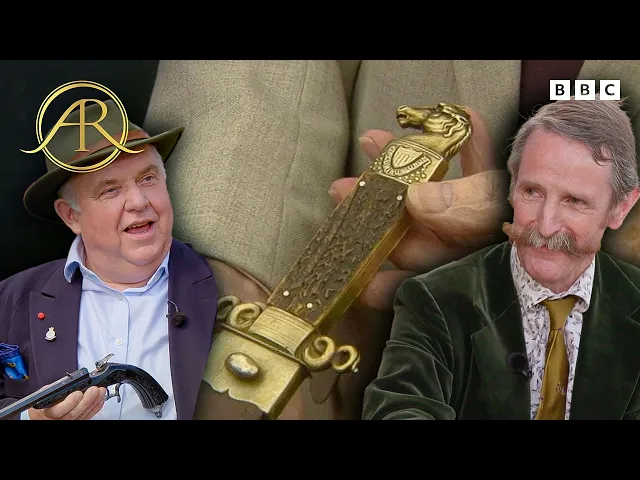
0:09 You know, I'm most amazed to see an American knife here today like this.
0:14 This particular knife is very, very sought after by American collectors.
0:20 How long have you had it?
0:22 50 years.
0:23 About 50 years in the family?
0:24 Mm-hmm.
0:25 Right.
0:25 Well, here we have the American eagle.
0:29 And on the other side, the motto,
0:31 which you often see on American coins, "E pluribus unum".
0:37 It's a Bowie knife, of course.
0:40 And there's the typical shaped Bowie,
0:43 named after James Bowie, who carried a very similar knife.
0:46 And so all these knives with clipped-back blades are known as Bowie knives.
0:51 But the Americans do like their own knives,
0:53 and this is very much an American knife.
0:56 Many Bowie knives were made in Sheffield,
0:59 and they were shipped through the Hudson's
1:02 Bay Company for trappers and hunters in America.
1:06 But this is an American-made one.
1:08 And of course, very, very desirable in the American knife market.
1:13 And I think you might be surprised to know it has a value of about £3,000.
1:22 You're joking!
1:23 No, and possibly more.
1:25 This is interesting.
1:26 This is a pass for Lieutenant LH Massey of the Inter-Services Research Bureau.
1:33 It's interesting because the Inter-Services Research Bureau didn't exist.
1:38 Indeed it didn't.
1:39 When my father was told to report to the headquarters
1:42 of the Inter-Services Research Bureau in Baker Street in London,
1:45 he was given that pass and told he'd joined the organisation,
1:49 but not what it was or what it did.
1:52 He was then taken into another room where there
1:54 were some senior officers who told him that, in fact,
1:56 Inter-Services Research Bureau,
1:58 which he'd never heard of, was the cover name for SOE,
2:02 Special Operations Executive, which he'd also never heard of.
2:05 But that that was really the organisation he was
2:07 going to be working for, in the Polish section.
2:11 Churchill was instrumental in forming the SOE.
2:14 It was formed in about 1940.
2:17 Now, presumably as an officer, he then had to buy all his own kit.
2:22 I'm assuming he bought this Fairbairn-Sykes fighting dagger,
2:26 for which he went to Wilkinson Sword and paid 16 shillings for it.
2:32 My father knew Lieutenant Sykes and worked with him in SOE.
2:37 Almost the first thing my father had to do on joining
2:40 the organisation was to go and do the commando training course at Arisaig,
2:44 in the western Highlands of Scotland.
2:46 His own job was going to be to train Polish volunteers who
2:50 were going back into Poland to join their version of the Resistance,
2:54 the AK, the Home Army.
2:56 But before he could do that, he had to do the course himself.
2:59 I'm going to be technical for a bit here.
3:01 This is a first pattern, third type.
3:06 First ones had a three-inch wavy crossguard.
3:09 They got rid of that, it snagged on everything.
3:12 Second type had a square ricasso here.
3:18 And this is a third type.
3:19 The blade goes straight in.
3:22 Now, if you look at another one of these, you'd
3:25 be quite lucky because they didn't make very many of them.
3:28 A few thousand, at the absolute outside.
3:31 They're all slightly different.
3:34 Because each one of those was handmade by the people at Wilkinson,
3:39 and they would hand-grind the blades on a great big stone.
3:44 It was handled by Sykes out of Fairbairn and Sykes.
3:51 With that, I would put £5,000 on that.
3:56 I'm astonished.
3:57 It's the most amazing thing.
4:00 Handled by the guy who invented it.
4:03 That has absolutely, totally made my day.
4:06 That is just a wonderful, wonderful thing.
4:09 This is one of the earliest firearms that we've ever had on the Roadshow.
4:13 It's a blunderbuss and it dates from about 1680.
4:16 And I wonder if you know what it was used for?
4:19 I've been told it's a turnpike gun.
4:21 So if people don't pay their tolls, that's what they'd get.
4:24 It's a sort of 17th century equivalent of the congestion charge then?
4:28 And if they heard the shot, they're still alive.
4:30 Yes.
4:31 Yeah.
4:31 Well, it could well be used on a turnpike,
4:35 but my view is that it's so big that it's actually for the defence of a ship.
4:40 OK.
4:40 And it's the sort of thing that would have been rushed out of the arms
4:42 chest to deal with boarders trying to get over the sides of the gunwales.
4:46 Or also, when two ships came together in an action
4:49 and boarders were trying to go from both sides,
4:51 then somebody could stay on one side and cover
4:53 his colleagues with this by shooting into them.
4:55 You could also put somebody up in one of the fighting tops,
4:57 actually shooting down with it.
5:00 So it's a blunderbuss and that's a firearm which fires a large charge of shot.
5:07 This would take something like about four or five ounces.
5:10 So there's a lot of pellets in there.
5:13 And they weren't loaded, as is popularly believed,
5:16 with bits of broken metal and anything that you could find.
5:19 But they were carefully cast little bullets, about the size of peas,
5:22 which were known as swan drops because they were for shooting wildfowl.
5:25 Yeah.
5:27 Now we can tell it's a very early gun because of the form of the lock.
5:31 And the whole of the lock is very,
5:34 very flat because it's been cut from solid sheets rather than forged.
5:38 But the thing which is the real giveaway is this little catch on the back.
5:43 Dog lock.
5:44 A dog lock as you rightly say, yes.
5:46 It's a sort of early form of safety catch.
5:48 And that held the cock in that position until you were ready to fire it,
5:52 so that you could keep it loaded and ready for any alarms or excursions.
5:57 OK.
5:58 Now, do you know who made it?
5:59 I've been told Godfrey Taylor.
6:01 That's absolutely right.
6:02 I don't know much about him.
6:04 Taylor spanned the last half, really, of the 17th century.
6:09 He was apprenticed in 1658 to a chap called John Silke.
6:13 And then in 1666, when he'd done his seven years,
6:17 he was free of the Gunmakers' Company,
6:18 which meant that he was allowed to work as a journeyman, a workman,
6:21 and go and earn his own wages, and work for who he pleased.
6:24 1682, he's elected an assistant of the Gunmakers' Company.
6:28 And in 1690 and 1699, he was the master of it.
6:32 So he was the leader of this very important livery company
6:36 in the City of London at a time of great interest in our history.
6:41 Constitutional monarchy was starting to come in, Pepys has died.
6:44 An absolutely wonderful period,
6:46 and it's amazing to think that this firearm was around at that time.
6:51 Now, this is a very,
6:52 very early firearm from the sort of real beginnings of the British gun trade.
6:55 And have you given any thought to what you think it might be worth?
6:59 Well, my friend bought it about 15 years
7:02 ago off an antiques dealer for £750, so...
7:06 I think he had a bargain.
7:06 Let's put a nought on it and say £7,500.
7:10 On a really good day, it would probably do better than that.
7:12 Because it's from this absolutely wonderful period of our history
7:16 and it's also at the beginning of the gun trade.
7:18 And frankly, you don't get them as big as this.
7:21 If I was given the choice of taking the money or opening the box,
7:26 faced with a lovely box like this, I would always open this.
7:29 Because I think this is going to contain something very special.
7:34 It's a box of the very highest quality, made from ebony with brass inlay.
7:39 There are two border lines, escutcheon.
7:42 And to protect it whenever the butler drops it, there's brass-bound corners.
7:48 So let's open it up.
7:50 And my choice would have been absolutely correct.
7:52 There is a wonderful pair of pistols in here.
7:56 Have you had any thoughts what these were originally made for?
7:59 Well, I thought perhaps they were for duelling,
8:02 or perhaps they were for target shooting.
8:05 I think they're a bit small for duelling,
8:07 on the basis that the barrels are only 7mm in diameter.
8:13 If you look at duelling pistols, they tend to be half inch and larger.
8:17 You're absolutely right, they are for target shooting,
8:19 but they're for indoor target shooting.
8:21 Really?
8:22 And they're called saloon pistols because that's
8:23 where they use them, in the saloon.
8:25 Well, when I saw them,
8:26 I thought how extraordinary was the method of hitting the cartridge.
8:31 Instead of a pin, it was a line across the cartridge at the back.
8:35 Yes, that's done for a special reason.
8:37 If I take one out and cock it...
8:41 ..you can see the striker runs the whole way across there.
8:44 Now that is so that it hits the little
8:47 7mm cartridge in two places along its rim.
8:50 And if you hit it twice, there's a pretty good chance it's going to go off.
8:54 The rimfire cartridge was invented in 1845 by Nicolas Flobert.
8:59 Right.
9:00 And that is an original cartridge for it.
9:04 Oh, right.
9:05 So you can see it's very, very tiny.
9:07 Have you any idea how old they might be and where they were made?
9:10 Well, I don't think they were made in this country,
9:12 but they look continental to me.
9:14 But I'm not quite sure.
9:15 I think you're absolutely right.
9:16 They are continental.
9:18 They are Belgian.
9:19 They were made in Liège.
9:20 Oh, right.
9:21 And they are about 1875, that sort of era.
9:25 These pistols are of really the highest quality.
9:30 They've got ebony stocks, the barrels are blued,
9:33 and there's a little tiny bit of silver and gold inlaid foliage on the breech.
9:37 And they are just wonderful, beautiful-quality things.
9:40 They can be owned by anybody, without a licence.
9:43 And I think if these appeared at auction, they would do £5,000 very easily.
9:50 And on a really good day, they might do £10,000.
9:52 Wow.
9:53 That's fantastic.
9:54 I think they're fantastic.
9:55 Well, thank you very much indeed.
9:57 It's been my pleasure to see them.
9:58 So firstly, thank you for bringing me back to the city of my birth.
10:02 And secondly, thank you for bringing me
10:04 these daggers and arms and armour from ancient India.
10:07 The religious aspect to a sword is quite
10:10 important for many of the martial races of India,
10:14 and the Sikhs being one of them.
10:15 We worship weaponry and so do many of the Hindu groups.
10:19 The Rajputs, for example, worship the sword.
10:23 Can you tell me how they came into your possession?
10:26 They belonged to my dad from his collection.
10:28 He started to collect when he was in his 20s and has been collecting ever since.
10:34 There is around about 500 pieces in his collection.
10:37 When did he buy these objects?
10:39 Probably bought them around the 1980s, 1990s.
10:42 It was really the golden age of collecting.
10:45 But I know your father, and I've dealt with him over the last few years,
10:50 but I know these objects were bought probably when I was at school,
10:54 and they're wonderful.
10:56 This one, in particular, is one of my favourites.
10:58 It's a South Indian bichwa.
11:01 OK.
11:01 Bichwa translates as "scorpion sting" because of the shape of the blade.
11:07 And this bronze grip tells a story of Sati.
11:11 Sati was married to Shiva, the Hindu god Shiva.
11:14 But the father-in-law, Daksha, held a fire ceremony,
11:18 religious ceremony, and he didn't invite Shiva.
11:21 And Sati was devastated.
11:23 So she attended and threw herself on the fire in protest.
11:28 When Shiva heard, he plucked one of his dreadlocks,
11:32 threw it on the floor and up sprung Virabhadra,
11:36 who is a protagonist of the story and is pictured right here.
11:40 Virabhadra attended the ceremony and he
11:44 replaced Daksha's head with a goat's head.
11:47 Oh!
11:47 And we can see Daksha pictured very meekly with a ram's head,
11:53 and then Shiva and Sati riding at the top on Nandi, the holy bull.
11:58 But a great object.
12:00 And up here, we have a katar or a "kay-tar",
12:03 and it's a classical Indian weapon, a punch dagger.
12:07 This example is 17th century, possibly late 16th century…- OK.
12:12 Wow.
12:12 ..and it's wonderfully decorated,
12:14 with this shell guard and these two small yalis,
12:18 which are mythological creatures.
12:21 We'll move on to this piece at the bottom.
12:23 It's not a piece to be used in anger.
12:26 OK.
12:27 It's a status object or a gift.
12:28 It's 18th century, made in Carnatic in the south of India.
12:33 This being the quality it is,
12:34 must have been made as a special commission for a ruler, a maharajah.
12:41 Oh, OK.
12:41 Somebody very important.
12:42 Really a wonderful group.
12:45 And you are unlikely to be able to find anything on the market nowadays.
12:50 So your father was really collecting at the right time.
12:53 Do you know how much he paid for all the objects?
12:56 I think, in total, around £10,000.
12:59 He bought very well.
13:01 In fact, he got his investment back
13:04 right with this piece here– £8,000 to £10,000.
13:07 Wow!
13:08 The punch dagger, the katar at the top here,
13:11 a similar one was sold in a German auction a few years ago,
13:14 Approximately £30,000, £35,000…- Golly!
13:18 ..if memory serves me.
13:20 The one at the front, it's unique.
13:22 A conservative figure would be £30,000 to £40,000.
13:29 Oh!
13:30 Right!
13:31 Total value, we're looking at £70,000 to £80,000…- Wow!
13:38 ..and that's being conservative.
13:39 Great.
13:39 Lovely.
13:39 Thank you very much.
13:41 Is that what you expected?
13:43 A lot more than what I expected.
13:45 Thank you so much for bringing them along.
13:47 Thank you.