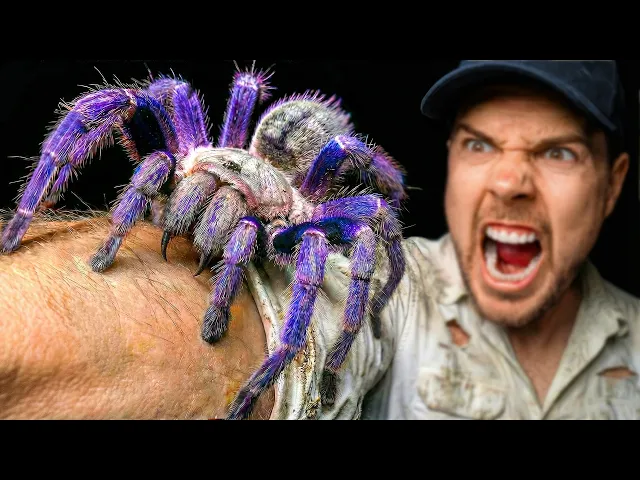
Venomous BLUE TARANTULA Caught in Asia!
Brave Wilderness Top Videos
0:08 That is a really big tarantula and it has blue legs.
0:13 [music] This is the coolest looking tarantula I have ever seen before.
0:16 This is not a spider that uh you can just pick up.
0:19 Tarantulas in Asia can be super venomous.
0:22 [music] Look at that.
0:29 This is not a spider that I would just want to hold.
0:32 A bite [music] from the spiders out here in Thailand is a totally
0:35 different ball game than the ones that we're used to handling in Arizona.
0:41 Yeah, that that time got me.
0:42 That time got me good.
0:43 But I had to take a chance so I could show you guys how cool this arachnid is.
0:47 [music] The venom from the species of tarantula out here in Thailand.
0:51 We're talking difficulty breathing, heart arhythmia, convulsions, vomiting.
0:56 Those are definitely symptoms that would send you to the hospital.
0:58 I'm going to attempt to hold the spider by the carropus
1:01 so I could show you the fangs that I'm trying to avoid.
1:05 Okay, I'm going to put it down again.
1:07 Oh jeez.
1:10 Grab my snake hook.
1:12 It is [music] so fast.
1:13 Look how Look at how it flies up.
1:16 See those fangs?
1:19 Okay, let's try again.
1:28 Oh my gosh.
1:30 All right, that took a lot of nerves.
1:34 Let's boost the lights.
1:36 It's chewing on that stick.
1:38 This spider wouldn't even hesitate for a second to put a bite on me.
1:41 And its venom be a whole lot worse than a beast thing.
1:47 Wow.
1:48 All right, I'm going to carefully put it down and we're
1:51 going to head out there and continue our search for scorpions.
1:59 Oh, that's a bark scorpion right there.
2:01 Leaf lurk.
2:02 I'm going to use these tweezers to pick the scorpion
2:04 out and then I'll get a safe grasp on the stinger.
2:09 Oh.
2:10 Oh no.
2:14 I think I lost it, guys.
2:15 Gosh, I thought that was going to be the easiest pick of all time.
2:18 They're super fast.
2:19 Seeing a scorpion doesn't mean catching a scorpion.
2:22 Let's keep moving and see if we can find another one.
2:26 Here's a big wood pile.
2:28 This is a great spot.
2:30 So, bark scorpions like to live under bark or under logs.
2:34 I want to search this log pile really well.
2:38 Oh, I saw one.
2:40 I think there's one right underneath this piece of wood.
2:44 Yep.
2:45 Right there.
2:48 Whoa.
2:48 Check that out.
2:50 Okay, let's try again for another grab with the tweezers.
2:53 Okay, here we go.
2:58 One, two, three.
3:02 Got it.
3:03 Got it.
3:04 Got it.
3:04 Got it.
3:04 Yes.
3:05 Yes.
3:05 Yes.
3:07 This is why I wanted to use tweezers first.
3:11 Look at how small the tip of that tail is.
3:13 And as you grab that tail just a a little bit off, you're taking a sting.
3:18 Dangerous little game of operation here.
3:20 [music] And look at that.
3:29 Look at how much it lights up.
3:30 It's like highlighter fluorescent.
3:32 [music] And that's the only way I would have ever seen the scorpion.
3:35 Now, don't let the size fool you guys.
3:38 the locals here in Thailand that this is a scorpion they fear.
3:41 And that's [music] why I'm going to get out the sting table and intentionally be
3:45 stung by the Thai ar scorpion to see just how potent it sting truly is.
3:50 All right, we're setting up for the sting.
3:53 It's daylight.
3:54 We have our bark scorpion getting the table out.
3:57 But man, guys, I am I'm pretty nervous.
4:00 Bark scorpions are, at least where we're from, a very serious thing.
4:05 And I did some homework last night,
4:07 some research into the severity of the tiebark scorpion.
4:10 I really couldn't find much of anything.
4:11 So, this is truly going to be an experiment into the unknown of scorpion stings.
4:16 Time to set up the sting table.
4:18 This table's been around the world seen its fair share of carnage.
4:24 How are you feeling?
4:25 Uh, I'm getting nervous.
4:26 Let's uh get out one more piece of equipment.
4:32 Epi pen.
4:33 Don't leave home without it.
4:35 Okay, so there [music] we have it.
4:37 The bark scorpion.
4:39 Let me tell you why I'm getting nervous about being stung by this species.
4:44 The general rule is the smaller the pinchers, the more potent the venom.
4:49 The larger the pinchers, the less potent the venom.
4:52 And that has to do a lot with how these animals are eating their food.
4:55 If you have big pinchers and you can put
4:57 your prey into submission just by brute [music] force,
5:00 you're not going to need a venom that's that potent.
5:02 But if you have thin tiny pinchers like this scorpion,
5:06 you're [music] going to need the venom to do most of the work.
5:08 So this species of bark scorpion has very thin and tiny pinchers,
5:13 which leads me to believe the venom and it's going to hurt a lot.
5:17 Oh man, I'm starting to sweat.
5:18 I don't know if that's the sun coming
5:20 out or it's my nerves starting to fire off,
5:23 but I am getting getting a little dry mouth here.
5:26 Let me get a get a sip of my Summit Adventure fuel.
5:31 I got to stay hydrated.
5:34 It is hot, hot, hot out here in Thailand.
5:37 All right, it is go time with the bark scorpion.
5:41 I'm going to rate the sting on three different factors.
5:43 Intimidation, pain of the sting, and of [music] course, the aftermath.
5:47 If this bark scorpion is anything like the bark scorpions in North America,
5:51 the aftermath could quite [music] possibly be
5:53 its biggest score out of all three factors.
5:56 But it's time it's time to get into it.
5:58 So, here's how it's going to go down.
5:59 I'm going to take the scorpion out of the capsule.
6:02 I'm going to hold its tail with the tweezers.
6:04 I'm going to use my finger to take the sting.
6:07 I'm going to release the tail.
6:08 Bang, bang, bang.
6:09 I'll put it back in the capsule and then I think you can guess [music] the rest.
6:14 But I'll try to endure the pain and then
6:16 tell you exactly what the experience is like.
6:19 It's time to enter the sting zone with the bark scorpion.
6:20 Let's get it out of the capsule.
6:25 Now, I don't want to lose it.
6:27 If it gets off this table, it's going to be bad news.
6:37 Okay.
6:37 Okay.
6:38 We got to go fast.
6:38 We got to go fast.
6:39 Everything in my brain right [music] now is screaming,
6:43 "Don't do this." And that is a really
6:46 good instinct for everyone at home to follow.
6:49 Never intentionally do anything like this.
6:51 Hopefully by me going through this wall,
6:54 learn what we need to know about the sting of this tiny bark scorpion.
7:02 I'm Mark Vens and I'm about to enter the sting
7:05 zone with the dreaded bark scorpion of Tyler on three.
7:13 One, two, three.
7:23 Oh, wow.
7:26 Oh my gosh.
7:28 Where is he?
7:28 Where'd he go?
7:29 Wow.
7:30 Oh my gosh, guys.
7:31 That was like a lightning bolt.
7:35 Trying to find him.
7:36 I'm losing him.
7:36 I'm losing him.
7:37 There he is.
7:38 All right.
7:39 Ah.
7:40 Wow.
7:42 Oh, talk to me, Mark.
7:43 What?
7:43 What do you think?
7:44 Hang on.
7:45 Uh-uh.
7:47 Oh.
7:49 Oh.
7:51 Ow.
7:54 Yeah.
7:55 Oh.
7:58 You okay?
8:06 It's bad.
8:07 [sighs and gasps] Wow.
8:11 Instant instant pain.
8:14 Instant pain.
8:18 Oh gosh.
8:18 I'm like getting like Whoa.
8:19 Whoa.
8:20 You okay?
8:20 It burns so bad, dude.
8:22 It burns.
8:27 See how red it's getting?
8:30 Ah, it's hot.
8:32 Pain.
8:32 It's hot.
8:33 It's hot.
8:34 Stings radiating all through this finger and it's spreading.
8:38 I can feel it coming up my finger.
8:42 Wow.
8:42 [snorts] It's like electrical shocks, man.
8:50 [sighs and gasps] Wow.
8:52 This is going to be a whopper of a score.
8:55 Let's go to the BSI and see where
8:57 the Bark Scorpion of Thailand ranks on the index.
9:00 Here we go.
9:01 On intimidation, the Taibark scorpion's uncanny resemblance to the fearsome
9:05 Arizona bark scorpion set my nerves on fire.
9:08 My experience with that scorpion still ranks at number
9:11 two all time on the Brave Wilderness Bitsting Index.
9:14 Knowing that I might be in for my worst sting yet,
9:16 I give the Thai bark scorpion a 9 out of 10.
9:20 For pain, the sting of this scorpion was shockingly painful.
9:23 My hand immediately lit up with hot electrical pain.
9:27 And just like the Arizona bark scorpion,
9:29 it delivered this brutal sting extremely fast.
9:32 A sign that the venom is extraordinarily potent.
9:35 I have to give the pain rating a 9.5 out of 10.
9:39 The aftermath of this sting was interesting.
9:41 The sting site burned afterwards [music] and was clearly irritated,
9:44 but it didn't cause much swelling.
9:46 And while the hours and days that followed were very painful,
9:49 it was nowhere near the Arizona bark scorpion.
9:52 So, this one only earns an 8 out of 10 for the aftermath.
9:56 All things considered, the Tai Bark Scorpion [music] earns an 8.8 out of 10,
10:00 rightfully ranking high on the list of the Brave Wilderness Bite Sting Index,
10:04 but falling short of the mighty Arizona bark Scorpion.
10:13 Whoa, we got a rattlesnake right there.
10:14 You see it coiled up right there.
10:17 Back up a little bit, guys.
10:18 That is a western Diamondback rattlesnake.
10:19 Now, it is not a big one.
10:20 This is a juvenile, but it is still capable of inflicting a very serious bite.
10:26 Can use a snake hook to move snakes out of our way.
10:29 Just like this.
10:31 [music] Let the snake go.
10:34 And we keep searching for spiders.
10:36 [music] Yes, it's a great sign that we're
10:38 seeing all these venomous creatures out on the hunt.
10:40 This desert is coming alive.
10:42 Put a scorpion right at your foot.
10:44 Look at this desert hairy scorpion right there.
10:47 See if I can grab it.
10:48 [music] Best way to do this is just to grab
10:50 right at the top knuckle so it can't sting me.
10:53 See if we can get him to calm down.
10:54 Stay.
10:54 Stay buddy.
10:55 Stay buddy.
10:55 Come on.
10:56 There we go.
10:57 That's good.
11:04 Oh yeah, he's pinching me.
11:05 All right, here we go.
11:07 See show you what we got here.
11:09 That is a pretty good size giant desert hairy scorpion.
11:13 The largest species of scorpion in the United States.
11:16 Luckily, I've got a good grip on its stinger there.
11:19 But you can see there's even a little bit
11:21 of venom starting to come out of the tip of it.
11:23 If you [music] don't grab these guys correctly,
11:26 they will give you a pretty good pop.
11:28 You can see why they call them the desert hairy.
11:30 Look at all the hairs all over its body.
11:32 Doesn't get much cooler than these [music] large scorpions.
11:35 All right, let's put them back and keep looking for those tarantulas.
11:40 Scorpions and tarantulas are out here hunting the same food.
11:43 I have a feeling we're closing in on our giant spider.
11:53 Oh, I got a spider right there.
11:56 Let's go.
11:57 All right, I got my container.
11:58 Let's see if we can get a catch.
11:59 Okay, it's holes right here.
12:01 Going to need to move in carefully.
12:06 That is a big male.
12:11 Oh no, I lost it.
12:14 Hang on.
12:15 Hang on.
12:15 Maybe I can cos it back out.
12:17 Oh no.
12:19 Ah, lost it.
12:21 Wait.
12:21 Hang on.
12:22 It's still there.
12:24 Got it back.
12:25 I got it back.
12:29 Snake hook is coming in clutch.
12:32 Okay.
12:32 Co this direction.
12:34 See it rearing its abdomen up.
12:37 Okay.
12:38 Oh, just bit the snake hook.
12:39 Here we go, guys.
12:41 Got it.
12:42 Got it.
12:43 Here we go.
12:49 Oh, buddy.
12:50 That is a good one.
12:52 Big male desert blonde tarantula.
12:56 After a little bit of searching and a little bit of luck,
12:59 then we brought the snake hook.
13:01 We got ourselves our tarantula for the bite test.
13:05 All right, I'll tie it back in.
13:06 Let's go, guys.
13:08 Yes.
13:08 As fate would have it,
13:09 as we were heading back to start setting up for the bite test,
13:12 we saw an even bigger spider.
13:15 Oh, another tarantula.
13:16 This one looks bigger.
13:17 Oh, yeah.
13:18 Okay, let's try to catch this one, too.
13:20 All right.
13:20 I don't know how close it is to its hole, but I'm going to go in for the catch.
13:22 Here we go.
13:23 Holy cow, that is a huge freaking spider, guys.
13:27 Wow.
13:31 [laughter] [laughter] That is the specimen we have been after.
13:42 That is a truly huge tarantula.
13:45 [music] I did not expect this.
13:48 Not one but two huge desert blonde tarantulas.
13:53 What we have here are a male and a female.
13:57 And unfortunately for me, I think this video just turned from a tarantula
14:00 bite test to a tarantula bite comparison.
14:03 And I'm sure you are as curious as I am
14:05 which of these two spiders has the more painful bite.
14:08 It's time to find out.
14:09 I am definitely nervous.
14:12 Oh man.
14:17 Oh my goodness.
14:18 Two full-grown desert blonde tarantulas and the table is now set
14:25 for the ultimate spider bite test here in the Sonora Desert.
14:30 I'm not going to sugarcoat it.
14:31 What I'm about to do is a bad idea.
14:34 Please do not attempt to recreate what you're about to see in this video.
14:38 We [music] have two tarantulas here in front of us.
14:41 We have a male and the female, which we found unexpectedly.
14:45 [music] I think it is worth doing a bite test comparison to see which
14:50 bite is more ferocious because these spiders
14:53 live very different lives from each other.
14:55 [music] Females actually live for a lot longer.
14:57 We're talking 25 years for a female tarantula and only 5 to 10 years for a male.
15:03 Females tend to bunker down.
15:05 They stay a lot more localized to their nests
15:08 where the males are much more nomadic and predatory.
15:11 I have a suspicion that we have a very different bite profile
15:14 to these two spiders and we are going to put that to the ultimate test.
15:17 Let's take a closer look at Arizona's largest spider.
15:21 Ladies first.
15:22 In order to get some really good footage of the spider,
15:25 I'm going to move it into this glass dome.
15:27 And of course, we don't want our spider to get away.
15:32 All right.
15:33 Delicate little procedure here.
15:35 Wow.
15:41 There we go.
15:41 Perfect.
15:42 Perfect.
15:44 Perfect transfer.
15:45 Oh my goodness.
15:47 The fangs on these spiders are enormous.
15:51 It's not just going to be the venom that I'm up against today.
15:54 We're talking actual puncture wounds from fangs that large
15:57 in terms of what they're out here hunting and eating.
16:00 Pretty much anything that they can grapple onto.
16:03 They are very strong spiders and of course possessing those large fangs.
16:07 They could subdue a variety of prey.
16:10 Even small lizards would be a good meal for a spider this size.
16:14 The females tend to be a little bit bigger [music] than the males.
16:17 They are called a desert blonde tarantula predominantly because you can see
16:22 those hairs and just how blonde they are in [music] the middle.
16:25 But that is a fullgrown desert blonde tarantula.
16:30 The best way to probably go about doing
16:32 this is for me to grab it by its carropus, the top of the head of the spider,
16:37 and I'm going to try to pin it, grab it,
16:39 [music] and then I'll be able to show you the fangs
16:42 and of course inflict the bite right here on my thumb.
16:46 All right.
16:48 Um, brought a couple things with me today.
16:50 I have large pair of tweezers.
16:52 Of course, we always bring first aid kit.
16:55 Thing I need the most is the EpiPen.
16:57 The worst outcome that can happen besides the pain
16:59 that I'm about to experience is an allergic reaction.
17:02 I think it's time to take the first of [music] two bites from a tarantula.
17:06 Okay, here we go.
17:13 Now, the females are known for being a little more docile than the males beyond.
17:21 Oh, easy girl.
17:22 Easy girl.
17:24 Back, back, back.
17:25 So, [music] you see how it's rearing its abdomen up right there.
17:27 Beyond their capability to inflict bites,
17:30 they also possess another defense mechanism,
17:33 which [music] is to flick the hairs off their abdomen.
17:36 Females are rumored to be less aggressive, but this one looks ready to bite.
17:42 And what I'm trying to do right now is to get a good hold on the carropus.
17:47 This is the safest way for me to hold it for [music] both me and the tarantula.
17:53 There we go.
17:54 Oh jeez.
17:56 Okay, that was that that made my heart go.
18:00 Okay, the spider just wants to come right at me.
18:07 Oh my gosh, did you hear that?
18:12 That is the sound of spider fangs scraping the table.
18:20 Look at the size of those fangs.
18:23 And their fangs are retractable just like a snake.
18:26 And they are thick.
18:27 We're talking some very large fangs.
18:31 Those are going to pop holes in my skin for sure.
18:35 Got to get up a lot of nerves to do this.
18:37 Okay, I've got a good grip on the spider.
18:38 I'm going to go for it.
18:40 On three.
18:41 I'm Mark Vins and I'm about to take a bite from Arizona's largest spider,
18:46 the desert blonde tarantula.
18:47 [music] On three.
18:51 One.
18:55 [music] I'm so nervous.
18:55 Two.
18:58 Three.
19:03 Spider's fangs are on my skin.
19:10 Yep.
19:10 Got me.
19:12 You can see there's a little blood right there.
19:13 Only popped one fang through.
19:16 I think I got to take a better bite, guys.
19:17 That wasn't a good enough bite.
19:19 All right, I'm going to do one more.
19:20 Ready?
19:21 On three.
19:22 One, two, three.
19:34 Yeah, that that time it got me.
19:35 That time it got me good.
19:37 Oh my god, that freaked me out.
19:42 Oh my gosh.
19:44 Okay, hang on.
19:45 Let me get the spider back.
19:47 Get back in there, girl.
19:48 Get back in there.
19:50 Ah.
19:52 Yeah.
19:53 See right there?
19:54 See that?
19:57 Definitely burns.
19:58 Oh my gosh.
19:59 My adrenaline is like firing right now, guys.
20:02 I I feel like my soul just jumped out of my body.
20:06 That is the freak.
20:07 Most freaked out I've been around an animal.
20:10 And it definitely burns.
20:12 Oh man, my neck.
20:15 Yeah, my neck is like seized up.
20:18 It's like I've got a cramp right here.
20:19 I don't know if it's from the bite
20:20 or if it's from just the nerves and the tension.
20:24 Oh my gosh.
20:26 I think it's [music] nerves.
20:28 I I don't think it's from the venom.
20:31 Definitely burns.
20:32 It's uh it's definitely a burning sensation.
20:35 I had to really try hard to get that spider to bite me.
20:38 I want to point that out that this this spider did not want to bite.
20:43 But that was not an [music] aggression bite for sure.
20:46 Okay, I think I'm I'm good enough to do another bite.
20:49 I think it's time to bring in the second tarantula and see
20:54 if the male can inflict a more [music] aggressive bite wound,
20:59 which I have a feeling that's going to happen.
21:01 Males are known to be more aggressive and that's
21:03 why I wanted to do a bite test here.
21:05 Much darker in coloration than the female, too.
21:07 Not looking forward to this.
21:10 And my hand still burns from that first bite.
21:14 Okay.
21:15 Come here.
21:16 Come here.
21:16 You come here you.
21:20 Okay.
21:21 Got a pin.
21:23 Oh my gosh.
21:24 Way stronger.
21:26 Way stronger.
21:28 Way more aggressive.
21:29 Look at it attacking.
21:36 God.
21:37 Oh boy, that was tough.
21:39 Okay, there you have it.
21:42 the male desert blonde tarantula.
21:47 Here are the fangs.
21:49 You can see just as terrifying [music] as the female spider.
21:54 And you can see there's even venom on these.
21:57 Okay, on three.
21:58 I'm about to take my second bite this time
22:01 from a male and much more aggressive desert blonde tarantula.
22:06 On three.
22:08 One, two, three.
22:14 Just waiting for the bite to come.
22:19 You see, he does not want to bite me.
22:24 It's not as angry as the female.
22:26 No.
22:26 Big reaction is that these these animals do not want to bite me.
22:31 So, while we've given this spider plenty of opportunity to inflict a bite,
22:35 [music] you can see it really has no intent to do me any harm.
22:38 And frankly, it should be a lot more afraid of me than I am of it.
22:43 So, I hope after watching this video, we all have learned some important
22:47 lessons about Arizona's [music] largest spider.
22:50 Even though these spiders are large and admittedly pretty creepy,
22:54 you really have no reason to fear them.
22:57 And honestly, their venom isn't that strong because spiders this large
23:01 tend to use their [music] strength to overtake their prey.
23:03 They don't want to bite you.
23:04 And even if they do, it's really not that bad.
23:08 All right, let's let our spiders back off into [music] the desert.
23:11 Right now, I am out tide pooling in eastern
23:13 Australia in search of the deadliest creature on the planet.
23:16 The blue ring octopus has one of the most toxic venoms on Earth.
23:20 And if we're lucky [music] enough to find one,
23:22 I'm going to attempt to touch it with my bare hands.
23:25 But first things first, let's get looking.
23:27 From experience tide pooling, the best results are usually from the edge.
23:32 The further out you can go, the better.
23:36 An octopus can change the texture of its [music]
23:38 skin and it would just look like any of these.
23:41 Now, I've struck out on all three previous
23:44 occasions trying to locate a blue ring octopus.
23:46 I'm [music] hoping fourth times a charm.
23:48 The difference this time is I'm searching with my good friend Miller Wilson,
23:51 who has seen blue rings in these tide pools before.
23:54 It's very hard to pick a octopus that's
23:56 a master [music] of camouflage out from this environment.
23:59 It's about to be low tide, and this is probably one of the most
24:02 dangerous tide pools that I have ever searched.
24:04 So, wearing some nice protective shoes, gloves.
24:09 I don't really want to handle the octopus,
24:10 but the gloves should protect me [music] just in case.
24:13 And of course, we still need to watch our steps
24:15 because if you look at this, all these rocks out here, exactly like a stonefish.
24:20 And this is stonefish territory.
24:22 The stonefish is the world's most venomous fish.
24:24 If you step on one, your boots will not protect you.
24:28 A single sting from a stonefish can be excruciating and can even be deadly.
24:36 But no octopus.
24:38 Flipping's not really doing it.
24:39 So, I'm just going to cruise to cover a lot of ground.
24:41 Looking for movement.
24:42 A lot of times I do see octopus moving from pocket to pocket,
24:45 but they slink along the surface.
24:47 So, I'm just looking for any movement right now.
24:49 Any movement.
24:50 We're getting it, though.
24:51 Feel it.
25:02 Oh my god.
25:02 I got an octopus.
25:03 I got a blue ring, guys.
25:10 It's right here.
25:18 There it is.
25:21 I missed it.
25:24 It's right in here.
25:26 It's right here.
25:28 How could I miss that?
25:31 That was it.
25:34 [music] Got it.
25:38 Oh my gosh, we got one.
25:43 Are you kidding me?
25:44 Yes.
25:46 Boom, baby.
25:47 Boom.
25:47 Yes.
25:49 Holy cow.
25:52 Miller, we're good.
25:54 We got one.
25:55 Can you help me get out of the net?
25:58 So, you'll see I'm wearing gloves, guys, for a reason right now.
26:01 This is This is a really good way to get a nip.
26:04 That is not what I want.
26:07 Put that guy in there.
26:08 The little guy.
26:09 Hey, buddy.
26:12 Let's talk about what we found.
26:14 Right there in my hand is the most dangerous animal on the planet.
26:20 At least when it comes to venom.
26:22 Nothing in the animal kingdom is more toxic than this tiny little octopus.
26:30 And yes, I am nervous about it.
26:31 [music] But before the end of this video,
26:33 I will officially touch with my bare hand
26:36 the most dangerous and toxic creature on Earth.
26:40 There are actually [music] four described varieties of blue ring octopus.
26:45 This one is the blue lined octopus.
26:48 It's the only one in the family that has
26:51 these really cool vivid blue pinstripes [music] surrounding the body.
26:56 It's almost like blue tiger stripes.
26:59 So, if this [music] animal is at all threatened here,
27:00 I want to show you what it does.
27:02 See that?
27:04 Look at those rings go.
27:09 Is that cool or what?
27:11 Oh.
27:11 Oh.
27:11 Oh.
27:12 Okay.
27:12 Stay down.
27:14 Stay down.
27:15 If the octopus [music] is at all agitated,
27:17 not only does it flare up the rings on its arms,
27:21 but those lines on its body glow.
27:24 Back up.
27:25 I'm toxic.
27:26 [music] That's your abosmatic warning.
27:28 And if you don't listen to me, I'm going to give you a nip.
27:31 And they show these vivid display warnings not only for predators,
27:36 but they also do it while they're hunting.
27:38 They will do it to confuse or [music] startle their wouldbe prey.
27:42 This is what our octopus friend here is out hunting.
27:46 This is a type of shore crab,
27:47 but this would be the perfect food for the octopus.
27:51 All right, we're going to let this crab go.
27:52 A single bite from this octopus could kill over 20 human beings.
27:59 Needless to say, if I get nipped by this creature,
28:03 that'll be the last nip I ever take.
28:06 Now, these octopus are nocturnal, [music] and they are masters of camouflage.
28:10 Its normal color pattern perfectly blends in to this silty environment.
28:15 They have three hearts that pump blue blood.
28:18 They also have nine brains.
28:21 one central brain to run the entire nervous system.
28:24 But then at the base of each arm, they have another brain.
28:27 And you can see there that little beak holds two venom sacks.
28:31 And it's actually a toxin that it
28:33 doesn't even produce itself that it actually picks
28:35 up through bacteria that it finds in the environment
28:38 through other organisms in this tide pool.
28:40 And it collects this bacteria in its saliva glands.
28:43 And when it uses its beak to bite into its prey or a predator for escape,
28:48 it will actually inject saliva into the wound.
28:51 Once this saliva enters the bloodstream, you get infected with TTX.
28:56 No animal has as lethal of a dose as the blue ring octopus does.
29:02 If you get even [music] a micro amount of TTX in your bloodstream,
29:06 all you can do is be put on life support and hope
29:09 that eventually your body works through the toxin on its own.
29:13 And here's the worst part about it.
29:14 While you might be in complete paralysis, you are lucid.
29:17 There are survivors that have lived to tell [music] the tale of having
29:21 people try to resuscitate them giving active
29:23 CPR and they weren't able to communicate, but they remember everything.
29:29 And a lot of people get bitten by these octopus because of mistaken identity.
29:33 You'll come out to a local beach in Tyel.
29:35 Guys, turn your cameras right now.
29:37 This is an active beach.
29:38 People take their dogs and kids and play on this beach.
29:41 And these animals live all along the coastline.
29:44 Now, that's not to scare you.
29:45 Obviously, we're out here actively looking for them.
29:46 They're hard to find,
29:48 but people do unfortunately come into contact
29:50 with these octopus and they will pick them up,
29:52 play with them, and in that process take a bite, which is completely painless.
29:56 By the way, initial symptoms are going to be things like [music] tingling,
30:01 difficulty breathing, difficulty thinking,
30:04 loss of your motor skills, wobbly walking.
30:07 If you think you are ever bitten by a blue
30:09 ring octopus and you start to have symptoms,
30:11 you have to be rushed to the hospital fast as you can.
30:15 We're talking like lifelight situation because you
30:17 only have a matter of minutes before your whole nervous system start to shut
30:21 down and you're no longer able to breathe.
30:24 and saying all that while holding the [music] octopus in your hand.
30:29 It's hard to remember the last time I was
30:32 this [music] nervous in the presence of an animal.
30:35 All right, the time has come for something that I've thought a lot about.
30:42 Because I know the only way that this octopus has
30:47 the ability to invenimate you is a bite with its beak.
30:51 I'm going to attempt to touch with my bare
30:54 hand the most lethal toxic animal on the planet.
30:58 In order to do that, I'm going to just dump out this water.
31:02 Look at that.
31:03 The octopus is trying to mimic the color of the cube.
31:07 Rest assured, this is just a camouflage tactic.
31:09 They are masters at this.
31:11 That octopus is still very much able to pounce and bite.
31:14 They can spend extended periods out of water.
31:17 All right.
31:17 So, just so you guys know, uh,
31:20 if this blue ring does snare me, we're going to the hospital on three.
31:26 One, two, three.
31:43 Oh, that made me nervous.
31:48 All right, lid back on.
31:50 I don't think I was just bitten now, but I'm I'm not completely sure.
31:54 I had to take a break, guys,
31:55 cuz like I'm definitely feeling a little lightheaded.
31:58 Like major anxiety.
32:01 That animal right there, if you get bit, it's game over.
32:05 It's lights out, guys.
32:08 I am like shaking right now.
32:09 Like my feet are tingling.
32:11 things that you normally wouldn't pick up on like heart rate, how I'm breathing,
32:16 tingle feeling like I'm just from like
32:18 all the adrenaline pumping through my body.
32:20 Um, and the the emotions are intense.
32:25 Super intense.
32:27 Got to shake that off.
32:28 The anxiety that I'm experiencing on camera is real as I
32:31 had almost identical symptoms to that of a blue ring bite.
32:35 While I was 99% sure I wasn't bitten,
32:38 we had to closely monitor my symptoms until
32:40 we deemed it safe enough to continue filming.
32:43 The symptoms of these bites can be subtle and can be
32:45 hard to differentiate from anxiety and panic from other sources of stress.
32:50 Please never attempt to do what you are seeing in this video.
32:53 I cannot stress enough if you are bitten [music] by a blue ring octopus,
32:57 you must seek medical attention immediately.
33:00 I think I'm all right.
33:00 I think I'm okay to continue.
33:01 Let's keep going.
33:03 Okay.
33:04 I it's been a while since I've had this kind
33:06 of reaction to being an encounter with an animal.
33:09 Like it's like my first time seeing a venomous snake.
33:12 It's like all kinds of emotions right [music] now.
33:15 Just brushing up against one in the tide pool.
33:17 Whether you're walking around, if you accidentally touch one,
33:19 you're going to be just fine.
33:20 It's like every other octopus.
33:22 The difference only occurs [music] when you
33:24 take a bite from the beak right there.
33:27 Let's let the octopus go.
33:28 I'm Mark Vins.
33:29 Be brave.
33:30 Stay wild.
33:32 We'll see you on the next adventure.
33:42 [music] [music] Welcome back to Guadalupe, Mexico,
34:00 the site of our [music] very first great white shark encounters.
34:06 Aboard the Sakura Vortex,
34:07 we traveled over 175 mi to this prehistoric island in hopes
34:12 of getting up close with the world's largest predatory shark.
34:15 Here we go.
34:18 And as millions of you witnessed, that's exactly what we did.
34:24 But what if I were to tell you that we really
34:26 didn't come all of this way for an ordinary shark cage adventure?
34:30 What if I were to tell you [music] the real reason we came
34:33 this far was to embark on the single
34:35 most daring mission we've [music] ever attempted?
34:39 Today, I will take you even closer to the most famous
34:42 set of jaws on Earth in a one-of-a-kind shark cage submarine.
34:48 By now, I'm sure everyone watching this video has
34:51 at least seen images of a great white shark before.
34:55 But have you ever seen a spock?
34:57 Probably not, because this self-propelled ocean
35:00 cage is highly experimental and can
35:03 only be piloted by one of two people in the entire world.
35:06 Now, the sharks will let us get close
35:08 in this or are they going to get close to us?
35:10 Well, both.
35:11 Yeah.
35:12 Meet Eric Haggera, our pilot for today's mission
35:15 and a worldrenowned marine biologist and ocean photographer.
35:19 So, no matter what, we're not going to sink.
35:22 Well, that's that that would be [clears throat] the second step.
35:24 That's not That's not what I wanted to hear.
35:26 Eric, [laughter] I want you to say, "Yeah, we're not going to sink."
35:28 You are in charge of monitoring your own air supply system.
35:33 I won't be able to monitor that.
35:35 If you run out of air, it's going to be your fault.
35:37 You're probably asking yourself or maybe even yelling at your screen,
35:41 why are you putting yourself in this situation?
35:44 Well, what we know of these mysterious creatures
35:46 has been limited to years of topside observation,
35:49 cage diving, and the infrequent free dive experiences
35:53 that only a few have lived to speak of.
35:56 So, this vehicle truly represents an evolution
35:58 in our understanding of the world's most famous shark,
36:02 which is also perhaps the world's most famous animal.
36:05 All right, so we had our debriefing
36:06 with Eric on the self-propelled ocean cage, aka Spock.
36:10 And I have to say, I am so excited to get
36:14 out there and in the water in this research vehicle.
36:17 This is going to be probably one of the most unique experiences you
36:20 could have with great white sharks in a safe way without free diving.
36:24 I mean, certainly someday I'd love to have
36:25 the opportunity to free dive with great white sharks,
36:27 but this is about as close as you're going to get here in Guadalupe.
36:31 And now all we need to do is go get suited up,
36:33 get our cameras ready, and get out there for some action.
36:38 As if this activity in of itself wasn't dangerous enough,
36:41 the technical nature of this dive was also quite daunting.
36:44 [music] I would need to wear a full face
36:46 regulator in order to maybe have communication with the pilot.
36:50 However, underwater comms are notoriously unreliable.
36:54 I would also be wearing a pony bottle BC in the case of an emergency
36:58 bailout in which I would need to rip off my full face rag to use it.
37:02 Not ideal.
37:04 Additionally, I would be wearing nearly 30 lb of weight without bins and I
37:09 would sink like a rock 1 ft outside the confines of the cage.
37:13 Oh, and did I mention this was an experimental craft?
37:16 The connections and critical mechanisms were all exposed
37:18 and at risk of damage from the divers.
37:21 If I were to kick one accidentally, it could prove catastrophic.
37:25 Eric is in the spock.
37:27 I'm about to get in the spock.
37:29 And then we're about to go get up close.
37:33 Okay, here we go, guys.
37:34 See you.
37:35 This was potentially the most dangerous step
37:38 of the day and potentially of my entire life.
37:44 Jump in and miss grabbing the cage, you sink fast.
37:50 This was a one-shot deal, a no miss scenario.
37:54 This wasn't just water.
37:55 It might as well have been looking off a 50story skyscraper.
38:01 This was it.
38:06 As soon as I got hold of the bar, I pulled myself into the cage.
38:11 And what had seemed roomy on the deck had suddenly shrunk,
38:15 and there was barely any room to move.
38:19 All right, I'm all set.
38:21 Ready to go.
38:23 But what was worse, my headset was silent.
38:27 The communications had already failed.
38:30 Eric and I would rely solely on hand signals for the entirety of the dive.
38:34 In a way, I was now completely on my own.
38:38 Once settled and breathing normally,
38:40 I set the cameras and gave Eric the signal to launch.
38:45 In an instant, we were off.
38:47 The rush of water pressing against me as we glided
38:50 below the boat was much more intense than I expected.
38:54 Great, another obstacle.
38:58 After adapting to these new sensations, the environment came into view.
39:04 Clear and brilliant blues to my sides and above with a dark,
39:07 ominous floor below, which wasn't really a floor at all.
39:11 instead literally thousands of feet of water.
39:16 The sharks were all around us, yet none of them were in sight.
39:21 So, we began our descent in hopes of meeting a great white shark face to face.
39:34 Eric zipped the Spock up and down,
39:36 checking different depths for shadows and signs of movement.
39:40 The thermoclines or [music] temperature layers were dramatic.
39:44 Each dive down would zap us with freezing cold
39:46 water and the light would retreat right along with it.
39:52 It was very dark below 60 ft.
39:54 A perfect environment for these sharks as they
39:57 have adapted retinas that are actually split.
40:00 One part suited for surface light and one part adapted for darkness.
40:05 And while we certainly require wet suits
40:07 to regulate our body temperatures to keep from hypothermia,
40:10 the sharks are able to regulate their bodies all on their own.
40:23 We had been looking for nearly 25 minutes without a single sign of a shark.
40:28 But then I saw a shadow to my right.
40:31 It was big.
40:33 I signaled to Eric to turn starboard and as soon as he did,
40:36 a great white swam into view.
40:40 I should have been alarmed the way it seemed to appear from nowhere.
40:44 However, with my camera rolling,
40:46 I was thrilled [music] to feel our speed increase to keep up with the predator.
40:50 I couldn't risk missing the shot.
40:55 The shark easily outflanked us and for a moment seemed to be gone entirely.
41:01 Then it quickly doubled back and was in front of us again.
41:06 However, we never really got that close.
41:09 A first sighting, yes, but the shot we were after, not at all.
41:14 This adventure was far from over.
41:20 After the relief of getting some footage had washed over me,
41:23 I was back on the lookout.
41:29 Great whites can grow up to 1 ton and over 18
41:32 ft in length and swim at speeds in excess of 30 mph.
41:37 Even with the Spock to protect us,
41:39 I couldn't help but feel completely outmatched.
41:42 But who could blame me?
41:44 It's not every day you find yourself in the kill zone,
41:46 a favorite hunting ground of the great white.
41:51 Again, we dashed around the grounds.
41:53 Only sardines and other fish came into view.
41:58 And after 45 minutes, I began to think that was it.
42:02 That was as close as we were going to get.
42:06 When then Eric suddenly turned.
42:09 He must have seen something I hadn't.
42:12 I knew we were near the boat, but I wasn't quite sure how close.
42:16 And then I saw the shark.
42:20 It was swimming straight for us.
42:24 All I could do was breathe and keep my camera as steady as possible.
42:30 This was it.
42:32 The encounter of a lifetime.
42:38 Time slowed in that moment.
42:40 And as the shark moved and swam back around for an even closer look,
42:45 the fact that I was being observed
42:47 and calculated by this creature was unmistakable.
42:50 A real connection between myself and the shark
42:53 that I've been dreaming to meet had finally happened.
43:00 As it turned and swam away, a sense of relief came over me.
43:04 I was ready to be back on the boat,
43:06 but I wanted to tell everyone the tale of how obvious and beneficial vessels
43:10 like the Spock would be for revealing
43:13 the true nature of this misunderstood species.
43:16 I certainly would be walking away today
43:18 with a brand new perspective that I never thought possible.
43:24 Woo!
43:25 We got really close to a shark.
43:27 That was awesome.
43:28 That was a shot we needed.
43:30 So much more intense than I thought it was going to be.
43:34 Just give me a second.
43:35 Need to like absorb the fact that I'm back on the boat.
43:40 Wow, what an experience getting to be in the realm
43:44 of the great white shark in a shark cage submersible.
43:48 Are you kidding me?
43:49 That was the coolest thing I have ever done.
43:51 The water viz got pretty bad at the end,
43:52 but we did get to see some great white sharks up close.
43:55 In fact, that last one I thought was going to hit the camera.
43:58 Huge thank you to Coral Vortex and all the crew that helped us out today.
44:01 A special thanks to Eric for captaining the Spock and keeping me
44:05 safe so I can get those up close shots for everybody at home.
44:08 I hope you guys love this episode as much as I did.
44:10 Make sure to subscribe and hit the notification bell so you
44:13 don't miss a second of the action ahead on Blue Wilderness.
44:16 I'm Mark Bins.
44:17 Be brave.
44:18 Stay wild.
44:20 We'll see you on the next dive.
44:21 All right, I'm going to go warm up and dry off.
44:25 As the boat departed back from the mainland,
44:28 I couldn't help but be grateful for all
44:30 that took place these last few days in Guadalupe.
44:33 I knew I would be back.
44:35 When?
44:36 I don't really know.
44:37 for another round in the Spock?
44:39 Probably not.
44:41 I won't lie, that was pretty crazy.
44:45 Sorry, Mom.
44:46 All right, guys.
44:47 It is the wee hours of the morning here in Western Australia,
44:50 and we woke up early because we are trying
44:52 to find one of the world's smallest marsupials, the honey possum.
44:56 These tiny creatures only live in Western Australia
44:59 and are rarely ever seen because they are super quick,
45:02 hopping and bouncing from tree to tree.
45:04 Now, while they are smaller than a mouse,
45:06 they are actually related to koalas, kangaroos, and wombats.
45:09 And if I'm able to catch one, I'm going to show you why this is one
45:12 of the most impressive and smallest mammals in the entire world.
45:16 Now, these creatures are very agile.
45:18 In order to have any chance of getting one up close to the cameras,
45:22 we're going to need to use some technology to aid [music] us.
45:24 So, what we have here is a thermal scope.
45:26 You can see the scanner here, a live feed on the phone,
45:29 and it will detect any body heat coming off of these small possums.
45:33 And if we are able to spot one on the scope,
45:35 we're then going to race out of the car and try
45:36 to get hands-on with this super cool and super tiny marsupial.
45:41 Joining us on our possum search
45:43 is Max Jackson from Australia Wildlife Encounters.
45:46 If there's anyone who can spot a creature in the outback, it's him.
45:50 All right, so we're going to start our search by looking for plants that flower
45:53 because these honey possums live on a diet completely made up of flower nectar.
45:57 So if we find flowers,
45:58 that's going to be a good indication that there'll be honey psums in the area.
46:02 This heathland habitat is perfect because
46:04 typically at all times during the year,
46:06 there's always going to be something in bloom.
46:09 It didn't take long for Max to guide
46:11 us to a location full of orange banks flowers, a favorite of the honey possum.
46:15 Unfortunately, by the time we got there,
46:18 the day temperatures rose and the thermal
46:20 cameras became less and less effective, making it difficult to spot the tiny
46:24 warm-blooded possums apart from the hot bankia trees.
46:27 So, we decided that although we found our location,
46:30 we would need to return back the next morning for another try there.
46:35 That's something that it's on the flower, too.
46:38 That's a possome.
46:38 That's a possum.
46:39 Look at it.
46:40 That's totally possome itself.
46:41 We got it.
46:42 You can see the thermoscope [music] is picking up
46:44 a small creature at the top of this flower.
46:48 Hopefully, that is the honey possum we are after.
46:51 This is awesome.
46:52 All right, let's go.
46:58 Oh, yeah.
46:58 I see it.
46:59 Yeah, I see it.
47:00 Yeah, I see him.
47:01 I definitely see [music] him, man.
47:02 He's flying around there.
47:06 Yeah.
47:05 All right.
47:06 Do you want me to hold Stand back and you see if you can go for a grab?
47:10 Yeah.
47:09 I'll keep an eye on it with this laser.
47:13 Okay.
47:26 coming down at me.
47:28 Yeah, I don't see anything.
47:30 Thought I saw a flash of it when he first walked up, but it's hard to tell.
47:34 I could have just been a branch in the wind.
47:37 See, I saw him moving down.
47:38 I kind of lost track of him from there.
47:42 Um Oh, hang on.
47:45 There.
47:46 That there.
47:47 That's him.
47:48 He's moving around.
47:48 He's at the bottom.
47:49 He's like, he's this head level.
47:51 He's around there somewhere.
47:52 Okay.
47:54 So, he's going to be at the top of this tree.
48:04 Oh, I got him.
48:05 I see him.
48:07 I think he jumped down.
48:09 Saw him for like a fleeting [music] glimpse.
48:12 All right.
48:14 Well, let's keep trying.
48:18 Yeah, he's like right there.
48:21 Oh, I see him.
48:22 I see him.
48:22 I got eyes on him.
48:23 Here, take the phone.
48:24 Yeah, just drop it.
48:25 It's fine.
48:27 Okay, I am looking at it.
48:29 I am staring right at it.
48:40 Oh, I just jumped.
48:43 Yep.
48:52 Got him.
48:55 He's moving.
48:56 Where is he now?
48:57 Behind you.
48:58 That way.
48:59 Oh, I see him.
49:00 Oh no.
49:01 Oh no.
49:02 Oh no.
49:04 Oh, I was so close.
49:06 Oh my gosh.
49:08 I can't believe I missed that.
49:11 Oh yeah.
49:15 All right.
49:15 These guys move fast.
49:17 They are so incredibly quick.
49:20 Is it the flower again?
49:22 There's just too many escape routes for these honey psums to go.
49:26 I could see them.
49:26 I get within like an arms reach and then they see
49:29 me and go bing and just jump to the other branch.
49:32 And these trees are super dense.
49:35 Like the leaves are very prickly.
49:37 The branches are very stiff.
49:38 So like moving the tree around is really complicated.
49:41 I almost had him.
49:43 I'm not joking.
49:44 We may want to go back and get my tidepool net.
49:46 cuz they are so fast.
49:50 We've got one.
49:52 Paul, I see two.
49:54 There's one up high.
49:56 That one should be That one looks like it's really resting easily.
49:59 Let's go for it.
50:02 All right, I'm going to go in for a catch.
50:04 Yep.
50:04 Okay, here we go.
50:06 It's going to be right here.
50:11 Yeah, it's there somewhere.
50:13 What?
50:13 in front of it.
50:15 Should be looking right at it.
50:19 Hasn't moved yet.
50:20 Oh, I see him.
50:22 He's up.
50:24 Oh, wait.
50:26 There's a little bird's nest there.
50:30 Ah, but I think it was I think it was one of them because I saw a tail.
50:35 He's still there.
50:35 Oh, wait.
50:35 I'm looking right at him.
50:36 Yep, I see him.
50:38 Okay.
50:44 looking right at him.
50:46 Oh, he's moving.
50:46 He's moving.
50:47 He's running overhead.
50:48 I heard it this way.
50:50 He's up high, actually.
50:51 Um, you should be able to see him.
50:53 He's there back.
51:03 Got him.
51:04 Yeah.
51:04 Got one.
51:06 [laughter] We got a honey possum, guys.
51:09 That was awesome.
51:10 That was awesome.
51:12 Hi.
51:14 Oh my goodness.
51:15 You are the cutest thing I have ever seen.
51:19 Okay, the sun [music] is coming up.
51:20 Let's let the light expose the habitat a little bit better and then
51:24 we are going to show you this tiny little creature up close and personal.
51:32 Oh, guys, look at how small this marsupial is.
51:38 And yes, I know at first glance it looks a little bit like a mouse,
51:43 [music] but in fact, this is a marsupial,
51:46 namely because of how it rears its young.
51:48 That when they Hey, buddy.
51:50 It's okay.
51:51 It's okay.
51:51 It's a little nervous.
51:52 I'm going to talk a little quieter.
51:54 So, this little honey possum [music] can give
51:57 birth to two to three joeies at a time.
52:00 And when they are born, they are no bigger than a grain of rice,
52:04 making [music] them the smallest mammal at birth in the world.
52:07 And then they will be reared in their mother's pouch for up
52:10 to [music] 3 months before they venture off to find their own flowers.
52:14 These little honey psums can drink up to 7 [music] milllers of nectar in a day.
52:18 That's the equivalent of a human being drinking 50 lers of soda.
52:22 Could you [music] imagine?
52:23 So their metabolism is super fast.
52:25 They are pretty much always hopped up on a good diet of sugar.
52:30 Hi.
52:31 Look at that iconic snout which is developed
52:35 [music] to help them get at the plant nectar,
52:38 the flowers in these banksia trees.
52:40 They are perfectly adapted for [music] their food source.
52:43 In addition to their slender snout, they also have a very long tongue which is
52:47 up to one quarter length of their entire head.
52:50 This tongue is covered in Hold.
52:52 I got to get a better [music] grip.
52:53 Sorry, guys.
52:53 We're almost done.
52:54 We're almost done.
52:55 We're going to put you back on your flower.
52:56 Don't worry.
52:57 Okay, let's see if we can uh feed our friend here some sugar water.
53:02 Ready?
53:03 Oh yeah, look at that.
53:05 Somebody was thirsty.
53:05 [music] You can see how it uses that little tongue to lap up the nectar.
53:11 Yum, yum, yum, yum, yum, yum, yum.
53:12 Oh my gosh, look how [music] long his tongue is.
53:15 Now their tongue is covered in bristles that helps
53:18 it extract the nectar out of the flowers.
53:20 And just like the bees behind us on the flower,
53:24 these honey possums are extraordinary pollinators.
53:27 Without them, this environment would certainly be [music] in peril.
53:31 They are a very important part of the ecosystem here in Western Australia.
53:35 And they are also super cool.
53:39 Like many other marsupials, it is prehensile.
53:41 You see how it grips onto my finger there?
53:43 How it curls up?
53:44 That prehensile tail can wrap around [music] branches and allows
53:48 this tiny little marsupial to grip onto flowers and tree
53:52 limbs with great efficiency and they can actually hang
53:55 and support their entire body weight just with their tail.
53:58 [music] So me gently holding it here is totally fine for this creature.
54:03 Their base of their tail is very strong and can support their entire body.
54:07 Now in addition to its prehensile tail,
54:09 it also has a very interesting hind foot.
54:10 [music] Similar to a koala bear,
54:12 it actually has a thumb that hangs out off the foot,
54:15 four fingers that allows [music] it to really grab onto
54:17 stems and limbs so we can get up on those flowers.
54:21 So, another distinguishing feature about
54:22 the honeypossum are those tiny little ears,
54:25 which are quite large for its head.
54:28 It has an extraordinary sense of hearing,
54:30 and that's going to help it stay away from predators that would
54:34 be out here trying to get them as they're feasting on flowers.
54:36 Anything from a snake to a bird would make a meal out of a honey possum.
54:42 They do have striping running along their back.
54:44 The males have a bit more of a prominent stripe down the back,
54:48 which leads me to believe that this is a male.
54:51 Sir, thank you for joining us today on Brave Wilderness.
54:55 Ow, he's trying to nip me a little bit.
54:58 Luckily, the honey possum really lacks any serious teeth.
55:01 It has a couple of flat pegike teeth,
55:04 but nothing that's going to give me a serious nip.
55:06 [music] this morning.
55:07 You are teeny tiny and super adorable.
55:11 All right, now these creatures are nocturnal.
55:14 The sun's starting to come up.
55:15 I think it's time to put our honey [music] possum back
55:17 on its flower and let it nap for the rest of the afternoon.
55:20 You were so good.
55:22 Thanks for hanging out with us.
55:24 How about a flower?
55:25 Want a flower?
55:27 You hungry?
55:29 So cool.
55:30 Oh, [music] coming back.
55:34 Back to me.
55:35 Back to me.
55:39 Oh.
55:40 Oh.
55:41 Oh.
55:43 You going to go back?
55:44 Where you going?
55:45 Can I offer you a flower?
55:47 All right.
55:47 Let's put the honey [music] psum back in the bush.
55:51 Oh, that's it.
55:55 That's all [music] she wrote.
55:57 Honey possum scene.
55:59 Cut.
56:02 You're out looking [music] for creatures anywhere.
56:04 The best time to do it is at night.
56:11 Do you see blue eyes?
56:14 Yeah.
56:13 All right.
56:14 We've got a uh blueeyed angleheaded lizard.
56:17 It's a type of dragon, but you can see it's got some super eccentric details.
56:23 It's almost like it has a wacky hairo with those spines up and down the back,
56:27 but it's sleeping right there on that limb.
56:29 We're just going to leave it alone.
56:29 It's a little too high up anyway.
56:31 Let's go.
56:32 When you're out night herping, best tool you can have, headlamp.
56:36 Head lamp or flashlight.
56:39 The main purpose of using these lights is to illuminate the forest,
56:43 but also really to get that eye shine popping off the eyes
56:47 of all the nocturnal creatures that live out here in this jungle.
56:54 Oh, we got something right here.
56:56 See if I can get it to climb onto my hand.
56:58 Another strange creature of the night.
57:02 We have a spiny stick insect here.
57:05 This is just a juvenile.
57:06 It's not very big one.
57:07 Look how it just remains still.
57:09 Thinks it's camouflaged on a branch, but you're not.
57:13 I see you.
57:15 Wow.
57:15 Just like pinched me with its feet.
57:17 Ah, spiny.
57:19 Ah, spiking me with those sharp legs.
57:21 It's got spines all up and down the legs, too.
57:24 All right, we've had a good look.
57:25 Let's put this spiky stick back on the plant.
57:33 All right, guys.
57:35 One of our spotters out here hiking with us tonight
57:37 just signal that they saw something on What do we got?
57:47 Oh, perfect.
57:50 Yes.
57:52 This is This is awesome.
57:54 Okay, guys.
57:55 It's staying put.
57:56 This is great.
57:56 I can probably just get right next to it.
58:01 All right.
58:03 Look at the size of this amphibian.
58:06 You guys can get closer.
58:10 As long as I don't touch it, it's going to stay right there.
58:13 Can you guys see without my light?
58:15 Oh, perfectly.
58:16 Okay.
58:16 Look at how big that leaf frog is.
58:19 Now, this is a Wallace's flying frog.
58:22 Its feet and the webs on them are so big and wide
58:26 that it can actually fly through the canopy as a glider.
58:31 Okay, I'm going to attempt to pick it up.
58:35 You guys ready?
58:36 I'm ready.
58:37 Okay, here we go.
58:43 Oh, wow.
58:45 Okay, check that out.
58:50 How cool is that frog?
58:54 Let me see if I can get it to just crawl on me.
58:58 You seen that?
59:00 Oh my gosh.
59:01 Oh.
59:01 Oh.
59:02 Oh.
59:02 Oh.
59:06 Get him back.
59:10 Gotcha.
59:11 Don't worry, buddy.
59:12 We just want to see how cool you are.
59:14 Don't worry.
59:14 I'm going to put you right back on your stick.
59:19 Mhm.
59:20 The pads on the feet, in case you're wondering, are super sticky.
59:25 It feels like sap on the bottom of its feet.
59:29 Super tacky.
59:30 And that is going to be good for climbing all
59:33 of the wet leaves and sticks out here in this rainforest.
59:36 But of course, in addition to climbing, this frog can glide.
59:41 The Wallace's flying frog has such large hands and back
59:45 feet pads that it can soar through the canopy.
59:49 Now, that is one really cool leaf frog,
59:52 and that's coming from someone who's seen a lot of frogs.
59:55 The Wallace's flying frog here in Borneo.
59:58 Let's put it back on its branch
1:00:00 and keep searching for other creatures of the night.
1:00:06 Too cool.
1:00:08 All right, so sometimes you can find mammals.
1:00:10 There's like tarscers that live out here.
1:00:12 There's all kinds of cool unique stuff.
1:00:15 And of course, this being our first major trip to Borneo.
1:00:18 Everything we find is brand new.
1:00:22 [music] Oh, got something on this branch.
1:00:26 Oh my gosh, guys.
1:00:28 Come look at this.
1:00:30 You guys have enough [music] light to see what this is?
1:00:32 Oh, yeah.
1:00:33 Okay.
1:00:33 What we have here, guys, is a dead leaf mantis.
1:00:37 What you're looking at right there is actually [music]
1:00:40 a praying mantis that looks almost identical to a leaf.
1:00:44 But let me see if I can get it to climb up on my fingers.
1:00:52 Oh yeah, now you can see it.
1:00:58 Oh, it's a hopper.
1:01:01 I would not expect a mantis like this to fly.
1:01:04 Although I'm sure it has tiny wings.
1:01:06 It's definitely well adapted to look just like [music] a leaf.
1:01:12 Now, there are actually over 2400 different species of mantis on the planet,
1:01:18 but this one has to be the coolest I've ever seen.
1:01:22 Now, you can really see that it's a mantis.
1:01:24 Before, when it was on the leaf,
1:01:25 it was inverted and you couldn't see the arms perfectly
1:01:29 camouflaging it as a dead leaf [music] hanging off that plant.
1:01:32 But, as much as it looks like a leaf, it is not dead.
1:01:36 It is very alive.
1:01:38 And make no mistake, this is a mantis.
1:01:41 It is an assassin.
1:01:42 It is out here looking for prey.
1:01:44 And they are relentless.
1:01:47 And they're highly intelligent.
1:01:50 You combine that with being excellently camouflaged
1:01:54 and you have a very formidable creature.
1:02:00 That is cool.
1:02:02 Beautiful.
1:02:03 Now, this is a fully grown mantis.
1:02:06 This is as big as they get.
1:02:08 Oh, hello.
1:02:09 It's looking right at me.
1:02:11 You're not going to hop on me, are you?
1:02:15 We're trying to get the shot.
1:02:16 Look that way.
1:02:17 Oh, [laughter] it's going for my pants because it's the same color.
1:02:25 I've been spotted.
1:02:26 We see you.
1:02:27 I mean, you can even see on its back just
1:02:31 like the striations of the leaf and like the dead spots.
1:02:35 I mean, it has so many little particular
1:02:38 [music] details that make it look like a leaf.
1:02:43 A truly remarkable adaptation.
1:02:48 Andrew, have you ever seen anything like that?
1:02:50 No.
1:02:50 That's so well camouflaged.
1:02:52 I don't know how you saw it.
1:02:54 Well, I saw it because it's on this bright green leaf.
1:02:56 So, it wasn't the best spot to hide for this leaf mantis.
1:03:01 But you could see if it was down here
1:03:03 in the leaf litter how it would just disappear.
1:03:05 Actually, let's do that.
1:03:06 Let's let it go and put it in the leaves and see how it just disappears.
1:03:10 Ready?
1:03:12 Just put a few leaves around it.
1:03:17 Just like disappears in the leaf litter.
1:03:19 And you can you imagine if it was dry?
1:03:21 [music] Like here's a dry leaf.
1:03:23 I mean, look at that.
1:03:29 Unbelievable, huh?
1:03:32 So cool.
1:03:32 All right, I've got to get a picture with this.
1:03:34 Um, going to get my phone out.
1:03:39 Not often you see a mantis as bizarre as that one.
1:03:52 You know, I've seen a lot of interesting mantis over the years,
1:03:55 but I cannot recall one as cool looking as this.
1:04:00 This is a wild one, guys.
1:04:01 Welcome to Leech Feast,
1:04:03 a video where I let a bunch of hungry leeches feast on my own
1:04:07 blood so I can rate their bite for the Brave Wilderness Bite Sting Index.
1:04:11 And in order to help me find some of these blood sucking vampires,
1:04:14 I'm joined again by our good friend Miller Wilson.
1:04:17 Miller, what's up?
1:04:18 What's up, Mark?
1:04:19 How are we going to fill this container full of bloodthirsty leeches?
1:04:23 So, sadly for you and me,
1:04:24 the best way to find these leeches is by using ourselves as bait.
1:04:28 I had a feeling he [clears throat] was going to say that.
1:04:30 So, how are we going to do it?
1:04:31 Shoes are coming off.
1:04:32 There's this track right down here which has so many leeches.
1:04:36 Within about 10 m, we should have our first one.
1:04:39 Really?
1:04:39 Wow.
1:04:39 That fast?
1:04:40 Yeah.
1:04:41 When we walk through this area, they will know that we're coming through.
1:04:44 They'll be able to smell us.
1:04:46 They smell us.
1:04:46 They can sense vibrations.
1:04:49 Yeah.
1:04:48 And they are going to be hungry.
1:04:50 All right, guys.
1:04:51 Well, you heard Miller.
1:04:52 Let's see how well human feet work as leech bait.
1:04:54 Here we go.
1:04:58 This just feels wrong.
1:04:59 Miller walking around in this tall grass.
1:05:02 Like, you have all kinds of crazy things, too, besides leeches out here.
1:05:05 Yeah.
1:05:05 Ticks.
1:05:06 Paralysis ticks.
1:05:07 Some of the world's most venomous snakes.
1:05:09 Oh, well, let's see.
1:05:11 This is This is generally where you find the leeches.
1:05:13 Yeah, this area coming up right here.
1:05:16 Some really big tiger leeches.
1:05:20 Okay.
1:05:19 So, watch where you're putting your feet.
1:05:22 Yeah.
1:05:22 Well, I'm watching.
1:05:23 I'm hoping we get one.
1:05:26 Yeah.
1:05:27 Oh, picked one up.
1:05:28 There you go.
1:05:30 You got one.
1:05:31 First leech.
1:05:35 Nice.
1:05:35 I told you we'd get one pretty quick.
1:05:37 [laughter] every day.
1:05:40 Wow.
1:05:40 Nice one.
1:05:41 All right.
1:05:42 Well, we feel like we've been walking too fast,
1:05:44 so we're just going to stand here and like let the leeches come to us.
1:05:48 They would know that we're here already.
1:05:50 Okay, cool.
1:05:50 All right, let the hunger games begin.
1:05:57 While many leeches are primarily aquatic, living only in the water,
1:06:01 Australian tiger leeches are both aquatic and terrestrial,
1:06:05 meaning they can scour the forest floor, leaf litter,
1:06:09 and plants in search of warm mamlian blood.
1:06:12 Let's just say these things really suck.
1:06:17 Oh, got one, guys.
1:06:21 And look at him.
1:06:21 He would have come from just this little leaf litter right here.
1:06:24 Look at this.
1:06:25 It's sniffing me.
1:06:27 Let's see if it'll find my foot.
1:06:31 Oh, here it comes.
1:06:35 It's so creepy.
1:06:37 Oh [laughter] no.
1:06:38 It's like I've never tried an American before.
1:06:41 Probably not.
1:06:43 There we go.
1:06:43 Oh no.
1:06:44 Oh, he got me.
1:06:47 Let's grab our leech off my foot for later.
1:06:51 Don't worry, you'll get fed.
1:06:54 Oh, all right.
1:06:55 And this leech, guys, may not look very big, but I'm going to tell you,
1:07:00 when it gorges with blood, it's going to become huge.
1:07:03 Yeah.
1:07:03 I think after lunch, [music] also known as you, Mark.
1:07:06 He could be about two or three times the size.
1:07:08 Really?
1:07:09 So, yeah.
1:07:10 Should be interesting.
1:07:10 We need to get a couple more, though.
1:07:13 Okay.
1:07:14 So, you want to like fan out?
1:07:14 Like maybe you pick a spot over there.
1:07:15 I'll pick a spot over here.
1:07:16 This tactic is definitely working.
1:07:18 Yeah.
1:07:18 All right.
1:07:19 Cool.
1:07:26 Oh, another leech, guys.
1:07:29 I got one right there.
1:07:33 Oh, Miller.
1:07:34 Another biggie.
1:07:36 Yeah.
1:07:36 Chuck it in a container.
1:07:38 Here we go.
1:07:39 That's another big one.
1:07:40 Is it?
1:07:43 Yeah.
1:07:41 We need at least one more right here.
1:07:50 Markers two.
1:07:51 You got two two big ones.
1:07:53 Big tiger leeches.
1:07:54 Oh man, those are They're all about the same size.
1:07:56 These are big.
1:07:57 Yeah, we found the hot spot.
1:07:58 Oh gosh, they're everywhere.
1:08:00 This is like vampires of the forest floor.
1:08:03 It's like makes your skin crawl just watching them go toward [music] your feet.
1:08:06 Oh, that one's got you.
1:08:07 It's [laughter] got you.
1:08:09 And that one's got you.
1:08:11 Both on my feet.
1:08:13 Double leech.
1:08:15 Oh, look at them climbing up my legs.
1:08:16 Now, how far will they climb before they bite?
1:08:19 They can climb all the way up.
1:08:20 really good buddy.
1:08:21 Yeah, I've had them all the way up here before,
1:08:23 but we're not going to let these get that far.
1:08:27 Wow.
1:08:27 There we go.
1:08:28 Okay, well, you know what time it is now?
1:08:30 It's time to set up the bite table and feed these little blood suckers.
1:08:34 Here we go.
1:08:36 They look hungry, Mom.
1:08:37 They do.
1:08:38 Look at how all of these leeches are just like coming after me.
1:08:41 Even in the container, they are like ravenous.
1:08:44 They want out and they want me.
1:08:46 And I'm going to serve them up this arm right here.
1:08:51 Hopefully multiple leeches will latch on and start drinking my blood.
1:08:54 And then we're going to talk a little bit more about how you
1:08:57 can remove a leech if you ever find yourself in the same situation.
1:09:01 Now, I am going to be rating
1:09:03 this bite for the Brave Wilderness Bite Sting Index,
1:09:05 the BSI, on three factors: intimidation, pain, and aftermath.
1:09:09 And I can tell you the aftermath is serious.
1:09:10 [music] That's why I brought this first aid kit because one
1:09:13 of the properties a leech has is anti-coagulant in [music] their saliva.
1:09:17 When they bite you, it doesn't just numb the bite wound.
1:09:20 It actually makes the blood flow and flow and flow.
1:09:22 And it's actually really [music] hard to stop the bleeding.
1:09:24 So, yeah, this could be a blood bath if all four of these decide to latch on.
1:09:31 Let's get our leeches here.
1:09:34 All right, I'm Mark Vins and I am about to feed four hungry leeches.
1:09:40 All right, here we go.
1:09:42 Get ready for the slowest bite you've ever seen.
1:09:46 They are not fast.
1:09:54 Oh, it's so creepy feeling them crawl on you.
1:09:58 Oh, look at that.
1:10:00 Gross.
1:10:02 Ew.
1:10:04 All right, here you go, Miller.
1:10:08 Oh gosh, it does not feel good.
1:10:11 Ah, the crazy things we do.
1:10:14 Oh my gosh.
1:10:18 Yep.
1:10:18 That one.
1:10:18 This one's biting me.
1:10:20 Yep.
1:10:20 I'm feeling something.
1:10:22 Can feel it sawing.
1:10:24 Oh yeah, something's happening.
1:10:27 Something's definitely happening.
1:10:28 You could feel it.
1:10:29 It's not painless.
1:10:30 It's not super painful either.
1:10:31 It's like It's almost like [music] being pinched
1:10:34 by a tiny tiny tiny set of tweezers.
1:10:36 Like All right, we got one latched.
1:10:39 See if we can get some more diners.
1:10:41 Oh yeah.
1:10:42 Oh.
1:10:42 Ow.
1:10:43 Another one.
1:10:44 Yeah, I think so.
1:10:45 Yeah.
1:10:46 Yep.
1:10:46 This one.
1:10:47 That one's got me.
1:10:49 That's the big one.
1:10:50 Yeah.
1:10:50 Okay, we got two.
1:10:52 About to get even bigger.
1:10:53 We need one more.
1:10:54 We need one more.
1:10:56 Oh, yeah.
1:10:57 I'm feeling it.
1:10:59 They're biting me.
1:11:00 [laughter] So, you can actually feel these leeches soaring a hole in your
1:11:07 I 100% can feel their teeth going like this.
1:11:09 That one looks like it's getting bigger as well.
1:11:11 Definitely this one.
1:11:12 Yeah, they both are.
1:11:14 Oh.
1:11:15 Oh, wait a second.
1:11:17 Might have another.
1:11:18 Might have another one.
1:11:20 This is actually good, too, because I just got stung by a giant hornet.
1:11:23 And uh maybe they'll help me with some of the venom that's left in my arm.
1:11:28 Oh, yeah.
1:11:28 I can feel it sawing.
1:11:31 So uncomfortable.
1:11:32 They've both gotten so much bigger since they first 100% 100%.
1:11:36 This one's like gorging itself for sure.
1:11:39 All right, that's it's on.
1:11:40 It's on.
1:11:41 Three is good.
1:11:41 Three is good.
1:11:43 I can feel it sawing the hole.
1:11:51 Oh, this is not fun.
1:11:54 Oh, it doesn't really hurt.
1:11:57 It's just really weird.
1:11:58 It's like really weird and uncomfortable and it's itchy.
1:12:02 I just want to like I just itch them off and I can't.
1:12:05 Got to like let them go.
1:12:06 [music] Yeah.
1:12:10 So, while I let these leeches feast on my blood, let's talk about leeches.
1:12:16 So, there are really three different kinds of leeches.
1:12:19 [music] There are leeches that have a proboscus where they
1:12:22 stick a needle into your skin and drink your blood.
1:12:24 There are leeches that eat their prey whole that don't have a mouth part at all.
1:12:28 They just ingest their prey [music] whole like invertebrates and other worms.
1:12:32 And then there are the jawed leeches, which is what we are looking at right
1:12:36 here with these three tiger [music] blood suckers.
1:12:41 The reason they're called jaw leeches is because they have a Y-shaped jaw.
1:12:44 This sharp little tooth that'll go and cut a hole into a victim.
1:12:49 And then once they saw that hole open, they will inject an enzyme that has
1:12:53 a numbing agent and an anti-coagulant property to it.
1:12:57 And it allows the leech to just totally fill up and gorge on blood.
1:13:00 You can really see that happening with this front one right now.
1:13:06 Now, there are many different species of tiger leeches around the world.
1:13:09 The reason why people call these tiger leeches,
1:13:11 as you're starting to see here on this front one,
1:13:13 when they gorge up, it looks like they have stripes.
1:13:16 You can actually see it moving at the front there.
1:13:20 Yeah.
1:13:20 Look at his body wriggling.
1:13:21 Look at that.
1:13:23 It's like a little blood balloon.
1:13:26 So gross.
1:13:27 And you can see the one at the back is starting to fill, too.
1:13:30 It's massive.
1:13:31 And I am curious how big these leeches are going to get.
1:13:34 There comes a point where these leeches are full
1:13:37 and they will kind of just let go and roll off.
1:13:40 Totally.
1:13:40 They'll just fall up on their own.
1:13:41 So, we're I think that back one's sort of getting to that point.
1:13:45 Really?
1:13:46 Yeah.
1:13:46 Okay.
1:13:46 So, we're going to let these leeches feast away.
1:13:48 Gorge as much as they can.
1:13:50 And when they start falling off,
1:13:51 that'll be a good point in time to remove the rest.
1:13:54 And I will show you exactly how you should
1:13:56 remove a leech if you're ever in a similar situation.
1:14:00 Let's see how plump they are getting.
1:14:02 They're like little blood sausages.
1:14:03 [music] Look at that.
1:14:05 Just checking in on my guests here.
1:14:07 Everybody doing well?
1:14:08 Happy with the food?
1:14:10 Oh, look at it flexing.
1:14:12 Ah.
1:14:13 Ah, I ticked it off.
1:14:16 Okay.
1:14:21 I can't even look at [music] him anymore.
1:14:23 I hope this is satisfying to watch cuz this is really awful to go through.
1:14:27 Oh gosh.
1:14:29 How much bigger are they going to get?
1:14:31 How much can you drink?
1:14:33 How much can you eat?
1:14:39 Just when you think this nightmare couldn't get any worse,
1:14:42 they're now like oozing.
1:14:44 There's like some kind of clear liquid coming out
1:14:46 of these leeches and it is just dripping down my arm now.
1:14:50 Gross.
1:14:50 See, it's like doesn't smell like anything, but it's super slimy.
1:14:57 Ah, it's probably just a walker for my blood.
1:15:01 How long have these leeches been attached to your arm now?
1:15:05 I'm going to say a good 20 minutes.
1:15:08 And they're four times the size from when [music] we first put them on.
1:15:12 And they just keep beasting.
1:15:14 They just keep sucking.
1:15:19 Oh gosh.
1:15:22 It's getting worse.
1:15:24 [laughter] Oh god, it's getting so much worse.
1:15:26 They're getting so [music] much bigger than I thought they would as well.
1:15:30 Really?
1:15:29 The thing is, I've never let a leech stay on me for this long.
1:15:32 [laughter] You just don't let the leech suck you dry.
1:15:35 Oh god.
1:15:36 This is e Ow.
1:15:37 Ow.
1:15:38 That one's really getting me again.
1:15:39 This is easily the longest bite.
1:15:41 I can tell you that.
1:15:42 In terms of like length of bite, it's the longest that you can imagine.
1:15:46 This is painfully slow.
1:15:48 At this point, I've stopped trying to guess how big they're going to get.
1:15:51 I mean, they could they could double in size of cat.
1:15:54 Yeah.
1:15:54 They're not going to be able to move.
1:15:57 I've had to I had to stand up now.
1:15:59 I've been kneeling here for like 45 minutes, guys.
1:16:02 This just keeps going and going and going.
1:16:06 Miller, let's get out that other leech that didn't bite.
1:16:11 This is where we started.
1:16:14 Where we started.
1:16:16 How it's going.
1:16:17 Look at how big those leeches get.
1:16:22 Look at that.
1:16:24 Look at the size difference, guys.
1:16:26 That is wild.
1:16:27 Sorry, buddy.
1:16:29 No blood for you.
1:16:30 No blood for you.
1:16:31 Oh my gosh.
1:16:32 That one's just like pumping itself with blood.
1:16:36 Whoa.
1:16:37 Look at that.
1:16:38 I'm going to lose it.
1:16:40 [laughter] I'm going to lose it.
1:16:42 Already there.
1:16:43 I can't keep it together.
1:16:44 I already lost it.
1:16:46 [laughter] Come on.
1:16:52 All right, guys.
1:16:54 It's officially 1 hour [music] of feasting.
1:16:59 They have to be getting toward the end of their meal.
1:17:02 This one is done, guys.
1:17:05 Look at that.
1:17:06 It's basically like foot has slid off.
1:17:09 You can see these have their feet still firmly attached.
1:17:12 This one just sliding around.
1:17:15 So, to conclude the leech feast,
1:17:19 I'm going to show you three different methods for removing leeches.
1:17:23 Here we go.
1:17:24 First method, just using any kind of card.
1:17:27 This is my Charlie card, public transit card for Massachusetts.
1:17:30 And I'm simply going to go at the head.
1:17:32 You want to make sure you're at the right end.
1:17:34 The front head part is what's really attached right now.
1:17:36 And I'm going to go in and swiftly remove the leech.
1:17:42 There we go.
1:17:43 Look at [music] how fat that sucker got.
1:17:46 Full of my blood.
1:17:48 Look at that.
1:17:50 Let's get the other one out real quick.
1:17:51 I just want to see a size comparison.
1:17:54 Wow, Miller.
1:17:55 That's more than six times.
1:17:56 That's like maybe 50 times larger.
1:18:00 That is unbelievable.
1:18:02 All right.
1:18:02 Well, there's a leech comparison.
1:18:04 Let's put this one back cuz I don't want to get bit by that.
1:18:05 That one's still hungry.
1:18:06 This one's not.
1:18:07 Oh.
1:18:07 Oh.
1:18:08 Uh Miller, can you hand me the first aid kit?
1:18:10 [music] Yeah.
1:18:10 Before we do the second method for releasing a leech,
1:18:14 I have a little clean up on aisle one.
1:18:17 And as you can see, the anti-coagulant really works, guys.
1:18:20 This is just going to keep going and going.
1:18:21 So, I'm going to put band-aids on these [music] before we get out of here.
1:18:24 But actually, look, you get in tight there.
1:18:26 You can see where that tooth solved that Y right into my skin.
1:18:31 That's just going to [music] keep on bleeding.
1:18:33 Just like that.
1:18:35 Okay, time to remove leech number two with the method that I like to use.
1:18:41 This is the one that you're always going to be able to do at any moment.
1:18:43 If you can't find a library card or a credit card,
1:18:47 you can always use your good old trusty thumbnail.
1:18:50 You just take your thumbnail, scrape it with the back edge.
1:18:54 Boom.
1:18:55 And there you have it.
1:18:57 Leech removed.
1:18:59 Okay, now it's time for the third method.
1:19:03 And this is something that we heard about locally here in Australia, Miller.
1:19:07 And you've actually used this method, too, to remove a leech.
1:19:10 Yeah.
1:19:10 What method is that?
1:19:11 So, what we're actually going to do is use some salt.
1:19:14 I'll be interested to see what the reaction of this leech is when we
1:19:18 put some on top of it because you heard that it doesn't actually work.
1:19:22 Yeah.
1:19:22 I I heard that this is sort of a tall tail.
1:19:26 Yeah.
1:19:26 But you think it will?
1:19:27 I think it will.
1:19:28 Okay.
1:19:28 Are we ready?
1:19:29 Method number three,
1:19:31 removing a leech using nothing but [music] common table saw.
1:19:34 Here we go.
1:19:41 All right, that should be enough.
1:19:45 Oh, it worked.
1:19:47 It worked.
1:19:48 It totally worked.
1:19:50 Get out of here.
1:19:53 Bleach feast.
1:19:55 Oh my goodness.
1:19:57 All right.
1:19:57 Well, that's going to about do it for today's leech feast.
1:20:00 We have three blood gorge tiger leeches here in Australia.
1:20:05 Some happy customers.
1:20:06 And now it is time to find out the official BSI
1:20:09 rating where the tiger [music] leech rates on our bite sting index.
1:20:13 But before we do that, I just want to thank Miller for helping us.
1:20:17 Elbow bump.
1:20:17 I'm bleeding like crazy.
1:20:19 And now it is time to [music] officially find
1:20:21 out where the tiger leech falls on the biteing index.
1:20:24 Roll it.
1:20:25 on intimidation.
1:20:26 Growing up in Ohio taught me to avoid leeches in stagnant water.
1:20:30 But out here in Australia,
1:20:31 these tiger leeches seek human blood on land and are relentless.
1:20:34 [music] So for that, I have to award this vampire
1:20:37 worm of the forest an 8.5 out of 10.
1:20:40 For pain, the natural [music] anesthetic the leeches
1:20:42 give off in their saliva really kept the feeling of the blood leaving my body
1:20:46 through that [music] small incision cut to a minimum.
1:20:48 It's rare to encounter a creature that evolved to gently suck your life away,
1:20:52 which makes these leeches perfect for nightmares,
1:20:54 but more itchy than painful during the actual bite.
1:20:57 And overall, it's a very unnerving experience,
1:21:00 which was painful for my eyes to watch.
1:21:02 So, for that, I'm going to give these leeches a generous 2.2 out of 10.
1:21:07 Then, finally, the aftermath.
1:21:09 Once these leeches were off my arm, and after about 20 minutes,
1:21:12 the anti-coagulant wore off, letting my wounds start to close.
1:21:16 And I kept the band-aids on overnight.
1:21:18 And the next day, those tiny incision cuts turned
1:21:20 into small bumps that itch like crazy for about a week.
1:21:24 So for all that, the aftermath only scores at a 3.2 out of 10,
1:21:28 giving the final tally for the Australian Tiger Leech a 4.6
1:21:32 out of 10 on the Brave Wilderness Bite Sting Index.
1:21:35 I have to say, I did feel a little bit
1:21:37 wrong returning these relentless blood suckers back to the forest floor,
1:21:41 but then again, who am I to get in the way of a future leech feast?
1:21:47 team and I are exploring an abandoned hotel in the middle
1:21:51 of Borneo in the search for some of the most dangerous,
1:21:54 creepiest, and bizarre wildlife which has taken over this forgotten resort.
1:21:58 Pretty dangerous, but that's never stopped us.
1:22:00 Let's start searching.
1:22:01 One of these animals is the ferocious spitting cobra.
1:22:04 This snake is famous worldwide for its
1:22:06 ability to shoot projectile venom from their fangs,
1:22:08 blinding their victims,
1:22:10 which only adds to the stress of being in such a deserted location.
1:22:13 There hasn't been a guest here for years,
1:22:16 and the jungle surrounding it is starting to reclaim
1:22:18 this entire mountaintop resort back into the wild.
1:22:22 Look at this place.
1:22:23 There [music] had to have been millions
1:22:24 and millions of dollars put into this resort.
1:22:26 It's enormous.
1:22:27 And our first encounter is about to begin.
1:22:29 Oh.
1:22:30 Wo.
1:22:36 Ah.
1:22:37 Ah.
1:22:37 It's got It's spiky.
1:22:40 What is that?
1:22:42 This is a Longhorn beetle,
1:22:43 but I have never seen or heard of one that looks like this.
1:22:46 Just thorn me.
1:22:47 Oh jeez, he's trying to bite me.
1:22:49 Ah!
1:22:50 Oh jeez, he's sharp and he's strong.
1:22:52 Oh no.
1:22:53 No.
1:22:55 Get off.
1:22:55 Get off.
1:22:56 Get off.
1:22:57 It's got me.
1:22:58 It's so strong, guys.
1:23:03 He has like bolt cutters.
1:23:04 And I don't think this insect would have
1:23:06 any problem just slicing right through your skin.
1:23:09 See how the head goes down?
1:23:11 has a very flat face, almost like a bull.
1:23:13 A lot of the Longhorn beetles have a head
1:23:15 that sticks straight out like a typical beetle.
1:23:17 This almost looks like it's wearing a mask.
1:23:19 This insect is super bizarre.
1:23:21 It like plays dead.
1:23:22 It is very much alive and it can without warning spring into action.
1:23:27 Very sharp spikes on both sides of its neck.
1:23:29 Ah, yeah.
1:23:30 That that could puncture your skin.
1:23:31 Velvety fuzz lining both of the horns.
1:23:35 You want to see the power of those jaws?
1:23:38 Oh my gosh.
1:23:40 locked in.
1:23:41 Ow ow ow ow.
1:23:45 Okay, I'm done with this one.
1:23:46 Let's put it back.
1:23:47 We only just got here and already discovered a creepy looking Longhorn beetle.
1:23:51 Who knows what other creatures and eerie
1:23:53 things await us as we continue to search.
1:23:55 So, let's see what the rest of this abandoned hotel has to offer.
1:23:59 The only question is, will we find gold or terror?
1:24:02 We could find all kinds of crazy stuff.
1:24:04 I mean, we are in the epicenter of bizarre animals here in Borneo.
1:24:08 kind of a post-apocalyptic scene.
1:24:10 I mean, look at this.
1:24:11 Like, look at this stuff, guys.
1:24:13 Those trucks are drivable.
1:24:15 They clearly have not been driven in a long time.
1:24:17 I mean, look at this.
1:24:19 There's like stuff growing out of them.
1:24:20 Plants are rooted in the back.
1:24:22 And there are so many golf carts back here.
1:24:24 It'd be difficult to search this resort by ourselves.
1:24:27 That's why we brought reptile expert Locky Gilding to join our expedition.
1:24:31 We're going to explore inside this abandoned hotel.
1:24:33 And after the sun goes down, we'll explore the rest of the compound.
1:24:38 Oh boy.
1:24:38 This is like the opening scene to a horror movie.
1:24:41 Whenever the people running this place left, it's like they left in a hurry.
1:24:44 What do you think, Locky?
1:24:45 Can we find some snakes in here?
1:24:46 I reckon.
1:24:47 Sorry.
1:24:47 If we can't find them here, we can't find them anyway.
1:24:49 Question is where you stop.
1:24:51 They've left everything.
1:24:52 There's still drinks.
1:24:53 There's drinks everywhere.
1:24:54 Bats.
1:24:55 Got bats right here.
1:24:56 Bunch of bats.
1:24:58 Lots of bats overhead.
1:25:00 Is there 10?
1:25:01 Two young ones in the middle.
1:25:03 They've been doing their thing.
1:25:04 Look at guys.
1:25:05 They left everything.
1:25:07 They left it all.
1:25:09 Who Who leaves a place with this much stuff behind?
1:25:13 Wasn't a little resort either.
1:25:14 This is a high end.
1:25:15 There's a golf course.
1:25:16 Oh, look at that.
1:25:17 There's even a There's even a helport.
1:25:18 This place is like Jurassic Park after they fled the island.
1:25:24 Oh, wasp nest and a bunch of rocks.
1:25:29 We're trying to figure out why everybody left this place.
1:25:32 This is Malaysian Flower Show, 2001.
1:25:35 Unbelievable that somebody just left it.
1:25:38 That everybody just left it.
1:25:39 There's like homes all around this community that are like vacant.
1:25:43 All right, keep an eye out for bats.
1:25:55 Oh man.
1:25:58 Wasn't that door closed, Locky?
1:26:04 We could hear something in here.
1:26:06 There's running water.
1:26:08 Could just be somebody stowing away in here.
1:26:09 It's definitely vacant.
1:26:12 That's recent trash.
1:26:14 There's definitely people squatting in here.
1:26:19 [music] There must have been a leak.
1:26:28 Old sauna.
1:26:31 This must have been the spa.
1:26:34 That's got to be the closest you could ever be to a zombie apocalypse.
1:26:38 It makes no sense.
1:26:39 It's a really incredible spot.
1:26:41 And these homes [music] are awesome.
1:26:42 How could you leave something like this?
1:26:44 They're not small houses.
1:26:45 They're mansions.
1:26:46 Let's be honest.
1:26:47 These are mansions.
1:26:48 Borneo at night is when the jungle comes alive.
1:26:52 Abandoned resort is creepy during the day, even scarier at night.
1:26:56 Oh my gosh, look at this caterpillar.
1:27:02 Oh wow.
1:27:04 Very fuzzy.
1:27:05 That is one wild caterpillar.
1:27:07 What a hairdo.
1:27:08 And it looks like one that would give you a pretty good sting.
1:27:12 I'm not sure if this is one of those species,
1:27:14 but there's always a good way to find out.
1:27:17 I'm Mark Vins and I'm about to enter
1:27:18 the sting zone with this super fuzzy caterpillar.
1:27:22 Well, maybe the sting zone.
1:27:23 On three.
1:27:24 One.
1:27:26 Two.
1:27:27 Three.
1:27:33 Nope.
1:27:33 It's just a fuzzy little caterpillar.
1:27:36 Well, maybe not so little.
1:27:38 Let's put it back and keep on our search.
1:27:40 Now that it's night time,
1:27:41 [music] we have a better chance of finding our spinning cobra.
1:27:44 Everywhere through Asia has these big drainage channels.
1:27:47 Because it gets so wet in this part of the world,
1:27:49 they need to have these big drainage channels to keep the road clear.
1:27:53 And it worked out big time in our favor.
1:27:55 These ditches are like highways for wildlife.
1:27:58 Whoa.
1:28:00 You know what this is?
1:28:01 Is that a marble?
1:28:02 A gigantic rolly poly.
1:28:05 A pill bug.
1:28:06 It has like tiger stripes, but it is completely tucked in.
1:28:10 That's the biggest one I've ever seen.
1:28:12 That's a whopper.
1:28:13 I don't think it's going to come out to say hi to us today, unfortunately.
1:28:16 I know with larger pill bugs,
1:28:18 but once they're locked in like that, completely tucked, they just don't uncoil.
1:28:23 Bye, [music] buddy.
1:28:24 Okay, cool.
1:28:25 This storm is getting worse.
1:28:26 It's already pouring out.
1:28:27 Invisibility is becoming a major problem.
1:28:29 [music] If any creature were to sneak up on us, we might be at risk.
1:28:34 Oh.
1:28:35 Oh, wow.
1:28:38 This one might be even stranger than the one we saw earlier today.
1:28:43 Look at those horns.
1:28:44 This is another species of Longhorn beetle.
1:28:47 Look at that.
1:28:48 It has like antlers.
1:28:50 I've never seen a beetle with antenna like this.
1:28:52 And it wants to bite me big time.
1:28:54 So, I'm going to hold it right there.
1:28:56 But look at those.
1:28:57 They're like [music] thorns.
1:28:58 Andrew, you got to stick your finger out and touch those antenna.
1:29:00 Try not to get bit.
1:29:01 Kind of spiky.
1:29:02 They're very sharp.
1:29:03 I have no idea why it would have antenna like that.
1:29:09 Almost makes me feel like it it uses them maybe for sparring with other males.
1:29:12 Maybe this is a male.
1:29:13 And this one does not have a broad face like the one from earlier.
1:29:16 This This one's face is more traditional.
1:29:18 It's more like forward.
1:29:20 Let's test the bite.
1:29:25 Chomp.
1:29:27 Chomp.
1:29:30 Just I mean bolt cutters.
1:29:33 These Longhorn beetle here in Borneo have the most incredible jaws.
1:29:38 If I were to take a bite, it would be instantly through my skin.
1:29:42 I'm going to keep my fingers clear of those jaws.
1:29:45 I'm not sure how much more rain [music] we can take.
1:29:48 Oh man, that is some soggy golf course.
1:29:52 All these little creatures are perfect food for snakes.
1:29:54 Like the spitting cobra.
1:29:56 I have a feeling we might be getting close.
1:29:58 We need to be careful.
1:29:59 They can camouflage into the environment perfectly.
1:30:02 This is the perfect habitat [music] for one of these snakes,
1:30:04 especially since humans never come here anymore.
1:30:06 But check this out.
1:30:07 More snake food.
1:30:10 A leaf-nosed horn frog.
1:30:12 [music] Distinguished.
1:30:13 How cool is that?
1:30:14 Was out here just in the grass.
1:30:16 Look at that face.
1:30:17 You are too cool.
1:30:18 Snake.
1:30:19 Got a snake.
1:30:19 You got a snake.
1:30:20 It's a cobra.
1:30:21 It's a cobra.
1:30:22 Cobra.
1:30:25 Wa.
1:30:25 Do you want to try and get it out?
1:30:26 Just careful.
1:30:27 Careful.
1:30:27 It's a spitting cobra.
1:30:28 Oh, I need to put it down for a second.
1:30:30 Get some.
1:30:31 Have you got glasses?
1:30:32 Yeah, I do.
1:30:32 All right.
1:30:33 Glasses on.
1:30:34 Cameras stay back a couple of meters.
1:30:35 These guys have a decent spit on them.
1:30:38 There it is.
1:30:38 The somatan spitting cobra.
1:30:40 Watch your eyes, guys.
1:30:41 It could spit venom at any moment.
1:30:43 Wow.
1:30:44 The uh the idea with these guys is just keep your movements very slow.
1:30:49 Any quick movement will will get them spitting.
1:30:52 If you leave a bit of body on the ground, they're focused on getting away.
1:30:55 As soon [music] as you pull them up off Oh, he's going to spit.
1:30:58 As soon as you pull them up off the ground,
1:31:00 then they're more worried about coming up cuz they can't see the ground anymore.
1:31:03 [music] Locky, how serious is the spit from this cobra?
1:31:06 Is the spit venom?
1:31:08 Yes.
1:31:08 When they spit, they are spitting venom.
1:31:10 All right?
1:31:10 So, what they're doing is they're constricting the muscles
1:31:13 around their venom glands whilst opening their mouth.
1:31:16 That venom shooting out of the fangs and potentially into the eyes.
1:31:20 So, if we talk about danger of spitting, what just happened?
1:31:31 We almost got struck by lightning.
1:31:35 Should we go under that roof?
1:31:36 All right, let's get under the roof.
1:31:37 Do you want me to move him?
1:31:39 I'm used to uh handling pit vipers.
1:31:41 Being from the United States, we don't have a lot of elapids.
1:31:44 The spit from these cobras, it it is venom.
1:31:47 If you get it on your skin, it's fine.
1:31:49 You can wash it off.
1:31:50 Where it becomes really dangerous is one,
1:31:52 if you get it in your eyes, it can cause blindness.
1:31:55 [music] You would need to wash it out very, very thoroughly and very quickly.
1:31:59 He can actually spit venom over 2 m.
1:32:01 And a bite from this snake can be life-threatening.
1:32:04 The chances of you encountering one of these and getting
1:32:07 spit in your eyes is actually really high.
1:32:09 It is.
1:32:09 They actually have incredible aim.
1:32:12 They're aiming for the eyes in the face.
1:32:14 That's right.
1:32:14 It's definitely getting defensive.
1:32:16 Look at that.
1:32:17 It's getting ready to spit.
1:32:19 The second thing that you really need to worry
1:32:21 about is that venom getting into an open wound.
1:32:23 You can get what we call a secondary invenimation.
1:32:26 Okay?
1:32:26 And that can be quite dangerous.
1:32:28 You can start getting the same symptoms as you would if you had a bite itself.
1:32:32 What if you get it in your mouth?
1:32:33 That's actually interesting.
1:32:34 That's the difference between venom and poison.
1:32:36 This is a [music] venomous animal.
1:32:38 Venom has to be injected to be dangerous, and poison has to be ingested.
1:32:42 If you got venom from this animal in your mouth and you essentially drank it,
1:32:47 stomach acid would break it down immediately.
1:32:49 You would not have any long-term effects whatsoever.
1:32:52 It would taste probably pretty bad, but that's about it.
1:32:55 Okay.
1:32:56 Now, if you had an ulcer or a a cut in your mouth,
1:32:59 you bit your lip, you bit your tongue,
1:33:01 and the venom comes into contact with that, well,
1:33:03 that then goes back to what we were just saying about coming into an open wound.
1:33:07 It's incredibly important that if you were bitten by any species of cobra,
1:33:11 including this one, that you get to hospital care immediately.
1:33:14 Not a great deal is known, unfortunately.
1:33:17 You know, places like Southeast Asia, a lot of the species are underststudied.
1:33:21 They're still capable of giving a fatal bite.
1:33:23 That's really what you're looking at.
1:33:24 The thing that people don't realize is
1:33:26 not all cobras will hood up straight away.
1:33:29 This animal here, very calm, very relaxed,
1:33:31 but as soon as there's movement in front of him,
1:33:33 he will start to stand up and he will start to flare out.
1:33:36 Without that [music] movement, he's not too worried.
1:33:38 This individual here is a perfect example of a snake
1:33:40 that that wants absolutely nothing to do with us.
1:33:43 He's not hooding up.
1:33:44 He's not spraying venom.
1:33:45 He's not trying to bite.
1:33:46 This is a younger animal.
1:33:48 This species doesn't get overly large, but they can still get over four four
1:33:51 to 5 ft and much thicker than this individual here.
1:33:55 What an absolutely amazing find and a perfect
1:33:57 climax to our exploration of this abandoned resort.
1:34:00 Getting up close with the spinning cobra here in the middle of Borneo.
1:34:04 I'm Mark Vins.
1:34:05 Be brave.
1:34:06 Stay wild.
1:34:08 We'll see you on the next adventure.
1:34:10 Should we put the cobra back?
1:34:11 Yeah, let's put him straight back.
1:34:12 All right, let's go.