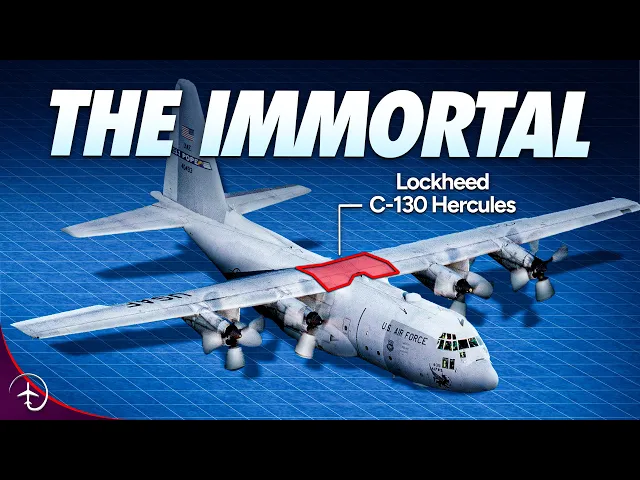
Why Can’t ANYTHING Replace THIS Aircraft?
Mentour Now!
0:01 Can one aircraft do basically everything?
0:05 Well, the C-130 Hercules, or the Herc as it's known to its friends,
0:10 is primarily a military cargo aircraft.
0:13 But it has also been used to carry paratroopers,
0:16 it can land on dirt, ice or snow, it has snooped on people,
0:21 it can refuel other planes and helicopters, fight fires and spray crops,
0:26 chase hurricanes and has performed all kinds
0:28 of humanitarian and research work known to man.
0:33 It has also landed on an aircraft carrier, it has dropped bombs,
0:37 big and small, and it's even managed
0:39 to recover spy satellites returning from space.
0:43 So how has one aircraft been able to do
0:46 all of those things and kept going for so long?
0:51 Because if you thought that the Boeing 737 has
0:53 been in production for longer than any other aircraft,
0:56 then you're actually wrong.
0:59 The C-130 entered service 12 years before the first 737
1:03 and has now been produced continuously for over 71 years.
1:08 Nothing even comes close to that.
1:12 In this video, we are going to look
1:13 at how the C-130 became such a lasting success,
1:17 which is made even more incredible considering that it almost didn't happen.
1:22 You see, Lockheed's most celebrated aircraft engineer absolutely hated it.
1:28 And finally, we're also going to look at if
1:30 there is anything out there that could eventually replace it.
1:35 Now, I will start this story by looking at a recent
1:39 incident involving a C-130 that got a bit hairy and expensive,
1:43 but serves as a great example of just how durable this aircraft is.
1:49 On the 23rd of April in 2020, a US Air Force C-130J-30 was on approach
1:55 to Runway 26 in Rammstein Air Force Base in Germany.
2:00 Now, the weather was fine,
2:01 although using that particular runway meant a six-knot tailwind,
2:05 which was by design.
2:08 You see, the pilot sitting in the left seat on that day was being evaluated,
2:12 and that check-ride involves a number of different tasks,
2:17 including flying formation with two other C-130s,
2:20 and also something known as a maximum effort landing.
2:25 A maximum effort, or assault landing,
2:27 is a tactical landing flown at slower speeds to enable
2:30 the plane to stop in as short of a distance as possible.
2:34 Now, there were quite a few complications in this approach,
2:37 including that tailwind, and to put it mildly, it didn't go as planned.
2:43 According to the accident report, the pilots started pulling back on the thrust
2:47 levers a bit too early during the flare, at around 70 feet above the runway,
2:51 bringing them back to the flight idle at around 45 feet.
2:55 In normal conditions,
2:56 that thrust reduction should have started at around 20 feet,
2:59 so this was very early.
3:02 Now, doing this is particularly bad in the C-130,
3:05 because the prop wash is actually helping
3:07 the wing generate lift during low speeds,
3:10 enabling it to land as slowly as possible.
3:13 Now, this didn't stall the plane, but it did cause a high sink rate,
3:17 which both pilots were then too late to react to.
3:20 The pilot sitting on the right seat called for a go-round
3:24 when the aircraft was about 30 feet above the runway,
3:26 and the pilot flying had, at that point,
3:28 already started doing that by pushing the thrust
3:31 levers forward and starting to pitch up.
3:34 But like I said, it was still a bit late,
3:37 and with the engines already at idle at that point,
3:40 they now couldn't spool up fast enough
3:42 to stop the plane from touching down hard.
3:46 Now, a maximum effort landing is a fairly hard landing anyway,
3:49 but every aircraft has a certain limit
3:51 for this, and the C-130 is no exception from that.
3:55 The maximum descent rate at touchdown that this plane should have had was,
4:00 based on its weight that day,
4:01 about 540 feet per minute, and the maximum load with the flaps extended was 2Gs,
4:08 or twice the force of gravity.
4:11 In this case though,
4:12 the plane touched down with a descent rate of approximately 834 feet per minute,
4:16 giving it a peak instantaneous g-load of between 3.62 and 3.81 Gs.
4:23 Now, despite this, the aircraft still went
4:25 around before the nose wheel touched the ground,
4:28 and initially the crew briefed for another
4:31 maximum effort landing in the opposite direction.
4:35 But as they prepared for that, the pilots noticed the max G-load
4:38 of 3.7 and 3.8 Gs from their previous landing in their primary flight displays,
4:43 which obviously made them change their plans.
4:46 So instead, they now made a more docile, uneventful landing with full flaps,
4:51 followed by a taxi into the parking area and them shutting down the engines.
4:56 And had this not been a C-130 Hercules,
5:00 that would likely have been the very last
5:03 flight that this plane would ever have done.
5:06 Because you see, the damage turned out to be pretty brutal.
5:10 There was buckling in the skin on the underside of the airframe,
5:13 and even worse than that, there were popped rivets and cracks all over the wing.
5:18 In the weeks after the incident,
5:19 maintenance crews at Lockheed Martin determined that the list
5:23 of damaged parts included the main landing gear,
5:26 propellers, propeller gearboxes,
5:28 spinners and other related parts on all four engines,
5:31 as well as all wing sections.
5:34 Now on most aircraft, such an extensive shopping list of broken parts
5:38 and components would simply be uneconomical to repair or replace,
5:43 if it even would be possible.
5:44 And yet, here is a photo of this same aircraft flying five years later.
5:51 Now to understand how this was even possible,
5:53 we need to look at the design of the C-130 a bit more closely.
5:58 And here, we should also address a small misunderstanding about this aircraft.
6:03 Kelly Johnson is one of the most
6:05 prolific aircraft designers in the 20th century.
6:08 Working for Lockheed, he designed many famous planes,
6:11 starting with the Model 10 Electra,
6:13 which was the plane that Amelia Earhart disappeared in.
6:17 He also designed the P-38 fighter, the Constellation,
6:20 the P-80, the T-33, the U-2 Spy Plane,
6:24 the SR-71 and its many, many derivatives, as well as the F-104, among others.
6:32 Quite a busy guy, in other words.
6:34 But unlike what some sources suggest, Johnson did not design the C-130.
6:40 And not only that, when he first took a look
6:42 at the written specifications and at an early model of the plane,
6:46 he turned to Lockheed's vice president
6:48 and chief engineer at the time, Hall Hibbard,
6:51 who had just gotten ready to send those specifications to the Air Force.
6:56 And Johnson said, "Hibbard, if you sign that letter,
6:59 you will destroy the Lockheed company." Now,
7:03 Willis Hawkins, the engineer who led the design team behind the C-130,
7:07 later explained this, saying that while Johnson was a genius,
7:11 he wasn't impressed by a simple transport plane that didn't carry bombs,
7:16 didn't have machine guns and didn't fly at Mach 3.
7:20 Also, every single plane Johnson designed looked sleek and fast,
7:24 even when it was sitting still on the apron.
7:27 And with all of the will in the world,
7:30 you just can't say that about the Hercules.
7:33 Now, Johnson eventually changed his mind about this plane,
7:36 and there is a really simple and practical reason
7:40 why the C-130 looks the way that it does.
7:43 World War II and the Korean War that followed both showed the military
7:47 that they really needed a medium-sized transport
7:49 aircraft that could land on unprepared runways.
7:53 Smaller aircraft with radial piston engines like the Douglas DC-3 or C-47
7:58 in military service could already do
8:00 that, but the Air Force needed something bigger,
8:03 with a ramp that would allow loading
8:05 and unloading of cargo to be done much faster.
8:08 Now, the C-130 wasn't the first plane to be
8:11 able to land on bad terrain or have a ramp.
8:14 Actually, it borrowed quite a lot of its
8:16 features from an older design called the Fairchild C-123,
8:20 which was quite successful in its own right,
8:24 even though its design had actually started out as a glider.
8:28 But the C-123 wasn't big enough to carry what the Air Force needed,
8:32 and like every other transport plane at the time,
8:35 it had piston engines, not turboprops.
8:39 Thus, the Air Force drafted a requirement for a new, bigger transport aircraft,
8:44 and the nature of this requirement meant that this new
8:47 plane would literally have to be designed from the inside out.
8:51 And crucially, the feature that would lead
8:53 to the C-130's longevity came almost as an afterthought,
8:58 which is quite astonishing as we will soon see.
9:02 Now, when we're talking about afterthoughts,
9:04 that's also how we often treat our internet access,
9:07 especially when we're traveling.
9:10 It is just so easy to connect
9:12 to unfamiliar free Wi-Fi networks in airport lounges, hotels and coffee shops,
9:17 but every time that you do that, it's a potential security risk,
9:22 especially when you're checking emails,
9:24 accessing work files or logging into sensitive accounts.
9:29 That was one of the main reasons why I started using today's sponsor, NordVPN,
9:33 since they are the only VPN certified by independent cybersecurity experts,
9:39 and therefore, perfect for providing the protection that I need.
9:43 Their Threat Protection Pro feature checks websites
9:46 before they even load on my devices,
9:49 and if something looks sketchy, then Nord will just block it.
9:53 Nord also blocks trackers,
9:55 those are those little virtual spies that follow you around everywhere and gives
9:59 you loads of ads for stuff that you maybe have searched for once,
10:03 and that has also gotten way, way better after I started using Nord.
10:08 Now obviously, I also use NordVPN for their fast connections to servers at home,
10:13 which lets me access my favorite content,
10:16 like watching the Swedish Olympic team win gold in female
10:20 curling when I was in Thailand a few weeks back.
10:23 Anna Hasselborg in Team Hasselborg is actually the sister of my brother-in-law,
10:28 so only being able to see her win was worth that Nord subscription.
10:34 Now if you want to try this as well,
10:35 then scan this QR code, or head over to nordvpn.com/mentournow.
10:42 That will give you four extra months for free
10:45 when you sign up for their two-year plan,
10:47 and remember, Nord will always give you a 30-day
10:50 money-back guarantee so you don't risk anything by trying.
10:53 Thank you, Nord.
10:54 Now let's get back to the Herc.
10:57 In its descriptions of the new transport plane that they wanted,
11:01 the US Air Force didn't specify the dimensions of the aircraft itself.
11:05 Instead, they provided a list of payloads involving vehicles and other pieces
11:10 of equipment that the aircraft would need to be able to carry.
11:14 Willis Hawkins, the plane's chief designer,
11:16 explains what his team did in response.
11:20 We basically took the dimensions of the biggest
11:23 piece of equipment the Air Force had specified,
11:25 drew a circle around its cross-section,
11:27 and then turned the circle into a tube about the length of a railroad boxcar.
11:33 We then put wings, a nose and a tail on it, and we had the design.
11:38 It was basically that simple.
11:40 Okay, there was a little bit more to it than that.
11:43 The plane also needed very sturdy but low landing gears,
11:46 so the ramp in the back wouldn't need to be so steep,
11:49 and it was configured so that it
11:52 wouldn't need any ground equipment to stay operational,
11:54 basically as long as it had fuel in its tanks, it would start up and fly.
12:00 The design then also had to be optimized for low speed,
12:03 so at least when it entered service,
12:05 its engines and propellers were set up to prioritize
12:08 maximum thrust at low speeds instead of efficiency in cruise.
12:13 Basically, the opposite of how airliners are designed, sort of.
12:18 But fundamentally, the C-130 was designed as a container with wings,
12:22 with the room and the necessary weight capacity to handle quite
12:25 a lot of equipment that the military was already familiar with.
12:29 And that was the reason why this aircraft eventually became so successful,
12:33 but more importantly, its size quickly became sort of a standard.
12:39 After the C-130 had entered service,
12:41 the US Army, and other armies for that matter,
12:44 would issue requests for new equipment that would
12:47 need to be air-transportable in a C-130.
12:51 And that led to the designs of some quite popular military vehicles,
12:55 like the M113 Armoured Personnel Carrier for example.
12:59 This standardization is a key reason why the C-130 was
13:03 able to stay in demand for such a long time.
13:06 It became the literal standard,
13:09 similar to the containers that we see on roads and cargo ships today.
13:14 Designers of a lot of newer military equipment then soon assumed
13:17 that their products would have to fit into the C-130 as well,
13:21 even if the specifications didn't say so.
13:24 Palletized equipment was then developed to fit the aircraft
13:28 to cover everything from military to civilian research projects.
13:32 Basically anything that involved getting to hard-to-reach places with no
13:36 runways would ease the fitting of bulky firefighting equipment.
13:41 There is also a commercial version of the C-130,
13:44 called the Lockheed L-100-Hercules,
13:46 which has been made in a few different versions,
13:49 although that hasn't been in continuous
13:51 production like its military equivalent have.
13:54 This feedback loop of specifications made
13:57 the Hercules a kind of a do-anything aircraft.
14:01 The US Air Force did try to replace it a few times.
14:05 A project called the Advanced Medium STOL Transport, or AMST for example,
14:10 was intended to replace the C-130 in the 1970s and 80s,
14:14 but like other prospective replacements,
14:17 it soon proved too costly or too complex for little extra benefit.
14:22 Here it is worth adding that unlike the airline world,
14:26 in the military efficiency isn't everything.
14:29 The Hercules is overbuilt anyway with its nice, thick,
14:33 low aspect ratio wing that is designed
14:35 to maximize lift at low and medium speeds,
14:38 so more modern designs, who promised to be more efficient and faster,
14:43 might not seem as attractive as their designers assumed that they would do.
14:48 Instead what ended up happening was that various
14:50 other designs were created who would end up
14:53 supplementing the Hercules in Air Force services around
14:56 the world by being either bigger or smaller.
14:59 But there still is one more element in this story,
15:02 which takes us back to that C-130 that made that heavy landing in Germany.
15:07 How was it possible to even repair that aircraft?
15:11 Now remember how the C-130's original designer described it?
15:15 A container or box car with wings,
15:17 nose and a tail that can land in a battle zone?
15:21 Well, the area that we need to concentrate on here
15:24 is the point where the wings meet the fuselage.
15:27 This is called the center wing box,
15:29 and all big aircraft have a structure similar to it.
15:33 In low wing aircraft like the C-737 that I fly,
15:36 the wing box is where all of the loads from the wing
15:39 and the landing gear meet the rest of the aircraft.
15:42 High wing aircraft are a little bit more complicated because
15:45 the landing gear isn't attached directly to the wing box,
15:48 which means that the fuselage section between the wings and the gear
15:52 has to be sturdy enough to still be able to transfer those loads.
15:56 And that is actually why high wing designs generally tend
15:59 to be a bit heavier than similar low wing designs.
16:03 But either way, in most cases a center wing
16:06 box is not a replaceable part in an aircraft.
16:10 Even if such a replacement would be possible theoretically,
16:13 you would essentially need to disassemble the whole aircraft to get to it,
16:18 in most aircraft, but not the C-130.
16:22 Now in the Hercules, this center wing box includes a section of the wing
16:26 up to and including the mounts for the two inboard engines,
16:29 which is mounted above the cabin.
16:32 And crucially, the way that it is mounted there means that it can be replaced,
16:35 which is a big deal.
16:38 You see, the lifespan of most complex modern aircraft is limited by fatigue,
16:43 and that fatigue can affect many areas,
16:46 but usually the ones that limit an aircraft's lifespan involve either
16:50 the compression and decompression cycles or wear on the wing and wing box.
16:56 When an aircraft completes a specific number of flight cycles,
16:59 flight hours or a combination of both,
17:01 well then it's just retired and broken up.
17:05 But in a beefy aircraft design like the Hercules,
17:08 which doesn't cruise quite as high as most airliners do,
17:11 it's the wing and wing box that would limit the plane's life,
17:16 if it hadn't been replaceable.
17:18 In the C-130, the center wing box is something called a lifed article.
17:23 Those are critical components or systems that have operational
17:26 limits specified in total flight hours, age or both.
17:30 In the case of the center wing box of the Hercules,
17:33 most of the early variants of the plane
17:35 had limits of around 19,000 flight hours,
17:38 although that number depends on the type of flying that that aircraft
17:41 had been subjected to, and calculating this number properly is really critical.
17:48 Back in 2002, a very early C-130 Alpha model, used for firefighting,
17:53 crashed very dramatically and killed all three crew members on board when
17:57 the wing box failed and the two wings folded upwards one after the other.
18:02 Those earlier wings were weaker, and at the time of the accident,
18:05 there were some serious maintenance
18:06 and operation-related issues with this specific aircraft.
18:10 But another important factor was that aircraft used in firefighting roles
18:14 are subjected to much higher stresses than planes just flying normal cargo,
18:19 something that hadn't been taken into account
18:21 in the maintenance and inspection schedules of that aircraft.
18:26 Now, in the newer C-130J,
18:29 the original center wing boxes had a limit of 45,000 flying hours,
18:33 up from 19,000 before, but more recently Lockheed has introduced
18:38 an enhanced service life, or ESL center wing,
18:41 initially estimated to be good for 90,000 hours, which is just crazy.
18:46 And Lockheed now even says that the ESL
18:49 wing actually has a proven lifespan of 122,500 hours.
18:54 In any case, like with other lifed parts,
18:57 once these center wing boxes are replaced, the life clock is reset on it,
19:01 and the hours of flight cycles start counting up from zero again.
19:05 And that matters, because getting used in unusual roles,
19:08 like firefighting or chasing hurricanes, would otherwise have quickly eaten up
19:12 the available flight hours of many middle-aged C-130s.
19:16 If it hadn't been possible to give them that new
19:19 leaf of life with a new wing box, that is.
19:22 Now, to be clear here,
19:23 replacing the wing box on a C-130 isn't an easy or cheap operation.
19:28 But if the rest of the aircraft doesn't have any other fatigue-related issues,
19:32 or isn't so old that its systems and other components are too hard to maintain,
19:37 well then it is a job worth doing.
19:39 The total cost of a C-130 wing box replacement is a little bit hard to find,
19:43 and will also vary depending on where it's being done and by whom.
19:48 But in 2007, the US Air Force priced the operation at $6.5 to $7 million,
19:54 which is still only a small fraction of the cost of getting a new C-130.
19:59 So if we go back to that C-130 that landed hard in Rammstein,
20:02 Germany, this was an aircraft built in 2013, so it was relatively new.
20:07 And even though that accident also required much more repairs and parts,
20:11 including four rebuilt engines,
20:13 the total cost of that operation was around $20.9 million.
20:19 Not cheap, but a brand new C-130J-30 would cost several times that amount,
20:25 so now maybe you start to understand why this was done and how it was possible.
20:31 But there was also an additional twist to that story.
20:34 You see, there is one company that can perform such a wing
20:37 replacement outside of the United States
20:39 called the Marshall Group in Cambridge, UK.
20:42 But the US Air Force themselves had only
20:44 ever done this job inside of the United States.
20:48 So for them to perform this field wing replacement in Germany,
20:51 the Air Force first had to figure out how to pack up and ship a wing over there,
20:56 and the job then also required quite a bit of precision,
21:00 special gigs and other mechanisms.
21:03 So all in all, pulling off this repair
21:05 and all the other repairs that this Hercules needed,
21:08 including the time needed to build the new wing and ship it across the pond,
21:12 took over five years.
21:15 Now one question that we haven't been able to find out, none of us in the team,
21:19 is whether or not the US Air Force actually intended
21:22 for the wingbox to be replaceable back when it was designed,
21:26 or if this was just a lucky coincidence in the way that the C-130 was built.
21:30 And if you guys know anything about
21:33 this, please let us know in the comments below.
21:36 Finally, there is also one more question that needs to be answered.
21:40 Is there any other aircraft out there that could
21:42 possibly replace the C-130 in the near future?
21:45 Well, Airbus tried it with their A400M, which actually did win some orders,
21:51 but not enough to really replace the C-130.
21:54 Well, in most countries at least.
21:55 But another possible candidate is the Embraer C-390.
22:00 This aircraft has a similar size and capacity as the C-130J-30,
22:03 and instead of four turboprops, it has two IAE V2500 turbo fans.
22:10 Those are the same engines used on many legacy Airbus A320s.
22:14 Sales for this aircraft suffered badly at first,
22:17 very likely because of the failed tie-up
22:19 between Boeing and Embraer back in 2020.
22:22 But in the last couple of years,
22:23 Embraer has secured a lot more orders for the plane,
22:26 so it is definitely one to look out for.
22:30 As for the C-130, well, it's still in production, so don't dismiss it just yet.
22:36 And even when no new ones are made anymore,
22:39 the existing models will take a very long time to go out of style.
22:44 As we saw in another video we did recently,
22:47 Boeing's B-52s will very likely stay in service for over a century.
22:52 But the B-52 was actually in production for only around a decade,
22:56 and when the last one of them is retired,
22:58 there will likely be a lot of C-130s still flying around,
23:02 proving that you don't have to be fast or good-looking to be cool.
23:07 So what do you think?
23:08 What is your favorite strange role that the C-130 has performed?
23:12 Let us know in the comments below.
23:14 Thank you all for watching,
23:15 and I really hope that you have subscribed to the channel.
23:18 Now, if you want to support my team and I,
23:21 watch all of our videos before everyone else, and join my next Zoom Hangout,
23:25 then please scan this QR code
23:27 or go to patreon.com/join/mentourpilot and sign up.
23:32 My name is Petter Hörnfeldt, and you're watching Mentour Now!
23:35 Have an absolutely fantastic day, and I'll see you next time.
23:38 Bye-bye.