When Baking As We Know It Changed Forever
Townsends
0:00 Imagine a food product we have today that nearly every person
0:04 interacts with but in the 18th century it did not exist.
0:10 So, today we're talking about the origins of chemical leavening.
0:14 Chemical leavening in essence is what makes cakes
0:18 and cookies and biscuits and pancakes light and fluffy.
0:22 So, if they didn't have chemical leavening, what is non-chemical leavening?
0:25 So, that's typically using yeast.
0:28 They might use a wild yeast.
0:30 They might not even know they're using yeast,
0:32 but they're using some kind of yeast
0:35 or a kind of yeast that they're propagating.
0:37 They know it's there.
0:39 They might not understand how it works.
0:41 They might call it fermenting or they might call it something else,
0:44 but it's some kind of yeast product.
0:47 And the trick with yeast is it's slow.
0:50 It takes a long time.
0:52 We can use a wild yeast in the air.
0:55 We can just mix up a bread dough and we can just let
0:58 it set there for like 24 hours and it will start to do something.
1:07 It will have a wild yeast in it and it will start to fluff up all by itself.
1:12 But what if we want instant yeast?
1:15 What if we want to make a bread product immediately?
1:20 Chemical leavening is what we want.
1:22 And they didn't know how to make that happen in the 18th
1:26 century or at least in the early part of the 18th century.
1:29 But they figured it out right here at the end of the 18th century.
1:35 Now, you're going to ask me,
1:35 "What is potash and pearl ash?" The answer is technical,
1:40 but it is related to our baking soda.
1:44 Pearl ash here is potassium carbonate and baking soda is sodium bicarbonate.
1:53 They're similar.
1:54 The carbonate is the part that matters here.
1:57 That's basically bound up carbon dioxide that when we introduce a little acid,
2:03 the carbon dioxide comes out and makes bubbles.
2:05 And it happens instantly.
2:07 And that's why it's it makes these great cakes and cookies.
2:10 We don't have to take any time waiting for yeast to create carbon dioxide.
2:16 It's our little chemical compound is doing it instead.
2:20 Now, America had a vast quantity of this particular resource.
2:27 It actually comes from burning up trees.
2:29 When we have lots and lots of tree ash,
2:32 we can change that into with a quick process of water and boiling,
2:39 we can turn it into our potash.
2:41 And we can use that to make soaps,
2:43 and we can use it for making glass and some other industrial processes.
2:47 This story of chemical leavening is fascinating and there's probably more to it.
2:52 I would love to find it.
2:54 It's a little bit hard to research.
2:56 There's some guide posts and documents that we can read along the way to fill
3:00 this story to help us understand what's happening
3:02 with light and fluffy biscuits that we love today.
3:07 So, the story I know of right now starts in 1788.
3:11 Now, it it's actually going on before 1788 because of the way it's written.
3:16 But there's a doctor.
3:18 It's Dr.
3:19 Mitchell, and he's sort of a professor.
3:21 He's a medical doctor, but he's interested in other things at the same time.
3:26 He's in America.
3:27 In 1788, he writes an article to a scientific newspaper of the time period.
3:34 He says, "Bread is super important,
3:37 and we don't spend enough time understanding it and why it's working." And so,
3:41 he he goes into this long explanation about
3:44 what's happening with wheat and the different components.
3:47 And there's one sentence in this three-page letter which sparks interest.
3:53 What good does potash do in cakes?
3:57 Potash contains a great portion of fixed air,
4:00 which is set at liberty by the heat necessary to bake the cake.
4:05 And therefore, potash supersedes the use of fermenting mixtures.
4:11 It's like two sentences, and we don't have any other story here.
4:15 It's like what do you mean potash cakes?
4:19 He doesn't describe them.
4:20 He But he says potash is used in baking cakes.
4:25 I don't have any other description.
4:26 There are no American cookbooks from previous to uh Amelia Simmons,
4:32 and they have nothing in them.
4:33 We don't know anything about baking this potash cake.
4:37 So, where does the story go from here?
4:39 There's a British magazine that's very similar
4:41 to this one that's called the Monthly Magazine, and the person says Dr.
4:46 Mitchell talked about potash cakes.
4:48 What are these?
4:49 And that was it, which is very odd.
4:51 It was That letter came out in April of uh 1799.
4:56 But a couple of months later, somebody wrote a response to that.
5:00 And it's one of the most incredible responses I have
5:05 ever read in a magazine like this from the time period.
5:10 And it wasn't Dr.
5:11 Mitchell.
5:12 It was Margaretta Curly, who apparently knew Dr.
5:15 Mitchell.
5:16 And she said, "Oh, I saw that question in your magazine,
5:19 and I thought I would give you a response to it."
5:22 And this is What kind of amazing thing is this?
5:25 Who would even read that little thing and say, "Oh, yeah,
5:27 I think I'll write a four-page uh letter to respond to that one
5:31 little tiny question in the magazine."
5:33 But that's exactly what Margaretta Curly did.
5:35 It says, "I observed in your number magazine of June last a question put to Dr.
5:43 Mitchell, how potash cake is made.
5:46 The question refers, I suppose,
5:48 to the mention of that sort of bread in his letter to Mrs.
5:53 F, printed in a magazine for April last.
5:57 I have examined several of your English books of cookery,
6:01 where receipts and directions are given for making
6:04 a great variety of good edible things,
6:07 but do not recollect to have ever observed in a chapter
6:11 of cakes any composition of the kind we call an America potash cakes.
6:16 Here is her written down recipe.
6:19 It goes, "A good recipe for this cake is as follows.
6:22 Take a good wheat and flour, 2 lbs of butter,
6:26 a half a pound of sugar, half a pound.
6:30 Add to these a heaping teaspoonful of the salt of tartar or other form
6:36 of potash or pearl ash that will hiss when vinegar is poured on it.
6:42 The potash must be dissolved in a little
6:46 water before it is added to the other materials,
6:48 and sugar stirred in about a pint of milk,
6:53 and being freed from lumps, the whole must be mixed and kneaded well together.
6:58 This may be done in a very few minutes,
7:01 and the dough will be instantly fit for rolling out and baking.
7:05 It is to be observed that the milk in which this cake is moistened,
7:10 if sour or coagulated, will be preferable.
7:15 In other words, use buttermilk or use sour milk.
7:18 So, isn't it massively fascinating that there's some kind
7:21 of food that's being made in say 1780 in colonial America,
7:26 some doctor writes about it in 1788, 10 years later it gets reprinted,
7:33 and then someone asks a question about it in a British newspaper in 1799,
7:38 and someone writes a response to it,
7:40 giving us this amazing letter here with all the explanation
7:46 and a recipe and the reasons and it goes on and on.
7:49 And then, if we're careful,
7:51 we can see the thread of that pop up again another 10
7:55 years later where this recipe actually shows up in a British cookbook.
7:59 This recipe is pretty easy.
8:00 We're going to cut it in half.
8:02 I have 1 lb of unbleached flour.
8:05 That's probably the best one to use.
8:08 She does have an option of using rye flour.
8:10 We don't need to do that.
8:11 And we have a quarter of a pound or 4 oz of butter.
8:16 We're going to cut that in or rub it
8:18 in so that it's basically just like a pie crust.
8:22 We also have 4 oz of sugar.
8:25 We're going to add that to our flour mixture and just mix it completely.
8:29 Now we have our liquid components.
8:32 We have about 4 oz of water and 4 oz of milk.
8:36 We're going to take our leavener,
8:38 which is our potassium carbonate or in your case,
8:41 you're going to be using baking soda.
8:43 1 tsp full and put that into 4 oz of water and stir it well.
8:48 We also have 4 oz of milk and since we want some kind of acid in here,
8:55 we're going to put in a tsp full of apple
8:58 cider vinegar into this milk and stir it well.
9:01 And then those two will go in to our combination
9:05 here of flour and all that good stuff.
9:07 We will mix that together.
9:08 Mix it together gently, bring it together into a dough.
9:12 Don't knead it well.
9:13 She says to knead it well, but we don't need to do that.
9:15 Just bring it together into our nice dough or batter here and we
9:21 can separate these into little cakes and put them on a baking sheet.
9:24 These go into the oven at 400° for approximately 20 minutes.
9:29 It depends on how big you make your little cakes.
9:32 The biscuits are out of the oven.
9:33 I've allowed them to cool so we can taste them out.
9:36 And I have a couple of versions here.
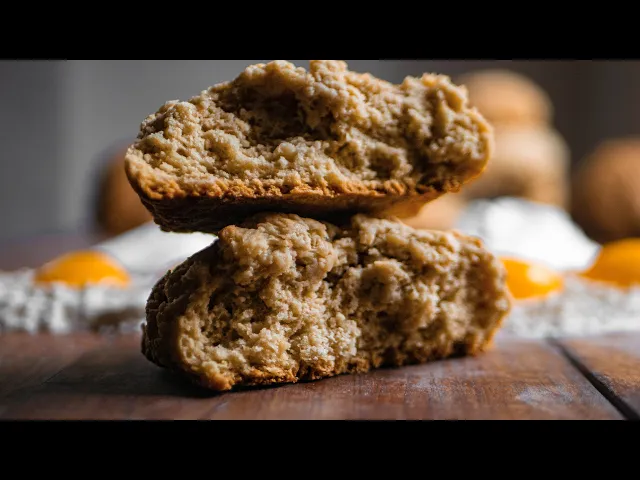
9:39 This one that I've broken open here is exactly what the recipe is.
9:43 This is uses the potassium carbonate, the pearl ash, as our leavener.
9:48 And you can see that it's not really fluffed up a lot.
9:52 There's a little bit of leavening going on here.
9:55 I did go ahead and I did a version of hers that used the rye and the molasses.
10:02 And these don't taste very good.
10:04 So, I don't suggest that necessarily.
10:07 And I went ahead and I also did one,
10:09 probably like the one that you're going to make with sodium bicarbonate,
10:14 which is baking soda.
10:16 And you can see it's much lighter and fluffier.
10:19 Just by the look of it is lighter and fluffier.
10:21 And when we break it open, you can see a lot more leavening going on here.
10:26 It's got twice as much leavening action.
10:29 So, we get a lot more fluffiness and it does taste a little better.
10:33 The difference between potassium carbonate and sodium is definitely tastable.
10:40 If you get too much of this potassium carbonate,
10:43 if you say, "I want this to be lighter and fluffier,
10:45 so I will use twice as much." It will start to taste
10:48 like soap because potassium carbonate is what they use to make soap with.
10:54 Versus sodium.
10:56 This sodium part ends up being a more
10:59 of a salty taste cuz we're used to sodium chloride, right?
11:02 Not potassium chloride, which has a kind of a metallic taste to it compared.
11:07 So, there is a a good reason why Margareta Curly,
11:11 even in her letter, suggests using
11:14 sodium carbonate instead of potassium carbonate.
11:17 We use it in America because we have lots of it.
11:20 In Europe, you might have sodium carbonate.
11:22 You should use that instead.
11:24 So, she really went in-depth in her letter about the differences
11:29 and how you can use it and what's even going on chemically.
11:32 She did a tremendous job.
11:34 So, let's give these a taste.
11:36 Here is our biscuit here and she did give us uh some sugar in these.
11:43 So, they are kind of sugary.
11:47 These are not bad at all.
11:49 A little dense, a little I'm probably going
11:52 to try a couple of different things to, you know,
11:55 tweak it and get a little more fluffiness in it.
11:59 Having to do with how much acid you put
12:02 in and exactly how much you kind of knead it.
12:05 Probably couldn't have got a little bit fluffier.
12:08 But, here's the sodium one, regular baking soda.
12:13 Definitely fluffier.
12:15 And you can still get a strange metallic taste if you,
12:20 you know, put too much in.
12:22 But, a really really interesting, wonderful little sweet kind of biscuit here.
12:27 You can make these and you are making
12:31 what turns into all our cakes, all our cookies,
12:36 all those things are based on the work that was done here by Margarita Curly.
12:41 They're totally amazing.