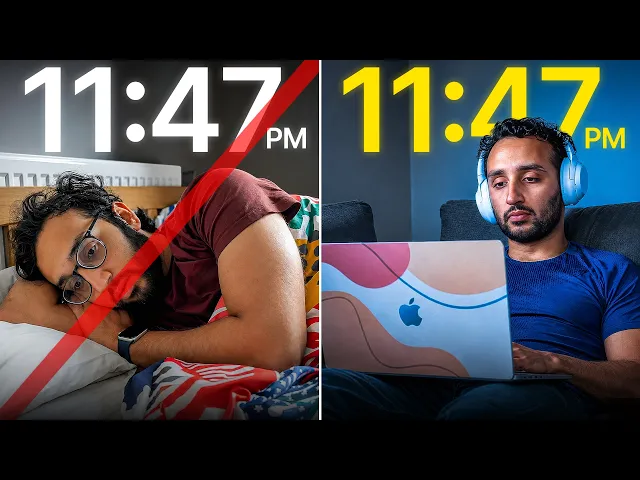
7 Obsessive Habits That Turned Me Into a Multi-Millionaire
Ali Abdaal
0:00 In this video, we're going to [music] be going through seven habits
0:02 that made me a bunch of money when I was in my 20s.
0:04 They were all [music] unhealthy in one way or another.
0:07 Yes, it's very good to become financially free and make all the money and stuff,
0:10 and it is also good to have [music] a balanced life and not be
0:12 sacrificing the things that are more important
0:15 than money on route [music] to getting there.
0:17 Oh, and by the way, if we haven't met yet, hello.
0:18 My name is Ali.
0:19 I'm a doctor turned entrepreneur, and on this YouTube channel since 2017,
0:22 [music] I've been documenting the journey from being
0:25 a broke-ass medical student to then working
0:27 full-time as a doctor to then becoming
0:28 a multi-million dollar entrepreneur [music] and best- selling author.
0:30 And my goal with this channel is to document the lessons
0:32 that I've learned and the lessons I'm continuing [music] to learn,
0:34 partly as a reminder for myself,
0:36 and also in the hope that you will find something that is
0:38 useful on your own journey of building a life you love.
0:40 All right, habit number one is what I like to call the zero downtime habit.
0:44 And to this day, I carry this laptop bag, this what, camera bag everywhere I go.
0:48 And I've been doing this for years, so much so to the point that when
0:50 my wife and I started dating like many years ago,
0:52 she referred to it as my safety blanket because, like a child,
0:54 I had to carry my safety blanket everywhere I went,
0:56 otherwise I would feel weird.
0:57 And the reason for this is that, in particular,
0:59 while I was in my 20s grinding away on building my business,
1:01 I would not allow myself to have any downtime.
1:04 Anytime there was a spare moment or where a normal person more likely
1:08 would take out their phone and like scroll Instagram or TikTok or whatever,
1:10 I would instead bust out the laptop,
1:12 and I would try and do as much work as I possibly
1:14 could in that time and almost like play this as like a challenge
1:16 or a game a game with myself where I'm like squeezing out
1:19 productivity and efficiency out of these like
1:21 minutes of downtime here and there.
1:22 There was almost no moment that I gave myself when I was sort
1:26 of in the build phase of building the business
1:28 of like actually allowing myself to chill out.
1:30 Now, the obvious benefit to this is that you actually just end up with a way
1:32 more time to grind on the thing that you want to be grinding on.
1:35 One of my friends, Matthew Dicks, he's a great writer and a teacher,
1:38 and he tells the story of how like whatever you're trying to do,
1:41 you probably don't have huge amounts of free time
1:43 on your hands to be able to work on the thing,
1:44 especially if you're trying to like if you've got a day job
1:47 and you're trying to do a side hustle at the same time,
1:48 like trying to build your business or I don't know, write a book or whatever.
1:51 And so, actually squeezing out productivity and efficiency out of those tiny
1:54 ass moments of time here and there that we [music] get
1:56 throughout the day instead of using that time scrolling or using
1:58 that time merely enjoying enjoying the taste of a cup of coffee.
2:01 That time actually does make a difference [music] in how
2:03 much progress you're able to make in your business,
2:05 and it does genuinely add up.
2:06 As with all of the habits in this video, this kind of habit comes at a cost.
2:10 [music] The cost is obviously you lose some sense of presence.
2:12 You lose some sense of like dancing through
2:14 life and actually just being able to take
2:16 [music] a moment to rest and reflect and like just be present in the moment.
2:19 And what it results, at least for me,
2:21 and speaking to a lot of my entrepreneur friends,
2:22 is you [music] end up training this muscle
2:24 to the point that it genuinely becomes difficult to switch off.
2:27 I now have to set rules for myself where I'm like,
2:29 Ali, you're not allowed to work on the weekend.
2:31 And then I get around those rules to be like,
2:32 well, it's not really work if you consider it fun, right?
2:34 So then I I literally change the rule for myself so I'm like,
2:37 I'm not allowed to do anything on the weekend
2:39 that would look like [music] work to someone else.
2:41 So I'm not judging what what work is.
2:43 An impartial, reasonable,
2:45 objective observer is judging does that thing actually look like work.
2:48 And I find that rule to be very helpful because then I'm like, okay, well,
2:50 that means I can't do quite a lot of things I would want to do.
2:52 Okay, maybe I'll read some Harry Potter fan fiction or I'll like,
2:54 I don't know, go for a walk without my phone or something like that.
2:57 Should you adopt the habit of having no downtime into your life?
2:59 I don't know.
3:00 This video is not a advice.
3:02 It's not a video about whether you should do anything or not.
3:04 I'm just giving you the information be like,
3:06 this worked for me when I was in my 20s, and it also had some, how do we say,
3:09 unhealthy implications [music] that I'm trying to unlearn now.
3:12 And so, up to you.
3:13 You can take it or leave it.
3:14 Now we come to habit number two.
3:15 Habit number two is the habit of constant consumption.
3:17 This is a habit that really helped me when I was,
3:20 you know, in the first like many years of building my business,
3:22 which is that if I was in a situation
3:24 where I physically couldn't get out my laptop and work,
3:26 I was always consuming something often related
3:29 to work or related to the business.
3:31 So I'd be listening to podcasts about business,
3:33 I'd be listening to audiobooks about business,
3:34 I'd be listening to YouTube videos at double speed about business.
3:36 If I was in bed, I'd be reading books on my Kindle about business
3:39 and about how to make more money and how to grow YouTube channels and you know,
3:41 all that kind of stuff.
3:42 And so for absolutely years, I basically didn't have many moments of like rest.
3:48 Even when I was doing things like commuting
3:50 to work [music] or like on the toilet,
3:51 I would always have my AirPods in and always be listening to something or other,
3:54 like constantly getting like injecting [music] all
3:56 of this business advice and stuff into my veins.
3:58 Now, the benefit of this is that, especially if you're a noob
4:00 to the world of business like I was back in the day,
4:02 you actually end up leveling up quite a lot by learning
4:05 from other people that have been on the journey before.
4:07 That was super super super helpful
4:09 in drastically leveling up my knowledge of business.
4:12 Not my skills, cuz skills require practice,
4:13 but at least my knowledge of like stuff.
4:15 It was also really helpful because then I was able
4:17 to do all of those things without actively making time for them.
4:19 It just sort of happened while I was doing all these other things.
4:21 But again, the downside and what makes this feel slightly unhealthy,
4:23 especially now that I'm looking back on it in hindsight,
4:25 is that A, it's not a particularly present or mindful way to live
4:29 where you're constantly injecting information through
4:31 your AirPods at like 3x speed.
4:33 It's very easy to miss any kind of nuance
4:34 and to really like reflect and engage deeply
4:36 with what you're listening to when it's like
4:38 just firehose of information into your into your brain.
4:41 The other downside, which is something that I'm I'm now realizing,
4:43 is that more information does not actually result in more progress.
4:47 For many years while I was in my 20s, I thought that like the thing that was
4:51 [music]
4:51 stopping my business from growing was that I just didn't know enough stuff.
4:53 And so the more books I would listen to or the more
4:55 books I would read or the more pop- podcasts
4:57 I would listen to, maybe there would be this like magical
4:59 idea out there that like I just hadn't come across before.
5:01 Even if I was thinking about [music] the business,
5:02 thinking about what is the bottleneck right
5:04 now that's stopping us from 10xing the business,
5:06 and then just thinking about that for an hour
5:07 rather than listening to an hour worth of audiobook,
5:10 that probably would have actually resulted in a greater a greater impact
5:13 on the business rather than me listening
5:15 to the 500th audiobook about business like, you know, in that decade.
5:20 All right, by the way, if you're at this point in the video,
5:22 then you're probably a very intelligent, you're probably very good-looking,
5:24 and you're probably serious about leveling up in your work and in your life,
5:27 which is where the sponsor of this video comes in, and that is Skillshare.
5:30 Skillshare is a wonderful online platform with thousands and thousands
5:32 of creative classes taught by real people, including me.
5:35 I've been teaching on Skillshare since 2019.
5:37 I've got a really good class on video editing, if I say so myself.
5:40 I have a class on how to get started with Notion.
5:41 I have a class on productivity for creators.
5:43 But recently, I've been getting into drawing because I decided
5:45 I wanted to have more things that were like less productive.
5:47 And so I took the how to draw class by Brent Eviston,
5:50 and it's been a nice way to get started with learning how to how
5:52 to draw and like doodling in the evenings and sort of sketching things out,
5:55 and that has been a very nice way of switching off from screens
5:57 and sort of reconnecting with my soul and my creativity and stuff.
6:00 Skillshare is nice because it genuinely is humans connecting with other humans,
6:03 and they don't just teach you the skill, they also give you a class project
6:05 that you can work through alongside learning the skill,
6:08 and then you can share your class project with other people,
6:09 and you can see what other people's projects are, and you can learn from them.
6:12 So if you're interested in trying out Skillshare,
6:13 and if you're one of the first 500
6:15 people to use the link in the video description,
6:16 you will get 1 month completely for free.
6:18 So thank you again, Skillshare,
6:19 for sponsoring this video and for being the place
6:20 that I've been putting my online classes since 2019.
6:23 So it's been a very long time.
6:24 Anyway, thank you, Skillshare, and let's get back to the video.
6:26 Habit number three is the habit of constantly thinking about your work.
6:30 For me, the way this manifested was in a few different ways.
6:32 Firstly, I'd be thinking about work all the [music] time,
6:34 I'd be thinking about it in the shower,
6:35 I'd be thinking about it while when driving to my actual day job,
6:38 I'd be thinking about it on my lunch breaks.
6:39 All of those things are fine.
6:41 But where it became [music] more unhealthy, shall we say,
6:44 was when I would be thinking about
6:46 it while spending time with friends and family.
6:48 A lot of the times I was physically present, but in hindsight,
6:51 I was not actually present because either I was thinking about [music] work
6:55 or I was literally like busting out my laptop on the dining table,
6:57 on the kitchen table rather than hanging out with my mom and grandma.
7:00 And if you decide to incorporate this kind of habit into your life,
7:02 the benefit you'll get is that basically
7:04 the more time you're spending [music] consciously
7:07 or subconsciously thinking about the thing that you need to do to make money,
7:10 your business, whatever the thing might be,
7:11 that level of focus often results in interesting ideas.
7:14 Most people will have breakthroughs in their business
7:16 not when they're sitting on their desk,
7:17 but when they're maybe in the shower or maybe driving to work.
7:19 But obviously, the cost of this is that [music]
7:21 it can often cost um something in your personal relationships.
7:26 And this is a difficult habit to [music] break.
7:28 I am currently trying to unlearn
7:30 the habit of constantly thinking about work stuff.
7:32 I have some friends and mentors who are also
7:34 entrepreneurs and who have kids that are older than mine,
7:37 and so it's they've been parents for longer.
7:39 And [music] one thing they've advised is that like, you know,
7:40 having a kid is the way is like a very good like reason to try
7:44 and actually learn the habit of being present
7:45 and not just having the sub-routine of like,
7:47 what's the next thing to do in the [music] business and running all the time.
7:49 So these days when I'm like spending time with my daughter,
7:51 I'm trying my best to approach it with true presence rather than
7:56 putting in the time without really putting in the sort of mental headspace,
7:59 if that makes sense.
8:00 Okay, so let's talk about habit number four,
8:02 shirking your other responsibilities.
8:04 In my case, and as is the case for a lot
8:07 of entrepreneurs I know who are now quite rich,
8:10 it's very very rare to have a fully, shall we say,
8:13 balanced life while you're in the grind phase of building up the business.
8:17 So for me, I started building my first
8:19 successful business while I was in medical school.
8:20 Honestly, I kind of half-assed medical school for 6 years because my mind
8:26 was always focused on this other thing of of building the business.
8:29 Similarly, when I was working as a doctor,
8:31 the discretionary time that I had at work,
8:33 like in lunch breaks and after work and like
8:35 on the on the way to work and, you know, all that kind of stuff,
8:37 my friends who were really really really
8:38 into medicine and who were whole-assing their medical careers,
8:41 they were using that additional time to boost up their CV or to do
8:45 research projects or to do audits
8:47 or to create like presentations for conferences and stuff.
8:49 And I was sort of doing the bare minimum of that just to sort of tick the boxes,
8:53 and I was spending all of the rest
8:54 of that discretionary time working on the business.
8:56 And to be honest, this is a pattern you see
8:57 amongst [music] any sort of outlier success in any field,
9:00 whether it's entrepreneurship or sports or acting or music
9:02 or anything like that, which is it's really really
9:04 hard to do something at a really high standard
9:07 if you're focusing on more than just that one thing.
9:09 Now, for most people who watch my stuff, if you are building business,
9:11 it's probably something you're going to start out
9:13 building on the side of your like main gig,
9:16 like whatever the things you're doing at university, whatever your career is.
9:19 And so you kind of have to recognize that probably,
9:22 unless you're particularly superhuman at this, cuz I certainly wasn't,
9:26 like your main thing is going to suffer
9:28 as a result of you building your side thing.
9:30 Whether you want to make that trade is entirely up to you.
9:33 I'm personally glad I made the trade for myself, but also survivorship bias.
9:36 It worked out for me.
9:37 But if for whatever reason the business thing didn't work out
9:39 or I did want to go back to medicine, I have I'm behind.
9:44 Relatively speaking.
9:44 All right, let's talk about habit number five, the health sacrifice.
9:47 So, when I was in the early days of building the business,
9:50 actually for for many many years,
9:51 I realized that shopping for groceries and cooking healthy food
9:55 were things that were taking up way too much time.
9:57 And I decided that I would rather invest that time into stuff
9:59 in the business rather than into cooking and eating healthy food.
10:02 The benefit of this was that it saved me many,
10:04 many hours every single week that I was able [music] to then
10:06 put into the business to grow the business and make more money.
10:08 The downside obviously is that I then ended
10:10 up living off takeaways for most of my 20s.
10:13 And so there is a certain level of health sacrifice that I
10:15 made in my 20s for the sake of grinding on the business.
10:18 Now that I'm in my 30s,
10:18 I'm trying you know I've got a personal trainer, I see a physio,
10:21 I'm trying to reverse the damage of like guys did
10:22 to my posture and like trying to activate [music] my glutes
10:24 and hamstrings cuz I never knew what those were because I
10:26 was just like sitting and grinding on a computer all the time.
10:28 My cardiovascular health is worse than it would have
10:30 been had I sort of taken better care of like
10:32 my arteries and stuff by not eating like fatty
10:34 and healthy foods when I was in my 20s.
10:36 Do I think you have to make that sacrifice?
10:37 I don't think so.
10:37 These days there are a lot of like super healthy takeout options,
10:40 but for me when I was in my 20s it just wasn't really a priority.
10:42 It wasn't really something I thought about.
10:44 If I had my time again, I would still do takeouts,
10:46 but I would find a way to really optimize the health side [music] of the takeout
10:49 so I wasn't living off of like kebab rolls and and you know, that kind of stuff.
10:53 Habit number six that I developed which was
10:55 slightly unhealthy is being okay with wasting money.
10:57 So if for example I wanted to buy something like a tech
11:00 purchase or something for work or something for the studio or like whatever,
11:03 instead of spending ages doing the research to figure out
11:05 like what's the best thing that I would want to buy.
11:07 If it was if it was below a certain price point,
11:09 I would just order the thing without thinking about it.
11:11 Then I would forget about it.
11:12 Then it would arrive in the post and then I would try it out
11:14 to see if it actually fulfilled fulfilled the needs that I wanted it to fulfill.
11:17 Now quite a lot of time, I would say maybe 80% of the time,
11:19 the answer was no and I didn't end up continuing to use the thing.
11:22 And so then I've got this tech which I've
11:24 just bought that's just sitting there doing absolutely nothing.
11:26 And so I would either give it away to a charity shop I
11:28 had like a donations box where I would like drop things off to Oxfam
11:30 every now and then or I would give it away to a friend
11:33 or if it was something low value I would just stick it in the bin.
11:35 Now the benefit of adopting this kind of attitude
11:37 into your life is that again you just get very,
11:39 very ruthless about how you are spending your time.
11:41 And if you think something is not worth your time,
11:43 then you don't bother doing it.
11:44 Which means that you probably have more time to be
11:46 able to focus on like revenue generating activities in your business.
11:49 The downside is that it ends up creating waste.
11:51 It's probably bad for the environment and it's probably
11:53 not good for the soul to just be able
11:55 to press a button and buy whatever you want
11:57 and then try it out and then almost like discard it.
11:59 And you know I would I would I would reason
12:00 with myself I'd be like oh I'm giving it away
12:01 to a charity shop or I'm giving it away
12:02 to a friend and like so it's not like fully wasted.
12:05 But even so, there is something about
12:06 that wastage that is probably suboptimal for the soul.
12:10 And so that was like the cost I paid
12:11 for having this attitude of being okay with waste.
12:14 It's something my wife and I clash about to this day.
12:16 She's very anti-waste.
12:17 I am still struggling to unlearn the habit of like being put wasteful when it
12:21 comes to like buying things cuz I'm still ingrained in the mindset of like well,
12:24 why would I bother spending two hours doing the research if
12:26 it's like it's not worth the time of doing the research.
12:28 You know, you know all of that kind of stuff.
12:29 And then habit number seven relates to this point of is this worth my time?
12:33 Now there is advice [music] in the world of entrepreneurship that says that you
12:36 should figure out what is your effective
12:38 hourly rate or your aspirational hourly rate.
12:41 So if for example my hourly rate is $100 an hour and I've ordered a $25 thing,
12:45 but it would take me half an hour to like
12:47 try and return the thing if I don't actually need it.
12:49 That half an hour is costing me $50,
12:51 but I'm only getting back $25 and so why would I bother?
12:54 You know, that kind of idea.
12:55 I thought this was great because then I realized
12:57 I figured out what my effective hourly rate was based
12:58 on how much money I was making in the business
13:00 at the time when I was in my early 20s.
13:01 I figured out what my aspirational hourly rate
13:03 was which was a lot higher than that.
13:04 And it gave me license to just to not do a lot of things and to be
13:08 okay with like wasting a lot of money because
13:10 I reasoned that it wasn't worth the hourly rate.
13:12 The benefit of this is that you then actually delete quite a lot of errands
13:16 and chores here and there that actually end up taking quite a lot of time.
13:19 So for example based on this was why I decided
13:21 to hire a cleaner fairly early on in my like professional career.
13:24 However, as with all of these habits, it does come with a cost.
13:27 And the cost is that it becomes very easy to start [music] thinking
13:30 of everything in life from this lens of what is the hourly rate.
13:33 I tried my best when I was a wee
13:34 lad to try and not over apply this particular razor,
13:38 to not think about it in context
13:39 of like French friendships or relationships or anything
13:41 like that because you really don't want to be starting to think of like oh well,
13:45 you know, I hung out with my mate for two hours.
13:46 That's [music] 500 pounds that I've just wasted.
13:48 You know, you you really don't want to be
13:49 thinking in in in those ways, but it is hard.
13:51 It is something that you have to actively fight against.
13:53 And it sort of runs the risk of turning time that you spend
13:57 on anything into like into a pure time equals money kind of trade.
14:01 And then when you start running this calculation, you're like huh,
14:03 is it really worth me I don't know reading a book
14:05 for half an hour because like you know, that's 250 quid.
14:08 Is it really worth me driving all the way
14:10 to see a friend because maybe the driving time.
14:12 So can I be productive in the driving time or do I really want to go?
14:14 It's kind of far away.
14:14 I could be working on the business instead to earn more money.
14:16 And so even this is I think a good habit
14:19 and I certainly wouldn't change it if I had my time again.
14:22 Like with all these habits,
14:23 it can be a double-edged sword that it's worth that's worth keeping in mind
14:27 if you're going to start adopting that kind of philosophy into your life.
14:29 Now ultimately for me,
14:30 all of the habits that I've talked about here actually did end up serving me.
14:34 They allowed me to build a business while I
14:36 was in med school and then later build a business,
14:38 grow my YouTube channel while I was working full-time
14:40 as a doctor and all of that has allowed me
14:42 to become financially free and be able to kind of do
14:44 what I want and live a life that I love.
14:45 So I don't regret any of that.
14:47 However, one thing that I've realized is that these sorts
14:49 of habits I think are useful for a season,
14:51 but they're not very useful when you apply them to your whole life.
14:54 And the habits that help you get rich seem to conflict
14:58 from what I've learned with the habits that actually lead to a happy,
15:01 fulfilled and peaceful life.
15:02 It's very useful to constantly value your time and only and never do
15:05 anything that's beneath your hourly rate when
15:07 you are trying to build a business.
15:08 But man, if you're trying to run a household,
15:09 if you're married and you have a wife and you
15:11 have a child and like stuff in the household
15:13 needs to be done and you're running everything
15:14 by that calculation of like is this really worth my time?
15:16 Takes you to places that you don't really
15:17 want to get to in in your relationship.
15:19 When I speak to entrepreneurs who are much older
15:21 than me like in their 50s or 60s or whatever,
15:23 almost all of them say that like it's okay to take
15:25 a break on the weekends and in fact it's a good thing because
15:27 like it helps you come up with more creative ideas and it
15:29 helps you rejuvenate you and rest and all that kind of stuff.
15:31 Like no one who is in their like 50s or 60s that I've
15:33 spoken to about this says even once you've made it made it,
15:35 you're still like grinding away on the weekends and stuff
15:37 even even while you have like a wife and a kid.
15:39 It sort of feels like the muscle of being productive and grinding away
15:42 on the business is is like for me that muscle has been overtrained.
15:46 So it's sort of like unlearning that is not
15:48 as straightforward as I would have thought it would be.
15:51 Still a journey that I'm I'm trying to navigate
15:53 because I do want to grow the business.
15:55 It is super fun and it does fund like the lifestyle that we have.
15:58 And also it's not the most important thing.
16:00 I have a wife and a kid.
16:00 I do want to take care of my health.
16:02 I do want to explore more home more hobbies.
16:03 So I guess maybe a takeaway from this video
16:05 is that if you are actively trying to get rich,
16:07 in general the more time you spend thinking
16:08 about and working towards the goal of getting rich,
16:10 the more time and effort and energy and focus you
16:13 spend on that, the more likely it is to happen.
16:15 However, time, energy and focus are a finite resource.
16:17 And so the more time you spend working on the goal of getting rich,
16:20 the less time you're going to be spending on everything else.
16:23 For me, I'm very glad about how I spent my 20s
16:25 grinding away on the business and trying to maximize productivity.
16:28 But at the same time, it does come with costs.
16:30 And so either you're willing to pay those costs
16:31 or you've actually ideally you find a way
16:33 to grind on your business and get rich without
16:35 having to sacrifice other things that you particularly care about.
16:38 I think ultimately whatever game you're playing,
16:40 whether it's the game of trying to build a business
16:42 or trying to get forward in your career or trying
16:44 to get better better grades in school or trying
16:45 to get rich or not like what whatever game you're playing,
16:47 one lesson that I'm learning right now is
16:49 that there are different strategies that work for different seasons.
16:53 And ultimately what I'm trying to remember for me,
16:55 we're not optimizing for trying to maximize the dollars in the bank account.
16:59 We're actually optimizing like all of us are optimizing for peace,
17:02 happiness, fulfillment, joy, all of that kind of stuff.
17:04 Dollars in the bank account, yes it does lead to financial freedom which
17:06 can lead to time freedom and creative freedom.
17:08 So it's amazing.
17:09 It's fantastic.
17:09 And it is also not the only thing that matters.
17:11 Like for me my 20s was like
17:12 strategically imbalanced in favor of like making money
17:15 and less in terms of like turning the dials
17:17 down in terms of like health and relationships.
17:18 But now that I'm in my 30s, I want to dial down the focus on making of the money
17:22 while still maintaining that and dial up the focus on health,
17:25 relationships, joy, family, peace, fulfillment, all of that kind of stuff.
17:28 And if you go into this point in the video
17:29 and you haven't yet seen my video about my 168 hours spreadsheet,
17:33 it's basically about like how to make time for everything where like
17:36 the key takeaway from that video is that you cannot make time for everything.
17:38 And so if you're interested in that one, that'll be linked right over there.
17:41 Thank you so much for watching and I'll see you next time.